
Caribsea
American Steam merchant
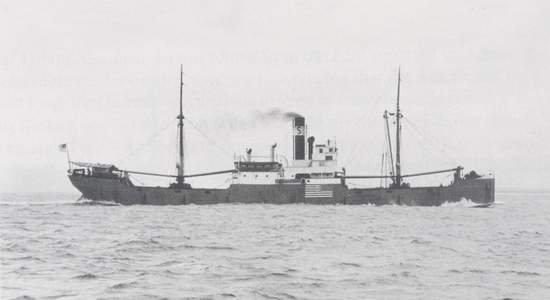
Photo courtesy of The Mariners Museum, Newport News VA
| Name | Caribsea | ||
| Type: | Steam merchant | ||
| Tonnage | 2,609 tons | ||
| Completed | 1919 - McDougall-Duluth Shipbuilding Co, Duluth MN | ||
| Owner | Stockard Steamship Co, New York | ||
| Homeport | New York | ||
| Date of attack | 11 Mar 1942 | Nationality:  American American | |
| Fate | Sunk by U-158 (Erwin Rostin) | ||
| Position | 34° 36'N, 76° 19'W - Grid DC 1136 | ||
| Complement | 28 (21 dead and 7 survivors). | ||
| Convoy | |||
| Route | Santiago de Cuba (5 Mar) – Norfolk, Virginia - Baltimore, Maryland | ||
| Cargo | 3600 tons of manganese ore | ||
| History | Completed in November 1919 as Lake Flattery for US Shipping Board (USSB). 1923 renamed Buenaventura for Panama Rail Road Co Inc, New York. 1940 renamed Caribsea for Stockard SS Co, New York. | ||
| Notes on event | At 07.58 hours on 11 March 1942 the unescorted and unarmed Caribsea (Master Nicholas Manolis) was hit on the starboard side at #2 hold by one G7e torpedo from U-158 about 11 miles east of the Cape Lookout Lighthouse. The U-boat was chasing an unknown tanker, which had been missed with one torpedo at 07.07 hours, when the shadow of Caribsea was sighted. It initially appeared larger than it was, so Rostin decided to let the tanker go and then mistook the new target for a coast guard vessel lying stopped. In fact, her master had reduced speed to four or five knots in accordance with the order he has received to pass Cape Hatteras in daylight. The Caribsea rapidly settled by the head due to her cargo, was shaken by a boiler explosion and sank in less than three minutes in shallow waters with her masts still visible. She sank so fast that no distress signals could be sent and the crew of eight officers and 20 men had no chance to launch the lifeboats. The few survivors climbed onto two rafts that floated free and they later observed the U-boat passing within 100 yards. The men on a raft made use of a small metal can as a reflector to attract the attention of the northbound Norlindo, which picked up two officers and five crewmen after ten hours. They were transferred to a USCG dispatch boat off Cape Henry and landed at Little Creek Coast Guard Station in the morning of 12 March, from where three injured survivors were taken to the Marine Hospital in Norfolk, Virgina. | ||
| On board | We have details of 28 people who were on board. | ||
If you can help us with any additional information on this vessel then please contact us.