
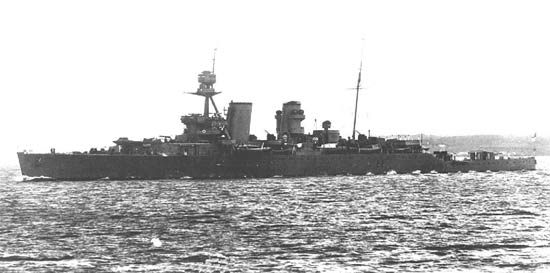
| Navy | The Royal Navy |
| Type | Heavy cruiser |
| Class | Cavendish |
| Pennant | D 86 |
| Mod | Heavy cruiser |
| Built by | Chatham Dockyard (Chatham, U.K.): Parsons |
| Ordered | Dec 1915 |
| Laid down | 3 Jun 1916 |
| Launched | 1 Oct 1917 |
| Commissioned | 25 Jul 1919 |
| End service | 14 Sep 1945 |
| History | Decommissioned at Falmouth into reserve (Cat. C) on 14 September 1945.
In January 1947, Hawkins was allocated for ship target trials, and was subjected to bombing by Royal Airforce Lincoln bombers off Spithead. She was sold for scrap on 21 August 1947 and in December the old cruiser was broken up by Arnott Young at Dalmuir. |
Commands listed for HMS Hawkins (D 86)
Please note that we're still working on this section
and that we only list Commanding Officers for the duration of the Second World War.
| Commander | From | To | |
| 1 | Capt. Eustace Rotherham, RN | 15 Nov 1939 | 7 May 1940 |
| 2 | Cdr. (Retd.) Wilfred Alfred Whitaker, RN | 7 May 1940 | 13 Jul 1940 |
| 3 | Capt. Harry Percy Kendall Oram, RN | 13 Jul 1940 | 3 Mar 1942 |
| 4 | Cdr. (Retd.) Peter Keith Wallace, RN | 3 Mar 1942 | 17 Mar 1942 |
| 5 | Cdr. Michael Everard, RN | 17 Mar 1942 | 16 Apr 1942 |
| 6 | Capt. Godfrey Alexander French, RN | 16 Apr 1942 | 12 Jan 1943 |
| 7 | Cdr. Michael Everard, RN | 12 Jan 1943 | 19 Feb 1943 |
| 8 | Capt. Godfrey Alexander French, RN | 19 Feb 1943 | 4 Jul 1943 |
| 9 | Capt. John William Josselyn, DSC, RN | 4 Jul 1943 | 8 Oct 1944 |
| 10 | Capt. (Retd.) Edward Clifford Watson, DSO, RN | 8 Oct 1944 | 16 Dec 1944 |
| 11 | A/Cdr. Arthur Alfred Havers, DSC, OBE, RN | 16 Dec 1944 | mid 1945 |
You can help improve our commands section
Click here to Submit events/comments/updates for this vessel.
Please use this if you spot mistakes or want to improve this ships page.
Notable events involving Hawkins include:
The page dealing with the wartime history of HMS Hawkins was created in September 2023.
11 Dec 1939
At 1300Z/11, HMS Hawkins (Capt. E. Rotherham, RN) is commissioned at the Portsmouth Dockyard. Her refit is almost completed. (1)
14 Dec 1939
HMS Hawkins (Capt. E. Rotherham, RN) conducted basin trials at the Portsmouth Dockyard. (1)
17 Dec 1939
HMS Hawkins (Capt. E. Rotherham, RN) conducted tilt test in C-Lock at the Portsmouth Dockyard. (1)
19 Dec 1939
HMS Hawkins (Capt. E. Rotherham, RN) proceeded from the Portsmouth Dockyard to Spithead. (1)
21 Dec 1939
HMS Hawkins (Capt. E. Rotherham, RN) conducted compass swing trials in the Solent. (1)
22 Dec 1939
HMS Hawkins (Capt. E. Rotherham, RN) conducted D/F calibration trials in the Solent on completion of which she proceeded to the Portsmouth Dockyard. (1)
28 Dec 1939
HMS Hawkins (Capt. E. Rotherham, RN) proceeded from Portsmouth to Portland. En-route gunnery trials were carried out. (1)
2 Jan 1940
HMS Hawkins (Capt. E. Rotherham, RN) conducted full power trials off Portland. (2)
4 Jan 1940
HMS Hawkins (Capt. E. Rotherham, RN) conducted gunnery exercises off Portland. (2)
5 Jan 1940
HMS Kelvin (Lt.Cdr. J.L. Machin, RN) and HMS Kimberley (Lt.Cdr. R.G.K. Knowling, RN) conducted exercises off Portland. They also screened the heavy cruiser HMS Hawkins (Capt. E. Rotherham, RN) which was also out for gunnery and torpedo firing exercises. (3)
6 Jan 1940
During the morning, HMS Kelvin (Lt.Cdr. J.L. Machin, RN) and HMS Kimberley (Lt.Cdr. R.G.K. Knowling, RN), screened the armed merchant cruiser HMS Jervis Bay (Capt.(Retd.) A.G. Harris, RN).
In the middle of the day they screened the heavy cruiser HMS Hawkins (Capt. E. Rotherham, RN) during her gunnery exercises in the first part of the afternoon.
Later in the afternoon they screened the armed merchant cruiser HMS Dunvegan Castle (Capt.(Retd.) H. Ardill, RN) during her gunnery exercises. (4)
8 Jan 1940
In the afternoon, after visibility had cleared, HMS Hawkins (Capt. E. Rotherham, RN) conducted torpedo firing and gunnery exercises off Portland during which she was escorted by HMS Kelvin (Lt.Cdr. J.L. Machin, RN) and HMS Kimberley (Lt.Cdr. R.G.K. Knowling, RN). (2)
9 Jan 1940
Around 1600Z/9, HMS Hawkins departed Portland for Freetown. She was to proceed to the South Atlantic where she was to join the South America Division as flagship. (5)
16 Jan 1940
Around 1145N/16, HMS Hawkins (Capt. E. Rotherham, RN) arrived at Freetown from Portland.
(2)
17 Jan 1940
Around 1730N/17, HMS Hawkins (Capt. E. Rotherham, RN) departed Freetown for patrol in the South Atlantic and then to make rendezvous with ships from the South American Division. (2)
29 Jan 1940
HMS Hawkins (Capt. E. Rotherham, RN) arrived in San Borombon Bay. Also there was HMS Achilles (New Zealand Division) (Capt. W.E. Parry, CB, RN, flying the flag of Rear-Admiral Sir H. Harwood, KCB, OBE, RN). Rear-Admiral Harwood then transferred his flag from HMS Achilles to HMS Hawkins.
HMS Hawkins then fuelled from the RFA tanker Olwen (6470 GRT, built 1917).
Early in the evening HMS Hawkins left for patrol and set course for the Rio de Janeiro focal area while HMS Achilles left for the Falkland Islands after which she was to proceed to New Zealand. (2)
3 Feb 1940
Around 0800O/3, HMS Dorsetshire (Capt. B.C.S. Martin, RN) and HMS Shropshire (Capt. A.W.la T. Bisset, RN), made rendez-vous in position 29°23'S, 41°49'W with HMS Hawkins (Capt. E. Rotherham, RN, flying the flag of Rear-Admiral Sir H. Harwood, KCB, OBE, RN). They then proceeded to patrol and conduct exercises in company with each other until around noon of the 5th when HMS Hawkins parted company with the two heavy cruisers which then set course for the River Plate area. (6)
12 Feb 1940
Around 1800P/12, HMS Hawkins (Capt. E. Rotherham, RN, flying the flag of Rear-Admiral Sir H. Harwood, KCB, OBE, RN) arrived at Rio de Janeiro from patrol. (7)
14 Feb 1940
Around 1730P/14, HMS Hawkins (Capt. E. Rotherham, RN, flying the flag of Rear-Admiral Sir H. Harwood, KCB, OBE, RN) departed Rio de Janeiro to patrol in the Rio de Janeiro focal area. In the evening she joined company with HMS Dorsetshire (Capt. B.C.S. Martin, RN) already on patrol. (7)
20 Feb 1940
At 0610P/20, the heavy cruisers HMS Hawkins (Capt. E. Rotherham, RN, flying the flag of Rear-Admiral Sir H. Harwood, KCB, OBE, RN) and HMS Dorsetshire (Capt. B.C.S. Martin, RN), which were still on patrol in the 'Rio de Janeiro focal area' were briefly joined by the armed merchant cruiser HMS Alcantara (Capt.(Retd.) J.G.P. Ingham, DSO, RN). The armed merchant cruiser parted company to resume her patrol around 1010P/20. (6)
22 Feb 1940
Around 2135P/22, HMS Queen of Bermuda (Capt. G.A.B. Hawkins, MVO, DSC, RN) made rendezvous with HMS Hawkins (Capt. E. Rotherham, RN, flying the flag of Rear-Admiral Sir H. Harwood, KCB, OBE, RN) and HMS Dorsetshire (Capt. B.C.S. Martin, RN) in approximate position 23°15'S, 42°00'W.
The specialist surgeon was then transferred from HMS Queen of Bermuda to HMS Dorsetshire for onward passage to Port Stanley.
Shortly after midnight HMS Queen of Bermuda then parted company with the other two ships which remained on patrol but now set course for the River Plate focal area. HMS Queen of Bermuda set course for Rio de Janeiro where she was to fuel. (8)
27 Feb 1940
While now in the 'River Plate area', HMS Dorsetshire (Capt. B.C.S. Martin, RN) parted company around 0810N/27, with HMS Hawkins (Capt. E. Rotherham, RN, flying the flag of Rear-Admiral Sir H. Harwood, KCB, OBE, RN). HMS Dorsetshire then set course to proceed to the Falkland Island. (6)
29 Feb 1940
Around 0915N/29, HMS Hawkins (Capt. E. Rotherham, RN, flying the flag of Rear-Admiral Sir H. Harwood, KCB, OBE, RN) arrived in San Borombon Bay. She then fuelled from the RFA tanker Olwen (6470 GRT, built 1917) and left to resume her patrol in the River Plate focal area around 1900N/29. (9)
4 Mar 1940
Around 1530P/4, HMS Hawkins (Capt. E. Rotherham, RN, flying the flag of Rear-Admiral Sir H. Harwood, KCB, OBE, RN) arrived at Montevideo from patrol. (9)
5 Mar 1940
Around 1530P/5, HMS Hawkins (Capt. E. Rotherham, RN, flying the flag of Rear-Admiral Sir H. Harwood, KCB, OBE, RN) departed Montevideo for Port Stanley, Falkland Islands. (9)
8 Mar 1940
Around 0800P/8, HMS Hawkins (Capt. E. Rotherham, RN, flying the flag of Rear-Admiral Sir H. Harwood, KCB, OBE, RN) arrived at Port Stanley, Falkland Islands from Montevideo. At Port Stanley she was to undergo a short 'self refit'. (9)
16 Mar 1940
Around 0630P/16, HMS Hawkins (Capt. E. Rotherham, RN, flying the flag of Rear-Admiral Sir H. Harwood, KCB, OBE, RN) departed Port Stanley to patrol in the River Plate focal area. (10)
1 Apr 1940
Around 0715O/1, HMS Hawkins (Capt. E. Rotherham, RN, flying the flag of Rear-Admiral Sir H. Harwood, KCB, OBE, RN) arrived in San Borombon Bay where she fuelled from the RFA tanker Arndale (8296 GRT, built 1937). Around 1250O/1, HMS Hawkins left San Borombon Bay to resume her patrol in the River Plate focal area and also a little north of Rio Grande do Sul, Brazil. (11)
8 Apr 1940
Around 0945PQ/8, HMS Hawkins (Capt. E. Rotherham, RN, flying the flag of Rear-Admiral Sir H. Harwood, KCB, OBE, RN) arrived at Montevideo from patrol. (11)
10 Apr 1940
Around 0835O/10, HMS Hawkins (Capt. E. Rotherham, RN, flying the flag of Rear-Admiral Sir H. Harwood, KCB, OBE, RN) departed Montevideo to resume her patrol in the River Plate focal area. (11)
22 Apr 1940
Around 1600Q/22, HMS Hawkins (Capt. E. Rotherham, RN, flying the flag of Rear-Admiral Sir H. Harwood, KCB, OBE, RN) arrived at Buenos Aires from patrol. (11)
25 Apr 1940
Shortly after noon, HMS Hawkins (Capt. E. Rotherham, RN, flying the flag of Rear-Admiral Sir H. Harwood, KCB, OBE, RN) and Queen of Bermuda (Capt. G.A.B. Hawkins, MVO, DSC, RN) made rendezvous off Cabo Polonio. After exchanging correspondence they both continued their patrols but making their way northwards towards the Rio de Janeiro focal area. (12)
29 Apr 1940
Late in the morning of 29 April 1940, HMS Cumberland (Capt. G.H.E. Russell, RN), HMS Hawkins (Capt. E. Rotherham, RN, flying the flag of Rear-Admiral Sir H. Harwood, KCB, OBE, RN) and Queen of Bermuda (Capt. G.A.B. Hawkins, MVO, DSC, RN) made rendezvous south-south-west of Rio de Janeiro in approximate position 25°00'S, 44°00'W.
HMS Queen of Bermuda remained in the Rio de Janeiro focal area but HMS Hawkins and HMS Cumberland, in company with each other, proceeded southwards to the River Plate focal area. (13)
1 May 1940
Around noon, HMS Cumberland (Capt. G.H.E. Russell, RN) and HMS Hawkins (Capt. E. Rotherham, RN, flying the flag of Rear-Admiral Sir H. Harwood, KCB, OBE, RN) parted company with each other.
HMS Cumberland then set course for Montevideo while HMS Hawkins continued to patrol in the River Plate focal area. (14)
3 May 1940
Around 1400O/3, HMS Hawkins (Capt. E. Rotherham, RN, flying the flag of Rear-Admiral Sir H. Harwood, KCB, OBE, RN) arrived at San Borombon Bay where she fuelled from the RFA tanker Arndale (8296 GRT, built 1937).
Around 1930O/3, HMS Hawkins departed to resume her patrol in the River Plate focal area. (15)
7 May 1940
Around 0830O/7, the heavy cruiser HMS Hawkins (Capt. E. Rotherham, RN, flying the flag of Rear-Admiral Sir H. Harwood, KCB, OBE, RN) and the armed merchant cruiser HMS Alcantara (Capt.(Retd.) J.G.P. Ingham, DSO, RN) made rendezvous at Samborombón Bay where both then anchored.
HMS Alcantara then embarked three crewmembers from HMS Hawkins to take these with her to Simonstown where they were to be hospitalised. The Commanding Officer of HMS Hawkins was among these three. The executive officer, Cdr.(Retd.) W.A. Whittaker, RN, took temporary command of HMS Hawkins.
Around 1900O/7, HMS Alcantara weighed anchor and set course for Simonstown where she was to dock and taken in hand for defects.
Around 2110O/7, HMS Hawkins weighed anchor after having fuelled from the RFA tanker Arndale (8296 GRT, built 1937) to resume her patrol in the River Plate focal area. (16)
12 May 1940
HMS Hawkins (Cdr.(Retd.) W.A. Whitaker, RN, flying the flag of Rear-Admiral Sir H. Harwood, KCB, OBE, RN) departed the River Plate focal area for Port Stanley, Falkland Islands. (15)
15 May 1940
Around 1020Q/15, HMS Hawkins (Cdr.(Retd.) W.A. Whitaker, RN, flying the flag of Rear-Admiral Sir H. Harwood, KCB, OBE, RN) arrived at Port Stanley, Falkland Islands from patrol. (15)
16 May 1940
Around 0945Q/16, HMS Hawkins (Cdr.(Retd.) W.A. Whitaker, RN, flying the flag of Rear-Admiral Sir H. Harwood, KCB, OBE, RN) departed Port Stanley, Falkland Islands to patrol in the River Plate focal area. (15)
23 May 1940
Around 0930O/23, HMS Hawkins (Cdr.(Retd.) W.A. Whitaker, RN, flying the flag of Rear-Admiral Sir H. Harwood, KCB, OBE, RN) arrived at San Borombon Bay where she fuelled from the RFA tanker Arndale (8296 GRT, built 1937).
She left again to resume her patrol in the River Plate area around 1330O/23. (15)
3 Jun 1940
Around 0900PQ/3, HMS Hawkins (Cdr.(Retd.) W.A. Whitaker, RN, flying the flag of Rear-Admiral Sir H. Harwood, KCB, OBE, RN) arrived Montevideo from patrol. (17)
4 Jun 1940
Around 0700O/4, HMS Hawkins (Cdr.(Retd.) W.A. Whitaker, RN, flying the flag of Rear-Admiral Sir H. Harwood, KCB, OBE, RN) departed Montevideo to resume patrol in the River Plate focal area. (17)
5 Jun 1940
Around 0915O/5, HMS Hawkins (Cdr.(Retd.) W.A. Whitaker, RN, flying the flag of Rear-Admiral Sir H. Harwood, KCB, OBE, RN) arrived in San Borombon Bay where she fuelled from the RFA tanker Olynthus (6888 GRT, built 1918).
Around 1700O/5, HMS Hawkins departed again to resume her patrol in the River Plate focal area. (17)
16 Jun 1940
Around 0900O/16, HMS Hawkins (Cdr.(Retd.) W.A. Whitaker, RN, flying the flag of Rear-Admiral Sir H. Harwood, KCB, OBE, RN) arrived at San Borombon Bay where she fuelled from the RFA tanker Arndale (8296 GRT, built 1937).
HMS Hawkins left again to resume her patrol in the River Plate area around 1615O/16. (17)
23 Jun 1940
HMS Hawkins (Cdr.(Retd.) W.A. Whitaker, RN, flying the flag of Rear-Admiral Sir H. Harwood, KCB, OBE, RN) departed her patrol area in the River Plate focal area to proceed towards the Rio de Janeiro focal area. (17)
27 Jun 1940
Around 1000P/27, HMS Hawkins (Cdr.(Retd.) W.A. Whitaker, RN, flying the flag of Rear-Admiral Sir H. Harwood, KCB, OBE, RN) arrived at Rio de Janeiro from patrol. Shortly before entering harbour she met HMS Pretoria Castle (Capt.(Retd.) E.J. Shelly, RN) and some mails and other correspondence were transferred. (17)
28 Jun 1940
Around 1615P/28, HMS Hawkins (Cdr.(Retd.) W.A. Whitaker, RN, flying the flag of Rear-Admiral Sir H. Harwood, KCB, OBE, RN) departed Rio de Janeiro. The next day she is to fuel off Armação dos Búzios, Brazil. (17)
29 Jun 1940
Around 0900O/29, HMS Hawkins (Cdr.(Retd.) W.A. Whitaker, RN, flying the flag of Rear-Admiral Sir H. Harwood, KCB, OBE, RN) dropped anchor near Armação dos Búzios, Brazil where she fuelled from the RFA tanker Arndale (8296 GRT, built 1937).
Around 1400O/29, HMS Hawkins left for patrol in the Rio de Janeiro focal area. (17)
6 Jul 1940
HMS Hawkins (Cdr.(Retd.) W.A. Whitaker, RN, flying the flag of Rear-Admiral Sir H. Harwood, KCB, OBE, RN) departed the Rio de Janeiro focal area for the River Plate focal area. Before leaving the area she met HMS Pretoria Castle (Capt.(Retd.) E.J. Shelly, RN) and some mails and other correspondence were transferred as this ship had to take over patrol in the Rio de Janeiro focal area. (18)
12 Jul 1940
Around 1245O/12, HMS Hawkins (Cdr.(Retd.) W.A. Whitaker, RN, flying the flag of Rear-Admiral Sir H. Harwood, KCB, OBE, RN) anchored in San Borombon Bay.
Around 2300O/12, the RFA tanker Arndale (8296 GRT, built 1937) also arrived and anchored.
Around 0005O/13, Capt. H.P.K. Oram, RN, then joined HMS Hawkins to take over command. He had taken passage in the Arndale.
The following day, HMS Hawkins then fuelled from the Arndale.
Around 1545O/13, HMS Hawkins departed to resume her patrol in the River Plate area. (18)
15 Jul 1940
Around 0910PQ/15, HMS Hawkins (Capt. H.P.K. Oram, RN, flying the flag of Rear-Admiral Sir H. Harwood, KCB, OBE, RN) arrived at Montevideo from patrol. (18)
16 Jul 1940
Around 0835P/16, HMS Hawkins (Capt. H.P.K. Oram, RN, flying the flag of Rear-Admiral Sir H. Harwood, KCB, OBE, RN) departed Montevideo to resume her patrol. (18)
17 Jul 1940
HMS Hawkins (Capt. H.P.K. Oram, RN, flying the flag of Rear-Admiral Sir H. Harwood, KCB, OBE, RN) departed the River Plate focal area and proceeded towards the Rio de Janeiro focal area. (18)
23 Jul 1940
In the morning and early in the afternoon, HMS Hawkins (Capt. H.P.K. Oram, RN, flying the flag of Rear-Admiral Sir H. Harwood, KCB, OBE, RN) fuelled from the RFA tanker Arndale (8296 GRT, built 1937) near Sao Sebastiao island, Brazil. On completion of fuelling HMS Hawkins resumed patrol.
[There is no log available for HMS Hawkins for the month of August 1940, therefore some details for this month may be missing.] (18)
8 Aug 1940
HMS Hawkins (Capt. H.P.K. Oram, RN, flying the flag of Rear-Admiral Sir H. Harwood, KCB, OBE, RN) left her patrol area in the Rio de Janeiro focal area to proceed to the River Plate focal area to fuel. (19)
10 Aug 1940
HMS Hawkins (Capt. H.P.K. Oram, RN, flying the flag of Rear-Admiral Sir H. Harwood, KCB, OBE, RN) fuelled from the RFA tanker Arndale (8296 GRT, built 1937) in San Borombon Bay. On completion of fuelling HMS Hawkins set course to return to her original patrol area in square L 32B. (19)
16 Aug 1940
HMS Hawkins (Capt. H.P.K. Oram, RN, flying the flag of Rear-Admiral Sir H. Harwood, KCB, OBE, RN) departed her patrol area to embark provisions and ammunition in the River Plate focal area. (19)
19 Aug 1940
HMS Hawkins (Capt. H.P.K. Oram, RN, flying the flag of Rear-Admiral Sir H. Harwood, KCB, OBE, RN) embarked provisions and ammunition in San Borombon Bay from the chartered transport Baltavia (British, 2461 GRT, built 1924).
The following day HMS Hawkins fuelled from the RFA tanker Arndale (8296 GRT, built 1937) after which HMS Hawkins resumed her patrol. (19)
24 Aug 1940
HMS Hawkins (Capt. H.P.K. Oram, RN, flying the flag of Rear-Admiral Sir H. Harwood, KCB, OBE, RN) made rendezvous, east of the English Bank, with the chartered transport Baltavia (British, 2461 GRT, built 1924) and obtained mail from her before resuming her patrol. (19)
26 Aug 1940
HMS Hawkins (Capt. H.P.K. Oram, RN, flying the flag of Rear-Admiral Sir H. Harwood, KCB, OBE, RN) arrived at Buenos Aires from patrol (19)
28 Aug 1940
HMS Hawkins (Capt. H.P.K. Oram, RN, flying the flag of Rear-Admiral Sir H. Harwood, KCB, OBE, RN) departed Buenos Aires to resume her patrol. (19)
29 Aug 1940
While on patrol off the River Plate, HMS Hawkins (Capt. H.P.K. Oram, RN, flying the flag of Rear-Admiral Sir H. Harwood, KCB, OBE, RN) made rendezvous with the RFA tanker Broomdale (8334 GRT, built 1937) which had just arrived in the area from Trinidad. Both ships then entered San Borombon Bay where stores had to be transferred from HMS Hawkins to the tanker however weather conditions prevented this and both ships anchored to await better wetter conditions. Transfer of the stores could finally take place on 31 August at which time HMS Hawkins topped off with fuel. (19)
31 Aug 1940
HMS Queen of Bermuda (Capt. G.A.B. Hawkins, MVO, DSC, RN) arrived in San Borombon Bay from Simonstown. Here she joined HMS Hawkins (Capt. H.P.K. Oram, RN, flying the flag of of Rear-Admiral Sir H. Harwood, KCB, OBE, RN) and the RFA tanker Broomdale (8334 GRT, built 1937).
Commodore F.H. Pegram, DSO, RN, then boarded HMS Hawkins. He was soon to take over command of the South America Division from Rear-Admiral Harwood.
HMS Queen of Bermuda then proceeded on patrol in area L 32 (River Plate focal area).
HMS Hawkins, after topping up with fuel from the Broomdale proceeded to patrol in area L 31 (River Plate focal area).
The Broomdale set course for the Falkland Islands. (20)
5 Sep 1940
Around 1525PQ/5, HMS Hawkins (Capt. H.P.K. Oram, RN, flying the flag of of Rear-Admiral Sir H. Harwood, KCB, OBE, RN) arrived at Montevideo from patrol. (21)
6 Sep 1940
Around 0930PQ/6, HMS Alcantara (Capt.(Retd.) J.G.P. Ingham, DSO, RN) arrived at Montevideo from patrol.
Already there was HMS Hawkins (Capt. H.P.K. Oram, RN, flying the flag of of Rear-Admiral Sir H. Harwood, KCB, OBE, RN) which had also on board Commodore F.H. Pegram, DSO, RN, who was to take over command of the South America Division from Rear-Admiral Harwood.
At 1430PQ/6, Commodore Pegram then hoisted his broad pendant in HMS Alcantara assuming command of the South America Division.
Rear-Admiral Harwood then struck his flag in HMS Hawkins after which Commodore Pegram transferred his broad pendant to HMS Hawkins. Rear-Admiral Harwood then boarded HMS Alcantara for passage to Freetown.
Around 1515PQ/6, HMS Hawkins departed Monevideo for patrol proceeding to the Rio de Janeiro focal area. (22)
10 Sep 1940
Around 1905N/10, HMS Hawkins (Capt. H.P.K. Oram, RN, flying the broad pendant of Commodore F.H. Pegram, DSO, RN) dropped anchor off Sao Sebastiao island, Brazil. She was to fuel from the RFA tanker Arndale (8296 GRT, built 1937) but weather conditions did not permit this. (21)
11 Sep 1940
Around 1145N/11, HMS Enterprise (Capt. J.C. Annesley, DSO, RN) joined HMS Hawkins (Capt. H.P.K. Oram, RN, flying the broad pendant of Commodore F.H. Pegram, DSO, RN) and the RFA tanker Arndale (8296 GRT, built 1937) off Sao Sebastiao island, Brazil.
Commodore F.H. Pegram, DSO, RN, then struck his broad pendant in HMS Hawkins and hoisted it in HMS Enterprise.
Around 1800N/11, HMS Hawkins departed to proceed to Simonstown where she was to refit. En-route Gough Island was to be inspected for signs of enemy activity. HMS Hawkins did not fuel before departure as it had been determined that she had enough fuel on board to reach Simonstown.
Around 2200N/11, HMS Enterprise, after having fuelled from the Arndale departed for patrol. (23)
17 Sep 1940
Late in the morning, HMS Hawkins (Capt. H.P.K. Oram, RN) briefly dropped anchor off Gough Island and launched her whaler to inspect the island for possible signs of enemy activity but nothing of interest was seen and HMS Hawkins continued her passage to Simonstown. (24)
21 Sep 1940
Around 0945B/21, HMS Hawkins (Capt. H.P.K. Oram, RN) arrived at Simonstown from patrol. (24)
24 Sep 1940
Having completed de-ammunitioning, HMS Hawkins (Capt. H.P.K. Oram, RN) is taken in hand for refit at the Simonstown Dockyard. (24)
29 Sep 1940
As it was not possible to dock, HMS Hawkins (Capt. H.P.K. Oram, RN) at the Simonstown Dockyard it had been decided to continue the ships refit at the Durban Dockyard. Therefore HMS Hawkins departed Simonstown for Durban around 1015B/29. (24)
2 Oct 1940
Around 0815B/2, HMS Hawkins (Capt. H.P.K. Oram, RN) arrived at Durban from Simostown. (25)
3 Oct 1940
HMS Hawkins (Capt. H.P.K. Oram, RN) is docked at the Durban Dockyard and taken in hand for refit. (25)
21 Oct 1940
HMS Hawkins (Capt. H.P.K. Oram, RN) is undocked. (25)
14 Nov 1940
HMS Hawkins (Capt. H.P.K. Oram, RN) conducted basin trials at the Durban Dockyard. (26)
17 Nov 1940
Around 0900B/17, HMS Hawkins (Capt. H.P.K. Oram, RN) departed Durban for Simonstown. (26)
18 Nov 1940
Convoy WS 4B.
This convoy departed Liverpool / the Clyde on 17/18 November 1940 for Suez where it arrived on 28 December 1940.
The convoy was made up of the troopships; Andes (British, 25689 GRT, built 1939), Duchess of Atholl (British, 20119 GRT, built 1928), Empress of Canada (British, 21517 GRT, built 1922), Orcades (British, 23456 GRT, built 1937), Otranto (British, 20026 GRT, built 1925), Reina del Pacifico (British, 17702 GRT, built 1931), Strathaird (British, 22281 GRT, built 1932), Strathallan (British, 23722 GRT, built 1938), Strathnaver (British, 22283 GRT, built 1931) and Viceroy of India (British, 19627 GRT, built 1929).
The convoy was formed at sea at 0830/18 when the two sections made rendez-vous west of Oversay Light.
The convoy was escorted by the heavy cruiser HMS Norfolk (Capt. A.J.L. Phillips, RN), light cruiser HMS Edinburgh (Capt. C.M. Blackman, DSO, RN) and the destroyers HMS Highlander (Cdr. W.A. Dallmeyer, RN), HMCS Ottawa (Cdr. E.R. Mainguy, RCN), HMCS St. Laurent (Lt. H.S. Rayner, RCN), HMCS Saguenay (Cdr. G.R. Miles, RCN), HMCS Skeena (Lt.Cdr. J.C. Hibbard, RCN), HMS Bath (Cdr.(Retd.) A.V. Hemming, RN) and HMS St. Albans (Lt.Cdr.(Emgy.) S.G.C. Rawson, RN).
The AA cruiser HMS Cairo (Capt. P.V. McLaughlin, RN) joined at 0945/18.
An additional destroyer, HMS St. Marys (Lt. K.H.J.L. Phibbs, RN), joined the convoy in the afternoon of the 18th.
Destroyers HMS Bath, HMS St. Albans and HMS St. Marys parted company with the convoy at 1730/19 followed by HMS Cairo one hour later.
Destroyer HMS Highlander parted company with the convoy at 0900/20 followed at 1800/20 by the four Canadian destroyers.
Heavy cruiser HMS Devonshire (Capt. R.D. Oliver, DSC, RN) joined the convoy at 1300/23. HMS Norfolk parted company with the convoy at 1600/23 and proceeded to patrol east of the Azores.
The convoy arrived at Freetown on 29 November 1940 escorted by HMS Devonshire and HMS Edinburgh.
--------------------------------------------------
The convoy departed Freetown on 1 December 1940 escorted by HMS Devonshire and HMS Cumberland (Capt. G.H.E. Russell, RN).
HMS Cumberland parted company with the convoy late in the morning of December 4th having been relieved by HMS Hawkins (Capt. H.P.K. Oram, RN). HMS Cumberland then proceeded to join the South America Division.
HMS Hawkins was detached with orders to proceed to Simonstown in the morning of December 8th. After fuelling at Simonstown, she was to rejoin the convoy. She arrived at Simonstown around 1630B/9 and departed again around 2110B/9 rejoining the convoy around dawn on the 10th.
The convoy arrived at Durban on 12 December 1940 escorted by HMS Devonshire and HMS Hawkins.
--------------------------------------------------
The convoy departed Durban on 16 December 1940 escorted by HMS Devonshire and HMS Shropshire (Capt. J.H. Edelsten, RN).
At 1000/18, the light cruiser HMS Southampton (Capt. B.C.B. Brooke, RN) took over from HMS Devonshire. This last cruiser then set course to return to Durban.
The convoy arrived near Aden on 25 December 1940 but it did not enter the port. HMS Southampton was briefly detached to fuel at Aden after which she rejoined the convoy. The escort was reinforced with the AA cruiser HMS Carlisle (Capt. G.M.B. Langley, OBE, RN) and the destroyers HMS Kandahar (Cdr. W.G.A. Robson, RN) and HMS Kimberley (Lt.Cdr. J.S.M. Richardson, RN). HMS Shropshire was then detached from the convoy and entered Aden.
HMS Carlisle and HMS Kimberey parted company with the convoy on 27 December 1940 and joined a southbound convoy.
The convoy arrived at Suez on 28 December 1940 escorted by HMS Southampton and HMS Kandahar. (27)
19 Nov 1940
Around 1120B/19, HMS Hawkins (Capt. H.P.K. Oram, RN) arrived at Simonstown from Durban.
Around 2110B/19, she departed Simonstown to try to intercept the Vichy French transport Ville de Tamatave (4993 GRT, built 1931) but was return to Simonstown if the Vichy ships was not sighted during daytime on the 20th. (28)
21 Nov 1940
Around 1100B/21, HMS Hawkins (Capt. H.P.K. Oram, RN) arrived at Simonstown from patrol. The Vichy French ship she was ordered to try to intercept had not been sighted. (26)
26 Nov 1940
HMS Hawkins (Capt. H.P.K. Oram, RN) conducted D/F calibration trials and gunnery exercises in False Bay. (26)
27 Nov 1940
HMS Hawkins (Capt. H.P.K. Oram, RN) conducted compass swing trials and gunnery exercises in False Bay.
In the evening more exercises were carried out on completion of which she left for patrol in the South Atlantic. She was also to make rendezvous with convoy WS 4B on 4 December 1940 in approximate position 04°00'S, 05°12'E.
[For more info on this convoy see the event ' Convoy WS 4B ' for 18 November 1940.] (28)
12 Dec 1940
Early in the afternoon HMS Devonshire (Capt. R.D. Oliver, DSC, RN) and HMS Hawkins (Capt. H.P.K. Oram, RN) arrived at Durban with convoy WS 4B. (29)
13 Dec 1940
Around 1220B/13, HMS Hawkins (Capt. H.P.K. Oram, RN) departed Durban for Simonstown. (30)
16 Dec 1940
Around 0850B/16, HMS Hawkins (Capt. H.P.K. Oram, RN) arrived at Simonstown from Durban. (30)
18 Dec 1940
Convoy WS 5A and the attack by the German heavy cruiser Admiral Hipper
This convoy departed U.K. ports on 18/19 December 1940. Destination for the majority of the convoy was Suez where the convoy arrived on 16 February 1941.
On 17 December 1940 the transport Rangitiki (British, 16698 GRT, built 1929) departed Avonmouth. She was escorted by HMS Kipling (Cdr. A. St. Clair-Ford, RN) towards the rendez-vous position.
On 18 December 1940 the following troop transports / transports departed Liverpool, they formed WS 5A slow; Anselm (British, 5954 GRT, built 1935), Atreus (British, 6547 GRT, built 1911), Bhutan (British, 6104 GRT, built 1929), City of Canterbury (British, 8331 GRT, built 1922), City of London (British, 8956 GRT, built 1907), Delane (British, 6054 GRT, built 1938), Elizabethville (Belgian, 8351 GRT, built 1922), Menelaus (British, 10307 GRT, built 1923), Orbita (British, 15495 GRT, built 1915), Settler (British, 6202 GRT, built 1939) and Tamaroa (British, 12405 GRT, built 1922). They were escorted by the destroyers HMS Witherington (Lt.Cdr. J.B. Palmer, RN), HMS Witch (Lt.Cdr. J.R. Barnes, RN), sloop HMS Wellington (Cdr. I.H. Bockett-Pugh, RN) and the corvettes HMS Clematis (Cdr. Y.M. Cleeves, DSO, DSC, RD, RNR), HMS Jonquil (Lt.Cdr. R.E.H. Partington, RNR), HMS Cyclamen (Lt. H.N. Lawson, RNR) and HMS Geranium (T/Lt. A. Foxall, RNR).
On 18 December 1940 the following troop transports / transports departed from the Clyde; Costa Rica (Dutch, 8055 GRT, built 1910), Ernebank (British, 5388 GRT, built 1937), Leopoldville (Belgian, 11509 GRT, built 1929) and Neuralia (British, 9182 GRT, built 1912). Ernebank was however forced to return around 1800 hours on the 21st escorted by HMS Witch and HMS St. Mary’s. On the 22nd, HMS Wellington, was detached to take over the escort of the Ernebank. They were escorted by the anti-aircraft cruiser HMS Cairo (Capt. P.V. McLaughlin, RN) and the destroyers HMS Bath (Cdr.(Retd.) A.V. Hemming, RN), HMS St. Marys (Lt. K.H.J.L. Phibbs, RN), HMS St. Albans (Lt.Cdr.(Emgy.) S.G.C. Rawson, RN), HMS Worcester (Lt.Cdr. E.C. Coats, RN).
On 18 December 1940 the following troop transports / transports departed from Lough Foyle (Belfast); City of Derby (British, 6616 GRT, built 1921) and Stentor (British, 6148 GRT, built 1926). They were escorted by the destroyer HMS Venomous (Lt.Cdr. J.E.H. McBeath, RN).
The slow part of the convoy was met around dawn on the 19th by the light cruiser HMS Bonaventure (Capt. H.G. Egerton, RN) and the destroyers HMS Vesper (Lt.Cdr. W.F.E. Hussey, DSC, RN), HMS Harvester (Lt.Cdr. M. Thornton, RN) and HMS Highlander (Cdr. W.A. Dallmeyer, RN).
Around 2300/21 all destroyers parted company with the slow part of the convoy.
On 19 December 1940 the following troop transports / transports departed Liverpool, they formed WS 5A fast; Clan MacDonald (British, 9653 GRT, built 1939), Essex (British, 13655 GRT, built 1936) and Northern Prince (British, 10917 GRT, built 1929).
On 19 December 1940 the following troop transports / transports departed from the Clyde; Adviser (British, 6348 GRT, built 1939), Arabistan (British, 5874 GRT, built 1929), Barrister (British, 6348 GRT, built 1939), Benrinnes (5410 GRT, built 1921), Clan Cumming (British, 7264 GRT, built 1938), Empire Song (British, 9228 GRT, built 1940) and Empire Trooper (British, 14106 GRT, built 1922).
Escort for the fast section of convoy WS 5A joined around dawn on the 20th and was provided by the aircraft carrier HMS Argus (Capt. E.G.N. Rushbrooke, DSC, RN), light cruiser HMS Naiad (Capt. M.H.A. Kelsey, DSC, RN, flying the flag of Rear-Admiral E.L.S. King, CB, MVO, RNRN), destroyers HMCS Ottawa (Cdr. E.R. Mainguy, RCN), HMCS St. Laurent (Lt. H.S. Rayner, RCN) and Piorun (Cdr. E.J.S. Plawski) which came from the Clyde. And also by the destroyers HMS Highlander, HMS Harvester and FSS Le Triomphant (Cdr. P.M.J.R. Auboyneau) which came from Londonderry. The first two of these destroyers had fuelled there after escorting the slow part of the convoy for a while. Also the aircraft carrier HMS Furious (Capt. A.G. Talbot, DSO, RN) (with fighters embarked for Takoradi) and the destroyers HMS Beverley (Cdr.(Retd.) E.F. Fitzgerald, RN), HMS Kelvin (Cdr. J.H. Allison, DSO, RN) and HMS Kipling joined from Liverpool.
The destroyers of the fast portion of the convoy were detached during the night of 21/22 December 1940.
At dawn on 23 December 1940 the slow and fast part of the convoy made rendez-vous and proceeded in company.
On the 24th, HMS Naiad parted company to return to the U.K. The heavy cruiser HMS Berwick (Capt. G.L. Warren, RN) and the light cruiser HMS Dunedin (Capt. R.S. Lovatt, RN) both joined the escort of the convoy.
At dawn on the 25th the convoy was attacked by the German heavy cruiser Admiral Hipper. She had made contact with the convoy with radar the previous day and had already made a torpedo attack shortly before 0400/25 but no hits had been obtained nor had the attack been noticed by the British.
Then shortly after 0800/25 she made visual contact with the convoy and it came as a surprise to the Germans to sight HMS Berwick.
Around 0830 hours the Germans opened fire on HMS Berwick but due to the bad visibility she soon shifted target to the troopship Empire Trooper which was not in her assigned station. The troopship was slightly damaged as was the merchant vessel Arabistan.
The convoy was ordered to scatter and HMS Berwick and HMS Bonaventure both engaged the German cruiser as did the corvette Cyclamen briefly.
Meanwhile HMS Dunedin laid a smokescreen to cover the ships of the convoy. HMS Furious flew off a few aircraft but these failed to find the German cruiser in the bad visibility.
HMS Berwick was damaged by gunfire from the German cruiser but she forced, together with HMS Bonaventure, the enemy to break off the action around 0915 hours.
In the evening HMS Boneventure was detached to search for the damaged Empire Trooper.
On the 28th the convoy was reassembled at sea (minus Empire Trooper which was ordered to proceed to Gibraltar via the Azores) and continued on to Freetown where it arrived on 5 January 1941.
------------------------------------------------------------------------------------------------------
The convoy departed Freetown for South Africa on 8 January.
The convoy was now made up of the (troop) transports; Adviser, Anselm, Arabistan, Atreus, Barrister, Benrinnes, Bhutan, City of Canterbury, City of Derby, City of London, Costa Rica, Delane, Elisabethville, Empire Ability (British, 7603 GRT, built 1931), Menelaus, Neuralia, Orbita, Rangitiki, Settler, Stentor and Tamaroa.
On departure from Freetown the convoy was escorted by the aircraft carrier HMS Formidable (Capt. A.W.La T. Bisset, RN, flying the flag of Rear-Admiral W.F. Wake-Walker CB, OBE, RN), heavy cruisers HMS Dorsetshire (Capt. B.C.S. Martin, RN), HMS Hawkins (Capt. H.P.K. Oram, RN), destroyers HMS Velox (Lt.Cdr. E.G. Roper, DSC, RN), HMS Vidette (Lt. E.N. Walmsley, RN), sloops HMS Milford (Cdr. (Retd.) the Hon. V.M. Wyndham-Quin, RN), HMS Bridgewater (A/Cdr. (Retd.) H.F.G. Leftwich, RN) and the corvettes HMS Asphodel (Lt.Cdr.(Retd.) K.W. Stewart, RN) and HMS Calendula (Lt.Cdr. A.D. Bruford, RNVR).
At 0700N/9, the heavy cruiser HMS Norfolk (Capt. A.J.L. Phillips, RN) joined the convoy. She had also departed Freetown around the same time as the convoy but apparently acted independently until the time she joined the convoy.
At 0600N/10, HMS Formidable, HMS Dorsetshire, HMS Norfolk, HMS Velox and HMS Vidette parted company with the convoy. At the same time the heavy cruiser HMS Devonshire (Capt. R.D. Oliver, DSC, RN) joined.
It appears that HMS Bridgewater, HMS Milford, HMS Asphodel and HMS Calendula parted company on 12 January.
At 1000B/21, the heavy cruiser HMS Shropshire (Capt. J.H. Edelsten, RN) joined the convoy and HMS Devonshire parted company.
At 1600B/22, HMS Hawkins parted company with the convoy taking the transports Anselm and City of Canterbury to Capetown where they arrived on 23 January.
The remainder of the convoy arrived at Durban on 25 January 1941 escorted by HMS Shropshire.
------------------------------------------------------------------------------------------------------
The convoy departed Durban for Suez on 29 January 1941. It was now made up of the transports, Adviser, Anselm, Arabistan, Atreus, Barrister, Benrinnes, Bhutan, City of Canterbury, City of Derby, City of London, Costa Rica, Delane, Elisabethville, Empire Ability, Menelaus, Neuralia, Nieuw Holland (Dutch, 11066 GRT, built 1927), Orbita, Rangitiki, Settler, Stentor, Talamba (British, 8018 GRT, built 1924) and Tamaroa.
They were escorted by the heavy cruiser HMS Shropshire and the light cruiser HMS Ceres (Capt. E.G. Abbott, AM, RN).
Around 0800B/30, HMS Shropshire was relieved by the light cruiser HMS Enterprise (Capt. J.C. Annesley, DSO, RN).
In the morning of 31 January the transport Delane parted company with the convoy to return to Durban due to engine defects.
At 1000CD(-3.5)/4, HMS Ceres parted company taking the transports Nieuw Holland and Orbita with her to Kilindini / Mombasa where they arrived on 5 February.
At 1440CD/5, the armed merchant cruiser HMS Hector (Capt.(Retd.) F. Howard, DSC, RN) joined.
At 1500CD/5, the light cruiser HMS Capetown (Capt. P.H.G. James, RN) joined.
At 0430CD/6, HMS Capetown parted company with the convoy having been ordered to do so.
At 1730CD/10, HMS Enterprise parted company with the convoy to fuel at Aden. She rejoined the convoy around 2130C/11.
Around 0630C/11, the convoy was joined by the light cruiser HMS Caledon (Capt. C.P. Clarke, RN) and the sloops HMS Flamingo (Cdr. J.H. Huntley, RN) and HMIS Indus (Cdr. E.G.G. Hunt, RIN). HMS Hector then parted company with the convoy.
At 2300C/11, HMIS Indus parted company with the convoy upon being relieved by the sloop HMS Grimsby (Cdr. K.J. D'Arcy, RN).
At 1830C/13, HMS Flamingo parted company with the convoy to return to Aden and HMS Grimsby parted company with the convoy taking the transport Neuralia with her to Port Sudan.
At 0400C/14, HMS Enterprise parted company with the convoy.
The convoy escorted by HMS Caledon arrived at Suez on 16 February 1941. (27)
21 Dec 1940
Around 1325B/21, HMS Hawkins (Capt. H.P.K. Oram, RN) departed Simonstown for Freetown. On departure gunnery exercises were carried out. (30)
30 Dec 1940
Around 0815N/30, HMS Hawkins (Capt. H.P.K. Oram, RN) arrived at Freetown from Simonstown. (30)
3 Jan 1941
Around 0100N/3, HMS Hawkins (Capt. H.P.K. Oram, RN) departed Freetown for an anti-raider patrol in the mid-Atlantic to the south and south-south-west of Freetown around the equator.
Around 0820N/3, HMS Hawkins, in position 08°08'N, 14°42'W, picks up 9 survivors from the British tanker British Premier that was torpedoed and sunk on 24 December 1940 by German U-boat U-65 200 nautical miles south-west of Freetown in position 06°20'N, 13°20'W. (31)
7 Jan 1941
Around 0900N/7, HMS Hawkins (Capt. H.P.K. Oram, RN) returned to Freetown from patrol. (31)
7 Jan 1941
Convoy WS 5B
This convoy departed U.K. ports on 7 January 1941 for variuos ports in the Far East and Mediterranean (see below).
The convoy was made up of the following troop transports; Arundel Castle (British, 19118 GRT, built 1921), Athlone Castle (25564 GRT, built 1936), Britannic (British, 26943 GRT, built 1930), Capetown Castle (British, 27002 GRT, built 1938), Duchess of Bedford (British, 20123 GRT, built 1928), Duchess of Richmond (British, 20022 GRT, built 1928), Duchess of York (British, 20021 GRT, built 1929), Durban Castle (British, 17388 GRT, built 1938), Empress of Australia (British, 21833 GRT, built 1914), Empress of Japan (British, 26032 GRT, built 1930), Franconia (British, 20175 GRT, built 1923), Highland Chieftain (British, 14131 GRT, built 1929), Highland Princess (British, 14133 GRT, built 1930), Monarch of Bermuda (British, 22424 GRT, built 1931), Nea Hellas (British, 16991 GRT, built 1922), Orbita (British, 15495 GRT, built 1915), Ormonde (British, 14982 GRT, built 1917), Pennland (Dutch, 16082 GRT, built 1922), Samaria (British, 19597 GRT, built 1921), Winchester Castle (British, 20012 GRT, built 1930) and Windsor Castle (British, 19141 GRT, built 1922).
Four of these ships departed Avonmouth on 7 January and six sailed from Liverpool. These ships anchored in Moelfre Bay for several days as the eleven ships that were to be sailed from the Clyde could not do so due to thick fog.
The Avonmouth (Bristol Channel) section of the convoy had been escorted to Moelfre Bay by the destroyer HMS Vansittart (Lt.Cdr. R.L.S. Gaisford, RN).
The Liverpool section was escorted to Moelfre Bay by the heavy cruiser HMAS Australia (Capt. R.R. Stewart, RN) and the destroyers HMS Harvester (Lt.Cdr. M. Thornton, DSC, RN), HMS Highlander (Cdr. W.A. Dallmeyer, DSO, RN) and HMS Witherington (Lt.Cdr. J.B. Palmer, RN).
The ships and their escorts anchored in Moelfre Bay from 8 to 11 January. The escorts remained there for A/S patrol and AA protection and were joined by the destroyer HMS Foresight (Lt.Cdr. G.T. Lambert, RN) which had departed Liverpool on the 8th and the light cruiser HMS Naiad (Capt. M.H.A. Kelsey, DSC, RN, flying the flag of Rear-Admiral E.L.S. King, CB, MVO, RN) which came from the Clyde.
When it became clear that the ships from the Clyde were finally able to sail the ships in Moelfre Bay sailed for Lough Foyle (near Londonderry, Northern Ireland) to take on board additional water.
The ships from Lough Foyle and the Clyde made rendez-vous at sea on 12 January and course was then set to Freetown.
The convoy was now escorted by the battleship HMS Ramillies (Capt. A.D. Read, RN), heavy cruiser HMAS Australia, light cruisers HMS Phoebe (Capt. G. Grantham, RN), HMS Naiad, destroyers HMS Jackal (Cdr. C.L. Firth, MVO, RN), HMS Harvester, HMS Highlander, HMS Fearless (Cdr. A.F. Pugsley, RN), HMS Brilliant (Lt.Cdr. F.C. Brodrick, RN), HMS Beagle (Lt.Cdr. R.H. Wright, DSC, RN), HMS Witherington, HMS Watchman (Lt.Cdr. E.C.L. Day, RN), HMS Vansittart, HMS Lincoln (Cdr. A.M. Sheffield, RN), HMS Leamington (Cdr. W.E. Banks, DSC, RN) and Léopard (Lt.Cdr. J. Evenou).
On 14 January the destroyers HMS Witherington and FFS Leopard parted company.
The light cruiser HMS Emerald (Capt. F.C. Flynn, RN) departed Plymouth on 12 January. She joined the convoy around noon on the 15th. Shortly afterwards HMS Naiad then parted company with the convoy and proceeded to Scapa Flow where she arrrived around 1430/17.
HMS Phoebe and HMS Fearless also parted company with the convoy escorting the Capetown Castle and Monarch of Bermuda to Gibraltar where they arrived in the afternoon of the 18th. On the 17th they were joined by the destroyer HMS Forester (Lt.Cdr. E.B. Tancock, RN) and on the 18th by two more destroyers; HMS Duncan (A/Capt. A.D.B. James, RN) and HMS Fury (Lt.Cdr. T.C. Robinson, RN).
At Gibraltar the two troopships took on board troops from the damaged troopship Empire Trooper. They departed Gibraltar for Freetown on 19 January being escorted by the destroyers HMS Fury, HMS Fearless and HMS Duncan until 21 January when they parted company. Both troopships arrived at Freetown on 26 January escorted by HMS Faulknor (Capt. A.F. de Salis, RN) and HMS Forester.
Meanwhile convoy WS 5B had coninued its passage southwards.
On the 16 January all remaining destroyers parted company.
HMS Ramillies parted company with the convoy on 17 January.
The troopship / liner Duchess of York was apparently detached at some point.
When approaching Freetown local A/S vessels started to join the convoy. On 21 January the corvettes HMS Asphodel (Lt.Cdr.(Retd.) K.W. Stewart, RN) and HMS Calendula (Lt.Cdr. A.D. Bruford, RNVR) joined and the next day the destroyer HMS Velox (Lt.Cdr. E.G. Roper, DSC, RN) also joined the convoy. Finally on 24 January the destroyer HMS Vidette (Lt. E.N. Walmsley, RN) also joined the convoy.
On 25 January 1941 the convoy arrived at Freetown escorted by HMAS Australia, HMS Emerald, HMS Velox, HMS Vidette, HMS Asphodel and HMS Calendula.
The convoy departed Freetown on 29 January with the addition of troop transport Cameronia (British, 16297 GRT, built 1920) still escorted by HMAS Australia and HMS Emerald. A local A/S force remained with the convoy until 1 February and was made up of the destroyers HMS Faulknor, HMS Forester, sloop HMS Milford (Capt.(Retd.) S.K. Smyth, RN) and the corvettes HMS Clematis (Cdr. Y.M. Cleeves, DSC, RD, RNR) and HMS Cyclamen (Lt. H.N. Lawson, RNR).
HMS Emerald arrived at Capetown on 8 February escorting Arundel Castle, Athlone Castle, Capetown Castle, Duchess of Bedford, Durban Castle, Empress of Australia, Empress of Japan, Monarch of Bermuda and Winchester Castle. The light cruiser then went to Simonstown.
HMAS Australia arrived at Durban on 11 February with Britannic, Cameronia, Duchess of Richmond, Franconia, Highland Chieftain, Highland Princess, Nea Hellas, Ormonde, Pennland, Samaria and Windsor Castle.
The Capetown section departed that place on 12 February and the Durban section on 15 February after which a rendez-vous of Durban was effected.
On 21 February the troopships Empress of Australia, Empress of Japan, Ormonde and Windsor Castle were detached to Kilindini / Mombasa escorted by HMS Emerald. They arrived at Kilindini / Mombasa on 22 February. In the approaches to Kilindini / Mombasa the convoy was joined by the destroyer HMS Kandahar (Cdr. W.G.A. Robson, RN).
The remainder of the convoy continued on Suez escorted by HMS Australia (until 2040D/22) and HMS Hawkins (Capt. H.P.K. Oram, RN) which joined the convoy shortly before HMS Emerald and the four troopships for Kilindini / Mombasa were detached.
Around 1200D/26, the light cruiser HMS Caledon (Capt. C.P. Clarke, RN) joined. HMS Hawkins then parted company and proceeded to Aden with the Duchess of Richmond.
On 27 August the sloops HMS Auckland (Cdr. J.G. Hewitt, DSO, RN) and HMAS Parramatta (Lt.Cdr. J.H. Walker, MVO, RAN) joined the convoy. HMS Hawkins and the Duchess of Richmond also rejoined after which HMS Caledon parted company to return to Aden.
Also on 27 August, the destroyer HMS Kingston (Lt.Cdr. P. Somerville, DSO, DSC, RN) departed Aden with the following (troop) transports; President Doumer (British, 11898 GRT, built 1935), Takliwa (British, 7936 GRT, built 1924), Varsova (British, 4701 GRT, built 1914) and Waimarama (British, 12843 GRT, built 1938).
Around daylight on 1 March, HMS Auckland was detached to proceed to Port Sudan taking the President Doumer with her.
Around 1600C/1, HMAS Parramatta was detached to return to Aden.
In the morning of 2 March, HMS Hawkins was detached to proceed to Aden.
The convoy arrived at Suez on 3 March 1941, still escorted by HMS Kingston.
The 'Kilindini / Mombasa section' meanwhile departed there on 24 February as convoy WS 5X now escorted by light cruiser HMS Enterprise (Capt. J.C. Annesley, DSO, RN). On 27 February light cruiser HMS Capetown (Capt. P.H.G. James, RN) joined this convoy as additional escort. The convoy arrived at Bombay on 3 March 1941.
Convoy WS 5BX, now made up of the troopship Aquitania (British, 44786 GRT, built 1914) and Empress of Japan, departed Bombay for Singapore on 5 March escorted by HMS Enterprise. The convoy was joined on 8 March by the light cruiser HMS Durban (Capt. J.A.S. Eccles, RN). HMS Enterprise left the convoy on 9 March. The convoy arrived at Singapore on 11 March. HMS Durban had parted company with the convoy the day before.
8 Jan 1941
The aircraft carrier HMS Formidable (Capt. A.W.La T. Bisset, RN, flying the flag of Rear-Admiral W.F. Wake-Walker CB, OBE, RN), heavy cruisers HMS Dorsetshire (Capt. B.C.S. Martin, RN), HMS Norfolk (Capt. A.J.L. Phillips, RN), HMS Hawkins (Capt. H.P.K. Oram, RN), destroyers HMS Velox (Lt.Cdr. E.G. Roper, DSC, RN), HMS Vidette (Lt. E.N. Walmsley, RN), sloops HMS Milford (Cdr. (Retd.) the Hon. V.M. Wyndham-Quin, RN), HMS Bridgewater (A/Cdr. (Retd.) H.F.G. Leftwich, RN) and the corvettes HMS Asphodel (Lt.Cdr.(Retd.) K.W. Stewart, RN) and HMS Calendula (Lt.Cdr. A.D. Bruford, RNVR) departed Freetown for escort duty with convoy WS 5A.
For more info on this convoy see the event ' Convoy WS 5A and the attack by the German heavy cruiser Admiral Hipper ' for 18 December 1940.]
23 Jan 1941
In the afternoon, HMS Hawkins (Capt. H.P.K. Oram, RN) arrived at Capetown with the Capetown-section of convoy WS 5A. (32)
25 Jan 1941
HMS Formidable (Capt. A.W.La T. Bisset, RN) and HMS Hawkins (Capt. H.P.K. Oram, RN) proceeded from Capetown to Simonstown. (33)
26 Jan 1941
Around 0500B/26, HMS Formidable (Capt. A.W.La T. Bisset, RN) and HMS Hawkins (Capt. H.P.K. Oram, RN) departed Simonstown for Aden. (33)
1 Feb 1941
HMS Formidable (Capt. A.W.La T. Bisset, RN) and HMS Hawkins (Capt. H.P.K. Oram, RN) are ordered to proceed at 22 knots to a position about 150 nautical miles north-west of the Seychelles where the transport Troilus (7422 GRT, built 1921) had reported that she had sighted a suspicious vessel. This report was however cancelled the following day and HMS Formidable and HMS Hawkins were ordered to continue their passage towards Aden. (34)
5 Feb 1941
Around 1945C/5, HMS Hawkins (Capt. H.P.K. Oram, RN) arrived at Aden. She had parted company with HMS Formidable (Capt. A.W.La T. Bisset, RN) around 1730C/5.
Around 1830C/5, HMS Formidable was joined by the destroyers HMS Griffin (Lt.Cdr. J. Lee-Barber, RN) and HMS Juno (Cdr. St.J.R.J. Thyrwhitt, RN). (35)
6 Feb 1941
Around 1200C/6, HMS Hawkins (Capt. H.P.K. Oram, RN) departed Aden for Kilindini / Mombasa where she was to join ' Force T ' for the upcoming ' Operation Canvas '. (36)
9 Feb 1941
Around 1620D/9, HMS Hawkins (Capt. H.P.K. Oram, RN) arrived at Kilindini / Mombasa from Aden. (36)
10 Feb 1941
HMS Hermes (Capt. R.F.J. Onslow, DSC, MVO, RN) and HMS Hawkins (Capt. H.P.K. Oram, RN) departed Kilindini / Mombasa for operations off Italian Somaliland.
[For more info on these operations see the event ' Operation Canvas ' for 11 February 1941.] (37)
11 Feb 1941
Operation Canvas
The object of this operation was the capture of Kismayu by land militery forces with the support of Naval and Air Force co-operation.
Regarding the naval side of the operations there were two objectives for which they were to assist the Army forces; 1) Bombarding the coast road and demonstrations off Brava (Barawe) and Merca (Marka). 2) Bombardment and bombing of Kismayu prior to the assault.
Purely naval objectives were; 1) The interception, capture or sinking of enemy merchant vessels escaping from Kismayu or Mogadishu. 2) Sweeping Kismayu clear after capture. 3) The arrangement and protection of seaborne military supplies in former Italian ports. 4) The taking over and establishment of a Naval Base at the port of Kismayu.
For the naval side of the operation ' Force T ' was formed. It was made up of the aircraft carrier HMS Hermes (Capt. R.F.J. Onslow, DSC, MVO, RN), heavy cruisers HMS Shropshire (Capt. J.H. Edelsten, RN, Senior Officer), HMS Hawkins (Capt. H.P.K. Oram, RN), light cruisers HMS Ceres (Capt. E.G. Abbott, AM, RN), HMS Capetown (Capt. P.H.G. James, RN) and the destroyer HMS Kandahar (Cdr. W.G.A. Robson, DSO, RN).
Of these ships HMS Hermes and HMS Hawkins had departed Kilindini / Mombasa around 1300C/10.
HMS Kandahar had already departed Aden on 8 Febraury.
A bombardment for coast road to the North of Kismayu was set for 13 and 14 February.
Bombardment and bombing of Kismayu was set for 15 and 16 February.
Air reconnaissance photographs taken on 30 January 1941 had shown 16 merchant ships off Kismayu, 10 of which were Italian and 4 German.
Air reconnaissance photographs taken on 5 and 6 February 1941 had shown that the German Tannenfels (7840 GRT, built 1938) had sailed.
Air reconnaissance, carried out on 11 February, showed a merchant vessel 26 miles south of Brava, and two self propelled lighters 10 miles south of Brava proceeding North, while three larger ships, one tug and one coaster were observed in the Northern anchorage at Kismayu and five merchant ships in the Southern anchorage.
11 February 1941.
On 11 February 1941, The Italian ships Adria (3809 GRT, built 1914) and Savoia (5490 GRT, built 1922) were captured by HMS Hawkins. Prize crews were put on board and the ships were taken to Kilindini / Mombasa. The captured Adria came across another Italian merchant ship, the Erminia Mazzella (5644 GRT, built 1917). This ship was then also captured. On this day HMS Ceres departed Kilindini / Mombasa to arrive in the operations area the following day.
Air reconnaissance, carried out on 12 February, showed that many of the merchant vessels had sailed. Four merchant vessels were seen in the Southern anchorage. In the Northern anchorage nine lighters were spotted.
Around 1630C/11, HMS Shropshire and HMS Ceres departed Kilindini / Mombasa for operations.
12 February 1941.
On 12 February 1941, The Italian ships Manon (5652 GRT, built 1901) and Leonardo da Vinci (7432 GRT, built 1937) were captured by HMS Hawkins and HMS Hermes respectively. Later the German Uckermark (7021 GRT, built 1930) was intercepted by HMS Hawkins but before she could be closed and captured she was scuttled by her crew. She did not sink however but no ship could be spared to try to salvage her at this moment in the operation as HMS Kandahar had been detached to fuel at Kilindini / Mombasa where she arrived on this day and HMS Capetown only departed Kilindini / Mombasa on this day to arrive in the operations area the following day. The small German ship Askari, with 'white' troops on board, is attacked by aircraft from HMS Hermes and driven ashore by near Brava.
Around 0830C/12, HMS Capetown departed Kilindini / Mombasa for operations.
13 February 1941.
On 13 February 1941, the Senior Officer of ' Force T ' was ordered, given the speedy advance on land, to reconnoitre Kismayu. HMS Kandahar, which had returned from Kilindini / Mombasa , was ordered to do this. She fired three salvoes from 10000 yards. There was no answering fire and it appreared the town had been abandoned by the enemy. Aircraft reported that there was oil all over the harbour and that no AA fire was encountered. HMS Shropshire showed herself of Mogadishu and bombarded a merchant vessel in the anchorage. This was later found out to be the Italian Pensilvania (6268 GRT, built 1903). On retiring from the area HMS Shropshire was bombed by a single Caproni bomber. She sustained no damage. HMS Shropshire also carried out a successful bombardment of an encampment and military lorries near Brava.
14 February 1941.
On 24 February, HMS Shropshire bombarded the Kismayu Island Battery for 22 minutes and then the Mtanga Ya Papa Battery for 15 minutes. They were engaged from ranges between 20000 and 25000 yards. There was no reply from either battery and numerous fires were started. As a result ground forces were able to enter Kismayu at 1415Z/14, six days ahead of shedule. The remainer of ' Force T ' patrolled so as to try to intercept enemy shipping. HMS Ceres left the area to fuel at Kilindini / Mombasa. She briefly towed the scuttled, but still not sunken, Uckermark but in the end the German ship could not be saved and she finally sank in the afternoon.
15 February 1941.
On 15 February 1941, HMS Shropshire carried out a bombardment of targets off Brava. With Kismayu fallen and the Italians in full retreat, the plan developed into an advance on Mogadishu, where it was proposed that HMS Shropshire, HMS Hermes and HMS Hawkins should bombard and bomb the defences as well as shipping. This proposal was, however, cancelled on receipt of an Admiralty message that no merchant vessel was to be sunk that could possibly be saved, and information that the advance on Mogadishu could not start for four day in view of the opposition encountered at the Jubba River. A supply convoy and minesweepers (these were most likely the 109th M/S Group made up of the M/S whalers, Skudd 3 (Lt. A.F. Harkness, RNR), Skudd 4 (T/Lt. K. Tholfson, RNR), Skudd 5 (S.Lt. R.A.N. Cox, RNR) and Swona (T/Lt. A.C.C. Seligman, RNR)) had left Kilindini / Mombasa for Kismayu. HMS Ceres arrived at Kilindini / Mombasa.
16 February 1941.
On 16 February HMS Shropshire remained in the Jubba River / Brava area in support of the ground troops. HMS Hermes and HMS Hawkins left the area for Kilindini / Mombasa, sweeping well to seaward during their passage south to look for enemy shipping. HMS Capetown remained on patrol off Mogadishu. HMS Ceres and HMS Kandahar were employed in giving protection to the supply convoy and the minesweepers.
17 February 1941.
On 17 February, HMS Shropshire relieved HMS Capetown on the Mogadishu patrol, HMS Capetown then proceeded to Kilindini / Mombasa to fuel and clean boilers. The Military hospital ship Tairea (7934 GRT, built 1924) arrived at Kilindini / Mombasa. The Admiralty suggested the withdrawal of HMS Hermes from this operation, and she was therefore sent to Kilindini / Mombasato fuel and clean boilers. In the meantime discussions were ongoing about the future of the operation. If not required HMS Hermes was to operate in the Indian Ocean together with the light cruiser HMS Enterprise (Capt. J.C. Annesley, DSO, RN) which was also proceeding to Kilindini / Mombasa. On land the Army was in contact with the enemy near the Jubba River.
18 February 1941.
On 18 February, HMS Shropshire left patrol off Magadishu and set course for Kilindini / Mombasa. HMS Ceres took over the Mogadishu patrol after arrival of the minesweepers and part of the supply convoy at Kismayu. HMS Capetown arrived at Kilindini / Mombasa. It was decided that ships involved in the operation would prepare for the next move, presumably to Mogadishu. It was confirmed that HMS Hermes was to clean boilers and then team up with HMS Enterprise for trade route protection. HMS Kandahar was to return to Aden to rejoin the Red Sea force. HMS Shropshire, HMS Ceres and HMS Capetown would remain on patrol off Mogadishu, one cruiser only at a time.
19 February 1941.
On 19 February, the remainder of the supply convoy arrived at Kismayu. HMS Shropshire, HMS Hermes, HMS Hawkins and HMS Kandahar arrived at Kilindini / Mombasa.
20 February 1941.
On 20 February, the Army crossed the Jubba River in force and captured Jumbo (Jamame). It was decided that the Army was to capture Mogadishu if possible but that they should also prepare to release a South African division for deployment in Eritrea at short notice if required.
21 February 1941.
On 21 February, an inter-service conference was held at Kismayu and, in brief, the following plans were made; 1) On 22 and on 23 February bombardments from seaward were to be carried out on the Brava area. HMS Shropshire was detailed for this duty. 2) On 24 February Brava was to be captured. 3) On 27 February Merca was to be captured. 4) On 1 March the attack on Magadishu was to commence. Also on 21 February HMS Shropshire left Kilindini / Mombasa for the Brava area and HMS Ceres left the Mogadishu patrol to return to Kilindini / Mombasa.
22 February 1941.
The ships in the operation were now designated as ' Force W '. HMS Shropshire bombarded Modun over Brava. Considarable damage was inflicted including direct hits on targets. Many casualties were reported. It was later learnt that the bombardment had been a decisive factor in the Italian rout. After the bombardment HMS Shropshire proceeded to join the hunt for the German pocket battleship sighted in the Indian Ocean and HMS Ceres was ordered to take over.
23 February 1941.
On 23 February 1941, HMS Ceres arrived at Kilindini / Mombasa. On land the rapid military advance continued and over 3000 prisoners were taken.
24 February 1941.
On 24 February 1941, the Army occupied Modaneun (?) and Brava.
25 February 1941.
On 25 February 1941, the Army occupied Merca and Vittorio (?). HMS Ceres departed Kilindini / Mombasa for Kismayu.
26 February 1941.
On 26 February 1941, HMS Ceres arrived at Kismayu. The army captured Mogadishu, three days before the assualt had been sheduled to start. (34)
12 Feb 1941
HMS Hawkins (Capt. H.P.K. Oram, RN) intercepts the German merchant Uckermark (7021 GRT) near Massawa, Eritrea. The Germans scuttled their ship when Hawkins approached.
19 Feb 1941
On 19 February 1941, the aircraft carrier HMS Hermes (Capt. R.F.J. Onslow, DSC, MVO, RN), heavy cruisers HMS Hawkins (Capt. H.P.K. Oram, RN), HMS Shropshire (Capt. J.H. Edelsten, RN) and the destroyer HMS Kandahar (Cdr. W.G.A. Robson, DSO, RN) all returned to Kilindini / Mombasa from operations off the coast of Italian Somaliland. (34)
21 Feb 1941
Around 0600C/21, HMS Hawkins (Capt. H.P.K. Oram, RN) departed Kilindini / Mombasa for escort duty with convoy WS 5B.
[For more info on this convoy see the event ' Convoy WS 5B ' for 7 January 1941.] (36)
22 Feb 1941
At 0515Z/22, the Dutch merchant vessel Rantaupandjang (2542 GRT, built 1922) sent out a raider signal from position 08°24'S, 51°35'E.
Then at 0818Z/22, a Walrus aircraft from the light cruiser HMS Glasgow (Capt. H. Hickling, RN) reported a German pocket battleship in position 08°30'S, 51°35'E.
In response the aircraft carrier HMS Hermes (Capt. R.F.J. Onslow, DSC, MVO, RN) and light cruiser HMS Emerald (Capt. F.C. Flynn, RN) were sailed from Kilindini / Mombasa for the area the raider was spotted. The light cruiser HMS Capetown (Capt. P.H.G. James, RN) was sent to the Seychelles.
The heavy cruiser HMS Shropshire (Capt. J.H. Edelsten, RN) was operating off Somaliland. She was ordered to joined HMS Hermes and HMS Emerald.
The heavy cruiser HMAS Australia (Capt. R.R. Stewart, RN) was sent to the area the raider was spotted from escort duty with convoy WS 5B. HMS Hawkins (Capt. H.P.K. Oram, RN) remained with this convoy.
Heavy cruiser HMAS Canberra (Capt. H.B. Farncomb, RAN), which was en-route to the Maledive Islands from Colombo was ordered to proceed towards position 06°00'S, 60°00'E.
Heavy cruiser HMS Dorsetshire (Capt. B.C.S. Martin, RN) was with ' Z Force ' near Durban. She was ordered to join the East Indies command to search for the enemy. She was ordered to return to Durban the following day to continue escorting ' Z Force '.
Light cruiser HMS Leander (from the New Zealand Division) (Capt. R.H. Bevan, RN) was ordered to proceed southwards from Bombay. (34)
26 Feb 1941
Around 1200D/26, in position 12°39'N, 49°40'E, HMS Hawkins (Capt. H.P.K. Oram, RN) parted company with the Suez section of convoy WS 5B and set course for Aden taking the troop transport Duchess of Richmond (British, 20020 GRT, built 1928) with her.
They arrived at Aden around 0930D/27 and departed again around 1415D/27 to rejoin the convoy which they did around 1700D/27. (36)
3 Mar 1941
Around 0730C/3, HMS Hawkins (Capt. H.P.K. Oram, RN) arrived at Aden from convoy escort duty. (38)
5 Mar 1941
In the morning, HMS Hawkins (Capt. H.P.K. Oram, RN) departed Aden for the Seychelles.
[As no log of HMS Hawkins is available for the month of March 1941 some details for this month may be missing.] (39)
8 Mar 1941
HMS Hawkins (Capt. H.P.K. Oram, RN) arrived at Port Vicoria, Seychelles from Aden. (34)
9 Mar 1941
HMS Hawkins (Capt. H.P.K. Oram, RN) departed Port Vicoria, Seychelles for patrol in the Indian Ocean including a search near the Agalega Islands. (34)
18 Mar 1941
Convoy SU 2.
This convoy departed Suez on 18 March 1941 for Durban where it arrived on 4 April 1941.
The convoy was made up of the following merchant vessels / troopships; Arundel Castle (British, 19118 GRT, built 1921), Athlone Castle (British, 25564 GRT, built 1936), Capetown Castle (British, 27000 GRT, built 1938), Duchess of Bedford (British, 20123 GRT, built 1928), Duchess of Richmond (British, 20020 GRT, built 1928), Franconia (British, 20175 GRT, built 1923), Monarch of Bermuda (British, 22424 GRT, built 1931), Nieuw Holland (British, 11066 GRT, built 1927), Samaria (British, 19597 GRT, built 1921) and Varsova (British, 4701 GRT, built 1914).
The convoy was unescorted until 20 March 1941 when the destroyer HMS Kandahar (Cdr. W.G.A. Robson, DSO, RN) and sloop HMS Flamingo (Cdr. J.H. Huntley, RN) joined.
The damaged aircraft carrier HMS Illustrious (Cdr. G.S. Tuck, RN) departed Suez on 21 March 1941 and was to join the convoy near Aden on 24 March. She was escorted by the destroyer HMS Kimberley (Lt.Cdr. J.S.M. Richardson, DSO, RN) from 0800/23.
The convoy arrived at Aden on 22 March and departed again on 24 March but now escorted by the light cruiser HMS Glasgow (Capt. H. Hickling, RN).
At sea they were joined by HMS Illustrious and HMS Kimberley.
HMS Kimberley parted company at 1030/25 and proceeded to Aden. The convoy then continued towards the south escorted by HMS Illustrious and HMS Glasgow.
The heavy cruiser HMS Hawkins (Capt. H.P.K. Oram, RN) left Mombasa to make rendez-vous with the convoy and relieve HMS Glasgow on 29 March. HMS Glasgow then proceeded with Arundel Castle to Mombasa.
The convoy arrived at Durban on 4 April escorted by HMS Illustrious and HMS Hawkins. (34)
25 Mar 1941
Convoy WS 7.
This convoy was assembled off Oversay on 25 March 1941 for several destinations in the Middle and Far East.
This convoy was made up of the following troopships / transports; Andes (British, 25689 GRT, built 1939), Dempo (Dutch, 17024 GRT, built 1931), Denbighshire (British, 8983 GRT, built 1938), Duchess of Atholl (British, 20119 GRT, built 1928), Duchess of York (British, 20021 GRT, built 1929), Empress of Canada (British, 21517 GRT, built 1922), Georgic (British, 27759 GRT, built 1932), Glenorchy (British, 8982 GRT, built 1939), Johan van Oldenbarnevelt (Dutch, 19429 GRT, built 1930), Orcades (British, 23456 GRT, built 1937), Orion (British, 23371 GRT, built 1935), Otranto (British, 20026 GRT, built 1925), Pasteur (British, 29253 GRT, built 1938), Stirling Castle (British, 25550 GRT, built 1936), Strathaird (British, 22281 GRT, built 1932), Strathallan (British, 23722 GRT, built 1938), Stratheden (British, 23722 GRT, built 1937), Strathmore (British, 23428 GRT, built 1935), Strathnaver (British, 22283 GRT, built 1931), Viceroy of India (British, 19627 GRT, built 1929) and Warwick Castle (British, 20107 GRT, built 1930).
These ships had come from Liverpool and from the Clyde. While proceeding to the Oversay rendezvous (from the Clyde) the Strathaird collided with the Stirling Castle and was forced to return due to the damage sustained. The Stirling Castle also had damage but was able to continue.
On departure from the U.K. waters the convoy was escorted by the battleships HMS Nelson (Capt. G.J.A. Miles, RN) (came from Scapa Flow), HMS Revenge (Capt. E.R. Archer, RN) (came from the Clyde), light cruiser HMS Edinburgh (Commodore C.M. Blackman, DSO, RN) (came from the Clyde), AA cruiser HMS Cairo (A/Capt. I.R.H. Black, RN) (came from Moelfre Bay) and the destroyers HMS Somali (Capt. C. Caslon, RN), HMS Bedouin (Cdr. J.A. McCoy, DSO, RN), HMS Mashona (Cdr. W.H. Selby, RN), HMS Matabele (Cdr. R.St.V. Sherbrooke, DSO, RN), HMS Legion (Cdr. R.F. Jessel, RN), ORP Piorun (Kmdr.por. (Cdr.) E.J.S. Plawski), HMS Broadwater (Lt.Cdr. W.M.L. Astwood, RN) (these destroyers came with the Clyde section of the convoy), HMS Whitehall (Lt.Cdr. A.B. Russell, RN), HMS Winchelsea (Lt.Cdr. W.A.F. Hawkins, DSC, RN) (came with the Liverpool section of the convoy), HMS Viceroy (Lt.Cdr. D.P. Trentham, RN), HMS Rockingham (Lt. A.H.T. Johns, RN), Léopard (Lt.Cdr. J. Evenou) (came from Londonderry), HMS Arrow (Cdr. R.E. Hyde-Smith, RN), HMS Eclipse (Lt.Cdr. I.T. Clark, RN), HMS Eskimo (Lt.Cdr. E.G. Le Geyt, RN) (had come from Scapa Flow with HMS Nelson) and HMCS St. Clair (Lt.Cdr. D.C. Wallace, RCNR) (came from Tobermory).
On assembly of the convoy, around 0800A/25, the destroyers HMS Winchelsea, HMS Arrow, HMS Eclipse and HMS Eskimo first proceeded to Londonderry to fuel. All rejoined the convoy later the same day, HMS Winchelsea at 1330A/25, at the same time HMCS St. Clair also joined. HMS Arrow, HMS Eclipse and HMS Eskimo rejoined around 1830A/25.
Around 2130A/26, HMS Winchelsea, HMS Viceroy, HMS Rockingham, HMS Legion, ORP Piorun and Léopard parted company with the convoy in position 54°05'N, 20°41'W.
Around 2200A/26, HMS Cairo also parted company with the convoy.
Around 2130A/27, HMS Arrow and HMS Eclipse parted company with the convoy to return to Scapa Flow via Londonderry. They arrived at Londonderry to fuel on the 29th and then left at 1100A/30 for Scapa Flow where they arrived around 0400A/31.
Around 0830A/28, HMS Broadwater and HMCS St. Clair parted company with the convoy in position 52°52'N, 23°54'W.
Around 1200A/28, HMS Somali, HMS Bedouin,HMS Eskimo, HMS Mashona and HMS Matabele parted company with the convoy in position 46°54'N, 27°50'W. They then set course to proceed to Scapa Flow where they arrived around 1425A/31.
Around 1230A/28, HMS Revenge parted company taking Georgic with her to escort her to Halifax.
Around 2200A/29, HMS Edinburgh parted company with the convoy to proceed to Gibraltar.
Around 1000A/1, the destroyers HMS Duncan (Lt.Cdr. A.N. Rowell, RN) and HMS Foxhound (Cdr. G.H. Peters, DSC, RN) joined the convoy coming from Bathurst.
Around 1350A/2, the destroyers HMS Wishart (Cdr. E.T. Cooper, RN) and HMS Vidette (Lt. E.N. Walmsley, RN) joined the convoy also coming from Bathurst.
The convoy arrived at Freetown on 4 April 1941.
------------------------------------------------------------------------------------------------------
The convoy departed Freetown for South Africa (Capetown and Durban) on 7 April 1941. The composition of the convoy was the same in which it had arrived at Freetown.
Escort on departure was also the same as on the convoy's arrival, battleship HMS Nelson, HMS Foxhound, HMS Duncan, HMS Wishart and HMS Vidette.
In the evening of April 7th, HMS Foxhound, picked up three crewmembers from the merchant vessel Umona that had been torpedoed and sunk on 30 March 1941 by the German submarine U-124.
At 0830Z/8 HMS Foxhound parted company with the convoy to return to Freetown due to defects.
The remaining three destroyers parted company at 1800Z/9 to return to Freetown.
Around 1430B/15, the light cruiser HMS Newcastle (Capt. E.A. Aylmer, DSC, RN) joined the convoy in position 30°30'S, 14°23'E and took over the escort. HMS Nelson then parted company to proceed to Capetown to fuel and then on to Simonstown for repairs to her leaking hull.
At 0900B/16, the convoy split up in position 33°53'S, 17°47'E in a Capetown portion and a Durban portion.
The Durban position was made up of the Denbighshire, Glenorchy, Johan van Oldenbarnevelt, Orontes, Otranto, Stirling Castle, Strathnaver, Viceroy of India and Warwick Castle. HMS Newcastle remained with this section until its arrival at Durban on 19 April 1941.
The remaining ships made up the Capetown section and arrived there on 16 April 1941. Dempo later went on independently to Durban arriving there on 20 April 1941.
------------------------------------------------------------------------------------------------------
On 20 April 1941 the Capetown portion of the convoy departed. It was made up of the Andes, Duchess of Athol, Duchess of York, Empress of Canada, Orcades, Orion, Pasteur, Strathallan, Stratheden, and Strathmore. They were escorted by the cruiser HMS Hawkins (Capt. H.P.K. Oram, RN).
On 23 April 1941 the Durban portion of the convoy departed. It was made up of the Dempo, Denbighshire, Empress of Australia, Glenorchy, Johan van Oldenbarnevelt, Orontes, Otranto, Strathnaver, Viceroy of India and Warwick Castle. They were escorted by the armed merchant cruiser HMS Carthage (Capt.(Retd.) H.L.I. Kirkpatrick, OBE, RN). The Stirling Castle which had arrived with the Durban section sailed on 26 April indepedently to Melbourne, Australia where she arrived on 10 May 1941.
These groups made rendezvous at 0900C/24 after which HMS Carthage parted company while HMS Hawkins continued on with the convoy.
Around 1600C/28, HMS Hawkins was relieved by the light cruisers HMS Glasgow (Capt. H. Hickling, RN) and HMS Colombo (Capt. C.A.E. Stanfield, RN) which both had departed Mombasa earlier that day.
On 1 May the Bombay section of the convoy split off. it was made up of the Duchess of York, Johan van Oldebarnevelt, Strathmore and Warwick Castle. HMS Colombo went with them as escort. They arrived at Bombay on 5 May 1941.
The remainder of the convoy continued on, escorted by HMS Glasgow until it was dispersed on 3 May after which the ships proceeded independently to Suez. (40)
27 Mar 1941
HMS Hawkins (Capt. H.P.K. Oram, RN) arrived at Kilindini / Mombasa from patrol. (34)
28 Mar 1941
HMS Hawkins (Capt. H.P.K. Oram, RN) departed Kilindini / Mombasa for escort duty with convoy SU 2.
[For more info on this convoy see the event ' Convoy SU 2 ' for 18 March 1941.] (34)
4 Apr 1941
Around 0715B/4, HMS Hawkins (Capt. H.P.K. Oram, RN) and the damaged HMS Illustrious (Cdr. G.S. Tuck, RN) arrived at Durban with convoy SU 2.
HMS Hawkins almost immediately entered the graving dock to change the outboard port propeller. (41)
5 Apr 1941
HMS Hawkins (Capt. H.P.K. Oram, RN) is undocked at commenced to self refit with some dockyard assistance. (42)
14 Apr 1941
Around 1455B/14, HMS Hawkins (Capt. H.P.K. Oram, RN) departed Durban for New London. (43)
15 Apr 1941
Around 0715B/15, HMS Hawkins (Capt. H.P.K. Oram, RN) arrived at New London from Durban.
Around 1545B/15, she departed New London for Simonstown. (43)
17 Apr 1941
Around 1000B/17, HMS Hawkins (Capt. H.P.K. Oram, RN) arrived at Simonstown from New London. (43)
20 Apr 1941
Around 1030B/17, HMS Hawkins (Capt. H.P.K. Oram, RN) departed Simonstown to join the Capetown section of convoy WS 7.
[For more info on this convoy see the event ' Convoy WS 7 ' for 25 March 1941.] (43)
26 Apr 1941
Convoy WS 8A
This convoy departed the Clyde on 26 April 1941 for various ports in the Far East and Mediterranean (see below).
The convoy was made up of the following merchant vessels and troop transports; Abbekerk (Dutch, 7889 GRT, built 1939), Aronda (British, 8328 GRT, built 1941), Clan Campbell (British, 7255 GRT, built 1937), Clan Chattan (British, 7262 GRT, built 1937), Clan Lamont (British, 7250 GRT, built 1939), Dominion Monarch (British, 27155 GRT, built 1939), Empire Song (British, 9228 GRT, built 1940), Empress of Asia (British, 16909 GRT, built 1913), Empress of Russia (British, 16810 GRT, built 1913), Highland Chieftain (British, 14135 GRT, built 1929), New Zealand Star (British, 12436 GRT, built 1935), Reina del Pacifico (British, 17702 GRT, built 1931), Sobieski (Polish, 11030 GRT, built 1939) and Strathaird (British, 22281 GRT, built 1932).
The armed merchant cruiser HMS Pretoria Castle (A/Capt.(Retd.) A.V. Hemming, RN) also took passage in the convoy.
On departure from the Clyde the convoy was escorted by the battlecruiser HMS Repulse (Capt. W.G. Tennant, CB, MVO, RN), light cruiser HMS Naiad (Capt. M.H.A. Kelsey, DSC, RN, flying the flag of Rear-Admiral E.L.S. King, CB, MVO, RN) and the destroyers HMS Harvester (Lt.Cdr. M. Thornton, DSC, RN), HMS Havelock (Cdr. E.H. Thomas, DSC, RN) and HMS Hesperus (Lt.Cdr. A.A. Tait, RN), HMS Hurricane (Lt.Cdr. H.C. Simms, RN), HMS Legion (Cdr. R.F. Jessel, RN), HMS Beagle, (Lt.Cdr. R.T. White, DSO and Bar, RN), HMCS Ottawa (Cdr. E.R. Mainguy, RCN), HMCS Restigouche (Cdr. H.N. Lay, OBE, RN), HMCS Saguenay (Lt. P.E. Haddon, RCN), ORP Piorun (Cdr. E.J.S. Plawski) and the escort destroyer HMS Eridge (Lt.Cdr. W.F.N. Gregory-Smith, RN).
In the morning of the 29th HMS Beagle and HMS Eridge were detached to join the escort of convoy SL 71.
Shortly afterwards HMS Hurricane was detached to search for the survivors of the liner City of Nagpur that had been torpedoed and sunk earlier that day.
On 30 April, at 0400 hours, HMCS Ottawa, HMCS Restigouche, HMCS Saguaenay, HMS Legion and ORP Piorun parted company.
On 2 May the light cruiser HMS Mauritius (Capt. W.D. Stephens, RN) joined shortly after noon. HMS Naiad was then detached and proceeded to Gibraltar where she arrived around 0900/4.
Earlier that morning HMS Repulse, HMS Harvester, HMS Havelock and HMS Hesperus had parted company with the convoy taking the transports Clan Campbell, Clan Chattan, Clan Lamont, Empire Song and New Zealand Star with them to Gibraltar.
The remainder of the convoy continued southwards. On 5 May the destroyers HMS Duncan (Lt.Cdr. A.N. Rowell, RN) and HMS Wishart (Cdr. E.T. Cooper, RN) joined followed on 6 May by two more destroyers; HMS Boreas (Lt.Cdr. D.H. Maitland-Makgill Crichton, DSC, RN) and HMS Hurricane (Lt.Cdr. H.C. Simms, RN). The convoy arrived at Freetown on 9 May.
The convoy departed Freetown on 14 May having been joined by the Imperial Star (British, 12427 GRT, built 1934). The Highland Chieftain was unable to depart on the 14th. She sailed one day later to overtake the convoy. She was being escorted by the armed merchant cruiser HMS Cicilia (Capt.(Retd.) V.B. Cardwell, OBE, RN).
On leaving Freetown A/S protection was given by the destroyers Highlander, HMS Duncan, HMS Boreas and HMS Wishart until 16 May.
HMS Mauritius was relieved by HMS Hawkins (Capt. H.P.K. Oram, RN) on 24 May.
The convoy arrived at Durban on 27 May minus the Empress of Asia, Imperial Star and Strathaird that had been detached to Capetown on the 24th. The Strathaird departed Capetown on the 25th to rejoin the convoy off Durban.
The remainder of the convoy arrived at Durban on 27 May escorted by HMS Hawkins.
On 31 May the Abbekerk, Aronda, Empress of Russia, Sobieski and Strathaird departed Durban escorted by HMS Hawkins. They arrived at Aden on 10 June after which the troopships / transports proceeded to Suez independently.
29 Apr 1941
Around 0900C/29, HMS Hawkins (Capt. H.P.K. Oram, RN) arrived at Kilindini / Mombasa from convoy escort duty.
After fuelling she departed for patrol around 1700C/29. She was ordered to patrol between Kilindini / Mombasa and the Seychelles with HMS Eagle (Capt. A.R.M. Bridge, CBE, RN) and HMS Cornwall (Capt. P.C.W. Manwaring, RN) which had departed Kilindini / Mombasa earlier in the day and were conducting exercises off the port until HMS Hawkins joined around 1800C/29. (42)
29 Apr 1941
The aircraft carrier HMS Eagle (Capt. A.R.M. Bridge, CBE, RN) and the heavy cruisers HMS Cornwall (Capt. P.C.W. Manwaring, RN) and HMS Hawkins (Capt. H.P.K. Oram, RN) departed Mombasa to search for a German raider after a report had been received that a ship was being attacked in position 05°24'N, 62°46'E.
HMS Eagle and HMS Hawkins remained in company while HMS Cornwall went ahead. Eagle and Hawkins were however ordered to return to Mombasa on 2 May 1941 and they returned there on the 4th.
HMS Cornwall remained on patrol in the Seychelles area. (34)
4 May 1941
Around 0830C/4, HMS Eagle (Capt. A.R.M. Bridge, CBE, RN) and HMS Hawkins (Capt. H.P.K. Oram, RN) arrived at Kilindini / Mombasa from patrol. (44)
5 May 1941
Around 0615C/5, HMS Eagle (Capt. A.R.M. Bridge, CBE, RN) and HMS Hawkins (Capt. H.P.K. Oram, RN) departed Kilindini / Mombasa for Durban. (44)
9 May 1941
Around 1615C/9, HMS Eagle (Capt. A.R.M. Bridge, CBE, RN) and HMS Hawkins (Capt. H.P.K. Oram, RN) arrived at Durban from Kilindini / Mombasa. (44)
12 May 1941
Around 1645B/12, HMS Hawkins (Capt. H.P.K. Oram, RN) departed Durban to patrol to the south of the Mozambique Channel. (45)
18 May 1941
Around 1330B/18, HMS Hawkins (Capt. H.P.K. Oram, RN) returned to Durban from patrol. (45)
22 May 1941
Around 1030B/22, HMS Hawkins (Capt. H.P.K. Oram, RN) departed Durban to make rendezvous with convoy WS 8A.
[For more info on this convoy see the event ' Convoy WS 8A ' for 26 April 1941.] (45)
27 May 1941
Around 1215B/27, HMS Hawkins (Capt. H.P.K. Oram, RN) arrived at Durban with the ' Durban section ' of convoy WS 8A.
HMS Hawkins had sustained some weather damage on the 25th while with this convoy for which she was taken in hand for repairs at the Durban Dockyard. Her readiness for sea was not effected. (45)
31 May 1941
Around 1730B/31, HMS Hawkins (Capt. H.P.K. Oram, RN) departed Durban for further escort duty with convoy WS 8A.
[For more info on this convoy see the event ' Convoy WS 8A ' for 26 April 1941.] (45)
4 Jun 1941
Convoy WS 9A.
This convoy was assembled off Oversay on 4 June 1941.
On assembly the convoy was made up of the transports; Aagtekerk (Dutch, 6811 GRT, built 1934), Capetown Castle (British, 27000 GRT, built 1938), Durban Castle (British, 17388 GRT, built 1938), Eastern Prince (British, 10926 GRT, built 1929), Empire Condor (British, 7773 GRT, built 1940), Empire Curlew (British, 7101 GRT, built 1941), Empire Egret (British, 7169 GRT, built 1939), Empire Widgeon (British, 6737 GRT, built 1940), Empress of Japan (British, 26032 GRT, built 1930), Franconia (British, 20175 GRT, built 1923), Highland Brigade (British, 14134 GRT, built 1929), Llangibby Castle (British, 11951 GRT, built 1929), Mendoza (British, 8233 GRT, built 1919), Mooltan (British, 20952 GRT, built 1923), Orbita (British, 15495 GRT, built 1915) and Samaria (British, 19597 GRT, built 1921).
On assembly of the convoy it was escorted by the light cruiser HMS Birmingham (Capt. A.C.G. Madden, RN), AA cruiser HMS Cairo (A/Capt. I.R.H. Black, RN), armed merchant cruisers HMS Ausonia (Capt.(Retd.) G.H. Freyberg, OBE, RN), HMS Dunnottar Castle (Capt.(Retd.) C.T.A. Bunbury, RN) and the destroyers HMS Cossack (Capt. P.L. Vian, DSO, RN), HMS Maori (Cdr. R.E. Courage, DSO, DSC and Bar, RN), HMS Sikh (Cdr. G.H. Stokes, RN), HMS Zulu (Cdr. H.R. Graham, DSO, RN), HMCS Ottawa (Cdr. E.R. Mainguy, RCN), HMCS Restigouche (Cdr. H.N. Lay, RCN), HMS Vanquisher (Cdr. N.V. Dickinson, DSC, RN), HMS Winchelsea (Lt.Cdr. W.A.F. Hawkins, OBE, DSC, RN), HMS Ramsey (Lt.Cdr. R.B. Stannard, VC, RNR) and HMS Richmond (Lt.Cdr. A.F.L. Evans, RN).
At 0130Z/7, HMS Vanquisher and HMS Winchelsea parted company with the convoy.
At 0700Z/7, HMS Ausonia, HMS Cairo and all remaining destroyer parted company with the convoy.
In the afternoon of the 14th the destroyers HMS Highlander (Cdr. S. Boucher, RN), HMS Boreas (Lt.Cdr. D.H. Maitland-Makgill Crichton, DSC, RN) and HMS Velox (Lt.Cdr. E.G. Roper, DSC, RN) joined the convoy escort.
HMS Highland was however soon detached for other duties.
In the morning of the 15th the destroyer HMS Brilliant (Lt.Cdr. F.C. Brodrick, RN) joined the convoy escort.
The convoy arrived at Freetown on 16 June 1941.
------------------------------------------------------------------------------------------------------
The convoy departed Freetown for South Africa on 20 June 1941.
The composition of the convoy was the same in which it had arrived with the addition of the transports Bergensfjord (Norwegian, 11015 GRT, built 1913) and Christiaan Huygens (Dutch, 16287 GRT, built 1927).
On departure from Freetown the convoy was escorted by the light cruiser HMS Birmingham and the destroyers HMS Boreas, HMS Vansittart (Lt.Cdr. R.L.S. Gaisford, RN), HMS Velox and HMS Wild Swan (Lt.Cdr. C.E.L. Sclater, RN).
At 0700ZA(-0.5)/23, the destroyers parted company with the convoy.
In the morning of July 1st, the transports Capetown Castle, Durban Castle, Eastern Prince, Empire Widgeon, Empress of Japan and Llangibby Castle parted company with the convoy and proceeded to Capetown.
At 1400AB(-1.5)/2, HMS Birmingham parted company with the convoy after the escort had been taken over by the heavy cruiser HMS Hawkins (Capt. H.P.K. Oram, RN) which came from Mauritius. HMS Birmingham then proceeded to Simonstown.
The Eastern Prince departed Capetown on 2 July to proceeded independently to Durban.
The remainder of the convoy arrived at Durban on 4 July 1941.
------------------------------------------------------------------------------------------------------
On 5 July 1941, the ships of the Capetown section (minus Eastern Prince, see above) departed there escorted by HMS Birmingham which had come from Simonstown.
On 8 July 1941, the transports Aagtekerk, Aronda (British, 9031 GRT, built 1941), Empire Condor, Empire Curlew, Empire Egret and Thysville (Belgian, 8351 GRT, built 1922) and their escort HMS Hawkins departed Durban to make rendezvous with the Capetown section the following day.
On making rendezvous, HMS Birmingham was detached to return to Simonstown.
At 1415D, the transports Capetown Castle, Durban Castle and Empress of Japan parted company with the convoy to proceed to Bombay. This was known as Convoy WS 9AX. They were escorted by the armed merchant cruiser HMS Hector (Capt.(Retd.) F. Howard, DSC, RN) which had just made rendezvous with the convoy. They arrived at Bombay at 24 July.
The remainder of the ships continued on to the vicinity of Aden escorted by HMS Hawkins. The convoy was dispersed on 21 July 1941. (40)
10 Jun 1941
Around 1715C/10, HMS Hawkins (Capt. H.P.K. Oram, RN) arrived at Aden after escort duty with convoy WS 8A. (46)
12 Jun 1941
Around 1345C/12, HMS Hawkins (Capt. H.P.K. Oram, RN) departed Aden for Port Victoria, Seychelles. (46)
16 Jun 1941
Around 1400D/16, HMS Hawkins (Capt. H.P.K. Oram, RN) arrived at Port Victoria, Seychelles from Aden. (46)
18 Jun 1941
Around 1310D/18, HMS Hawkins (Capt. H.P.K. Oram, RN) departed Port Victoria, Seychelles for a patrol in the Indian Ocean. (47)
23 Jun 1941
Around 0930E/23, HMS Hawkins (Capt. H.P.K. Oram, RN) arrived at Diego Garcia from patrol.
Around 1625E/23, she departed to resume her patrol. She had not fuelled at Diego Garcia as no tanker was there. (46)
27 Jun 1941
Around 0855D/27, HMS Hawkins (Capt. H.P.K. Oram, RN) arrived at Mauritius from patrol.
Around 1600D/27, she departed to join convoy convoy WS 9A to the south of South Africa. While at Mauritius she had fuelled from the RFA tanker Olcades (6891 GRT, built 1918).
[For more info on this convoy see the event ' Convoy WS 9A ' for 4 June 1941.] (47)
4 Jul 1941
Around 1115B/4, HMS Hawkins (Capt. H.P.K. Oram, RN) arrived at Durban with the ' Durban section ' of convoy WS 9A. (48)
8 Jul 1941
Around 1615B/8, HMS Hawkins (Capt. H.P.K. Oram, RN) departed Durban with the ' Durban section ' of convoy WS 9A. At sea they joined up with the ' Capetown section ' of convoy WS 9A.
[For more info on this convoy see the event ' Convoy WS 9A ' for 4 June 1941.] (48)
21 Jul 1941
Around 0900D/21, HMS Hawkins (Capt. H.P.K. Oram, RN) arrived at Aden from convoy escort duty.
After having fuelled she departed again around 1830D/21, to escort the troop transport Dempo (Dutch, 17024 GRT, built 1931, 1101 military personnel on board) part of her way to Durban. They were to part company on reaching meridian 70°E after which HMS Hawkins is to proceed to Colombo. The two ships parted company early in the evening of the 25th. (49)
28 Jul 1941
Around 0830EF/28, HMS Hawkins (Capt. H.P.K. Oram, RN) arrived at Colombo from escort duty / patrol. (50)
31 Jul 1941
Around 0900EF/31, HMS Hawkins (Capt. H.P.K. Oram, RN) departed Colombo for Kilindini / Mombasa. She is escorting the troop transport Durban Castle (British, 17388 GRT, built 1938, with the former C-in-C East Indies, Vice-Admiral R. Leatham, CB, RN, and his family on board as well as 112 naval personnel). (49)
2 Aug 1941
Convoy WS 10
This convoy assembled in the Clyde area on 2 August 1941 destined for the middle east area.
The convoy was made up of the following troop transports; Andes (25689 GRT, built 1939), Britannic (26943 GRT, built 1930), Cameronia (16297 GRT, built 1920), Highland Monarch (14139 GRT, built 1928), Indrapoera (Dutch, 10825 GRT, built 1925), Nea Hellas (16991 GRT, built 1922), Orcades (23456 GRT, built 1937), Rangitiki (16698 GRT, built 1928), Reina del Pacifico (17702 GRT, built 1931), Stirling Castle (25550 GRT, built 1936), Strathallan (23722 GRT, built 1938), Volendam (Dutch, 15434 GRT, built 1922), Warwick Castle (20107 GRT, built 1930), Windsor Castle (19141 GRT, built 1922) and the following transports; Diomed (10374 GRT, built 1922), Indian Prince (8587 GRT, built 1926), Manchester Port (7071 GRT, built 1935), Nigerstroom (Dutch, 4639 GRT, built 1939) and Phemius (7406 GRT, built 1921),
Escort was initially provided by the heavy cruiser HMS London (Capt. R.M. Servaes, CBE, RN) (2 – 10 August), armed merchant cruiser HMS Worcestershire (A/Capt.(Retd.) E.H. Hopkinson, RN) (2 – 6 August), the light cruiser HMS Cairo (A/Capt. I.R.H. Black, RN) (2 – 5 August), the destroyers HMS Winchelsea (Lt.Cdr. W.A.F. Hawkins, OBE, DSC, RN) (2 – 5 August), HMS Witch (Lt.Cdr. C.H. Holmes, RN) (2 – 5 August), HMS Whitehall (Lt.Cdr. A.B. Russell, RN) (2 – 5 August), HMS Broadway (Lt.Cdr. T. Taylor, RN) (2 – 6 August), HMS Gurkha (Cdr. C.N. Lentaigne, RN) (2 – 6 August), HMS Lance (Lt.Cdr. R.W.F. Northcott, RN) (2 – 6 August), HMS Legion (Cdr. R.F. Jessel, RN) (2 – 6 August), HrMs Isaac Sweers (Cdr. J. Houtsmuller, RNN) (2 – 6 August), ORP Piorun (Cdr. S. Hryniewiecki) (2 – 6 August) and HMS Jupiter (Lt.Cdr. N.V.J.T. Thew, RN) (2 August – 17 August).
On 5 August, around 2200 hours, HMS Cairo, HMS Winchelsea, HMS Witch and HMS Whitehall parted company with the convoy.
On 6 August, around 2300 hours, HMS Worcestershire, HMS Broadway, HMS Gurkha, HMS Lance, HMS Legion, HrMs Isaac Sweers and ORP Piorun parted company with the convoy. Shorty afterwards the troopships Warwick Castle and Windsor Castle collided. Due to this the Warwick Castle was detached and was escorted to Halifax, Nova Scotia by HMS Worcestershire. Windsor Castle dropped astern and was brought back to the convoy the next day by HMS Jupiter who had been despached to search for her.Jupiter
Very early on the 9th HMS Jupiter was detached to fuel at Ponta Delgada, Azores. HMS Jupiter re-joined the convoy around 0700 on the 10th.
Around noon on 10 August, HMS London, was relieved by the light cruiser HMS Edinburgh (Capt. H.W. Faulkner, RN, flying the flag of Rear-Admiral E.N. Syfret, RN) which had departed Gibraltar on the 8th. HMS Edinburgh remained with the convoy until it reached Freetown on the 17th.
When approaching Freetown A/S escorts joined the convoy. On 14 August 1941 two destroyers and a corvette joined, these were; HMS Velox (Lt.Cdr. E.G. Roper, DSC, RN), HMS Wrestler (Lt. E.L. Jones, DSC, RN) and HMS Bergamot (T/A/Lt.Cdr. R.P. Chapman, RNR). The next day the corvette HMS Cyclamen (Lt. H.N. Lawson, RNR) also joined.
On 21 August 1941 the convoy departed Freetown for South Africa. Escort was provided by the light cruiser HMS Edinburgh until 2 September 1941, when part of the convoy (Troopships Britannic, Indrapoera, Reina Del Pacifico, Striling Castle, Strathallan, Volendam, Windsor Castle and the transports Nigerstroom and Phemius) arrived at Capetown. HMS Edinburgh then went to Simonstown. On departure from Freetown A/S escort was provided until dawn on the 24th by the destroyer HMS Jupiter and the corvettes HMS Anchusa (Lt. J.E.L. Peters, RNR), HMS Clematis (Cdr. Y.M. Cleeves, DSO, DSC, RD, RNR), HMS Crocus (Lt.Cdr. E. Wheeler, RNR) and HMS Cyclamen (Lt. H.N. Lawson, RNR). The corvettes then returned to Freetown while HMS Jupiter proceed to St. Helena.
The light cruiser HMS Hawkins (Capt. H.P.K. Oram, RN) then took over the remainer of the convoy and took these towards Durban were they arrived on 5 September 1941. These were the troopships Andes, Cameronia, Highland Monarch, Nea Hellas, Rangitiki and the transports Diomed, Indian Price and Manchester Port.
On 6 September 1941 the part of the convoy (minus Reina del Pacifico) that had entered Capetown on 2 September departed from Capetown escorted by the armed merchant cruiser HMS Carnarvon Castle (Capt.(Retd.) H.N.M. Hardy, DSO, RN). On 8 September the Britannic split off and proceeded to Durban to embark troops that had been on the Cameronia. Britannic rejoined the next day escorted by Hawkins. The troop transport Aronda (9031 GRT, built 1941) was also with them and joined the convoy. After these ships had joined HMS Carnavon Castle then split off with the Indrapoera, Volendam, Nigerstroom and Phemius and took these ships to Durban.
The convoy (by now called WS 10B), now made up of the troopships Aronda, Britannic, Stirling Castle, Strathallan and Windsor Castle, and escorted by HMS Hawkins proceeded to Bombay where it arrived on 20 September 1941. En-route, in position 03.25’S, 51.12’E and on September 13th, HMS Hawkins had been relieved by the light cruiser HMS Emerald (Capt. F.C. Flynn, RN).
[Other ships that had been part of convoy WS 10 later proceeded to their destinations in other convoys.]
6 Aug 1941
Convoy SW 8.
This convoy departed Aden on 6 August 1941.
It was made up of the following troop transports; Duchess of Bedford (British, 20123 GRT, built 1928) and Orduna (British, 15507 GRT, built 1914).
On departure from Aden the convoy was escorted by the heavy cruiser HMAS Australia (Capt. R.R. Stewart, RN).
The convoy arrived at Kilindini / Mombasa on 13 August 1941.
The convoy departed Kilindini / Mombasa on 14 August 1941 now escorted by the heavy cruiser HMS Hawkins (Capt. H.P.K. Oram, RN).
The convoy arrived at Durban on 18 August 1941. (51)
7 Aug 1941
Around 1600C/7, HMS Hawkins (Capt. H.P.K. Oram, RN) and the troop transport Durban Castle (British, 17388 GRT, built 1938) arrived at Kilindini / Mombasa from Colombo. Before entering harbour HMS Hawkins conducted gunnery exercises. (52)
9 Aug 1941
Around 1315C/9, the heavy cruiser HMS Hawkins (Capt. H.P.K. Oram, RN) and the troop transport Durban Castle (British, 17388 GRT, built 1938) departed Kilindini / Mombasa for Durban.
Around 1335CD/11, the armed merchant cruiser HMS Ranchi (Capt.(Retd.) H.C. Legge, DSC, RN) took over the escort of the troopship. HMS Hawkins then set course to return to Kilindini / Mombasa. (53)
13 Aug 1941
Around 1000C/13, HMS Hawkins (Capt. H.P.K. Oram, RN) arrived at Kilindini / Mombasa from escort duty. (53)
14 Aug 1941
Around 0745C/14, HMS Hawkins (Capt. H.P.K. Oram, RN) departed Kilindini / Mombasa escorting convoy SW 8.
[For more info on this convoy see the event ' Convoy SW 8 ' for 6 August 1941.] (53)
18 Aug 1941
Around 2310B/18, HMS Hawkins (Capt. H.P.K. Oram, RN) arrived at Durban with convoy SW 8. (53)
18 Aug 1941
Operation Kedgeree
The purpose of this operation was to intercept a Vichy French convoy en-route from Tamatave, Madagascar to France.
A Vichy French convoy, made up of the transports Dalny (6672 GRT, built 1914), Lipari (9954 GRT, built 1922), Linois (7473 GRT, built 1907), Sagittaire (7706 GRT, built 1929) and Ville d'Oran (10172 GRT, built 1936) had departed Tamatave on the 12th to proceed into the Atlantic. It had been decided to try to intercept this convoy when it was rounding South Africa.
The following warships were sent out to intercept the convoy; heavy cruisers HMAS Australia (Capt. G.D. Moore, RAN) and HMS Hawkins (Capt. H.P.K. Oram, RN) and the auxiliary whalers HMSAS Blaauwberg, HMSAS Cederberg, HMSAS Odberg, HMSAS Southern Barrier and HMSAS Sydoslandet.
Around 1800B/18, HMSAS Odberg and HMSAS Southern Barrier departed Durban for the operation.
Around 1900B/18, HMSAS Blaauwberg, HMSAS Cederberg and HMSAS Sydoslandet departed Capetown for the operation.
During the night of 18 / 19 August 1941, HMAS Australia departed Durban for the operation.
And finally around 1015B/19, HMS Hawkins departed Durban for the operation.
Also South African aircraft were deployed to search for the convoy.
Around 1730B/22, HMSAS Blaauwberg, sighted two eastbound French transports and an escorting sloop. Contact was however lost in the poor visibility.
The French convoy was however not sighted and at sunset 25 August 1941 the operation was called off and all ships involved set course to return to harbour. (54)
26 Aug 1941
Around 0940B/26, HMS Hawkins (Capt. H.P.K. Oram, RN) arrived at Simonstown from Operation Kedgeree. (55)
27 Aug 1941
HMS Hawkins (Capt. H.P.K. Oram, RN) conducted exercises south of False Bay on completion of which she returned to Simonstown. (53)
2 Sep 1941
Around 0815B/2, HMS Hawkins (Capt. H.P.K. Oram, RN) departed Simonstown to join convoy WS 10 and take care of the ' Durban section ' of the convoy. She joined the convoy around 1130B/2.
[For more info see the event ' Convoy WS 10 ' for 2 August 1941.] (56)
5 Sep 1941
Around 0900B/5, HMS Hawkins (Capt. H.P.K. Oram, RN) arrived at Durban with the ' Durban section ' of convoy WS 10. (57)
9 Sep 1941
Around 0930B/9, HMS Hawkins (Capt. H.P.K. Oram, RN) departed Durban with the ' Durban section ' of convoy WS 10 and then joined the ' Capetown section ' at sea.
[For more info see the event ' Convoy WS 10 ' for 2 August 1941.] (56)
17 Sep 1941
Around 1130C/17, HMS Hawkins (Capt. H.P.K. Oram, RN) arrived at Kilindini / Mombasa after having been relieved on the 13th as escort of convoy WS 10B. (56)
18 Sep 1941
Around 0730C/18, HMS Hawkins (Capt. H.P.K. Oram, RN) departed Kilindini / Mombasa for Port Victoria, Seychelles. (56)
19 Sep 1941
Operation Snip.
The purpose of this operation was to intercept a Vichy French escorted convoy en-route from Saigon to Madagascar.
On 19 September 1941, the aircraft carrier HMS Hermes (Capt. R.F.J. Onslow, DSC, MVO, RN) and light cruisers HMS Mauritius (Capt. W.D. Stephens, RN), HMS Enterprise (Capt. J.C. Annesley, DSO, RN) and the armed merchant cruiser HMS Antenor (Capt.(Retd.) D.I. McGillewie, RN) departed Diego Garcia for this operation.
On 24 September 1941, the ' heavy ' cruiser HMS Hawkins (Capt. H.P.K. Oram, RN) departed Port Victoria, Seychelles for this operation.
On 27 September 1941, the operation was abandoned as the convoy had not been sighted.
On 28 September 1941, HMS Enterprise arrived at Port Victoria and HMS Mauritius arrived at Mauritius from the operation.
On 29 September 1941, HMS Hermes and HMS Hawkins, which had joined company around 0615E/28, arrived at Mauritius from the operation.
On 30 September 1941, HMS Antenor arrived at Colombo from the operation. (58)
21 Sep 1941
Around 1700D/21, HMS Hawkins (Capt. H.P.K. Oram, RN) arrived at Port Victoria, Seychelles from Kilindini / Mombasa. (56)
24 Sep 1941
Around 0615D/24, HMS Hawkins (Capt. H.P.K. Oram, RN) departed Port Victoria, Seychelles for ' Operation Snip '.
[For more info on this operation see the event ' Operation Snip ' for 19 September 1941.] (56)
29 Sep 1941
Around 1130D/29, HMS Hermes (Capt. R.F.J. Onslow, DSC, MVO, RN) and HMS Hawkins (Capt. H.P.K. Oram, RN) arrived at Mauritius from ' Operation Snip '. (56)
3 Oct 1941
Around 1255D/3, HMS Hawkins (Capt. H.P.K. Oram, RN) departed Mauritius for Simonstown where she was to dock for repairs and a propeller change. (59)
9 Oct 1941
Around 1330B/9, HMS Hawkins (Capt. H.P.K. Oram, RN) arrived at Simonstown. (60)
10 Oct 1941
HMS Hawkins (Capt. H.P.K. Oram, RN) is docked in the Selborne graving dock at the Simonstown Dockyard. (60)
28 Oct 1941
HMS Hawkins (Capt. H.P.K. Oram, RN) is undocked.q (60)
31 Oct 1941
Convoy CF 3.
This convoy departed Durban on 31 October 1941.
It was made up of only one ship, the troop transport Volendam (Dutch, 15434 GRT, built 1922).
On leaving Durban the convoy was joined by the armed merchant cruiser HMS Alcantara (Capt.(Retd.) J.G.P. Ingham, DSO, RN) as escort.
Around 0600B/3, the heavy cruiser HMS Hawkins (Capt. H.P.K. Oram, RN) joined and took over escort duties from HMS Alcantara which then parted company to proceed to Simonstown.
Around 0700A/12, the corvette HMS Woodruff (T/Lt. T. Muir, RNVR) joined. HMS Hawkins then parted company to proceed to Freetown.
The convoy arrived at Takoradi on 16 November 1941.
2 Nov 1941
HMS Hawkins (Capt. H.P.K. Oram, RN) conducted trials and exercises in False Bay. (61)
3 Nov 1941
Around 0200B/3, HMS Hawkins (Capt. H.P.K. Oram, RN) departed Simonstown to join convoy CF 3.
[For more info on this convoy see the event ' Convoy CF 3 ' for 31 October 1941.] (61)
16 Nov 1941
Around 1430Z/16, HMS Hawkins (Capt. H.P.K. Oram, RN) arrived at Freetown after convoy escort duty. (61)
17 Nov 1941
HMS Hawkins (Capt. H.P.K. Oram, RN) conducted D/G trials at Freetown. (61)
18 Nov 1941
Around 0630N/18, HMS Hawkins (Capt. H.P.K. Oram, RN) departed Freetown for Portsmouth.
On 27 November, HMS Hawkins was informed that there were u-boats in the area she was proceeding through and she was ordered to keep up a speed as high as possible and endurance allowed.
HMS Hawkins arrived at Portsmouth in the afternoon of 30 November 1941. (61)
4 Dec 1941
Having completed de-ammunitioning, HMS Hawkins (Capt. H.P.K. Oram, RN) is taken in hand for a major refit at the Portsmouth Dockyard. She is docked on this day. (62)
2 May 1942
Nearing the completion of her refit HMS Hawkins (Capt. G.A. French, RN) is undocked. After basin trials and an inclination test she was docked again later the same day.
[We have been unable to find out the date she was initially docked, possibly in March 1942 as there is no log available for this month.] (63)
9 May 1942
HMS Hawkins (Capt. G.A. French, RN) is undocked. (63)
16 May 1942
HMS Hawkins (Capt. G.A. French, RN) conducted D/G and D/F calibration trials off Portsmouth. (63)
19 May 1942
HMS Hawkins (Capt. G.A. French, RN) conducted compass swing trials off Portsmouth. (63)
23 May 1942
HMS Hawkins (Capt. G.A. French, RN) conducted AA gunnery exercises off Portsmouth. (63)
26 May 1942
HMS Hawkins (Capt. G.A. French, RN) proceeded from Portsmouth to Plymouth. She was escorted, part of the way, by HMS Atherstone (Lt. E.N. Wood, DSC, RNVR). (63)
27 May 1942
Around 1030B/27, HMS Hawkins (Capt. G.A. French, RN) departed Plymouth for Scapa Flow where she is to undergo a work-up programme. (63)
29 May 1942
Around 0815B/29, HMS Hawkins (Capt. G.A. French, RN) arrived at Scapa Flow from Plymouth. (63)
3 Jun 1942
HMS Hawkins (Capt. G.A. French, RN) conducted gunnery exercises at Scapa Flow. (64)
5 Jun 1942
HMS Hawkins (Capt. G.A. French, RN) conducted gunnery exercises off Scapa Flow. (64)
9 Jun 1942
HMS Hawkins (Capt. G.A. French, RN) conducted gunnery and torpedo firing exercises at Scapa Flow. (64)
10 Jun 1942
HMS Hawkins (Capt. G.A. French, RN) conducted torpedo firing exercises at Scapa Flow and later gunnery exercises off Scapa Flow. (64)
12 Jun 1942
HMS Hawkins (Capt. G.A. French, RN) conducted gunnery exercises at Scapa Flow. (64)
15 Jun 1942
HMS Hawkins (Capt. G.A. French, RN) conducted gunnery exercises at Scapa Flow. She also made a run on the measured mile to calibrate the log. (64)
16 Jun 1942
HMS Hawkins (Capt. G.A. French, RN) conducted gunnery exercises at Scapa Flow. (64)
17 Jun 1942
HMS Hawkins (Capt. G.A. French, RN) conducted gunnery exercises off Scapa Flow. (64)
18 Jun 1942
At Scapa Flow, Vice-Admiral S.S. Bonham-Carter, CB, CVO, DSO, RN, temporarily transferred his flag from HMS Manchester (Capt. H. Drew, DSC, RN) to HMS Hawkins (Capt. G.A. French, RN). The flag was transferred back to HMS Manchester upon her return to Scapa Flow the following day. (65)
20 Jun 1942
HMS Hawkins (Capt. G.A. French, RN) conducted an underway refuelling exercises at Scapa Flow during which she fuelled HMAS Nepal (Cdr. F.B. Morris, RAN). (64)
22 Jun 1942
HMS Hawkins (Capt. G.A. French, RN) conducted gunnery and torpedo firing exercises at Scapa Flow. (64)
24 Jun 1942
HMS Hawkins (Capt. G.A. French, RN) conducted torpedo firing exercises at Scapa Flow. (64)
28 Jun 1942
Around 1250B/28, HMS Hawkins (Capt. G.A. French, RN) departed Scapa Flow for Greenock. (64)
29 Jun 1942
Around 1205B/29, HMS Hawkins (Capt. G.A. French, RN) arrived at Greenock from Scapa Flow. (64)
30 Jun 1942
HMS Hawkins (Capt. G.A. French, RN) proceeded from Greenock to Dalmuir where she was then taken in hand for some repairs. (64)
15 Jul 1942
With the repairs completed, HMS Hawkins (Capt. G.A. French, RN), proceeded from Dalmuir to Greenock. (66)
16 Jul 1942
Around 0815B/16, HMS Hawkins (Capt. G.A. French, RN) departed Greenock for Scapa Flow. (66)
17 Jul 1942
Around 1000B/17, HMS Hawkins (Capt. G.A. French, RN) arrived at Scapa Flow from Greenock. (66)
20 Jul 1942
HMS Hawkins (Capt. G.A. French, RN) conducted gunnery exercises at Scapa Flow. She later left Scapa Flow for exercises in the Pentland Firth. (66)
23 Jul 1942
HMS King George V (Capt. P.J. Mack, DSO and Bar, RN), HMS Hawkins (Capt. G.A. French, RN) and HMS Aurora (Capt. W.G. Agnew, CB, RN) conducted exercises off Scapa Flow.
HMS King George V was most likely escorted by the escort destroyers HMS Chiddingfold (Lt.Cdr. L.W.L. Argles, RN) and HMS Lamerton (Lt.Cdr. C.R. Purse, DSC, RN). (67)
26 Jul 1942
Around 1730B/26, the battleship HMS Duke of York (Capt. C.H.J. Harcourt, CBE, RN) departed Scapa Flow for Hvalfjord, Iceland. She is escorted by the destroyers USS Hambleton (T/.Cdr. F. Close, USN), USS Rodman (T/Cdr. W.G. Michelet, USN), USS Emmons (T/Cdr. T.C. Ragan, USN) and USS Macomb (T/Cdr. W.H. Duvall, USN). The heavy cruiser HMS Hawkins (Capt. G.A. French, RN) was in company until 2135B/26 when she parted company to proceed to Greenock. (68)
27 Jul 1942
Around 1835B/27, HMS Hawkins (Capt. G.A. French, RN) arrived at Greenock from Scapa Flow. (66)
30 Jul 1942
Convoy WS 21.
This convoy was assembled off Oversay on 30 July 1942.
It was made up of the following (troop) transports; Antenor (British, 11174 GRT, built 1925), Aorangi (British, 17491 GRT, built 1924), Circassia (British, 11136 GRT, built 1937), Curacao (Dutch, 8269 GRT, built 1930), James Lykes (American, 6760 GRT, built 1940), Largs Bay (British, 14182 GRT, built 1921), Maloja (British, 20914 GRT, built 1923), Narkunda (British, 16227 GRT, built 1920), Rangitiki (British, 16698 GRT, built 1928), Samaria (British, 19597 GRT, built 1921), Tamaroa (British, 12405 GRT, built 1922) and Volendam (Dutch, 15434 GRT, built 1922).
On assembly the convoy was escorted by the heavy cruiser HMS Hawkins (Capt. G.A. French, RN), armed merchant cruiser HMS Ranpura (Capt.(Retd.) H.T.M. Pawsey, RN), destroyers HMS Keppel (Cdr. J.E. Broome, RN), HMS Salisbury (Lt.Cdr. H.M.R. Crichton, RN), HMS Petard (Lt.Cdr. M. Thornton, DSC, RN) and the escort destroyers HMS Bicester (Lt.Cdr. S.W.F. Bennetts, RN), HMS Bramham (Lt. E.F. Baines, RN), HMS Lamerton (Lt.Cdr. C.R. Purse, DSC, RN), HMS Ledbury (Lt.Cdr. R.P. Hill, RN) and HMS Wilton (Lt. A.P. Northey, RN) and HMS Catterick (Lt. A. Tyson, RN).
Around 0625A/31, in position 55°24'N, 11°55'W, in very thick fog, HMS Lamerton collided with the merchant vessel Almenara (British, 1851 GRT, built 1922) from convoy HG 86. HMS Lamerton was then detached to Liverpool where she was then taken in hand for repairs.
On 1 August 1942, HMS Bicester and HMS Ledbury fuelled from HMS Hawkins. Both destroyer again fuelled (topped off) from HMS Hawkins on 2 August.
Around 2100Z/1, in position 49°30'N, 20°50'W, HMS Petard and HMS Catterick were detached to the Azores to fuel.
Around 1830Z/2, HMS Bramham and HMS Wilton were detached to return to the U.K.
Around 0600Z/4, in position 37°32'N, 23°42'W, HMS Petard and HMS Catterick rejoined the convoy coming from the Azores.
Around 0800Z/4, in position 37°20'N, 23°35'W, HMS Keppel, HMS Salisbury, HMS Bicester and HMS Ledbury were detached to Gibraltar.
Around 1100Z/10, the destroyer HMS Velox (Lt. G.B. Barstow, RN) joined the convoy.
The convoy arrived at Freetown in the afternoon of 10 August 1942.
------------------------------------------------------------------------------------------------------
The convoy departed Freetown on 15 August 1942.
The folling (troop) transports; Erria (British, 8786 GRT, built 1932), Lookout (Panamanian (former Danish Anna Maersk, 5339 GRT, built 1932) and Silverwalnut (British, 6770 GRT, built 1930) had joined the convoy which otherwise was made up of the same ships that had departed the U.K.
The convoy was now escorted by HMS Hawkins, HMS Petard and HMS Catterick.
Around 1330Z/18, in position 06°29'S, 13°28'W, the transports American Press (American, 6778 GRT, built 1941), China Mail (American, 8616 GRT, built 1942), joined the convoy coming from Ascension.
Around 1000Z/19, in position 10°37'S, 10°10'W, HMS Ranpura joined the convoy coming from Takoradi.
Around 0700Z/20, in position 12°38'S, 07°07'W, HMS Catterick parted company with the convoy to fuel at St. Helena. She rejoined the convoy around 0700Z/21 in position 16°30'S, 02°35'W.
Around 2359Z/20, in position 15°10'S, 04°30'W, the Erria parted company with the convoy to proceed to St. Helena.
Around 0700Z/21, in position 16°30'S, 02°35'W, HMS Petard parted company with the convoy to fuel at St. Helena. She rejoined the convoy around 0700Z/22 in position 19°15'S, 00°20'E.
Around 0800B/26, in position 33°45'S, 16°32'E, the 'Capetown Section', made up of the American Press, Antenor, Aorangi, China Mail, Curacoa, James Lykes, Lookout, Maloya and Silverwalnut parted company. They were escorted by HMS Hawkins, HMS Petard and HMS Catterick. The 'Capetown Section', including HMS Hawkins arrived at its destination around 1530B/27. HMS Petard and HMS Catterick continued on to Simonstown where they arrived later the same day. The remaining ships of the convoy formed the 'Durban Section'.
Around 15300B/26, in position 34°34'S, 17°31'E, the armed merchant cruiser HMS Corfu (Capt.(Retd.) J.P. Landon, RN) joined the 'Durban Section' of the convoy.
Around 1000B/29, in position 33°03'S, 29°33'E, the corvettes HMS Amaranthus (T/Lt. W.S. Thomson, RNR) and HMS Thyme (Lt. H. Roach, RNR) joined the convoy.
The 'Durban Section' arrived at its destination around 0900C/30. HMS Corfu did not enter Durban but proceeded to East London where she arrived around 0900B/31. The corvettes also did not enter but proceeded westwards to make rendezvous with the 'Capetown Section' of the convoy.
------------------------------------------------------------------------------------------------------
The 'Capetown Section' of the convoy, made up of the same ships that had arrived there but now joined by the transport Bantam (Dutch, 9312 GRT, built 1939) departed Capetown around 0930B/30. They were escorted by HMS Hawkins.
In the morning of 2 September HMS Amaranthus and HMS Thyme joined.
Around 1100C/3, the 'Durban Section' joined off the end of the Durban swept channel. The 'Durban Section' was made up of the Samaria and the Volendam. It was escorted by HMS Ranpura and HMS Petard. The corvettes then parted company.
Around 1100D/9, in position 14°09'S, 52°26'E, HMS Petard parted company to refuel at Diego Suarez. She rejoined around 1300D/10 in position 09°01'S, 52°23'E.
Around 1430D/10, the convoy was split up with convoy WS 21A proceeding towards Aden and convoy WS 21B proceeding towards Bombay / Persian Gulf.
------------------------------------------------------------------------------------------------------
Convoy WS 21A was made up of the Aorangi, Bantam, James Lykes, Lookout, Samaria and Silverwalnut. Escort was HMS Ranpura and HMS Petard.
Around 0600D/15, the destroyer HMS Hero (Lt. W. Scott, RN) joined the convoy in position 12°30'N, 50°58'E.
Around 1900D/15, the destroyer escort HMS Tetcott (Lt.Cdr. H.R. Rycroft, RN) joined the convoy in position 12°18'N, 48°28'E.
Around 1200C/15, the convoy arrived at Aden.
------------------------------------------------------------------------------------------------------
Convoy WS 21B was made up of the Antenor, Curacao and Majola for Bombay and the American Press and China Mail for the Persian Gulf. HMS Volendam which was to proceed to Kilindini / Mombasa, was also with this convoy. Convoy WS 21B was escorted by HMS Hawkins.
Around 0700D/11, the light cruiser HMS Enterprise (Capt. G.E.M. O’Donnell, DSO, RN) joined. HMS Hawkins and the Volendam then parted company and proceeded to Kilindini / Mombasa where they arrived around 0930C/13.
Around 1300EF/18, the American Press and China Mail parted company to proceed to the Persian Gulf. To escort them there the minesweeper HMIS Punjab (T/Lt. C.T. Hyde, RINVR) had just joined.
The remainder of convoy WS 21B arrived at Bombay around 1100FG on 19 September 1942. (69)
29 Aug 1942
Convoy WS 22.
This convoy was assembled off Oversay on 29 August 1942.
It was made up of the following (troop) transports; Almanzora (British, 15551 GRT, built 1914), Andes (British, 25689 GRT, built 1939), Boissevain (Dutch, 14134 GRT, built 1937), California (British, 16792 GRT, built 1923), Canara (British, 7024 GRT, built 1942), Dominion Monarch (British, 27155 GRT, built 1939), Franconia (British, 20175 GRT, built 1923), Highland Brigade (British, 14134 GRT, built 1929), Highland Chieftain (British, 14135 GRT, built 1929), Highland Princess (British, 14133 GRT, built 1930), Johan van Oldenbarnevelt (Dutch, 19429 GRT, built 1930), Leinster (British, 4303 GRT, built 1937), Mataroa (British, 12390 GRT, built 1922), Nea Hellas (British, 16991 GRT, built 1922), Nieuw Holland (Dutch, 11066 GRT, built 1927), Orcades (British, 23456 GRT, built 1937), Orduna (British, 15507 GRT, built 1914), Rangitata (British, 16737 GRT, built 1929), Ruys (Dutch, 14155 GRT, built 1937) and Suffolk (British, 11145 GRT, built 1939).
On assembly off Oversay the convoy was escorted by the light cruiser HMS Aurora (Capt. W.G. Agnew, CB, RN), armed merchant cruiser HMS Carthage (A/Capt.(Retd.) W.V.H. Harris, DSC, MVO, RN), destroyers HMS Bulldog (Cdr. M. Richmond, OBE, DSO, RN), HMS Keppel (Cdr. J.E. Broome, RN), HMS Beverley (Lt. R.A. Price, RN), HMS Chesterfield (Lt. J. Smallwood, RN), HMS Partridge (Lt.Cdr. W.A.F. Hawkins, DSC, OBE, RN), HMAS Quiberon (Cdr. H.W.S. Browning, OBE, RN), ORP Blyskawica (Lt.Cdr. L. Lichodziejewski, ORP) and the escort destroyers HMS Bicester (Lt.Cdr. S.W.F. Bennetts, RN) and HMS Zetland (Lt. J.V. Wilkinson, RN).
Around 1800Z/31, ORP Blyskawica was detached to Londonderry due to abnormal high fuel consumption.
Around 0600Z/1, HMS Bulldog, HMS Keppel and HMS Zetland were detached to return to the U.K.
Around 1315Z/1, HMS Bicester was detached to Plymouth.
Around 1520Z/1, HMS Partridge and HMAS Quiberon were detached to fuel at the Azores. They arrived there around 1600Z/2.
Around 1540Z/2, the Leinster parted company with the convoy to proceed to Gibraltar. The destroyers HMS Laforey (Capt. R.M.J. Hutton, RN) and HMS Lookout (Lt.Cdr. A.G. Forman, DSC, RN) had come from Gibraltar to escort her.
Around 0930Z/3, HMS Partridge and HMAS Quiberon rejoined from fuelling having departed Ponta Delgada around 0200Z/3. HMS Beverley and HMS Chesterfield were then detached to fuel at the Azores.
Around 1400Z/6, the destroyer HMS Antelope (Lt.Cdr. E.N. Sinclair) joined.
Around 1300Z/7, the escort destroyer RHS Pindos joined.
The convoy arrived at Freetown shortly after noon on 9 September 1942.
------------------------------------------------------------------------------------------------------------------------------------------
The convoy departed Freetown in the same composition around 0700Z/13. One additional vessel had joined the convoy, this was the transport Sibajak (Dutch, 12226 GRT, built 1927). The convoy was now escorted by the light cruiser HMS Aurora, armed merchant cruiser HMS Alcantara (A/Capt.(Retd.) J.D. Harvey, RN), destroyers HMAS Quiberon, HMS Partridge, HMS Boreas (Lt.Cdr. E.L. Jones, DSC, RN), HMS Antelope and the escort destroyers HMS Derwent (Cdr. R.H. Wright, DSC, RN) and RHS Pindos.
Around 1800Z/15, the Highland Princess was detached to Takoradi escorted by HMS Boreas. HMS Antelope was also detached to return to Freetown.
Around 1800A/16, HMS Alcantara, HMS Derwent and RHS Pindos were detached to Pointe Noire to fuel. They rejoined the convoy around 1800A/19 after which HMS Aurora, HMAS Quiberon and HMS Partidge parted company with the convoy to fuel at Pointe Noire. They did not rejoin the convoy.
Around 1015BC/24, the heavy cruiser HMS Shropshire (Capt. J.T. Borrett, OBE, RN) joined the convoy coming from Simonstown.
Around 1200BC/24, the convoy split into the Capetown section and the Durban section.
The Capetown section was made up of the Almanzora, Andes, California, Canara, Dominion Monarch, Franconia, Johan van Oldenbarnevelt, Nea Hellas, Nieuw Holland, Orduna and Ruys. The arrived at Capetown on 25 September escorted by HMS Alcantara, HMS Derwent and RHS Pindos.
The Durban section was made up of the Boissevain, Highland Brigade, Highland Chieftain, Mataroa, Orcades, Rangitata, Sibajak and Suffolk. They were escorted by HMS Shropshire.
The Durban section arrived at Durban on 29 September 1942.
------------------------------------------------------------------------------------------------------------------------------------------
On 29 September 1942, the Capetown section, now made up of the following ships; Almanzora, Dominion Monarch, Franconia, Johan van Oldenbarnevelt, Nieuw Holland and Orduna departed. They were escorted by the armed merchant cruisers HMS Alcantara and HMS Ranchi (Capt.(Retd.) J.M. Alleyne, DSO, DSC, RN).
On 3 October 1942, HMS Alcantara parted company with the convoy and entered Durban. The Durban section of the convoy then joined. It was now made up of the following ships; Boissevain, California, Canera, Ekma (British, 5108 GRT, built 1911), Felix Roussel (British, 17083 GRT, built 1930), Indrapoera (Dutch, 10825 GRT, built 1925), Rangitata and Ruys. They were escorted by the heavy cruiser HMS Devonshire (Capt. R.D. Oliver, CBE, DSC, RN).
Around 0600D/8, HMS Ranchi parted company with the convoy to fuel at Diego Suarez. She arrived there around 1730D/9. Having completed fuelling she departed again around 2330D/9 to rejoined the convoy which she did around 0600D/11.
Around 1130E/10, the 'heavy' cruiser HMS Hawkins (Capt. G.A. French, RN) joined the convoy. HMS Devonshire then parted company with the convoy to proceed to Kilindini / Mombasa taking the Almanzora and Rangitata with her. They arrived at Kilindini / Mombasa on the 12th.
Around 0710D/11, HMS Hawkins parted company taking the Bombay section of the convoy with her. The Bombay section was made up of the Boissevain, California, Canara, Dominion Monarch, Franconia, Indrapoera, Johan van Oldenbarnevelt, Nieuw Holland and Ruys. They arrived at Bombay on 17 October 1942 minus the Canera which had been detached around 1920EF/15 to Karachi where she arrived on 18 October 1942.
HMS Ranchi escorting the Aden section, made up of the Ekma, Felix Roussel and Orduna , had meanwhile arrived at Aden on 16 October 1942. (69)
23 Sep 1942
HMS Hawkins (Capt. G.A. French, RN) conducted 4" HA gunnery exercises off Kilindini / Mombasa. (70)
29 Sep 1942
During 29/30 September 1942, the battleship HMS Valiant (Capt. L.H. Ashmore, RN), heavy cruiser HMS Hawkins (Capt. G.A. French, RN) and the light cruiser HMS Caradoc (Capt. J.W. Josselyn, DSC, RN) conducted exercises off Kilindini. These included night exercises. HMS Valiant was escorted by the destroyers HMAS Nepal (Cdr. F.B. Morris, RAN), HMS Fortune (Lt.Cdr. R.D.H.S. Pankhurst, RN) and the escort destroyer HMS Catterick (Lt. A. Tyson, RN). (71)
30 Sep 1942
During 30 September / 1 October 1942, the battleship HMS Resolution (Capt. A.R. Halfhide, CBE, RN , flying the flag of A/Vice-Admiral A.U. Willis, DSO, RN, Second in Command, Eastern Fleet), heavy cruiser HMS Hawkins (Capt. G.A. French, RN) and the destroyers HMAS Nepal (Cdr. F.B. Morris, RAN), HMS Fortune (Lt.Cdr. R.D.H.S. Pankhurst, RN), HMS Express (Lt.Cdr. F.J. Cartwright, RN) and the escort destroyer HMS Catterick (Lt. A. Tyson, RN) conducted exercises off Kilindini / Mombasa. (72)
2 Oct 1942
Convoy CM 32A
This convoy departed Kilindini / Mombasa on 2 October 1942.
The convoy was made up of the (troop) transports; Salween (British, 7063 GRT, built 1937) and Takliwa (British, 7936 GRT, built 1924).
On departure from Kilindini / Mombasa , around 0730C/2, the convoy was escorted by the heavy cruiser HMS Hawkins (Capt. G.A. French, RN) and the corvette HMS Fritillary (Lt.Cdr. W.H. Barker, RD, RNR).
HMS Fritillary parted company with the convoy around 1100C/2.
Around the armed merchant cruiser HMS Chitral (A/Capt.(Retd.) G.W. Hoare-Smith, RN) joined and took over from HMS Hawkins which then set course to return to Kilindini / Mombasa. [File ADM 199/1389 gives that the escort was taken over by HMS Alaunia but this is incorrect.]
The convoy arrived at Aden around 0830C on 8 October 1942.
5 Oct 1942
Around 0930C/5, HMS Hawkins (Capt. G.A. French, RN) returned to Kilindini / Mombasa from convoy escort duty. (73)
5 Oct 1942
Convoy WS 23.
This convoy was formed off Oversay on 5 October 1942.
It consisted of the following transports / troopships; Capetown Castle (British, 27002 GRT, built 1938), Empress of Russia (British, 16810 GRT, built 1913), Highland Monarch (British, 14139 GRT, built 1928), Kina II (British, 9823 GRT, built 1939), Moreton Bay (British, 14193 GRT, built 1921), Port Jackson (British, 9687 GRT, built 1937), Silverandal (British, 6770 GRT, built 1930) and Straat Malakka (Dutch, 439 GRT, built 1939).
Initial escort consisted of the light cruisers HMS Despatch (Capt. W.R.C. Leggatt, RN), HMS Durban (Capt. G.F. Stevens-Guille, DSO and Bar, OBE, RN), armed merchant cruiser HMS Queen of Bermuda (A/Capt.(Retd.) A.D. Cochrane, DSO, RN), destroyers HMS Beagle (Cdr. R.C. Medley, RN), HMS Wrestler (Lt. R.W.B. Lacon, DSC, RN) and the escort destroyers HMS Bicester (Lt.Cdr. S.W.F. Bennetts, RN), HMS Puckeridge (Lt. J.C. Cartwright, DSC, RN), HMS Zetland (Lt. J.V. Wilkinson, RN) and RHS Kanaris.
At 2200Z/6, HMS Durban parted company with the convoy to proceed to Ponta Delgada to fuel.
At 1850Z/8, HMS Beagle parted company with the convoy to return to the UK. HMS Zetland had a leaking Asdic dome and was apparently also detached on the 8th to return to the UK for a docking and repairs.
At 1000Z/9, HMS Puckeridge arrived at Ponta Delgada to refuel. She departed to rejoin the convoy at 1345Z/9. RHS Kanaris arrived at 1100Z/9 and departed again at 1430Z/9. [It is currently not known to us when they had left the convoy to proceed to Ponta Delgada.]
At 1545Z/9, HMS Durban rejoined the convoy. HMS Despatch was then detached to fuel at Ponta Delgada.
At 1900Z/9, HMS Puckeridge and RHS Kanaris rejoined the convoy.
At 0100Z/10, HMS Wrestler and HMS Bicester parted company with the convoy to fuel at Ponta Delgada after which they were to return to the UK.
At 0810/Z/13, HMS Antelope (Lt.Cdr. E.N. Sinclair, RN) joined the convoy shorly afterwards followed by HMS Velox (Lt. G.B. Barstow, RN).
On 16 October 1942 the convoy arrived at Freetown escorted by HMS Despatch, HMS Durban, HMS Queen of Bermuda, HMS Antelope, HMS Velox, HMS Puckeridge and RHS Kanaris.
----------------------------------------------------------------------------------------------------
The convoy departed Freetown for Durban on 20 October 1942.
The same ships made up the convoy plus the merchant vessels Hai Lee (Norwegian, 3616 GRT, built 1934) and Tamesis (Norwegian, 7256 GRT, built 1939).
On departure from Freetown the convoy escort was made up of the light cruisers HMS Despatch, HMS Durban, armed merchant cruiser HMS Carthage (A/Capt.(Retd.) W.V.H. Harris, DSC, MVO, RN), escort destroyers HMS Avon Vale (Lt.Cdr. P.A.R. Withers, DSO, RN), RHS Kanaris, sloop HMS Milford (Cdr.(Retd.) the Hon. V.M. Wyndham-Quin, RN) and the corvette HMS Tamarisk (Lt. S. Ayles, RNR).
At 1020A/23, HMS Avon Vale parted company. HMS Southern Gem (T/Lt. D.C. Hayes, RNVR) had joined just before. She had sailed from Takoradi on the 22nd.
At 1842A/23, HMS Durban parted company with the convoy to proceed to Takoradi to repair a defect. She arrived at Takoradi around 0745/24 and departed again around 0230A/25. She rejoined the convoy around 0945A/27.
Also detached on 23 October were the two Norwegian merchant vessels and the corvette HMS Tamarisk. These were also to proceed to Takoradi.
The corvette HMS Amaranthus (T/Lt. W.S. Thomson, RNR) joined on the 25th coming from Ponte Noire. After she joined HMS Southern Gem was detached to Ponte Noire due to engine trouble.
On the 26th, HMS Amaranthus parted company to join convoy CF 7.
On 30 October the destroyer HMAS Norman (Cdr. H.M. Burrell, RAN) and the corvettes HMS Rockrose (Lt. E.J. Binfield, DSC, RNR) and HMS Thyme (Lt. H. Roach, RNR) joined the convoy. These ships had sailed from Walvis Bay, the corvettes at 0600Z/29 and HMAS Norman at 2000Z/29. HMAS Norman joined the convoy around 1300B/30 and the corvettes around 1530B/30.
At 2100B/30, HMS Durban, HMS Despatch and HMS Milford were detached to fuel at Walvis Bay where they arrived around 0840/30. HMS Durban departed Walvis Bay aroud 1845B/31 and she rejoined the convoy around 1800B/1
On 2 November the transport / troopship Rimutaka (British, 16576 GRT, built 1923) joined the convoy coming from Capetown.
At 1330C/2, the destroyer HMS Express (Lt.Cdr. F.J. Cartwright, RN) and escort destroyer HMS Catterick (Lt. A. Tyson, RN) joined coming from Simonstown.
Around 1545C/2, RHS Kanaris parted company to refuel at Simonstown. She rejoined the convoy around 0100C/3.
At 2215C/2, HMS Rockrose and HMS Thyme were detached to search for survivors from ships that had been torpedoed by German submarines.
At 1950C/4, HMS Express was detached to search for survivors from a ship that had been torpedoed by a German submarines.
At 0530C/5, the escort destroyer HMS Derwent (Cdr. R.H. Wright, DSC, RN) joined.
The convoy arrived at Durban in the early afternoon of 5 November escorted by HMS Durban, HMS Carthage, HMAS Norman, HMS Catterick, HMS Derwent and RHS Kanaris.
----------------------------------------------------------------------------------------------------
The convoy departed Durban around noon on 9 November 1942, now made up of Capetown Castle, Empress of Russia, Highland Monarch, Kina II, Port Jackson, Silversandal and Straat Malakka.
On departure from Durban the convoy was escorted by the light cruiser HMS Dauntless (Cdr.(Retd.) N.G. Leeper, RN), armed merchant cruiser HMS Carthage, destroyers HMAS Norman, HMS Inconstant (Lt.Cdr. W.S. Clouston, RN), escort destroyers HMS Blackmore (Lt. H.T. Harrel, RN), RHS Kanaris and the corvettes HMS Genista (Lt.Cdr. R.M. Pattinson, DSC, RNR) and HMS Jasmine (Lt.Cdr.(Retd.) C.D.B. Coventry, RNR).
At 1700C/10, HMS Insconstant, HMS Genista and HMS Jasmine were detached.
At 1500D/11, HMS Dauntless, HMAS Norman, HMS Blackmore and RHS Kanaris were detached.
At 1830D/11, the cruiser HMS Hawkins (Capt. G.A. French, RN) joined.
At 1600E/16, HMS Mauritius (Capt. W.D. Stephens, RN) joined and at 1230E/16, HMS Hawkins parted company with the convoy to proceed to Kilindini taking the Empress of Russia with her. They arrived at Kilindini around 1700D/18.
At 1800E/17, the convoy was split up into the ' Aden section ' and the ' Bombay section '.
The ' Aden section ' was made up of the Highland Monarch, Kina II, Port Jackson and the Straat Malakka. They were escorted by HMS Carthage and arrived at Aden around 1300C/21. They had earlier been joined by the destroyer RHS Panther around 0615/20.
The ' Bombay section ' was made up of the other transports escorted by HMS Mauritius. They arrived at Bombay around 1000FG/24 except for the Silversandal which had been detached on November 22nd to proceed to Karachi where she also arrived on the 24th. (69)
8 Oct 1942
Around 1800C/8, the light cruiser HMS Birmingham (Capt. H.B. Crane, RN, flying the flag of Rear Admiral W.G. Tennant, CB, MVO, RN), heavy cruiser HMS Hawkins (Capt. G.A. French, RN) and the destroyers HMS Express (Lt.Cdr. F.J. Cartwright, RN) and HMS Fortune (Lt.Cdr. R.D.H.S. Pankhurst, RN) departed Kilindini / Mombasa.
Around 2345C/8, HMS Express and HMS Fortune were detached to return to Kilindini / Mombasa.
Around 2359C/8, HMS Hawkins parted company with HMS Birmingham. HMS Hawkins was to join convoy WS 22. [For more info on this convoy see the event ' Convoy WS 22 ' for 29 August 1942 on the page of HMS Hawkins.] HMS Birmingham was to proceed to Durban. (74)
17 Oct 1942
Late in the morning, HMS Hawkins (Capt. G.A. French, RN) arrived at Bombay with the ' Bombay section ' of convoy WS 22. (75)
20 Oct 1942
Around 1730FG/20, HMS Hawkins (Capt. G.A. French, RN) departed Bombay for Colombo. (75)
23 Oct 1942
Around 0900FG/23, HMS Hawkins (Capt. G.A. French, RN) arrived at Colombo from Bombay. (75)
28 Oct 1942
The heavy cruiser HMS Hawkins (Capt. G.A. French, RN) and minesweeper HMAS Lismore (Lt.Cdr. S.H. Crawford, RANR(S)) departed Colombo for Addu Atoll. They were escorting the (troop) transport Kutsang (5847 GRT, built 1922). (76)
31 Oct 1942
The heavy cruiser HMS Hawkins (Capt. G.A. French, RN), minesweeper HMAS Lismore (Lt.Cdr. S.H. Crawford, RANR(S)) and the (troop) transport Kutsang (5847 GRT, built 1922) arrived at Addu Atoll from Colombo. (77)
2 Nov 1942
Around 0700F/2, HMS Hawkins (Capt. G.A. French, RN) departed Addu Atoll for the Seychelles. She is escorting the (troop) transport Kutsang (5847 GRT, built 1922). (78)
6 Nov 1942
Around 1630E/6, HMS Hawkins (Capt. G.A. French, RN) and the (troop) transport Kutsang (5847 GRT, built 1922) arrived at Port Victoria, Seychelles from Addu Atoll. (78)
7 Nov 1942
Around 0620D/7, after having completed fuelling from the RFA tanker Cedardale (8132 GRT, built 1939), HMS Hawkins (Capt. G.A. French, RN) departed Port Victoria for Mauritius. (78)
9 Nov 1942
Around 0900D/9, HMS Hawkins (Capt. G.A. French, RN) arrived at Mauritius from Port Victoria.
After having fuelled from the RFA tanker Olcades (6891 GRT, built 1918) she departed again around 1330D/9 to make rendezvous with and join convoy WS 23.
[For more info on this convoy see the event ' Convoy WS 23 ' for 5 October 1942.] (78)
18 Nov 1942
Around 1700C/18, HMS Hawkins (Capt. G.A. French, RN) and the troop transport Empress of Russia (British, 16810 GRT, built 1913) arrived at Kilindini / Mombasa after they had parted company with convoy WS 23. (78)
27 Nov 1942
HMS Hawkins (Capt. G.A. French, RN) conducted gunnery exercises off Kilindini / Mombasa. (79)
29 Nov 1942
From 29 November to 1 December 1942, the battleship HMS Warspite (Capt. F.E.P. Hutton, RN, flying the flag of Admiral J.F. Somerville, KCB, KBE, DSO, RN, C-in-C Eastern Fleet), heavy cruisers HMS Frobisher (Capt. J.F.W. Mudford, RN), HMS Hawkins (Capt. G.A. French, RN), light cruiser HMS Ceres (Capt. C.C.A. Allen, RN), destroyer HMS Hotspur (Lt. P. Bekenn, RN) and the escort destroyer HMS Blackmore (Lt. H.T. Harrel, RN) conducted exercises off Kilindini / Mombasa.
Around 1100C/30, HMS Hawkins parted company to proceed to Diego Suarez and HMS Frobisher parted company to proceed to Durban. (80)
1 Dec 1942
Around 1800C/1, HMS Hawkins (Capt. G.A. French, RN) arrived at Diego Suarez from Kilindini / Mombasa. (81)
2 Dec 1942
Around 1550C/2, HMS Hawkins (Capt. G.A. French, RN) departed Diego Suarez for Durban. (81)
6 Dec 1942
Around 1000C/6, HMS Hawkins (Capt. G.A. French, RN) arrived at Durban from Diego Suarez. At Durban she was taken in hand for a short refit including a docking. (81)
13 Dec 1942
HMS Hawkins (Capt. G.A. French, RN) is docked in the Prince Edward graving dock at Durban. (81)
22 Dec 1942
HMS Hawkins (Capt. G.A. French, RN) is undocked. (81)
23 Dec 1942
Around 1100C/23, HMS Hawkins (Capt. G.A. French, RN) departed Durban for Kilindini / Mombasa. (81)
27 Dec 1942
Around 1500C/27, HMS Hawkins (Capt. G.A. French, RN) arrived at Kilindini / Mombasa from Durban. (81)
29 Dec 1942
During 29/30 December 1942, the battleship HMS Revenge (Capt. L.V. Morgan, CBE, MVO, DSC, RN), heavy cruiser cruiser HMS Hawkins (Capt. G.A. French, RN), destroyer HMS Rotherham (Capt. F.S.W. de Winton, RN) and the escort destroyer HMS Blackmore (Lt. H.T. Harrel, RN) conducted exercises off Kilindini / Mombasa. These included night exercises. (82)
30 Dec 1942
During 30/31 December 1942, the battleship HMS Resolution (Capt. J.W. Durnford, RN, flying the flag of A/Vice-Admiral A.U. Willis, DSO, RN, Second in Command, Eastern Fleet), heavy cruiser HMS Hawkins (Capt. G.A. French, RN), light cruisers HMS Birmingham (Capt. H.B. Crane, RN, flying the flag of Rear Admiral W.G. Tennant, CB, MVO, RN), HMS Capetown (Capt. G.E.M. O’Donnell, DSO, RN), destroyer HMS Rotherham (Capt. F.S.W. de Winton, RN) and escort destroyer HMS Blackmore (Lt. H.T. Harrel, RN) carried out exercises off Kilindini / Mombasa. These included night exercises.
HMS Capetown came from Manza Bay. (83)
5 Jan 1943
During 5 to 8 January 1943, the battleships HMS Resolution (Capt. J.W. Durnford, RN, with Rear Admiral W.G. Tennant, CB, MVO, RN, on board), HMS Revenge (A/Capt. St.J. Cronyn, DSO, RN), aircraft carrier HMS Illustrious (Capt. R.L.B. Cunliffe, RN), heavy cruiser HMS Hawkins (Capt. G.A. French, RN), light cruisers HMS Birmingham (Capt. H.B. Crane, RN), HMS Mauritius (Capt. W.D. Stephens, RN), destroyers HMS Rotherham (Capt. F.S.W. de Winton, RN), HMAS Norman (Cdr. H.M. Burrell, RAN), HMAS Nizam (Cdr. M.J. Clark, DSC, RAN), HMAS Nepal (Cdr. F.B. Morris, RAN), HMS Foxhound (Cdr. C.J. Wynne-Edwards, DSC and Bar, RN), escort destroyers HMS Blackmore (Lt. H.T. Harrel, RN) and HMS Catterick (Lt. A. Tyson, RN) conducted exercises off Kilindini.
HMS Blackmore returned to Kilinidi for other duties on the 6th. (84)
9 Jan 1943
Convoy CM 37.
This convoy departed Durban on 9 January 1943.
The convoy was made up of the transports / tankers; British Unity (British (tanker), 8407 GRT, built 1939), Cap Tourane (British, 8009 GRT, built 1923, former French), City of Canterbury (British, 8331 GRT, built 1922), City of London (British, 8956 GRT, built 1907), City of Paris (British, 10902 GRT, built 1922), Devonshire (British, 11275 GRT, built 1939), Dromus (British (tanker), 8036 GRT, built 1938), Eastern Prince (British, 10926 GRT, built 1929) and Elisabethville (Belgian, 8351 GRT, built 1922).
On departure from Durban the convoy was escorted by the cruisers HMS Frobisher (Capt. J.F.W. Mudford, RN), HMS Gambia (Capt. M.J. Mansergh, CBE, RN), destroyers HMS Foxhound (Cdr. C.J. Wynne-Edwards, DSC and Bar, RN), HMS Inconstant (Lt.Cdr. W.S. Clouston, RN) and the corvette HMS Nigella (T/Lt. L.J. Simpson, RNR).
Around 0645C/10, the corvettes HMS Jasmine (Lt.Cdr.(Retd.) C.D.B. Coventry, RNR) and HMS Thyme (Lt. H. Roach, RNR) joined the convoy.
Around 1710C/11, the convoy split into two sections; Convoy CM 37A bound for Aden was made up of the British Unity, Cap Tourane, City of Canterbury, Dromus and Elisabethville escorted by HMS Gambia and possible briefly the three corvettes but it is also possible they were detached around this time.
Around 0800C/17, the armed merchant cruiser HMS Ranpura (Capt.(Retd.) H.T.M. Pawsey, RN) relieved HMS Gambia which then set course to proceed to Kilindini / Mombasa. The minesweeper HMAS Ipswich (T/Lt.Cdr. J.S. McBryde, RANR(S)) also joined the convoy.
Convoy CM 37A arrived at Aden on 24 January 1943.
Convoy CM 37B bound for Bombay was made up of the City of London, City of Paris, Devonshire and Eastern Prince escorted by HMS Frobisher, HMS Fortune and HMS Inconstant . The two destroyers parted company around 0100C/12.
Around 1100D/16, the cruiser HMS Hawkins (Cdr. M. Everard, RN) took over from HMS Frobisher which then set course to proceed to Kilindini / Mombasa.
Convoy CM 37B arrived at Bombay on 25 January 1943.
12 Jan 1943
Capt. G.A. French, RN, was discharged to hospital, Cdr. M. Everard, RN then temporarily took command of HMS Hawkins. (85)
13 Jan 1943
During 13/14 January 1943, the battleship HMS Warspite (Capt. F.E.P. Hutton, RN, flying the flag of Admiral J.F. Somerville, KCB, KBE, DSO, RN, C-in-C Eastern Fleet), heavy cruiser HMS Hawkins (Cdr. M. Everard, RN), light cruisers HMS Birmingham (Capt. H.B. Crane, RN), HMS Mauritius (Capt. W.D. Stephens, RN, flying the flag of Rear Admiral W.G. Tennant, CB, MVO, RN), HMS Ceres (Capt. C.C.A. Allen, RN), destroyers HMAS Nizam (Cdr. M.J. Clark, DSC, RAN), HMS Foxhound (Cdr. C.J. Wynne-Edwards, DSC and Bar, RN) and the escort destroyer HMS Catterick (Lt. A. Tyson, RN) conducted exercises off Kilindini. These included night exercises.
Shortly before the exercises commenced Rear Admiral W.G. Tennant, CB, MVO, RN, had transferred his flag from HMS Birmingham to HMS Mauritius.
Early on the 14th HMS Birmingham and HMS Hawkins parted company and set course to proceed to Diego Suarez. HMS Ceres also parted company to proceed to Durban. (86)
15 Jan 1943
Around 1400CD/15, HMS Birmingham (Capt. H.B. Crane, RN) and HMS Hawkins (Cdr. M. Everard, RN) arrived at Diego Suarez.
After having topped off with fuel HMS Hawkins , departed again around 1830CD/15. She was to join convoy CM 37. [For more info on this convoy see the event ' Convoy CM 37 ' for 9 January 1943.] (87)
24 Jan 1943
Combined convoy WS 26 / KMF 8.
This combined convoy was formed off Oversay on 24 January 1943. The convoy was divided into convoys WS 26 and KMF 8 at sea on 29 January 1943.
The combined convoy was made up of the following (troop) transports; Antenor (British, 11174 GRT, built 1925), Arundel Castle (British, 19118 GRT, built 1921), California (British, 16792 GRT, built 1923), Chyebassa (British, 7043 GRT, built 1942), Circassia (British, 11136 GRT, built 1937), Dempo (Dutch, 17024 GRT, built 1931), Dominion Monarch (British, 27155 GRT, built 1939), Duchess of Richmond (British, 20022 GRT, built 1928), Duchess of York (British, 20021 GRT, built 1929), Dunnottar Castle (British, 15007 GRT, built 1936), Durban Castle (British, 17388 GRT, built 1938), Empire Pride (British, 9248 GRT, built 1941), Empress of Canada (British, 21517 GRT, built 1922), Highland Chieftain (British, 14135 GRT, built 1929), Letitia (British, 13595 GRT, built 1925), Maloja (British, 20914 GRT, built 1923), Mooltan (British, 20952 GRT, built 1923), Orduna (British, 15507 GRT, built 1914), Rembrandt (Dutch, 8126 GRT, built 1941), Ruys (British, 14155 GRT, built 1937), Samaria (British, 19597 GRT, built 1921), Sibajak (British, 12226 GRT, built 1927), Stratheden (British, 23722 GRT, built 1937), Strathnaver (British, 22283 GRT, built 1931), Tiwali (British, 8178 GRT, built 1931) and Volendam (Dutch, 15434 GRT, built 1922).
The aircraft carrier HMS Argus (Capt. H.L.St.J. Fancourt, RN) was also part of the convoy.
On assembly off Oversay the convoy was escorted by the armed merchant cruisers HMS Canton (A/Capt. G.N. Loriston-Clarke, RN), HMS Cicilia (Capt.(Retd.) J.M. Scott, RN), destroyers HMS Relentless (Lt.Cdr. R.A. Fell, RN), HMS Quadrant (Lt.Cdr. W.H. Farrington, RN), HMS Clare (Lt.Cdr. J.P. Stewart, DSC, RNR), escort destroyers RHS Adrias, RHS Miaoulis, sloops HMS Egret (Cdr. C.R.S. Farquhar, RN), Savorgnan de Brazza, cutters HMS Banff (Lt. P. Brett, RNR), HMS Fishguard (Lt.Cdr. H.L. Pryse, RNR) and the frigate HMS Test (Lt.Cdr.(Retd.) F.B. Collinson, RD, RN).
On 25 January 1943 the destroyer HMS Clare parted company to return to Londonderry. The escort destroyer RHS Miaoulis had lost touch with the convoy during the night of 24/25 January 1943. She was unable to regain touch and was also ordered to return to Londonderry. Her sister ship RHS Adrias had also lost touch but apparently was able to regain contact.
Around 1730A/26, the Antenor parted company with defects to return to the Clyde. It appears that she was escorted back to the Clyde by the sloop Savorgnan de Brazza.
Around 1630A/29, the convoy split into two parts.
Convoy KMF 8 continued on towards the Mediterranean and was made up of the transports Circassia, Duchess of York, Dunnottar Castle, Empire Pride, Letitia, Samaria, Strathnaver, Tawali and the aircraft carrier HMS Argus. They were escorted by HMS Egret, HMS Banff, HMS Fishguard and HMS Test.
Around 1630A/30, HMS Argus and the transport Letitia parted company with convoy KMF 8 to proceed to Gibraltar. They entered Gibraltar Bay around 0330A/31. Presumably they were escorted by the frigate HMS Test which also arrived at Gibraltar on this day.
On 31 January the destroyer HMS Verity, (Lt.Cdr. R. Horncastle, RN) and sloop HMS Enchantress (Lt.Cdr. A.E.T. Christie, OBE, RN) joined convoy KMF 8 having departed Gibraltar on 30 January.
Later on 31 January the destroyers HMS Laforey (Capt. R.M.J. Hutton, DSO, RN), HMS Lookout (Lt.Cdr. A.G. Forman, DSC, RN) and the corvettes HMCS Alberni (Lt. I.H. Bell, RCNVR), HMCS Baddeck (T/Lt. J. Brock, RCNVR), HMCS Lunenburg (T/Lt. W.E. Harrison, RCNVR), HMCS Port Arthur (T/A/Lt.Cdr. E.T. Simmons, DSC, RCNVR) and HMCS Summerside (T/A/Lt.Cdr. F.O. Gerity, RCNR) joined the escort of convoy KMF 8. They had departed Mers-el-Kebir earlier on 31 January. On the joining of HMS Laforey and HMS Lookout, HMS Verity was detached to join convoy GUF 4 as was the corvette HMCS Port Arthur.
The transport Strathnaver was detached to proceed to Oran escorted by HMCS Alberni, HMCS Baddeck, HMCS Luneburg and HMCS Summerside.
The remainder of convoy KMF 8 arrived at Algiers on 1 February escorted by HMS Laforey, HMS Lookout, HMS Egret, HMS Enchantress, HMS Banff and HMS Fishguard.
------------------------------------------------------------------------------------------------------
When the convoys split up, WS 26 continued on to Freetown. It was made up of the transports . They were escorted by the armed merchant cruisers HMS Canton, HMS Cilicia, destroyers HMS Quadrant, HMS Relentless and the escort destroyer RHS Adrias.
On 31 January, the repair ship HMS Wayland (A/Capt.(Retd.) W.S. Carson, RN) and the transport Leopoldville (Belgian, 11509 GRT, built 1929) escorted by the destroyers HMS Racehorse (Cdr. A.F. Burnell-Nugent, DSC, RN), HMS Redoubt (Lt.Cdr. N.E.G. Ropner, DSO, RN) and HMAS Quickmatch (Lt.Cdr. R. Rhoades, DSC, RAN) joined. They had departed Gibraltar on 29 January. Also on 31 January the destroyers HMS Quality (Lt.Cdr. G.L. Farnfield, DSO, RN) and HMAS Quiberon (Cdr. G.S. Stewart, RAN) joined. They had departed Gibraltar on 30 January.
The destroyers HMS Quadrant, HMS Relentless and escort destroyer RHS Adrias parted company on 31 January to fuel at Casablanca from where they departed again on 1 February to rejoin the convoy. HMS Quadrant and HMS Relentless rejoined on 3 February. RHS Adrias only rejoined on 5 February.
On 4 February the transport Leopoldville parted company with the convoy escorted by the destroyer HMS Redoubt. They arrived at Bathurst on 5 February.
Convoy WS 26 arrived at Freetown on 6 February 1943 escorted by the armed merchant cruisers HMS Canton, HMS Cilicia, destroyers HMS Quality, HMS Quadrant, HMAS Quiberon, HMAS Quickmatch, HMS Racehorse, HMS Relentless and the escort destroyer RHS Adrias.
------------------------------------------------------------------------------------------------------
Convoy WS 26 departed Freetown on 9 February for South Africa. It was made up of the transports Arundel Castle, California, Chyebassa, Dempo, Dilwara (British, 11080 GRT, built 1936), Dominion Monarch, Duchess of Richmond, Empress of Canada, Highland Chieftain, Maloja, Mooltan, Orduna, Rembrandt, Ruys, Sibajak, Stratheden, Volendam and the repair ship HMS Wayland.
On departure from Freetown the convoy was escorted by the armed merchant cruisers HMS Canton, HMS Cilicia, armed boarding vessel HMS Corinthian (Cdr. E.J.R. Pollitt, RNR), destroyers HMS Quality, HMAS Quiberon, HMAS Quickmatch, HMS Racehorse and the escort destroyer RHS Adrias.
On 12 February HMS Corinthian and RHS Adrias parted company with the convoy.
At 1145AB(-1.5)/13, the destroyer HMS Relentless joined the convoy coming from Lagos having departed there on 12 February immediately after being undocked.
Also on the 13th the corvette FFS Commandant d'Estienne d'Orves joined the convoy escort.
In the morning and early afternoon of the 14th, HMS Racehorse and HMAS Quickmatch fuelled from HMS Canton.
Around 0900AB/15 the destroyers HMS Quality and HMAS Quiberon arrived at Porte Noire to fuel after having parted company with the convoy around 2300AB/14. After doing so they departed again around 1230AB/15 to rejoin the convoy which they did around 1700AB/15. Also on the 15th the Commandant d'Estienne d'Orves fuelled from HMS Canton.
Around 2215B/20, the escort destroyer HMS Blackmore (Lt. H.T. Harrel, RN) joined the convoy coming from Saldanha Bay.
Around 0630B/21, HMAS Quiberon and HMAS Quickmatch parted company with the convoy to proceed to Capetown where they arrived around 2100C/21. They departed again around 0730C/22 to rejoin the convoy which they did around 1000C/22.
Around 1000C22, the Capetown section of the convoy, made up of Arundel Castle, California, Cheyebassa, Duchess of Richmond, Highland Chieftain, Orduna, Ruys, Sibajak and HMS Wayland parted company with the convoy to proceed to Capetown. Part of the escort, HMS Racehorce, HMS Relentless, HMAS Quiberon and FFS Commandant d'Estienne d'Orves went with them, some of which then went on to Simonstown.
The light cruiser HMS Ceres (Capt. C.C.A. Allen, RN) joined the Durban section as did the corvette HMS Genista (Lt.Cdr. R.M. Pattinson, DSC, RNR). This corvette was later detached around 1000C/24 and arrived at Port Elizabeth on later 24 February. Around 1200C/22, HMS Racehorce later rejoined after having fuelled at Capetown. HMS Blackmoor then parted company.
HMS Canton proceeded to Simonstown where she arrived around 1530C/22.
The remaining ships proceeded to Durban arriving there on 25 February escorted by HMS Ceres, HMS Cicilia, HMAS Quiberon, HMAS Quickmatch and HMS Racehorse.
------------------------------------------------------------------------------------------------------
On 26 February 1943 the Capetown section departed there to proceed towards Durban. It was now made up of the transports Arundel Castle, California, Cheybassa, Highland Chieftain, Orduna and HMS Wayland. The convoy was escorted by the armed merchant cruiser HMS Canton, destroyer HMS Relentless and the escort destroyers HMS Catterick (Lt. A. Tyson, RN) and HMS Blackmore.
At 0115C/1, HMS Relentless was detached to proceed ahead to Durban to fuel.
On completion of fuelling she returned from Durban together with the corvette HMS Freesia (T/A/Lt.Cdr. R.A. Cherry, RNR), and the minesweepers HMIS Carnatic (Lt. H.J.D. Hamilton, RIN) and Commandant Duboc.
Meanwhile the corvette HMS Jasmine (Lt.Cdr.(Retd.) C.D.B. Coventry, RNR) had also joined the convoy escort.
HMS Blackmore and HMS Catterick also went to Durban to fuel. They returned later together with the light cruisers HMS Birmingham (Capt. H.B. Crane, RN) and HMS Ceres.
HMS Canton parted company with the convoy and entered Durban.
Transports that joined coming from Durban were the City of Paris (British, 10902 GRT, built 1922), Dempo, Dilwara, Dominion Monarch, Lancashire (British, 9445 GRT, built 1917), Maloja, Mooltan, Rembrandt, Selandia (South African, 8482 GRT, built 1938) and Stratheden. The repair ship HMS Resource (Capt.(Retd.) D.B. O’Connell, RN) also joined the convoy. The Dilwara however returned to Durban with defects shortly after sailing.
Around 1830C/3, HMS Jasmine and HMS Freesia parted company.
Around 0530C/4, HMS Relentless, HMS Blackmore and HMS Catterick parted company.
Around 1500D/6, the Lancashire was detached to Tamatave escorted by the Commandant Duboc.
Around 0300C/8, HMS Ceres parted company with the convoy to proceed to Diego Suarez.
Around 0800CD(-3.5)/9, HMS Resource was detached from the convoy to proceed to Kilindini escorted by HMS Birmingham. The heavy cruiser HMS Hawkins (Capt. G.A. French, RN) had joined just before.
Around 1200D/10, the heavy cruiser HMS Frobisher (Capt. J.F.W. Mudford, RN) joined the convoy.
Around 0700D/11, the convoy split up into the Aden section and the Bombay section.
The Aden section was made up of the Arundel Castle, City of Paris, Highland Chieftain, Maloja, Orduna, Rembrandt and Selandia. They were escorted by HMS Frobisher. They arrived off Aden on 15 March 1943 where the convoy was dispersed.
The Bombay section was made up of the California, Chyebassa, Dempo, Dominion Monarch, Mooltan and Stratheden. They were escorted by HMS Hawkins. They arrived at Bombay on 17 March 1943.
25 Jan 1943
Around 1500FG/25, HMS Hawkins arrived at Bombay with convoy CM 37B. (85)
3 Feb 1943
HMS Hawkins (Cdr. M. Everard, RN) conducted D/G trials at Bombay. (88)
4 Feb 1943
Around 0945FG/4, HMS Hawkins (Cdr. M. Everard, RN) departed Bombay for Aden. (88)
8 Feb 1943
Around 0930C/8, HMS Hawkins (Cdr. M. Everard, RN) arrived at Aden from Bombay. (88)
11 Feb 1943
Convoy MC 4.
This convoy departed Aden on 11 February 1943 and arrived at Durban on 27 February 1943.
The convoy was made up of the transports City of Canterbury (British, 8331 GRT, built 1922) and Elisabethville (British, 8351 GRT, built 1922).
On departure from Aden the convoy was escorted by the heavy cruiser HMS Hawkins (Cdr. M. Everard, RN) and the minesweeper HMAS Toowoomba (Lt.Cdr. J.H. Simpson, RANR(S)).
Around 0300D/14, HMAS Toowoomba parted company with the convoy for other escort duties for which she proceeded to and arrived at Dante (now Ras Hafun, Somalia) later the same day.
Around 0800CD(-3.5)/18, HMS Birmingham (Capt. H.B. Crane, RN) took over the escort from HMS Hawkins which then set course to proceed to Kilindini.
The convoy arrived at Durban on 27 February 1943.
19 Feb 1943
Capt. G.A. French, RN, resumed command of HMS Hawkins on his release from hospital.
HMS Hawkins had arrived at Kilindini / Mombasa from convoy escort duty around 1030C/19. (88)
25 Feb 1943
HMS Hawkins (Capt. G.A. French, RN) and HMAS Nepal (Cdr. F.B. Morris, RAN) conducted exercises off Kilindini / Mombasa. On completion of these exercises HMS Hawkins proceeded to Manza Bay. (88)
2 Mar 1943
HMS Hawkins (Capt. G.A. French, RN) returned to Kilindini / Mombasa from Manza Bay. (89)
4 Mar 1943
Around 1630C/4, HMS Hawkins (Capt. G.A. French, RN) departed Kilindini / Mombasa for Diego Suarez via the Agalega Islands. (89)
7 Mar 1943
In the morning, HMS Hawkins (Capt. G.A. French, RN) arrived off the Agalega Islands where she embarked an officer and his baggage. HMS Hawkins then set course for Diego Suarez. (89)
8 Mar 1943
Around 1000C/8, HMS Hawkins (Capt. G.A. French, RN) arrived at Diego Suarez. After fuelling she departed around 1630C/8 to join convoy WS 26 and then escort the Bombay section of this convoy to Bombay.
[For more info on this convoy see the event ' Combined convoy WS 26 / KMF 8 ' for 24 January 1943.] (89)
17 Mar 1943
In the morning, HMS Hawkins (Capt. G.A. French, RN) arrived at Bombay with convoy WS 26B. (89)
20 Mar 1943
Around 0930FG/20, HMS Hawkins (Capt. G.A. French, RN) departed Bombay for Kilindini / Mombasa. (89)
25 Mar 1943
Around 1000C/25, HMS Hawkins (Capt. G.A. French, RN) arrived at Kilindini / Mombasa from Bombay. (89)
30 Mar 1943
During 30/31 March 1943, the battleship HMS Resolution (Capt. J.W. Durnford, RN), heavy cruisers HMS Devonshire (Capt. D. Young-Jamieson, RN), HMS Hawkins (Capt. G.A. French, RN), light cruisers HMS Gambia (Capt. M.J. Mansergh, CBE, RN, flying the flag of Rear-Admiral W.G. Tennant, CB, MVO, RN), HMS Caradoc (Capt. J.W. Josselyn, DSC, RN) and the destroyers HMAS Nizam (Cdr. C.H. Brooks, RAN) and HMAS Quickmatch (Lt.Cdr. R. Rhoades, DSC, RAN) conducted exercises off Kilindini / Mombasa. These included night exercises.
On completion of the exercises HMS Resolution, HMAS Nizam and HMAS Quickmatch proceeded to Manza Bay. (90)
5 Apr 1943
Around 0610C/5, HMAS Nizam (Cdr. C.H. Brooks, RAN) and HMAS Quickmatch (Lt.Cdr. R. Rhoades, DSC, RAN) departed Manza Bay to act as targets for torpedo firing aircraft during exercises.
Around 0845C/5, HMS Resolution (Capt. J.W. Durnford, RN) departed Manza Bay for exercises and to return to Kilindini / Mombasa on completion of these. The destroyers then joined her as A/S escorts.
Around 1145C/5, HMS Hawkins (Capt. G.A. French, RN) departed Kilindini to join in these exercises.
HMS Resolution and the destroyers arrived at Kilindini / Mombasa around 1745C/6. HMS Hawkins had returned to harbour a little over an hour earlier. (91)
12 Apr 1943
From 12 to 16 April 1943, the battleship HMS Revenge (Capt. G.B. Middleton, CBE, RN), heavy cruisers HMS Frobisher (Capt. J.F.W. Mudford, RN), HMS Hawkins (Capt. G.A. French, RN), light cruisers HMS Gambia (Capt. M.J. Mansergh, CBE, RN, flying the flag of Rear-Admiral W.G. Tennant, CB, MVO, RN), HMS Mauritius (Capt. W.W. Davis, RN, flying the flag of Adm. J.F. Somerville, KCB, KBE, DSO, RN) and the destroyers HMAS Nizam (Cdr. C.H. Brooks, RAN) and HMAS Quickmatch (Lt.Cdr. R. Rhoades, DSC, RAN) conducted exercises off Kilindini / Mombasa. (92)
17 Apr 1943
Around 1530C/17, HMS Hawkins (Capt. G.A. French, RN), departed Kilindini / Mombasa for Aden. (93)
21 Apr 1943
Around 0915C/21, HMS Hawkins (Capt. G.A. French, RN), arrived at Aden from Kilindini / Mombasa. (93)
21 Apr 1943
Convoy AB 7.
This convoy departed Aden on 21 April 1943.
It was made up of the troop transports; Capetown Castle (British, 27002 GRT, built 1938), Devonshire (British, 11275 GRT, built 1939), Strathaird (British, 22281 GRT, built 1932) and Strathmore (British, 23428 GRT, built 1935).
The convoy was escorted by the heavy cruiser HMS Hawkins (Capt. G.A. French, RN).
The convoy arrived at Bombay on 26 April 1943.
7 May 1943
Convoy JM 1.
This convoy departed Bombay on 7 May 1943 and arrived at Durban on 18 May 1943.
The convoy was made up of the troopships; Strathaird (British, 22281 GRT, built 1932) and Strathmore (British, 23428 GRT, built 1935).
On departure from Durban (around 1530FG/7) the convoy was escorted by the 'heavy' cruiser HMS Hawkins (Capt. G.A. French, RN).
Around 0915C/13, the light cruiser HMS Kenya (Capt. D.P. Evans, RN) took over the escort from HMS Hawkins which then proceeded to Kilindini / Mombasa arriving there around 1300C/14.
Around 1130C/15, the destroyer HMAS Quickmatch (Lt.Cdr. R. Rhoades, DSC, RAN) joined.
The convoy arrived at Durban around 0715B/18. (94)
14 May 1943
Around 1300C/14, HMS Hawkins (Capt. G.A. French, RN) arrived at Kilindini / Mombasa from convoy escort duty. (95)
25 May 1943
From 25 to 28 May exercises were carried out by ships from the Eastern Fleet off Kilindini. The following ships participated in these exercises; battleship HMS Revenge (Capt. G.B. Middleton, CBE, RN), heavy cruiser HMS Hawkins (Capt. G.A. French, RN), light cruisers HMS Mauritius (Capt. W.W. Davis, RN, flying the flag of Rear-Admiral W.G. Tennant, CB, MVO, RN), HMS Capetown (Capt. C.L. Robertson, RN), HMS Caradoc (Capt. J.W. Josselyn, DSC, RN), armed merchant cruiser HMS Chitral (A/Capt.(Retd.) G.W. Hoare-Smith, RN) and the destroyers HMAS Napier (Lt.Cdr. A.H. Green, DSC, RAN) and HMS Raider (Lt.Cdr. K.W. Michell, RN).
HMS Chitral returned to Kilindini early, on May 27th. (96)
31 May 1943
Around 0645C/31, HMS Hawkins (Capt. G.A. French, RN) departed Kilindini / Mombasa for Simonstown via Durban. On departure gunnery exercises were carried out. (95)
4 Jun 1943
Around 0645B/4, HMS Hawkins (Capt. G.A. French, RN) arrived at Durban from Kilindini / Mombasa. (97)
5 Jun 1943
Around 1700B/5, HMS Hawkins (Capt. G.A. French, RN) departed Durban for Simonstown. (97)
9 Jun 1943
Around 1200B/9, HMS Hawkins (Capt. G.A. French, RN) arrived at Simonstown from Durban. After de-ammunitioning she was taken in hand for refit on the 12th. Refit was expected to be completed by August 14th. (98)
28 Jun 1943
HMS Hawkins (Capt. G.A. French, RN) is docked in the Selborne graving dock at the Simonstown Dockyard. (97)
2 Jul 1943
HMS Hawkins (Capt. G.A. French, RN) is undocked. (99)
19 Jul 1943
Combined convoy WS 32 / KMF 20.
This convoy was assembled off Oversay on 19 July 1943.
On assembly the convoy was made up of the following transports; Chyebassa (British, 7043 GRT, built 1942), City of Bristol (British, 8424 GRT, built 1943), Copacabana (Belgian, 7340 GRT, built 1938), Dempo (Dutch, 17024 GRT, built 1931), Esperance Bay (British, 14204 GRT, built 1922), Highland Chieftain (British, 14135 GRT, built 1929), Highland Princess (British, 14133 GRT, built 1930), Maloja (British, 20914 GRT, built 1923), Mooltan (British, 20952 GRT, built 1923), Moreton Bay (British, 14193 GRT, built 1921), Orion (British, 23371 GRT, built 1935), Rangitata (British,16737 GRT, built 1929), Rembrandt (British, 5559 GRT, built 1941), Rochester Castle (British, 7795 GRT, built 1937), Rowallan Castle (British, 7798 GRT, built 1939) and Volendam (Dutch, 15434 GRT, built 1922).
The convoy was escorted by the destroyer HMS Beagle (Lt.Cdr. N.R. Murch, RN), sloops HMS Egret (Lt. G.H. Cook, RN), HMS Pelican (Capt. G.N. Brewer, RN) and the frigates HMS Derg (A/Lt.Cdr.(Retd.) J.W. Cooper, RNR), HMS Jed (Lt.Cdr. R.C. Freaker, DSO, RD, RNR), Kale (HMS Kale (Lt.Cdr. G.W. Houchen, OBE, RD, RNR), HMS Rother (Lt.Cdr. R.V.E. Case, DSO, DSC and Bar, RD, RNR), HMS Tay (Lt.Cdr. R.E. Sherwood, RNR) and HMS Wear (Cdr. E. Wheeler, RD, RNR).
On 21 July 1943 the AA cruiser HMS Charybdis (Capt. G.A.W. Voelcker, RN) departed Plymouth to join the convoy which she did early in the evening off 22 July.
The convoy split up at 2000B/25.
Convoy KMF 20, continued on to the Mediterranean. It was made up of the following transports; Cheyebassa, City of Bristol, Dempo, Highland Princess, Mooltan, Orion, Rembrandt and Volendam.
They were escorted by HMS Egret, HMS Pelican, HMS Jed, HMS Rother and HMS Wear.
At 1000B/26, HMS Charybdis parted company and proceeded ahead to Gibraltar arriving there around 2000B/26.
The convoy passed the straits of Gibraltar during the night of 27/28 July. HMS Pelican was detached and arrived at Gibraltar on 27 July.
The transports Dempo, Highland Princess, Mooltan, Orion and Volendam arrived at Algiers on 28 July 1943 escorted by HMS Egret, HMS Jed, HMS Rother and HMS Wear.
Cheyebassa, City of Bristol and Rembrandt continued on the the eastwards towards Malta as convoy KMF 20A. They were escorted by HMS Egret, HMS Jed and HMS Rother which, most likely, had fuelled at Algiers.
On 30 July 1943, HMS Egret, HMS Jed and HMS Rother arrived at Malta. Their escort duties taking over by the destroyers HMS Ilex (Lt.Cdr. V.A. Wight-Boycott, OBE, RN) and HMS Intrepid (Cdr. C.A.de W. Kitcat, RN) which had departed Malta earlier on 30 July.
The three ships of the convoy joined convoy GTX 4 on 31 July following which HMS Ilex and HMS Intrepid returned to Malta arriving on 1 August.
------------------------------------------------------------------------------------------------------------------------------------------
Convoy WS 32 continued on towards Freetown. It was made up of the following transports; Copacabana, Esperance Bay, Highland Chieftain, Maloja, Moreton Bay, Rangitata, Rochester Castle and Rowallan Castle.
They were escorted by the destroyer Beagle and the frigates HMS Derg, HMS Kale and HMS Tay. These were joined by the destroyer HMS Douglas (Lt.Cdr. K.H.J.L. Phibbs, RN) and the frigate HMS Ness (A/Cdr. T.G.P. Crick, DSC, RN).
The convoy arrived at Freetown on 28 July 1943.
------------------------------------------------------------------------------------------------------------------------------------------
Convoy WS 32 departed Freetown for South Africa on 5 August 1943.
It was now made up of the transports; Britannic (British, 26943 GRT, built 1930), Esperance Bay, Highland Chieftain, Maloja, Moreton Bay, Rangitata and Rochester Castle.
On 8 August 1943 the transport Nea Hellas (British, 16991 GRT, built 1922) joined the convoy coming from Takoradi. She was escorted by the destroyer HMS Wolverine (Cdr. J.M. Money, RN) which also joined the convoy.
On 9 August 1943, the transports Largs Bay (British, 14182 GRT, built 1921) and Tamaroa (British, 12405 GRT, built 1922) joined the convoy coming from Lagos.
The convoy was escorted by the destroyers HMS Beagle, HMS Bulldog (Lt.Cdr. E.J. Lee, RN), HMS Douglas and the frigates HMS Derg, HMS Kale and HMS Tay.
On 12 August 1943, HMS Beagle, HMS Bulldog, HMS Douglas and HMS Wolverine parted company after having been relieved by the destroyers HMAS Norman (Cdr. H.J. Buchanan DSO, RAN), HMAS Quiberon (Lt. G.J.A. Ashley-Brown, RAN), HMS Rapid (Lt.Cdr. M.W. Tomkinson, DSC and Bar, RN) and HMS Relentless (Lt.Cdr. R.A. Fell, RN).
The convoy arrived at Capetown in 18 August 1943.
It sailed again the following day, minus the Rochester Castle for Durban where it arrived on 22 August 1943. They had been escorted by HMAS Norman, HMAS Quiberon, HMS Rapid and HMS Relentless.
------------------------------------------------------------------------------------------------------------------------------------------
On 28 August 1943 convoy WS 32 departed Durban for Bombay. It was now made up of the transports Britannic, Largs Bay, Maloja, Strathmore (British, 23428 GRT, built 1935) and Tamaroa.
They were escorted by the heavy cruiser HMS Hawkins (Capt. J.W. Josselyn, DSC, RN) and the destroyers HMAS Norman, HMAS Quiberon and HMS Rapid.
On 3 September 1943, the light cruiser HMS Emerald (Capt. F.J. Wylie, RN) took over from HMS Hawkins and the three destroyers which then proceeded to Kilindini where they arrived the following day after having participated in night exercises.
The convoy arrived at Bombay on 10 September minus the Strathmore which had been detached to Aden on 6 September.
29 Jul 1943
HMS Hawkins (Capt. J.W. Josselyn, DSC, RN) is docked in the Selborne graving dock at the Simonstown Dockyard. (99)
15 Aug 1943
HMS Hawkins (Capt. J.W. Josselyn, DSC, RN) is undocked. (100)
20 Aug 1943
HMS Hawkins (Capt. J.W. Josselyn, DSC, RN) conducted post refit trials off Simonstown. (100)
21 Aug 1943
HMS Hawkins (Capt. J.W. Josselyn, DSC, RN) conducted trials and exercises off Simonstown. (100)
22 Aug 1943
Around 0630B/22, HMS Hawkins (Capt. J.W. Josselyn, DSC, RN) departed Simonstown for Durban. (100)
24 Aug 1943
Around 1200B/24, HMS Hawkins (Capt. J.W. Josselyn, DSC, RN) arrived at Durban from Simonstown. (100)
28 Aug 1943
The heavy cruiser HMS Hawkins (Capt. J.W. Josselyn, DSC, RN) and the destroyers HMAS Norman (Cdr. H.J. Buchanan DSO, RAN), HMAS Quiberon (Cdr. G.S. Stewart, RAN) and HMS Rapid (Lt.Cdr. M.W. Tomkinson, DSC and Bar, RN) departed Durban escorting convoy WS 32.
The parted company with the convoy on 3 September and proceeded to Kilindini.
[For more info on this convoy see the event ' Combined convoy WS 32 / KMF 20 ' for 19 July 1943.] (101)
4 Sep 1943
Durning 3 / 4 September 1943, HMS Kenya (Cdr. T.E. Podger, RN, flying the flag of Rear-Admiral W.G. Tennant, CB, MVO, RN), HMS Hawkins (Capt. J.W. Josselyn, DSC, RN), HMAS Norman (Cdr. H.J. Buchanan DSO, RAN), HMAS Quiberon (Cdr. G.S. Stewart, RAN) and HMS Rapid (Lt.Cdr. M.W. Tomkinson, DSC and Bar, RN) conducted exercises off Kilindini. These included night exercises.
HMS Hawkins, HMAS Norman, HMAS Quiberon and HMS Rapid had joined coming from escort duty with convoy WS 32. (102)
9 Sep 1943
During 9 / 10 September 1943, HMS Kenya (Capt. C.L. Robertson, RN, flying the flag of Rear-Admiral W.G. Tennant, CB, MVO, RN), HMS Hawkins (Capt. J.W. Josselyn, DSC, RN) and HMS Ceres (A/Capt. R.C. Harry, RN) conducted exercises off Kilindini. These included night exercises. (103)
14 Sep 1943
HMS Hawkins (Capt. J.W. Josselyn, DSC, RN) conducted gunnery exercises off Kilindini / Mombasa. (104)
15 Sep 1943
Around 1700C/15, HMS Hawkins (Capt. J.W. Josselyn, DSC, RN) departed Kilindini / Mombasa for Colombo. On board was the C-in-C Eastern Fleet, Adm. J.F. Somerville, KCB, KBE, DSO, RN and part of his staff. The Headquarters of the Admiral was being transferred from Kenya to Ceylon. (105)
21 Sep 1943
Around 1000FG/21, HMS Hawkins (Capt. J.W. Josselyn, DSC, RN), with Adm. J.F. Somerville, KCB, KBE, DSO, RN and part of his staff on board, arrived at Colombo from Kilindini / Mombasa. (105)
1 Oct 1943
HMS Hawkins (Capt. J.W. Josselyn, DSC, RN) conducted gunnery and torpedo firing exercises off Colombo. Also a range and inclination (RIX) exercises was carried out during which HMS Scout (Lt. R.G. Woodward, RN) acted as target. (106)
5 Oct 1943
HMS Hawkins (Capt. J.W. Josselyn, DSC, RN) departed Colombo to make rendezvous with the troop transport George Washington (American, 25570 GRT, built 1909) coming from Fremantle and then relieve the troopships current escort. Rendezvous was made around 1000G/11.
Around 1300FG/15, HMS Hawkins was relieved by HMS Frobisher (Capt. J.F.W. Mudford, RN). She then proceed to Addu Atoll. (106)
7 Oct 1943
Around 0920H/19, the troop transport George Washington (American, 25570 GRT, built 1909) departed Fremantle for Bombay.
On departure from Fremantle, around 1030H/7, she is escorted by the light cruiser HMAS Adelaide (A/Capt. J.C.D. Esdaile, OBE, RAN) and the destroyer HrMs Van Galen (Lt.Cdr. F.T. Burghard, RNethN).
Around 1900H/8, HrMs Van Galen was detached to return to Fremantle.
Around 1000G/11, the heavy cruiser HMS Hawkins (Capt. J.W. Josselyn, DSC, RN) took over the escort duties from HMAS Adelaide which was then detached to return to Fremantle.
Around 1300FG/15, near Addu Atoll, the heavy cruiser HMS Frobisher (Capt. J.F.W. Mudford, RN) took over from HMS Hawkins which then proceeded to Addu Atoll to fuel.
Around 0730F/19, in approximate position 16°43'N, 68°45'E, the destroyers HMAS Norman (Cdr. H.J. Buchanan DSO, RAN) and HMAS Nepal (Cdr. F.B. Morris, RAN) joined.
The George Washington, HMS Frobisher, HMAS Nepal and HMAS Norman arrived at Bombay around 0930F/20. (107)
15 Oct 1943
Around 1955FG/15, HMS Hawkins (Capt. J.W. Josselyn, DSC, RN) arrived at Addu Atoll from escort duty. (106)
16 Oct 1943
Around 1815FG/16, HMS Hawkins (Capt. J.W. Josselyn, DSC, RN) departed Addu Atoll for Kilindini / Mombasa. (106)
21 Oct 1943
Around 1300C/21, HMS Hawkins (Capt. J.W. Josselyn, DSC, RN) arrived at Kilindini / Mombasa from Addu Atoll. (106)
27 Oct 1943
During 27/28 October 1943, HMS Newcastle (Capt. P.B.R.W. William-Powlett, DSO, RN, flying the flag of Rear-Admiral W.G. Tennant, CB, MVO, RN), HMS Hawkins (Capt. J.W. Josselyn, DSC, RN), HMS Emerald (Capt. F.J. Wylie, RN) and HMS Danae (Capt. J.R.S. Haines, RN) conducted exercises off Kilindini. These included night exercises. HMS Suffolk (Capt. R. Shelley, CBE, RN), which was approaching Kilindini coming from Durban also joined in during the night.
All cruisers returned to Kilindini On the 28th. (108)
29 Oct 1943
HMS Newcastle (Capt. P.B.R.W. William-Powlett, DSO, RN, flying the flag of Rear-Admiral W.G. Tennant, CB, MVO, RN), HMS Suffolk (Capt. R. Shelley, CBE, RN), HMS Hawkins (Capt. J.W. Josselyn, DSC, RN), HMS Emerald (Capt. F.J. Wylie, RN) and HMS Danae (Capt. J.R.S. Haines, RN) departed Kilindini for Diego Suarez. (109)
1 Nov 1943
HMS Newcastle (Capt. P.B.R.W. William-Powlett, DSO, RN, flying the flag of Rear-Admiral W.G. Tennant, CB, MVO, RN), HMS Suffolk (Capt. R. Shelley, CBE, RN), HMS Hawkins (Capt. J.W. Josselyn, DSC, RN), HMS Emerald (Capt. F.J. Wylie, RN) and HMS Danae (Capt. J.R.S. Haines, RN) arrived at Diego Suarez. (109)
3 Nov 1943
In the morning, HMS Hawkins (Capt. J.W. Josselyn, DSC, RN) conducted gunnery exercises off Diego Suarez.
Around 1700C/3, she departed Diego Suarez for Simonstown. (110)
9 Nov 1943
Around 1700C/9, HMS Hawkins (Capt. J.W. Josselyn, DSC, RN) arrived at Simonstown from Diego Suarez. At Simonstown she was to be taken in hand for refit and a docking. (110)
18 Nov 1943
HMS Hawkins (Capt. J.W. Josselyn, DSC, RN) is docked in the Selborne graving dock at the Simonstown Dockyard. (110)
30 Nov 1943
HMS Hawkins (Capt. J.W. Josselyn, DSC, RN) is undocked. (110)
23 Dec 1943
HMS Hawkins (Capt. J.W. Josselyn, DSC, RN) is docked in the Selborne graving dock at the Simonstown Dockyard. (111)
5 Jan 1944
HMS Hawkins (Capt. J.W. Josselyn, DSC, RN) is undocked. (112)
9 Jan 1944
HMS Hawkins (Capt. J.W. Josselyn, DSC, RN) conducted gunnery exercises off Simonstown. (112)
10 Jan 1944
In the late afternoon and evening, HMS Hawkins (Capt. J.W. Josselyn, DSC, RN) conducted exercises off Simonstown. (112)
11 Jan 1944
Around 1230C/11, HMS Hawkins (Capt. J.W. Josselyn, DSC, RN) departed Simonstown for Durban. (112)
13 Jan 1944
Around 0930C/13, HMS Hawkins (Capt. J.W. Josselyn, DSC, RN) arrived at Durban from Simonstown. (112)
19 Jan 1944
Around 1800C/19, HMS Hawkins (Capt. J.W. Josselyn, DSC, RN) departed Durban for Kilindini / Mombasa. (112)
24 Jan 1944
Around 1000C/19, HMS Hawkins (Capt. J.W. Josselyn, DSC, RN) arrived at Kilindini / Mombasa from Durban. (112)
31 Jan 1944
During 31 January / 1 February 1944, HMS Hawkins (Capt. J.W. Josselyn, DSC, RN) and, at least, HMS Lulworth (Lt.Cdr. R.C.S. Woolley, RNR) conducted exercises off Kilindini / Mombasa. (113)
3 Feb 1944
HMS Hawkins (Capt. J.W. Josselyn, DSC, RN) conducted gunnery exercises off Kilindini / Mombasa. (114)
5 Feb 1944
Convoy KR 8.
This convoy departed Kilindini on 5 February 1944.
It was made up of the following (troop) transports; City of Paris (British, 10902 GRT, built 1922), Ekma (British, 5108 GRT, built 1911), Ellenga (British, 5196 GRT, built 1911), Khedive Ismael (British, 7290 GRT, built 1922) and Varsova (British, 4701 GRT, built 1914).
On departure from Kilindini the convoy was escorted by the heavy cruiser HMS Hawkins (Capt. J.W. Josselyn, DSC, RN), sloops HMS Lulworth (Lt.Cdr. R.C.S. Woolley, RNR), HMS Sennen (Lt.Cdr. F.H. Thornton, DSC, RNR) and the corvette HMS Honesty (T/Lt. M.J. Rowlands, RNVR).
Around 0100E/9, HMS Honesty parted company to proceed to Port Victoria, Seychelles.
Around 0620E/9 HMS Lulworth and HMS Sennen parted company to return to Kilindini.
Around 0830E/11, the destroyers HMS Petard (Lt.Cdr. R.C. Egan, RN) and HMS Paladin (Lt. E.A.S. Bailey DSC, MBE, RN) joined coming from Addu Atoll which they had departed on the 10th.
At 1435EF/12, the Khedive Ismael was torpedoed and sunk by the Japanese submarine I-27. The ship sank with heavy loss of life, there were almost 1300 casualties amongst the crew and passengers.
The convoy immediately scattered but reformed later. HMS Petard and HMS Paladin remained in the area to hunt the attacker and pick up survivors.
Additional escorts were sent to the convoy to replace HMS Petard and HMS Paladin which proceeded to Addu Atoll with the survivors they had picked up after they had managed to sink the I-27. They had forced the submarine to the surface with depth charges and later sank her with gunfire and torpedoes. HMS Paladin also closed to ram but the Commanding Officer of HMS Petard, who was the senior, ordered her not to do so at the last moment and HMS Paladin just managed to miss ramming the submarine. Her hull was however thorn open by a bow diving plane of the submarine and HMS Paladin went dead in the water. She later was able to get underway again.
The convoy later re-grouped and continued its passage to Colombo.
Around 1000FG/13, the destroyer HMAS Quickmatch (Lt.Cdr. R. Rhoades, DSC, RAN) joined. She had parted company with convoy BM 85A around 2120FG/12.
Around 1130FG/13, HMS Hawkins parted company with the convoy to proceed to Addu Atoll.
Two more destroyers joined the convoy later on the 13th, these were HrMs Van Galen (Lt.Cdr. F.T. Burghard, RNethN) which had been withdrawn from escorting a tanker to Trincomalee and HMS Rocket (Lt.Cdr. H.B. Acworth, OBE, RN) which had departed Trincomalee on the 12th.
The convoy arrived at Colombo on 14 February 1944.
14 Feb 1944
Around 0015FG/14, HMS Hawkins (Capt. J.W. Josselyn, DSC, RN) arrived at Addu Atoll from convoy escort duty. (114)
15 Feb 1944
Around 1200FG/15, HMS Hawkins (Capt. J.W. Josselyn, DSC, RN) departed Addu Atoll for Colombo. (114)
17 Feb 1944
Around 1145FG/17, HMS Hawkins (Capt. J.W. Josselyn, DSC, RN) arrived at Colombo from Addu Atoll. (114)
24 Feb 1944
Around 1315FG/24, HMS Hawkins (Capt. J.W. Josselyn, DSC, RN) departed Colombo for Trincomalee. (114)
25 Feb 1944
Around 0945FG/25, HMS Hawkins (Capt. J.W. Josselyn, DSC, RN) departed Colombo for Trincomalee. (114)
29 Feb 1944
Around 1500FG/29, HMS Hawkins (Capt. J.W. Josselyn, DSC, RN) departed Trincomalee for Colombo. (114)
1 Mar 1944
Around 1330FG/1, HMS Hawkins (Capt. J.W. Josselyn, DSC, RN) arrived at Colombo from Trincomalee. (115)
3 Mar 1944
Around 1800FG/3, HMS Hawkins (Capt. J.W. Josselyn, DSC, RN) departed Colombo for Aden. HMS Hawkins is to return to the U.K. (116)
8 Mar 1944
Around 1400C/8, HMS Hawkins (Capt. J.W. Josselyn, DSC, RN) arrived at Aden from Colombo. (115)
10 Mar 1944
Around 0900C/10, HMS Hawkins (Capt. J.W. Josselyn, DSC, RN) departed Aden for Suez. (115)
13 Mar 1944
Around 1255B/13, HMS Hawkins (Capt. J.W. Josselyn, DSC, RN) arrived at Port Tewfik from Aden. (115)
14 Mar 1944
Around 0545B/14, HMS Hawkins (Capt. J.W. Josselyn, DSC, RN) departed Port Tewfik for Alexandria where she arrived around 1400B/15. (115)
15 Mar 1944
HMS Caledon (Capt. R.F. Nichols, RN) and HMS Undine (Cdr. T.C. Robinson, RN) conducted exercises off Alexandria. They were briefly joined by HMS Hawkins (Capt. J.W. Josselyn, DSC, RN) which was on passage from Port Said to Alexandria. (117)
17 Mar 1944
Around 1800B/17, HMS Hawkins (Capt. J.W. Josselyn, DSC, RN) departed Alexandria for Gibraltar. (115)
19 Mar 1944
At 0002B/19, the heavy cruiser HMS Hawkins (Capt. J.W. Josselyn, DSC, RN) and the escort destroyer RHS Kanaris collided in position 33°28'N, 19°34'E. HMS Hawkins sustained some minor damage. RHS Kanaris suffered damage to her bow above the waterline. She was only able to make 12 knots in moderate weather conditions because otherwise she would ship water. (118)
21 Mar 1944
Around 2230A/21, HMS Hawkins (Capt. J.W. Josselyn, DSC, RN) arrived at Gibraltar from Alexandria. (115)
24 Mar 1944
Around 1815A/24, HMS Hawkins (Capt. J.W. Josselyn, DSC, RN) departed Gibraltar for Greenock. (115)
29 Mar 1944
Around 0915A/29, HMS Hawkins (Capt. J.W. Josselyn, DSC, RN) arrived at Greenock from Gibraltar. While in the Clyde she was taken in hand for repairs and some modifications to her AA armament. (115)
23 Apr 1944
Around 1300B/23, HMS Hawkins (Capt. J.W. Josselyn, DSC, RN) departed Greenock for Plymouth. On departure she first carried out D/G exercises followed by torpedo firing exercises. (119)
24 Apr 1944
Around 1800B/24, HMS Hawkins (Capt. J.W. Josselyn, DSC, RN) arrived at Plymouth from Greenock. (119)
26 Apr 1944
Around 2300B/26, HMS Hawkins (Capt. J.W. Josselyn, DSC, RN) and HMS Enterprise (Capt. H.T.W. Grant, DSO, RCN) departed Plymouth for bombardment exercises between Start Point and Dartmouth. They were escorted by HMS Obedient (Lt.Cdr. H. Unwin, DSC and Bar, RN) and HMS Orwell (Lt.Cdr. J.M. Hodges, DSO, RN).
HMS Hawkins and the destroyers returned to Plymouth around 1730B/27. HMS Enterprise proceeded to Greenock where she arrived around 1530B/28. (120)
28 Apr 1944
Around 1145B/28, HMS Hawkins (Capt. J.W. Josselyn, DSC, RN) departed Plymouth for Scapa Flow.
Around 1530B/28, she developed engine trouble and the ship came to a stop at 1540B/28.
Repairs were made and HMS Hawkins got underway around 1640B/28 and course was set to return to Plymouth where she arrived around 0100B/29. (121)
4 May 1944
HMS Hawkins (Capt. J.W. Josselyn, DSC, RN) is docked at the Devonport Dockyard. (122)
6 May 1944
HMS Hawkins (Capt. J.W. Josselyn, DSC, RN) is undocked. (122)
9 May 1944
Around 1500B/9, HMS Hawkins (Capt. J.W. Josselyn, DSC, RN) departed Plymouth for Scapa Flow. (122)
11 May 1944
Around 0830B/11, HMS Hawkins (Capt. J.W. Josselyn, DSC, RN) arrived at Scapa Flow from Plymouth. (122)
12 May 1944
During 12/13 May 1944, HMS Hawkins (Capt. J.W. Josselyn, DSC, RN) and HMS Aurora (Capt. G. Bernard, CBE, DSO, RN) conducted exercises off Scapa Flow. (123)
13 May 1944
HMS Hawkins (Capt. J.W. Josselyn, DSC, RN) conducted bombardment exercises at Scapa Flow. (123)
15 May 1944
HMS Nelson (Capt. A.H. Maxwell-Hyslop, AM, RN) and HMS Hawkins (Capt. J.W. Josselyn, DSC, RN) conducted exercises off Scapa Flow. During the exercises HMS Nelson was escorted by HMS Whelp (Cdr. G.A.F. Norfolk, RN) and HMS Meteor (Lt.Cdr. D.J.B. Jewitt, RN). (124)
17 May 1944
Around 0715B/17, HMS Nelson (Capt. A.H. Maxwell-Hyslop, AM, RN) and HMS Hawkins (Capt. J.W. Josselyn, DSC, RN) departed Scapa Flow for Greenock where they arrived around 0830B/18. (124)
20 May 1944
HMS Hawkins (Capt. J.W. Josselyn, DSC, RN) conducted bombardment and AA gunnery exercises in the Clyde area. (123)
21 May 1944
HMS Hawkins (Capt. J.W. Josselyn, DSC, RN) conducted bombardment and AA gunnery exercises in the Clyde area. (123)
25 May 1944
Around 1900B/25, HMS Hawkins (Capt. J.W. Josselyn, DSC, RN) departed Greenock for Belfast Lough where she arrived around 2330B/25. (123)
31 May 1944
During 31 May / 1 June 1944, HMS Hawkins (Capt. J.W. Josselyn, DSC, RN) conducted bombardment exercises off Newcastle, Northern Ireland. (125)
3 Jun 1944
Around 0800B/3, the heavy cruisers USS Tuscaloosa (Capt. J.B.W. Waller, USN, flying the flag of T/R.Adm. M.L. Deyo, USN), USS Quincy (Capt. E.M. Senn, USN), HMS Hawkins (Capt. J.W. Josselyn, DSC, RN), light cruisers HMS Glasgow (Capt. C.P. Clarke, DSO, RN), HMS Enterprise (Capt. H.T.W. Grant, DSO, RCN), HMS Bellona (Capt. C.F.W. Norris, RN), HMS Black Prince (Capt. D.M. Lees, DSO, RN) and the destroyers USS Butler (T/Cdr. M.D. Matthews, USN, with COMDESDIV 34, T/Capt. W.L. Benson, on board), USS Herndon T/Cdr. G.A. Moore, USN), USS Shubrick (T/Cdr. W. Blenman, USN) and Murphy (T/Cdr. R.A. Wolverton, USN) departed Belfast Lough for the operations area of Normandy.
Around 0745B/4, HMS Glasgow, HMS Bellona and USS Murphy parted company off Falmouth.
6 Jun 1944
At 0538B/6, HMS Hawkins (Capt. J.W. Josselyn, DSC, RN) commenced bombarding German positions on the French coast in the ' Utah Beach sector '. The initial bombardments by HMS Hawkins ceased at 0945B/6.
From 1600B6/ to 1630B/6 another bombardment was carried out.
HMS Hawkins was part of ' Bombardment Force A ' which was part of the Western Task Force. (126)
7 Jun 1944
Late in the morning, HMS Hawkins (Capt. J.W. Josselyn, DSC, RN) carried out a bombardment of German positions.
Three further bombardments were carried out late in the afternoon / early in the evening. (126)
8 Jun 1944
Late in the afternoon, HMS Hawkins (Capt. J.W. Josselyn, DSC, RN) carried out a bombardment on a German gun position.
In the evening two further bombardments were carried out on enemy troop concentrations. (126)
10 Jun 1944
Late in the morning, HMS Hawkins (Capt. J.W. Josselyn, DSC, RN) opened fire on an enemy small craft close inshore.
During the afternoon four bombardments of enemy gun positions / troop concentrations were carried out.
Around 1845B/10, HMS Hawkins departed the operations area for Portsmouth. She arrived there around 2330B/10. (126)
15 Jun 1944
Around 1410B/15, HMS Hawkins (Capt. J.W. Josselyn, DSC, RN) departed Portsmouth for Juno Beach where she anchored around 1935B/15. She then assumed her new role as depot ship.
At 2000B/15, the Commodore Depot Ships Eastern Task Force, Commodore H.T. England, DSO, RNR, hoisted his broad pendant in her. (126)
23 Jul 1944
Around 1130B/23, HMS Hawkins (Capt. J.W. Josselyn, DSC, RN, flying the broad pendant of Commodore H.T. England, DSO, RNR) departed the operations area of Normandy for Portsmouth (Spithead) where she anchored around 1930B/23. (127)
28 Jul 1944
HMS Hawkins (Capt. J.W. Josselyn, DSC, RN, flying the broad pendant of Commodore H.T. England, DSO, RNR) proceeded from Spithead to Portsmouth. (127)
29 Jul 1944
Around 2000B/29, HMS Hawkins (Capt. J.W. Josselyn, DSC, RN) departed Portsmouth for Rosyth where she arrived around 0830B/31.
Shortly before departure Commodore H.T. England, DSO, RNR, struck his broad pendant and had left the ship. (127)
24 Aug 1944
Around 1420B/24, HMS Hawkins (Capt. J.W. Josselyn, DSC, RN) departed Rosyth for Greenock she arrived around 0945B/26. It had originally been intended that HMS Hawkins would join the training squadron at Rosyth but this appointment was cancelled and she was sent to the Clyde where she served as depot ship.
Around 0545B/25, the destroyers HMS Kempenfelt (Capt. E.G. McGregor, DSO, RN), HMS Zambesi (Lt.Cdr. W. Scott, DSC and Bar, RN), HMS Zest (Lt.Cdr. R.B.N. Hicks, DSO, RN) and HMS Cassandra (Cdr. P.F. Powlett, DSO and Bar, DSC, RN) joined. They had departed Scapa Flow around 0400B/25 to escort the cruiser to the Minches and then join the escort carriers HMS Trumpeter (A/Capt. K.S. Colquhoun, RN), HMS Nabob (Cdr. H.N. Lay, OBE, RCN) near the Faeroer Islands. The destroyers parted company with HMS Hawkins around 0850A/25 after a new escort [names not known to us for the moment] for HMS Hawkins had joined.
On 10 September 1945, she arrived at Falmouth and on 14 September 1945 she was paid off into reserve (Cat. C). (128)
Sources
- ADM 53/109115
- ADM 53/112398
- ADM 53/112398 + ADM 53/112519
- ADM 53/112094 + ADM 53/112398 + ADM 53/112519
- ADM 53/112398 + ADM 199/2556
- ADM 53/112032
- ADM 53/112399 + ADM 199/380
- ADM 53/112032 + ADM 53/112399 + ADM 53/113004
- ADM 53/112399
- ADM 53/112400
- ADM 53/112401
- ADM 53/112401 + ADM 53/113006
- ADM 53/111883 + ADM 53/112401 + ADM 53/113006
- ADM 53/111884 + ADM 53/112402
- ADM 53/112402
- ADM 53/111361 + ADM 53/112402
- ADM 53/112403
- ADM 53/112404
- ADM 199/384
- ADM 53/113010 + ADM 199/384
- ADM 53/112405 + ADM 199/384
- ADM 53/111365 + ADM 53/112405 + ADM 199/384
- ADM 53/112159 + ADM 53/112405 + ADM 199/384
- ADM 53/112405
- ADM 53/112406
- ADM 53/112407
- ADM 199/1136
- ADM 53/112407 + ADM 199/381
- ADM 53/112014
- ADM 53/112408
- ADM 53/114368 + ADM 199/394
- ADM 53/114368
- ADM 53/114264 + ADM 53/114368 + ADM 199/402
- ADM 199/408
- ADM 53/114265 + ADM 53/114369
- ADM 53/114369
- ADM 53/114369 + ADM 53/114404 + ADM 199/408
- ADM 53/114565 + ADM 199/2556
- ADM 199/408 + ADM 199/2556
- ADM 199/1138
- ADM 53/114370 + ADM 53/114441 + ADM 199/402
- ADM 53/114370
- ADM 53/114441
- ADM 53/114190 + ADM 53/114371
- ADM 53/114371 + ADM 199/402
- ADM 53/114372
- ADM 53/114372 + ADM 199/408
- ADM 53/114373 + ADM 199/402
- ADM 53/114373 + ADM 199/408
- ADM 53/114373
- ADM 53/114374 + Report of proceedings of HMAS Australia for August 1941
- ADM 53/114374 + ADM 199/408
- ADM 53/114374
- ADM 53/114374 + ADM 199/402 + Report of proceedings of HMAS Australia for August 1941
- ADM 53/114374 + ADM 199/402
- ADM 53/114375
- ADM 53/114375 + ADM 199/402
- ADM 53/114237 + ADM 53/114375 + ADM 53/114410 + ADM 53/114643 + ADM 199/408
- ADM 53/114376 + ADM 199/2556
- ADM 53/114376
- ADM 53/114377
- ADM 53/114378 + Portsmouth Dockyard docking register
- ADM 53/116039
- ADM 53/116040
- ADM 199/427
- ADM 53/116041
- ADM 53/116137
- ADM 53/115832 + ADM 199/427 + ADM 199/429
- ADM 199/1211
- ADM 53/116043
- ADM 53/116729
- ADM 53/116043 + ADM 53/116044 + ADM 53/116539 + ADM 53/116540 + ADM 199/429
- ADM 53/116044
- ADM 53/115438
- ADM 53/116767
- ADM 53/116767 + ADM 199/1389
- ADM 53/116044 + ADM 199/1389
- ADM 53/116045 + ADM 199/1389
- ADM 53/116045
- ADM 53/115566 + ADM 53/115956 + ADM 53/116045 + ADM 53/116768 + ADM 53/115566 + ADM 53/115957 + ADM 53/116046 + ADM 53/116769
- ADM 53/116046
- ADM 53/116046 + ADM 53/116564
- ADM 53/115440 + ADM 53/115502 + ADM 53/116046 + ADM 53/116542
- ADM 53/117047 + ADM 53/117617 + ADM 53/117652 + ADM 53/117894 + ADM 53/118438 + ADM 53/118460
- ADM 53/117617
- ADM 53/117047 + ADM 53/117173 + ADM 53/117617 + ADM 53/117894 + ADM 53/118709
- ADM 53/117047 + ADM 53/117617
- ADM 53/117618
- ADM 53/117619
- ADM 53/117123 + ADM 53/117367 + ADM 53/117563 + ADM 53/117619 + ADM 53/118440
- ADM 53/117620 + ADM 53/118441
- ADM 53/117540 + ADM 53/117564 + ADM 53/117620 + ADM 53/117897 + ADM 53/118463
- ADM 53/117620
- ADM 53/117621 + ADM 53/117705
- ADM 53/117621
- ADM 53/117120 + ADM 53/117125 + ADM 53/117215 + ADM 53/117621 + ADM 53/117898 + ADM 53/118464
- ADM 53/117622
- ADM 53/117622 + ADM 199/2556
- ADM 53/117623
- ADM 53/117624
- Report of proceedings of HMAS Quiberon for August 1943
- ADM 53/117625 + ADM 53/117709
- ADM 53/117181 + ADM 53/117625 + ADM 53/117709
- ADM 53/117625
- ADM 53/117625 + ADM 199/643
- ADM 53/117626
- ADM 53/ + Report of proceedings of HMAS Adelaide for October 1943
- ADM 53/117307 + ADM 53/117446 + ADM 53/117626 + ADM 53/118269 + ADM 53/118587
- ADM 199/643
- ADM 53/117627
- ADM 53/117628
- ADM 53/119537
- ADM 53/119537 + ADM 53/119538
- ADM 53/119538
- ADM 53/119539
- ADM 53/119539 + ADM 199/1388
- ADM 53/119060 + ADM 53/119539
- ADM 53/119539 + ADM 199/1428
- ADM 53/119540
- ADM 53/119391 + ADM 53/119540 + ADM 199/1393
- ADM 53/119391
- ADM 53/119392
- ADM 53/119541
- ADM 53/119541 + ADM 53/120128
- ADM 53/119541 + ADM 53/119542
- ADM 53/119542
- ADM 53/119543
- ADM 53/119544
ADM numbers indicate documents at the British National Archives at Kew, London.