
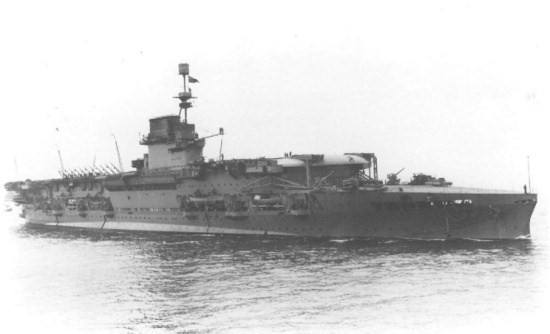
| Navy | The Royal Navy |
| Type | Aircraft Carrier |
| Class | Courageous |
| Pennant | 50 |
| Built by | Armstrong (Newcastle-on-Tyne, U.K.) : Parsons |
| Ordered | |
| Laid down | 29 Mar 1915 |
| Launched | 5 Feb 1916 |
| Commissioned | 4 Nov 1916 |
| Lost | 17 Sep 1939 |
| Loss position | 50° 10'N, 14° 45'W |
| History | Converted to aircraft carrier at Devonport Dockyard from June 1924 until 5 May 1928. Recommissioned on 21 February 1928, this was prior to the completion of her conversion. At 1950 hours on 17 September 1939 HMS Courageous (Capt. William Totfield Makeig-Jones, RN) was struck by two torpedoes from the German submarine U-29 about 190 nautical miles south-west of Dursey Head, Ireland, in position 50º10'N, 14º45'W, and sank quickly after only 17 minutes. The carrier had been on patrol against U-boats with her destroyer screen. After this incident, carriers are withdrawn from such patrols. Hit by U-boat |
| U-boat Attack | See our U-boat attack entry for the HMS Courageous |
Commands listed for HMS Courageous (50)
Please note that we're still working on this section
and that we only list Commanding Officers for the duration of the Second World War.
| Commander | From | To | |
| 1 | Capt. William Totfield Makeig-Jones, RN | 24 Jul 1939 | 17 Sep 1939 (+) |
You can help improve our commands section
Click here to Submit events/comments/updates for this vessel.
Please use this if you spot mistakes or want to improve this ships page.
Notable events involving Courageous include:
This page was last updated in December 2017
31 Aug 1939
HMS Courageous (Capt. W.T. Makeig-Jones, RN) departed Portsmouth for Portland. She was escorted by HMS Sturdy (Lt.Cdr. G.T. Cooper, RN).
HMS Courageous had been commissioned with full completment from the Reserve Fleet on 31 July 1939. In late August 1939 it was decided that Courageous was to join forces with HMS Ramillies and that they would be sent to Freetown. On 3 September it was decided that the should join the Channel Force instead. (1)
1 Sep 1939
HMS Courageous (Capt. W.T. Makeig-Jones, RN), and her escort, HMS Sturdy (Lt.Cdr. G.T. Cooper, RN), arrived at Portland.
2 Sep 1939
HMS Courageous (Capt. W.T. Makeig-Jones, RN), still escorted by HMS Sturdy (Lt.Cdr. G.T. Cooper, RN), shifted from Portland to Plymouth.
4 Sep 1939
HMS Courageous (Capt. W.T. Makeig-Jones, RN) departed Plymouth for an anti-submarine patrol. She was escorted by the destroyers HMS Acasta (Cdr. P.J. Oliver, RN), HMS Anthony (Lt.Cdr. N.V.J.T. Thew, RN), HMS Amazon (Lt.Cdr. N.E.G. Roper, RN), HMS Ardent (Lt.Cdr. J.F. Barker, RN).
At sea they were joined by HMS Eclipse (Lt.Cdr. E.L. Woodhall, RN) which attacked a submarine contact around 1915 hours near Plymouth. The contact appears to have been bogus.
The force returned to Plymouth later the same day.
9 Sep 1939
HMS Courageous (Capt. W.T. Makeig-Jones, RN) departed Plymouth for an anti-submarine patrol in the Western Approaches. She was escorted by the destroyers HMS Kempenfelt (Capt. C. Caslon, RN), HMS Ardent (Lt.Cdr. J.F. Barker, RN), HMS Echo (Cdr. S.H.K. Spurgeon, RAN).
10 Sep 1939
HMS Courageous (Capt. W.T. Makeig-Jones, RN) and her escort; the destroyers HMS Kempenfelt (Capt. C. Caslon, RN), HMS Ardent (Lt.Cdr. J.F. Barker, RN), HMS Echo (Cdr. S.H.K. Spurgeon, RAN) arrive at Milford Haven.
Around 1030 hours a Swordfish aircraft from HMS Courageous had attacked a submarine about 280 nautical miles west of Ushant. The German submarine U-34 reported being attacked by a British aricraft at 1117 hours (Berlin time, 1017 hours British time) which dropped one bomb which caused no damage.
A second attack on a submarine was carried out 270 nautical miles west of Ushant at 1250 hours. This attack is not reported by the Germans unless it was on a submarine which did not return from patrol.
11 Sep 1939
HMS Courageous (Capt. W.T. Makeig-Jones, RN) departed Milford Haven for an anti-submarine patrol in the Western Approaches. Again she was escorted by the destroyers HMS Kempenfelt (Capt. C. Caslon, RN), HMS Ardent (Lt.Cdr. J.F. Barker, RN), HMS Echo (Cdr. S.H.K. Spurgeon, RAN).
14 Sep 1939
HMS Courageous (Capt. W.T. Makeig-Jones, RN) and her escort; the destroyers HMS Kempenfelt (Capt. C. Caslon, RN), HMS Ardent (Lt.Cdr. J.F. Barker, RN), HMS Echo (Cdr. S.H.K. Spurgeon, RAN) arrived at Plymouth from an anti-submarine patrol in the Western Approaches.
They had provided cover for the damaged destroyers HMS Vanquisher (Lt.Cdr. K.H. Fraser, RN) and HMS Walker (Cdr. W.J.C. Robertson, RN) which had collided late on the 11th and were both heavily damaged.
16 Sep 1939
HMS Courageous (Capt. W.T. Makeig-Jones, RN) departed Plymouth for an anti-submarine patrol in the Western Approaches. She was escorted by the destroyers HMS Inglefield (Capt. A.G. Talbot, RN), HMS Ivanhoe (Cdr. B. Jones, RN), HMS Impulsive (Lt.Cdr. W.S. Thomas, RN) and HMS Intrepid (Cdr. J.W. Josselyn, RN) of which the last one listed joined later at sea as she was unable to depart Plymouth on time.
In the evening HMS Impulsive attacked a submarine contact and HMS Inglefield went to assist but the contact was classified as 'non-sub' and both destroyers then re-joined the screen.
17 Sep 1939
The sinking of HMS Courageous.
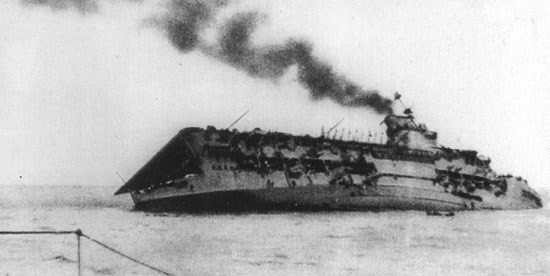 HMS Courageous sinking as seen from one of the escorting destroyers.
HMS Courageous (Capt. W.T. Makeig-Jones, RN) was on anti-submarine patrol about 350 nautical miles west of Lands End, still escorted by HMS Inglefield (Capt. A.G. Talbot, RN), HMS Ivanhoe (Cdr. B. Jones, RN), HMS Impulsive (Lt.Cdr. W.S. Thomas, RN) and HMS Intrepid (Cdr. J.W. Josselyn, RN).
At 1445 hours, the group picked up a distress call from the British merchant Kafiristan that was being attacked by the German submarine U-53 about 350 miles west of Cape Clear. The destroyers HMS Inglefield and HMS Intrepid were detached and the carrier launched four Swordfish aircraft, one of them forced the U-boat to dive without damaging it at 1700 hours.
At about 1800 hours, another U-boat, U-29, spotted the carrier group and began chasing it, but had no chance to get into a favorable attack position until the carrier turned into the wind to recover the four Swordfish returning from the search for U-53. She was now heading on a straight course at 18 knots towards the U-boat which attacked only five minutes after the last aircraft landed. At 1950 hours, U-29 fired a spread of three G7e torpedoes at HMS Courageous and hit her with two of them on the port side abaft the bridge. She almost immediately took a heavy list to port and sank after 17 minutes about 190 miles southwest of Dursey Head, Ireland.
The Commanding Officer, 17 other officers and 501 ratings were lost, including 36 RAF service crewmen. All Swordfish aircraft of 811 and 822 Sqdn FAA were lost with the ship.
While HMS Ivanhoe attacked U-29 with depth charges, HMS Impulsive began to rescue the survivors and was soon joined by the American merchant Collingsworth, the British merchant Dido and the Dutch passenger ship Veendam, which launched 14 lifeboats and also saved the ships log. The rescue work proved difficult due to the heavily oiled sea. Further help arrived when HMS Kempenfelt (Capt. C. Caslon, RN) and HMS Echo (Cdr. S.H.K. Spurgeon, RAN) joined HMS Ivanhoe in the submarine hunt together with the by now returned HMS Intrepid, but the U-boat escaped during the night. Also two light cruisers, HMS Caradoc (Capt. E.W.L. Longley-Cook, RN) and HMS Ceres (Capt. E.G. Abbott, AM, RN) arrived at the scene together with the destroyer HMS Kelly (Capt. L.F.A.V.N. Mountbatten, GCVO, RN), but the cruisers were soon ordered away.
The merchant Dido had picked up 23 officers and 195 ratings and was escorted to Liverpool by HMS Intrepid. The survivors rescued by the neutral merchants were transferred to HMS Inglefield and HMS Kelly and arrived at Devonport (Plymouth) on the afternoon of 19 September.
After this loss and the unsuccessful attack of U-39 on HMS Ark Royal (Capt. A.J. Power, RN) only three days earlier, carriers were withdrawn from such patrols as they were considered to be to valuable.
Media links
|

Sources
- ADM 199/2551
ADM numbers indicate documents at the British National Archives at Kew, London.
As an Amazon Associate uboat.net earns a commission from qualifying purchases.