
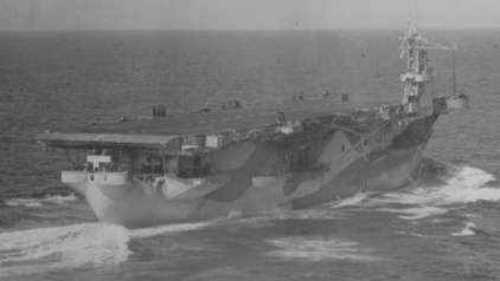
| Navy | The Royal Navy |
| Type | Escort Carrier |
| Class | Attacker |
| Pennant | D 64 |
| Built by | Western Pipe & Steel Co. (San Francisco, California, U.S.A.) |
| Ordered | |
| Laid down | 5 Sep 1941 |
| Launched | 4 Apr 1942 |
| Commissioned | 20 Feb 1943 |
| End service | |
| History | On 11 December 1946, HMS Fencer was returned to the US Navy, and was subsequently converted for merchant service and renamed Sydney in 1951. In 1968 Sydney was renamed Roma. In 1970 she became the Galaxy Queen. In 1973 she changed owners twice, first becoming the Lady Dina and then the Cariba 2. In September 1975 she was sold to be broken up for scrap at La Spezia, Italy. |
| Former name | USS Croatan (i) |
Commands listed for HMS Fencer (D 64)
Please note that we're still working on this section
and that we only list Commanding Officers for the duration of the Second World War.
| Commander | From | To | |
| 1 | Capt. Edmund Walter Anstice, RN | 1 Aug 1942 | 21 Jan 1944 |
| 2 | A/Capt. Wolf Walter Rudolf Bentinck, OBE, RN | 21 Jan 1944 | 30 Mar 1945 |
| 3 | A/Cdr. (emergency) Alan Moir Harris, RN | 30 Mar 1945 | Oct 45 ? |
You can help improve our commands section
Click here to Submit events/comments/updates for this vessel.
Please use this if you spot mistakes or want to improve this ships page.
Notable events involving Fencer include:
The page of HMS Fencer was created in April 2023.
This page was last updated also in April 2023.
[Note: information regarding operations by the Fleet Air Arm (FAA) aircraft of HMS Fencer is not complete on this page. Further research from first hand sources, read original documents from the National Archives, will have to be undertaken in the (far) future.]
27 Feb 1943
HMS Fencer (Capt. E.W. Anstice, RN) is commissioned at San Francisco with an advance party of 29 officers and 150 men on board. (1)
1 Mar 1943
HMS Fencer (Capt. E.W. Anstice, RN) is commissioned in full at San Francisco after another 119 men had joined the ship. (1)
25 Mar 1943
HMS Fencer (Capt. E.W. Anstice, RN) conducted D/G trials at San Francisco. (1)
26 Mar 1943
HMS Fencer (Capt. E.W. Anstice, RN) conducted compass swing trials and exercises at / off San Francisco. (1)
27 Mar 1943
HMS Fencer (Capt. E.W. Anstice, RN) conducted gunnery exercises off San Francisco. (1)
29 Mar 1943
During 29/30 March 1943, HMS Fencer (Capt. E.W. Anstice, RN) conducted exercises off San Francisco. These included night exercises. (1)
5 Apr 1943
Around 1200T/5, HMS Fencer (Capt. E.W. Anstice, RN) departed San Francisco for Balboa, Panama Canal Zone. (2)
15 Apr 1943
Around 1200R/15, HMS Fencer (Capt. E.W. Anstice, RN) arrived at Balboa, Panama Canal Zone from San Francisco. (2)
16 Apr 1943
HMS Fencer (Capt. E.W. Anstice, RN) transited the Panama Canal eastbound and arrived at Cristobal.
18 Apr 1943
Around 0600R/18, HMS Fencer (Capt. E.W. Anstice, RN) departed Cristobal, Panama Canal Zone for Hampton Roads, Virginia. (2)
23 Apr 1943
Around 1855Q/23, HMS Fencer (Capt. E.W. Anstice, RN) arrived in Hampton Roads from the Panama Canal Zone. (2)
24 Apr 1943
HMS Fencer (Capt. E.W. Anstice, RN) proceeded to the Norfolk Navy Yard for some voyage repairs and the installation of D/F equipment. (2)
27 Apr 1943
HMS Fencer (Capt. E.W. Anstice, RN) proceeded to the Norfolk Naval Base. (2)
1 May 1943
HMS Fencer (Capt. E.W. Anstice, RN) departed Norfolk for New York. Before departure D/F and RDF calibration trials were carried out as were AA gunnery exercises. (3)
2 May 1943
Around 1100Q/2, HMS Fencer (Capt. E.W. Anstice, RN) arrived at New York from Norfolk. (3)
7 May 1943
Convoy HX 238.
This convoy departed New York on 7 May 1943.
It was made up of the following transports / tankers; Atlanta City (American, 5686 GRT, built 1921), Basil (British, 4913 GRT, built 1928), Bernard N. Baker (American, 7191 GRT, built 1943), Bralanta (Norwegian (tanker), 9608 GRT, built 1936), British Fidelity (British (tanker), 8465 GRT, built 1938), Cyrus Field (British (cable ship), 1288 GRT, built 1924), Daphnella (British (tanker), 8078 GRT, built 1938), Edward N. Hurley (American, 7191 GRT, built 1943), Edwin M. Stanton (American, 7176 GRT, built 1942), Egero (Norwegian (tanker), 7590 GRT, built 1929), Elizabeth Bakke (Norwegian, 5450 GRT, built 1937), Elmer A. Sperry (American, 7176 GRT, built 1942), Empire Nugget (British (tanker), 9807 GRT, built 1942), Evita (Norwegian (tanker), 6346 GRT, built 1927), Fort Acton (British, 7122 GRT, built 1942), Franz Klasen (Panamanian (tanker), 11194 GRT, built 1932), Glenogle (British, 9513 GRT, built 1920), Kaldfonn (Norwegian (tanker), 9931 GRT, built 1936), Levernbank (British, 5150 GRT, built 1925), Lista (British, 3671 GRT, built 1920), Miralda (British (tanker), 8013 GRT, built 1936), Montevideo (Norwegian, 4639 GRT, built 1928), Morgenen (Norwegian (tanker), 7093 GRT, built 1930), Noesaniwi (Dutch, 6737 GRT, built 1936), Norvinn (Panamanian, 6322 GRT, built 1930), O.B. Sorensen (Norwegian (tanker), 7919 GRT, built 1931), Pan-Maryland (American (tanker), 7701 GRT, built 1938), Philipp Barbour (American, 7176 GRT, built 1942), Ralph Waldo Emerson (American, 7176 GRT, built 1942), Robert E. Peary (American, 7181 GRT, built 1942), San Ambrosio (British (tanker), 7410 GRT, built 1935), Southern Sun (American (tanker), 8893 GRT, built 1931) and William J. Worth (American, 7176 GRT, built 1943).
The escort carrier HMS Fencer (Capt. E.W. Anstice, RN), carrying new aircraft was also part of the convoy. She was not able to operate aircraft.
On departure from New York the convoy was escorted by the corvettes HMCS Lethbridge (T/Lt.Cdr. W. Woods, RCNR), HMCS Oakville (T/Lt. H. Farncomb, RCNVR) and the minesweeper HMCS Brockville (Lt. R.C. Chenoweth, RCNVR).
On 9 May 1943, the following merchant vessels departed Halifax to join the convoy Aedanus Burke (American, 7176 GRT, built 1943), Alcedo (Panamanian, 1392 GRT, built 1937), Argolicos (Greek, 4786 GRT, built 1921), Bruarfoss (Icelandic, 1580 GRT, built 1927), Cavina (British, 6907 GRT, 1924), City of Glasgow (British, 5321 GRT, 1920), City of Kimberley (British, 6169 GRT, built 1925), Emma Willard (American, 7176 GRT, built 1943), Fort Abitibi (British, 7122 GRT, built 1942), Manchester Commerce (British, 5343 GRT, built 1925), Tjisalak (Dutch, 5787 GRT, built 1917) and Troubadour (Norwegian, 5808 GRT, built 1920).
They were escorted by the destroyer HMS Chelsea (Lt.Cdr. J.E.R. Wilford, RNR) and the corvettes HMCS Shawinigan (T/Lt. C.P. Balfry, RCNR), HMCS Sudbury (T/Lt. D.S. Martin, RCNR) and the minesweeper HMCS Milltown (A/Lt.Cdr. J.H. Marshall, RCNVR).
On these ships from Halifax joining, most likely on 10 May, the Cyrus Field parted company with the convoy to proceed, with the original escort, to Halifax where they arrived on 11 May 1943.
On 12 May 1943, the merchant vessels Stephen A. Douglas (American, 7219 GRT, built 1942) and Wendell Phillips (American, 7176 GRT, built 1942) sailed from St.John's, Newfoundland to join the convoy.
They were escorted by the destroyers HMCS Skeena (A/Lt.Cdr. E.E.G. Boak, RCN), corvettes HMCS Algoma (T/A/Lt.Cdr. J. Harding, RCNR), HMCS Bittersweet (T/Lt. F.B. Brooks-Hill, RCNVR), HMCS Eyebright (T/Lt. H.L. Quinn, RCNVR), HMCS Galt (T/Lt. A.M. Kirkpatrick, RCNVR), HMCS Mayflower (Lt. V. Browne, RCNR), HMCS Pictou (T/Lt. P.T. Byers, RCNR) and the A/S trawler HMS Northern Sun (T/Lt. W.G.N. Aplin, RNR). The rescue tug HMS Samsonia was also with them. They joined the convoy on 13 May 1943. On these ship joining HMS Chelsea, HMCS Shawinigan, HMCS Sudbury and HMCS Milltown were detached to proceed to St. John's.
On the 14th the destroyer HMS Burnham (Cdr. R.C. Medley, DSO, RN) and corvette HMCS La Malbaie (T/Lt. J.S. Davis, RCNVR) departed St. John's to overtake and join the convoy.
Around 0415A/20, HMS Fencer and HMCS Skeena to proceed to Belfast and Londonderry respectively.
The convoy arrived in U.K. waters on 21/22 May 1943.
21 May 1943
Around 1125A/21, HMS Fencer (Capt. E.W. Anstice, RN) arrived at belfast. She departed for Liverpool around 1410A/21. (3)
22 May 1943
Around 0900A/22, HMS Fencer (Capt. E.W. Anstice, RN) anchored off Liverpool. She proceeded up river later the same day. At Liverpool she was taken in hand for alterations. (3)
29 Jun 1943
HMS Fencer (Capt. E.W. Anstice, RN) is docked in the Canada Graving Dock at Liverpool. (4)
4 Jul 1943
HMS Fencer (Capt. E.W. Anstice, RN) is undocked. (4)
30 Jul 1943
Around 1200B/30, HMS Fencer (Capt. E.W. Anstice, RN) departed Liverpool for the Clyde via Loch Foyle. (4)
31 Jul 1943
Around 0700B/31, HMS Fencer (Capt. E.W. Anstice, RN) anchored in Loch Foyle coming from Liverpool. She departed around 1225A/31 for Greenock where she arrived around 2020A/31. (4)
3 Aug 1943
HMS Fencer (Capt. E.W. Anstice, RN) conducted flying exercises in the Clyde area. (5)
5 Aug 1943
HMS Fencer (Capt. E.W. Anstice, RN) conducted flying exercises in the Clyde area. (5)
6 Aug 1943
HMS Fencer (Capt. E.W. Anstice, RN) conducted flying exercises in the Clyde area. (5)
7 Aug 1943
HMS Fencer (Capt. E.W. Anstice, RN) conducted flying exercises in the Clyde area. (5)
9 Aug 1943
HMS Fencer (Capt. E.W. Anstice, RN) conducted flying exercises in the Clyde area. (5)
11 Aug 1943
HMS Fencer (Capt. E.W. Anstice, RN) conducted flying exercises in the Clyde area. (5)
12 Aug 1943
HMS Fencer (Capt. E.W. Anstice, RN) conducted flying exercises in the Clyde area. (5)
13 Aug 1943
HMS Fencer (Capt. E.W. Anstice, RN) conducted flying exercises in the Clyde area. (5)
18 Aug 1943
During 18/19 August 1943, HMS Fencer (Capt. E.W. Anstice, RN) conducted flying exercises in the Clyde area. These included night flying exercises. (5)
20 Aug 1943
During 20/21 August 1943, HMS Fencer (Capt. E.W. Anstice, RN) conducted flying exercises in the Clyde area. These included night flying exercises. (5)
23 Aug 1943
During 23/24 August 1943, HMS Fencer (Capt. E.W. Anstice, RN) conducted flying exercises in the Clyde area. These included night flying exercises. (5)
25 Aug 1943
From 25 to 27 August 1943, HMS Fencer (Capt. E.W. Anstice, RN) conducted flying exercises in the Clyde area. These included night flying exercises. (5)
28 Aug 1943
HMS Fencer (Capt. E.W. Anstice, RN) conducted special trials in the Clyde area. (5)
30 Aug 1943
During 30/31 August 1943, HMS Fencer (Capt. E.W. Anstice, RN) conducted flying exercises in the Clyde area. These included night flying exercises. (5)
1 Sep 1943
From 1 to 3 September 1943, HMS Fencer (Capt. E.W. Anstice, RN) conducted flying exercises in the Clyde area. These included night flying exercises. (6)
20 Sep 1943
HMS Fencer (Capt. E.W. Anstice, RN) conducted flying exercises in the Clyde area. Also HF/DF calibration trials were carried out. (6)
21 Sep 1943
HMS Fencer (Capt. E.W. Anstice, RN) conducted flying exercises in the Clyde area. (6)
22 Sep 1943
HMS Fencer (Capt. E.W. Anstice, RN) conducted flying exercises in the Clyde area. (6)
23 Sep 1943
During 23/24 September 1943, HMS Fencer (Capt. E.W. Anstice, RN) conducted flying exercises in the Clyde area. These included night flying exercises. In the morning of the 24th an oiling at sea exercise was carried out during which the destroyer HMS Wrestler (Lt. R.W.B. Lacon, DSC, RN) was fuelled. (6)
23 Sep 1943
HMS Storm (T/Lt. E.P. Young, DSC, RNVR) conducted exercises in the Clyde area. Also night attack exercises were carried out during which HMS Fencer (Capt. E.W. Anstice, RN) and five escorts served as targets. (7)
28 Sep 1943
HMS Fencer (Capt. E.W. Anstice, RN) conducted flying exercises in the Clyde area. (6)
28 Sep 1943
Operation Alacrity.
The object of this operation was to land at the Azores (Portugese territory) and establish air bases there.
Negotiations with the Portugese were still ongoing to effect this through diplomatic ways and eventually this succeeded and the airbases were established with Portugese consent.
For this operations three convoys left the U.K., these were the following; Convoy UA 1. This convoy departed the Clyde on 28 September 1943 and was made up of the following transports / tankers Corfell (British, 1802 GRT, built 1934), Dux (Norwegian, 1590 GRT, built 1934) and Empire Garden (British (tanker), 8966 GRT, built 1920) which were to proceed to Horta and the Corfirth (British, 1803 GRT, built 1934) and Crane (British, 785 GRT, built 1937) as well as the landing ship HMS LST 13 (Lt.Cdr. R.A. Crozier, RD, RNR) which were to proceed to Angra. The Corfith and HMS LST 13 were however unable to sail with the convoy and remained behind.
Escort for this convoy was made up of the destroyer HMS Volunteer (Lt.Cdr. G.J. Luther, RN), corvette HMS Lavender (Lt. L.G. Pilcher, RNR), A/S trawlers HMS Cape Portland (T/Lt. K.F. Rasmussen, RNR), HMS Saon (T/Lt. J.C. Payne, RNVR), HMS Vascama (T/Lt. H.A.R. Twomey, RNR) and the M/S trawlers HMS Bruray (T/Lt. G.H. Clark, DSC, RNVR), HMS Hayling (T/Lt. G.F. Bryant, RNVR), HMS Mangrove (T/Lt. J.K.M. Warde, RNVR) and HMS Whalsay (T/Lt. F.J.S. Crawford, RNVR).
Convoy UA 2. This convoy departed the Clyde on 30 September 1943 and was made up of the following transports Empire Outpost (British, 6978 GRT, built 1943) and Scottish Monarch (British, 7004 GRT, built 1943). The landing ships HMS Bachaquero (Lt.Cdr. P.G. Britten, RD, RNR) and (RFA) Dewdale (8265 GRT, built 1941) were also part of this convoy.
Convoy UA 2 was escorted by the destroyers HMS Havelock (Cdr. R.C. Boyle, DSC, RN), HMS Warwick (Cdr. Y.M. Cleeves, DSO, DSC, RD, RNR), corvettes HMS Buttercup (T/Lt. R.J. Jonckheere, RNR), HMS Godetia (T/Lt. M.A.F. Larose, RNR), A/S trawlers HMS Kingston Agate (Lt. J. Simms, RNR), HMS Kingston Amber (T/Lt. R. Adams, RNR), HMS St. Elstan (Lt. R.M. Roberts, RNR) and HMS Vizalma (T/Lt. B. James, RNVR).
Convoy UA 3. This convoy departed Liverpool on 2 October 1943 and was made up of the troop transport Franconia (British, 20175 GRT, built 1923). She was escorted by the destroyers HMS Inconstant (Cdr. R.H. Mills, RN) and ORP Garland (Kmdr.ppor. (Cdr.) S. Biskupski). These ships were fist to proceed to Belfast Lough were the destroyers were to be fuelled and then on 3 October 1943 they were to rendezvous with the escort carrier HMS Fencer (Capt. E.W. Anstice, RN) and the destroyers ORP Burza (Kmdr.ppor. (Cdr.) F. Pitulko) and HMS Whitehall (Cdr. C.L.de H. Bell, RD, RNR) coming from the Clyde which they had departed also on 3 October 1943. The destroyers HMS Wrestler (Lt. R.W.B. Lacon, DSC, RN) and HMS Viscount (Lt.Cdr. L.E. Woodhouse, RN) joined coming from Londonderry which they had departed also on 3 October 1943.
The convoys arrived near the Azores on or around 8 October 1943. [Further research is required regarding the exact movements of the convoys and the ships in it.]
29 Sep 1943
During 29/30 September 1943, HMS Fencer (Capt. E.W. Anstice, RN) conducted flying exercises in the Clyde area. These included night flying exercises. (6)
3 Oct 1943
Around 0900A/3, the escort carrier HMS Fencer (Capt. E.W. Anstice, RN) and the destroyers ORP Burza (Kmdr.ppor. (Cdr.) F. Pitulko) and HMS Whitehall (Cdr. C.L.de H. Bell, RD, RNR) departed the Clyde to join convoy UA 3 and to participate in operation Alacrity.
[For more info on this convoy and operation see the event ' Operation Alacrity ' for 28 September 1943.] (8)
8 Oct 1943
Around 1900O/8, HMS Fencer (Capt. E.W. Anstice, RN) anchored off Angra, Azores. (8)
23 Oct 1943
HMS Fencer (Capt. E.W. Anstice, RN) was underway for several hours off Angra, Azores to conduct flying operations. (8)
24 Oct 1943
Around 1910N/24, the escort carrier HMS Fencer (Capt. E.W. Anstice, RN) departed Angra, Azores for Greenock. En-route they were to conduct A/S operations in the North Atlantic, initially near position 45°N, 30°W. She was escorted by the destroyers HMS Inconstant (Cdr. R.H. Mills, RN), ORP Garland (Kmdr.ppor. (Cdr.) S. Biskupski) and ORP Burza (Kmdr.ppor. (Cdr.) F. Pitulko).
Around 1400O/25, ORP Burza commenced fuelling from HMS Fencer. [No time known when this was completed.]
Around 1036O/26, ORP Garland commenced fuelling from HMS Fencer. This was completed around 1352O/30.
Around 1515O/26, HMS Inconstant commenced fuelling from HMS Fencer. This was completed around 1738O/30.
Around 1120O/28, a submarine was sighted on the surface by Swordfish 'C' from 842 Squadron FAA. This was U-405. The aircraft was driven off by AA gunfire and later crashed while trying to land on the escort carrier.
Around 1105P/29, the A/S force joined convoy SC 145. [For more info on this convoy see the event ' Convoy SC 145 ' for 24 October 1943.]
Around 1320N/2, the A/S force parted company with convoy SC 145 and proceed to Greenock where they arrived around 0830A/5. (8)
24 Oct 1943
Convoy SC 145.
This convoy departed Halifax on 24 October 1943.
On departure from Halifax the convoy was made up of the following merchant vessels; Agwistar (American, 4661 GRT, built 1919), Athelprince (British (tanker), 8782 GRT, built 1926), Atlantic (Panamanian, 6132 GRT, built 1919), Baltrover (British, 4916 GRT, built 1913), Baron Dunmore (British, 3938 GRT, built 1933), Bayou Chico (American, 5401 GRT, built 1920), Benedick (British (tanker), 6978 GRT, built 1928), Bonaire (Dutch, 3164 GRT, built 1926), Boston City (British, 2870 GRT, built 1920), Chr. Th. Boe (Norwegian (tanker), 6192 GRT, built 1930), Clam (British, 7404 GRT, built 1927), Delmar (American, 5107 GRT, built 1920), Dundee (British, 1541 GRT, built 1934), El Ciervo (British (tanker), 5841 GRT, built 1923), El Grillo (British (tanker), 7264 GRT, built 1922), Fort Slave (British, 7134 GRT, built 1942), Gudfor (Norwegian, 2280 GRT, built 1928), Gyda (British, 1695 GRT, built 1934), H.M. Flagler (Panamanian (tanker), 8208 GRT, built 1918), Kingman (Panamanian, 1513 GRT, built 1934), Leerdam (Dutch, 8815 GRT, built 1921), Maycrest (British, 5923 GRT, built 1913), Michigan (Panamanian (former French), 6419 GRT, built 1920), Orwell (Norwegian (tanker), 7920 GRT, built 1905), Pacific Shipper (British, 6290 GRT, built 1924), San Felix (British (tanker), 13037 GRT, built 1921), San Valerio (British (tanker), 6493 GRT, built 1913), Sarazen (British, 5401 GRT, built 1920), Sulev (British (former Estonian), 2233 GRT, built 1908), Van de Velde (Dutch, 6389 GRT, built 1919), Vav (Norwegian (tanker), 6415 GRT, built 1931) and Wisla (Polish, 3108 GRT, built 1928).
On departure from Halifax the convoy was escorted by the destroyer HMCS Annapolis (Lt.Cdr. A.G. Boulton, RCNVR) and the corvettes HMCS Kenogami (T/Lt. J.L. Percy, RCNVR), HMCS Saskatoon (Lt.Cdr. T. MacDuff, RCNR) and HMCS Shediac (T/A/Lt.Cdr. A. Moorhouse, RCNR).
The minesweeper HMCS Clayoquot (T/Lt. C.L. Campbell, RCNVR) was with the convoy during 25/26 October 1943.
On 28 October 1943, the original escort from Halifax parted company to proceed to St. Johns, Newfoundland after the relief escort had joined coming from St. Johns. This relief escort was made up of the destroyers HMS Fame (Cdr. R.A. Currie, RN), HMS Vanquisher (Lt.Cdr. G.A.G. Ormsby, RN), frigates HMS Deveron (Lt.Cdr. R.E.H. Partington, RD, RNR), HMS Domett (T/A/Lt.Cdr. S. Gordon, RNVR) and the corvettes HNoMS Potentilla, HNoMS Rose and HMS Linaria (T/A/Lt.Cdr. R.H. Jameson, RNR).
Around 1105P/29 the escort carrier HMS Fencer (Capt. E.W. Anstice, RN) and the destroyers HMS Inconstant (Cdr. R.H. Mills, RN), ORP Garland (Kmdr.ppor. (Cdr.) S. Biskupski) and ORP Burza (Kmdr.ppor. (Cdr.) F. Pitulko) joined the convoy. They parted comanay with the convoy to proceed to the Clyde around 1320N/2.
The convoy arrived in U.K. waters on 6 November 1943.
2 Nov 1943
Around 1320N/2, HMS Fencer (Capt. E.W. Anstice, RN), HMS Inconstant (Cdr. R.H. Mills, RN), ORP Garland (Kmdr.ppor. (Cdr.) S. Biskupski) and ORP Burza (Kmdr.ppor. (Cdr.) F. Pitulko) arrived in the Clyde from operations / convoy escort duty. (9)
19 Nov 1943
During 19/20 November 1943, HMS Fencer (Capt. E.W. Anstice, RN) conducted flying exercises in the Clyde Area / North Channel. These included night flying exercises. (9)
22 Nov 1943
During 22/23 November 1943, HMS Fencer (Capt. E.W. Anstice, RN) conducted flying exercises in the Clyde area. These included night flying exercises. (9)
22 Nov 1943
Convoy SL 141.
This convoy departed Freetown on 22 November 1943.
On departure from Freetown the convoy was made up of the following merchant vessels; Agia Marina (Greek, 4151 GRT, built 1912), Akaroa (British, 15130 GRT, built 1914), Baron Ruthven (British, 3178 GRT, built 1925), Cape Sable (British, 4398 GRT, built 1936), Conakrian (British, 4876 GRT, built 1937), Dordrecht (Dutch, 4402 GRT, built 1928), Empire Arun (British, 5490 GRT, built 1922), Empire Flamingo (British, 4994 GRT, built 1920), Gascony (British, 4716 GRT, built 1925), Hilversum (Dutch, 3717 GRT, built 1920), Langleebrook (British, 4246 GRT, built 1930), Palembang (Dutch, 7070 GRT, built 1921), Princesa (British, 8731 GRT, built 1918) and Scottish American (British (tanker), 6999 GRT, built 1920).
On departure from Freetown the convoy was escorted by the sloops HMS Leith (Lt.Cdr.(Retd.) A.W. Preston, RN), HMS Sandwich (T/A/Lt.Cdr. A.J. Clemence, RNR) and the corvette HMS Anchusa (T/Lt. R.A. Baker, RNVR).
On 25 November 1943, the merchant vessels Bosphorus (Norwegian, 2111 GRT, built 1934), El-Biar (French, 4678 GRT, built 1927), Empire Buckler (British, 7046 GRT, built 1942) and Marija Petrinovic (Yugoslavian, 5684 GRT, built 1918) departed Dakar to join the convoy.
On 3 December 1943, the merchant vessels Coulmore (British, 3670 GRT, built 1936) and Fort Gibraltar (British, 7134 GRT, built 1942) departed Casablanca to join the convoy. They were escorted to the rendezvous by the minesweeping sloop Commandant Delage and the patrol vessel USS PC-480 (Lt. F.W. Meyers, Jr., USNR) which then returned to Casablanca taking the El-Biar with them.
On 4 December 1943, the convoy merged with convoy MKS 32(G) coming from the Mediterranean.
This convoy was made up of the following merchant vessels; Arlesford (British, 2472 GRT, built 1922), Arawa (British, 14462 GRT, built 1922), Ashbury (British, 3901 GRT, built 1924), Blackheath (British, 4637 GRT, built 1936), Capitaine Paul Lemerle (French, 4945 GRT, built 1925), City of Hongkong (British, 9609 GRT, built 1924), Clan Cameron (British, 7243 GRT, built 1937), Cochrane (British, 7203 GRT, built 1923), Dalcross (British, 4557 GRT, built 1930)), Dalemoor (British, 5835 GRT, built 1922), Empire Derwent (British, 4026 GRT, built 1930), Empire Gold (British (tanker), 8028 GRT, built 1941), Empire Scout (British, 2185 GRT, built 1936), Empire Wolfe (British, 2888 GRT, built 1941), Explorer (British, 6235 GRT, built 1935), Hardingham (British, 7269 GRT, built 1942), Hartbridge (British, 5080 GRT, built 1927), Iris (British (cable ship), 1479 GRT, built 1940), Itinda (British, 6619 GRT, built 1938), Mandalay (British, 5529 GRT, built 1911), Parklaan (Dutch, 3807 GRT, built 1911), Porjus (Swedish, 2965 GRT, built 1906), Recorder (British, 2276 GRT, built 1902) and Socotra (British, 7840 GRT, built 1943).
The rescue ship Bury (British, 1686 GRT, built 1911) was also with the convoy.
The LST's USS LST 5 (Lt. J.F. Lambden Jr., USNR), USS LST 7 (Lt. F. O'Neil, USN), USS LST 306 (Lt. R.H. Kimball, USNR), USS LST 307 (Lt. J.B. Markham, USNR), USS LST 331 (Lt. J. Mazotta, USCG), USS LST 335 (Lt. H.R. Roberts, USNR), USS LST 336 (Lt. D.L. Biberman, USNR), USS LST 369 (Lt. J.P. O'Riorden, USNR), USS LST 388 (Lt. R.S. Browning, USNR), USS LST 391 (Lt. I. Ehrensall, USNR), USS LST 392 (Lt. L.R. Lemaire, Jr., USNR) and USS LST 393 (Lt. W.C. Knight, USNR) also took passage in the convoy.
Convoy MKS 32(G) was escorted by the armed merchant cruiser HMS Ranpura (Capt.(Retd.) H.T.M. Pawsey, RN), sloops HMS Rochester (Cdr. H.V. King, OBE, DSO, RN), HMS Scarborough (Lt.Cdr. E.B. Carnduff, RN), frigate HMS Tavy (T/A/Lt.Cdr. F. Ardern, RNR) and the corvettes HMS Balsam (Lt. J.E.L. Peters, DSC, RNVR), HMS Geranium (T/Lt. A.R.J. Tilston, DSC, RNR) and HMS Mignonette (Lt. H.H. Brown, DSC, RNR).
The original escort of convoy SL 141 then parted company and proceeded to Gibraltar where they arrived on 5 December 1943.
Around 1015Z/6, the escort carrier HMS Fencer (Capt. E.W. Anstice, RN) joined the convoy. She parted company around 0630Z/12 to join the combined convoy Combined convoy OS 61 / KMS 35. She was escorted to the rendezvous with this convoy by HMS Tavy which then parted company to rejoin convoy SL 141 / KMS 32.
The now combined convoy SL 141 / MKS 32 arrived in U.K. waters on 17 December 1943. The Arawa (to Clyde, arrived 14 December 1943) and Socotra (to Liverpool, arrived 12 December 1943) had been detached earlier and proceeded to their respective destinations independently.
25 Nov 1943
HMS Fencer (Capt. E.W. Anstice, RN) proceeded from Greenock to Moville. (9)
26 Nov 1943
Combined convoy OS 60 / KMS 34.
This combined convoy assembled off Oversay on 26 November 1943.
It was made up of the following merchant vessels; Alex (British, 3932 GRT, built 1914), Allerton (British, 7195 GRT, built 1941), Baron Ramsay (British, 3650 GRT, built 1929), Belgian Sailor (Belgian, 7028 GRT, built 1942), Benton Field (British, 1124 GRT, built 1943), Chief Joseph (American, 7176 GRT, built 1943), Clan Forbes (British, 7529 GRT, built 1938), Clan MacBean (British, 5000 GRT, built 1918), Colytto (Dutch, 4408 GRT, built 1926), Elswick Park (British, 4138 GRT, built 1920), Empire Chamois (British, 5684 GRT, built 1918), Empire Chivalry (British, 6007 GRT, built 1937), Empire Jessica (British, 2890 GRT, built 1943), Empire Planet (British, 4290 GRT, built 1923), Empire Torridge (British, 4050 GRT, built 1923), Erastus Smith (American, 7244 GRT, built 1943), Fauzon (French, 4376 GRT, built 1938), Flimston (British, 4674 GRT, built 1925), Fort Alexander (British, 7127 GRT, built 1942), Fort Augustus (British, 7134 GRT, built 1942), Gabon (Norwegian, 4651 GRT, built 1931), Hardanger (Norwegian, 4000 GRT, built 1924), Inventor (British, 6210 GRT, built 1935), Jerome K. Jones (American, 7199 GRT, built 1943), Jobshaven (Dutch, 3528 GRT, built 1916), John M. Harlan (American, 7176 GRT, built 1943), Kaldfonn (Norwegian (tanker), 9931 GRT, built 1936), Kerma (British, 4333 GRT, built 1928), Mary Kingsley (British, 5021 GRT, built 1930), Nairung (British, 5414 GRT, built 1942), Narwick (Polish, 7031 GRT, built 1942), Nassa (British (tanker), 8134 GRT, built 1942), Norefjord (Norwegian, 3082 GRT, built 1920), Norfalk (British, 5675 GRT, built 1919), Pandorian (British, 4159 GRT, built 1941), Scorton (British, 4813 GRT, built 1939), Silverteak (British, 6770 GRT, built 1930), Simon Willard (American, 7176 GRT, built 1942), Souliotis (Greek, 4299 GRT, built 1917), Stad Haarlem (Dutch, 4518 GRT, built 1929), Stuyvesant (Dutch, 4249 GRT, built 1918), Thistleford (British, 4781 GRT, built 1928), Timok (Yugoslavian, 3130 GRT, built 1924), Tudor Prince (British, 1914 GRT, built 1940), Vera Radcliffe (British, 5587 GRT, built 1925), Wellington Court (British, 4979 GRT, built 1930) and William Kent (American, 7187 GRT, built 1942).
The rescue ship Fastnet (British, 1415 GRT, built 1928) was also with the convoy as was the French survey vessel President Theodore Tissier.
On assembly the convoy was escorted by the escort carrier HMS Fencer (Capt. E.W. Anstice, RN), destroyer HMS Highlander (Cdr. C.W. McMullen, DSC, RN), corvettes HMS Abelia (Lt. R.I. Floris, RNZNR), HMS Clover (Lt. P.H. Grieves, RNR), HMS Linaria (T/A/Lt.Cdr. R.H. Jameson, RNR) and the A/S trawlers HMS Northern Spray (Lt. F.A.J. Downer, RNR) and HMS Northern Sun (T/Lt. H. Meredith, RNVR).
On 27 November 1943, the frigate HMS Avon (Lt.Cdr. P.G.A. King, RD, RNR) joined coming from Londonderry.
On 1 December 1943, the frigates HMS Nene (Cdr. J.D. Birch, RD, RNR), HMS Tweed (Lt.Cdr. R.S. Miller, DSC, RNR) and corvettes HMCS Lunenburg (T/Lt. D.L. Miller, RCNVR) and HMCS Snowberry (T/Lt. J.A. Dunn, RCNVR) joined . These ships had departed Plymouth on 28 November 1943. They parted company with the convoy on 3 December 1943 to join convoy MKF 26. Also on 1 December 1943, a fighter from HMS Fencer reported shooting down a German Focke Wolf reconnaissance aircraft.
On 2 December 1943, the destroyer HMS Walker (Lt.Cdr. A.N. Rowell, RN) overtook and joined the convoy after having departed Londonderry on 30 November. She had grounded on 27 November when originally sailing to join the convoy and had needed repairs.
Also on 2 December 1943, the Allerton arrived in the Clyde after having been detached from the convoy, most likely due to engine trouble.
Around 0515Z/6, HMS Fencer parted company with the convoy to join the combined convoy SL 141 / MKS 32.
Also on 6 December 1943, HMS Linaria arrived at Horta with the Kaldfonn. They had parted company with the convoy on 4 December 1943.
On 7 December 1943 the convoy split into convoy OS 60 bound for Freetown and convoy KMS 34 bound for the Mediterranean. The merchant vessels Alex, Baron Ramsay, Elswick Park, Pandorian and Thistleford were detached to Lisbon.
------------------------------------------------------------------------------------------------------
Convoy OS 60 was made up of the merchant vessels; Fauzon, Flimston, Gabon, Mary Kingsley, Nassa, Silverteak and Stuyvesant.
These were joined by the merchant vessels Bactria (British, 2407 GRT, built 1928), Celtic Monarch (British, 5824 GRT, built 1929), Empire Lightning (British, 6942 GRT, built 1940), Fort Liard (British, 7133 GRT, built 1942), Glenwood (British, 4897 GRT, built 1940), Keila (British, 3621 GRT, built 1905), Riley (British, 4993 GRT, built 1936) and Stanford (British, 5969 GRT, built 1941) coming from Gibraltar which they had departed earlier that day.
These ships had been escorted by the frigate HMS Ballinderry (Lt.Cdr. E.F. Aikman, RNR) and the corvettes HMS Aubretia (Lt. G.D. Fowler, RNR) and HMS Cyclamen (T/Lt. W.S. Joliffe, RNR) which now formed the escort of this convoy towards Freetown.
On 8 December 1943 the merchant vessel Canada (French, 9684 GRT, built 1912) departed Casablanca to join the convoy which she did later the same day. She was escorted by the sloop / minesweeper Annamite which also joined the convoy.
On 14 December 1943, the merchant vessels Lycaon (British, 7552 GRT, built 1913) and Thomas Holt (British, 3585 GRT, built 1929) departed Dakar to join the convoy.
On 15 December 1943, the Canada and Fauzon arrived at Dakar after having parted company with the convoy. They were escorted to Dakar by the Annamite.
The convoy arrived at Freetown on 18 December 1943. Some ships of the convoy did not enter Freetown but proceed directly to other destinations.
------------------------------------------------------------------------------------------------------
Convoy KMS 34 was made up of the merchant vessels; Belgian Sailor, Benton Field, Chief Joseph, Clan Forbes, Clan MacBean, Colytto, Empire Chamois, Empire Chivalry, Empire Jessica, Empire Planet, Empire Torridge, Erastus Smith, Fort Alexandria, Fort Augustus, Hardanger, Inventor, Jerome K. Jones, Jobshaven, John M. Harlan, Kerma, Nairung, Narwick, Norefjord, Norfalk, Scorton, Simon Willard, Souliotis, Stad Haarlem, Timok, Tudor Prince, Vera Radcliffe, Wellington Court and William Kent as well as the Fastnet and the President Theodore Tissier.
Escort was provided by the remaining escort from combined convoy OS 60 / KMS 34.
While en-route to the Straits of Gibraltar the Kerma and Empire Jessica were detached to Huelva and Cadiz respectively.
On 9 December 1943 the original escort parted company and entered Gibraltar harbour as did the Fastnet, President Theodore Tissier, Timok and Tudor Prince. The Vera Radcliffe, which had straggled from the convoy, arrived on the 10th.
Off Gibraltar new escorts joined the convoy, these were the AA cruiser HMS Colombo (Capt. D.H. Hall-Thompson, RN), frigate HMS Cuckmere (Lt.Cdr. A. Johnson, VRD, RNVR) corvettes HMS Anemone (Lt. J.B. Sparkes, RNR), HMS Coltsfoot (T/Lt. G.W. Rayner, RNVR), HMS Convolvulus (A/Lt.Cdr. R.F.R. Yarde-Buller, RNVR) and HMS Hyderabad (T/Lt. T. Cooper, RNR). The rescue tug HMRT Mindful, minesweeper HMS BYMS 2187 (T/Lt. P. Moore, RNVR), motor minesweeper HMS MMS 20 (T/Lt. L.S. Kay, RNVR) and boom defence vessel HMS Barnehurst (T/Lt. T. Robb, RNR) also joined the convoy.
On 10 December 1943, the following merchant vessels joined the convoy off Oran; Colin P. Kelly Jr. (American, 7176 GRT, built 1942), David G. Farragut (American, 7191 GRT, built 1942), Jade (British, 930 GRT, built 1938), John Blair (American, 7181 GRT, built 1942), John Howland (American, 7191 GRT, built 1943), John Murray Forbes (American, 7176 GRT, built 1942), John Stevens (American, 7181 GRT, built 1942), Jonathan Worth (American, 7177 GRT, built 1943), Newton D. Baker (American, 7176 GRT, built 1943), Richard Rush (American, 7180 GRT, built 1943) and Russell A. Alger (American, 7176 GRT, built 1943).
Around 1304A/11, in position 36°55'N, 03°01'E, north-north-east of Algiers, HMS Cuckmere was torpedoed and heavily damaged by the German submarine U-223. She was towed to Algiers but later declared a total loss.
On the 11th the following merchant ships were detached to Algiers; Empire Planet, John M. Harlan, Russell A. Alger as was HMS MMS 20 while the following merchant ships joined the convoy off Algiers; Anglo-African (British, 5601 GRT, built 1929), Argentina (Italian, 5085 GRT, built 1907), Baron Inchcape (British, 7005 GRT, built 1917), Benjamin Tay (British, 1814 GRT, built 1943), Borgholm (Norwegian, 1557 GRT, built 1922), British Endurance (British (tanker), 8406 GRT, built 1936), Cape Hawke (British, 5081 GRT, built 1941), Chester O. Swain (American (tanker), 8146 GRT, built 1921), Empire Tana (British, 6148 GRT, built 1923), Helmwood (British, 2156 GRT, built 1923), Hjalmar Wessel (Norwegian, 1742 GRT, built 1935), Lesto (British, 1893 GRT, 1918), Marita (Norwegian, 1931 GRT, built 1919), Nolisement (British, 5084 GRT, built 1928), Thorsholm (Norwegian (tanker), 9937 GRT, built 1937) and William L. Yancey (American, 7176 GRT, built 1943). Also the motor minesweepers HMS MMS 13 (T/Lt. A.E. Durham, RNVR) and HMS MMS 48 (T/Lt. J.R. Kingdon, RNVR) joined the convoy.
On 11 December 1943, the merchant vessels Empire Daring (British, 7059 GRT, built 1943) and Fort Reliance (British, 7134 GRT, built 1942) departed Bougie to join the convoy while the Borgholm and Empire Tana were detached to Bougie arriving on the 12th.
On 12 December 1943, the merchant vessel Norefjord was detached to Philippeville while the Dux (Norwegian, 1590 GRT, built 1934) and Stancleeve (British, 5970 GRT, built 1942) joined the convoy.
On 13 December 1943, the merchant vessels Belgian Sailor, John Wise, Lesto, Narwick and HMS Mindful were detached to Bone while the Chloris (British, 1171 GRT, built 1910), Empire Gain (British (tanker), 3738 GRT, built 1943), Fort Carillon (British, 7129 GRT, built 1943), Jennings (British, 1148 GRT, built 1943) and Shirrabank (British, 7274 GRT, built 1940) joined the convoy.
Later on 13 December 1943, the merchant vessels Baron Inchcape, Empire Gain, Helmwood, Jobshaven, Norfalk and William L. Yancey arrived at Bizerta after having parted company with the convoy while the Benjamin Huntington (American, 7176 GRT, built 1942), Daniel H. Lownsdale (American, 7176 GRT, built 1942), George Shiras (American, 7200 GRT, built 1943), George Vickers (American, 7176 GRT, built 1943), Gleniffer (British, 9559 GRT, built 1919), Joel Chandler Harris (American, 7176 GRT, built 1942), John Hopkinson (British, 1314 GRT, built 1932), Marion McKinley Bovard (American, 7176 GRT, built 1942), Ocean Volunteer (British, 7174 GRT, built 1942), Patrick Henry (American, 7191 GRT, built 1941), Ponce de Leon (American, 7176 GRT, built 1943), Tarvisio (Italian, 5484 GRT, built 1927) and Titus (Dutch, 1712 GRT, built 1930) joined coming from Bizerta. HMS Colombo also parted company with the convoy arriving at Bizerta around 0800A/13.
On 14 December 1943, HMS BYMS 2187 and HMS HMS Barnehurst arrived at Malta after having been detached from the convoy while the minesweepers HMS BYMS 2203 (/Lt. R.D. Adam, RNVR), HMS BYMS 2204 (T/Lt. M.R. Bell, RNR), HMS BYMS 2232 (?) and the merchant vessel Talma (British, 10000 GRT, built 1923) joined the convoy.
On the 14 December 1943, the merchant vessels Comliebank (British, 5149 GRT, built 1924), Defender (British, 8078 GRT, built 1915), Fort St. Francois (British, 7125 GRT, built 1942), Newbrough (British, 5255 GRT, built 1941), Reginald A. Fessenden (American, 7213 GRT, built 1943), Trevelyan (British, 7292 GRT, built 1943) and Vasco (British, 2878 GRT, built 1939) departed Augusta to join the convoy.
On 14/15 December 1943, the merchant vessels Argentina, Benjamin Huntington, Benjamin Tay, British Endurance, Chester O. Swain, Chief Joseph, Chloris, Colin P. Kelly Jr., Daniel H. Lownsdale, David G. Farragut, Dux, Empire Chamois, Empire Chivalry, Empire Daring, Empire Torridge, Erastus Smith, Fort Alexandria, Fort Carillon, Fort Reliance, George Shiras, George Vickers, Gleniffer, Hardanger, Hjalmar Wessel, Jade, Jerome K. Jones, John Blair, John Hopkinson, John Howland, John Murray Forbes, John Stevens, Jonathan Worth, Marion McKinley Bovard, Marita, Nairung, Newton D. Baker, Patrick Henry, Ponce de Leon, Richard Rush, Scorton, Shirrabank, Simon Willard, Stad Haarlem, Stancleeve, Tarvisio, Thorsholm, Wellington Court and William Kent arrived at Augusta after having been detached from the convoy. HMS MMS 13 and HMS MMS 48 were also detached to Augusta.
On 18 December 1943, the merchant vessels Cape Hawke, Fort St. Francois and Newbrough arrived at Alexandria after having been detached from the convoy. They were escorted by HMS Coltsfoot
The remainder of the convoy arrived at Port Said on 19 December 1943.
2 Dec 1943
Convoy SL 142.
This convoy departed Freetown on 22 November 1943.
On departure from Freetown the convoy was made up of the following merchant vessels; Balfe (British, 5369 GRT, built 1920), Baron Elgin (British, 3942 GRT, built 1933), Cape Wrath (British, 4512 GRT, built 1940), Egton (British, 4363 GRT, built 1938), Empire Foam (British, 7047 GRT, built 1941), Empire Pibroch (British, 7046 GRT, built 1942), Empire Swale (British, 5452 GRT, built 1937), Fordsdale (British, 11023 GRT, built 1924), Gerard Dou (Dutch, 7242 GRT, built 1941), Janeta (British, 4312 GRT, built 1929), Katanga (Belgian, 5183 GRT, built 1917), Lycaon (British, 7552 GRT, built 1913), North Leigh (British, 5450 GRT, built 1937), Royal Star (British, 7900 GRT, built 1919), San Tirso (British (tanker), 6266 GRT, built 1913), Silverlarch (British, 5064 GRT, built 1924), Silverlaurel (British, 6142 GRT, built 1939), Temple Arch (British, 5138 GRT, built 1940), Troilus (British, 7422 GRT, built 1921), Umberleigh (British, 4950 GRT, built 1927) and William Hawkins (American, 7177 GRT, built 1942).
The rescue tug Thames was also part of the convoy.
On departure from Freetown the convoy was escorted by the destroyer HMS Active (Lt.Cdr. P.G. Merriman, RN), sloop HMS Enchantress (Lt.Cdr. E.D.J. Abbot, DSC, RN), corvettes HMS Bellwort (A/Lt.Cdr. N.F.R. Gill, RNR), HMS Columbine (T/Lt. J.C. Grose, RNR) and the A/S whaler HMS Southern Gem (T/Lt. P.H. Riseley, RNVR).
On 3 December 1943, the Umberleigh arrived back at Freetown after having been forced to return .
On 4 December 1943, HMS Southern Gem was detatched as was the William Hawkins which arrived at Bathurst later the same day.
On 5 December 1943, the Lycaon arrived at Dakar after having been detached from the convoy while the merchant vessels Djebel Aures (French, 2835 GRT, built 1929) and Rutenfjell (Norwegian, 1334 GRT, built 1935) departed Dakar to join the convoy as did the submarine tender Jules Verne.
Also on 5 December 1943, HMS Bellwort was detached and joined southbound convoy OS 59.
On 12 December 1943, the merchant vessels Belgian Crew (Belgian, 7048 GRT, built 1943), Fort Frobisher (British, 7134 GRT, built 1943), Thistlemuir (British, 7237 GRT, built 1942) and Tilemachos (Greek, 3658 GRT, built 1921) departed Casablanca to join the convoy. They were escorted by the patrol vessels USS PC-480 (Lt. F.W. Meyers, Jr., USNR), USS PC-481 (Lt. N.W. Roeder, USNR) and USS PC-482 (Lt. D.W. Hunter, USNR).
On these ships joining the Djebel Aures and Jules Verne were detached to Casablanca where they arrived on 13 December 1943 escorted by the three above mentioned patrol vessels.
On 14 December 1943, the convoy merged with convoy MKS 33(G) coming from the Mediterranean.
This convoy was made up of the following merchant vessels; Anadyr (British, 5321 GRT, built 1930), Baron Forbes (British, 3061 GRT, built 1915), Blackheath (British, 4637 GRT, built 1936), Boltonhall (British, 4824 GRT, built 1935), Ceronia (British (tanker), 4955 GRT, built 1929), City of Lancaster (British, 3041 GRT, built 1924), Debrett (British, 6244 GRT, built 1940), Egholm (British, 1327 GRT, built 1924), Empire Faith (British, 7061 GRT, built 1941), Empire Gareth (British, 2847 GRT, built 1942), Empire Trent (British, 5006 GRT, built 1927), Errington Court (British, 4913 GRT, built 1925), Masirah (British, 6578 GRT, built 1919), Norman Monarch (British, 7005 GRT, built 1943), Rancher (British, 5882 GRT, built 1927), Rippingham Grange (British, 10365 GRT, built 1943), Robert Maersk (British, 2294 GRT, built 1937), Schiaffino (British, 3236 GRT, built 1920), Spurt (Norwegian, 2061 GRT, built 1918) and Tarantia (British, 7268 GRT, built 1942).
The rescue ship Fastnet (British, 1415 GRT, built 1928) and the headquarters ship HMS Hilary (Capt.(Retd.) J.F. Paget, RN) were also with the convoy.
Convoy MKS 33(G) was escorted by the destroyers HMS Highlander (Cdr. C.W. McMullen, DSC, RN), HMS Walker (Lt.Cdr. A.N. Rowell, RN), frigates HMS Avon (Lt.Cdr. P.G.A. King, RD, RNR), corvettes HMS Abelia (Lt. R.I. Floris, RNZNR), HMS Asphodel (Lt.Cdr. H.P. Carse, DSC, RNVR), HMS Clover (Lt. P.H. Grieves, RNR) and the A/S trawlers HMS Northern Spray (Lt. F.A.J. Downer, RNR) and HMS Northern Sun (T/Lt. H. Meredith, RNVR).
The original escort of convoy SL 142 then parted company and proceeded to Gibraltar where they arrived on 14 December 1943.
Around 1120Z/17, the escort carrier HMS Fencer (Capt. E.W. Anstice, RN) joined the convoy.
During 20/21 December 1943, the escort was reinforced by the destroyers Hurricane, Wanderer, Watchman and the frigate Glenarm.
On 22 December 1943, in bad weather conditions the Baron Forbes straggled from the convoy.
On 23 December 1943, HMS Hilary was detached to Milford Haven where she arrived on 26 December 1943.
Around 1700Z/24, HMS Fencer, HMS Walker and HMS Abelia were detached from the convoy to proceed ahead with three of the merchant vessels (the Troilus was one of them). HMS Fencer arrived at Greenock on 26 December 1943, HMS Walker and HMS Abelia arrived at Londonderry also on the 26th.
On 25 December 1943, the Tilemachos straggled from the convoy.
The convoy arrived in U.K. waters on 27/28 December 1943.
6 Dec 1943
Around 0515Z/6, HMS Fencer (Capt. E.W. Anstice, RN) parted company with the combined convoy OS 60 / KMS 34 to join the combined convoy SL 141/ MKS 32 which she did around 1015Z/6.
[For more info on the convoy she joined see the event ' Convoy SL 141 ' for 22 November 1943.] (10)
9 Dec 1943
Combined convoy OS 61 / KMS 35.
This combined convoy assembled off Oversay on 9 December 1943.
It was made up of the following merchant vessels; Agen (French, 4186 GRT, built 1921), Anglo-Indian (British, 5609 GRT, built 1938), Baron Fairlie (British, 6706 GRT, built 1925), Barrgrove (British, 5222 GRT, built 1918), Barrington Court (British, 4910 GRT, built 1924), Chertsey (British, 6001 GRT, built 1943), Clan MacGillivray (British, 5023 GRT, built 1911), Clan MacIlwraith (British, 4839 GRT, built 1924), Commandant Dorise (British (former French), 5529 GRT, built 1917), Dimitrios Inglessis (Greek, 5275 GRT, built 1918), Drammensfjord (Norwegian, 5339 GRT, built 1920), Empire Austen (British, 7057 GRT, built 1942), Empire Boswell (British, 2898 GRT, built 1942), Empire Gale (British, 7089 GRT, built 1941), Empire Razorbill (British, 5620 GRT, built 1920), Empire Snow (British, 6327 GRT, built 1941), Fairwater (British, 4108 GRT, built 1928), Fort Covington (British, 7130 GRT, built 1943), Fort George (British, 7129 GRT, built 1942), Fort Meductic (British, 7134 GRT, built 1943), Ingleton (British, 7203 GRT, built 1942), Ingman (British, 3149 GRT, built 1907), Johilla (British, 4042 GRT, built 1937), Keilehaven (Dutch, 2968 GRT, built 1919), Kiruna (Swedish, 5484 GRT, built 1921), Linge (Dutch, 2114 GRT, built 1928), Lisbeth (Norwegian, 2732 GRT, built 1922), Madoera (Dutch, 9360 GRT, built 1922), Madras City (British, 5080 GRT, built 1940), Mahanada (British, 8489 GRT, built 1943), Manchester Commerce (British, 5343 GRT, built 1925), Manchester Port (British, 7071 GRT, built 1935), Martand (British, 7967 GRT, built 1939), Melampus (Dutch, 6336 GRT, built 1924), Merton (British, 7195 GRT, built 1941), Ocean Vesper (British, 7174 GRT, built 1942), Sobo (British, 5353 GRT, built 1937), Stad Arnhem (Dutch, 3819 GRT, built 1920), Stanhill (British, 5969 GRT, built 1942), Tactician (British, 5996 GRT, built 1928), Temple Inn (British, 5218 GRT, built 1940), Tiba (Dutch, 5239 GRT, built 1938) and Zypenberg (Dutch, 4973 GRT, built 1920).
The rescue ship Pinto (British, 1346 GRT, built 1928) was also part of the convoy as were three Greek LST's, RHS Lemnos, RHS Lesbos and RHS Samos.
On assembly the convoy was escorted by the destroyer ORP Burza (Kmdr.ppor. (Cdr.) F. Pitulko), cutter HMS Fishguard (Lt. C.D. Smith, DSC, RNR), frigates HMS Inver (Lt.Cdr. F.H. Gray, RNR), HMS Towy (Cdr. M.J Evans, OBE, RN), corvettes HMS Narcissus (T/Lt. G.T.S. Clampitt, RNR), FFS Aconit, FFS Lobelia, FFS Roselys and the A/S trawlers HMS Lady Madeleine (T/Lt. R.C. Heron, RNVR) and HMS Sapper (T/Lt. R.C. Lees, RNR).
The Clan MacGillivray had to return to the U.K. and arrived in the Clyde on 10 December 1943.
On 11 December 1943, the AA ship HMCS Prince Robert (Cdr. A.M. Hope, RCN) joined the convoy coming from Plymouth which she had departed on 10 December.
Around 1245Z/12, the escort carrier HMS Fencer (Capt. E.W. Anstice, RN) joined the convoy having parted company with northbound convoy SL 141 / KMS 32.
On 16 December 1943, HMCS Prince Robert parted company. Also the transport Linge parted company with the convoy to proceed to the Azores. She was escorted by HMS Fishguard. They arrived at the Azores on 18 December 1943.
Around 0535Z/17, HMS Fencer parted company with the convoy to join the combined convoy SL 142 / MKS 33. She joined this combined convoy around 1120Z/17. She had been escorted to the rendezvous by HMS Inver which then parted company to rejoin combined convoy OS 61 / KMS 35.
On 19 December 1943 the convoy split into convoy OS 61 bound for Freetown and convoy KMS 35 bound for the Mediterranean. The merchant vessels Barrington Court, Empire Boswell, Fort Covington and Lisbeth were detached to Lisbon.
------------------------------------------------------------------------------------------------------
Convoy OS 61 was made up of the merchant vessels; Commandant Dorise, Fort George, Kiruna, Merton and Sobo.
They were joined by the following merchant vessels; Baron Stranraer (British, 3668 GRT, built 1929)), Corfirth (British, 1803 GRT, built 1934), Domby (British, 5582 GRT, built 1932), Empire Farmer (British, 7049 GRT, built 1943), Fort Binger (British, 5671 GRT, built 1919), Fort Charnisay (British, 7133 GRT, built 1943), Fort Finlay (British, 7134 GRT, built 1942), Fort Yale (British, 7132 GRT, built 1942), Marrakech (French, 6179 GRT, built 1914), Middlesex Trader (British, 7421GRT, built 1942), Nairnbank (British, 5155 GRT, built 1925), Orient City (British, 5095 GRT, built 1940), Silverash (British, 7750 GRT, built 1926) and Tynebank (British, 4651 GRT, built 1922) which came from Gibraltar which they had departed Gibraltar on 19 December 1943 escorted by the sloops HMS Leith (Lt.Cdr.(Retd.) A.W. Preston, RN), HMS Sandwich (T/A/Lt.Cdr. A.J. Clemence, RNR) and the corvette HMS Anchusa (T/Lt. R.A. Baker, RNVR) which now took over the escort of convoy convoy OS 61.
On 21 December 1943, the merchant vessels Chelma (French, 4968 GRT, built 1920), El-Biar (French, 4678 GRT, built 1927) and Montaigne (French, 2770 GRT, built 1920) joined coming from Casablanca which they had departed on 20 December 1943. The Corfirth, Fort George and Kiruna were then detached to Casablanca where they arrived on 22 December 1943.
On 26 December 1943, the Chelma, Marrakech, Montaigne and Tynebank arrived at Dakar after having been detached from the convoy while the merchant vessel Canada (French, 9684 GRT, built 1912) and the minesweeping sloop Gazelle departed Dakar to join the convoy.
The convoy arrived at Freetown on 29 December 1943. Some ships of the convoy did not enter Freetown but proceed directly to other destinations.
------------------------------------------------------------------------------------------------------
Convoy KMS 35 was made up of the merchant vessels; Agen, Anglo-Indian, Baron Fairlie, Barrgrove, Chertsey, Clan MacIlwraith, Dimitrios Inglessis, Drammensfjord, Empire Austen, Empire Gale, Empire Razorbill, Empire Snow, Fairwater, Fort Meductic, Ingleton, Ingman, Johilla, Keilehaven, Madoera, Madras City, Mahanada, Manchester Commerce, Manchester Port, Martand, Melampus, Ocean Vesper, Stad Arnhem, Stanhill, Tactician, Temple Inn, Tiba and Zypenberg.
The Pinto and the three Greek LST's, RHS Lemnos, RHS Lesbos and RHS Samos were also part of this convoy.
On 21 December 1943, the following ships; Agen, Barrgrove, Ingman, Pinto, RHS Lemnos, RHS Lesbos and RHS Samos arrived at Gibraltar after having parted company with the convoy as did the original escort. [It is possible several other ships of the convoy made a short stop at Gibraltar.]
Early on 22 December 1943, the three Greek LST's and the merchant vessels Colytto (Dutch, 4408 GRT, built 1926), Djebel Aures (French, 2835 GRT, built 1929), Empire Pierrot (British (tug), 232 GRT, built 1943), Fomalhaut (French, 5795 GRT, built 1936), Haakon Hauan (Norwegian (tanker), 6582 GRT, built 1935), Harry A. Garfield (American, 7176 GRT, built 1943), Stal (British (former Danish), 2242 GRT, built 1921), Vera Radcliffe (British, 5587 GRT, built 1925) and Zena (British, 1416 GRT, built 1911) departed Gibraltar to (re)join the convoy. Also joining were the submarine tender Jules Verne, RFA salvage vessel Salvage Duke, rescue tug HMRT Mindful and the submarine HMS Sea Rover (Lt. J.P. Angell, RN). A new escort group also joined, made up of the frigates HMS Dart (Cdr. J.T. Jones, RD, RNR), HMS Inver, corvettes HMS Gloxinia (Lt. M.C. English, RNR), HMS Primula (Lt. G.H. Taylor, RNR), A/S trawler HMS Wolborough (T/Lt. G.A. Hartnell, RNR) and the A/S whaler HMSAS Southern Maid (?). Additional escorts were the AA cruiser HMS Colombo (Capt. D.H. Hall-Thompson, RN), cutter HMS Fishguard (Lt. C.D. Smith, DSC, RNR), minesweepers HMS Rosario (A/Cdr. F.E. Brooking, RN), HMS Waterwitch (Lt.Cdr. D.S. Campbell, RNVR), patrol vessel / sloop Amiral Mouchez and the A/S trawler La Setoise.
On 23 December 1943, the following ships; Dimitrios Inglessis, Haakon Hauan, Stad Arnhem, Vera Radcliffe and Zypenberg were detached to Oran, as were the Amiral Mouchez and La Setoise, while the following merchant vessels; George Dewey (American, 7225 GRT, built 1943), George Matthews (American, 7176 GRT, built 1942), Hilary A. Herbert (American, 7176 GRT, built 1943), James G. Birney (American, 7176 GRT, built 1943), Loke (Norwegian, 2421 GRT, built 1915), Paul Hamilton (American, 7176 GRT, built 1942) and William Patterson (American, 7191 GRT, built 1942) joined the convoy coming from Oran. Also joining from Oran was the salvage vessel USS Tackle (Lt. J.M. Gillespie , USNR).
On 24 December 1943, the following ships; were detached to Djebel Aures, Empire Austen, Empire Razorill, Fort Meductic, Madras City and Temple Inn to Algiers as were the Jules Verne, HMS Salvage Duke and the USS Tackle. The following ships joined the convoy of Algiers; Dallington Court (British, 6889 GRT, built 1929), Empire Bairn (British (tanker), 813 GRT, built 1941), Empire Summer (British, 6949 GRT, built 1941), Esneh (British, 1931 GRT, built 1919), Harald (British, 1970 GRT, built 1903), Ile de Brehat (French, 6176 GRT, built 1919), Kosciuszko (Polish, 6852 GRT, built 1915), Loriga (British, 6665 GRT, built 1919) and Norbris (Panamanian (tanker), 7619 GRT, built 1930). The LST HMS LST 324 (T/A/Lt.Cdr. A.J. Bell, RNR) also joined the convoy.
On 25 December 1943, the merchant vessel Empire Tana () joined the convoy off Bougie.
Later on 25 December 1943, the merchant vessels Riverton (British, 7307 GRT, built 1943) and Van der Capelle (Dutch, 7037 GRT, built 1942) joined the convoy off Bougie.
Also on 25 December 1943, the Harry A. Garfield, Ingleton, Stal and Tiba were detached off Bone as was the rescue tug HMRT Mindful while the following merchant vessels joined the convoy coming from Bone; Empire Damsel (British (tanker), 784 GRT, built 1942), Ocean Stranger (British, 7178 GRT, built 1942), Star (Norwegian, 1531 GRT, built 1922) and Tintern Abbey (British, 2471 GRT, built 1939).
On 26 December 1943, the merchant vessels Harald, Keilehaven, Loke and Paul Hamilton parted company with the convoy off Bizerta as did HMS Colombo, HMS LST 324, RHS Lemnos, RHS Lesbos and RHS Samos.
The following merchant vessels joined the convoy off Bizerta; Benjamin Goodhue (American, 7176 GRT, built 1942), Empire Opal (British (tanker), 9811 GRT, built 1941), Joseph Hewes (American, 7177 GRT, built 1942), Mannington (British, 1127 GRT, built 1943), Theodore Foster (American, 7191 GRT, built 1942) and Ugo Fiorelli (Italian, 1600 GRT, built 1943) as did the buoy tender Sunflower (American, 1100 GRT, built 1907).
The Empire Damsel and Sunflower were subsequently detached to Porto Empedocle on the south coast of Sicily.
On 27 December 1943, the merchant vessels Drammensfjord, Kosciuszko and Manchester Port were detached to Malta as was the minesweeper HMS Waterwitch while the merchant vessels Bantria (British, 2407 GRT, built 1928) and Forthbank (British, 5057 GRT, 1929) joined the convoy.
On 27 December 1943 the following merchant vessels departed Augusta to join the convoy; Aelbert Cuyp (Dutch, 7086 GRT, built 1942), Berkel (Dutch, 2130 GRT, built 1930), Clan Murdoch (British, 5950 GRT, built 1919), Crista (British, 2590 GRT, built 1938), Empire Addison (British, 7010 GRT, built 1942), Empire Capulet (British, 7044 GRT, built 1943), Empire Daring (British, 7059 GRT, built 1943), Empire Glory (British, 7290 GRT, built 1943), Empire Path (British, 6140 GRT, built 1943), Fort Ash (British, 7131 GRT, built 1943), Fort Caribou (British, 7132 GRT, built 1943), Fort Erie (British, 7128 GRT, built 1943), Fort Frederick (British, 7135 GRT, built 1942), Fort Nashwaak (British, 7134 GRT, built 1943), Fort St. Paul (British, 7137 GRT, built 1943), Ocean Liberty (British, 7174 GRT, built 1942), Sambrake (British, 7219 GRT, built 1943) and Sofala (British, 1031 GRT, built 1937).
On 28 December 1943, the following merchant vessels arrived at Augusta after having parted company with the convoy; Baron Fairlie, Benjamin Goodhue, Chertsey, Colytto, Empire Bairn, Empire Gale, Empire Snow, Empire Summer, Empire Tana, Esneh, Fairwater, Fomalhaut, George Dewey, George Matthews, Hilary A. Herbert, Ile de Brehat, James G. Birney, Joseph Hewes, Loriga, Mannington, Manchester Commerce, Norbris, Ocean Stranger, Ocean Vesper, Riverton, Stanhill, Star, Theodore Foster, Tintern Abbey, Ugo Fiorelli, Van der Capelle, William Patterson and Zena.
On 30 December 1943, HMS Inver arrived at Tobruk after having been detached from the convoy.
On 31 December 1943, the following merchant vessels Aelbert Cuyp, Bantria, Berkel, Crista, Empire Capulet, Empire Daring, Empire Glory, Fort Ash, Fort Erie, Fort Nashwaak, Sambrake and Sofala were detached to Alexandria as were HMS Gloxinia, HMS Fishguard, HMS Rosario, HMS Wolborough and HMSAS Southern Maid.
The remainder of the convoy arrived at Port Said on 1 January 1944 after which the two remaining escorts, HMS Dart and HMS Primula proceeded to Haifa.
12 Dec 1943
Around 0630Z/12, HMS Fencer (Capt. E.W. Anstice, RN) parted company with the combined convoy SL 141/ MKS 32 to join the combined convoy OS 61 / KMS 35 which she did around 1345Z/12.
[For more info on the convoy she joined see the event ' Combined convoy OS 61 / KMS 35 ' for 9 December 1943.] (10)
17 Dec 1943
Around 0535Z/17, HMS Fencer (Capt. E.W. Anstice, RN) parted company with the combined convoy OS 61 / KMS 35 to join the combined convoy SL 142/ MKS 33 which she did around 1120Z/17.
[For more info on the convoy she joined see the event ' Convoy SL 142 ' for 2 December 1943.] (10)
26 Dec 1943
Around 1125A/26, HMS Fencer (Capt. E.W. Anstice, RN) arrived at Greenock from convoy escort duty. (10)
17 Jan 1944
HMS Fencer (Capt. E.W. Anstice, RN) conducted flying exercises in the Clyde area. (11)
18 Jan 1944
During 18/19 January 1944, HMS Fencer (Capt. E.W. Anstice, RN) conducted flying exercises in the Clyde area. These included night flying exercises. (11)
20 Jan 1944
HMS Fencer (A/Capt. W.W.R. Bentinck, OBE, RN) conducted flying exercises in the Clyde area. (11)
27 Jan 1944
During 27/28 January 1943, HMS Fencer (A/Capt. W.W.R. Bentinck, OBE, RN) conducted flying exercises in the Clyde area. These included night flying exercises. (11)
29 Jan 1944
HMS Fencer (A/Capt. W.W.R. Bentinck, OBE, RN) departed Greenock for Bangor Bay where she arrived very early the following day. (11)
31 Jan 1944
HMS Fencer (A/Capt. W.W.R. Bentinck, OBE, RN) conducted flying exercises in the North Channel. (11)
1 Feb 1944
HMS Fencer (A/Capt. W.W.R. Bentinck, OBE, RN) conducted flying exercises in the North Channel. (12)
3 Feb 1944
During 3/4 February 1943, HMS Fencer (A/Capt. W.W.R. Bentinck, OBE, RN) conducted flying exercises in the North Channel. These included night flying exercises. (12)
5 Feb 1944
Convoy HX 278.
This convoy departed New York on 5 February 1944.
It was made up of the following merchant vessels; A Frank Lever (American, 7198 GRT, built 1943), Alan-A-Dale (Panamanian, 4646 GRT, built 1938), Andrea Gritti (Italian, 6404 GRT, built 1943), Andrew A. Humphreys (American, 7218 GRT, built 1943), Athelduke (British (tanker), 8966 GRT, built 1929), Avristan (British, 7266 GRT, built 1942), Belgian Gulf (Panamanian (tanker), 8237 GRT, 1929), Brimanger (Norwegian, 4883 GRT, built 1929), Cornwall (British, 10605 GRT, built 1920), Cymbula (British (tanker), 8082 GRT, built 1938), Edward D. White (American, 7176 GRT, built 1943), El Oceano (Panamanian, 6767 GRT, built 1925), Empire Strength (British, 7355 GRT, built 1942), Fernwood (Norwegian, 4695 GRT, built 1930), Fjordass (Norwegian (tanker), 7361 GRT, built 1931), Florence Crittenton (American, 7176 GRT, built 1943), Fort St.Croix (British, 7160 GRT, built 1943), George G. Crawford (American, 7198 GRT, built 1944), George T. Angell (American, 7176 GRT, built 1944), Grant Wood (American, 7240 GRT, built 1943), Harvey Cushing (American, 7240 GRT, built 1943), Henry S. Lane (American, 7176 GRT, built 1943), Henry Watterson (American, 7225 GRT, built 1943), Irwin Russell (American, 7218 GRT, built 1943), James J. Maguire (British (tanker), 10525 GRT, built 1939), John Davenport (American, 7176 GRT, built 1942), John Merrick (American, 7176 GRT, built 1943), John N. Maffitt (American, 7176 GRT, built 1943), Joseph Jefferson (American, 7176 GRT, built 1942), Julius Rosenwald (American, 7176 GRT, built 1943), Longwood (British (tanker), 9463 GRT, built 1930), Mataroa (British, 12390 GRT, built 1922), Mobile City (American, 6157 GRT, built 1920), Omar E. Chapman (American, 7176 GRT, built 1943), Orari (British, 10350 GRT, built 1931), Ovula (Dutch (tanker), 6256 GRT, built 1938), Robert Toombs (American, 7176 GRT, built 1943), Samuel Colt (American, 7176 GRT, built 1942), San Vito (British (tanker), 8163 GRT, built 1943), Socony-Vacuum (American (tanker), 9511 GRT, built 1935), Sovac (British (tanker), 6724 GRT, 1938), Trojan Star (British, 9037 GRT, built 1936), Vacport (British (tanker), 6774 GRT, built 1930), W.R. Keever (American, 5350 GRT, built 1920), William McKinley (American, 7200 GRT, built 1920) and William Pepperell (American, 7176 GRT, built 1943).
On departure from New York the convoy was escorted by the corvettes HMCS Cobalt (T/A/Lt.Cdr. R.A. Judges, RCNVR), HMCS Timmins (T/A/Lt.Cdr. H.S. Maxwell, RCNVR), HMCS Trail (T/Lt. G.M. Hope, RCNVR) and the minesweeper HMCS Winnipeg (T/A/Lt.Cdr. W.D.F. Johnston, RCNR).
On 7 February 1944, the following merchant vessels departed Halifax to join the convoy; Ariguani (British, 6746 GRT, built 1926), Bayano (British, 6815 GRT, built 1917), Benjamin H. Grierson (American, 7176 GRT, built 1943), Cairnesk (British, 5007 GRT, built 1926), David F. Houston (American, 7176 GRT, built 1943), Edward Everett (American, 7176 GRT, built 1942), Egbert Benson (American, 7176 GRT, built 1942), Empire MacMahon (British (tanker and MAC ship), 8856 GRT, built 1943), Fort Amherst (British, 3489 GRT, built 1936), Henry George (American, 7176 GRT, built 1943), James I. McKay (American, 7176 GRT, built 1943), Jeremiah O'Brien (American, 7176 GRT, built 1943), John Chandler (American, 7176 GRT, built 1943), John G. Whittier (American, 7176 GRT, built 1942), Montgemery City (American, 5686 GRT, built 1920), Stephen B. Elkins (American, 7180 GRT, built 1943), Victor Herbert (American, 7176 GRT, built 1943) and Walter A. Luckenbach (American, 6024 GRT, built 1918).
The rescue ship Fastnet (British, 1415 GRT, built 1928) was also part of this group.
They were escorted by the corvettes HMCS Arrowhead (Skr.Lt. L.A. Hickey, RCNR), HMCS Port Arthur (T/Lt.Cdr. E.T. Simmons, DSO, DSC, RCNVR) and the minesweeper HMCS Sault Ste Marie (Lt.Cdr. R. Jackson, RCNVR). HMCS Arrowhead however returned the following day.
On these merchant ships joining the convoy the Harvey Cushing and Socony-Vacuum were detached to Halifax escorted by HMCS Port Arthur and HMCS Sault Ste Marie. They all arrived around Halifax on 9 February 1944.
Also on 9 February 1944, the Vacport arrived back at New York after having been forced to return.
On 10 February 1944, the original escort was replaced by a new escort made up of the frigates HMS Mourne (Lt.Cdr. R.S. Holland, RD, RNR), corvettes HMS Clematis (T/Lt. R.H. Farrands, DSC, RNR), HMS Gentian (T/A/Lt.Cdr. E.W.C. Dempster, RNVR), HMS Heather (T/Lt. W.L. Turner, RNR) and the minesweeper HMS Tattoo (T/Lt. A. Twiss, RNVR). The came from Argentia and St. Johns which they had departed between 7 and 9 February 1944.
On 11 February 1944, the Fort Amherst arrived at St. Johns after having been detached from the convoy. She was escorted by HMS Cobalt and HMCS Winnipeg.
On 13 February 1944, the Cairnesk arrived at St. Johns with defects after having been detached from the convoy. She was escorted by HMS Timmins and HMCS Trail.
On 14 February 1944, the corvette HMS Berkeley Castle (T/Lt. F.A. Darrah, RNVR) joined the convoy after having departed St. Johns on 11 February 1944.
On 14 February 1944, ships from the 2nd Escort Group joined the convoy, these were the sloops HMS Starling (Capt. F.W. Walker, CB, DSO and Bar, RN), HMS Magpie (Lt.Cdr. R.S. Abram, RN), HMS Wild Goose (Lt.Cdr. D.E.G. Wemyss, DSC, RN), HMS Woodpecker (Cdr. H.L. Pryse, RNR) and HMS Wren (Cdr.(Retd.) L.B.A. Majendie, RN). They remained with the convoy until 17 February 1944.
On 15 February 1944, the escort carriers HMS Striker (Capt. F.M. Walton, RN), HMS Fencer (A/Capt. W.W.R. Bentinck, OBE, RN) joined the convoy.
On 16 February 1944, ships from the 7th Escort Group joined the convoy, these were the sloops HMS Woodcock (Cdr.(Retd.) J.F. Blackburn, DSO, RN), HMS Whimbrel (Lt.Cdr. W.J. Moore, DSC, RNR), HMS Hart (Cdr.(Retd.) M.B. Sherwood, DSO and Bar, RN), HMS Crane (Lt.Cdr. R.G. Jenkins, RN) and from the 10th Escort Group joined the convoy, these were the frigates HMS Spey (Cdr. G.A.G. Ormsby, RN), HMS Findhorn (Lt.Cdr. J.C. Dawson, RD, RNR), HMS Lossie (Lt.Cdr. A.F. MacFie, OBE, RNR), HMS Rother (Cdr. Y.M. Cleeves, DSO, DSC, RD, RNR) and HMS Wear (Lt.Cdr. Gerald MacClelland, DSC, RN). Both the 7th and 10th Escort Group parted company with the convoy on 17 February 1944.
The convoy arrived in U.K. waters on 19 February 1944.
6 Feb 1944
HMS Fencer (A/Capt. W.W.R. Bentinck, OBE, RN) conducted flying exercises in the North Channel. (12)
7 Feb 1944
Around 0800A/7, the escort carriers HMS Striker (Capt. F.M. Walton, RN) and HMS Fencer (A/Capt. W.W.R. Bentinck, OBE, RN) departed Bangor Bay to join convoy ON 223.
[For more info on this convoy see the event ' Convoy ON 223 ' for 8 February 1944.] (13)
8 Feb 1944
Convoy ON 223.
This convoy was assembled in the North Channel on 8 February 1944.
It was made up of the following merchant vessels; A.J. Cermak (American, 7176 GRT, built 1943), Alabaman (American, 7033 GRT, built 1921), Alcoa Cutter (American, 5057 GRT, built 1918), Alcoa Trader (American, 5590 GRT, built 1920), Ameriki (Greek, 7176 GRT, built 1943), Atlanta City (American, 5686 GRT, built 1921), British Promise (British (tanker), 8443 GRT, built 1942), Caxton (British, 7271 GRT, built 1943), Ceronia (Dutch (tanker), 8096 GRT, built 1939), Champ Clark (American, 7196 GRT, built 1942), Charles C. Jones (American, 7198 GRT, built 1943), Columbian (American, 6310 GRT, built 1913), Daghestan (British, 7248 GRT, built 1941), Duala (Norwegian, 1800 GRT, built 1938), Duke of Athens (British, 5217 GRT, built 1940), Edwin L. Godkin (American, 7198 GRT, built 1943), Empire MacAlpine (British (MAC ship), 7954 GRT, built 1943), Empire Sceptre (British, 7359 GRT, built 1944), Fagerfjell (Norwegian (tanker), 8072 GRT, built 1935), Fort Moose (British, 7130 GRT, built 1943), Frithjof Nansen (Norwegian, 7177 GRT, built 1943), George Berkeley (American, 7176 GRT, built 1943), Hawaiian (American, 6270 GRT, built 1919), Hindustan (British, 5245 GRT, built 1940), Hoke Smith (American, 7199 GRT, built 1943), Howell E. Jackson (American, 7176 GRT, built 1943), Idefjord (Norwegian, 4287 GRT, built 1921), J.L. Luckenbach (American, 6369 GRT, built 1919), James McHenry (American, 7191 GRT, built 1943), James Rumsey (American, 7181 GRT, built 1942), Joel R. Poinsett (American, 7176 GRT, built 1943), John A. Brown (British (tanker), 10455 GRT, built 1938), John Catron (American, 7176 GRT, built 1943), John Sedgwick (American, 7176 GRT, built 1942), Joshua B. Lippencott (American, 7176 GRT, built 1943), Katrina Luckenbach (American, 5854 GRT, built 1918), Lombardy (British, 3379 GRT, built 1921), Mexican (American, 8030 GRT, built 1907), Naranio (British (tanker), 8134 GRT, built 1943), Norheim (Norwegian (tanker), 9816 GRT, built 1941), Oliver Hazard Perry (American, 7176 GRT, built 1942), Palembang (Dutch, 7070 GRT, built 1921), Peter Cartwright (American, 7176 GRT, built 1942), Raranga (British, 10043 GRT, built 1916), Riverview Park (Canadian, 7130 GRT, built 1943), Roger Griswold (American, 7191 GRT, built 1943), Samuel Moody (American, 7176 GRT, built 1942), Stephen C. Foster (American, 7196 GRT, built 1943), Sun Yat-Sen (American, 7176 GRT, built 1943), Tetela (British, 5389 GRT, built 1926), Thomas F. Cunningham (American, 7218 GRT, built 1943), Tigre (Norwegian, 5498 GRT, built 1926), Walter Raleigh (American, 7177 GRT, built 1943), Webb Miller (American, 7176 GRT, built 1943), William Grayson (American, 7191 GRT, built 1942), William Paca (American, 7191 GRT, built 1942), William Tilghman (American, 7191 GRT, built 1942) and Woodrow Wilson (American, 7177 GRT, built 1943).
The rescue ship Zamalek (British, 1567 GRT, built 1921) was also part of the convoy.
On assembly the convoy was escorted by the frigates HMS Conn ( Lt. C.D.T. Williams, RN), HMS Chelmer (T/A/Lt.Cdr. R.A. Cherry, RNR) and the corvettes HMS Kenilworth Castle (Lt. J.J.Allon, RNR), HMS Portchester Castle (Lt. A.G. Scott, RNR), HMS Pink (Lt. W.K. Tadman, RNR) and HMS Sunflower (A/Lt.Cdr. J. Plomer, DSC, RCNVR).
A support group made up of the escort carriers HMS Striker (Capt. F.M. Walton, RN), HMS Fencer (A/Capt. W.W.R. Bentinck, OBE, RN) and the sloops HMS Woodcock (Cdr.(Retd.) J.F. Blackburn, DSO, RN), HMS Whimbrel (Lt.Cdr. W.J. Moore, DSC, RNR), HMS Hart (Cdr.(Retd.) M.B. Sherwood, DSO and Bar, RN), HMS Crane (Lt.Cdr. R.G. Jenkins, RN) and the frigates HMS Spey (Cdr. G.A.G. Ormsby, RN, Senior Officer of the A/S vessels of the group), HMS Findhorn (Lt.Cdr. J.C. Dawson, RD, RNR), HMS Lossie (Lt.Cdr. A.F. MacFie, OBE, RNR), HMS Rother (Cdr. Y.M. Cleeves, DSO, DSC, RD, RNR) and HMS Wear (Lt.Cdr. Gerald MacClelland, DSC, RN) was also with the convoy until 11 February 1944 when left to conduct A/S operations in the central North Atlantic.
Several of the merchant vessels were forced to return to the U.K., these were the Alabaman, Joel R. Poinsett, Katrina Luckenbach and Lombardy. Of these the Alabaman had lost her rudder on the 11th and she then fell out of the convoy and had to be towed back. HMS Pink remained with her for A/S protection.
On 18 February 1944, the merchant vessel J.L. Luckenbach and the current escort parted company with the convoy to proceed to Newfoundland. The transport and HMS Sunflower proceeded to St. Johns while the two frigates and the two Castle-class corvettes proceeded to Argentia. On these ships parted company a new escort took over. This was made up of the corvettes HMCS Cobalt (T/A/Lt.Cdr. R.A. Judges, RCNVR), HMCS Timmins (T/A/Lt.Cdr. H.S. Maxwell, RCNVR), HMCS Trail (T/Lt. G.M. Hope, RCNVR) and the minesweeper HMCS Winnipeg (T/A/Lt.Cdr. W.D.F. Johnston, RCNR). They had departed St. Johns on 17 February 1944.
On 21 February 1944, the merchant vessels Champ Clark, Duala, rescue ship Zamalek, Mac Ship Empire MacAlpine and the current escort parted company with the convoy to proceed to Halifax where they arrived on 22 February 1944. On these ships parted company a new escort took over. This was made up of the corvettes HMCS Kenogami (T/Lt. J.L. Percy, RCNVR), HMCS Shediac (T/Skr.Lt. J.B. Cooper, RCNR) and the minesweeper HMCS Wallaceburg (T/A/Lt.Cdr. F.R. Naftel, RCNVR).
The convoy arrived at New York on 24 February 1944.
10 Feb 1944
The German U-boat U-666 was sunk in the North Atlantic west of Ireland, in position 53°56'N, 17°16'W, by depth charges from a Swordfish aircraft (842 Sqn FAA/A) of the British escort carrier HMS Fencer.
11 Feb 1944
The escort carriers HMS Striker (Capt. F.M. Walton, RN), HMS Fencer (A/Capt. W.W.R. Bentinck, OBE, RN) and the sloops HMS Woodcock (Cdr.(Retd.) J.F. Blackburn, DSO, RN), HMS Whimbrel (Lt.Cdr. W.J. Moore, DSC, RNR), HMS Hart (Cdr.(Retd.) M.B. Sherwood, DSO and Bar, RN), HMS Crane (Lt.Cdr. R.G. Jenkins, RN) parted company with convoy ON 223. They were to conduct A/S operations in the North Atlantic and later to join convoy HX 278.
[For more info on this convoy, see the event ' Convoy HX 278 ' for 5 February 1944.]
11 Feb 1944
Convoy SL 149.
This convoy departed Freetown on 11 February 1944.
On departure from Freetown the convoy was made up of the following merchant vessels; Ann Stathatos (Greek, 5685 GRT , built 1918), Baron Fairlie (British, 6706 GRT, built 1925), Bosphorus (Norwegian, 2111 GRT, built 1934), Dan-Y-Bryn (British, 5117 GRT, built 1940), Empire Farmer (British, 7049 GRT, built 1943), Empire Lightning (British, 6942 GRT, built 1940), Flimston (British, 4674 GRT, built 1925), Fort Charnisay (British, 7133 GRT, built 1943), Fort Yale (British, 7132 GRT, built 1942), Kong Haakon VII (Norwegian, 7073 GRT, built 1942), Mary Kingsley (British, 5021 GRT, built 1930), Middlesex Trader (British, 7421GRT, built 1942), Nicolaou Virginia (Greek, 6869 GRT, built 1920), Olaf Bergh (Norwegian, 5811 GRT, built 1921), Ragnhildsholm (Swedish, 2818 GRT, built 1929), Riley (British, 4993 GRT, built 1936), St. Clears (British, 4312 GRT, built 1936), Tynebank (British, 4651 GRT, built 1922), William Hawkins (American, 7177 GRT, built 1942) and Zarembo (American, 4957 GRT, built 1919).
On departure from Freetown the convoy was escorted by the sloops HMS Leith (Lt.Cdr.(Retd.) A.W. Preston, RN), HMS Sandwich (T/A/Lt.Cdr. A.J. Clemence, RNR), corvette HMS Anchusa (T/Lt. R.A. Baker, RNVR) and the patrol vessels HMS Kildwick (T/Lt. P. Pannell, RNVR) and HMS Kilkenzie (T/Lt. B.C. Sheen, RNVR). The A/S trawler HMS Yestor (T/Lt. H. Sidmouth-Willing, DSC, RNVR) and the M/S trawler HMS Copinsay (Skr. J.A. MacTean, RNR) were with the convoy of the day of the convoys departure only.
On 14 February 1944, the merchant vessels Bactria (British, 2407 GRT, built 1928), Canada (French, 9684 GRT, built 1912), Danae II (British, 2660 GRT, built 1936), Fort Archambault (French, 5549 GRT, built 1918) and the coastal transport RHS APc-75 (?) departed Dakar to join the convoy. With them was the minesweeping sloop Gazelle which also joined the convoy.
At some point, presumably not too long after departure from Freetown, the William Hawkins and Zarembo were detached to Trinidad.
On 15 February 1944, the Olaf Bergh arrived at Dakar after having been detached from the convoy.
Also on 15 February 1944, HMS Kildwick and HMS Kilkenzie arrived at Freetown after having been detached from the convoy the previous day.
On 21 February 1944, the mechant vessel Empire Tana (British, 6148 GRT, built 1923) departed Casablanca to join the convoy which she did the following day. She was escorted by the patrol vessels USS PC-475 (Lt. W.W. Devine, Jr., USNR) and USS PC-481 (Lt. D.W. Hunter, USNR).
On 22 February 1944, the Canada and the Fort Archambault were detached to Casablanca with the Gazelle, USS PC-475 and USS PC-481. They arrived at Casablanca on 23 February 1944.
On 22 February 1944, the convoy merged with convoy MKS 40(G) coming from the Mediterranean.
This convoy was made up of the following merchant vessels; Baron Ramsay (British, 3650 GRT, built 1929), Baron Ruthven (British, 3178 GRT, built 1925), City of Christiania (British, 4940 GRT, built 1921), City of Durban (British, 5945 GRT, built 1921), City of Lancaster (British, 3041 GRT, built 1924), Clan MacInnes (British, 4672 GRT, built 1920), Cydonia (British, 3517 GRT, built 1927), Director (British, 5107 GRT, built 1926), Drammensford (Norwegian, 5329 GRT, built 1920), Dromore (British, 4096 GRT, built 1920), Empire Deed (British, 6766 GRT, built 1943), Empire Snow (British, 6327 GRT, built 1941), Finland (British, 1375 GRT, built 1939), Flaminian (British, 2711 GRT, built 1917), Gatineau Park (Canadian, 7128 GRT, built 1942), Jersey Hart (British, 7275 GRT, built 1943), Lornaston (British, 4934 GRT, built 1925), Mariposa (British, 3702 GRT, built 1914), Marita (Norwegian, 1931 GRT, built 1919), Mathura (British, 8890 GRT, built 1920), North Devon (British, 3658 GRT, built 1924), Rideau Park (Canadian, 7134 GRT, built 1943), Samark (British, 7219 GRT, built 1943), Sambut (British, 7219 GRT, built 1943), Samzona (British, 7219 GRT, built 1943), Scottish Monarch (British, 7004 GRT, built 1943) and Shahzada (British, 5454 GRT, built 1942). With these ships were also the LST's HMS LST 324 (T/A/Lt.Cdr. A.J. Bell, RNR), HMS LST 362 (Lt.Cdr. Reginald Harry Andrew Clark, RD, RNR), HMS LST 413 (T/A/Lt.Cdr. R.J.W. Crowdy, RNVR) and HMS LST 427 (T/Lt. W.R.G. Carling, RNR).
The rescue ship Accrington (British, 1678 GRT, built 1910) was also with this convoy.
Convoy MKS 40(G) was escorted by the sloops HMS Rochester (Cdr. H.V. King, OBE, DSO, RN), HMS Londonderry (Lt.Cdr. L.B. Philpott, DSC, RD, RNR), HMS Scarborough (Lt.Cdr. E.B. Carnduff, RN), frigate HMS Tavy (T/A/Lt.Cdr. F. Ardern, RNR) and the corvettes HMS Geranium (T/Lt. G. Wallace, RNR), HMS Mignonette (Lt. H.H. Brown, DSC, RNR). The damaged escort destroyer HMS Rockwood (Lt. S.R. Le H. Lombard-Hobson, RN) was also with the convoy for passage to the U.K. where she was to undergo repairs. She had only one engine available.
The original escort of convoy SL 149 and APc-75 then parted company and proceeded to Gibraltar where they arrived on 24 February 1944.
Around 1500N/26, the escort carrier HMS Fencer (A/Capt. W.W.R. Bentinck, OBE, RN) joined the convoy.
On 1 March 1944, the four LST's, HMS LST 324, HMS LST 362, HMS LST 413 and HMS LST 427 were detached to Plymouth escorted by HMS Rockwood.
Around 0350A/2, the German submarine U-744 fired a salvo of four torpedoes in position 48°00'N, 17°23'W at what was thought to be a convoy of four tankers. It was thought that three of the tankers were hit and sunk but in fact only one ship HMS LST 362 was hit. The LST broke in two with the fore part sinking immediately without any survivors from that part. The after part remained afloat for a while and 73 surivors, on of which later died, were picked up by HMS LST 324. The U-boat was then attacked with depth charges by HMS Rockwood. The U-boat then fired a gnat, acoustic homing torpedo at the escort destroyer but this missed, most likely due to the limited speed of the escort destroyer which had only one engine operational. HMS Rockwood later picked up another 22 surivivors of which unfortunately two later died.
At 0700A/2, HMS Tavy was detached from the convoy to proceed to the aid of the detached LST's and HMS Rockwood. Also aircraft from HMS Fencer were sent to the area of the attack.
The remainder of the convoy arrived in U.K. waters on 6/7 March 1944. The Jersey Hart had been detached en-route [no further details currently available].
19 Feb 1944
Around 1830Z/19, the escort carriers HMS Striker (Capt. F.M. Walton, RN) and HMS Fencer (A/Capt. W.W.R. Bentinck, OBE, RN) arrived at Greenock from convoy cover and A/S operations in the North Atlantic. (13)
21 Feb 1944
Convoy KMF 29.
This convoy was assembled in the North Channel on 21 February 1944.
It was made up of the (troop) transports; Almanzora (British, 15551 GRT, built 1914), Antenor (British, 11174 GRT, built 1925), Aorangi (British, 17491 GRT, built 1924), Boissevain (Dutch, 14134 GRT, built 1937), Capetown Castle (British, 27002 GRT, built 1938), Dempo (Dutch, 17024 GRT, built 1931), Duchess of Richmond (British, 22022 GRT, built 1928), Franconia (British, 20175 GRT, built 1923), Leopoldville (Belgian, 11509 GRT, built 1929), Morarch of Bermuda (British, 22424 GRT, built 1931), Monowai (New Zealand, 10852 GRT, built 1925), New Zealand Star (British, 10740 GRT, built 1935), Ormonde (British, 14982 GRT, built 1917), Orontes (British, 20097 GRT, built 1929), Reina del Pacifico (British, 17702 GRT, built 1931), Sibajak (Dutch, 12226 GRT, built 1927), Stratheden (British, 23722 GRT, built 1937), Tegelberg (Dutch, 14150 GRT, built 1937) and Volendam (Dutch, 15434 GRT, built 1922).
On assembly the convoy was escorted by the escort carrier HMS Fencer (A/Capt. W.W.R. Bentinck, OBE, RN), AA ship Prince HMCS Prince Robert (Cdr. A.M. Hope, RCN), destroyers HMS Terpsichore (Cdr. A.C. Behague, DSC, OBE, RN), HMS Urania (Lt.Cdr. D.H.P. Gardiner, DSC, RN) and the frigates HMS Bentinck (Cdr. E.H. Chavasse, DSO, DSC, RN, HMS Burges (Lt.Cdr. H. Hill, DSC, RD, RNR), HMS Byard (T/A/Lt.Cdr. E.M. Ferris, RNVR), HMS Calder (T/A/Lt.Cdr. E. Playne, RNVR), HMS Curzon (Lt.Cdr. A.A. Diggins, DSC, RN) and HMS Drury (Lt. N.J. Parker, RN).
On 26 February 1944, the New Zealand Star arrived at Fayal after having been detached from the convoy. She later continued on independently towards the River Plate area.
Around 1200N/26, HMS Fencer parted company with the convoy to join northbound combined convoy SL 149 / MKS 40.
Around 0900Z/27, the destroyers USS Kendick (T/Cdr. A.M. Boyd, Jr., USN) and USS Mackenzie (T/Cdr. B.N. Rittenhouse, Jr., USN) joined the convoy.
Also on 27 February, the Antenor and Sibajak were detached to Horta, Azores where they arrived later the same day. They were escorted by HMS Terpsichore and HMS Urania. These ships departed for Gibraltar the next day. They all arrived at Gibraltar on 29 February 1944.
On 28 February 1944, the destroyers HMS Undine (Cdr. T.C. Robinson, RN) and HMS Vanoc (Lt.Cdr. P.R. Ward, RN) joined coming from Gibraltar which they had departed on the 27th. These two destroyers, with HMCS Prince Robert and the two American destroyers were detached on passing the Straits of Gibraltar and returned there on 29 February 1944.
On passing Gibraltar the escort was reinforced by the AA cruiser HMS Colombo (Capt. H.W. Williams, RN), escort vessel HMS Antwerp (Cdr. J.N. Hulse, DSC, RD, RNR), destroyer HMS Isis (Lt. H.D. Durell, RN) and the escort destroyers HMS Beaufort (Lt. J.R.L. Moore, RN), HMS Blankney (Lt.Cdr. D.H.R. Bromley, RN), HMS Farndale (Cdr. G. Ransome, DSC, RN), RHS Kanaris and Pindos.
During the night of 29 February / 1 March 1944, the convoy passed Oran. The Dempo and Volendam were detached to that place while the (troop) transports Champollion (French, 12546 GRT, built 1924), Circassia (British, 11136 GRT, built 1937), Highland Chieftain (British, 14135 GRT, built 1929), Lancashire (British, 9557 GRT, built 1917), Letitia (British, 13595 GRT, built 1925), Llangibby Castle (British, 11951 GRT, built 1929) and the AA cruiser HrMs Jacob van Heemskerck (Capt. W. Harmsen, RNethN) joined the convoy.
On 1 March 1944, the Capetown Castle and Ormonde were detached to Algiers while the (troop) transports Hai Lee (Norwegian, 3616 GRT, built 1934) and Winchester Castle (British, 20012 GRT, built 1930) joined.
Around 2105A/1, the Monarch of Bermuda parted company to proceed to Palermo where she arrived the following day. She was escorted by HMS Blankney which subsequently arrived at Augusta on 3 March.
Around 1100A/2, the Naples section of the convoy parted company. This was made up of the following (troop) transports; Almanzora, Boissevain, Champollion, Circassia, Hai Lee, Highland Chieftain, Letitia, Llangibby Castle, Leopoldville, Tegelberg, Winchester Castle. Escort for the Naples section was provided by HMS Colombo, HMS Bentinck, HMS Burges, HMS Byard, HMS Calder, HMS Curzon and HMS Drury. The Naples section arrived at its destination on 3 March 1944.
On 3 March 1944, HMS Isis arrived at Bizerta after having been detached from the convoy.
Later on 3 March 1944, the Aorangi and HrMs Heemskerck arrived at Malta after having been detached from the convoy while the (troop) transport Princess Kathleen (British, 5875 GRT, built 1925) and the netlayer HMS Guardian (Capt.(Retd.) H.A.C. Lane, OBE, RN) joined the convoy coming from Malta.
Also on 3 March 1944, the Duchess of Richmond was detached to August as was HMS Farndale as escort.
On 4 March 1944, RHS Kanaris arrived at Tobruk after having been detached from the convoy. She departed again later the same day and rejoined the convoy.
On 5 March 1944, HMS Antwerp and RHS Pindos arrived at Alexandria after having been detached from the convoy.
The remainder of the convoy, Franconia, Lancashire, Monowai, Orontes, Princess Kathleen, Reina del Pacifico, Stratheden escorted by HMS Beaufort, RHS Kanaris and HMS Guardian arrived at Port Said on 6 March 1944.
26 Feb 1944
Around 1200N/26, HMS Fencer (A/Capt. W.W.R. Bentinck, OBE, RN) parted company with convoy KMF 29 to join the combined convoy SL 149/ MKS 40 which she did around 1500N/26.
[For more info on the combined convoy she joined see the event ' Convoy SL 149 ' for 11 February 1944.] (12)
6 Mar 1944
Around 0930A/6, HMS Fencer (A/Capt. W.W.R. Bentinck, OBE, RN) arrived at Greenock from convoy escort duty. (14)
17 Mar 1944
Around 0815A/17, the escort carriers HMS Fencer (A/Capt. W.W.R. Bentinck, OBE, RN), HMS Pursuer (A/Capt. H.R. Graham, DSO, DSC, RN), HMS Searcher (Capt. G.O.C. Davies, RN), HMS Emperor (A/Capt. T.J.N. Hilken, DSO, RN) and the light cruiser HMS Royalist (Capt. M.H. Evelegh, RN, flying the flag of Rear-Admiral A.W.la T. Bisset, RN) departed Greenock for Scapa Flow where they arrived around 1700A/18.
The destroyers HMS Savage (Cdr. M.D.C. Meyrick, DSO, RN), HMS Offa (Lt.Cdr. R.F. Leonard, RN) and HMS Obedient (Lt.Cdr. H. Unwin, DSC and Bar, RN) had joined around 0600A/18. They had departed Scapa Flow around 2200A/17. (15)
22 Mar 1944
The escort carriers HMS Fencer (A/Capt. W.W.R. Bentinck, OBE, RN), HMS Pursuer (A/Capt. H.R. Graham, DSO, DSC, RN), HMS Searcher (Capt. G.O.C. Davies, RN), HMS Emperor (A/Capt. T.J.N. Hilken, DSO, RN) and the light cruiser HMS Royalist (Capt. M.H. Evelegh, RN, flying the flag of Rear-Admiral A.W.la T. Bisset, RN) conducted exercises off Scapa Flow. They were, most likely, escorted by HMS Offa (Lt.Cdr. R.F. Leonard, RN), HMS Obedient (Lt.Cdr. H. Unwin, DSC and Bar, RN) and HMCS Sioux (A/Lt.Cdr. E.E.G. Boak, RCN). (16)
24 Mar 1944
The escort carriers HMS Fencer (A/Capt. W.W.R. Bentinck, OBE, RN), HMS Pursuer (A/Capt. H.R. Graham, DSO, DSC, RN), HMS Searcher (Capt. G.O.C. Davies, RN) and the light cruiser HMS Royalist (Capt. M.H. Evelegh, RN, flying the flag of Rear-Admiral A.W.la T. Bisset, RN) conducted exercises off Scapa Flow. They were, most likely, escorted by HMS Marne (Lt.Cdr. P.A.R. Withers, DSO, RN), HMS Obedient (Lt.Cdr. H. Unwin, DSC and Bar, RN) and another one [unable to read the name in the log of HMS Royalist. (17)
27 Mar 1944
The escort carriers HMS Fencer (A/Capt. W.W.R. Bentinck, OBE, RN), HMS Pursuer (A/Capt. H.R. Graham, DSO, DSC, RN), HMS Searcher (Capt. G.O.C. Davies, RN), HMS Emperor (A/Capt. T.J.N. Hilken, DSO, RN) and the light cruiser HMS Royalist (Capt. M.H. Evelegh, RN, flying the flag of Rear-Admiral A.W.la T. Bisset, RN) conducted exercises off Scapa Flow. They were, most likely, escorted by the destroyers HMS Swift (Lt.Cdr. J.R. Gower, RN), HMS Marne (Lt.Cdr. P.A.R. Withers, DSO, RN) and HMS Javelin (Lt.Cdr. P.B.N. Lewis, DSC, RN). (16)
28 Mar 1944
The escort carriers HMS Fencer (A/Capt. W.W.R. Bentinck, OBE, RN), HMS Pursuer (A/Capt. H.R. Graham, DSO, DSC, RN), HMS Searcher (Capt. G.O.C. Davies, RN), HMS Emperor (A/Capt. T.J.N. Hilken, DSO, RN) and the light cruisers HMS Royalist (Capt. M.H. Evelegh, RN, flying the flag of Rear-Admiral A.W.la T. Bisset, RN) and HMS Jamaica (Capt. J. Hugh-Hallett, DSO, RN) conducted exercises off Scapa Flow. They were escorted by the destroyers HMS Ursa (Cdr. D.B. Wyburd, DSC, RN), HMS Swift (Lt.Cdr. J.R. Gower, RN), HMS Javelin (Lt.Cdr. P.B.N. Lewis, DSC, RN) and ORP Piorun (Kmdr.ppor. (Cdr.) T. Gorazdowski). (18)
30 Mar 1944
Operation Tungsten
Air attacks by the FAA against the German battleship Tirpitz
Around 1200A/30, ' Force 1 ', departed Scapa Flow. It was made up of the battleships HMS Duke of York (Capt. G.H.E. Russell, RN, flying the flag of Admiral B.A. Fraser, GCB, KBE, RN), HMS Anson (Capt. E.D.B. McCarthy, DSO and Bar, RN flying the flag of Vice-Admiral H.R. Moore, KCB, DSO, CVO, RN), aircraft carrier HMS Victorious (Capt. M.M. Denny, CB, CBE, RN), light cruiser HMS Belfast (Capt. F.R. Parham, DSO, RN) and the destroyers HMS Onslaught (Cdr. the Hon. A. Pleydell-Bouverie, RN), HMS Javelin (Lt.Cdr. P.B.N. Lewis, DSC, RN), ORP Piorun (Kmdr.ppor. (Cdr.) T. Gorazdowski), HMCS Algonquin (Lt.Cdr. D.W. Piers, DSC, RCN) and HMCS Sioux (A/Lt.Cdr. E.E.G. Boak, RCN).
Ships of ' Force 1 ' was first to provide cover for Convoy JW 58 for part of it's passage to Northern Russia.
Around 1900A/30, ' Force 2 ' departed Scapa Flow. It was made up of the light cruisers HMS Royalist (Capt. M.H. Evelegh, RN, flying the flag of Rear-Admiral A.W.la T. Bisset, RN), HMS Sheffield (Capt. C.T. Addis, DSO, RN), HMS Jamaica (Capt. J. Hugh-Hallett, DSO, RN), aircraft carrier HMS Furious (Capt. G.T. Philip, DSO, DSC, RN), escort carriers HMS Searcher (Capt. G.O.C. Davies, RN), HMS Pursuer (A/Capt. H.R. Graham, DSO, DSC, RN), HMS Fencer (A/Capt. W.W.R. Bentinck, OBE, RN), HMS Emperor (A/Capt. T.J.N. Hilken, DSO, RN) and the destroyers HMS Swift (Lt.Cdr. J.R. Gower, RN), HMS Verulam (Lt.Cdr. W.S. Thomas, DSC, RN), HMS Vigilant (Lt.Cdr. L.W.L. Argles, RN), HMS Virago (Lt.Cdr. A.J.R. White, RN) and HMS Wakeful (Lt.Cdr. G.D. Pound, DSC, RN).
The RFA oilers Black Ranger (3417 GRT, built 1941) and Blue Ranger (3417 GRT, built 1941) were also with ' Force 2 '.
Around 0250A/31, the destroyers HMS Milne (Capt. I.M.R. Campbell, DSO, RN), HMS Marne (Lt.Cdr. P.A.R. Withers, DSO, RN), HMS Matchless (Lt.Cdr. E.N. Walmsley, DSC and Bar, RN), HMS Meteor (Lt.Cdr. D.J.B. Jewitt, RN), HMS Undaunted (Lt.Cdr. A.A. Mackenzie, RD, RNR) and HMS Ursa (Cdr. D.B. Wyburd, DSC, RN) joined ' Force 1 ' coming from Skaalefjord, Faeroer Islands.
Around 0340A/31, the original destroyer screen of ' Force 1 ' was detached to Skaalefjord arriving there later the same day.
On 2 April ' Force 1 ' fuelled its destroyers (by the battleships) and proceeded to join ' Force 2 ' coming from Scapa Flow for the upcoming Operation Tungsten. Rendezvous was effected around 1600A/2.
Some regrouping was done and the battleship HMS Duke of York and the destroyers HMS Marne and HMS Matchless parted company to proceed to position 74°00'N, 12°30'E from where they were to provide cover for the operation.
' Force 1 ' was now made up of HMS Anson, HMS Victorious, HMS Furious, HMS Belfast, HMS Jamaica, HMS Milne, HMS Meteor, HMS Swift, HMS Ursa, HMS Undaunted and HMS Virago. This force proceeded to the flying off position for Operation Tungsten which was in approximately 71°30'N, 19°00'E.
' Force 2 ' was now made up of HMS Royalist, HMS Sheffield, HMS Searcher, HMS Pursuer, HMS Fencer, HMS Emperor, HMS Onslaught, HMS Verulam, HMS Vigilant, HMS Wakeful, HMCS Algonquin and HMS Sioux.
And there was also ' Force 7 ' the oiling force made up of the RFA oilers Black Ranger, Blue Ranger escorted by ORP Piorun and HMS Javelin.
In the morning of 3 April, HMS Victorious and HMS Furious launched air strikes against the German battleship Tirpitz in the Altafjord. In two strikes the German battleship was hit by a total of 15 bombs. In total 123 of the crew of the Tirpitz were killed and 329 were wounded for the loss of only four British aircraft.
Course was then set by all units to return to Scapa Flow.
Around 1400A/3, the escort carrier HMS Searcher, which had developed engine trouble, parted company with ' Force 2 '. She was given an escort, made up of the the light cruiser HMS Jamaica and the destroyers HMS Virago and HMS Wakeful.
On 4 April the destroyer HMS Ulysses (Lt.Cdr. R.J. Hanson, DSO, DSC, RN) departed Scapa Flow to join ' Force 7 ', the oiling force as additional escort.
HMS Duke of York, HMS Marne and HMS Matchless arrived around 0915A/5.
' Force 1 ' and ' Force 2 ' arrived around 1600A/6.
Around 0115A/7, HMS Searcher, HMS Jamaica, HMS Virago and HMS Wakeful arrived at Scapa Flow.
Around 0330A/7, the fuelling force arrived at Scapa Flow. (19)
11 Apr 1944
The escort carriers HMS Fencer (A/Capt. W.W.R. Bentinck, OBE, RN) and HMS Emperor (A/Capt. T.J.N. Hilken, DSO, RN) conducted exercises off Scapa Flow. [No details available on a possible destroyer escort.] (20)
13 Apr 1944
Operation Pitchbowl.
The object of this operation was to provide fighter protection to RAF Beaufighters operating in two strikes against shipping in the Norwegian Leads.
The light cruiser HMS Royalist (Capt. M.H. Evelegh, RN, flying the flag of Rear-Admiral A.W.la T. Bisset, RN), HMS Sheffield (Capt. C.T. Addis, DSO, RN), heavy cruiser HMS Berwick (Capt. N.V. Grace, RN), escort carriers HMS Emperor (A/Capt. T.J.N. Hilken, DSO, RN), HMS Fencer (A/Capt. W.W.R. Bentinck, OBE, RN), HMS Pursuer (A/Capt. H.R. Graham, DSO, DSC, RN) and the destroyers HMS Marne (Lt.Cdr. P.A.R. Withers, DSO, RN), HMS Matchless (Lt.Cdr. E.N. Walmsley, DSC and Bar, RN), HMS Meteor (Lt.Cdr. D.J.B. Jewitt, RN), HMS Musketeer (Cdr. R.L. Fisher, OBE, DSC, RN), HMS Onslaught (Cdr. the Hon. A. Pleydell-Bouverie, RN), HMCS Sioux (A/Lt.Cdr. E.E.G. Boak, RCN) and ORP Piorun (Kmdr.ppor. (Cdr.) T. Gorazdowski) left Scapa Flow to proceed to the flying off position in 62°00'N, 02°30'E.
Visibility was poor throughout the day and no flying was possible. On the following day, the first RAF strike was postponed owing to bad weather conditions and the force reversed its course.
In the afternoon of the 14th there was no improvement in the weather and the second RAF strike was also cancelled. The following day was the weather was the same and the operation was now abandoned. The force then returned to Scapa Flow arriving in the afternoon of the 15th. (21)
18 Apr 1944
HMS Fencer (A/Capt. W.W.R. Bentinck, OBE, RN) conducted flying operations at Scapa Flow. (22)
19 Apr 1944
Around 1000B/19, the light cruiser HMS Diadem (Capt. E.G.A. Clifford, RN, flying the flag of Rear-Admiral R.R. McGrigor, CB, DSO, RN), escort carriers HMS Activity (Capt. G. Willoughby, RN), HMS Fencer (A/Capt. W.W.R. Bentinck, OBE, RN), destroyers HMS Milne (Capt. M. Richmond, DSO, OBE, RN), HMS Marne (Lt.Cdr. P.A.R. Withers, DSO, RN), HMS Matchless (Lt.Cdr. E.N. Walmsley, DSC and Bar, RN), HMS Meteor (Lt.Cdr. D.J.B. Jewitt, RN), HMS Musketeer (Cdr. R.L. Fisher, OBE, DSC, RN), HMS Ulysses (Lt.Cdr. R.J. Hanson, DSO, DSC, RN), HMS Verulam (Lt.Cdr. W.S. Thomas, DSC, RN), HMS Virago (Lt.Cdr. A.J.R. White, RN), HMS Inconstant (Lt.Cdr J.H. Eaden, DSC and Bar, RN), HMS Keppel (Cdr. I.J. Tyson, DSC, RD, RNR), HMS Walker (Lt.Cdr. A.N. Rowell, RN), HMS Westcott (Cdr.(Retd.) H. Lambton, RN), HMS Whitehall (Lt.Cdr. P.J. Cowell, DSC, RN), HMS Wrestler (Lt.Cdr. R.W.B. Lacon, DSC, RN) and the frigates HMCS Cape Breton (T/Lt.Cdr. A.M. McLarnon, RCNR), HMCS Grou (T/A/Lt.Cdr. H.G. Dupont, RCNR), HMCS Outremont (T/A/Lt.Cdr. H. Freeland, DSO, RCNR) and HMCS Waskesiu (Lt.Cdr. J.P. Fraser, RCNR) departed Scapa Flow for the Kola Inlet. The troop transport Nea Hellas (British, 16991 GRT, built 1922) was also with them.
On 20 April 1944, the destroyers HMS Beagle (Lt.Cdr. N.R. Murch, RN) and HMS Boadicea (Lt.Cdr. F.W. Hawkins, RN) joined coming from Skaalefjord, Faeroer Islands. On the same day the Nea Hellas had to be detached to return to Scapa Flow due to defects.
In the late evening of 23 April 1944, the force arrived in the Kola Inlet.
(22)
28 Apr 1944
Convoy RA 59 / Operation FZ.
This convoy departed the Kola Inlet on 28 April 1944. The passage of this convoy to the U.K. was known as Operation FZ.
The convoy was made up of the following merchant vessels; Andrew Carnegie (American, 7176 GRT, 1942), Arunah S. Abell (American, 7176 GRT, 1943), Benjamin H. Latrobe (American, 7176 GRT, 1942), Benjamin Schlesinger (American, 7176 GRT, 1944), Charles Henderson (American, 7176 GRT, 1943), Dolabella (British (tanker), 8142 GRT, built 1939), Edward P. Alexander (American, 7201 GRT, 1942), Fort Brule (British, 7133 GRT, built 1942), Fort Columbia (British, 7155 GRT, built 1942), Fort Hall (British, 7157 GRT, built 1943), Fort Kullyspell (British, 7190 GRT, built 1943), Fort Yukon (British, 7153 GRT, built 1943), Francis Scott Key (American, 7191 GRT, 1941), Francis Vigo (American, 7176 GRT, 1943), George Gale (American, 7176 GRT, 1942), George M. Cohan (American, 7176 GRT, 1943), George T. Angell (American, 7176 GRT, 1944), Gilbert Stuart (American, 7176 GRT, 1943), Grace Abbott (American, 7191 GRT, 1942), Hawkins Fudske (American, 7176 GRT, 1943), Henry Villard (American, 7176 GRT, 1942), James Smith (American, 7181 GRT, 1942), John B. Lennon (American, 7198 GRT, 1943), John Carver (American, 7176 GRT, 1942), John Davenport (American, 7176 GRT, 1942), John McDonogh (American, 7176 GRT, 1943), John T. Holt (American, 7176 GRT, 1943), Joseph N. Licollet (American, 7176 GRT, 1943), Joshua Thomas (American, 7176 GRT, 1943), Joyce Kilmer (American, 7176 GRT, 1943), Julien Poydras (American, 7176 GRT, 1943), Lapland (British, 2897 GRT, built 1942), Morris Hillquit (American, 7210 GRT, 1944), Nicholas Biddle (American, 7191 GRT, 1943), Noreg (Norwegian (tanker), 7605 GRT, built 1931), Pierre S. DuPont (American, 7176 GRT, 1942), Robert Eden (American, 7176 GRT, 1943), Thomas Sim Lee (American, 7191 GRT, 1942), Townsend Harris (American, 7176 GRT, 1943), William D. Byron (American, 7210 GRT, 1943), William Matson (American, 7176 GRT, 1943), William McKinley (American, 7200 GRT, 1943), William Moultrie (American, 7177 GRT, 1942), William Pepper (American, 7176 GRT, 1943) and William S. Thayer (American, 7176 GRT, 1943).
On departure from the Kola Inlet the convoy was escorted by the light cruiser HMS Diadem (Capt. E.G.A. Clifford, RN, flying the flag of Rear-Admiral R.R. McGrigor, CB, DSO, RN), escort carriers HMS Activity (Capt. G. Willoughby, RN), HMS Fencer (A/Capt. W.W.R. Bentinck, OBE, RN), destroyers HMS Milne (Capt. M. Richmond, DSO, OBE, RN), HMS Marne (Lt.Cdr. P.A.R. Withers, DSO, RN), HMS Matchless (Lt.Cdr. E.N. Walmsley, DSC and Bar, RN), HMS Meteor (Lt.Cdr. D.J.B. Jewitt, RN), HMS Musketeer (Cdr. R.L. Fisher, OBE, DSC, RN), HMS Ulysses (Lt.Cdr. R.J. Hanson, DSO, DSC, RN), HMS Verulam (Lt.Cdr. W.S. Thomas, DSC, RN), HMS Virago (Lt.Cdr. A.J.R. White, RN), HMS Inconstant (Lt.Cdr J.H. Eaden, DSC and Bar, RN), HMS Beagle (Lt.Cdr. N.R. Murch, RN), HMS Boadicea (Lt.Cdr. F.W. Hawkins, RN), HMS Keppel (Cdr. I.J. Tyson, DSC, RD, RNR), HMS Walker (Lt.Cdr. A.N. Rowell, RN), HMS Westcott (Cdr.(Retd.) H. Lambton, RN), HMS Whitehall (Lt.Cdr. P.J. Cowell, DSC, RN), HMS Wrestler (Lt.Cdr. R.W.B. Lacon, DSC, RN), frigates HMCS Cape Breton (T/Lt.Cdr. A.M. McLarnon, RCNR), HMCS Grou (T/A/Lt.Cdr. H.G. Dupont, RCNR), HMCS Outremont (T/A/Lt.Cdr. H. Freeland, DSO, RCNR) and HMCS Waskesiu (Lt.Cdr. J.P. Fraser, RCNR) and the corvette HMS Lotus (Lt. C.S. Thomas, RNR).
The Russian destroyers Gremyashchiy, Razyarenniy, minesweepers T 112, T 114, T 119 and the patrol vessels BO 201, BO 204, BO 205, BO 207, BO 209 and BO 212 were also with the convoy but later returned.
Not long after departure the convoy was sighted by the German air reconnaissance. The German U-boats U-277, U-278, U-307, U-313, U-315, U-354, U-387, U-636, U-674, U-711, U-739 and U-959 were waiting for the convoy in two patrol lines.
Around 0015B/30, U-739 was attack with gunfire and subsequently depth charges while trying to close the convoy.
Around 1956B/30, the William S. Thayer was torpedoed and sunk by U-307 which was subsequently depth charged by HMS Milne and HMS Beagle but escaped without damage.
Around 2013B/30, U-636 was depth charged by HMS Boadicea and sustained damage resulting in her being forced to abandon her patrol.
Around 2124B/30, U-387 fired a T-5 torpedo at one of the escorts but it did not hit the target.
Around 2138B/30, U-387 fired another T-5 torpedo at one of the escort but it did not hit the target. Following this attack she was depth charged by HMCS Waskesiu but escaped without damage.
Around 2156B/30, a Swordfish aircraft ('F' from 842 Squadron FAA, from HMS Fencer) tried to attack U-315 but was driven off by AA fire.
Around 2206B/30, U-711 fired a T-5 torpedo at one of the escorts but it did not hit the target.
Around 2212B/30, U-711 fired a torpedo at one of the merchant vessels but it did not hit the target.
Around 2245B/30, U-387 fired another T-5 torpedo at one of the escorts but it did not hit the target.
Around 2347B/30, U-387 fired another T-5 torpedo at one of the escorts but it did not hit the target.
Around 0013B/1, U-711 attacked the convoy with one torpedoes which missed.
Around 0041B/1, U-387 attacked the convoy with two torpedoes which both missed.
Around 0247B/1, U-277 was sunk by a Swordfish aircraft ('C' from 842 Squadron FAA, from HMS Fencer) in position 73°24'N, 15°32'E.
Around 0404B/1, U-387 was detected and attacked by a Swordfish aircraft ('H' from 842 Squadron FAA, from HMS Fencer). The submarine was not damaged by the two bombs that were dropped by the aircraft.
Around 0445B/1, U-354 was detected and attacked by a Swordfish aircraft ('F' from 819 Squadron FAA, from HMS Activity). The submarine made a crash dive and escaped undamaged.
Around 0947B/1, U-278 fired a torpedo at one of the merchant vessels but it did not hit the target.
Around 1140B/1, a Wildcat fighter from HMS Activity (from 833 Squadron FAA) shot down a German BV 138 reconnaissance aircraft.
Around 1206B/1, U-278 fired another T-5 torpedo at two of the escorts but it did not hit either of them. Following this attack she was depth charged by HMCS Cape Breton during which some damage was sustained.
Around 1640B/1, U-307 fired a T-5 torpedo at one of the escorts but it did not hit the target.
Around 1715B/1, U-307 was detected and depth charged by HMCS Cape Breton and HMCS Outremont. She was able to escape undamaged.
Around 2230B/1, U-307 fired a T-5 torpedo at one of the escorts but it did not hit the target.
Around 2330B/1, U-307 was detected and depth charged by HMS Westcott and HMS Wrestler. She was able to escape undamaged.
On 1 May 1944, U-959, which was lost the following day, reported having made two torpedo attacks with T-5 torpedoes on escort vessels which both missed.
Around 0247B/2, U-674 was sunk with rockets by a Swordfish aircraft ('B' from 842 Squadron FAA, from HMS Fencer) in position 70°32'N, 04°37'E.
Around 1030B/2, U-307 fired a T-5 torpedo at one of the escorts but it did not hit the target.
Around 1137B/2, U-387 was detected and attacked by a Swordfish aircraft ('A' from 842 Squadron FAA, from HMS Fencer). The submarine was not damaged by the bombs / depth charges that were dropped by the aircraft.
Around 1351B/2, U-711 fired a T-5 torpedo at one of the escorts but it did not hit the target.
Around 1645B/2, U-959 was sunk by depth charges from a Swordfish aircraft ('K' from 842 Squadron FAA, from HMS Fencer) in position 69°20'N, 00°20'W.
Around 1753B/2, U-307 was detected and attacked by a Swordfish aircraft ('H' from 842 Squadron FAA, from HMS Fencer). The submarine was not damaged by the rockets hat were fired by the aircraft. Shortly afterwards U-307 was depth charged by one of the escorts but she was again not damaged.
Around 0332/3, U-278 was detected and attacked by two Swordfish and one Wildcat aircraft (all from 842 Squadron FAA, from HMS Fencer). She shot down the Wildcat and was then able to escape through crash diving.
Around 0811B/3, U-387 was detected and attacked by a Swordfish aircraft ('G' from 842 Squadron FAA, from HMS Fencer). The submarine was not damaged by the six rockets hat were fired by the aircraft.
Around 1100B/3, U-387 was detected and attacked by a Swordfish aircraft ('G' from 842 Squadron FAA, from HMS Fencer). The submarine was not damaged by the six rockets that were fired by the aircraft.
Around 1100B/3, U-711 was detected and attacked by a Swordfish aircraft ('K' from 842 Squadron FAA, from HMS Fencer). The aircraft was driven off by AA fire from the U-boat.
Around 1124B/3, U-711 was detected at periscope depth and attacked by a Swordfish aircraft ('B' from 842 Squadron FAA, from HMS Fencer). The submarine was not damaged by the two rockets that were fired by the aircraft.
Around 2230B/3, HMS Fencer, with Russian and American naval personnel on board, parted company to proceed to the Clyde. She was escorted by HMS Walker, HMS Whitehall and HMS Boadicea. They arrived at Greenock around around 1900B/5.
At the same time HMS Diadem, with American naval personnel on board, parted company to proceed to the Scapa Flow. She was escorted by HMS Ulysses, HMS Verulam and HMS Virago. They arrived at Scapa Flow around 1500B/4.
Around 1300B/4, HMS Activity, with American naval personnel on board, parted company to proceed to the Scapa Flow. She was escorted by HMS Milne, HMS Marne, HMS Matchless, HMS Meteor and HMS Musketeer. They arrived at Scapa Flow around 0600B/5.
On 6 May 1944, the convoy split to proceed to several destinations on the west coast of the U.K. with most ships arriving at their destinations the following day.
Also on 6 May 1944, HMS Keppel, HMS Westcott, HMS Wrestler, HMS Beagle and HMS Inconstant were detached from the convoy and they arrived in the Clyde later the same day.
Also on 6 May 1944, HMCS Cape Breton, HMCS Grou, HMCS Outremont and HMCS Waskesiu were detached from the convoy and they arrived at Londonderry the following day.
1 May 1944
German U-boat U-277 was sunk in the Arctic Ocean south-west of Bear Island, Norway, in position 73°24'N, 15°32'E, by depth charges from a British Swordfish aircraft (Sqdn. 842/C) from the British escort carrier HMS Fencer.
2 May 1944
German U-boat U-674 was sunk in the Norwegian Sea east of Jan Mayen Island, in position 70°32'N, 04°37'E, by rockets from a Swordfish aircraft (842 Sqn FAA/B) of the British escort carrier HMS Fencer.
2 May 1944
German U-boat U-959 was sunk south-east of Jan Mayen, in position 69°20'N, 00°20'W, by depth charges from a British Swordfish aircraft of the escort carrier HMS Fencer (Sqdn 842/K).
10 May 1944
HMS Fencer (A/Capt. W.W.R. Bentinck, OBE, RN) is docked in the floating dock at Greenock. (23)
7 Jun 1944
HMS Fencer (A/Capt. W.W.R. Bentinck, OBE, RN) is undocked. (24)
10 Jun 1944
HMS Fencer (A/Capt. W.W.R. Bentinck, OBE, RN) conducted flying exercises in the Clyde area. (24)
12 Jun 1944
Around 0625B/12, the escort carrier HMS Fencer (A/Capt. W.W.R. Bentinck, OBE, RN) departed Greenock for Scapa Flow where she arrived around 0915B/13.
Around 0220B/13, she had been joined near Cape Wrath by the destroyer HMS Wakeful (Lt.Cdr. G.D. Pound, DSC, RN). (24)
17 Jun 1944
HMS Fencer (A/Capt. W.W.R. Bentinck, OBE, RN) conducted flying exercises off Scapa Flow.
[No details available on a possible destroyer escort during her exercises.] (24)
19 Jun 1944
The escort carriers HMS Striker (Capt. W.P. Carne, RN), HMS Fencer (A/Capt. W.W.R. Bentinck, OBE, RN) conducted flying exercises off Scapa Flow. They were escorted by the light cruiser HMS Royalist (Capt. M.H. Evelegh, RN, flying the flag of Rear-Admiral A.W.la T. Bisset, RN) and the destroyers HMS Milne (Capt. M. Richmond, DSO, OBE, RN), HMS Marne (Lt.Cdr. P.A.R. Withers, DSO, RN, HMS Meteor (Lt.Cdr. D.J.B. Jewitt, RN) and HMS Musketeer (Cdr. R.L. Fisher, OBE, DSC, RN). (25)
20 Jun 1944
Operation Wanderers.
The object of this operation was to create a diversion in Norwegian waters so that the enemy was tempted to retain his large U-boat force in that area.
The light cruisers HMS Royalist (Capt. M.H. Evelegh, RN, flying the flag of Rear-Admiral A.W.la T. Bisset, RN), HMS Sheffield (Capt. C.T. Addis, DSO, RN), escort carriers HMS Striker (Capt. W.P. Carne, RN), HMS Fencer (A/Capt. W.W.R. Bentinck, OBE, RN) and the destroyers HMS Milne (Capt. M. Richmond, DSO, OBE, RN), HMS Marne (Lt.Cdr. P.A.R. Withers, DSO, RN), HMS Meteor (Lt.Cdr. D.J.B. Jewitt, RN), HMS Musketeer (Cdr. R.L. Fisher, OBE, DSC, RN), HMS Wakeful (Lt.Cdr. G.D. Pound, DSC, RN) and WESSEX departed Scapa Flow on 20 June 1944.
No actual U-boats were sighted by the aircraft from the escort carriers.
The Force returned to Scapa Flow on 25 June 1944. (26)
26 Jun 1944
HMS Fencer (A/Capt. W.W.R. Bentinck, OBE, RN) was briefly underway at Scapa Flow for flying operations. (24)
30 Jun 1944
HMS Fencer (A/Capt. W.W.R. Bentinck, OBE, RN) conducted flying exercises off Scapa Flow.
[No details available on a possible destroyer escort during her exercises.] (24)
5 Jul 1944
HMS Fencer (A/Capt. W.W.R. Bentinck, OBE, RN) was briefly underway at Scapa Flow for flying operations. (27)
6 Jul 1944
Around 1510B/6, the escort carriers HMS Fencer (A/Capt. W.W.R. Bentinck, OBE, RN) and HMS Khedive (Capt.(Retd.) H.J. Haynes, DSO, DSC, RN) departed Scapa Flow for the Clyde.
Around 1705B/6, they were joined by the destroyers HMS Milne (Capt. M. Richmond, DSO, OBE, RN), HMS Marne (Lt.Cdr. P.A.R. Withers, DSO, RN) and HMS Verulam (Lt.Cdr. W.S. Thomas, DSC, RN) which had been out on an A/S search for a reported enemy submarine near Cape Wrath.
Around 0315B/7, the destroyers were detached in the Minches.
The escort carriers arrived at Greenock around 1715B/7. (28)
10 Jul 1944
HMS Fencer (A/Capt. W.W.R. Bentinck, OBE, RN) proceeded from Greenock to Larne. (27)
10 Jul 1944
Convoy SL 164.
This convoy departed Freetown on 10 July 1944.
On departure from Freetown the convoy was made up of the following merchant vessels; Calumet (British, 7268 GRT, built 1923), Chateauroux (British, 4765 GRT, built 1921), Cordillera (British, 6865 GRT, built 1920), Empire Archer (British, 7031 GRT, built 1942), Empire Austen (British, 7057 GRT, built 1942), Empire Highway (British, 7166 GRT, built 1942), Fort Remy (British, 7127 GRT, built 1943), Hopecrown (British, 5180 GRT, built 1937), Jersey City (British, 6686 GRT, built 1942), MacGreggor Laird (British, 4992 GRT, built 1930), Princesa (British, 8731 GRT, built 1918), Settler (British, 6202 GRT, built 1939), Silverguava (British, 5305 GRT, built 1927), Tyndareus (British, 11361 GRT, built 1916), Ville de Strasbourg (British, (former French), 7007 GRT, built 1920), Vinriver (British, 3881 GRT, built 1917) and Waiotapu (British, 6035 GRT, built 1913).
On departure from Freetown the convoy was escorted by the frigates HMS Ballinderry (Lt.Cdr. E.F. Aikman, RNR), HMS Inver (Lt.Cdr. F.H. Gray, RNR), corvettes HMS Snowdrop (T/Lt. C.A. Boardman, RNVR), HMS Willowherb (Lt. A. Hague, RNR) and the patrol vessel HMS Kilmelford (T/Lt. H. Brown, RNR).
On 13 July 1944, the merchant vessels Briarwood (British, 4019 GRT, built 1930) and Finisterre (French, 1158 GRT, built 1909) departed Dakar to join the convoy.
On 15 July 1944, the merchant vessel Paul de Rousiers (French, 3548 GRT, built 1942) departed Port Etienne to join the convoy.
On 20 July 1944, the merchant vessels Dunav (Yugosalvian, 4369 GRT, built 1912) and Keilehaven (Dutch, 2968 GRT, built 1919) departed Casablanca to join the convoy. They were escorted by the minesweeping sloop La Boudeuse and the patrol vessel L'Eveille. On these ships joining the Finisterre and Paul de Rousiers parted company with the convoy to proceed to Casablanca escorted by the two French warships. HMS Kilmelford was also with them. They arrived at Casablanca on 22 July 1944.
On 21 July 1944, the convoy merged with convoy MKS 55(G) coming from the Mediterranean.
This convoy was made up of the following merchant vessels; English Prince (British, 7275 GRT, built 1943), Ernebank (British, 5388 GRT, built 1937), Hermiston (British, 4813 GRT, built 1939), Highland Prince (British, 7043 GRT, built 1942), James J. Pettigrew (American, 7177 GRT, built 1942), Marpessa (Dutch (tanker / escort oiler), 7408 GRT, built 1927), Merchant Prince (British, 5229 GRT, built 1939), Middlesex Trader (British, 7421GRT, built 1942), Nicolaos Michalos (Greek, 4342 GRT, built 1913), Ocean Verity (British, 7174 GRT, built 1942), Ottinge (British, 2818 GRT, built 1940), Peribonka (British, 5673 GRT, built 1937), Samguadie (British, 7210 GRT, built 1944), Samsette (British, 7219 GRT, built 1943), Samuta (British, 7219 GRT, built 1943), Stad Arnhem (Dutch, 3819 GRT, built 1920), Strategist (British, 6255 GRT, built 1937) and Ulla (British, 1575 GRT, built 1930).
The rescue ship Fastnet (British, 1415 GRT, built 1928) was also with this convoy.
Convoy MKS 55(G) was escorted by the frigates HMS Exe (Cdr. C.E.E. Paterson, RN), HMS Ascension (Lt.Cdr. A. Wilkinson, RNR) and the corvettes HMS Berkeley Castle (T/Lt. F.A. Darrah, RNVR), HMS Carisbrooke Castle (T/Lt. W.H. Forster, RNR), HMS Dumbarton Castle (T/A/Lt.Cdr. P.F. Broadhead, RNR) and HMS Hadleigh Castle (Lt. C. Sandeman, RN).
The original escort of convoy SL 164 and the merchant vessels Dunav, Empire Highway, Vinriver and Waiotapu then parted company and proceeded to Gibraltar where they arrived on 23 July 1944. HMS Snowdrop did not part company with the convoy though as she was to return to the U.K. to refit.
Around 1945B/22, the escort carrier HMS Fencer (A/Capt. W.W.R. Bentinck, OBE, RN) joined the convoy.
The escort oiler Marpessa later parted company with the convoy to join the southbound combined convoy OS 84 / KMS 58.
The convoy arrived in U.K. waters on 31 July 1944. Some ships had parted company on 29 July 1944 to proceed ahead of the main convoy.
11 Jul 1944
HMS Fencer (A/Capt. W.W.R. Bentinck, OBE, RN) conducted flying exercises in the North Channel. (27)
12 Jul 1944
HMS Fencer (A/Capt. W.W.R. Bentinck, OBE, RN) conducted flying exercises in the North Channel. (27)
13 Jul 1944
Combined convoy OS 83 / KMS 57.
This combined convoy assembled off Oversay on 13 July 1944.
It was made up of the following merchant vessels; Adrastus (British, 7905 GRT, built 1923), Ashbury (British, 3901 GRT, built 1924), Astrid (Norwegian, 2861 GRT, built 1942), Bactria (British, 2407 GRT, built 1928), Baron Tweedmouth (British, 3357 GRT, built 1927), Benedick (British, 6978 GRT, built 1928), Bestik (Norwegian, 2684 GRT, built 1920), Bornholm (British, 3177 GRT, built 1930), Capitaine Paul Lemerle (French, 4945 GRT, built 1925), Clan Chattan (British, 7262 GRT, built 1937), Empire Addison (British, 7010 GRT, built 1942), Empire Clive (British, 7069 GRT, built 1941), Empire Derwent (British, 4026 GRT, built 1930), Empire Fal (British, 4880 GRT, built 1914), Empire Melody (British, 2283 GRT, built 1942), Empire Pakeha (British, 8115 GRT, built 1910), Empire Peacock (British, 6098 GRT, built 1919), English Monarch (British, 4557 GRT, built 1924), Fort Lawrence (British, 7134 GRT, built 1943), Fresno Star (British, 7998 GRT, built 1919), Geologist (British, 6202 GRT, built 1944), Glaucus (British, 7596 GRT, built 1921), Harberton (British, 4585 GRT, built 1930), Harpalycus (British, 5629 GRT, built 1935), Maihar (British, 7563 GRT, built 1917), Novasli (Norwegian, 3204 GRT, built 1920), Pacheco (British, 1405 GRT, built 1927), Samcebu (British, 7253 GRT, built 1944), Samfinn (British, 7253 GRT, built 1944), Silverlarch (British, 5064 GRT, built 1924) and Tweedbank (British, 5627 GRT, built 1930).
The rescue ship Gothland (British, 1286 GRT, built 1932) was also part of the convoy.
On assembly the convoy was escorted by the escort carrier HMS Fencer (A/Capt. W.W.R. Bentinck, OBE, RN), destroyer HMS Hesperus (Cdr. G.V. Legassick, RD, RNR), frigates HMS Cotton (Lt.Cdr. I.W.T. Beloe, RN), HMS Gardiner (A/Lt.Cdr. W.G.H. Bolton, DSC, RD, RNR), corvettes HMS Flint Castle (T/Lt. S.G. Wright, RNVR), HMS Oxford Castle (T/Lt. H.E. Holden, DSC, RNR), HMS Rushen Castle (T/A/Lt.Cdr. R.C. Warwick, DSC and Bar, RNR) and HNoMS Tunsberg Castle (?).
On assembly the Empire Fal and Tweedbank collided and the returned to port.
On 21 July 1944, the merchant vessel Empire Chamois (British, 5684 GRT, built 1918) joined the convoy coming from the Azores.
Around 0615B/22, HMS Fencer parted company with the convoy to join the combined convoy SL 164 / MKS 55 which she did around 1945B/22. She was escorted by HMS Cotton which did not join this convoy but returned to convoy OS 83/ KMS 57.
On 23 July 1944 the convoy split into convoy OS 83 bound for Freetown and convoy KMS 53 bound for the Mediterranean.
------------------------------------------------------------------------------------------------------
Convoy OS 83 was made up of the merchant vessels; Adrastus, Bactria, Bornholm, Clan Chattan, Empire Chamois, Empire Clive, Empire Pakeha, Fresno Star, Harberton and Silverlarch.
These were joined by the merchant vessels Beckenham (British, 4636 GRT, built 1937), Empire Flame (British, 7069 GRT, built 1941), Empire Moonrise (British, 6854 GRT, built 1941), Nailsea Moor (British, 4926 GRT, built 1937) and Radmanso (Swedish, 4280 GRT, built 1914) coming from Gibraltar which they had departed earlier that day.
These ships had been escorted by the frigates HMS Aire (A/Lt.Cdr. N.K. Boyd, DSC and Bar, RNR), HMS Odzani (Lt.Cdr. L.A. Sayers, RD, RNR), corvette HMS Bellwort (T/A/Lt.Cdr. L.V. Banks, RNVR) and the patrol vessel HMS Kilmington (T/Lt. D.D. Humphreys, RNVR) which now formed the escort of this convoy towards Freetown.
on 24 July 1944, the merchant vessel Samstrudy (British, 7210 GRT, built 1944) departed Casablanca to join the convoy. She was escorted by the patrol vessel / sloop Amiral Mouchez. On this ship joining the convoy, the Hamberton parted company to proceed to Casablanca escorted by the Amiral Mouchez. They arrived at Casablanca on 25 July.
On 31 July 1944, the Bactria and Empire Clive arrived at Dakar having been detached from the convoy while the merchant vessel Slesvig (British, 3098 GRT, built 1938) had joined the convoy coming from Dakar.
The convoy arrived at Freetown on 2 August 1944. Some ships of the convoy did not enter Freetown but proceed directly to other destinations.
------------------------------------------------------------------------------------------------------
Convoy KMS 57 proceeded towards the Straits of Gibraltar. This convoy was made up the merchant vessels Ashbury, Astrid, Baton Tweedmouth, Benedick, Bestik, Capitaine Paul Lemerle, Empire Addison, Empire Derwent, Empire Derwent, Empire Melody, Empire Peacock, English Monarch, Fort Lawrence, Geologist, Glaucus, Harpalycus, Maihar, Novasli, Pacheco, Samcebu and Samfinn.
The rescue ship Gothland was also with them.
Escort was provided by the escort from combined convoy OS 83 / KMS 57.
On 25 July 1944, the Baron Tweedmouth, Benedick, Pacheco and Gothland arrived at Gibraltar together with the original escort of the convoy.
Off Gibraltar the merchant vessels Alexandre Andre (Belgian (tanker), 5261 GRT, built 1928), Antonio (British, 5225 GRT, built 1918), Empire Highway (British, 7166 GRT, built 1942), Fort Colville (British, 7153 GRT, built 1943), Parame (French, 2337 GRT, built 1918) joined the convoy as did a new escort which was made up of the AA cruiser HMS Colombo (Capt. C.T. Jellicoe, DSO, DSC and Bar, RN), frigates HMS Evenlode (Cdr. V.F. Smith, DSO, RD, RNR), HMS Usk (Lt.Cdr. R.M. Pattinson, DSC, RD, RNR), corvettes HMS Bergamot (A/Lt.Cdr. W. McInnes, RNR), HMS Delphinium (T/Lt. S. Rule, RNVR) and the A/S whalers HMSAS Protea (Lt. A. Thomas, DSC, SANF) and HMSAS Southern Sea (Lt.Cdr. M.R.J. Terry-Lloyd, SANF).
On 26 July 1944, the Empire Derwent and Parame arrived at Oran after having been detached from the convoy while the merchant vessels Aztec (Hunduran, 5511 GRT, built 1929), Chateau Latour (French, 1912 GRT, built 1914), Dromus (British (tanker), 8036 GRT, built 1938), Elias Boldinot (American, 7191 GRT, built 1943), James E. Howard (American, 7191 GRT, built 1943), Joel Chandler Harris (American, 7176 GRT, built 1942), Silverster Gardiner (American, 7176 GRT, built 1943), Smith Thompson (American, 7176 GRT, built 1942), William H. Wilmer (American, 7191 GRT, built 1943) and the net tender USS Pepperwood (Lt. E.F. McLaughlin, USNR) and the self propelled fuel barge USS Gauger (Lt. G.V. Davis, USNR) joined the convoy.
On 27 July 1944, the Alexandre Andre, Astrid, Capitaine Paul Lemerle, Chateau Latour, Empire Highway, Empire Melody, Fort Lawrence, Silverster Gardiner, Smith Thompson and William H. Wilmer arrived at Algiers after having been detached from the convoy while the merchant vessels Avon Coast (British, 1036 GRT, built 1923), Empire Tern (British, 2479 GRT, built 1919), Fort Grahame (British, 7133 GRT, built 1943), Fort Hall (British, 7157 GRT, built 1943) and James J. Maguire (British (tanker), 10525 GRT, built 1939) joined the convoy.
On 28 July 1944, the Empire Tern arrived at Algiers after having been detached from the convoy while the merchant vessel Kola (British, 1538 GRT, built 1924) joined the convoy.
Around 0555B/29, HMS Colombo parted company wth the convoy and set course for Malta where she arrived around 1850B/29.
On 30 July 1944, the Antonio, Aztec, Dromus, Joel Chandler Harris and Novasli arrived at Bizerta after having been detached from the convoy while the merchant vessel George F. Patten (American, 7176 GRT, built 1943) joined the convoy.
On 30 July 1944, the Bestik arrived at Tunis after having been detached from the convoy.
On 30 July 1944, Avon Coast and Fort Colville arrived at Malta after having been detached from the convoy.
On 30 July 1944, the merchant vessels Albert G. Brown (American (tanker), 7218 GRT, built 1943), Destro (British, 3553 GRT, built 1920), Evviva (Norwegian, 1597 GRT, built 1921), Fort Clatsop (British, 7157 GRT, built 1943), James J. Hill (American, 7181 GRT, built 1942), Ocean Vulcan (British, 7174 GRT, built 1942), Samconon (British, 7210 GRT, built 1944), and Zaanstroom (Dutch, 1646 GRT, built 1920) departed Augusta to join the convoy. With them was also the frigate HMS Awe (Lt.Cdr. H.P. Carse, DSC, RNVR) which also joined the convoy.
On 31 July 1944, the Ashbury, Elias Boldinot, Empire Peacock, English Monarch, Fort Grahame, Fort Hall, George F. Patten, Harpalycus, James E. Howard, James J. Maguire, Kola and Samcebu, Samfinn, Silvester Gardiner and Smith Thompson as well as USS Pepperwood and USS Gauger all arrived at Augusta after having been detached from the convoy.
On 3 August 1944, the Fort Clatsop, James J. Hill, Ocean Vulcan and Zaanstroom arrived at Alexandria after having been detached from the convoy. With them the HMS Awe, HMS Evenlode and HMS Usk also arrived at Alexandria.
The remainder of the convoy arrived at Port Said on 4 August 1944.
22 Jul 1944
Around 0615B/22, HMS Fencer (A/Capt. W.W.R. Bentinck, OBE, RN) parted company with the convoy to join the combined convoy SL 164 / MKS 55 which she did around 1945B/22. She was escorted by HMS Cotton (Lt.Cdr. I.W.T. Beloe, RN) which did not join this convoy but returned to convoy OS 83/ KMS 57.
[For more info on the convoy she joined see the event ' Convoy SL 164 ' for 10 July 1944.] (27)
31 Jul 1944
Around 1030B/31, HMS Fencer (A/Capt. W.W.R. Bentinck, OBE, RN) arrived at Greenock from convoy escort duty. (27)
7 Aug 1944
Around 1210B/7, HMS Fencer (A/Capt. W.W.R. Bentinck, OBE, RN) departed Scapa Flow for Stornoway where she was to disembark her A/S squadron after which she was to continue on to Scapa Flow.
She arrived at Stornoway around 1030B/8 and departed for Scapa Flow around 2200B/8.
She arrived at Scapa Flow around 0700B/9. (29)
10 Aug 1944
Around 0800B/10, the escort carrier HMS Fencer (A/Capt. W.W.R. Bentinck, OBE, RN) departed Scapa Flow for Loch Ewe where she arrived around 1930B/10. She was escorted until the vicitity of Cape Wrath by the destroyers HMS Scorpion (Cdr. W.S. Clouston, DSC, RN) and HMS Nubian (Lt.Cdr. T.A. Pack-Beresford, RN). The destroyers arrived back at Scapa Flow around 2200B/10. (29)
16 Aug 1944
HMS Fencer (A/Capt. W.W.R. Bentinck, OBE, RN) proceeded Loch Ewe to Moville. (30)
17 Aug 1944
Around 0600B/17, 'Force 32', made up of the escort carrier HMS Fencer (A/Capt. W.W.R. Bentinck, OBE, RN), frigates HMS Moorsom (Lt.Cdr. J.P. Stewart, DSC, RD, RNR), HMS Anguilla (T/A/Lt.Cdr. C. Morrison-Payne, RNVR) and the corvettes HMS Abelia (T/Lt. D.S. Hutton, RNR), HNoMS Acanthus (?) and HNoMS Rose departed Loch Foyle for an A/S patrol in the central North Atlantic between 52°N / 55°N and 30°W and 34°W. Later they were ordered to patrol in the Cape Wrath / North Minches area.
In the afteroon of 19 August 1944, HMS Abelia was topped off with fuel by HMS Fencer.
In the morning of 20 August 1944, HMS Anguilla was topped off with fuel by HMS Fencer.
Around 2315B/21, HMS Fencer escorted by HMS Anguilla and HNoMS Rose set course for Loch Ewe where HMS Fencer arrived around 1630B/22.
HMS Moorsom, HMS Abelia arrived at Lough Foyle on 22 August 1944. HNoMS Acanthus arrived at Liverpool on 23 August 1944. After escorting HMS Fencer to Loch Ewe, HMS Anguilla arrived at Lough Foyle on 22 August 1944 and HNoMS Rose arrived at Liverpool on 23 August 1944. (31)
8 Sep 1944
Around 0800B/8, HMS Fencer (A/Capt. W.W.R. Bentinck, OBE, RN) departed Loch Ewe for Greenock where she arrived around 0800B/9. (32)
24 Sep 1944
Around 1600A/24, HMS Fencer (A/Capt. W.W.R. Bentinck, OBE, RN) departed Greenock for Belfast where she arrived around 2145A/24. (32)
25 Sep 1944
Around 0915A/25, the escort carrier HMS Fencer (A/Capt. W.W.R. Bentinck, OBE, RN) departed Belfast for Scapa Flow. She was escorted by the frigates HMS Deane (Lt. V.A. Hickson, DSO, RN) and HMS Redmill (Lt. J.R.A. Denne, RN) until 0105A/26, when the destroyers HMS Offa (Lt.Cdr. R.C. Biggs, DSO and Bar, DSC, RN) and HMS Obedient (Lt.Cdr. H. Unwin, DSC and Bar, RN) took over. These destroyers had departed Scapa Flow around 1900A/25.
HMS Fencer, HMS Offa and HMS Obedient arrived at Scapa Flow around 0900A/26. (32)
28 Sep 1944
Operation Tenable.
Laying of air laid mines in Ramisoysund, Lepsoyrev, and Harhamsfjord.
The light cruiser HMS Euryalus (Capt. R. Oliver-Bellasis, RN), escort carriers HMS Fencer (A/Capt. W.W.R. Bentinck, OBE, RN), HMS Trumpeter (A/Capt. K.S. Colquhoun, RN) and the destroyers HMS Myngs (Capt. M.L. Power, CBE, RN), HMS Zambesi (Lt.Cdr. W. Scott, DSC and Bar, RN), HMS Savage (Lt.Cdr. C.W. Malins, DSO, DSC and Bar, RN), HMS Cambrian (Lt.Cdr. H.T. Harrel, RN), HMS Caprice (Lt.Cdr. G.W. McKendrick, RN) and HMS Cassandra (Cdr. P.F. Powlett, DSO and Bar, DSC, RN) departed Scapa Flow around 0800A/28.
The Force reached the operational area, but the operation had to be abandoned owing to the persistent bad weather conditions and the force returned to Scapa Flow around 1630A/5 after having conducted an A/S patrol for which the 6th Escort Group also joined. This group was at that moment made up of the frigates HMCS New Waterford (T/A/Cdr. W.E.S. Briggs, DSC, RCNR, Senior Officer of the 6th Escort Group), HMCS Annan (T/A/Lt.Cdr C.P. Balfry, RCNR), HMCS Cape Breton (T/Lt.Cdr. A.M. McLarnon, RCNR), HMCS Grou (T/Lt.Cdr. H.G. Dupont, RCNR), HMCS Outremont (T/Lt.Cdr. F.O. Gerity, RCNR) and HMCS Loch Achanalt (T/Lt. R.W. Hart, RCNVR). The 6th Escort Group did not return to Scapa Flow on the 5th though but remained at sea.
HMS Euryalus had already parted company around 0810A/2 to return to Scapa Flow where she arrived around 2345A/2. (33)
6 Oct 1944
HMS Fencer (A/Capt. W.W.R. Bentinck, OBE, RN) conducted D/G trials at Scapa Flow. (34)
10 Oct 1944
The escort carriers HMS Fencer (A/Capt. W.W.R. Bentinck, OBE, RN) and HMS Trumpeter (A/Capt. K.S. Colquhoun, RN) conducted flying exercises off Scapa Flow during which they were escorted by the destroyers HMS Milne (Capt. M. Richmond, DSO, OBE, RN) and HMS Obedient (Lt.Cdr. H. Unwin, DSC and Bar, RN). (35)
11 Oct 1944
In the morning, the escort carrier HMS Fencer (A/Capt. W.W.R. Bentinck, OBE, RN) conducted an underway refuelling exercise at Scapa Flow during which the destroyer HMS Volage (Cdr. L.G. Durlacher, OBE, RN) was fuelled. (34)
13 Oct 1944
Operation Lycidas.
Laying of air laid mines in Lepsoyrev, Ramsoyund and Harhamsfjord.
Around 1030A/13, the light cruiser HMS Euryalus (Capt. R. Oliver-Bellasis, RN), escort carriers HMS Fencer (A/Capt. W.W.R. Bentinck, OBE, RN), HMS Trumpeter (A/Capt. K.S. Colquhoun, RN) and the destroyers HMS Myngs (Capt. M.L. Power, CBE, RN), HMS Zambesi (Lt.Cdr. W. Scott, DSC and Bar, RN), HMS Savage (Lt.Cdr. C.W. Malins, DSO, DSC and Bar, RN), HMS Cambrian (Lt.Cdr. H.T. Harrel, RN), HMS Caprice (Lt.Cdr. G.W. McKendrick, RN) and HMS Cassandra (Cdr. P.F. Powlett, DSO and Bar, DSC, RN) departed Scapa Flow for this operation.
The Force reached the operational area, but just like with operation Tenable (28 September - 2 October) the operation had to be abandoned owing to the weather conditions and the force returned to Scapa Flow around 0845A/17. (36)
17 Oct 1944
Around 1630A/17, the escort carrier HMS Fencer (A/Capt. W.W.R. Bentinck, OBE, RN) and the destroyers HMS Zealous (Cdr. R.F. Jessel, DSO, DSC and Bar, RN) and HMS Zephyr (Lt.Cdr. J.F.D. Bush, DSC and 2 Bars, RN) departed Scapa Flow for Greenock where they arrived around 1800A/18.
The berth of HMS Fencer was however not yet available and she was ordered to proceed to the Clyde for the night. She returned to Greenock around 0830A/19. (37)
25 Oct 1944
HMS Fencer (A/Capt. W.W.R. Bentinck, OBE, RN) proceeded from Greenock to Glasgow. (34)
31 Oct 1944
HMS Fencer (A/Capt. W.W.R. Bentinck, OBE, RN) proceeded from Glasgow to Greenock. (34)
31 Oct 1944
Around 1600A/31, the escort carriers HMS Striker (Capt. W.P. Carne, RN) and HMS Fencer (A/Capt. W.W.R. Bentinck, OBE, RN) departed Greenock for the Far East.
Around 1430A/1, the destroyers HMS Musketeer (Cdr. R.L. Fisher, OBE, DSC, RN), HMS Marne (Lt.Cdr. P.A.R. Withers, DSO, RN) and HMS Kelvin (Lt.Cdr. R.M.W. MacFarlan, RN) joined.
Around 0930A/2, the destroyer HMS Undaunted (Lt.Cdr. C.E.R. Sharp, RN) also joined. She had departed Greenock on 1 November 1944 to overtake and join the escort carriers.
They all arrived at Gibraltar around 2130A/4. (38)
5 Nov 1944
Around 1200A/5, the escort carriers HMS Striker (Capt. W.P. Carne, RN) and HMS Fencer (A/Capt. W.W.R. Bentinck, OBE, RN) and the destroyers HMS Musketeer (Cdr. R.L. Fisher, OBE, DSC, RN), HMS Marne (Lt.Cdr. P.A.R. Withers, DSO, RN), HMS Kelvin (Lt.Cdr. R.M.W. MacFarlan, RN) and HMS Undaunted (Lt.Cdr. C.E.R. Sharp, RN) departed Gibraltar to proceed eastwards.
Around 0130B/8, HMS Kelvin parted company to proceed to Malta, presumably to fuel and then rejoin.
Around 0245B/8, the destroyer HMS Ursa (Cdr. D.B. Wyburd, DSC, RN) joined coming from Malta.
Around 1500B/8, HMS Kelvin rejoined.
Around 1045B/10, HMS Undaunted parted company to proceed ahead to arrive at Port Said earlier.
Around 0415B/11, HMS Musketeer, HMS Marne and HMS Kelvin were detached to Alexandria where they arrived later the same day.
HMS Fencer, HMS Striker and HMS Ursa arrived at Port Said around 0700B/11.
HMS Fencer, HMS Striker, HMS Ursa and HMS Undaunted all passed the Suez Canal southbound on the 11th and arrived at Suez. (39)
12 Nov 1944
Around 0800B/12, the escort carriers HMS Striker (Capt. W.P. Carne, RN) and HMS Fencer (A/Capt. W.W.R. Bentinck, OBE, RN) departed Suez for Trincomalee.
Around 1930B/12, the destroyers HMS Ursa (Cdr. D.B. Wyburd, DSC, RN) and HMS Undaunted (Lt.Cdr. C.E.R. Sharp, RN) briefly joined. They parted company around 2115B/12, to proceed ahead to Aden to refuel.
Around 1600C/15, HMS Ursa and HMS Undaunted rejoined the escort carriers off Aden.
Around 0930FG/22, they all arrived at Trincomalee. (39)
8 Dec 1944
The escort carrier HMS Atheling (A/Cdr. H.L. Oliver, RN) and the destroyer HMS Wager (Lt.Cdr. R.C. Watkin, RN) departed Cochin to proceed to the Colombo area to make rendezvous with the light cruiser HMNZS Achilles (Capt. F.J. Butler, CBE, RN), escort carrier HMS Battler (A/Capt. H. Norman, RN) and the destroyer HMS Whelp (Cdr. G.A.F. Norfolk, RN) which had departed Colombo on the 9th.
Also on the 9th the light cruiser HMS Swiftsure (Capt. R.D. Oliver, CBE, DSC, RN, flying the flag of Rear-Admiral E.J.P. Brind, CBE, CB, RN), escort carriers HMS Fencer (A/Capt. W.W.R. Bentinck, OBE, RN), HMS Striker (Capt. W.P. Carne, RN) and the destroyers HMS Kempenfelt (Capt. E.G. McGregor, DSO, RN), HMS Wakeful (Lt.Cdr. G.D. Pound, DSC, RN) and HMS Wessex (Lt.Cdr. R. Horncastle, RN) departed Trincomalee.
In the morning of 10 December 1944, these ships made rendezvous and course was set for Australia.
The destroyers parted company in the early evening of the 11th to return to Ceylon.
In the early evening of the 16th, the cruisers parted company with the carriers to proceed to Fremantle. (40)
18 Dec 1944
Around 1040I/18, the destroyers HMS Quilliam (Capt. R.G. Onslow, DSO and 2 Bars, RN), HMS Quality (Lt.Cdr. the Viscount Jocelyn, RN), HMS Quadrant (Lt.Cdr. P.C. Hopkins, RN) and HMAS Quiberon (Cdr. W.H. Harrington, DSO, RAN), coming from Albany, made rendezvous with the escort carriers HMS Atheling (A/Cdr. H.L. Oliver, RN), HMS Battler (A/Capt. H. Norman, RN), HMS Fencer (A/Capt. W.W.R. Bentinck, OBE, RN) and HMS Striker (Capt. W.P. Carne, RN) coming from Ceylon. Course was then set to the eastwards.
The destroyers had been delayed due to the heavy weather conditions they had encountered on passage to the rendezvous. (41)
21 Dec 1944
Around 0500K/21, HMS Atheling (A/Cdr. H.L. Oliver, RN) and HMS Battler (A/Capt. H. Norman, RN) parted company with HMS Fencer (A/Capt. W.W.R. Bentinck, OBE, RN), HMS Striker (Capt. W.P. Carne, RN), HMS Quilliam (Capt. R.G. Onslow, DSO and 2 Bars, RN), HMS Quality (Lt.Cdr. the Viscount Jocelyn, RN), HMS Quadrant (Lt.Cdr. P.C. Hopkins, RN) and HMAS Quiberon (Cdr. W.H. Harrington, DSO, RAN).
HMS Atheling and HMS Battler continued on to Sydney where they arrived around 1215K/25.
HMS Fencer, HMS Striker, HMS Quilliam, HMS Quality, HMS Quadrant and HMAS Quiberon meanwhile set course for Port Phillip. Around 2035K/22, the destroyers parted company and arrived at Williamstown very early on 23 December. The escort carriers arriving at Melbourne later the same morning. (42)
5 Jan 1945
Around 1600K/5, the escort carriers HMS Striker (Capt. W.P. Carne, RN) and HMS Fencer (A/Capt. W.W.R. Bentinck, OBE, RN) departed Melbourne for Sydney. In company was also the stores ship Priam (British, 9795 GRT, built 1942). Escort was provided by the the destroyers HMS Quilliam (Capt. R.G. Onslow, DSO and 2 Bars, RN) and HMS Quality (Lt.Cdr. the Viscount Jocelyn, RN).
They arrived at Sydney around 0730K/7. (43)
12 Jan 1945
Around 1620K/12, HMS Fencer (A/Capt. W.W.R. Bentinck, OBE, RN) departed Sydney for Cochin.
HMS Fencer is assigned the role of ferry carrier for the British Pacific Fleet. She was to transport replacement aircraft to the forward bases. (44)
27 Jan 1945
Around 1530F/27, HMS Fencer (A/Capt. W.W.R. Bentinck, OBE, RN) arrived at Cochin from Sydney. (44)
12 Feb 1945
Around 1015FG/12, HMS Fencer (A/Capt. W.W.R. Bentinck, OBE, RN) departed Cochin for Colombo. (45)
13 Feb 1945
Around 0900FG/13, HMS Fencer (A/Capt. W.W.R. Bentinck, OBE, RN) arrived at Colombo from Cochin. (45)
14 Feb 1945
Around 1430FG/14, HMS Fencer (A/Capt. W.W.R. Bentinck, OBE, RN) departed Colombo for Trincomalee. (45)
15 Feb 1945
Around 1430FG/15, HMS Fencer (A/Capt. W.W.R. Bentinck, OBE, RN) arrived at Trincomalee from Colombo. (45)
19 Feb 1945
Around 1300FG/19, HMS Fencer (A/Capt. W.W.R. Bentinck, OBE, RN) departed Trincomalee for Madras. (45)
20 Feb 1945
Around 1020FG/20, HMS Fencer (A/Capt. W.W.R. Bentinck, OBE, RN) arrived at Madras from Trincomalee. (45)
22 Feb 1945
Around 1515FG/22, HMS Fencer (A/Capt. W.W.R. Bentinck, OBE, RN) departed Madras for Colombo. (45)
24 Feb 1945
Around 0815FG/24, HMS Fencer (A/Capt. W.W.R. Bentinck, OBE, RN) arrived at Colombo from Madras. (45)
25 Feb 1945
Around 1130FG/25, HMS Fencer (A/Capt. W.W.R. Bentinck, OBE, RN) departed Colombo for Cochin. (45)
26 Feb 1945
Around 0830FG/26, HMS Fencer (A/Capt. W.W.R. Bentinck, OBE, RN) arrived at Cochin from Colombo. (45)
1 Mar 1945
Around 1815FG/1, the destroyers HMAS Norman (Cdr. J. Plunkett-Cole, RAN) and HMAS Nepal (Lt.Cdr. C.J. Stephenson, RAN) departed Trincomalee to make rendezvous with the escort carriers HMS Ruler (Capt. H.P. Currey, OBE, RN) and HMS Fencer (A/Capt. W.W.R. Bentinck, OBE, RN). HMS Fencer had departed Cochin around 1415FG/1. HMS Ruler had departed Colombo around 0900FG/2.
Rendezvous was affected around 1600FG/2, in position 05°26'N, 80°10'E and course was set for Australia.
On 3 March 1944, both destroyers were topped off by HMS Fencer.
On 4 March 1944, HMAS Nepal was topped off by HMS Fencer.
On 5 March 1944, HMAS Norman was topped off by HMS Fencer.
On 6 March 1944, HMAS Nepal was again topped off by HMS Fencer.
Around 0400H/8, the destroyers parted company with the escort carriers in position 23°01'S, 99°59'E. The destroyers then set course for Fremantle while the escort carriers continued their passage to Sydney. (46)
16 Mar 1945
Around 1000K/16, HMS Ruler (Capt. H.P. Currey, OBE, RN) and HMS Fencer (A/Capt. W.W.R. Bentinck, OBE, RN) arrived at Sydney. (47)
31 Mar 1945
Around 1730K/31, HMS Fencer (A/Cdr.(Emgy.) A.M. Harris, RN) departed Sydney for Leyte. (48)
10 Apr 1945
Around 1000H/10, HMS Fencer (A/Cdr.(Emgy.) A.M. Harris, RN) arrived at Leyte from Sydney. (49)
29 Apr 1945
Around 1000K/29, HMS Fencer (A/Cdr.(Emgy.) A.M. Harris, RN) arrived at Hollandia from Leyte.
She departed for Manus around 1515K/29. (49)
30 Apr 1945
Around 1730K/30, HMS Fencer (A/Cdr.(Emgy.) A.M. Harris, RN) arrived at Manus from Hollandia. (49)
1 May 1945
Around 1400K/1, HMS Fencer (A/Cdr.(Emgy.) A.M. Harris, RN) departed Manus for Brisbane. On 2 May 1945 she made a very short stop at Lae, New Guinea to land some personnel before continuing on to Brisbane. (50)
6 May 1945
Around 1030K/6, HMS Fencer (A/Cdr.(Emgy.) A.M. Harris, RN) arrived at Brisbane from Manus. (50)
8 May 1945
Around 0615K/8, HMS Fencer (A/Cdr.(Emgy.) A.M. Harris, RN) departed Brisbane for Sydney. (50)
9 May 1945
Around 1545K/9, HMS Fencer (A/Cdr.(Emgy.) A.M. Harris, RN) arrived at Sydney from Brisbane. (50)
13 May 1945
Around 1445K/13, HMS Fencer (A/Cdr.(Emgy.) A.M. Harris, RN) departed Sydney for Brisbane. (50)
14 May 1945
Around 2245K/14, HMS Fencer (A/Cdr.(Emgy.) A.M. Harris, RN) arrived at Brisbane from Sydney. (50)
16 May 1945
Around 0700K/16, HMS Fencer (A/Cdr.(Emgy.) A.M. Harris, RN) departed Brisbane for Sydney. (50)
18 May 1945
Around 0730K/18, HMS Fencer (A/Cdr.(Emgy.) A.M. Harris, RN) arrived at Sydney from Brisbane. (50)
26 May 1945
Around 1015K/26, HMS Fencer (A/Cdr.(Emgy.) A.M. Harris, RN) departed Sydney for Simonstown, South Africa where she is to refit. (50)
13 Jun 1945
Around 1015B/26, HMS Fencer (A/Cdr.(Emgy.) A.M. Harris, RN) arrived at Simonstown from Sydney. (51)
9 Jul 1945
HMS Fencer (A/Cdr.(Emgy.) A.M. Harris, RN) is docked in the Selborne Graving Dock at the Simonstown Dockyard. (52)
21 Jul 1945
HMS Fencer (A/Cdr.(Emgy.) A.M. Harris, RN) is undocked. (52)
29 Jul 1945
With her refit completed, HMS Fencer (A/Cdr.(Emgy.) A.M. Harris, RN) departed Simonstown around 0900B/29 for Capetown where she arrived around 1345B/29. (52)
31 Jul 1945
Around 0715B/31, HMS Fencer (A/Cdr.(Emgy.) A.M. Harris, RN) departed Capetown for Cochin. (52)
12 Aug 1945
Around 0330FG/12, HMS Fencer (A/Cdr.(Emgy.) A.M. Harris, RN) arrived at Cochin from Capetown. (53)
13 Aug 1945
Around 1530FG/13, HMS Fencer (A/Cdr.(Emgy.) A.M. Harris, RN) departed Cochin for Sydney.
Around 2200FG/14, course was changed to return to Cochin. Three hours later a singal was received confirming the end of hostilities with Japan. The Second World War had ended. (53)
16 Aug 1945
Around 0730FG/13, HMS Fencer (A/Cdr.(Emgy.) A.M. Harris, RN) arrived back at Cochin. (53)
30 Aug 1945
Around 1050FG/30, HMS Fencer (A/Cdr.(Emgy.) A.M. Harris, RN) departed Cochin for Colombo. (53)
31 Aug 1945
Around 1330FG/31, HMS Fencer (A/Cdr.(Emgy.) A.M. Harris, RN) arrived at Colombo from Cochin.
On 4 September 1945, HMS Fencer departed Colombo to return to the U.K. where she arrived on 25 September. She was later converted to naval transport for trooping duties at London. The conversion was completed in December and she was then employed on ferry runs to and from the Far East. (54)
Sources
- ADM 53/117499
- ADM 53/117500
- ADM 53/117501
- ADM 53/117502
- ADM 53/117504
- ADM 53/117505
- ADM 173/18122
- ADM 53/117506
- ADM 53/117507
- ADM 53/117508
- ADM 53/119419
- ADM 53/119420
- ADM 53/119420 + ADM 53/120556
- ADM 53/119421
- ADM 53/119421 + ADM 53/119342 + ADM 53/120282 + ADM 53/120420 + ADM 53/120460 + ADM 199/1427
- ADM 53/119421 + ADM 53/119342 + ADM 53/120282 + ADM 53/120420 + ADM 53/120460 + ADM 53/120653
- ADM 53/119421 + ADM 53/120282 + ADM 53/120420 + ADM 53/120460 + ADM 53/120653
- ADM 53/119421 + ADM 53/119342 + ADM 53/119620 + ADM 53/120282 + ADM 53/120420 + ADM 53/120460
- ADM 199/1427
- ADM 53/119422 + ADM 53/119343
- ADM 53/118996 + ADM 53/119343 + ADM 53/119422 + ADM 53/120283 + ADM 53/120421 + ADM 53/120485 + ADM 199/1427
- ADM 53/119422
- ADM 53/119423
- ADM 53/119424
- ADM 53/119424 + ADM 53/120423 + ADM 53/120560
- ADM 53/119424 + ADM 53/120423 + ADM 53/120487 + ADM 53/120560 + ADM 199/1427
- ADM 53/119425
- ADM 53/119425 + ADM 53/119658
- ADM 53/119426 + ADM 199/1427
- ADM 53/119426
- ADM 53/119426 + ADM 199/1392
- ADM 53/119427
- ADM 53/119415 + ADM 53/119416 + ADM 53/119427 + ADM 53/119428 + ADM 53/120647 + ADM 53/120648 + ADM 199/1426 + ADM 199/1427
- ADM 53/119428
- ADM 53/119428 + ADM 53/120648
- ADM 53/119416 + ADM 53/119428 + ADM 53/120648 + ADM 199/1426 + ADM 199/1427
- ADM 53/119428 + ADM 199/1427
- ADM 53/119428 + ADM 53/119429 + ADM 53/120564 + ADM 53/120565
- ADM 53/119429 + ADM 53/120565
- ADM 53/118758 + ADM 53/118910 + ADM 53/118957 + ADM 53/119430 + ADM 53/120566 + ADM 53/120605
- ADM 53/119430 + Report of proceedings of HMAS Quiberon for December 1944
- ADM 53/118957 + ADM 53/119430 + Report of proceedings of HMAS Quiberon for December 1944
- ADM 53/121366 + ADM 53/122309
- ADM 53/121366
- ADM 53/121367
- ADM 53/121368 + ADM 53/122180 + Report of proceedings of HMAS Nepal for March 1945 + Report of proceedings of HMAS Norman for March 1945
- ADM 53/121368 +ADM 53/122180
- ADM 53/121368
- ADM 53/121369
- ADM 53/12170
- ADM 53/12171
- ADM 53/12172
- ADM 53/12173
- ADM 53/12173 + ADM 53/12173 + ADM 199/2554
ADM numbers indicate documents at the British National Archives at Kew, London.