
Allied Warships
HMS Argonaut (61)
Light cruiser of the Dido class
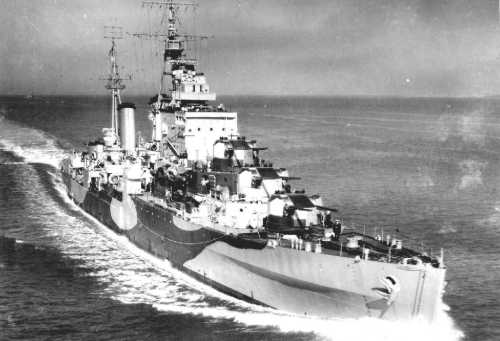
HMS Argonaut after repairs in the U.S.A. November 1943
| Navy | The Royal Navy |
| Type | Light cruiser |
| Class | Dido |
| Pennant | 61 |
| Built by | Cammell Laird Shipyard (Birkenhead, U.K.) |
| Ordered | 4 Sep 1939 |
| Laid down | 21 Nov 1939 |
| Launched | 6 Sep 1941 |
| Commissioned | 8 Aug 1942 |
| End service | |
| History | Argonaut's first mission was to bring some reinforcements, several 3.7" guns and some Norwegian soldiers, to Spitzbergen island. She set sail on October 13th 1942. From there she continued to Murmansk as part of a convoy escort. Back home, Argonaut left Scapa Flow on October 30th as part of a fleet bound for North Africa as part of Force H, comprising battleships HMS Nelson, HMS Duke of York, HMS Renown, joined later by carriers HMS Illustrious and HMS Formidable. They were going to take part in Operation Torch, the invasion of the French North Africa. During that operation, Argonaut was dispatched as a decoy ship, sending false signals to confuse the Axis forces. In December 1942, Argonaut joined Force Q. Along with cruisers HMS Aurora and HMS Sirius and destroyers HMS Quentin and HMAS Quiberon. On December 1st the force found an Axis convoy, and engaged in an hour battle, in which the Italian destroyer Folgore and four troopships were sunk, and destroyer Da Recco and a torpedo-boat were damaged. On their way back, they suffered an air attack in which Quentin was sunk. On December 13th Argonaut joined cruiser Aurora and destroyers HMS Eskimo and HMS Quality, and they left Bone to intercept another Axis convoy, which they missed. Instead, on December 14th Argonaut was torpedoed by Italian submarine Mocenigo in position 37.30N, 08.13E. Two torpedoes struck the ship, and blew off both stern and bow. Amazingly, only three crewmen lost their lives in the explosions. Argonaut managed to get to Gibraltar. Provisional repairs proved to be precaroius, and on April 4th 1943 she set sail to Philadelphia, escorted by the destroyer HMS Hero. After a brief scale in the Azores, Hero had engine problems and had to leave Argonaut on her own on April 9th. On April 13th she was sighted by the American destroyer USS Butler, that escorted her to Bermuda, where some additional repairs were done. Escorted by the American minesweepers USS Tumult and USS Pioneer, she reached Philadelphia on April 27th. The repairs were completed on November 13th 1943. In December 1943, Argonaut joined the Home Fleet and was attached to the 10th Cruiser Division. She took part in the invasion of Normandy, where she fired 4359 shells. Again a lucky ship, she was hit by a German artillery shell that penetrated the quarterdeck and emerged by the starboard side without exploding and without a single casualty. In August 1944 Argonaut was transferred to the Mediterranean Fleet, where she took part in Operation Dragoon (the invasion of Southern France) In September 1944 she was moved to the Aegean Sea, and saw action when she spotted some boats carrying troops, which she sunk, taking many prisoners. She was also involved in some shore bombardments in the Greek coast. In early November she was ordered to Trincomalee, in the Indian Ocean. She was assigned in escort duties, and involved in the bombardment of Palembang oil fields in Sumatra. She was lucky once more: attacked several times by kamikaze aircrafts, she sustained only minor damages. In January 1945 Argonaut was ordered to Sydney, to join the Pacific Fleet. In February she took part in the shelling of Saskishima (the diversion operation from the main American operation in Okinawa). In August 1945 she sailed to Formosa, to help with the evacuation of British prisoners of war. The same mission brought her to Hong Kong later. She finally returned to Portsmouth on 6 July 1946, where she was sent to reserve, neved to be recommissioned again. Her last trip was to the Cashmore scrapyard at Newport, South Wales, UK for disposal where she arrived on 19 November 1955. |
Commands listed for HMS Argonaut (61)
Please note that we're still working on this section
and that we only list Commanding Officers for the duration of the Second World War.
| Commander | From | To | |
| 1 | Capt. Eric William Longley Longley-Cook, RN | 21 Apr 1942 | 6 Jan 1943 |
| 2 | Cdr. Frederick Stanley Walford, RN | 6 Jan 1943 | 28 Mar 1943 |
| 3 | A/Capt. Henry John Haynes, DSO, DSC, RN | 28 Mar 1943 | 27 Jul 1943 |
| 4 | Cdr. Frederick Stanley Walford, RN | 27 Jul 1943 | 27 Oct 1943 |
| 5 | Capt. Eric William Longley Longley-Cook, RN | 27 Oct 1943 | 10 Jan 1945 |
| 6 | Capt. William Patrick McCarthy, RN | 10 Jan 1945 | mid 1946 |
You can help improve our commands section
Click here to Submit events/comments/updates for this vessel.
Please use this if you spot mistakes or want to improve this ships page.
Notable events involving Argonaut include:
21 Aug 1942
The light cruisers HMS Sheffield (Capt. A.W. Clarke, RN) and HMS Argonaut (Capt. E.W.L. Longley-Cook, RN) departed Scapa Flow for exercises. At sea they joined the AA cruiser HMS Scylla (Capt. I.A.P. Macintyre, CBE, RN) which had already been at sea since the 20th. The three cruisers then conducted exercises during the day and then returned to Scapa Flow. (1)
27 Aug 1942
In the afternoon, HMS Jamaica (Capt. J.L. Storey, RN) and HMS Argonaut (Capt. E.W.L. Longley-Cook, RN) conducted RIX (rangefinding and inclination) exercises off Scapa Flow on completion of which HMS Jamaica returned to Scapa Flow.
HMS Argonaut remained out during the night for NEX (night encounter) exercises for which she was joined by HMS Scylla (Capt. I.A.P. Macintyre, CBE, RN) which had been carrying out RDF exercises during the afternoon. HMS Argonaut and HMS Scylla returned to Scapa Flow in the morning of the 28th. (2)
28 Aug 1942
HMS H 34 (Lt. J.P.H. Oakley, DSC, RN) conducted A/S exercises at / off Scapa Flow with HMS Argonaut (Capt. E.W.L. Longley-Cook, RN), HNoMS Eskdale (Lt.Cdr. S.V. Storheill, RNorN) and possibly other vessels. (3)
9 Sep 1942
HMS H 34 (Lt. J.P.H. Oakley, DSC, RN) conducted A/S exercises at / off Scapa Flow with HMS Argonaut (Capt. E.W.L. Longley-Cook, RN) and A/S trawlers. (4)
11 Sep 1942
During 11/12 September 1942, HMS Argonaut (Capt. E.W.L. Longley-Cook, RN) and HMS Durban (Capt. P.G.L. Cazalet, DSC, RN), conducted exercises off Scapa Flow. These included night exercises. (5)
18 Sep 1942
During 18/19 September 1942, HMS Howe (Capt. C.H.L. Woodhouse, CB, RN), HMS Argonaut (Capt. E.W.L. Longley-Cook, RN) and HMS Durban (Capt. P.G.L. Cazalet, DSC, RN), conducted exercises off Scapa Flow. These included night exercises. During these exercises HMS Howe was escorted by HMS Porcupine (Cdr. G.S. Stewart, RAN), HMS Oribi (Cdr. J.E.H. McBeath, DSO, DSC, RN) and HMS Blean (Lt. N.J. Parker, RN). (6)
24 Sep 1942
During 24/25 September 1942, HMS Berwick (Capt. G.H. Faulkner, DSC, RN), HMS Sussex (Capt. W.Y.La R. Beverley, RN), HMS Bermuda (Capt. T.H. Back, RN) and HMS Argonaut (Capt. E.W.L. Longley-Cook, RN), conducted exercises off Scapa Flow. These included night exercises. (7)
7 Oct 1942
HMS Sheffield (Capt. A.W. Clarke, RN, flying the flag of Rear-Admiral C.H.J. Harcourt, CBE, RN) joined HMS Argonaut (Capt. E.W.L. Longley-Cook, RN), which was already out since the previous day, for exercises. (8)
30 Oct 1942
' Force H ' departed Scapa Flow around 1630A/30 to participate in the landings in North Africa (Operation Torch). This force was made up of the battleships HMS Duke of York (Capt. G.E. Creasy, DSO, RN, flying the flag of flying the flag of Vice-Admiral E.N. Syfret, CB, RN), HMS Nelson (Capt. H.B. Jacomb, RN), battlecruiser HMS Renown (Capt. C.S. Daniel, CBE, DSO, RN), light cruiser HMS Argonaut (Capt. E.W.L. Longley-Cook, RN). They were escorted by the destroyers HMS Milne (Capt. I.M.R. Campbell, RN), HMS Martin (Cdr. C.R.P. Thomson, DSO, RN), HMS Meteor (Lt.Cdr. D.J.B. Jewitt, RN), HMAS Quiberon (Cdr. H.W.S. Browning, OBE, RN), HMS Ashanti (Cdr. R.G. Onslow, DSO, RN), HMS Tartar (Cdr. St.J.R.J. Tyrwhitt, DSC, RN) and HMS Eskimo (Capt. J.W.M. Eaton, DSO, DSC, RN).
Around 1000A/31, they made rendezvous with the aircraft carriers HMS Victorious (Capt. H.C. Bovell, CBE, RN, flying the flag of Rear Admiral A.L.St.G. Lyster, CB, CVO, DSO, RN) and HMS Formidable (Capt. A.G. Talbot, DSO, RN) and their escort of the destroyers HMS Pathfinder (Cdr. E.A. Gibbs, DSO and Bar, RN), HMS Partridge (Lt.Cdr. W.A.F. Hawkins, DSC, OBE, RN), HMS Porcupine (Cdr. G.S. Stewart, RAN), HMS Quality (Lt.Cdr. G.L. Farnfield, DSO, RN) and HMS Quentin (Lt.Cdr. A.H.P. Noble, DSC, RN). These ships had departed the Clyde around 2300A/30.
At 1600Z/2 the destroyers HMS Panther (Lt.Cdr. R.W. Jocelyn, RN), HMS Penn (Lt.Cdr. J.H. Swain, RN), HMS Opportune (Cdr. J. Lee-Barber, DSO and Bar, RN), HMS Lookout (Lt.Cdr. A.G. Forman, DSC, RN), HMS Beagle (Cdr. R.C. Medley, DSO, RN), HMS Boadicea (Lt.Cdr. F.C. Brodrick, RN), HMS Brilliant (Lt.Cdr. A.G. Poe, RN), HMS Bulldog (Cdr. M. Richmond, OBE, DSO, RN) and the escort destroyers HMS Avon Vale (Lt.Cdr. P.A.R. Withers, DSO, RN) and HMS Puckeridge (Lt. J.C. Cartwright, DSC, RN) departed Gibraltar to make rendezvous with ' Force H '. They joined around 0730Z/4 after which HMS Argonaut, HMS Milne, HMS Martin, HMS Meteor, HMS Quality, HMS Quentin, HMAS Quiberon, HMS Pathfinder, HMS Partridge, HMS Ashanti, HMS Eskimo and HMS Tartar, parted company to proceed to Gibraltar to fuel. These ships arrived at Gibraltar around 1430Z/5. Of the original screen only HMS Porcupine remained with ' Force H ' at this moment.
Around 1730Z/4, the light cruiser HMS Bermuda (Capt. T.H. Back, RN) joined.
Around 0830Z/5, the destroyer HrMs Isaac Sweers (Capt. W. Harmsen, RNN) joined from convoy KMF 1.
Around 1400Z/5, the escort destroyers HMS Calpe (Lt.Cdr. H. Kirkwood, DSC, RN) and HMS Farndale (Cdr. D.P. Trentham, RN) joined. They had sailed from Gibraltar at 0700Z/5.
Around 1740Z/5, HMS Duke of York and HMS Renown parted company to fuel in the Bay of Gibraltar. They were escorted by the destroyers HMS Panther, HMS Penn, HMS Opportune, HMS Lookout, HMS Beagle and HMS Bulldog. The remaining ships remained to the west of the Straits of Gibraltar.
Around 2200Z/5, the remaining ships; HMS Nelson, HMS Victorious, HMS Formidable, HMS Bermuda, HMS Porcupine, HMS Boadicea, HMS Brilliant, HrMs Isaac Sweers, HMS Avon Vale, HMS Calpe, HMS Farndale and HMS Puckeridge set course to the west to the Straits of Gibraltar.
On passing the Straits, HMS Nelson and the destroyer and escort destroyers parted company around 0420Z/6 and proceeded to Gibraltar. They passed through the gate around one hour later.
6 Nov 1942
On 6 November 1942, ' Force H ' was (re)assambled at sea to the east of Gibraltar to provide cover during the landings in North-Africa.
Around 0430Z/6, the aircraft carriers HMS Victorious (Capt. H.C. Bovell, CBE, RN, flying the flag of Rear Admiral A.L.St.G. Lyster, CB, CVO, DSO, RN), HMS Formidable (Capt. A.G. Talbot, DSO, RN), light cruiser HMS Bermuda (Capt. T.H. Back, RN), destroyers HMS Boadicea (Lt.Cdr. F.C. Brodrick, RN), HMS Brilliant (Lt.Cdr. A.G. Poe, RN) and the escort destroyers HMS Avon Vale (Lt.Cdr. P.A.R. Withers, DSO, RN), HMS Calpe (Lt.Cdr. H. Kirkwood, DSC, RN), HMS Farndale (Cdr. D.P. Trentham, RN) and HMS Puckeridge (Lt. J.C. Cartwright, DSC, RN) entered the Mediterranean.
They were then joined by ships coming from Gibraltar (Bay), these were the battleships HMS Duke of York (Capt. G.E. Creasy, DSO, RN, flying the flag of flying the flag of Vice-Admiral E.N. Syfret, CB, RN), HMS Rodney (Capt. J.W. Rivett-Carnac, DSC, RN), battlecruiser HMS Renown (Capt. C.S. Daniel, CBE, DSO, RN), light cruiser HMS Argonaut (Capt. E.W.L. Longley-Cook, RN), destroyers HMS Milne (Capt. I.M.R. Campbell, RN), HMS Martin (Cdr. C.R.P. Thomson, DSO, RN), HMS Meteor (Lt.Cdr. D.J.B. Jewitt, RN), HMS Quality (Lt.Cdr. G.L. Farnfield, DSO, RN), HMS Quentin (Lt.Cdr. A.H.P. Noble, DSC, RN), HMAS Quiberon (Cdr. H.W.S. Browning, OBE, RN), HMS Panther (Lt.Cdr. R.W. Jocelyn, RN), HMS Pathfinder (Cdr. E.A. Gibbs, DSO and Bar, RN), HMS Partridge (Lt.Cdr. W.A.F. Hawkins, DSC, OBE, RN), HMS Penn (Lt.Cdr. J.H. Swain, RN), HMS Opportune (Cdr. J. Lee-Barber, DSO and Bar, RN), HMS Lookout (Lt.Cdr. A.G. Forman, DSC, RN), HMS Ashanti (Cdr. R.G. Onslow, DSO, RN), HMS Eskimo (Capt. J.W.M. Eaton, DSO, DSC, RN), HMS Tartar (Cdr. St.J.R.J. Tyrwhitt, DSC, RN), HMS Beagle (Cdr. R.C. Medley, DSO, RN), HMS Boreas (Lt.Cdr. E.L. Jones, DSC, RN) and HMS Bulldog (Cdr. M. Richmond, OBE, DSO, RN).
HMS Boadicea, HMS Brilliant, HMS Avon Vale, HMS Calpe, HMS Farndale and HMS Puckeridge were then detached to Gibraltar where they arrived around 0615Z/6.
Around 0900Z/6, the light cruiser HMS Sirius (Capt. P.W.B. Brooking, RN) joined.
The orders for ' Force H ' were to support the Eastern (Algiers) and Centre Task Forces (Oran) and their follow-up convoys (TE and TF) agains seaborne attack by Vichy-French or Italian Mediterranean Fleets. ' Force H ' was not to proceed eastwards of 04°30'E except to engage the enemy. Unless strong enemy forces were reported to be at sea, HMS Rodney, escorted by HMS Beagle, HMS Boreas, HMS Bulldog were to join the Centre Task Force at 0600Z/8. HMS Bermuda might also be detached but to join the Eastern Task Force. ' Force H ' was to refuel from ' Force R ' at sea if necessary, but if the military situation permitted, it would withdraw to the westward to refuel, possibly at Oran about 13 November, in immediate readiness for further operations. Force R ' was made up of the RFA tankers Dingledale (8145 GRT, built 1941, master R.T. Duthie) and Brown Ranger (3417 GRT, built 1941, master D.B.C. Ralph). Escort was provided by the corvette HMS Coreopsis (Lt.Cdr. A.H. Davies, RNVR) and four A/S trawlers, HMS Arctic Ranger (Skr. J.F. Banks, RNR), HMS Imperialist (T/Lt. A.R.F. Pelling, RNR), HMS Loch Oskaig (T/Lt. G.T.S. Clampitt, RNR) and HMS St. Nectan (Lt. J.B. Osborne, RANVR).
Around 1730Z/7, ' Force H ' was attacked by enemy aircraft in position 37°46'N, 02°52'E. HMS Panther was near missed and sustained damage. She had to return to Gibraltar, first steaming only 6 knots but later this could be increased to 14 knots. En-route she sighted an enemy submarine in position 37°46'N, 02°12'E and forced it to dive. This was U-458 which fired two torpedoes but apparently these were not sighted by the British. HMS Panther arrived at Gibraltar in the afternoon of November 8th.
At 1810Z/7, HMS Rodney, HMS Beagle, HMS Boreas and HMS Bulldog parted company with ' Force H ' to join the Centre Task Force. HMS Bermuda appeared to also have parted company around this time.
' Force H ' and the fuelling force, ' Force R ', cruised in the area of Algiers until 1830Z/8 when ' Force H ' turned north. It turned back at midnight when in position 39°00'N, 02°29'E and patrolled off Algiers again during the 9th. During the night of 9/10 November it steamed eastwards at 60 miles from the North-African coast, turning back 30 miles to the east of Bougie at midnight.
Shortly before 0300Z/10 (0252Z/10 according to German sources and 0258Z/10 according to British sources) the destroyer HMS Martin was torpedoed and sunk in position 37°53'N, 03°57'E by the German submarine U-431. 161 officers and ratings lost their lives. 4 Officers and 59 ratings were picked up by HMS Quentin.
By noon on 10 November ' Force H ' was in position 37°08'N, 01°36'E, between Algiers and Tenez, with ' Force R ' close at hand. From then onwards ' Force H ' patrolled 60 miles from the coast between Algiers and Cape Tenez.
' Force H ' was joined around 0630Z/12 by HMS Rodney and her destroyer screen now made of of the escort destroyers HMS Calpe, HMS Farndale and HMS Puckeridge.
Late in the evening of the 11th the destroyers HMS Porcupine (Cdr. G.S. Stewart, RAN) and HrMs Isaac Sweers (Capt. W. Harmsen, RNN) departed Gibaltar to join ' Force H '. Before joining they fuelled from ' Force R ' in the evening of the 12th. They had been ordered to remain with ' Force R ' during the night to reinforce its escort and then join ' Force H ' after dawn on the 13th. However before the joined, HrMs Isaac Sweers was torpedoed and sunk by U-431, so only HMS Porcupine joined ' Force H ' early on the 13th.
At 0615Z/14 ' Force H ' split up to return to Gibraltar; HMS Duke of York, HMS Formidable, HMS Bermuda, HMS Argonaut, HMS Sirius, HMS Eskimo, HMS Ashanti, HMS Tartar, HMS Opportune, HMS Partridge, HMS Pathfinder, HMS Penn and HMS Porcupine arrived at Gibraltar around 0130Z/15.
HMS Rodney, HMS Renown, HMS Victorious, HMS Milne, HMS Meteor, HMS Quality, HMS Quentin, HMAS Quiberon, HMS Lookout, HMS Calpe, HMS Farndale and HMS Puckeridge formed the other group. They were joined at 0630Z/15 by HMS Scylla (Capt. I.A.P. Macintyre, CBE, RN) and HMS Charybdis (Capt. G.A.W. Voelcker, RN). They returned to Gibraltar around 1800Z/15 but HMS Rodney was not able to berth and had to steam up and down in Gibraltar Bay until late in the evening when she anchorded there. The destroyers HMS Pathfinder, HMS Penn, HMS Opportune and HMS Tartar were sent out to patrol to the seaward of the Bay.
16 Nov 1942
Around 1030Z/16, ' Force H ' departed Gibraltar for a patrol off the Balearic Islands to provide cover for the ongoing operations off the North-African Coast. ' Force H ' was now made up of the battleships Nelson HMS Nelson (Capt. H.B. Jacomb, RN, flying the flag of flying the flag of Vice-Admiral E.N. Syfret, CB, RN), HMS Rodney (Capt. J.W. Rivett-Carnac, DSC, RN), aircraft carriers HMS Formidable (Capt. A.G. Talbot, DSO, RN), HMS Furious (Capt. T.O. Bulteel, RN), light cruisers HMS Argonaut (Capt. E.W.L. Longley-Cook, RN), HMS Sirius (Capt. P.W.B. Brooking, RN) and the destroyers HMS Eskimo (Capt. J.W.M. Eaton, DSO, DSC, RN), HMS Ashanti (Cdr. R.G. Onslow, DSO, RN), HMS Tartar (Cdr. St.J.R.J. Tyrwhitt, DSC, RN), HMS Penn (Lt.Cdr. J.H. Swain, RN), HMS Pathfinder (Cdr. E.A. Gibbs, DSO and Bar, RN), HMS Partridge (Lt.Cdr. W.A.F. Hawkins, DSC, OBE, RN), HMS Porcupine (Cdr. G.S. Stewart, RAN), HMS Opportune (Cdr. J. Lee-Barber, DSO and Bar, RN), HMS Bulldog (Cdr. M. Richmond, OBE, DSO, RN) and HMS Vanoc ( A/Cdr. C.F.H. Churchill, RN).
At 1730Z/16, the destroyers HMS Meteor (Lt.Cdr. D.J.B. Jewitt, RN), HMS Lookout (Lt.Cdr. A.G. Forman, DSC, RN) and escort destroyers HMS Calpe (Lt.Cdr. H. Kirkwood, DSC, RN) and HMS Puckeridge (Lt. J.C. Cartwright, DSC, RN) departed Gibraltar to join ' Force H ' which they did at 1113Z/17.
HMS Bulldog and HMS Opportune then parted company to return to Gibratar.
At 1215Z/17, HMS Ashanti parted company to proceed to Mers-el-Kebir to arrange the berthing of ' Force H ' for the following day. HMS Ashanti rejoined at 0655Z/18.
' Force H ' arrived at Mers-el-Kebir around 1100Z/18. (9)
24 Nov 1942
Around 0700A/24, the light cruisers HMS Bermuda (Capt. T.H. Back, RN, flying the flag of Rear-Admiral C.H.J. Harcourt, CBE, RN), HMS Argonaut (Capt. E.W.L. Longley-Cook, RN), HMS Sirius (Capt. P.W.B. Brooking, RN) and the destroyers HMS Quentin (Lt.Cdr. A.H.P. Noble, DSC, RN) and HMS Ithuriel (Lt.Cdr. D.H. Maitland-Makgill-Crichton, DSO, DSC, RN) departed Mers-el-Kebir for Algiers. At sea they were joined by HMAS Quiberon (Cdr. H.W.S. Browning, OBE, RN) which had been on A/S patrol.
They arrived at Algiers around 1630A/24. The destroyers did not enter harbour though but remained out in the bay on A/S patrol. They also provided smoke cover for transports anchored in the bay. (10)
25 Nov 1942
Around 2215A/25, ' Force Q ', made up of the light cruisers HMS Bermuda (Capt. T.H. Back, RN, flying the flag of Rear-Admiral C.H.J. Harcourt, CBE, RN), HMS Argonaut (Capt. E.W.L. Longley-Cook, RN), HMS Sirius (Capt. P.W.B. Brooking, RN) departed Algiers for Bone. In the bay they were to be joined by the destroyers HMS Quentin (Lt.Cdr. A.H.P. Noble, DSC, RN), HMAS Quiberon (Cdr. H.W.S. Browning, OBE, RN) and HMS Ithuriel (Lt.Cdr. D.H. Maitland-Makgill-Crichton, DSO, DSC, RN).
However, HMS Quentin and HMS Ithuriel failed to make contact.
The cruisers and HMAS Quiberon proceeded towards Bone. Around 0300A/26, they were ordered to return to Algiers where they arrived around 0830A/26. (11)
26 Nov 1942
Around 1900A/26, ' Force Q ', made up of the light cruisers HMS Bermuda (Capt. T.H. Back, RN, flying the flag of Rear-Admiral C.H.J. Harcourt, CBE, RN), HMS Argonaut (Capt. E.W.L. Longley-Cook, RN), HMS Sirius (Capt. P.W.B. Brooking, RN) and the destroyers HMS Quentin (Lt.Cdr. A.H.P. Noble, DSC, RN), HMAS Quiberon (Cdr. H.W.S. Browning, OBE, RN) and HMS Ithuriel (Lt.Cdr. D.H. Maitland-Makgill-Crichton, DSO, DSC, RN) departed Algiers for Bone where they arrived around 0830A/27. (11)
28 Nov 1942
Around 1730A/28, ' Force Q ' made up of the light cruisers light cruisers HMS Bermuda (Capt. T.H. Back, RN, flying the flag of Rear-Admiral C.H.J. Harcourt, CBE, RN), HMS Argonaut (Capt. E.W.L. Longley-Cook, RN), HMS Sirius (Capt. P.W.B. Brooking, RN) and the destroyers HMS Quentin (Lt.Cdr. A.H.P. Noble, DSC, RN) and HMAS Quiberon (Cdr. H.W.S. Browning, OBE, RN) departed Bone to intercept a reported enemy convoy. These orders were however cancelled in the evening and they set course for Algiers where they arrived around 0730A/29. (11)
30 Nov 1942
Around 1800A/30, ' Force Q ', made up of the light cruisers HMS Aurora (Capt. W.G. Agnew, CB, RN, flying the flag of Rear-Admiral C.H.J. Harcourt, CBE, RN), HMS Argonaut (Capt. E.W.L. Longley-Cook, RN), HMS Sirius (Capt. P.W.B. Brooking, RN) and the destroyers HMS Quentin (Lt.Cdr. A.H.P. Noble, DSC, RN) and HMAS Quiberon (Cdr. H.W.S. Browning, OBE, RN) departed Algiers for Bone where they arrived around 0800A/1. (12)
2 Dec 1942
Around 1700A/2, ' Force Q ', made up of the light cruisers HMS Aurora (Capt. W.G. Agnew, CB, RN, flying the flag of Rear-Admiral C.H.J. Harcourt, CBE, RN), HMS Argonaut (Capt. E.W.L. Longley-Cook, RN), HMS Sirius (Capt. P.W.B. Brooking, RN) and the destroyer HMAS Quiberon (Cdr. H.W.S. Browning, OBE, RN) departed Bone for Algiers where they arrived around 0730A/3. (13)
28 Apr 1944
HMS Duke of York (Capt. G.H.E. Russell, CBE, DSO, RN, flying the flag of Adm. B.A. Fraser, GCB, KBE, RN) conducted gunnery exercises at Scapa Flow.
She then left Scapa Flow for exercises with HMS Argonaut (Capt. E.W.L. Longley-Cook, CBE, RN).
[No details available on a possible destroyer escort of HMS Duke of York. (14)
19 May 1944
HMS Jamaica (Capt. J. Hugh-Hallett, DSO, RN) and HMS Argonaut (Capt. E.W.L. Longley-Cook, CBE, RN) conducted exercises off Scapa Flow. HMS Jamaica returned to Scapa Flow late in the evening. HMS Argonaut remained out for night exercises and she returned to Scapa Flow late the following morning. (15)
26 May 1944
During 26/27 May, HMS Belfast (Capt. F.R. Parham, DSO, RN, flying the flag of flying the flag of Rear-Admiral F.H.G. Dalrymple-Hamilton, CB, RN), HMS Diadem (Capt. E.G.A. Clifford, RN), HMS Argonaut (Capt. E.W.L. Longley-Cook, CBE, RN), HMS Ajax (Capt. J.J. Weld, MVO, RN), HMS Orion (Capt. J.P. Gornall, RN) and HMS Emerald (Capt. F.J. Wylie, RN) conducted exercises off Scapa Flow. These included night exercises. (16)
30 May 1944
The light cruisers HMS Belfast (Capt. F.R. Parham, DSO, RN, flying the flag of flying the flag of Rear-Admiral F.H.G. Dalrymple-Hamilton, CB, RN), HMS Diadem (Capt. E.G.A. Clifford, RN), HMS Argonaut (Capt. E.W.L. Longley-Cook, CBE, RN), HMS Ajax (Capt. J.J. Weld, MVO, RN), HMS Orion (Capt. J.P. Gornall, RN), HMS Emerald (Capt. F.J. Wylie, RN) and the destroyers HMS Grenville (Capt. H.P. Henderson, RN), HMS Ulster (Lt.Cdr. W.S. Donald, DSC and Bar, RN), HMS Undine (Cdr. T.C. Robinson, RN) and HMS Urchin (Lt.Cdr. J.T.B. Birch, DSO, DSC, RN) departed Scapa Flow for the Clyde where they arrived the following day. (17)
3 Jun 1944
Around 1100B/3, 'Bombarding Group E' made up of the light cruisers HMS Belfast (Capt. F.R. Parham, DSO, RN, flying the flag of flying the flag of Rear-Admiral F.H.G. Dalrymple-Hamilton, CB, RN), HMS Diadem (Capt. E.G.A. Clifford, RN) and 'Bombarding Group K' made up of the light cruisers HMS Emerald (Capt. F.J. Wylie, RN), HMS Argonaut (Capt. E.W.L. Longley-Cook, CBE, RN), HMS Ajax (Capt. J.J. Weld, MVO, RN) and HMS Orion (Capt. J.P. Gornall, RN) departed Greenock as part of the invasion force for Operation Neptune, the Normandy landings. They were escorted by the destroyers HMS Grenville (Capt. H.P. Henderson, RN), HMS Ulster (Lt.Cdr. W.S. Donald, DSC and Bar, RN), HMS Undine (Cdr. T.C. Robinson, RN) and HMS Urchin (Lt.Cdr. J.T.B. Birch, DSO, DSC, RN).
They were given the designation of convoy ' G 14 '.
Around 2200B/5, the gunboat HMS Flores (Lt.Cdr. G. Koudijs, RNN) joined 'Bombarding Group E' in position 50°27'N, 01°25'W (south of the Isle of Wight).
Convoy ' G 14 ' was to arrive in their selected position for the landings at 0435B/6.
The two bombarding groups parted company around 0120B/6 to proceed to their respective destinations.
[Further research on these ships exact movements and bombardments during Operation Neptune is required.] (18)
21 Nov 1944
During 21/22 November 1944, the battleship HMS King George V (Capt. T.E. Halsey, DSO, RN), light cruisers HMS Aurora (Capt. G.B. Bernard, CBE, DSO, RN, flying the flag of A/Vice-Admiral W.G. Tennant, CB, MVO, RN), HMS Argonaut (Capt. E.W.L. Longley-Cook, CBE, RN) and HMS Black Prince (Capt. D.M. Lees, DSO, RN) conducted exercises off Alexandria. These included night exercises.
[Destroyers also participated in the exercises but their identity is not known to us.] (19)
7 Dec 1944
HMS Swiftsure (Capt. R.D. Oliver, CBE, DSC, RN, flying the flag of Rear-Admiral E.J.P. Brind, CBE, CB, RN) conducted a bombardment exercise off Trincomalee.
On completion of this exercises more exercises were carried out together with HMS Argonaut (Capt. E.W.L. Longley-Cook, CBE, RN) and HMS Black Prince (Capt. D.M. Lees, DSO, RN). These included night exercises. (20)
17 Dec 1944
Operation Robson.
Air strike against the Pangkalan Brandan oil refinery (North-East Sumatra).
On 17 December 1944, Task Force 67, made up of the aircraft carriers HMS Indomitable (Capt. J.A.S. Eccles, RN, flying the flag of Rear Admiral P.L. Vian, KCB, KBE, DSO and 2 Bars, RN), HMS Illustrious (Capt. C.E. Lambe, CB, CVO, RN), light cruisers HMS Newcastle (Capt. J.G. Roper, OBE, RN), HMS Argonaut (Capt. E.W.L. Longley-Cook, CBE, RN), HMS Black Prince (Capt. D.M. Lees, DSO, RN), destroyers HMS Kempenfelt (Capt. E.G. McGregor, DSO, RN), HMS Wager (Lt.Cdr. R.C. Watkin, RN), HMS Wakeful (Lt.Cdr. G.D. Pound, DSC, RN), HMS Wessex (Lt.Cdr. R. Horncastle, RN), HMS Whelp (Cdr. G.A.F. Norfolk, RN), Whirlwind (Cdr. W.A.F. Hawkins, DSO, DSC, OBE, RN) and Wrangler (Lt.Cdr. D.W. Austin, RN) departed Trincomalee for a carrier raid on the Pangkalan Brandan oil refinery.
On 18 December, HMS Argonaut, HMS Black Prince and the destroyers topped off with fuel from the RFA tanker Wave King (8159 GRT, built 1944).
At dawn on 20 December, north of Diamond Point, a total of 28 Avengers, 16 Hellcats and 16 Corsairs were flown off to attack the Pangkalan Brandan oil refinery. On arrival they found the refinery completely obscured by clouds and they therefore attacked harbour warehouses, railway yards and oil installations at Belawan. The fighters also attacked some airfields.
The enemy was taken by surprise, no fighters were encountered and flak was light. The results were difficult to observe due to the low cloud. No aircraft were lost in the attacks.
The weather had been unfavourable and as no improvment was expected the force withdrew and no second strike was carried out.
On 21 December rendezvous was made with the tanker Wave King but apparently no ship needed to fuel. HMS Wager and HMS Whirlwind were detached to escort the tanker back to Trincomalee.
Task Force 67 arrived at Trincomalee on 22 December 1944. (21)
1 Jan 1945
Operation Lentil.
Air strikes against oil refineries at Pangkalan-Brandan (North-East Sumatra).
On 1 January 1945 a Force made up of the aircraft carriers HMS Indomitable (Capt. J.A.S. Eccles, RN, flying the flag of Rear Admiral P.L. Vian, KCB, KBE, DSO and 2 Bars, RN), HMS Victorious (Capt. M.M. Denny, CB, CBE, RN), HMS Indefatigable (Capt. Q.D. Graham, CBE, DSO, RN), heavy cruiser HMS Suffolk (Capt. D. Gilmour, RN), light cruisers HMS Argonaut (Capt. E.W.L. Longley-Cook, CBE, RN), HMS Black Prince (Capt. D.M. Lees, DSO, RN), HMS Ceylon (Capt. G.B. Amery-Parkes, RN) and the destroyers HMS Kempenfelt (Capt. E.G. McGregor, DSO, RN), HMS Wakeful (Lt.Cdr. G.D. Pound, DSC, RN), HMS Wager (Lt.Cdr. R.C. Watkin, RN), HMS Whelp (Cdr. G.A.F. Norfolk, RN), HMS Grenville (Capt. H.P. Henderson, RN), HMS Undaunted (Lt.Cdr. C.E.R. Sharp, RN), HMS Undine (Cdr. T.C. Robinson, RN), HMS Urania (Lt.Cdr. D.H.P. Gardiner, DSC, RN) and HMS Ursa (Cdr. D.B. Wyburd, DSC, RN) departed Trincomalee for an air strike on oil refineries at Pangkalan-Brandan (North-East Sumatra).
On the morning of 4 January 1945, carrier aircraft were flown off to attack the oil refineries at Pangkalan Brandan and successfully completed the operation. Photographic reconnaissance was also made of port installations at Belawan Deli, Brandan, and Soesoe.
In the afternoon of 6 January 1945, HMS Indefatigable, HMS Suffolk, HMS Kempenfelt, HMS Wakeful and HMS Uriana parted company with the remainder of the Force. These ships were to proceed to Colombo.
All ships from the force arrived at Trincomalee / Colombo on 7 January 1945. (22)
12 Jan 1945
During 12/13 January 1945, the battleship HMS King George V (Capt. T.E. Halsey, DSO, RN, flying the flag of Vice Admiral H.B. Rawlings, KCB, OBE, RN), aircraft carriers HMS Indomitable (Capt. J.A.S. Eccles, RN, flying the flag of Rear Admiral P.L. Vian, KCB, KBE, DSO and 2 Bars, RN), HMS Illustrious (Capt. C.E. Lambe, CB, CVO, RN), HMS Victorious (Capt. M.M. Denny, CB, CBE, RN), HMS Indefatigable (Capt. Q.D. Graham, CBE, DSO, RN), light cruisers HMS Argonaut (Capt. W.P. McCarthy, RN), HMS Black Prince (Capt. D.M. Lees, DSO, RN) and the destroyers HMS Grenville (Capt. H.P. Henderson, RN), HMS Undaunted (Lt.Cdr. C.E.R. Sharp, RN), HMS Undine (Cdr. T.C. Robinson, RN), HMS Ursa (Cdr. D.B. Wyburd, DSC, RN), HMS Wager (Lt.Cdr. R.C. Watkin, RN), HMS Wakeful (Lt.Cdr. G.D. Pound, DSC, RN), HMS Wessex (Lt.Cdr. R. Horncastle, RN), HMS Whelp (Cdr. G.A.F. Norfolk, RN) and Whirlwind (Cdr. W.A.F. Hawkins, DSO, DSC, OBE, RN) conducted exercises off Trincomalee. (23)
16 Jan 1945
Operation Meridian.
Air strikes against oil installations in the Palembang area (South-East Sumatra).
On 16 January 1945 ' Force 63 ' made up of the battleship HMS King George V (Capt. T.E. Halsey, DSO, RN, flying the flag of Vice Admiral H.B. Rawlings, KCB, OBE, RN), aircraft carriers HMS Indomitable (Capt. J.A.S. Eccles, RN, flying the flag of Rear Admiral P.L. Vian, KCB, KBE, DSO and 2 Bars, RN), HMS Illustrious (Capt. C.E. Lambe, CB, CVO, RN), HMS Victorious (Capt. M.M. Denny, CB, CBE, RN), HMS Indefatigable (Capt. Q.D. Graham, CBE, DSO, RN), light cruisers HMS Argonaut (Capt. W.P. McCarthy, RN), HMS Euryalus (Capt. R. Oliver-Bellesis, RN), HMS Black Prince (Capt. D.M. Lees, DSO, RN), HMS Ceylon (Capt. G.B. Amery-Parkes, RN) and the destroyers HMS Grenville (Capt. H.P. Henderson, RN), HMS Undaunted (Lt.Cdr. C.E.R. Sharp, RN), HMS Undine (Cdr. T.C. Robinson, RN), HMS Ursa (Cdr. D.B. Wyburd, DSC, RN), HMS Kempenfelt (Capt. E.G. McGregor, DSO, RN), HMS Wager (Lt.Cdr. R.C. Watkin, RN), HMS Wakeful (Lt.Cdr. G.D. Pound, DSC, RN), HMS Wessex (Lt.Cdr. R. Horncastle, RN), HMS Whelp (Cdr. G.A.F. Norfolk, RN) and Whirlwind (Cdr. W.A.F. Hawkins, DSO, DSC, OBE, RN).
HMS Wessex apparently sailed from Trincomalee on the 17th and joined the Force at sea on the 19th.
An oiling force (' Force 69 ') made up of the tankers Echodale (8150 GRT, built 1941), Wave King (8159 GRT, built 1944) and Empire Salvage (10746 GRT, built 1940) had already departed Trincomalee on 13 January. They were escorted by the destroyer HMS Urchin (Lt.Cdr. A.F. Harkness, DSC, OBE, RD, RNR). A fouth tanker, the Arndale (8296 GRT, built 1937) joined ' force 69 ' on 23 January coming from Fremantle.
The submarines HMS Tantalus (Lt.Cdr. H.S. Mackenzie, DSO and Bar, RN), HMS Tantivy (Lt. P.S. May, RN) and HMS Sturdy (Lt. W.St.G. Anderson, DSC, RNR) were positioned for air/sea rescue duties. (Tantalus east of Sumatra, Tantivy west of Sumatra and Sturdy in the Sunda Strait area.)
On 20 January ships from ' Force 63 ' were refuelled by ' Force 69 '. Due to the weather conditions this was done only with difficulty and some of the refuelling gear of the tankers was damaged. HMS Ceylon was now assigned to ' Force 69 ' to give protection to this Force. [Note: Arndale at this moment was not yet with ' Force 69 '.]
' Force 63 ' then proceeded on the first phase of the operation, to launch air strikes on the oil installations at Pladjoe (north of Palembang) which were to be flown off on 21 January but the weather prevented this. It was only at 24 January that the weather had cleared to enable flying operations. 43 Avengers, 12 Firefly's (equipped with rockets) and 50 Hellcat, Corsair and Seafire fighters were flown off. The enemy installations were damaged but at the cost of no less then 32 aircraft due to enemy action (7) or crash landings (25). 14 enemy fighters were reported shot down in the air and 38 aircraft were reported to have been destroyed on the gound.
' Force 63 ' then retired from the area to rendezvous with ' Force 69 ' and refuel. This was done on 26 / 27 January.
' Force 63 ' then proceeded to the launch position for the second phase of operation during which air attacks were to be made on oil installations at Soengi-Gerong (also near Palembang). 48 Avenger, 10 Fireflies, 24 Corsairs and 16 Hellcats were launched. During dogfight 30 Japanese aircraft were shot down and another 38 were reported as having been destroyed on the ground. 16 aircraft did not return to the carriers.
A Japanese counter attack with 12 bombers failed. All were shot down by fighters from the Combat Air Patrol or AA fire from the ships.
' Force 63 ' then fuelled again from ' Force 69 ' on 30 January.
' Force 63 ' arrived at Fremantle on 4 February 1945.
' Force 69 ', minus Arndale and Wave King returned to Trincomalee on 6 February 1945. The other two tankers went to Australia. HMS Ceylon had parted company with ' Force 69 ' on 4 February and arrived at Trincomalee on 5 February.
4 Feb 1945
Around 1730H/4, the aircraft carriers HMS Indomitable (Capt. J.A.S. Eccles, RN, flying the flag of Rear Admiral P.L. Vian, KCB, KBE, DSO and 2 Bars, RN), HMS Illustrious (Capt. C.E. Lambe, CB, CVO, RN), HMS Indefatigable (Capt. Q.D. Graham, CBE, DSO, RN), light cruisers HMS Argonaut (Capt. W.P. McCarthy, RN), HMS Black Prince (Capt. D.M. Lees, DSO, RN), HMS Grenville (Capt. H.P. Henderson, RN), HMS Undaunted (Lt.Cdr. C.E.R. Sharp, RN), HMS Undine (Cdr. T.C. Robinson, RN), HMS Wager (Lt.Cdr. R.C. Watkin, RN) and HMS Wessex (Lt.Cdr. R. Horncastle, RN) departed Fremantle for Sydney. (24)
10 Feb 1945
Around 0900K/10, the aircraft carriers HMS Indomitable (Capt. J.A.S. Eccles, RN, flying the flag of Rear Admiral P.L. Vian, KCB, KBE, DSO and 2 Bars, RN), HMS Illustrious (Capt. C.E. Lambe, CB, CVO, RN), HMS Indefatigable (Capt. Q.D. Graham, CBE, DSO, RN), light cruisers HMS Argonaut (Capt. W.P. McCarthy, RN), HMS Black Prince (Capt. D.M. Lees, DSO, RN), HMS Grenville (Capt. H.P. Henderson, RN), HMS Undaunted (Lt.Cdr. C.E.R. Sharp, RN), HMS Undine (Cdr. T.C. Robinson, RN), HMS Wager (Lt.Cdr. R.C. Watkin, RN) and HMS Wessex (Lt.Cdr. R. Horncastle, RN) arrived at Sydney from Fremantle. (24)
27 Feb 1945
On 27 February 1945, the 1st Aircraft Carrier Squadron, made up of the aircraft carriers HMS Indomitable (Capt. J.A.S. Eccles, RN, flying the flag of Rear Admiral P.L. Vian, KCB, KBE, DSO and 2 Bars, RN), HMS Victorious (Capt. M.M. Denny, CB, CBE, RN) and HMS Indefatigable (Capt. Q.D. Graham, CBE, DSO, RN) departed Sydney for exercises and the flying on of their aircraft. They were escorted by the destroyers HMAS Quickmatch (Cdr. O.H. Becher, DSC and Bar, RAN, with Capt. R.G. Onslow, DSO and 2 Bars, RN, on board), HMAS Quiberon (Lt.Cdr. G.F.E. Knox, RAN), HMS Queenborough (Cdr. P.L. Saumarez, DSC and Bar, RN) and HMS Quality (Lt.Cdr. the Viscount Jocelyn, RN).
The remainder of Task Force 113, the battleships HMS King George V (Capt. T.E. Halsey, DSO, RN, flying the flag of Vice Admiral H.B. Rawlings, KCB, OBE, RN), HMS Howe (Capt. H.W.U. McCall, DSO, RN), maintenance carrier HMS Unicorn (A/Capt.(Retd.) C.M. Merewether, RN), light cruisers HMS Swiftsure (Capt. P.V. McLaughlin, RN, flying the flag of Rear-Admiral E.J.P. Brind, CBE, CB, RN), HMNZS Gambia (Capt. N.J.W. William-Powlett, DSC, RN), HMS Argonaut (Capt. W.P. McCarthy, RN), HMS Euryalus (Capt. R. Oliver-Bellesis, RN, flying the flag of Rear-Admiral J.H. Edelsten, CB, CBE, RN), HMS Black Prince (Capt. D.M. Lees, DSO, RN) and the destroyers HMS Grenville (Capt. H.P. Henderson, RN), HMS Ulster (Lt.Cdr. R.J. Hanson, DSO and Bar, DSC, RN), HMS Undine (Cdr. T.C. Robinson, RN), HMS Urania (Lt.Cdr. D.H.P. Gardiner, DSC, RN), HMS Ursa (Cdr. D.B. Wyburd, DSC, RN), HMS Kempenfelt (Capt. E.G. McGregor, DSO, RN), HMS Wakeful (Lt.Cdr. G.D. Pound, DSC, RN), HMS Wessex (Lt.Cdr. R. Horncastle, RN), HMS Whelp (Cdr. G.A.F. Norfolk, RN) and HMS Whirlwind (Cdr. W.A.F. Hawkins, DSO, DSC, OBE, RN) departed Sydney on the 28th.
Both forces made rendezvous P.M. on the 28th and course was set to proceed to Manus.
On 2 March, HMS Urania was detached to return to Sydney as ordered in a signal from the Commander-in-Chief British Pacific Fleet.
Also on 2 March the cruisers and destroyers were fuelled by a tanker force made up of the RFA tankers Wave King (8159 GRT, built 1944), Arndale (8296 GRT, built 1937), Cedardale (8132 GRT, built 1939) and San Adolpho (7365 GRT, built 1935) escorted by the corvette (minesweeper) HMAS Whyalla (A/Cdr. N.R. Read, RAN).
Task Force 113 arrived at Manus in the afternoon of March 7th. En-route from Sydney various exercises had been carried out. (22)
12 Mar 1945
HMS Argonaut (Capt. W.P. McCarthy, RN), HMS Black Prince (Capt. D.M. Lees, DSO, RN), HMAS Quickmatch (Cdr. O.H. Becher, DSC and Bar, RAN, with Capt. R.G. Onslow, DSO and 2 Bars, RN, on board), HMAS Quiberon (Lt.Cdr. G.F.E. Knox, RAN), HMS Queenborough (Cdr. P.L. Saumarez, DSC and Bar, RN) and HMS Quality (Lt.Cdr. the Viscount Jocelyn, RN) conducted exercises off Manus. (25)
18 Mar 1945
Task Force 113 departed Manus for Ulithi in two groups.
The 1st group was made up of the battleships HMS King George V (Capt. T.E. Halsey, DSO, RN, flying the flag of Vice Admiral H.B. Rawlings, KCB, OBE, RN), HMS Howe (Capt. H.W.U. McCall, DSO, RN), light cruisers HMS Swiftsure (Capt. P.V. McLaughlin, RN, flying the flag of Rear-Admiral E.J.P. Brind, CBE, CB, RN), HMNZS Gambia (Capt. N.J.W. William-Powlett, DSC, RN), HMS Argonaut (Capt. W.P. McCarthy, RN), HMS Euryalus (Capt. R. Oliver-Bellesis, RN) and the destroyers HMS Grenville (Capt. H.P. Henderson, RN), HMS Ulster (Lt.Cdr. R.J. Hanson, DSO and Bar, DSC, RN), HMS Undaunted (Lt.Cdr. C.E.R. Sharp, RN), HMS Undine (Cdr. T.C. Robinson, RN), HMS Urania (Lt.Cdr. D.H.P. Gardiner, DSC, RN).
The 2nd group was made up of the aircraft carriers HMS Indomitable (Capt. J.A.S. Eccles, RN, flying the flag of Rear Admiral P.L. Vian, KCB, KBE, DSO and 2 Bars, RN), HMS Illustrious (Capt. C.E. Lambe, CB, CVO, RN), HMS Victorious (Capt. M.M. Denny, CB, CBE, RN) and HMS Indefatigable (Capt. Q.D. Graham, CBE, DSO, RN). They were escorted by the destroyers HMAS Quickmatch (Cdr. O.H. Becher, DSC and Bar, RAN, with Capt. R.G. Onslow, DSO and 2 Bars, RN, on board), HMAS Quiberon (Lt.Cdr. G.F.E. Knox, RAN), HMS Queenborough (Cdr. P.L. Saumarez, DSC and Bar, RN), HMS Quality (Lt.Cdr. the Viscount Jocelyn, RN), HMS Wager (Lt.Cdr. R.C. Watkin, RN) and HMS Whelp (Cdr. G.A.F. Norfolk, RN).
The 1st group arrived at Ulithi in the morning of March 20th. The 2nd group arrived in the afternoon.
As usual while en-route exercises had been carried out. (22)
23 Mar 1945
The British Pacific Fleet during Operation Iceberg, the landings on Okinawa (1st phase).
The British Pacific Fleet, now known as Task Force 57, departed Ulithi for the operations area near Okinawa.
The task for Task Force 57 is to neutralize airfields in the Sakishima Gunto to the south-west of Okinawa.
Task Force 57 was made up of the battleships HMS King George V (Capt. T.E. Halsey, DSO, RN, flying the flag of Vice-Admiral H.B. Rawlings, KCB, OBE, RN), HMS Howe (Capt. H.W.U. McCall, DSO, RN), aircraft carriers HMS Indomitable (Capt. J.A.S. Eccles, RN, flying the flag of Rear- Admiral P.L. Vian, KCB, KBE, DSO and 2 Bars, RN), HMS Illustrious (Capt. C.E. Lambe, CB, CVO, RN), HMS Victorious (Capt. M.M. Denny, CB, CBE, RN) and HMS Indefatigable (Capt. Q.D. Graham, CBE, DSO, RN), light cruisers HMS Swiftsure (Capt. P.V. McLaughlin, RN, flying the flag of Rear-Admiral E.J.P. Brind, CBE, CB, RN), HMNZS Gambia (Capt. N.J.W. William-Powlett, DSC, RN), HMS Argonaut (Capt. W.P. McCarthy, RN), HMS Euryalus (Capt. R. Oliver-Bellasis, RN, flying the flag of Rear-Admiral J.H. Edelsten, CB, CBE, RN), HMS Black Prince (Capt. D.M. Lees, DSO, RN) and the destroyers HMS Grenville (Capt. H.P. Henderson, RN), HMS Ulster (Lt.Cdr. R.J. Hanson, DSO and Bar, DSC, RN), HMS Undaunted (Lt.Cdr. C.E.R. Sharp, RN), HMS Undine (Cdr. T.C. Robinson, RN), HMS Urania (Lt.Cdr. D.H.P. Gardiner, DSC, RN), HMAS Quickmatch (Cdr. O.H. Becher, DSC and Bar, RAN, with Capt. R.G. Onslow, DSO and 2 Bars, RN, on board), HMAS Quiberon (Lt.Cdr. G.F.E. Knox, RAN), HMS Queenborough (Cdr. P.L. Saumarez, DSC and Bar, RN), HMS Quality (Lt.Cdr. the Viscount Jocelyn, RN), HMS Wager (Lt.Cdr. R.C. Watkin, RN) and HMS Whelp (Cdr. G.A.F. Norfolk, RN).
On 25 March the fleet met with the replenishment groups Task Group 112.2.1 and Task Group 112.2.5 and the cruisers and destroyers fuelled throughout the morning and first part of the afternoon. Weather conditions were not suitable and not all ships were able to complete with fuel for 100%.
These two Task Groups had departed Manus on 17 March 1945 and their composition was as follows; Task Group 112.2.1, was made up of the escort carrier HMS Striker (Capt. W.P. Carne, RN) (with replacement aircraft) and the RFA tankers Cedardale (8132 GRT, built 1939), San Ambrosio (7410 GRT, built 1935) and San Adolpho (7365 GRT, built 1935). They were escorted by the destroyer Whirlwind (Cdr. W.A.F. Hawkins, DSO, DSC, OBE, RN), sloop HMS Crane (Lt.Cdr. R.G. Jenkins, DSC, RN) and frigate HMS Findhorn (Lt.Cdr. J.C. Dawson, RNR).
Task Group 112.2.5 was made up of the escort carrier HMS Speaker (A/Capt. U.H.R. James, RN) (for Combat Air Patrol duties), destroyer HMS Kempenfelt (Capt. E.G. McGregor, DSO, RN) and sloop HMS Pheasant (Lt.Cdr. J.B. Palmer, RN).
HMS Wager, which had bearing trouble joined Task Group 112.2.1 being substituted with HMS Whirlwind (Cdr. W.A.F. Hawkins, DSO, DSC, OBE, RN).
HMS Quality, which also had defects, was substituted with HMS Kempenfelt (Capt. E.G. McGregor, DSO, RN) from Task Group 112.2.5.
26 March 1945.
Task Force 57 arrived in her operations area.
At 0605I/26, the Combat Air Patrol and A/S patrol were flown off, whilst HMS Argonaut and HMS Kempenfelt were detached to carry out picket duties warning the Fleet in advance of the possible approach of enemy aircraft.
At sunrise, at 0635I/26 strong fighter sweeps were flown off from a position 100 miles 180° from Miyako Jima to attack the enemy airfields at Ishigaki and Miyako. They reported little activity there. At 0850I/26, one aircraft was reported to have ditched 20 miles from Tarima Shima. A Walrus aircraft was flown off and subsequently rescued the pilot.
These fighter sweeps were followed by two escorted bombers strikes and one fighter bomber strike with airfields and associated buildings as targets. Withdrawal was begun at dusk.
At 0940I/26, a Mitsubishi Ki-46 ' Dinah ' was intercepted by the Combat Air Patrol but it managed to escape. It was apparent that the Fleet had been reported but no attacks developed.
After the last aircraft had flown on Task Group 57 disengaged to the south-eastward. The night was fine and the moon bright and an enemy air attack was considered likely.
27 March 1945.
At 0245I/27, a bogey to the eastward was contacted by radar. As it seemed that Task Force 57 was being shadowed course was altered in an attempt to shake off the aircraft.
At 0307I/27, HMS Euryalus was ordered to open out from the screen and fire at the enemy aircraft which then remained at a respectful distance for a time. A Hellcat was then flown off to intercept but the moon became obscured by a cloud and the enemy made good his escape. At 0305I/27 Japanese transmissions had been reported and Task Force 57 commenced jamming.
At sunrise a fighter sweep was sent to Ishigaki only from a flying off position 100 miles 180° from Miyako Jima. No increased acitivity was reported. Two bomber strikes were directed against radio stations, barracks and airfields not covered the previous day. Coasters off the islands were also attacked. The final strike was a small fighter bomber strike. Withdrawal was begun at dusk.
At 1130I/27, HMS Undine escorted by fighters was despatched to the rescue of an aircraft which had ditched 56 miles from the flying off position. At 1750I/27, she rejoined the Fleet having picked up the Avenger crew and also a United States Corsair pilot who was discovered after having been adrift for 48 hours.
The American (rescue) submarine USS Kingfish (T/Lt.Cdr. T.E. Harper, USN) was requisted to keep a good lookout for any of our ditched aircrews, but apparently she had not been fully instructed by the American authorities as she replied that 'she would have to ask her boss first'. The first situation was soon clarified and USS Kingfish was ordered to act as rescue submarine when required. At 1805I/27, USS Kingfish reported that she had rescued the pilot of one of HMS Illustrious's Avengers.
It had been intended that Task Force 57 should continue operating off Sakishimi Gunto, the day's programme to include a bombardment of Ishigaki, but Guam reported a typhoon to the southward whose position and estimated track appeared to threaten the fuelling area. The risk of bad weather completely dislocating fuelling for some time would have precluded Task Force 57 from returning to the operating area during the time of the initial landings on Okinawa. This was not acceptable. The necessity to withdraw to the fuelling area was accentuated by certain ships having been short of fuel at the commencement of the operation.
28 March 1945.
At 0730I/28 made contact with Task Unit 112.2.5 and Task Unit 112.2.1 in area Midge, a rectangle extending 50 miles to the south and 100 miles to the west of 19°55'N, 129°40'E. Fuelling and transfer of replacement aircraft continued throughout the day. The Fleet disengaged from the tanker group for the night.
At 1835I/28, HMS Striker parted company with the Fleet Train to proceed to Leyte escorted by HMS Crane.
29 March 1945.
The fuelling of the Fleet proceeded with constant interruptions and delays caused by hoses parting etc. Aircraft carriers experienced great difficulty in obtaining supplies of Avgas for this reason.
Rear-Admiral J.H. Edelsten transferred his flag from HMS Euryalus to HMS Whirlwind and proceeded in the afternoon with HMS Striker and HMS Crane for Leyte. HMS Quality and HMS Whelp rejoined Task Force 57, HMS Kempenfelt and HMS Whirlwind rejoining Task Unit 112.2.5 and 112.2.1 repectively.
30 March 1945.
At 1430I/30 after many more delays due to leaking hoses fuelling was completed and Task Force 57 departed at 22 knots for the operating area.
31 March 1945.
As usual the Combat Air Patrol and A/S Patrol were flown off around dawn. At 0530I/31, HMS Argonaut and HMS Wager were detached to a position 300°, 30 miles from the Fleet centre to act as pickets to prevent enemy aircraft returning with our own strikes. HMS Argonaut was chosen for this purpose as having the most suitable radar outfit.
At 0630I/31, a fighter sweep was sent in from a flying-off position 23°10'N, 125°23'E and thereafter fighter patrols were maintained over Ishigaki and Miyako. There appeared to be little activity in either island. Two bomber strikes were sent against Ishigaki airfield, installations and barracks. USS Kingfish again did useful service and rescued the crew of an Avenger which had ditched. At dusk the Fleet disengaged to the south-westward. Two fighters were kept at readiness from moonrise but the Fleet was not shadowed.
1 April 1945.
Around dawn HMS Argonaut and HMS Wager were again detached to proceed to their picket positions and at 0640I/1 a fighter sweep was sent in from a flying off position 23°26'N, 125°25'E.
At 0650I/1, bogeys were detected by radar 75 miles to the westward at a height of 8000 feet closing at 210 knots. The fighter sweep was recalled to intercept and additional fighters were flown off.
The raid split up more then 40 miles from the Fleet. The first interception was by Corsairs from HMS Victorious which shot down one enemy. Seafires shot down two more close to the Fleet and a fourth was destroyed by Hellcats recalled from the fighter sweep. At 0705I/1 the Fleet had been alerted to ' Flash Red ' and a few minutes later the enemy planes commenced their attacks.
One enemy single engined aircraft machine-gunned HMS Indomitable in a low attack killing one rating and wounding two officers and four ratings. Still flying very low it made a similar attack on HMS King George V but without causing casualties. Considerable difficulty was experienced in identifying enemy from our own planes who where hard on the enemy heels.
At 0727I/1, an enemy plane dived into the base of HMS Indefatigable's island. Four officers and ten ratings were killed and sixteen of her complement were wounded. The flight deck was put temporarily out of action, but within a remarkale short time, and in a most creditable manner, aircraft were again being operated from this ship athough that day on a reduced scale.
At about 0755I/1, HMS Ulster was near missed by what appeared to be a 500lb. bomb from an aircraft then being chased by one of our fighters. She reported that the bulkhead between the engine-room and the after boiler room had blown, flooding both compardments, but that the ship was floating well. Casualties were two killed and one seriously wounded. She was unable to steam but her armament remained effective. HMAS Quiberon was ordered to stand by her and as soon as the raid was over, HMNZS Gambia was ordered to tow her to Leyte.
At 1215I/1, a bombing strike was sent in against Ishigaki to bomb airfields and runways. No activity was noted. At 1430I/1, reports were received from combat patrols over the islands that more aircraft had been sighted at Hirara and Ishigaki airfields. These were attacked by the fighter patrols and were followed by a fighter sweep. It was estimated that about 14 enemy aircraft were detroyed on the ground during this attack and others damaged.
At 1730I/1, a low flying bogey was detected by radar at a range of 15 miles to the north-westward. Hellcats were sent to intercept this raid which developed into 2 plus but the enemy avoided them in cloid. Soon afterwards the Fleet sighted the enemy and opened fire, sometimes it is regretted, at fiendly fighters. One enemy aircraft dived on HMS Victorious, her swing under full helm was successful and the plane touched its wing only on the flight deck edge spinning harmlessly into the sea where its bomb exploded clear of the ship. The manuscript instructions to the pilot were blown on board HMS Victorious. This interesting document donoting priority of targets for suicide planes, has been translated and the contents forwarded to intelligence centre. It seems certain that Victorious's guns hit this aircraft during its dive.
At dusk the Fleet disengaged to the south-eastward.
2 April 1945.
It was evident from experience the day before that the Japanese had started staging ito the Sakishima airfields and it was therefore decided to cancel the planned bombardment in favour of air operations.
The absence of enemy activity noticed by the first fighter sweep the previous day made it appear likely that enemy might be leaving the airfields at first light. In consequence two aircraft from HMS Indomitable, having been flown off by moonlight, were sent to Ishigaki at 0510I/2. Two other aircraft flown off at the same time and destined for Miyako were unable to proceed owing to radio failures. No activity was reported from Ishigaki.
At 0630I/2, from a flying off position 23°12'N, 126°02'E a fighter Ramrod left to attack all airfields before the Fleet withdrew. Little activity was noticed, but one airborne Zeke (Mitsubishi A6M 'Zero') was shot down over Ishigaki by Hellcats.
After landing on the fighter Ramrod at 1045I/2, the Fleet withdrew to fuelling area Midge, maintaining a Combat Air Patrol (CAP) of 12 aircraft until 1600I/2, and a CAP of 8 aircraft until dark.
It was very disappointing to cancel the bombardment again. Once however enemy aircraft begin staging through or operating from an aerodrome the most profitable means of destroying them is by air and not by guns.
At 1450I/2, HMS Illustrious reported man overboard. Fighters of the CAP and destroyers were sent to search and the Fleet was turned 360° for a period. Unfortunately the man was not recovered.
3 April 1945.
At 0630I/3, there was no sign of the tanker group in rendezvous position Midge One (19°12'N, 128°00'E). Weather was a heavy N.E. swell, wind north force 5. Spread HMS Swiftsure, HMS Argonaut and HMS Euryalus to carry out a search.
At 0900I/3, W/T contact was made with the tanker group.
At 1320I/3, contact was made with Task Units 112.2.5 and 112.2.2. The weather and cross swell were too heavy to attempt fuelling. The Fleet remained in the area throughout the day, but towards the evening, meteorological information suggesting more suitable weather to the westward, the Fleet with tankers turned west towards area Mosquito.
An American Task Group of Task Force 58 had meanwhile been ordered to cover Sakishima Gunto during Task Force 57's underway replenishment.
4 April 1945.
0630I/4, Task Units 112.2.2 and 112.2.3 joined from Leyte. These were made up of the escort carrier HMS Slinger (Capt. B.L. Moore, RN) (with replacement aircraft) and the tankers Wave King (8159 GRT, built 1944), Wave Monarch (8159 GRT, built 1944), Arndale (8296 GRT, built 1937), Dingledale (8145 GRT, built 1941) and Aase Maersk (6184 GRT, built 1930). They were escorted by the sloop HMS Woodcock (A/Lt.Cdr. S.J. Parsons, DSC, RN), frigates HMS Avon (Lt.Cdr. P.G.A. King, RD, RNR), HMS Parrett (Lt.Cdr.(Retd.) T. Hood, RNR) and the corvettes (minesweepers) HMAS Bendigo (Lt. W. Jackson, RANVR) and HMAS Pirie (A/Cdr. A.J. Travis, RAN).
At 0730I/4, fuelling was commenced as well as stores being transferred and replacement aircraft being flown over. The swell was heavy in position Mosquito One (19°37'N, 124°42'E). Fuelling proceeded throughout the day with many interruptions due to weak oiling gear and especially due to parting Avgas hoses.
At 1920I/4, the Fleet disengaged from the tanker group for the night.
5 April 1945.
At 0630I/5, the Fleet continued to fuel in position Mosquito One, the weather conditions having considerably improved. The transfer of essential stores, correspondence mail and casualties by destroyers and escort vessels seriously weakened the A/S screen and for future replenishment operation additional A/S escorts were requisted.
At 1930I/5, the Fleet disengaged from the tanker group and set course at 20 knots to the operations area. Some ships of the Fleet train also started their return trip to Leyte.
The two battleships had not completed fully with fuel and the aircraft carriers had only been able to embark sufficient Avgas for the forthcoming two days of operation. Staying longer with the tanker group was not possible in order to be back at the time promised to the Americans.
6 April 1945.
At 0450I/6, four fighters were flown off from HMS Indomitable, two each to Miyako and Ishigaki airfields to attack any enemy aircraft taking off at dawn but early reports from these planes indicated little or no activity in the islands. Heavy low cloud over the islands impeded operations, but eight enemy aircraft not previously noticed at Ishigaki were attacked with apparent result.
At 0530I/6, HMS Argonaut and HMS Urania with a CAP patrol were detached to act as picket to the north-westward.
At 0625I/6, CAP (Combat Air Patrol) and ASP (A/S Patrol) for the Fleet were flown off.
At 0635I/6, In position 23°16'N, 125°36'E CAPS were flown off to cover both islands. The craters in the runway at Miyako were observed to be filled in.
At 0650I/6, HMS Argonaut and HMS Urania were ordered to rejoin the Fleet. No being required under the circumstances.
At 0850I/6, the Fleet was detected by an enemy aircraft who escaped in cloud cover.
Hellcats returning from Miyako in the forenoon shot down a Francies after a 30 mile chase.
Avengers bombed and hit Hirara runway and town, and bombed Nobara, Sukhama and Myara airstrips causing fires.
Fighters attacked radio and radar stations, sank two junks and blew up a bowser.
At about 1700I/6, bogeys were detected on the radar screen. Fighters intercepted them and splasged one Judy. One enemy aircraft out of an estimated raid of four broke through in cloud and later dived on HMS Illustrious, who took radical avoiding action. The suicider's wingtip hit the island, spinning the aircraft into the sea where the bomb exploded. Only slight damage and no casualties were caused. The ship probably hit the aircraft during her dive.
One Judy and another unidentified enemy plane flying low were engaged by destroyers one the screen. One being hit by gunfire. Corsairs and Hellcats closed the Judy and shot it down in flames after it had jettisoned its bomb. The other plane was seen in flames on the horizon about five minutes later and is considered to have been destroyed by the destroyers. A second Judy orbiting the Fleet at about 10 miles range was intercepted by Corsairs and Hellcats and splashed.
Unfortunately one Seafire was shot down by gunfire from the Fleet during the raid. The pilot was not recovered.
This raid was preceded by enemy jamming out fighter direction frequencies, its source appearing to be airborne. This disorganised the fighter defence to some extent, but pilots and fighter direction operators and had since become well drilled in shifting from jammed frequencies.
During the day our own losses were the one Seafire shot down by the Fleet, two Corsairs by bomb blast and one Avenger which crashed on taking off. Total enemy losses for the day were estimated as six aircraft destroyed and six damaged. Two junks were sunk.
After the dusk CAP had been flown on, the Fleet disengaged to the south-eastward.
7 April 1945.
A report was received that an enemy surface force had been sighted in the early hours leaving the Inland Sea and steering to the southward.
The plan for the day was to maintain a constant CAP over the enemy airfields during daylight bombing and straffing when targets offered. The weather at dawn was good and the clouds higher the yesterday.
At 0530I/7, HMS Argonaut and HMS Urania were detached to the north-westward to act as picket, with orders to rejoin at 0810I/7.
At 0610I/7, CAP's for the Fleet and Islands and ASP were flown off from position 23°16'N, 125°36'E. The Islands CAP's reported little activity on the islands, but noticed that bomb craters on Ishigaki had been filled in, abd that Hirara and Nobara airfields appeared serviceable. It was therefore decided to send in three bomber strikes during the day to recrater these fields. This was successfully carried out without loss.
In the afternoon HMS Urania escorted by two fighters was despatched to the rescue of a Corsair pilot who had lost his way and landed in the sea abbout 70 miles from the Fleet. An American Privateer having reported him dropped dinghies and remained in the vicinity until relieved by Fireflys. HMS Urania recovered the pilot but he was unfortunately found to be dead. The afternoon strike destroyed oneand damaged other aircraft found on the ground at Nobara.
Enemy search planes were again active early in the day making intelligent use of the 9/10 cloud cover they were not sighted by the fighters sent to intercept.
By the end of the day all runways in the islands were left well cratered and unserviceable. All visible aircraft had been attacked and there was no activity on any airfield.
During the day the enemy lost three aircraft destroyed on the ground and four were damaged. Four fishing vessels and three luggers were also claimed to have been damaged.
Own losses were two aircraft shot down by flak and four lost from other causes.
Task Force 57 then set course to refuel in area Cootie. This was an American area closer to our operating area that areas Midge or Mosquito. In the evening it was also leart that US aircraft of Task Force 58 had dealt with the Japanese surface force that had been reported proceeding towards Okinawa. Reports, indicated that the enemy lost one battleship, one cruiser and four destroyers and two more destroyers reported to be on fire.
American Task Force 52 was ordered to cover Sakishima during the absence of Task Force 57.
8 April 1945.
0600I/8, Task Force 57 made rendezvous with Task Unit 112.2.5 and Task Unit 112.2.1 in position Cootie One (21°12'N, 128°44'E), and commenced to refuel the fleet in excellent weather conditions. By dusk all ships except one battleship and one carrier had fuelled from the five tankers. The light cruiser HMCS Uganda (Capt. E.R. Mainguy, OBE, RCN) and the destroyers HMS Urchin (Lt.Cdr. A.F. Harkness, DSC, OBE, RD, RNR) and HMS Ursa (Cdr. D.B. Wyburd, DSC, RN) reinforce Task Force 57 as did the light cruiser HMNZS Gambia which returned from Leyte having towed the damaged destroyer HMS Ulster there.
As structural defects in HMS Illustrious were beginning to increase and her pilots were showing signs of operational fatigue, HMS Kempenfelt was detached a signal ordering HMS Formidable (Capt. P. Ruck-Keene, CBE, RN) from Leyte, to join the Fleet on the next occasion of fuelling. These structural defects in HMS Illustrious, the legacy of past underwater damage, were found on arrival in harbour to be rather more serious than had been thought. HMS Kempenfelt was routed to Leyte to act as additional escort to HMS Formidable.
9 April 1945.
At 0630I/9, Task Force 57 recommenced fuelling, which was completed by 1500I/9. HMS Undaunted from Leyte rejoined Task Unit 112.2.5 and HMS Whirlwind joined Task Force 57 from Task Unit 112.2.5. HMS Whelp, which had a defective Asdic dome was ordered to proceed to Leyte.
1315I/9, HMS Swiftsure, HMNZS Gambia and HMCS Uganda carried out independent exercises until 1615I/9.
At 1530I/9, Task Force 57 proceeded, setting course to carry out final air strikes on Sakishima on 10 and 11 April. It was intended to proceed to Leyte afterwards.
However shortly afterwards signals were received that the Americans would continue to deal with Sakishima Gunto and that Task Force 57 was to attack airfield in northern Formosa.
10 April 1945.
The Fleet was getting into position to launch strikes against Matsuyama and Shinchiku airfields on Formosa on the forenoons of 11th and 12th April from approximate position Samson (196° 30 miles from western tip of Yonaguni Jima flying off at 0700I each day. Then to withdraw to replanish area Cootie for replenishment on 13 April and arrive at Leyte about 16 April.
11 April 1945.
At 0600I/11, Task Force 57 arrived in flying-off position 30 miles 202° from Yonaguni Shima. There was a fresh north-north-east wind and a moderate sea and short swell. Cloud base was about 1000 feet with intermittent rain and drizzle.
Course was reversed and in daylight it was seen apparent that conditions were unlikely to improve in the flying area during the day while weather reports showed that conditions over Natsuyama precluded any hope of attack. It was considered that a small fighter sweep coasting round north Formosa might find Shinchiku, but that their return journey would be a considerable gamble and surprise lost. Conditions were most unsuitable also for air sea rescue. Operations were accordingly postponed 24 hours and the Fleet continued to the south-eastward.
Early in the evening all Task Group commanders were informed by signal that heavy enemy air attacks were to be expected the following day.
Course was reversed during the night so as to be in the flying off position at dawn. Task Force 58 reported being under heavy air attack all afternoon, with the enemy showing a preference to commit suicide by crashing on the decks of radar pickets.
12 April 1945.
The weather had improved considerable during the night.
Enemy reconnaissance aircraft possibly detected the Fleet at 0555I/12 and soon afterwards enemy air activity was detected to the northward. CAP was flown off at 0615I/12 and at 0704 Seafires had an inconclusive encounter with four eastbound Zeke's, one of which was shot down.
The main strikes, each of 24 bombers and 20 fighters were flown off at 0715I/12 from position 23°58'N, 122°46'E and proceeded in company around the coast.
Cloud prevented the strikes going over the mountains. One strike bombed Shinchiku airfields with delay fuzed bombs and attacked dispersals. There was flak but no airborne opposition. Due to cloud conditions over Matsuyama airfield the other strike attacked their alternative target, Kiirun harbour where hits were observed on the chemical plant, dock area and shipping.
One flight investigated Matsuama and found little activity. A rearby railway station and factory were attacked. A bridge over the river south of Matsuama was destroyed and shipping at Tansui shot up.
Two Fireflies which had been sent to rendezvous with Dumbo aircraft at Yonaguni Shima shot down four out of five eastbound Sonias (Mitsubishi Ki-51) and damaged the remaining one at 0920I/12. As these aircraft had not been detected by radar, fighters were thereafter maintained over the island.
Corsairs attacked aircraft which had force landed on Yonagumi Shimi and set fire to a Sally (Mitsubishi Ki-21).
At 1135I/12, a shadowing Dinah (Mitsubishi Ki-46), was chased by Corsairs, which, after releasing their drop tanks, caught and destroyed it.
At 1410I/12, another Dinah escorted by two Oscars (Nakajima Ki-43) escaped from the CAP fighters in a cloud.
At 1430I/12, Hellcats to the north-westward of the Fleet shot down a Zeke.
In the evening the enemy made a sortie from Ishigaki, which was intercepted by fighters, no enemy getting within sight of the Fleet. Hellcats spalshed four Oscars and two Tomies and damaged two more. Corsairs splashed a Val (Aichi D3A) and one Oscar. They also damaged an Oscar. One Hellcat was badly damaged in the engagement the pilot being killed when making a forced landing.
During the day, except for the evening sortie and one shadower, all enemy air traffic appeared to have been between Formosa and Sakishima. Fighter direction of our fighters during the day was well carried out, and some excellend interceptions were made. The score for the day was 17 enemy aircraft destroyer, 16 of which were airborne and 1 on the ground. Two more aircraft were probably destroyed. Two enemy aircraft were claimed to have been damaged. Own losses were 4 aircraft.
After dark an enemy plane carried out an unsuccessful box search for the Fleet which had disengaged to the south-eastward for the night.
It was clear that from signals received that the enemy were engaging in very heavy air attacks on American forces in the Okinawa area, and that Formosa based planes were taking part. Vice-Admiral Rawlings came to the conclusion during the evening that Task Force 57 was to remain operating in this area for a further period, even if they could do little more than occasionally strike at the Sakishima Gunto Task Force 57 should anyhow provide an alternative target to take some of the weight. Rear-Admiral Vian, by himself, had meanwhile come to the same conclusion, and he informed Vice-Admiral Rawlings accordingly. The US Commander of the 5th Fleet was informed of the decision by signal.
13 April 1945.
At 0550I/13, four fighters were flown off. A bogey originally detected at 0540I/13 developed into an ineffective raid by four Vals accomanied by a radar fitted search plane probably performing the dual role of pilot plane and 'Gestapo'. One Val dive bombed, but missed, HMS Indomitable. This aricraft switched on navigation lights and fired an incorrect recognition cartridge. It was engaged but probably not hit. A second Val was shot down by gunfire from the Fleet. Unfortunately gunfire also shot down one Hellcat which failed to clear the Fleet during the attack, and the pilot was killed.
At 0615I/13, the proper CAP was flown off in position 23°58'N, 122°46'E.
At 0640I/13, a small group of bogeys was intercepted 25 miles to the north-west of the Fleet. Two Zekes were splashed by Corsairs and the remainder retired to the northward.
At 0645I/13, Avenger strikes were flown off to attack Matsuyama and Shinchiku airfields on Formosa. The weather over Matsutyama was fair, runways, barracks and dispersal points were successfully bombad and a petrol or ammunition dump was blown up. Few aircraft were seen on the airfield.
The other Avenger force bombed Shinchiku airfield through low cloud, hitting the runway intersections and installations. No aircraft were lost in either of these strikes and there was no airborne opposition.
Fireflies attacked the suspected radar station on Yonakuni Shima with rockets and apparently destroyed it. When relieved, they also shot up luggers and small craft in the harbour close to Iriizaki.
After these bomber strikes were flown on, Task Force 57 disengaged to the south-eastward to refuel.
1300I/13, Hellcats intercepted 3 Zekes about 40 miles north of the Fleet, and Corsairs intercepted a Dinah escorted by Tojo's (Nakajima Ki-44). All the enemy aircraft escaped in the clouds.
Enemy losses were thought to be 8 aircraft destroyed and 1 probably damaged. 1 of our own aircraft was lost in combat.
A signal was received thanking the British for their initiative to stay in the area longer and they were ordered to cover Sakishima on 16 and 17 April unless otherwise directed prior to that time.
14 April 1945.
At 0630I/14, Task Force 57 made contact with task Unit 112.2.5 and the tanker group (five tankers) in position Cootie One (21°12'N, 128°44'E).
The aircraft carrier HMS Formidable and the destroyers HMS Kempenfelt and HMS Wessex (Lt.Cdr. R. Horncastle, RN) joined Task Force 57.
Fuelling was commenced in fine weather and proceeded with less delays then usual.
HMS Illustrious was sailed for Leyte at 1755I/14 escorted by HMS Urania and HMS Quality.
The Fleet disengaged from the tanker force for the night.
15 April 1945.
The Fleet joined the tanker group, now consisting of three tankers, fuelling and general replenishing was completed by 1400I/15 when Task Force 57 disengaged and took departure to cover the Sakishima area again. No supply of new aircraft were available during this replenishment period.
16 April 1945.
No picket cruiser was stationed owing to the shortage of fighter aircraft.
0600I/16, the CAP was flown off in position 23°28'N, 125°18'E, 17 minutes before sunrise and in excellent operating weather.
At 0622I/16, an enemy snooper at 20000 feet escaped before the CAP had time to gain height.
At 0630I/16, the first strike took off to attack Ishigaki aircfields. This attack, and a further one flow off at 1230I/16, left all the runways unserviceable.
At 0930I/16, the second strike took off to attack Miyako airfields where previous craters were found to be filled in and every endeavour had been made to keep the airfields serviceable. This attack, together with another flow off at 1533I/16, left all Miyako airfields out of action.
CAP's were left over both islands during the day. Rocket firing Fireflies staffed a radar station at Miyako and ground installations, barracks and grounded aircraft generally were straffed. These was no airborn opposition over the targets and flack was moderate.
At 0700I/16, bad height estimation was the cause of failure to interceot a bogey which crossed ahead of the Fleet from east to west.
At 1441I/16, two divisions of fighters staggered in height and range get close to an erratic and fast moving bogey but were unable to find any target. More fast moving bogeys were reported during the afternoon. These were thought to be flying bombs launched too far away from the Fleet and exhausting their fuel before reaching the Fleet.
At 1722I/16, Hellcats shot down a Myrt (Nakajima C6N) which was apparently stalking an American Privateer search plane.
A Seafire landing on HMS Indefatigable bounced, cleared the barriers and crashed. The pilot was unhurt but the plane wrecked an Avenger, damaged a Firefly, and knocked two ratings over the side. HMAS Quiberon picked up one but the other was unfortunately not recovered.
In spite of having received no replenishment aircraft since April 9th, and the lack of fighters consequently felt, Rear-Admiral Vian, considered a sixth opertional period possible, if confined to one day of operations. He informed Vice-Admiral Rawlings accordingly.
As the Americans were still under heavy air attacks in the Okinawa area Vice-Admiral Rawlings reported this to the Commander 5th Fleet.
17 April 1945.
At 0600I/17, the CAP was flown off from position 23°34'N, 125°38'E.
In view if the apparent success of yesterday's neutralisation, the number of bombers in the main strikes was reduced, the first strike taking off at 0630I/17. First reports showed that considerable effort had been made to fill in the runway craters at Miyako but none at Ishigaki. Consequently no bombing strike was sent to Ishigaki. Of the three strikes sent to Miyako, the first two left all airfields unservicable and the third attacked municipal buildings and barracks.
In the last attack an Avenger was shot down and one of the crew succeeded in baling out and alighted on the water 1.5 miles from Hirara Town. A Walrus was quickly flow off and rescued the airman, whilst a fighter escort kept down fire which was opened from the town.
CAP's were maintained over both islands, but reported no activity on any airfield, all of which remained unservicable at the end of the day. No operational aircraft could be found on the ground.
At 0609I/17, a few bogeys were detected to the north-west of the Fleet. Fighters sent to investigate splashed one Zeke.
At 1627I/17, bogeys were detected 110 miles west of the Fleet. Fighters intercepted at 55 miles and two out of six Zeke's were shot down. The others escaped into the clouds.
At 1750I/17, close range weapons in HMS King George V suddenly opened fire on what appeared to be a blazing aircraft diving virtically on the ship. It turned out to be a drop tank from a Corsair overhead.
During the day three airborne enemy aircraft were destroyed and several small ship were claimed to have been damaged. One own aircraft was lost in combat.
At 1915I/17, Task Force 57 withdrew to fuel in area Mosquito. It was intended to return to the operations area for on more day, April 20th.
18 April 1945.
At 0630I/18, commenced fuelling in area Mosquito from the tanker group, now made up of five tankers. Four additional destroyers were also with them, HMAS Napier (Capt. H.J. Buchanan, DSO, RAN), HMAS Nepal (Lt.Cdr. C.J. Stephenson, RAN), HMAS Norman (Cdr. J. Plunkett-Cole, RAN) and HMS Undaunted.
Mails, stores and correspondence were transferred but no replenishment aircraft were available. Owing to the extention of operation programme none had been expected.
By dusk the Fleet had completed fuelling and disengaged from the tanker group for the night. Three of the five tankers then set course to return to Leyte escorted by HMS Pheasant.
19 April 1945.
At 0730I/19, the Fleet rejoined the remaining two tankers and the destroyers were then topped off with fuel. This second day in the replenishing area was necessary in order to rest aircrews and for maintenance work on aircraft.
At 1300I/19, the Fleet disengaged and took departure for the Sakishima area, leaving two tankers, HMS Speaker, HMS Kempenfelt, HMS Woodcock and HMS Findhorn in the fuelling area with orders to proceed to Leyte at dawn on 21 April.
20 April 1945.
At 0555I/20, the CAP was flown off in position 23°33'N, 125°02'E. The plan for the day followed generally the pattern of previous strikes, namely to crater the runways on all Myako and Ishigaki airfields and to maintain a CAP over them to prevent repair work, destroying any enemy airborne, and to strafe any grounded planes. In addition two strikes by rocket firing Fireflies were ordered to attack coastal shipping and ground installations.
Four bomber strikes were sent in, and found that most craters had been filled in on runways at both islands. By the end of the day all airfield runways on both islands were left unserviceable, with the exception of these at Hirara (Miyako) which were only partially cratered.
There was no enemy airborne opposition over the islands and none came near the Fleet. The several bogeys detected during the day were all found to be friendly search planes when intercepted. A lugger and some junks were rocketed and left burning, as were a possible radar station and barracks.
One Avenger reported ditching 10 miles south of Ishigaki. The position was searched all the afternoon and evening without success, but the survivors were fortunately rescued the following afternoon by a US seaplane.
One enemy aircraft was damaged on the ground and one own aircraft was lost.
At 1910I/20, Task Force 57 set course for Leyte having completed 12 strike days out of 26 days bwtween first and last strikes.
21 April 1945.
At 0650I/21, HMS Crane was met who had sailed from Leyte to bring out to the Fleet a slightly overdue airmail. She also brought out Commodore Evans-Lombe, Chief Staff officer to the C-in-C, British Pacific Fleet. He was transferred to HMS King George V. HMS Crane was then despatched to overtake the tanker group who were on their way to Leyte, to relieve HMS Kempenfelt who was ordered to proceed at best speed to Leyte.
It was decided that every destroyer was to boiler clear at Leyte and that the battleships and cruisers were to assist them doing so.
22 April 1945.
At 2000I/22, HMS Euryalus, HMNZS Gambia and HMCS Uganda were ordered to proceed ahead of the Fleet to Leyte where they arrived around 0900I/23.
23 April 1945.
At 0700I/23, the Fleet was formed into two groups for proceeding up Leyte Gulf. They were brought to anchor around 1245I/23 in San Pedro Bay. (26)
22 Jul 1945
At dusk on 22 July 1945, Task Force 37 had completed underway replenishment operations and set course to proceed to the north-west towards the new operations area off Shikoku Island.
Task Force 37 was at that moment made up the following units; CTF 37; battleship HMS King George V (Capt. T.E. Halsey, DSO, RN, flying the flag of Vice-Admiral H.B. Rawlings, KCB, OBE, RN, 2nd in command British Pacific Fleet).
CTU 37.1.1; aircraft carriers HMS Formidable (Capt. P. Ruck-Keene, CBE, RN, flying the flag of Vice-Admiral P.L. Vian, KCB, KBE, DSO and 2 Bars, RN), HMS Victorious (Capt. M.M. Denny, CB, CBE, RN), HMS Implacable (Capt. C.C. Hughes-Hallett, RN) and HMS Indefatigable (Capt. Q.D. Graham, CBE, DSO, RN).
CTU 37.1.4; light cruisers HMS Newfoundland (Capt. R.W. Ravenhill, CBE, DSC, RN, flying the flag of Rear-Admiral E.J.P. Brind, CBE, CB, RN), HMCS Uganda (Capt. E.R. Mainguy, OBE, RCN), HMNZS Gambia (Capt. R.A.B. Edwards, CBE, RN), HMNZS Achilles (Capt. F.J. Butler, MBE, RN), HMS Euryalus (Capt. R. Oliver-Bellesis, RN) and HMS Black Prince (Capt. D.M. Lees, DSO, RN).
CTU 37.1.5; HMS Barfleur (Cdr. M.S. Townsend, DSO, DSC and Bar, OBE, RN, flying the flag of Rear-Admiral J.H. Edelsten, CB, CBE, RN), HMS Grenville (Capt. R.G. Onslow, DSO, RN, Capt. D 25), HMS Ulysses (Lt.Cdr. B.G.B. Bordes, DSC, RN), HMS Undaunted (Lt.Cdr. C.E.R. Sharp, RN), HMS Undine (Cdr. T.C. Robinson, RN), HMS Urania (Lt.Cdr. J.M. Alliston, DSO, DSC, RN), HMS Urchin (Lt.Cdr. A.F. Harkness, DSC, OBE, RD, RNR), HMS Quadrant (Lt.Cdr. P.C. Hopkins, RN), HMS Quality (Cdr. the Viscount Jocelyn, RN), HMAS Quiberon (Lt.Cdr. F.G.E. Knox, DSO, RAN) and HMAS Quickmatch (Cdr. J.K. Walton, RAN). HMS Troubridge (Capt. G.F. Burghard, RN, Capt. D 24), HMS Teazer (Lt.Cdr. T.F. Taylor, DSC, RN), HMS Tenacious (Lt.Cdr. D.F. Townsend, RN), HMS Termagant (Lt.Cdr. J.P. Scatchard, DSC and Bar, RN), HMS Terpsichore (Cdr. R.T. White, DSO and 2 Bars, RN), HMS Wakeful (Lt.Cdr. G.D. Pound, DSC, RN), HMS Wrangler (Lt.Cdr. E.G. Warren, RN) and HMAS Napier (Capt. H.J. Buchanan, DSO, RAN).
At 0300/24 Vice-Admiral Vian assumed tactical control of Task Force 37 for the period of the upcoming flying operations. 45 minutes later the Combat Air Patrol was flown off and first strikes were launched against the port of Tokushima on the island of Shikoku.
Air operations continued throughout the day against targets in the Inland Sea and the islands of Shikoku, Kyushu and Honshu. 15 Aircraft were claimed to have been destroyed on the ground and 2 were possibly destroyed. Also 3 hangars were claimed destroyed. 1 transport ship, 1 small tanker and a number of luggers and junks were also claimed sunk. 31 aircraft on the ground, 1 escort carrier, an aircraft factory and a shipyard were claimed to have been damaged. 4 British aircraft were lost during the attacks.
At dusk all aircraft were recovered and Vice-Admiral Rawlings assumed tactical command and Task Force 37 retired to the east.
At 0300/25, Vice-Admiral Vian assumed tactical control for the duration of the flying operations of that day.
At 0345/25, the first aircraft of the day were flown off, which was the Combat Air Patrol. Air strikes were also flown off, the targets were the same as the day before. The following results were reported; 2 aircraft destroyed on the ground, several small cargo vessels, and many junks, luggers and other small craft sunk. Buildings, hangars, factories, a wireless station, and a lighthouse were claimed sunk or destroyed.
1 large and 1 medium freighter, 13 coasters including a small tanker and two corvettes were claimed damaged and possibly destroyed.
6 aircraft on the ground, more shipping and buildings were cliamed to have been damaged.
In the evening a group of enemy aircraft was intercepted approaching Task Force 37; It were Hellcats from HMS Formidable which intercepted the attackers, shooting down three and driving off the remainder.
At dusk on the 25th, after all aircraft had been landed on, Vice-Admiral Rawlings once again assumed tactical control and Task Force 37 proceeded southwards towards replenishment area, 'British Tizzy' (28°00'N, 138°55'E, approximately 460 miles south of Tokyo).
In the morning of the 26th, Task Force 37 made rendezvous with Task Unit 112 and replenishment commenced. Task Unit 112 consisted of the RFA tankers Olna (12667 GRT, built 1945), Wave Governor (8190 GRT, built 1945), Wave King (8190 GRT, built 1944), Carelia (8082 GRT, built 1938), victualling stores ship Glenartney (9795 GRT, built 1940), ammunition ship Robert Maersk (2290 GRT, built 1937), stores ship Corinda (3376 grt, built 1937). Also part of this force were the escort carriers HMS Chaser (Capt. R.G. Poole, RN), HMS Ruler (Capt. H.P. Currey, OBE, RN) and HMS Speaker (A/Capt. U.H.R. James, RN), which carried with replacement aircraft. Task Unit 112 was escorted by light cruiser HMS Argonaut (Capt. W.P. McCarthy, RN), destroyers HMAS Norman (Cdr. J. Plunkett-Cole, RAN), HMAS Nepal (Lt.Cdr. C.J. Stephenson, RAN), sloops HMS Crane (Lt.Cdr. R.G. Jenkins, DSC, RN), HMS Pheasant (Lt.Cdr. J.B. Palmer, RN), HMS Redpole (Lt.Cdr. E.J. Lee, RN), HMS Woodcock (A/Lt.Cdr. S.J. Parsons, DSC, RN), frigates HMS Derg (Lt.Cdr. N.B.J. Stapleton, RD, RNR), HMS Odzani (A/Lt.Cdr. J.N. Burgess, RANVR) and the minesweeper/corvette HMAS Pirie (Lt. C.K. Mackenzie, RANVR).
At dusk Task Force 37 detached from Task Unit 112 for the night.
In the morning of the 27th replenishment re-commenced. HMCS Uganda parted company with Task Force 37 and proceeded to Esquimalt via Pearl Harbour. HMS Argonaut then joined Task Force 37 as relief for HMCS Uganda which had to return to Canada as part of her crew had not signed up to fight Japan and as this was against Canadian legislation these crewmembers had to be replaced.
Fuelling proceeded slowly and HMS Newfoundland and HMNZS Achilles eventually were sent to the US Task Group 30.8 to fuel.
After having completed replenishment Task Force 37 detached from Task Unit 112 and set course to the north-west to return the operations area off Japan. (22)
28 Jul 1945
At dusk on 28 July 1945, Task Force 37 had completed underway replenishment operations and set course to proceed to the north-west towards the new operations area off Shikoku Island.
Task Force 37 was at that moment made up the following units; CTF 37; battleship HMS King George V (Capt. T.E. Halsey, DSO, RN, flying the flag of Vice-Admiral H.B. Rawlings, KCB, OBE, RN, 2nd in command British Pacific Fleet).
CTU 37.1.1; aircraft carriers HMS Formidable (Capt. P. Ruck-Keene, CBE, RN, flying the flag of Vice-Admiral P.L. Vian, KCB, KBE, DSO and 2 Bars, RN), HMS Victorious (Capt. M.M. Denny, CB, CBE, RN), HMS Implacable (Capt. C.C. Hughes-Hallett, RN) and HMS Indefatigable (Capt. Q.D. Graham, CBE, DSO, RN).
CTU 37.1.4; light cruisers HMS Newfoundland (Capt. R.W. Ravenhill, CBE, DSC, RN, flying the flag of Rear-Admiral E.J.P. Brind, CBE, CB, RN), HMNZS Gambia (Capt. R.A.B. Edwards, CBE, RN), HMNZS Achilles (Capt. F.J. Butler, MBE, RN), HMS Argonaut (Capt. W.P. McCarthy, RN), HMS Euryalus (Capt. R. Oliver-Bellesis, RN) and HMS Black Prince (Capt. D.M. Lees, DSO, RN).
CTU 37.1.5; HMS Barfleur (Cdr. M.S. Townsend, DSO, DSC and Bar, OBE, RN, flying the flag of Rear-Admiral J.H. Edelsten, CB, CBE, RN), HMS Grenville (Capt. R.G. Onslow, DSO, RN, Capt. D 25), HMS Ulysses (Lt.Cdr. B.G.B. Bordes, DSC, RN), HMS Undaunted (Lt.Cdr. C.E.R. Sharp, RN), HMS Undine (Cdr. T.C. Robinson, RN), HMS Urania (Lt.Cdr. J.M. Alliston, DSO, DSC, RN), HMS Urchin (Lt.Cdr. A.F. Harkness, DSC, OBE, RD, RNR), HMS Quadrant (Lt.Cdr. P.C. Hopkins, RN), HMS Quality (Cdr. the Viscount Jocelyn, RN), HMAS Quiberon (Lt.Cdr. F.G.E. Knox, DSO, RAN) and HMAS Quickmatch (Cdr. J.K. Walton, RAN). HMS Troubridge (Capt. G.F. Burghard, RN, Capt. D 24), HMS Teazer (Lt.Cdr. T.F. Taylor, DSC, RN), HMS Tenacious (Lt.Cdr. D.F. Townsend, RN), HMS Termagant (Lt.Cdr. J.P. Scatchard, DSC and Bar, RN), HMS Terpsichore (Cdr. R.T. White, DSO and 2 Bars, RN), HMS Wakeful (Lt.Cdr. G.D. Pound, DSC, RN), HMS Wrangler (Lt.Cdr. E.G. Warren, RN) and HMAS Napier (Capt. H.J. Buchanan, DSO, RAN).
At 0330/28, Vice-Admiral Vian assumed tactical control of Task Force 37 during the days flying operations.
At 0400/28, from approximate position 31°30'N, 135°00'E (south of Shikoku), the Combat Air Patrol was flown off and first strike aircraft were also launched. The targets were the port of Harima and targets of opportunity, mainly in and around the Inland Sea. The naval base of Maizuru was also attacked. British aircraft sank the Japanese frigates Kaibokan 4 (offsite link) in Ise Bay.
Also six aircraft were claimed to have been destroyed on the ground. Also three small cargo vessels and several more small ships and junks were claimed to have been sunk.
Two large merchant ships and one smaller ships were claimed as probably sunk.
Fourteen aircraft were claimed to have been damaged on the ground. Also claimed damaged were many ships, including three destroyers or escort destroyers and numerous junks, luggers and barges. Also several shore installations were damaged.
Eight aircraft were lost on this day including one aircrew.
At dusk all aircraft were recovered and Vice-Admiral Rawlings assumed tactical command for the night.
At 0330/29, Vice-Admiral Vian assumed tactical control for the duration the flying operations. At 0400/29, the Combat Air Patrol was flown off and also the first strike aircraft were launched. They were however soon recalled when it was found out that fog was obscuring the selected targets.
Around 1200/29, HMS King George V was detached. She was to make rendezvous with the to carry out a bombardment of the city of Hamamatsu together with ships from the US Task Unit 34.8.1. HMS King George V was screened by the destroyers HMS Undine, HMS Ulysses and HMS Urania.
The target that had been selected for HMS King George V was the Japanese Musical Instrument Company, this may sound strange but at the time they were manufacturing propellers instead of musical instruments.
Before the bombardment commenced however the destroyers Urania and Ulysses collided with each other and HMS Ulysses sustained some damage.
At 2319/29, HMS King Geore V opened fire on her target from a range of about 20000 yards. She fired a total of 265 14" shells but only a few were seen by the spotter aircraft to have hit the target.
During the bombardment HMS Undine engaged some small groups of ships, most likely fishing vessels.
The bombardment was over at 2356/29 and HMS King George V and her escorting destroyers set course to rejoin Task Force 37 which she did at 0600/30.
At 0330/30, Vice-Admiral Vian again assumed tactical control for the days flying operations. Half an hour later the the Combat Air Patrol was flown off and the first strike aircraft were launched but one again the first strike ran into fog over the coast. targets for this day were airfields around Tokyo and the large naval base at Maizuru.
Six enemy aircraft were claimed to have been destroyed as were one oil tank, one locomotive and a warehouse. Two luggers were claimed sunk.
More shipping was claimed probably sunk; one destroyer, one large transport, one small freighter, two small coasters, four luggers and three fuel barges.
Claimed to have been damaged were six aircraft on the ground as were many hangars and shore installations.
More shipping was claimed damaged, five destroyers, four destroyer escorts, one medium freighter and many small vessels.
Three aircraft were lost on this day, with all pilots missing.
Around dawn, after the last aircraft had been recovered Task Force 37 set course to the south towards the replenishment area. Vice-Admiral Rawlings resumed tactical command.
At 0900/31 Task Force 37 made rendezvous with Task Unit 112 near point ' British Tizzy ' and replenishment commenced shortly afterward despite the worsening weather conditions. Task Unit 112 consisted of the RFA tankers Olna (12667 GRT, built 1945), Wave Governor (8190 GRT, built 1945), Wave King (8190 GRT, built 1944), Carelia (8082 GRT, built 1938), victualling stores ship Glenartney (9795 GRT, built 1940), ammunition ship Robert Maersk (2290 GRT, built 1937), stores ship Corinda (3376 grt, built 1937). Also part of this force were the escort carriers HMS Chaser (Capt. R.G. Poole, RN), HMS Ruler (Capt. H.P. Currey, OBE, RN) and HMS Speaker (A/Capt. U.H.R. James, RN), which carried with replacement aircraft as well as the radar and radio repair vessel HMNZS Arbutus (T/Lt. N.D. Blair, RNZNVR). Task Unit 112 was escorted by the destroyers HMAS Norman (Cdr. J. Plunkett-Cole, RAN), HMAS Nepal (Lt.Cdr. C.J. Stephenson, RAN), sloops HMS Crane (Lt.Cdr. R.G. Jenkins, DSC, RN), HMS Pheasant (Lt.Cdr. J.B. Palmer, RN), HMS Redpole (Lt.Cdr. E.J. Lee, RN), HMS Woodcock (A/Lt.Cdr. S.J. Parsons, DSC, RN), frigates HMS Derg (Lt.Cdr. N.B.J. Stapleton, RD, RNR), HMS Odzani (A/Lt.Cdr. J.N. Burgess, RANVR) and the minesweeper/corvette HMAS Pirie (Lt. C.K. Mackenzie, RANVR). During the replenishment Rear-Admiral Edelsten was transferred from HMS Barfleur to HMS Speaker for onward passage back to Manus.
As usual, at dusk Task Force 37 detached from Task Unit 112 for the night.
Replenishment was completed on August 3rd and course was then set to return to the operations area off Japan. (22)
3 Aug 1945
Having completed replenishment around noon on 3 August, Task Force 37 set course to proceed to the northwards to the operations area off Japan.
Task Force 37 was at that moment made up the following units; CTF 37; battleship HMS King George V (Capt. T.E. Halsey, DSO, RN, flying the flag of Vice-Admiral H.B. Rawlings, KCB, OBE, RN, 2nd in command British Pacific Fleet).
CTU 37.1.1; aircraft carriers HMS Formidable (Capt. P. Ruck-Keene, CBE, RN, flying the flag of Vice-Admiral P.L. Vian, KCB, KBE, DSO and 2 Bars, RN), HMS Victorious (Capt. M.M. Denny, CB, CBE, RN), HMS Implacable (Capt. C.C. Hughes-Hallett, RN) and HMS Indefatigable (Capt. Q.D. Graham, CBE, DSO, RN).
CTU 37.1.4; light cruisers HMS Newfoundland (Capt. R.W. Ravenhill, CBE, DSC, RN, flying the flag of Rear-Admiral E.J.P. Brind, CBE, CB, RN), HMNZS Gambia (Capt. R.A.B. Edwards, CBE, RN), HMNZS Achilles (Capt. F.J. Butler, MBE, RN), HMS Argonaut (Capt. W.P. McCarthy, RN), HMS Euryalus (Capt. R. Oliver-Bellesis, RN) and HMS Black Prince (Capt. D.M. Lees, DSO, RN).
CTU 37.1.5; HMS Barfleur (Cdr. M.S. Townsend, DSO, DSC and Bar, OBE, RN, flying the flag of Rear-Admiral J.H. Edelsten, CB, CBE, RN), HMS Grenville (Capt. R.G. Onslow, DSO, RN, Capt. D 25), HMS Ulysses (Lt.Cdr. B.G.B. Bordes, DSC, RN), HMS Undaunted (Lt.Cdr. C.E.R. Sharp, RN), HMS Undine (Cdr. T.C. Robinson, RN), HMS Urania (Lt.Cdr. J.M. Alliston, DSO, DSC, RN), HMS Urchin (Lt.Cdr. A.F. Harkness, DSC, OBE, RD, RNR), HMS Quadrant (Lt.Cdr. P.C. Hopkins, RN), HMS Quality (Cdr. the Viscount Jocelyn, RN), HMAS Quiberon (Lt.Cdr. F.G.E. Knox, DSO, RAN) and HMAS Quickmatch (Cdr. J.K. Walton, RAN). HMS Troubridge (Capt. G.F. Burghard, RN, Capt. D 24), HMS Teazer (Lt.Cdr. T.F. Taylor, DSC, RN), HMS Tenacious (Lt.Cdr. D.F. Townsend, RN), HMS Termagant (Lt.Cdr. J.P. Scatchard, DSC and Bar, RN), HMS Terpsichore (Cdr. R.T. White, DSO and 2 Bars, RN), HMS Wakeful (Lt.Cdr. G.D. Pound, DSC, RN), HMS Wrangler (Lt.Cdr. E.G. Warren, RN) and HMAS Napier (Capt. H.J. Buchanan, DSO, RAN).
While En-route to the operational area a signal was received from the US Fleet Admiral Nimitz to all units of the US 3rd Fleet (which included the British Pacific Fleet) ordering them to cease offensive strikes and do not close the coast of Japan to within 300 miles. This was because the first atomic bomb was about to be dropped. Vice-Admiral Rawlings was informed off this not by signal but some British liaison officers with the US Fleet were put on board the flagship by a US destroyer to inform the Vice-Admiral in person and strict secrecy.
At 0815/6, around the time the first atomic bomb was dropped on Hiroshima Task Force 37 was in approximate position 34°30'N, 146°00'E, some 315 nautical miles east of Tokyo.
Shortly afterwards they made rendezvous with Task Unit 112 now made up of the tankers Dingledale (8145 GRT, built 1941), San Amado (7316 GRT, built 1935), Wave King (8190 GRT, built 1944), stores ships Glenartney (9795 GRT, built 1940), and Fort Wrangell (7213 GRT, built 1944), ammunition ship Robert Maersk (2290 GRT, built 1937), escort carriers HMS Arbiter (Capt. D.H. Everett, DSO, RN), HMS Chaser (Capt. R.G. Poole, RN) and HMS Ruler (Capt. H.P. Currey, OBE, RN). They were escorted by destroyers HMAS Norman (Cdr. J. Plunkett-Cole, RAN), HMAS Nizam (A/Lt.Cdr. W.F. Cook, RAN), sloop HMS Pheasant (Lt.Cdr. J.B. Palmer, RN), frigate HMS Barle (T/A/Lt.Cdr. J. Duncan, DSC, RNR) and minesweepers/corvettes HMAS Ballarat (A/Cdr. N.R. Read, RAN) and HMAS Burnie (Lt.Cdr. E.M. Andrewartha, RANR). Replenishment started soon afterwards.
As usual Task Force 37 detached at dusk from Task Unit 112 for the night.
In the morning of the 7th, Task Force 37 continued with replenishment from Task Unit 112. HMAS Nizam detached from Task Unit 112 and joined Task Force 37.
In the late afternoon of the 7th, Task Force 37 completed replenishment and detached from Task Unit 112 and set course for the north-west towards the operations area.
7 Aug 1945
Having completed replenishment on 7 August, Task Force 37 set course to close the coast of Japan for flying operations.
Task Force 37 was at that moment made up the following units; CTF 37; battleship HMS King George V (Capt. T.E. Halsey, DSO, RN, flying the flag of Vice-Admiral H.B. Rawlings, KCB, OBE, RN, 2nd in command British Pacific Fleet).
CTU 37.1.1; aircraft carriers HMS Formidable (Capt. P. Ruck-Keene, CBE, RN, flying the flag of Vice-Admiral P.L. Vian, KCB, KBE, DSO and 2 Bars, RN), HMS Victorious (Capt. M.M. Denny, CB, CBE, RN), HMS Implacable (Capt. C.C. Hughes-Hallett, RN) and HMS Indefatigable (Capt. Q.D. Graham, CBE, DSO, RN).
CTU 37.1.4; light cruisers HMS Newfoundland (Capt. R.W. Ravenhill, CBE, DSC, RN, flying the flag of Rear-Admiral E.J.P. Brind, CBE, CB, RN), HMNZS Gambia (Capt. R.A.B. Edwards, CBE, RN), HMNZS Achilles (Capt. F.J. Butler, MBE, RN), HMS Argonaut (Capt. W.P. McCarthy, RN), HMS Euryalus (Capt. R. Oliver-Bellesis, RN) and HMS Black Prince (Capt. D.M. Lees, DSO, RN).
CTU 37.1.5; HMS Barfleur (Cdr. M.S. Townsend, DSO, DSC and Bar, OBE, RN), HMS Grenville (Capt. R.G. Onslow, DSO, RN, Capt. D 25), HMS Ulysses (Lt.Cdr. B.G.B. Bordes, DSC, RN), HMS Undaunted (Lt.Cdr. C.E.R. Sharp, RN), HMS Undine (Cdr. T.C. Robinson, RN), HMS Urania (Lt.Cdr. J.M. Alliston, DSO, DSC, RN), HMS Urchin (Lt.Cdr. A.F. Harkness, DSC, OBE, RD, RNR), HMS Quadrant (Lt.Cdr. P.C. Hopkins, RN), HMS Quality (Cdr. the Viscount Jocelyn, RN), HMAS Quiberon (Lt.Cdr. F.G.E. Knox, DSO, RAN) and HMAS Quickmatch (Cdr. J.K. Walton, RAN). HMS Troubridge (Capt. G.F. Burghard, RN, Capt. D 24), HMS Teazer (Lt.Cdr. T.F. Taylor, DSC, RN), HMS Tenacious (Lt.Cdr. D.F. Townsend, RN), HMS Termagant (Lt.Cdr. J.P. Scatchard, DSC and Bar, RN), HMS Terpsichore (Cdr. R.T. White, DSO and 2 Bars, RN), HMS Wakeful (Lt.Cdr. G.D. Pound, DSC, RN), HMS Wrangler (Lt.Cdr. E.G. Warren, RN), HMAS Napier (Capt. H.J. Buchanan, DSO, RAN) and HMAS Nizam (A/Lt.Cdr. W.F. Cook, RAN).
When Task Force 37 arrived in the operations area on the 8th, the weather was found unsuitable for flying operations. Course was then set to the south-east in search of better weather.
At 0330/9, Vice-Admiral Vian assumed tactical control for the duration of the flying operations. Shortly afterwards, when Task Force 37 was in approximate position 38°35'N, 144°12'E the first Combat Air Patrol and strike aircraft were launched. The target for the first air strikes was Matsushima.
At 0500/9, HMS Newfoundland, HMNZS Gambia, HMS Tenacious, HMS Termagant and HMS Terpsichore were detached from Task Force 37. They were known as Task Unit 37.1.8 and were to join a US Task Unit of battleship, cruisers and destroyers (Task Unit 38.8.1) for a bombardment of the steel works and docks at Kamaishi. The bombardment commenced around 1300/9 and was completed around 1445/9. The detached ships rejoined Task Force 37 around 2100/9.
During the aircraft attacks on this day the Japanese frigate Amakusa (offsite link) is sunk in Onagawa Bay. Ths pilot that hit the ship was killed during the attack and he was posthumously awarded the Victoria Cross (Lt. R.H. Gray, RCNVR).
At 1202/9, the second atomic bomb was dropped on Nagasaki.
During the attack on the 9th the following damage was claimed to have been inflicted on the ememy; Destroyed; 44 enemy aircraft on the ground (including 17 probably destroyed) as well as hangars and shops at Matsushima. 2 Locomotives and freight cars. Shipping sunk; 2 Destroyers, 1 old destroyer, 1 submarine chaser, 1 freighter, 2 small coasters, 4 junks and 2 launches (some of the above were shared with aircraft from Task Force 38).
Probably sunk were two destroyer escorts (shared with Task Force 38) and a torpedo boat as well as a lot of small craft.
Claimed to have been damaged were 22 aircraft on the ground as well as various ground installations.
Shipping that was claimed to have been damaged were 1 destroyer, 2 destroyer escorts, 1 freighter and many small craft including 9 coasters and 9 luggers.
7 Aircraft including 5 pilots were missing following these attacks.
At dusk, Vice-Admiral Rawlings again took control of Task Force 37.
At 0330/10, Vice-Admiral Vian took control of the force for the duration of the flying operations.
At 0400/10, the first Combat Air Patrol was launched followed about an hour later by the first strike aircraft. The target was shipping in Onagawa Bay and other targets of opportunity in northern Honshu.
During the attack on the 10th the following damage was claimed to have been inflicted on the ememy; Destroyed; 16 aircraft on the ground including one probably damaged, 4 locomotives, 2 coaches, 3 tank cars.
Shipping sunk; 3 freighters, 2 coasters, 8 small craft.
Shipping probably sunk; 1 freighter, 2 luggers,
Aircraft and installations damaged; 31 aircraft on the ground, several freight trains, factories, hangars and other installations.'
Shipping damaged; 2 destroyers, 2 destroyer escorts, 1 merchant vessel, 6 small coasters and 4 luggers.
6 aircraft and 4 pilots and 2 aircrewmen were missing.
At dusk all aircraft were recovered and Vice-Admiral Rawlings again assumed tactical command. Task Force 37 then set course to the eastwards for replenishment.
Around 0430/11, Task Force 37 made rendezvous with Task Unit 112 and fuelling commenced shortly afterwards from five tankers; Olna (12667 GRT, built 1945), San Adolpho (7365 GRT, built 1935), San Amado (7316 GRT, built 1935), San Ambrosio (7410 GRT, built 1935) and Wave Emperor (7196 GRT, built 1944). Also part of Task Unit 112 were the stores ship Fort Wrangell (7213 GRT, built 1944), hospital ship Tjitjalengka (10972 GRT, built 1939) and the escort carrier HMS Ruler (Capt. H.P. Currey, OBE, RN). Task Unit 112 was escorted by the sloops HMS Crane (Lt.Cdr. R.G. Jenkins, DSC, RN), HMS Pheasant (Lt.Cdr. J.B. Palmer, RN), frigates HMS Barle (T/A/Lt.Cdr. J. Duncan, DSC, RNR), HMS Findhorn (T/A/Lt.Cdr. J.P. Burnett, RNVR), HMS Usk (T/A/Lt.Cdr. G.B. Medlycott, RNR) and the minesweepers/corvettes HMAS Ballarat (A/Cdr. N.R. Read, RAN), HMAS Burnie (Lt.Cdr. E.M. Andrewartha, RANR), HMAS Geraldton (A/Cdr. A.J. Travis, RAN) and HMAS Ipswich (T/Lt. R.H. Creasey, RANR(S)).
HMS King George V fuelled from the American Task Group 30.8 as Vice-Admiral Rawlings had been invited for a conferance by the American Commander-in-Chief aboard USS Missouri.
It had also been decided that the majority of the ships of Task Force 37 were to return to Manus so on the 12th the aircraft carriers HMS Formidable, HMS Victorious, HMS Indefatigable, light cruisers HMS Black Prince, HMS Euryalus, HMNZS Achilles and the destroyers HMS Grenville, HMS Ulysses, HMS Undaunted, HMS Undine, HMS Uranua, HMS Urchin, HMS Quality, HMS Quadrant, HMAS Quiberon and HMAS Quickmatch parted company. They were now known as Task Group 37.3. They arrived at Manus on 18 August 1945.
18 Aug 1945
Around 1200K/18, HMS Formidable (Capt. P. Ruck-Keene, CBE, RN, flying the flag of Vice-Admiral P.L. Vian, KCB, KBE, DSO and 2 Bars, RN), HMS Victorious (Capt. M.M. Denny, CB, CBE, RN), HMS Implacable (Capt. C.C. Hughes-Hallett, RN), HMNZS Achilles (Capt. F.J. Butler, MBE, RN), HMS Argonaut (Capt. W.P. McCarthy, RN), HMS Euryalus (Capt. R. Oliver-Bellesis, RN), HMS Grenville (Capt. R.G. Onslow, DSO, RN, Capt. D 25), HMS Undine (Cdr. T.C. Robinson, RN), HMS Urania (Lt.Cdr. J.M. Alliston, DSO, DSC, RN), HMS Urchin (Lt.Cdr. A.F. Harkness, DSC, OBE, RD, RNR), HMS Quadrant (Lt.Cdr. P.C. Hopkins, RN), HMS Quality (Cdr. the Viscount Jocelyn, RN), HMAS Quiberon (Lt.Cdr. F.G.E. Knox, DSO, RAN) and HMAS Quickmatch (Cdr. J.K. Walton, RAN) arrived at Manus from operations.
20 Aug 1945
Around 1800K/20, Task Unit 111.3, made up of the light cruiser carrier HMS Bermuda (Capt. J.S. Bethell, CBE, RN, flying the flag of R.M Servaes, CBE, RN), HMS Argonaut (Capt. W.P. McCarthy, RN), light aircraft carrier HMS Colossus (Capt. G.H. Stokes,CB, DSC, RN) and the destroyers HMS Tyrian (Cdr. R.H. Mills, RN), HMS Tumult (Lt.Cdr. A.S. Pomeroy DSC, RN) and HMS Tuscan (Lt.Cdr. P.B.N. Lewis, DSC, RN) departed Manus for Leyte.
Around 2100K/20, HMS Tyrian and HMS Tuscan parted company to return to Manus. (27)
23 Aug 1945
Around 1930I/23, Task Unit 111.3, made up of the light cruiser carrier HMS Bermuda (Capt. J.S. Bethell, CBE, RN, flying the flag of R.M Servaes, CBE, RN), HMS Argonaut (Capt. W.P. McCarthy, RN), light aircraft carrier HMS Colossus (Capt. G.H. Stokes,CB, DSC, RN) and the destroyer HMS Tumult (Lt.Cdr. A.S. Pomeroy DSC, RN) arrived at Leyte.
[They were later to be deployed in the Formosa / Shanghai area.] (27)
Sources
- ADM 53/115354 + ADM 53/116617 + ADM 53/116629
- ADM 53/115354 + ADM 53/116096 + ADM 53/116617
- ADM 173/17240
- ADM 173/17241
- ADM 53/115355 + ADM 53/115857
- ADM 53/115355 + ADM 53/115857 + ADM 53/116069
- ADM 53/116682
- ADM 53/115356 + ADM 53/116631
- ADM 199/652
- Report of proceedings of HMAS Quiberon for November 1942
- ADM 53/116663 + Report of proceedings of HMAS Quiberon for November 1942
- ADM 53/115357 + ADM 53/115409 + ADM 53/115410 + ADM 53/116663 + ADM 53/116664 + ADM 199/652 + Report of proceedings of HMAS Quiberon for November 1942 + Report of proceedings of HMAS Quiberon for December 1942
- ADM 53/115357 + ADM 53/115410 + ADM 53/116664 + ADM 199/652 + Report of proceedings of HMAS Quiberon for December 1942
- ADM 53/118876 + ADM 53/119292
- ADM 53/118877 + ADM 53/119622
- ADM 53/118877 + ADM 53/118967 + ADM 53/119262 + ADM 53/119332
- ADM 53/118877 + ADM 53/118967 + ADM 53/119262 + ADM 53/119332 + ADM 199/1392 + ADM 199/1427
- ADM 53/118968
- ADM 53/119674
- ADM 53/118880 + ADM 53/120605
- ADM 199/1388
- ADM 199/1457
- ADM 53/120865 + ADM 53/121521 + ADM 53/121545 + ADM 53/121557 + ADM 53/121599 + ADM 53/122476 + ADM 53/122524
- ADM 53/120866 + ADM 53/121546 + ADM 53/121558 + ADM 53/121522 + ADM 199/1457
- ADM 53/122408 + Report of proceedings of HMAS Quiberon for March 1945 + Report of proceedings of HMAS Quickmatch for March 1945
- ADM 234/368
- ADM 53/120872 + ADM 53/120982 + ADM 53/121142
ADM numbers indicate documents at the British National Archives at Kew, London.