
Allied Warships
HMS Rodney (29)
Battleship of the Nelson class
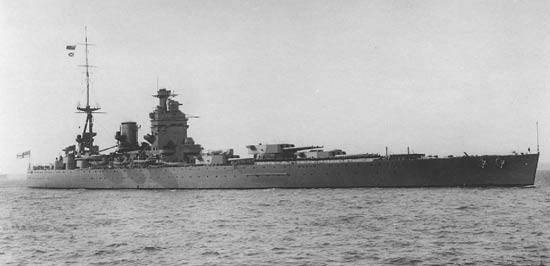
HMS Rodney as seen before the Second World War.
| Navy | The Royal Navy |
| Type | Battleship |
| Class | Nelson |
| Pennant | 29 |
| Built by | Cammell Laird Shipyard (Birkenhead, U.K.) |
| Ordered | 11 Dec 1922 |
| Laid down | 28 Dec 1922 |
| Launched | 17 Dec 1925 |
| Commissioned | 10 Nov 1927 |
| End service | 30 Nov 1945 |
| History | Reduced to reserve on 30 November 1945. Sold to T.W. Ward on 19 March 1948, arrived at Inverkeithing for scrapping on 26 March 1948. |
Commands listed for HMS Rodney (29)
Please note that we're still working on this section
and that we only list Commanding Officers for the duration of the Second World War.
| Commander | From | To | |
| 1 | Capt. Sir Edward Neville Syfret, RN | 15 Aug 1938 | 21 Nov 1939 |
| 2 | Capt. Sir Frederick Hew George Dalrymple-Hamilton, RN | 21 Nov 1939 | 22 Jul 1941 |
| 3 | Capt. James William Rivett-Carnac, DSC, RN | 22 Jul 1941 | 25 Sep 1943 |
| 4 | Capt. Robert Oliver Fitzroy, RN | 25 Sep 1943 | Dec 1945 |
You can help improve our commands section
Click here to Submit events/comments/updates for this vessel.
Please use this if you spot mistakes or want to improve this ships page.
Notable events involving Rodney include:
The page for this battleship was last updated in November 2021.
31 Aug 1939
Around 1800A/31, the Home Fleet departed Scapa Flow to patrol between Scotland, Iceland and Norway for returning German merchant vessels.
Ships that participated in this patrol were; battleships HMS Nelson (Capt. G.J.A. Miles, RN, flying the flag of Admiral J.M. Forbes, KCB, DSO, RN), HMS Rodney (Capt. E.N. Syfret, RN), aircraft carrier HMS Ark Royal (Capt. A.J. Power, RN, flying the flag of Vice-Admiral L.V. Wells, CB, DSO, RN), light cruisers HMS Aurora (Capt. G.B. Middleton, RN, flying the flag of Rear-Admiral R.H.C. Hallifax, RN), HMS Sheffield (Capt. E. de F. Renouf, CVO, RN), HMS Belfast (Capt. G.A. Scott, DSC, RN) (from the 18th Cruiser Squadron), HMS Effingham (Capt. J.M. Howson, RN), HMS Cardiff (Capt. P.K. Enright, RN), HMS Dunedin (Capt. C.E. Lambe, CVO, RN), HMS Emerald (Capt. A.W.S. Agar, VC, DSO, RN) (from the 12th Cruiser Squadron), HMS Caledon (Capt. C.P. Clark, RN), HMS Calypso (Capt. N.J.W. William-Powlett, DSC, RN), HMS Diomede (Commodore E.B.C. Dicken, OBE, DSC, RN), HMS Dragon (Capt. R.G. Bowes-Lyon, MVO, RN) (from the 7th Cruiser Squadron. These ships were escorted by destroyers from the 8th Destroyer Flotilla; HMS Faulknor (Capt. C.S. Daniel, RN), HMS Fame (Cdr. P.N. Walter, RN), HMS Fearless (Cdr. K.L. Harkness, RN), HMS Firedrake (Lt.Cdr. S.H. Norris, RN), HMS Foresight (Lt.Cdr. G.T. Lambert, RN), HMS Forester (Lt.Cdr. E.B. Tancock, RN), HMS Fortune (Cdr. E.A. Gibbs, RN), HMS Foxhound (Lt.Cdr. P.H. Hadow, RN) and HMS Fury (Cdr. G.F. Burghard, RN).
To patrol off the Skagerrak was the battlecruiser squadron which was made up of the battlecruisers HMS Hood (Capt. I.G. Glennie, RN, flying the flag of Rear-Admiral W.J. Whitworth, CB, DSO, RN), HMS Repulse (Capt. E.J. Spooner, DSO, RN) which were escorted by destroyers from the 6th Destroyer Flotilla; HMS Somali (Capt. R.S.G. Nicholson, DSC, RN), HMS Ashanti (Cdr. W.G. Davis, RN), HMS Bedouin (Cdr. J.A. McCoy, RN), HMS Eskimo (Cdr. St. J.A. Micklethwait, RN), HMS Mashona (Cdr. P.V. McLaughlin, RN), HMS Matabele (Cdr. G.K. Whitmy-Smith, RN), HMS Punjabi (Cdr. J.T. Lean, RN) and HMS Tartar (Capt. G.H. Warner, DSC, RN). These ships departed Scapa Flow around the same time.
Some of the ships had already been at sea for exercises.
The bulk of the Fleet returned to Scapa Flow in the morning of September 6th.
Most of the cruisers had acted independently to inspect shipping. HMS Caledon, HMS Calypso, HMS Cardiff and HMS Dunedin returned to Scapa Flow in the early morning of September 5th.
HMS Aurora and HMS Sheffield returned to Scapa Flow in the evening of September 5th.
HMS Belfast returned to Scapa Flow on the 6th after having joined other ships for exercises on the 5th.
HMS Diomede, HMS Dragon, HMS Effingham and HMS Emerald returned to Scapa Flow in the morning of the 7th.
Most of the destroyer had to return to Scapa Flow once to refuel, HMS Somali and HMS Ashanti were at Scapa Flow between 0100/2 and 0400/2.
HMS Faulknor, HMS Fearless, HMS Firedrake, HMS Fortune and HMS Foxhound were at Scapa Flow between 1000A/3 and 1530A/3.
HMS Bedouin, HMS Eskimo, HMS Punjabi and HMS Tartar were at Scapa Flow between 1100A/3 and 1600A/3.
HMS Fame was detached at 2359A/3 to go to the aid of the torpedoed liner Athenia but she was not needed to pick up survivors and proceeded to the Clyde arriving in the moring of the 5th having carried out an A/S sweep en-route.
HMS Matabele was detached to Scapa Flow at 1130/5. Around 2030A/5, she grounded near the boom and damaged her propellers.
HMS Foresight, HMS Forester, HMS Fury and HMS Mashona did not refuel before they returned with the Fleet in the morning of the 6th. (1)
7 Sep 1939
Around 0730A/7 the battleships HMS Nelson (Capt. G.J.A. Miles, RN, flying the flag of Admiral J.M. Forbes, KCB, DSO, RN), HMS Rodney (Capt. E.N. Syfret, RN), battlecruiser HMS Repulse (Capt. E.J. Spooner, DSO, RN), aircraft carrier HMS Ark Royal (Capt. A.J. Power, RN, flying the flag of Vice-Admiral L.V. Wells, CB, DSO, RN), light cruisers HMS Aurora (Capt. G.B. Middleton, RN, flying the flag of Rear-Admiral R.H.C. Hallifax, RN), HMS Sheffield (Capt. E. de F. Renouf, CVO, RN) and the destroyers HMS Faulknor (Capt. C.S. Daniel, RN), HMS Firedrake (Lt.Cdr. S.H. Norris, RN), HMS Foresight (Lt.Cdr. G.T. Lambert, RN), HMS Fortune (Cdr. E.A. Gibbs, RN), HMS Fury (Cdr. G.F. Burghard, RN), HMS Ashanti (Cdr. W.G. Davis, RN), HMS Bedouin (Cdr. J.A. McCoy, RN), HMS Mashona (Cdr. P.V. McLaughlin, RN), HMS Punjabi (Cdr. J.T. Lean, RN), HMS Somali (Capt. R.S.G. Nicholson, DSC, RN) and HMS Tartar (Capt. G.H. Warner, DSC, RN) departed Scapa Flow to operate off the Norwegian coast as far north as 63°00'N to intercept German shipping.
They returned to Scapa Flow in the evening of the 10th having sighted no German ships. Visibility had been bad throughout.
14 Sep 1939
The battleship HMS Rodney (Capt. E.N. Syfret, RN), battlecruiser HMS Hood (Capt. I.G. Glennie, RN, flying the flag of Rear-Admiral W.J. Whitworth, CB, DSO, RN) and the destroyers HMS Tartar (Capt. G.H. Warner, DSC, RN), HMS Punjabi (Cdr. J.T. Lean, RN), HMS Eskimo (Cdr. St. J.A. Micklethwait, RN) and HMS Bedouin (Cdr. J.A. McCoy, RN) departed Scapa Flow in the evening for Loch Ewe. They arrived the next morning minus HMS Tartar, HMS Punjabi and HMS Bedouin which had been detached en-route for other duties.
20 Sep 1939
Battleships HMS Nelson (Capt. G.J.A. Miles, RN, flying the flag of Admiral J.M. Forbes, KCB, DSO, RN), HMS Rodney (Capt. E.N. Syfret, RN), battlecruisers HMS Hood (Capt. I.G. Glennie, RN, flying the flag of Rear-Admiral W.J. Whitworth, CB, DSO, RN), HMS Repulse (Capt. E.J. Spooner, DSO, RN), aircraft carrier HMS Ark Royal (Capt. A.J. Power, RN, flying the flag of Vice-Admiral L.V. Wells, CB, DSO, RN) and the destroyers HMS Firedrake (Lt.Cdr. S.H. Norris, RN), HMS Fortune (Cdr. E.A. Gibbs, RN), HMS Punjabi (Cdr. J.T. Lean, RN) and HMS Tartar (Capt. G.H. Warner, DSC, RN) departed Loch Ewe in the evening for Scapa Flow. They were joined by the destroyers HMS Faulknor (Capt. C.S. Daniel, RN), HMS Fearless (Cdr. K.L. Harkness, RN), HMS Foresight (Lt.Cdr. G.T. Lambert, RN), HMS Forester (Lt.Cdr. E.B. Tancock, RN), HMS Foxhound (Lt.Cdr. P.H. Hadow, RN) and HMS Fury (Cdr. G.F. Burghard, RN) which had departed Scapa Flow earlier, most likely for an A/S sweep and then to join the escort.
This force arrived at Scapa Flow in the morning of the 21st but not before four more destroyers; HMS Bedouin (Cdr. J.A. McCoy, RN), HMS Eskimo (Cdr. St. J.A. Micklethwait, RN), HMS Mashona (Cdr. P.V. McLaughlin, RN) and HMS Matabele (Cdr. G.K. Whitmy-Smith, RN) had joined the escort.
22 Sep 1939
Operation SK.
To conduct an operation against German shipping off the Norwegian coast the light cruiser HMS Aurora (Capt. G.B. Middleton, RN, flying the flag of Rear-Admiral R.H.C. Hallifax, RN) and the destroyers HMS Tartar (Capt. G.H. Warner, DSC, RN), HMS Punjabi (Cdr. J.T. Lean, RN), HMS Eskimo (Cdr. St. J.A. Micklethwait, RN) and HMS Bedouin (Cdr. J.A. McCoy, RN) departed Scapa Flow as well as the light cruisers HMS Southampton (Capt. F.W.H. Jeans, CVO, RN, flying the flag of Vice-Admiral G.F.B. Edward-Collins, CB, KCVO, RN), HMS Sheffield (Capt. E. de F. Renouf, CVO, RN), HMS Glasgow (Capt. F.H. Pegram, RN) and the destroyers HMS Jervis (Capt. P.J. Mack, RN), HMS Javelin (Cdr. A.F. Pugsley, RN) and HMS Jupiter (Lt.Cdr. D.B. Wyburd, RN) departed Rosyth. HMS Jersey (Lt.Cdr. A.M. McKillop, RN), coming from the Chatham Dockyard, joined at sea.
To provide cover for this operation two forces were deployed from Scapa Flow. One force was made up of the battlecruisers HMS Hood (Capt. I.G. Glennie, RN, flying the flag of Rear-Admiral W.J. Whitworth, CB, DSO, RN), HMS Repulse (Capt. E.J. Spooner, DSO, RN) and the destroyers HMS Fame (Cdr. P.N. Walter, RN), HMS Firedrake (Lt.Cdr. S.H. Norris, RN), HMS Foresight (Lt.Cdr. G.T. Lambert, RN) and HMS Fortune (Cdr. E.A. Gibbs, RN).
The other force was made up of the battleships HMS Nelson (Capt. G.J.A. Miles, RN, flying the flag of Admiral J.M. Forbes, KCB, DSO, RN), HMS Rodney (Capt. E.N. Syfret, RN), aircraft carrier HMS Ark Royal (Capt. A.J. Power, RN, flying the flag of Vice-Admiral L.V. Wells, CB, DSO, RN) and the destroyers HMS Faulknor (Capt. C.S. Daniel, RN), HMS Fearless (Cdr. K.L. Harkness, RN), HMS Foxhound (Lt.Cdr. P.H. Hadow, RN), HMS Somali (Capt. R.S.G. Nicholson, DSC, RN), HMS Mashona (Cdr. P.V. McLaughlin, RN) and HMS Matabele (Cdr. G.K. Whitmy-Smith, RN). Later the destroyers HMS Forester (Lt.Cdr. E.B. Tancock, RN), HMS Fury (Cdr. G.F. Burghard, RN), HMS Esk (Lt.Cdr. R.J.H. Couch, RN) and HMS Express (Cdr. J.G. Bickford, RN) joined at sea.
The raid was abandoned when HMS Javelin and HMS Jersey collided in position 57°09'N, 03°08'W at 2038A/22.
All forces returned to their port of departure on 23 September but not before HMS Hood reported an explosion at 1330A/23. The destroyers HMS Firedrake and HMS Fortune were detached to investigate but no contact was obtained. In fact this was indeed an attack by a German submarine; U-24 which reported to have made a failed torpedo attack at 1328A/23 on HMS Hood and two escorting destroyers.
25 Sep 1939
At 0510A/25 a radio message was received from the submarine HMS Spearfish (Lt. J.H. Eaden, RN) that she had been badly damaged by enemy warships and that she was unable to dive and was proceeding along the Danish coast try to make it back to the U.K.
Around 0730A/25 the light cruisers HMS Southampton (Capt. F.W.H. Jeans, CVO, RN, flying the flag of Vice-Admiral G.F.B. Edward-Collins, CB, KCVO, RN) and HMS Glasgow (Capt. F.H. Pegram, RN) departed Rosyth and joined destroyers HMS Jervis (Capt. P.J. Mack, RN) and HMS Jupiter (Lt.Cdr. D.B. Wyburd, RN) near May Island shortly after 0900 hours. They were to operate off the Norwegian coast at 60°N to closely cover the retreat of the damaged submarine. with the destroyers HMS Somali (Capt. R.S.G. Nicholson, DSC, RN), HMS Eskimo (Cdr. St. J.A. Micklethwait, RN), HMS Mashona (Cdr. P.V. McLaughlin, RN) and HMS Matabele (Cdr. G.K. Whitmy-Smith, RN) which were already on patrol in that area.
The light cruisers HMS Aurora (Capt. G.B. Middleton, RN, flying the flag of Rear-Admiral R.H.C. Hallifax, RN) and HMS Sheffield (Capt. E. de F. Renouf, CVO, RN) departed Scapa Flow and were ordered to proceed well into the approaches of the Skagerrak with the destroyers HMS Fame (Cdr. P.N. Walter, RN), and HMS Foresight (Lt.Cdr. G.T. Lambert, RN) which had been on the Fare Island patrol. These ships were to try to make contact with HMS Spearfish.
To provide more distant cover for the whole operation the battlecruisers HMS Hood (Capt. I.G. Glennie, RN, flying the flag of Rear-Admiral W.J. Whitworth, CB, DSO, RN), HMS Repulse (Capt. E.J. Spooner, DSO, RN), heavy cruiser HMS Norfolk (Capt. A.G.B. Wilson, DSO, RN) and the destroyers (Capt. A.G.B. Wilson, DSO, RN) and the destroyers HMS Faulknor (Capt. C.S. Daniel, RN), HMS Fearless (Cdr. K.L. Harkness, RN), HMS Firedrake (Lt.Cdr. S.H. Norris, RN), HMS Foresight (Lt.Cdr. G.T. Lambert, RN), HMS Forester (Lt.Cdr. E.B. Tancock, RN), HMS Fortune (Cdr. E.A. Gibbs, RN) and HMS Foxhound (Lt.Cdr. P.H. Hadow, RN) departed Scapa Flow.
[It is often stated that the light cruisers HMS Newcastle (Capt. J. Figgins, RN), HMS Edinburgh (Capt. F.C. Bradley, RN) also sailed with the 'Hood-Force' but this was not the case.]
Also from Scapa Flow sailed yet another cover force made up of the battleships HMS Nelson (Capt. G.J.A. Miles, RN, flying the flag of Admiral J.M. Forbes, KCB, DSO, RN), HMS Rodney (Capt. E.N. Syfret, RN), aircraft carrier HMS Ark Royal (Capt. A.J. Power, RN, flying the flag of Vice-Admiral L.V. Wells, CB, DSO, RN) and the destroyers HMS Tartar (Capt. G.H. Warner, DSC, RN), HMS Punjabi (Cdr. J.T. Lean, RN), HMS Bedouin (Cdr. J.A. McCoy, RN) and HMS Fury (Cdr. G.F. Burghard, RN).
Around 0100A/26 the destroyers HMS Somali and HMS Eskimo made contact with HMS Spearfish which was then safely escorted to Rosyth despite German air attacks during which HMS Ark Royal was near missed and HMS Hood struck by a bomb which did not explode.
All ships returned to port on 27 September minus HMS Norfolk which was detached earlier to join the Northern Patrol being ordered to patrol in the Iceland-Faeroer gap.
29 Sep 1939
HMS Nelson (Capt. G.J.A. Miles, RN, flying the flag of Admiral J.M. Forbes, KCB, DSO, RN) and HMS Rodney (Capt. E.N. Syfret, RN) both conducted gunnery exercises at and later off Scapa Flow. While in the Pentland Firth the battleships were escorted by HMS Foxhound (Lt.Cdr. P.H. Hadow, RN).
After the battleships returned to Scapa Flow, HMS Foxhound joined other destroyers on A/S patrol. (2)
1 Oct 1939
Battleships HMS Nelson (Capt. G.J.A. Miles, RN, flying the flag of Admiral J.M. Forbes, KCB, DSO, RN), HMS Rodney (Capt. E.N. Syfret, RN), battlecruisers HMS Hood (Capt. I.G. Glennie, RN, flying the flag of Rear-Admiral W.J. Whitworth, CB, DSO, RN), HMS Repulse (Capt. E.J. Spooner, DSO, RN), aircraft carrier HMS Ark Royal (Capt. A.J. Power, RN, flying the flag of Vice-Admiral L.V. Wells, CB, DSO, RN) and the destroyers HMS Somali (Capt. R.S.G. Nicholson, DSC, RN), HMS Mashona (Cdr. P.V. McLaughlin, RN), HMS Matabele (Cdr. G.K. Whitmy-Smith, RN), HMS Ashanti (Cdr. W.G. Davis, RN), HMS Fame (Cdr. P.N. Walter, RN), HMS Firedrake (Lt.Cdr. S.H. Norris, RN), HMS Foresight (Lt.Cdr. G.T. Lambert, RN) and HMS Fortune (Cdr. E.A. Gibbs, RN) departed Scapa Flow very late in the evening for Loch Ewe where they arrived around 0700A/2.
5 Oct 1939
Around 1900A/5, the battleships HMS Nelson (Capt. G.J.A. Miles, RN, flying the flag of Admiral J.M. Forbes, KCB, DSO, RN), HMS Rodney (Capt. E.N. Syfret, RN), battlecruisers HMS Hood (Capt. I.G. Glennie, RN, flying the flag of Rear-Admiral W.J. Whitworth, CB, DSO, RN), HMS Repulse (Capt. E.J. Spooner, DSO, RN), aircraft carrier HMS Furious (Capt. M.L. Clarke, DSC, RN) and the destroyers HMS Somali (Capt. R.S.G. Nicholson, DSC, RN), HMS Mashona (Cdr. P.V. McLaughlin, RN), HMS Ashanti (Cdr. W.G. Davis, RN), HMS Fame (Cdr. P.N. Walter, RN), HMS Foresight (Lt.Cdr. G.T. Lambert, RN) and HMS Fortune (Cdr. E.A. Gibbs, RN) departed Loch Ewe late in the evening for Scapa Flow where they arrived around 0700A/6.
8 Oct 1939
A force of German warships departed Kiel to operate off the south coast of Norway. They were to sink Allied shipping and lure the British Home Fleet into the range of Luftwaffe aircraft. This force was made up of the battlecruiser Gneisenau, light cruiser Köln and the destroyers Z 3 / Max Schultz, Z 5 / Paul Jacobi, Z 11 / Bernd von Arnim, Z/14 Friedrich Ihn, Z 15 / Erich Steinbrinck, Z 16 / Friedrich Eckholdt, Z 17 / Diether von Roeder, Z 20 / Karl Galster, Z 21 / Wilhelm Heidkamp. In addition, four submarines were deployed in a patrol line to attack the Home Fleet, these were U-10, U-18, U-20 and U-23.
The Admiralty took the bait and around 1600A/8 the battlecruisers HMS Hood (Capt. I.G. Glennie, RN, flying the flag of Rear-Admiral W.J. Whitworth, CB, DSO, RN), HMS Repulse (Capt. E.J. Spooner, DSO, RN), light cruisers HMS Aurora (Capt. G.B. Middleton, RN, flying the flag of Rear-Admiral R.H.C. Hallifax, RN) and HMS Sheffield (Capt. E. de F. Renouf, CVO, RN) and the destroyers HMS Somali (Capt. R.S.G. Nicholson, DSC, RN), HMS Mashona (Cdr. P.V. McLaughlin, RN), HMS Eskimo (Cdr. St. J.A. Micklethwait, RN) and HMS Ashanti (Cdr. W.G. Davis, RN) departed Scapa Flow for a position about 50 miles to the north-west of Stadlandet, Norway.
Around 1900A/8, the battleships HMS Nelson (Capt. G.J.A. Miles, RN, flying the flag of Admiral J.M. Forbes, KCB, DSO, RN), HMS Rodney (Capt. E.N. Syfret, RN), aircraft carrier HMS Furious (Capt. M.L. Clarke, DSC, RN), light cruiser HMS Newcastle (Capt. J. Figgins, RN) and the destroyers HMS Faulknor (Capt. C.S. Daniel, RN), HMS Fame (Cdr. P.N. Walter, RN), HMS Firedrake (Lt.Cdr. S.H. Norris, RN), HMS Foresight (Lt.Cdr. G.T. Lambert, RN), HMS Forester (Lt.Cdr. E.B. Tancock, RN), HMS Fury (Cdr. G.F. Burghard, RN), HMS Punjabi (Cdr. J.T. Lean, RN) and HMS Bedouin (Cdr. J.A. McCoy, RN) departed Scapa Flow for a position north of Muckle Flugga. Both forces were to reach their positions by dawn the following day and then steam towards each other in a pincer movement to cut off the German ships from their home ports.
The light cruisers HMS Southampton (Capt. F.W.H. Jeans, CVO, RN, flying the flag of Vice-Admiral G.F.B. Edward-Collins, CB, KCVO, RN), HMS Glasgow (Capt. F.H. Pegram, RN), HMS Edinburgh (Capt. F.C. Bradley, RN) and the destroyers HMS Jervis (Capt. P.J. Mack, RN), HMS Jaguar (Lt.Cdr. J.F.W. Hine, RN) and HMS Jupiter (Lt.Cdr. D.B. Wyburd, RN). They were joined at sea by the destroyers HMS Jackal (Cdr. T.M. Napier, RN) and HMS Janus (Lt.Cdr. J.A.W. Tothill, RN) which came from Grimsby. This force was ordered to operate off the western end of the Skagerrak and then sweep northwards.
At 0600A/9 HMS Jaguar was ordered to return to Rosyth to refuel. En-route there she was attacked by German aircraft but she was not hit.
HMS Jervis and HMS Jupiter were ordered to search for the small Danish merchant vessel Teddy (503 GRT, built 1907) which had reported that she had picked up the crew of a German flying boat whih was shot down on the 8th. They were attacked by German aircraft at 1518A/9, but neither destroyer was damaged. However, about 1.5 hours laters HMS Jupiter broke down and had to be taken in tow by her sister ship.
HMS Jaguar meanwhile had completed refuelling at Rosyth. She left that port together with HMS Jersey (Lt.Cdr. A.M. McKillop, RN) which just finished repairs to the damage sustained in her collision of 22 September.
The were ordered to screen the withdrawal of HMS Jervis and HMS Jupiter. But it was not to be as shorty after departing Rosyth, Jaguar struck a small islet above the Forth bridge and damaged her starboard propeller shaft and HMS Jersey struck the Rosyth boom defence. Both destroyers proceeded to Leith for repairs.
Between 1120A/9 and 1645A/9 the Luftwaffe heavily bombed the 'Humber force' made up at that time of HMS Southampton, HMS Glasgow, HMS Edinburgh, HMS Jackal and HMS Janus which had arrived off the western entrance to the Skagerrak by that time. HMS Southampton and HMS Glasgow were near missed but were not damaged.
The German force returned to Kiel shortlyafter midnight during the night of 9/10 October. This news reached the C-in-C, Home Fleet in the afternoon of the 10th after which all ships were ordered to return to port.
HMS Nelson, HMS Rodney, HMS Hood, HMS Faulknor, HMS Firedrake, HMS Forester, HMS Fury, HMS Bedouin and HMS Punjabi proceeded to Loch Ewe arriving in the early evening of the 11th.
HMS Repulse, HMS Furious, HMS Aurora, HMS Newcastle, HMS Southampton, HMS Glasgow, HMS Somali, HMS Mashona, HMS Eskimo, HMS Ashanti, HMS Fame, HMS Foresight, HMS Jervis, HMS Jackal, HMS Janus and HMS Jupiter (which by now as able to proceed under her own power) arrived at Scapa Flow on the 11th. They had been joined at sea before arrival by two more destroyers which came from Scapa Flow; HMS Fearless (Cdr. K.L. Harkness, RN) and HMS Foxhound (Lt.Cdr. P.H. Hadow, RN).
HMS Edinburgh had been detached and proceeded to Rosyth where she arrived on the 10th.
HMS Sheffield had already been detached on the 9th with orders to patrol in the Denmark Strait.
15 Oct 1939
Around 1800A/15, the battleships HMS Nelson (Capt. G.J.A. Miles, RN, flying the flag of Admiral J.M. Forbes, KCB, DSO, RN), HMS Rodney (Capt. E.N. Syfret, RN), battlecruiser HMS Hood (Capt. I.G. Glennie, RN, flying the flag of Rear-Admiral W.J. Whitworth, CB, DSO, RN), HMS Furious (Capt. M.L. Clarke, DSC, RN), light cruisers HMS Aurora (Capt. G.B. Middleton, RN, flying the flag of Rear-Admiral R.H.C. Hallifax, RN), HMS Belfast (Capt. G.A. Scott, DSC, RN) and the destroyers HMS Bedouin (Cdr. J.A. McCoy, RN), HMS Fearless (Cdr. K.L. Harkness, RN), HMS Foxhound (Lt.Cdr. P.H. Hadow, RN) and HMS Fury (Cdr. G.F. Burghard, RN) departed Loch Ewe for operations.
They were to patrol north of Iceland as it was thought the German pocket battleship Deutschland was proceeding into the Atlantic. From this position they were able to support the Northern Patrol.
More destroyers later joined at sea; HMS Mashona (Cdr. P.V. McLaughlin, RN), HMS Matabele (Cdr. G.K. Whitmy-Smith, RN), HMS Punjabi (Cdr. J.T. Lean, RN and HMS Firedrake (Lt.Cdr. S.H. Norris, RN) departed Scapa Flow on the 15th. They were followed on the 16th by HMS Forester (Lt.Cdr. E.B. Tancock, RN).
On the 18th the battlecruiser HMS Repulse (Capt. E.J. Spooner, DSO, RN), which had completed boiler cleaning, departed Rosyth escorted by the destroyers HMS Jervis (Capt. P.J. Mack, RN), HMS Jersey (Lt.Cdr. A.M. McKillop, RN), HMS Cossack (Capt. D. de Pass, RN) and HMS Maori (Cdr. G.N. Brewer, RN). HMS Cossack and HMS Maori returned to Rosyth on the 19th. HMS Repulse, HMS Jervis and HMS Jersey joined the fleet at sea on the 20th but HMS Jervis and HMS Jersey were detached to Sullum Voe shortly afterwards.
HMS Nelson, HMS Rodney, HMS Hood, HMS Repulse, HMS Furious, HMS Aurora, HMS Belfast, HMS Bedouin, HMS Mashona, HMS Matabele, HMS Punjabi, HMS Fearless, HMS Firedrake, HMS Forester, HMS Foxhound and HMS Fury arrived at Loch Ewe around 0830A/22.
23 Oct 1939
HMS Nelson (Capt. G.J.A. Miles, RN, flying the flag of Admiral J.M. Forbes, KCB, DSO, RN), HMS Rodney (Capt. E.N. Syfret, RN), battlecruiser HMS Hood (Capt. I.G. Glennie, RN, flying the flag of Rear-Admiral W.J. Whitworth, CB, DSO, RN) and the destroyers HMS Intrepid (Cdr. J.W. Josselyn, RN), HMS Icarus (Lt.Cdr. C.D. Maud, RN), HMS Ivanhoe (Cdr. B. Jones, RN), HMS Kelly (Capt. L.F.A.V.N. Mountbatten, GCVO, RN) and HMS Kingston (Lt.Cdr. P. Somerville, RN) departed Loch Ewe for operations in the Norwegian Sea.
[See the event 'Convoy Narvik 1' for 26 October 1939 for more details.]
26 Oct 1939
Convoy Narvik 1.
This convoy departed Narvik, Norway on 26 October 1939. It arrived at Methil on 31 October 1939.
This convoy was made up of the following merchant vessels; Albuera (British, 3494 GRT, built 1921), Alex (British, 3892 GRT, built 1914), Carperby (British, 4890 GRT, built 1928), Cree (British, 5596 GRT, built 1920), Creekirk (British, 3793 GRT, built 1912), Imperial Monarch (British, 5835 GRT, built 1926), Leo Dawson (British, 4734 GRT, built 1918), Lindenhall (British, 5248 GRT, built 1937), Polzella (British, 4751 GRT, built 1929), Riley (British, 4993 GRT, built 1936), Santa Clara Valley (British, 4685 GRT, built 1928) and Starcross (British, 4662 GRT, built 1936).
Escort / cover for this convoy was provided by the battleships HMS Nelson (Capt. G.J.A. Miles, RN, flying the flag of Admiral J.M. Forbes, KCB, DSO, RN), HMS Rodney (Capt. E.N. Syfret, RN), battlecruiser HMS Hood (Capt. I.G. Glennie, RN, flying the flag of Rear-Admiral W.J. Whitworth, CB, DSO, RN) and the destroyers HMS Intrepid (Cdr. J.W. Josselyn, RN), HMS Icarus (Lt.Cdr. C.D. Maud, RN), HMS Ivanhoe (Cdr. B. Jones, RN), HMS Kelly (Capt. L.F.A.V.N. Mountbatten, GCVO, RN) and HMS Kingston (Lt.Cdr. P. Somerville, RN). These ships sailed from Loch Ewe at 1800A/23.
On the 25th the destroyer HMS Impulsive (Lt.Cdr. W.S. Thomas, RN) sailed from Scapa Flow to join the force at sea. HMS Kingston had to be detached to Scapa Flow due to defects on the 28th. On the 29th another destroyer joined the force at sea; HMS Firedrake (Lt.Cdr. S.H. Norris, RN).
Light cruiser HMS Edinburgh (Capt. F.C. Bradley, RN) departed Rosyth on 23 October and joined the cover force at sea around 1200A/24. HMS Aurora (Capt. G.B. Middleton, RN, flying the flag of Rear-Admiral R.H.C. Hallifax, RN) sailed from Loch Ewe on 23 October and joined the convoy itself off the Norwegian coast around 0130A/26. Destroyers HMS Somali (Capt. R.S.G. Nicholson, DSC, RN), HMS Ashanti (Cdr. W.G. Davis, RN), HMS Tartar (Lt.Cdr. D.E. Holland-Martin, RN) and HMS Fame (Cdr. P.N. Walter, RN) also joined the convoy having sailed from Scapa Flow.
HMS Fame was later detached with two of the merchant vessels as these were to join an Atlantic convoy.
29 Oct 1939
Search for the American merchant vessel City of Flint.
The destroyers HMS Kelly (Capt. L.F.A.V.N. Mountbatten, GCVO, RN), HMS Bedouin (Cdr. J.A. McCoy, RN), HMS Eskimo (Cdr. St.J.A. Micklethwait, RN), HMS Matabele (Cdr. G.K. Whitmy-Smith, RN), HMS Fearless (Cdr. K.L. Harkness, RN) and HMS Foxhound (Lt.Cdr. P.H. Hadow, RN) departed Sullom Voe to search of the coast of Norway for the seized US merchant vessel City of Flint (4963 GRT, built 1920) that was on passage to Germany. HMS Fearless and HMS Foxhound were later detached to join the main cover force.
This vessel had been seized on 9 October by the German pocket battleship Deutschland in the North Atlantic while en-route from New York to the U.K. A german prize crew was to take the ship to Germany as it was carrying contraband. The ship was refused entrance into Norwegian waters and was taken to Murmansk where it arrived on 23 October. The German prize crew was interned by the Soviet authorities the next day. On 27 October, the City of Flint was returned to German control and she left the following day and set course to Germany.
Close cover for this destroyer force was provided by the light cruisers HMS Glasgow (Capt. F.H. Pegram, RN) and HMS Newcastle (Capt J. Figgins, RN) which had been diverted during their passage from the Channel area to Rosyth on 1 November.
A larger cover force for the entire operation as well as convoy ON 1 (Methil-Norway) sailed from the Clyde in the morning of November 2nd. It was made up of the battleships HMS Nelson (Capt. G.J.A. Miles, RN, flying the flag of Admiral J.M. Forbes, KCB, DSO, RN), HMS Rodney (Capt. E.N. Syfret, RN), battlecruiser HMS Hood (Capt. I.G. Glennie, RN, flying the flag of Rear-Admiral W.J. Whitworth, CB, DSO, RN) escorted by the destroyers HMS Faulknor (Capt. C.S. Daniel, RN), HMS Foresight (Lt.Cdr. G.T. Lambert, RN), HMS Fortune (Cdr. E.A. Gibbs, RN), HMS Icarus (Lt.Cdr. C.D. Maud, RN), HMS Impulsive (Lt.Cdr. W.S. Thomas, RN), HMS Foxhound (Lt.Cdr. P.H. Hadow, RN), HMS Ivanhoe (Cdr. B. Jones, RN) and HMS Punjabi (Cdr. J.T. Lean, RN).
The captured merchant ship was however not sighted.
30 Oct 1939
HMS Nelson (Capt. G.J.A. Miles, RN, flying the flag of Admiral J.M. Forbes, KCB, DSO, RN), HMS Rodney (Capt. E.N. Syfret, RN), battlecruiser HMS Hood (Capt. I.G. Glennie, RN, flying the flag of Rear-Admiral W.J. Whitworth, CB, DSO, RN) and the destroyers HMS Icarus (Lt.Cdr. C.D. Maud, RN), HMS Impulsive (Lt.Cdr. W.S. Thomas, RN), HMS Intrepid (Cdr. J.W. Josselyn, RN), HMS Ivanhoe (Cdr. B. Jones, RN) and HMS Firedrake (Lt.Cdr. S.H. Norris, RN) ran into a uboat line (U-56, U-57, U-58 and U-59) to the west of the Orkneys. At 0941A/30, U-56 attacked HMS Nelson but all three torpedoes that were fired and hit the target failed to explode). [There is however no mention at all in the log of HMS Nelson about her being struck by the torpedoes. Also there is no mention of evase action or other A/S measured by the destroyers.]
31 Oct 1939
Around 0900A/31, HMS Nelson (Capt. G.J.A. Miles, RN, flying the flag of Admiral J.M. Forbes, KCB, DSO, RN), HMS Rodney (Capt. E.N. Syfret, RN), battlecruiser HMS Hood (Capt. I.G. Glennie, RN, flying the flag of Rear-Admiral W.J. Whitworth, CB, DSO, RN) and the destroyers HMS Icarus (Lt.Cdr. C.D. Maud, RN), HMS Impulsive (Lt.Cdr. W.S. Thomas, RN), HMS Intrepid (Cdr. J.W. Josselyn, RN), HMS Ivanhoe (Cdr. B. Jones, RN) aand HMS Firedrake (Lt.Cdr. S.H. Norris, RN) arrived at Greenock (Clyde) from operations.
2 Nov 1939
Around 0900A/2, the battleships HMS Nelson (Capt. G.J.A. Miles, RN, flying the flag of Admiral J.M. Forbes, KCB, DSO, RN), HMS Rodney (Capt. E.N. Syfret, RN), battlecruiser HMS Hood (Capt. I.G. Glennie, RN, flying the flag of Rear-Admiral W.J. Whitworth, CB, DSO, RN) escorted by the destroyers HMS Faulknor (Capt. C.S. Daniel, RN), HMS Foresight (Lt.Cdr. G.T. Lambert, RN), HMS Fortune (Cdr. E.A. Gibbs, RN), HMS Icarus (Lt.Cdr. C.D. Maud, RN), HMS Impulsive (Lt.Cdr. W.S. Thomas, RN), HMS Foxhound (Lt.Cdr. P.H. Hadow, RN), HMS Ivanhoe (Cdr. B. Jones, RN) and HMS Punjabi (Cdr. J.T. Lean, RN) departed the Clyde in the morning to provide cover for operations of Norway.
[See the event 'Search for the American merchant vessel City of Flint' for 29 October 1939 for more info.]
4 Nov 1939
The destroyers HMS Fearless (Cdr. K.L. Harkness, RN), HMS Foxhound (Lt.Cdr. P.H. Hadow, RN), HMS Imperial (Lt.Cdr. C.A.de W. Kitcat, RN) and HMS Kandahar (Cdr. W.G.A. Robson, RN) departed Scapa Flow to join the force of Admiral Forbes (made up of the battleships HMS Nelson (Capt. G.J.A. Miles, RN, flying the flag of Admiral J.M. Forbes, KCB, DSO, RN), HMS Rodney (Capt. E.N. Syfret, RN), battlecruiser HMS Hood (Capt. I.G. Glennie, RN, flying the flag of Rear-Admiral W.J. Whitworth, CB, DSO, RN) and the destroyers HMS Faulknor (Capt. C.S. Daniel, RN), HMS Foresight (Lt.Cdr. G.T. Lambert, RN), HMS Fortune (Cdr. E.A. Gibbs, RN), HMS Icarus (Lt.Cdr. C.D. Maud, RN), HMS Impulsive (Lt.Cdr. W.S. Thomas, RN), HMS Foxhound (Lt.Cdr. P.H. Hadow, RN), HMS Ivanhoe (Cdr. B. Jones, RN) and HMS Punjabi (Cdr. J.T. Lean, RN)) at sea which they did the following day.
9 Nov 1939
Around 0800A/9, the battleships HMS Nelson (Capt. G.J.A. Miles, RN, flying the flag of Admiral J.M. Forbes, KCB, DSO, RN), HMS Rodney (Capt. E.N. Syfret, RN) and the destroyers HMS Faulknor (Capt. C.S. Daniel, RN), HMS Fame (Cdr. P.N. Walter, RN), HMS Fearless (Cdr. K.L. Harkness, RN), HMS Foresight (Lt.Cdr. G.T. Lambert, RN), HMS Fortune (Cdr. E.A. Gibbs, RN), HMS Foxhound (Lt.Cdr. P.H. Hadow, RN) and HMS Imperial (Lt.Cdr. C.A.de W. Kitcat, RN) arrived at Rosyth.
12 Nov 1939
Around 1600A/12, the battleships HMS Nelson (Capt. G.J.A. Miles, RN, flying the flag of Admiral J.M. Forbes, KCB, DSO, RN), HMS Rodney (Capt. E.N. Syfret, RN) and the destroyers HMS Faulknor (Capt. C.S. Daniel, RN), HMS Fame (Cdr. P.N. Walter, RN), HMS Foresight (Lt.Cdr. G.T. Lambert, RN), HMS Fortune (Cdr. E.A. Gibbs, RN) and HMS Foxhound (Lt.Cdr. P.H. Hadow, RN) departed Rosyth to patrol between the Faroer Island and the coast of Norway to provide cover during convoy operations to and from Norway. En-route the were to carry out gunnery exercises off Cape Wrath which they did around noon on the 13th.
Around 0830A/13, the Fleet was joined by the destroyers HMS Imogen (Cdr. E.B.K. Stevens, RN) and HMS Impulsive (Lt.Cdr. W.S. Thomas, RN) which came from Scapa Flow.
Around 1000A/13, the Fleet was joined by another destroyer, HMS Icarus (Lt.Cdr. C.D. Maud, RN) also coming from Scapa Flow.
Around 1100A/13, the Fleet arrived off Cape Wrath and gunnery exercises were commenced around 1145A/13. Upon completion of the exercises the Fleet set course to the north to proceed to the patrol area.
At 2000A/13, HMS Icarus, HMS Imogen and HMS Impulsive were detached to Sullom Voe.
On the 16th the Fleet set course for the Clyde. While en-route a signal was received that the Clyde was closed for shipping so course was changed to proceed to Loch Ewe instead.
Around 0915A/17, the Fleet arrived in Loch Ewe.
20 Nov 1939
Around 1130A/20, the battleships HMS Nelson (Capt. G.J.A. Miles, RN, flying the flag of Admiral J.M. Forbes, KCB, DSO, RN), HMS Rodney (Capt. E.N. Syfret, RN) and the destroyers HMS Faulknor (Capt. C.S. Daniel, RN), HMS Fame (Cdr. P.N. Walter, RN), HMS Firedrake (Lt.Cdr. S.H. Norris, RN), HMS Fortune (Cdr. E.A. Gibbs, RN), HMS Foxhound (Lt.Cdr. P.H. Hadow, RN), HMS Somali (Capt. R.S.G. Nicholson, DSC, RN) and HMS Tartar (Lt.Cdr. D.E. Holland-Martin, RN) departed Loch Ewe for the Clyde where they arrived around 1000A/21.
23 Nov 1939
Sinking of the armed merchant cruiser HMS Rawalpindi
Around midday on 21 November 1939 the German battlecruisers Scharnhorst and Gneisenau, escorted by the light cruisers Köln and Leipzig and the destroyers Z 11 / Bernd von Arnim, Z 12 / Erich Giese and Z 20 / Karl Galster, departed Wilhelmshaven for a raid into the North Atlantic, this was to relieve the pressure of the pocket battleship Admiral Graf Spee operating in the South Atlantic. Late on the 21st the escorts left the battlecruisers.
Just after 1500A/23 the British armed merchant cruiser HMS Rawalpindi (Capt.(Retd.) E.C. Kennedy, RN) sighted the Scharnhorst. Rawalpindi was part of the British Northern Patrol and was stationed south-east of Iceland in the Iceland-Faroe gap. Captain Kennedy at first tried to get away from the German ship and report to the Admiralty that he sighted the German pocket battleship Deutschland, still believed to be operating in the North Atlantic, and so as to buy time so that other ships of the Northern patrol could come to his assistance. Just after 1600 hours, Rawalpindi came within range of the Scharnhorst and was quickly reduced to a flaming wreck. During this engagement Scharnhorst was hit by a 6in shell from Rawalpindi causing only light damage. Scharnhorst and Gneisenau together picked up 27 survivors from the Rawalpindi which finally sank around 2000 hours.
The British light cruiser HMS Newcastle (Capt J. Figgins, RN), that was also part of the Northern Patrol, picked up Rawalpindi's signal and closed the scene. She sighted the Gneisenau but the Germans managed to escape in the fog.
The Admiralty also thought the ship sighted by Rawalpindi and Newcastle was the Deutschland that was trying to return to Germany. In response to the sighting and destruction of the Rawalpindi the Admiralty took immediate action; The battleships HMS Nelson (Capt. G.J.A. Miles, RN, flying the flag of Admiral J.M. Forbes, KCB, DSO, RN) HMS Rodney (Capt. F.H.G. Dalrymple-Hamilton, RN) and the heavy cruiser HMS Devonshire (Capt. J.M. Mansfield, DSC, RN, flying the flag of Vice-Admiral J.H.D. Cunningham, CB, MVO, RN) escorted by the destroyers HMS Faulknor (Capt. C.S. Daniel, RN), HMS Fame (Cdr. P.N. Walter, RN), HMS Firedrake (Lt.Cdr. S.H. Norris, RN), HMS Foresight (Lt.Cdr. G.T. Lambert, RN), HMS Forester (Lt.Cdr. E.B. Tancock, RN), HMS Fortune (Cdr. E.A. Gibbs, RN) and HMS Fury (Cdr. G.F. Burghard, RN) departed the Clyde around 1930A/23 to patrol of Norway to cut off the way to Germany for the Deutschland.
The light cruisers HMS Southampton (Capt. F.W.H. Jeans, CVO, RN, flying the flag of Vice-Admiral G.F.B. Edward-Collins, CB, KCVO, RN), HMS Edinburgh (Capt. F.C. Bradley, RN) and HMS Aurora (Capt. G.B. Middleton, RN) escorted by the destroyers HMS Afridi (Capt. G.H. Creswell, DSC, RN), HMS Gurkha (Cdr. F.R. Parham, RN), HMS Bedouin (Cdr. J.A. McCoy, RN), HMS Kingston (Lt.Cdr. P. Somerville, RN) and HMS Isis (Cdr. J.C. Clouston, RN) departed Rosyth to patrol between the Orkney and Shetland islands.
Light cruiser HMS Sheffield (Capt. E. de F. Renouf, CVO, RN) was sent from Loch Ewe to the last known position of the German ship(s).
On northern patrol, south of the Faroes were the light cruisers HMS Caledon (Capt. C.P. Clark, RN), HMS Cardiff (Capt. P.K. Enright, RN) and HMS Colombo (Commodore R.J.R. Scott, RN). These were joined by HMS Dunedin (Capt. C.E. Lambe, CVO, RN) and HMS Diomede (Commodore E.B.C. Dicken, OBE, DSC, RN).
Of the ships of the Denmark strait patrol, the heavy cruisers HMS Suffolk (Capt. J.W. Durnford, RN) and HMS Norfolk (Capt. A.G.B. Wilson, MVO, DSO, RN) were ordered to proceed to the Bill Bailey Bank (to the south-west of the Faroe Islands).
The light cruiser HMS Glasgow (Capt. F.H. Pegram, RN) escorted by the destroyers HMS Maori (Cdr. G.N. Brewer, RN) and HMS Zulu (Cdr. J.S. Crawford, RN) were already at sea patrolling north-east of the Shetlands were to be joined by the destroyers HMS Inglefield (Capt. P. Todd, RN), HMS Imperial (Lt.Cdr. C.A.de W. Kitcat, RN), HMS Impulsive (Lt.Cdr. W.S. Thomas, RN) and HMS Imogen (Cdr. E.B.K. Stevens, RN).
The light cruisers HMS Calypso (Capt. N.J.W. William-Powlett, DSC, RN) and HMS Ceres (Capt. E.G. Abbott, AM, RN) were stationed off Kelso Light to act as a night attack striking force. The destroyers HMS Somali (Capt. R.S.G. Nicholson, DSC, RN), HMS Ashanti (Cdr. W.G. Davis, RN), HMS Mashona (Cdr. P.V. McLaughlin, RN) and HMS Punjabi (Cdr. J.T. Lean, RN) had just departed Belfast on escort duties. They were ordered to join Admiral Forbes. The ships they were escorting were ordered to return to Belfast.
The destroyers HMS Tartar (Lt.Cdr. D.E. Holland-Martin, RN), HMS Kandahar (Cdr. W.G.A. Robson, RN) and HMS Kashmir (Cdr. H.A. King, RN) departed Scapa Flow with orders to locate and shadow the German ships. HMS Tartar however had to return to Scapa Flow the next day due to a damaged rudder. The other two destroyers were ordered to join HMS Aurora which was to form a strike group of destroyers.
Despite the British effort to intercept the German ships, both German battlecruisers returned to Wilhelmshaven on the 27th.
2 Dec 1939
HMS Rodney (Capt. F.H.G. Dalrymple-Hamilton, RN) arrived in the Clyde for repairs to her damaged rudder due to which she had been detached from the Fleet. On arrival in the Clyde she was being escorted by the destroyers HMS Bedouin (Cdr. J.A. McCoy, RN) and HMS Gurkha (Cdr. F.R. Parham, RN). (3)
7 Dec 1939
HMS Rodney (Capt. F.H.G. Dalrymple-Hamilton, RN) departed the Clyde for Liverpool where she is to undergo repairs to her damaged rudder. Tugs assisted HMS Rodney with steering.
During the passage to Liverpool several destroyer provided escort and A/S sweeps along the route. These were HMS Exmouth (Cdr. R.S. Benson, RN), HMS Eclipse (Lt.Cdr. I.T. Clark, RN), HMS Fearless (Cdr. K.L. Harkness, RN), HMS Impulsive (Lt.Cdr. W.S. Thomas, RN) and HMS Gurkha (Cdr. F.R. Parham, RN).
HMS Rodney arrived at Liverpool on the 9th. She was immediately docked in the Gladstone dry dock.
28 Dec 1939
HMS Rodney (Capt. F.H.G. Dalrymple-Hamilton, RN) is undocked. (4)
30 Dec 1939
HMS Rodney (Capt. F.H.G. Dalrymple-Hamilton, RN) departed Liverpool for Greenock. She is escorted by HMS Icarus (Lt.Cdr. C.D. Maud, RN) and HMS Imogen (Cdr. E.B.K. Stevens, DSC, RN).
They arrived at Greenock the following day. (4)
1 Jan 1940
Admiral J.M. Forbes, KCB, DSO, RN hoisted his flag in HMS Rodney (Capt. F.H.G. Dalrymple-Hamilton, RN) (5)
4 Jan 1940
Battleship HMS Rodney (Capt. F.H.G. Dalrymple-Hamilton, RN, flying the flag of Admiral J.M. Forbes, KCB, DSO, RN), battlecruiser HMS Repulse (Capt. E.J. Spooner, DSO, RN) and the destroyers HMS Inglefield (Capt. P. Todd, RN), HMS Icarus (Lt.Cdr. C.D. Maud, RN), HMS Imogen (Capt. E.B.K. Stevens, DSC, RN), HMS Firedrake (Lt.Cdr. S.H. Norris, DSC, RN), HMS Bedouin (Cdr. J.A. McCoy, RN), HMS Matabele (Cdr. G.K. Whitmy-Smith, RN), HMS Mohawk (Cdr. J.W.M. Eaton, RN) and HMS Kingston (Lt.Cdr. P. Somerville, DSO, RN) departed Greenock to patrol near the Shetland Islands to provide distant cover for the Northern Patrol and convoys to and from Norway.
10 Jan 1940
Battleship HMS Rodney (Capt. F.H.G. Dalrymple-Hamilton, RN, flying the flag of Admiral J.M. Forbes, KCB, DSO, RN), battlecruiser HMS Repulse (Capt. E.J. Spooner, DSO, RN) and the destroyers HMS Inglefield (Capt. P. Todd, RN), HMS Icarus (Lt.Cdr. C.D. Maud, RN), HMS Imogen (Capt. E.B.K. Stevens, DSC, RN), HMS Bedouin (Cdr. J.A. McCoy, RN), HMS Matabele (Cdr. G.K. Whitmy-Smith, RN), HMS Mohawk (Cdr. J.W.M. Eaton, RN) and HMS Kingston (Lt.Cdr. P. Somerville, DSO, RN) returned to Greenock from patrol.
27 Jan 1940
Battleship HMS Rodney (Capt. F.H.G. Dalrymple-Hamilton, RN, flying the flag of Admiral J.M. Forbes, KCB, DSO, RN), battlecruiser HMS Repulse (Capt. E.J. Spooner, DSO, RN) and the destroyers HMS Faulknor (Capt. C.S. Daniel, DSO, RN), HMS Fame (Cdr. P.N. Walter, RN), HMS Fearless (Cdr. K.L. Harkness, RN), HMS Foresight (Lt.Cdr. G.T. Lambert, RN), HMS Fortune (Cdr. E.A. Gibbs, DSO, RN), HMS Foxhound (Lt.Cdr. G.H. Peters, RN) and HMS Fury (Cdr. G.F. Burghard, RN) departed Greenock to patrol near the Shetland Islands to provide distant cover for the Northern Patrol and convoys to and from Norway.
31 Jan 1940
Battleship HMS Rodney (Capt. F.H.G. Dalrymple-Hamilton, RN, flying the flag of Admiral J.M. Forbes, KCB, DSO, RN), battlecruiser HMS Repulse (Capt. E.J. Spooner, DSO, RN) and the destroyers HMS Faulknor (Capt. C.S. Daniel, DSO, RN), HMS Fame (Cdr. P.N. Walter, RN), HMS Fearless (Cdr. K.L. Harkness, RN), HMS Foresight (Lt.Cdr. G.T. Lambert, RN), HMS Fortune (Cdr. E.A. Gibbs, DSO, RN), HMS Foxhound (Lt.Cdr. G.H. Peters, RN) and HMS Fury (Cdr. G.F. Burghard, RN) returned to Greenock from patrol.
19 Feb 1940
A group of German warships departed Wilhelmshaven to attack allied shipping between the Shetland Isands and Bergen (Operation 'Nordmark'). This force was made up of the battleships Gneisenau and Scharnhorst, heavy cruiser Admiral Hipper and the destroyers Z 9 / Wolfgang Zenker, Z 20 / Karl Galster and Z 21 / Wilhelm Heidkamp. Wolfgang Zenker however had to return shortly after sailing due to ice damage.
In response the Admiralty sailed the battleship HMS Rodney (Capt. F.H.G. Dalrymple-Hamilton, RN, flying the flag of Admiral J.M. Forbes, KCB, DSO, RN), battlecruiser HMS Hood (Capt. I.G. Glennie, RN, flying the flag of Vice-Admiral W.J. Whitworth, CB, DSO, RN) and the destroyers HMS Faulknor (Capt. A.F. de Salis, RN), HMS Fearless (Cdr. K.L. Harkness, RN), HMS Firedrake (Lt.Cdr. S.H. Norris, DSC, RN), HMS Foresight (Lt.Cdr. G.T. Lambert, RN), HMS Fortune (Cdr. E.A. Gibbs, DSO, RN), HMS Foxhound (Lt.Cdr. G.H. Peters, DSC, RN) and HMS Fury (Cdr. G.F. Burghard, RN) from the Clyde. HMS Hardy (Capt. B.A. Warburton-Lee, RN) departed from the Clyde later the same day to overtake while HMS Khartoum (Cdr. D.T. Dowler, RN) sailed from Scapa Flow. On the 20th two more destroyers sailed from Scapa Flow to join the force at sea, these were; HMS Tartar (Cdr. L.P. Skipwith, RN) and HMS Kandahar (Cdr. W.G.A. Robson, RN).
The German C-in-C was forced to abandon his mission as his seaplanes were unable to be operated in the bad weather and course was set to return to Germany where they arrived back on the 20th. (6)
24 Feb 1940
The battleship HMS Rodney (Capt. F.H.G. Dalrymple-Hamilton, RN, flying the flag of Admiral J.M. Forbes, KCB, DSO, RN), battlecruiser HMS Hood (Capt. I.G. Glennie, RN, flying the flag of Vice-Admiral W.J. Whitworth, CB, DSO, RN) and the destroyers HMS Faulknor (Capt. A.F. de Salis, RN), HMS Fearless (Cdr. K.L. Harkness, RN), HMS Firedrake (Lt.Cdr. S.H. Norris, DSC, RN), HMS Foresight (Lt.Cdr. G.T. Lambert, RN), HMS Fortune (Cdr. E.A. Gibbs, DSO, RN) and HMS Hardy (Capt. B.A. Warburton-Lee, RN) arrived in the Clyde.
7 Mar 1940
In the late afternoon, the battleship HMS Rodney (Capt. F.H.G. Dalrymple-Hamilton, RN, flying the flag of Admiral J.M. Forbes, KCB, DSO, RN), battlecruisers HMS Renown (Capt. C.E.B. Simeon, RN) and HMS Repulse (Capt. E.J. Spooner, DSO, RN) and the destroyers HMS Hardy (Capt. B.A. Warburton-Lee, RN), HMS Hostile (Cdr. J.P. Wright, RN), HMS Fortune (Cdr. E.A. Gibbs, DSO, RN), HMS Foxhound (Lt.Cdr. G.H. Peters, RN), HMS Inglefield (Capt. P. Todd, RN), HMS Imogen (Cdr. C.L. Firth, MVO, RN), HMS Punjabi (Cdr. J.T. Lean, RN) and HMS Kimberley (Lt.Cdr. R.G.K. Knowling, RN) departed the Clyde for Scapa Flow.
They were joined shortly after noon on the 8th by the destroyers HMS Faulknor (Capt. A.F. de Salis, RN) and HMS Forester (Lt.Cdr. E.B. Tancock, RN).
At 1730/8, they arrived off the Hoxa entrance to Scapa Flow but was could not enter due to the possible threat from aerial laid magnetic mines. The force remained steaming up and down in the Pentland Firth whilst minesweepers started to clear the entrance.
The ships were only able to enter Scapa Flow around 1000/9.
13 Mar 1940
HMS Rodney (Capt. F.H.G. Dalrymple-Hamilton, RN, flying the flag of Admiral J.M. Forbes, KCB, DSO, RN) conducted 6" gunnery and torpedo firing exercises at Scapa Flow. (7)
19 Mar 1940
Ships from the Home Fleet departed Scapa Flow in the afternoon in two groups to cover (convoy) operations.
These groups were; Battleships HMS Rodney (Capt. F.H.G. Dalrymple-Hamilton, RN, flying the flag of Admiral J.M. Forbes, KCB, DSO, RN), HMS Valiant (Capt. H.B. Rawlings, OBE, RN) and HMS Warspite (Capt. V.A.C. Crutchley, VC, DSC, RN). These were escorted by the destroyers HMS Hardy (Capt. B.A. Warburton-Lee, RN), HMS Hero (Cdr. H.W. Biggs, RN), HMS Hostile (Cdr. J.P. Wright, RN), HMS Hotspur (Cdr. H.F.H. Layman, RN), HMS Hunter (Lt.Cdr. L. de Villiers, RN), HMS Hyperion (Cdr. H.St.L. Nicholson, RN), HMS Fearless (Cdr. K.L. Harkness, RN) and HMS Forester (Lt.Cdr. E.B. Tancock, RN).
Battlecruisers HMS Renown (Capt. C.E.B. Simeon, RN, flying the flag of Vice Admiral W.J. Whitworth, CB, DSO, RN) and HMS Repulse (Capt. E.J. Spooner, DSO, RN). These were escorted by the destroyers HMS Inglefield (Capt. P. Todd, RN), HMS Ilex (Lt.Cdr. P.L. Saumarez, DSC, RN), HMS Delight (Cdr. M. Fogg-Elliot, RN), HMS Diana (Lt.Cdr. E.G. Le Geyt, RN), HMS Fortune (Cdr. E.A. Gibbs, DSO, RN) and HMS Bedouin (Cdr. J.A. McCoy, RN).
27 Mar 1940
The two groups of the Home Fleet that had been covering operations returned to Scapa Flow around 1100 hours. These were;
Battleships HMS Rodney (Capt. F.H.G. Dalrymple-Hamilton, RN, flying the flag of Admiral J.M. Forbes, KCB, DSO, RN), HMS Valiant (Capt. H.B. Rawlings, OBE, RN) and HMS Warspite (Capt. V.A.C. Crutchley, VC, DSC, RN). Escorted by the destroyers HMS Hardy (Capt. B.A. Warburton-Lee, RN), HMS Hasty (Lt.Cdr. L.R.K. Tyrwhitt, RN), HMS Hero (Cdr. H.W. Biggs, RN), HMS Hostile (Cdr. J.P. Wright, RN), HMS Hotspur (Cdr. H.F.H. Layman, RN), HMS Hunter (Lt.Cdr. L. de Villiers, RN), HMS Hyperion (Cdr. H.St.L. Nicholson, RN), HMS Fearless (Cdr. K.L. Harkness, RN) and HMS Forester (Lt.Cdr. E.B. Tancock, RN).
Battlecruisers HMS Renown (Capt. C.E.B. Simeon, RN, flying the flag of Vice Admiral W.J. Whitworth, CB, DSO, RN) and HMS Repulse (Capt. E.J. Spooner, DSO, RN). Escorted by the destroyers HMS Inglefield (Capt. P. Todd, RN), HMS Ilex (Lt.Cdr. P.L. Saumarez, DSC, RN), HMS Delight (Cdr. M. Fogg-Elliot, RN), HMS Diana (Lt.Cdr. E.G. Le Geyt, RN), HMS Fortune (Cdr. E.A. Gibbs, DSO, RN) and HMS Bedouin (Cdr. J.A. McCoy, RN).
7 Apr 1940
In the evening, ships from the Home Fleet; battleships HMS Rodney (Capt. F.H.G. Dalrymple-Hamilton, RN, flying the flag of Admiral J.M. Forbes, KCB, DSO, RN), HMS Valiant (Capt. H.B. Rawlings, OBE, RN), battlecruiser HMS Repulse (Capt. E.J. Spooner, DSO, RN), light cruisers HMS Penelope (Capt. G.D. Yates, RN), HMS Sheffield (Capt. C.A.A. Larcom, RN), Emile Bertin (Capt. R.M.J. Battet), with destroyers HMS Codrington (Capt. G.E. Creasy, MVO, RN), HMS Brazen (Lt.Cdr. M. Culme-Seymour, RN), HMS Electra (Lt.Cdr. S.A. Buss, MVO, RN), HMS Escapade (Cdr. H.R. Graham, RN), HMS Griffin (Lt.Cdr. J. Lee-Barber, RN), HMS Bedouin (Cdr. J.A. McCoy, RN), HMS Eskimo (Cdr. St.J.A. Micklethwait, DSO, RN), HMS Punjabi (Cdr. J.T. Lean, RN), HMS Jupiter (Cdr. D.B. Wyburd, RN) and HMS Kimberley (Lt.Cdr. R.G.K. Knowling, RN) departed from Scapa Flow to patrol in Norwegian waters near position 61°00'N, 01°00'E.
12 Apr 1940
After having patrolled off the Lofoton on the 11th and part of the 12th, around 0730/12, HMS Renown (Capt. C.E.B. Simeon, RN, flying the flag of Vice-Admiral W.J. Whitworth, CB, DSO, RN) and HMS Repulse (Capt. E.J. Spooner, DSO, RN) made rendezvous with the Home Fleet that comprised, at that moment, battleships HMS Rodney (Capt. F.H.G. Dalrymple-Hamilton, RN, flying the flag of Admiral J.M. Forbes, KCB, DSO, RN), HMS Valiant (Capt. H.B. Rawlings, OBE, RN), HMS Warspite (Capt. V.A.C. Crutchley, VC, DSC, RN), aircraft carrier HMS Furious (Capt. T.H. Troubridge, RN) and the destroyers HMS Ashanti (Cdr. W.G. Davis, RN), HMS Cossack (Cdr. R.St.V. Sherbrooke, RN), HMS Maori (Cdr. G.N. Brewer, RN), HMS Zulu (Cdr. J.S. Crawford, RN), HMS Janus (Cdr. J.A.W. Tothill, RN), HMS Javelin (Cdr. A.F. Pugsley, RN) and HMS Juno (Cdr. W.E. Wilson, RN), HMS Faulknor (Capt. A.F. de Salis, RN), HMS Forester (Lt.Cdr. E.B. Tancock, RN) and HMS Foxhound (Lt.Cdr. G.H. Peters, RN).
Around 1300/12, HMS Valiant, HMS Repulse, HMS Janus, HMS Javelin and HMS Juno parted company with the Fleet.
At 2300/12, Vice-Admiral Whitworth transferred his flag from HMS Renown to HMS Warspite.
HMS Rodney, HMS Renown and HMS Furious continued to operate off the Vestfiord / Lofoten until 15 April when HMS Rodney and HMS Renown set course for Scapa Flow. HMS Furious remained in the area.
[During their patrol they were escorted by several destroyers but it is unknown to us which destroyers were with them during which time as there are no logs of destroyers available for this period and the logs of the capital ships don't give the names of the escorting destroyers.]
17 Apr 1940
Around 1900 hours, the battleship HMS Rodney (Capt. F.H.G. Dalrymple-Hamilton, RN, flying the flag of Admiral J.M. Forbes, KCB, DSO, RN) and the destroyers HMS Esk (Lt.Cdr. R.J.H. Couch, RN, with Capt. J.G. Bickford, DSC, RN, Capt. D.10 onboard), HMS Icarus (Lt.Cdr. C.D. Maud, RN), HMS Ivanhoe (Cdr. P.H. Hadow, RN) and HMS Greyhound (Cdr. W.R. Marshall-A'Deane, RN) arrived at Scapa Flow from operations. (8)
16 May 1940
HMS Rodney (Capt. F.H.G. Dalrymple-Hamilton, RN, flying the flag of Admiral of the Fleet J.M. Forbes, KCB, DSO, RN) conducted DG trials at Scapa Flow. (9)
5 Jun 1940
Around 0700 hours, HMS Rodney (Capt. F.H.G. Dalrymple-Hamilton, RN, flying the flag of Admiral of the Fleet J.M. Forbes, KCB, DSO, RN) departed Scapa Flow for gunnery exercises off Cape Wrath. She returned to Scapa Flow around 1430 hours after which she ran over the DG range.
During her gunnery exercises she was escorted by the destroyers HMS Zulu (Cdr. J.S. Crawford, RN), HMS Maori (Cdr. H.T. Armstrong, RN) and HMS Foxhound (Lt.Cdr. G.H. Peters, RN). (10)
9 Jun 1940
At 1245A/9, the battleship HMS Rodney (Capt. F.H.G. Dalrymple-Hamilton, RN, flying the flag of Admiral of the Fleet C.M. Forbes, KCB, DSO, RN), battlecruiser HMS Renown (Capt. C.E.B. Simeon, RN, flying the flag of Vice-Admiral W.J. Whitworth, CB, DSO, RN) escorted by the destroyers HMS Inglefield (Capt. P. Todd, RN), HMS Electra (Lt.Cdr. S.A. Buss, MVO, RN), HMS Escort (Lt.Cdr. J. Bostock, RN), HMS Zulu (Cdr. J.S. Crawford, RN) and HMS Kelvin (Lt.Cdr. J.L. Machin, RN) departed Scapa Flow to provide cover for convoys coming down from Norway and to search for the reported German capital ships. A sixth destroyer, HMS Amazon (Lt.Cdr. N.E.G. Roper, RN), which had been en-route from the Clyde to Scapa Flow, apparently joined at sea.
At 1345A/10, HMS Amazon was detached to fuel at Sullom Voe.
On June, 10th the aircraft carrier HMS Ark Royal (Capt. C.S. Holland, RN, flying the flag of Vice-Admiral L.V. Wells, CB, DSO, RN) was ordered to join this force which she did at 1525A/10. She had the destroyers HMS Ashanti (Cdr. W.G. Davis, RN), HMS Mashona (Cdr. W.H. Selby, RN) and HMS Highlander (Cdr. W.A. Dallmeyer, RN) with her. At 1140A/10, the destroyers HMS Diana (Lt.Cdr. E.G. Le Geyt, RN) and HMS Acheron (Lt.Cdr. R.W.F. Northcott, RN) had been exchanged for HMS Ashanti and HMS Mashona.
At 1925A/10, HMS Mashona was detached to join the destroyer HMS Campbell (Lt.Cdr. R.M. Aubrey, RN) and escort this destroyer, which had to proceed at the most economical speed due to fuel shortage, to Sullom Voe where they arrived at 0745A/12.
At 1020A/11, HMS Ashanti and HMS Highlander were detached to Scapa Flow. They were ordered to proceed through positions 64'N, 05'W and 61'N, 05'W.
The destroyers HMS Fearless (Cdr. K.L. Harkness, RN), HMS Escapade (Cdr. H.R. Graham, RN), HMS Antelope (Lt.Cdr. R.T. White, RN), and HMS Amazon departed Sullom Voe at 2230A/11th to join the Home Fleet at sea which they did at 0830A/12. [HMS Amazon did not join the Home Fleet so either she did not sail or returned.] At 2100A/12, the destroyer HMS Forester (Lt.Cdr. E.B. Tancock, RN) sailed from Scapa Flow to make rendez-vous with the Home Fleet in position 63'N, 04'W at 1300A/13. The destroyers HMS Mashona, HMS Campbell and HMS Veteran (Cdr. J.E. Broome, RN) departed Sullom Voe at 0400A/13 to do the same. They joined the Home Fleet at 1725A/14 with the exception of HMS Campbell which joined HMS Ark Royal's screen at 2230A/13.
Between 0007A/13and 0015A/13, HMS Ark Royal flew off fifteen Skuas to attack German warships at Trondheim. Seven of them returned around 0330A/13, eight had been lost.
Around 0430A13, HMS Electra collided with HMS Antelope in thick fog which the Fleet had just entered. HMS Inglefiel stood by HMS Antelope while HMS Zulu took HMS Electra in tow. All set course for Scapa Flow.
At 0600A/13, HMS Ark Royal was detached to proceed to Scapa Flow escorted by HMS Escort and HMS Kelvin. HMS Campbell joined them at 2230A/13. They arrived at Scapa Flow wit at 1545A/14.
At 1130A/13, the destroyers HMS Tartar (Capt. C. Caslon, RN), HMS Maori (Cdr. H.T. Armstrong, RN), HMS Bedouin (Cdr. J.A. McCoy, DSO, RN) and HMS Ashanti (Cdr. W.G. Davis, RN) departed Scapa Flow to make rendez-vous with the Home Fleet in position 65'N, 04'W. They joined at 0840A/14.
At 0950A/14, HMS Escapade was detached from the screen of the Home Fleet to join HMS Electra that was being towed by HMS Zulu..
At 0100A/15, HMS Forester and HMS Veteran were detatched from the Home Fleet to proceed to the Faroes for escort duty.
At 0330A/15, HMS Antelope, escorted by HMS Inglefield arrived at Scapa Flow.
At 1715A/15, HMS Rodney, HMS Renown, HMS Tartar, HMS Mashona, HMS Maori, HMS Bedouin, HMS Ashanti and HMS Fearless arrived at Scapa Flow.
At 1430A/16, HMS Electra, in tow of the tug HMS Brigand and escorted by HMS Zulu and HMS Escapade arrived at Scapa Flow. (11)
24 Jun 1940
HMS Rodney (Capt. F.H.G. Dalrymple-Hamilton, RN, flying the flag of Admiral of the Fleet J.M. Forbes, KCB, DSO, RN) conducted 6" gunnery exercises at Scapa Flow. (10)
28 Jun 1940
HMS Rodney (Capt. F.H.G. Dalrymple-Hamilton, RN, flying the flag of Admiral of Fleet J.M. Forbes, KCB, DSO, RN) conducted gunnery exercises off Scapa Flow during which she was (most likely) escorted by HMS Inglefield (Capt. P. Todd, DSO, RN), HMS Zulu (Cdr. J.S. Crawford, RN) and HMS Diana (Lt.Cdr. E.G. Le Geyt, RN). (10)
5 Jul 1940
HMS Rodney (Capt. F.H.G. Dalrymple-Hamilton, RN, flying the flag of Admiral of the Fleet J.M. Forbes, KCB, DSO, RN) conducted 6" gunnery and torpedo firing exercises at Scapa Flow. (12)
24 Jul 1940
Admiral of the Fleet J.M. Forbes, GCB, DSO, RN, transferred hist flag from HMS Rodney (Capt. F.H.G. Dalrymple-Hamilton, RN) to HMS Nelson (Capt. G.J.A. Miles, RN). (13)
25 Jul 1940
HMS Rodney (Capt. F.H.G. Dalrymple-Hamilton, RN) conducted gunnery exercises at Scapa Flow. (12)
1 Aug 1940
HMS Rodney (Capt. F.H.G. Dalrymple-Hamilton, RN) conducted gunnery exercises at Scapa Flow. (14)
15 Aug 1940
HMS Rodney (Capt. F.H.G. Dalrymple-Hamilton, RN) conducted gunnery exercises at Scapa Flow. (14)
23 Aug 1940
HMS Rodney (Capt. F.H.G. Dalrymple-Hamilton, RN) proceeded from Scapa Flow to Rosyth where she is to refit. She was escorted by the destroyers HMS Inglefield (Capt. P. Todd, DSO, RN), HMS Echo (Cdr. S.H.K. Spurgeon, DSO, RAN), HMS Escapade (Cdr. H.R. Graham, DSO, RN) and HMS Javelin (Cdr. A.F. Pugsley, RN). (14)
29 Aug 1940
HMS Rodney (Capt. F.H.G. Dalrymple-Hamilton, RN) is docked in No.3 Dock at Rosyth. (14)
10 Sep 1940
HMS Rodney (Capt. F.H.G. Dalrymple-Hamilton, RN) is undocked.
Upon completion of her refit HMS Rodney is ordered to remain at Rosyth. (15)
27 Sep 1940
The battleships HMS Nelson (Capt. G.J.A. Miles, RN, flying the flag of Admiral of the Fleet C.M. Forbes, GCB, DSO, RN), HMS Rodney (Capt. F.H.G. Dalrymple-Hamilton, RN) conducted gunnery exercises off the Firth of Forth. They were escorted by the destroyers HMS Cossack (Capt. P.L. Vian, DSO, RN), HMS Maori (Cdr. H.T. Armstrong, RN), HMS Tartar (Cdr. L.P. Skipwith, RN), HMS Zulu (Cdr. J.S. Crawford, RN), HMS Jackal (Cdr. C.L. Firth, MVO, RN), HMS Kashmir (Cdr. H.A. King, RN), HMS Kipling (Cdr. A. St. Clair-Ford, RN) and HMS Electra (Lt.Cdr. S.A. Buss, MVO, RN). (16)
8 Oct 1940
HMS Bonaventure (Capt. H.J. Egerton, RN) and HMS Naiad (Capt. M.H.A. Kelsey, DSC, RN, flying the flag of Rear-Admiral E.L.S. King, CB, MVO, RN) served as targets during gunnery exercises off Rosyth for the battleships HMS Nelson (Capt. G.J.A. Miles, RN, flying the flag of Admiral of the Fleet C.M. Forbes, GCB, DSO, RN) and HMS Rodney (Capt. F.H.G. Dalrymple-Hamilton, RN).
The destroyers HMS Cossack (Capt. P.L. Vian, DSO, RN), HMS Ashanti (Cdr. W.G. Davis, RN), HMS Maori (Cdr. H.T. Armstrong, RN), HMS Sikh (Cdr. J.A. Giffard, RN), HMS Zulu (Cdr. J.S. Crawford, RN), HMS Fame (Cdr. C.A.N. Chatwin, RN), HMS Electra (Lt.Cdr. S.A. Buss, MVO, RN), HMS Brilliant (Lt.Cdr. F.C. Brodrick, RN) and HMS Bulldog (Lt.Cdr. F.J.G. Hewitt, RN) provided an A/S screen for the battleships during the exercises. (17)
16 Oct 1940
The battleships HMS Nelson (Capt. G.J.A. Miles, RN, flying the flag of Admiral of the Fleet C.M. Forbes, GCB, DSO, RN), HMS Rodney (Capt. F.H.G. Dalrymple-Hamilton, RN) conducted gunnery exercises off the Firth of Forth. They were escorted by the destroyers HMS Fame (Cdr. C.A.N. Chatwin, RN), HMS Fearless (Cdr. I.R.H. Black, RN), HMS Electra (Lt.Cdr. S.A. Buss, MVO, RN), HMS Brilliant (Lt.Cdr. F.C. Brodrick, RN), HMS Beagle (Lt.Cdr. R.H. Wright, RN), HMS Ashanti (Cdr. W.G. Davis, RN), HMS Maori (Cdr. H.T. Armstrong, RN) and HMS Sikh (Cdr. J.A. Giffard, RN). (18)
4 Nov 1940
The battleships HMS Nelson (Capt. G.J.A. Miles, RN, flying the flag of Admiral of the Fleet C.M. Forbes, GCB, DSO, RN) and HMS Rodney (Capt. F.H.G. Dalrymple-Hamilton, RN) and the light cruisers HMS Bonaventure (Capt. H.J. Egerton, RN) and HMS Naiad (Capt. M.H.A. Kelsey, DSC, RN, flying the flag of Rear-Admiral E.L.S. King, CB, MVO, RN) departed the Firth of Forth for full calibre gunnery exercises before these ships were to proceed to Scapa Flow. Due to enemy air activity the exercises were cancelled. Escort for these ships was provided by the destroyers HMS Cossack (Capt. P.L. Vian, DSO, RN), HMS Maori (Cdr. H.T. Armstrong, RN), HMS Matabele (Cdr. R.St.V. Sherbrooke, DSO, RN), HMS Electra (Lt.Cdr. S.A. Buss, MVO, RN), HMS Brilliant (Lt.Cdr. F.C. Brodrick, RN). These were later joined by HMS Punjabi (Cdr. J.T. Lean, DSO, RN) which had come from Scapa Flow. All ships arrived at Scapa Flow the next day with both light cruiser gone ahead of the battleships and destroyers. (19)
5 Nov 1940
Hunt for the German pocket battleship Admiral Scheer after the attack on convoy HX 84.
Timespan: 5 to 23 November 1940.
In response to the attack on convoy HX 84 by the German pocket battleship Admiral Scheer the Admiralty acted quickly.
The battlecruisers HMS Hood (Capt. I.G. Glennie, RN, flying the flag of Vice-Admiral W.J. Whitworth, CB, DSO, RN), HMS Repulse (Capt. W.G. Tennant, CB, MVO, RN), light cruisers HMS Naiad (Capt. M.H.A. Kelsey, DSC, RN, flying the flag of Rear-Admiral E.L.S. King, CB, MVO, RN), HMS Phoebe (Capt. G. Grantham, RN), HMS Bonaventure (Capt. H.J. Egerton, RN) and the destroyers HMS Somali (Capt. C. Caslon, RN), HMS Eskimo (Cdr. St. J.A. Micklethwait, DSO and Bar, RN), HMS Mashona (Cdr. W.H. Selby, RN), HMS Matabele (Cdr. R.St.V. Sherbrooke, DSO, RN), HMS Punjabi (Cdr. J.T. Lean, DSO, RN) and HMS Electra (Lt.Cdr. S.A. Buss, MVO, RN) departed Scapa Flow at 2330A/5 to proceed to the last reported position of the German pocket battleship 52°50'N, 32°15'W at 2003A/5.
At 1050A/6 the force split up; HMS Hood, HMS Naiad, HMS Phoebe, HMS Somali, HMS Eskimo and HMS Punjabi proceeded to patrol off the Bay of Biscay to cover the approaches to Brest and Lorient.
HMS Repulse, HMS Bonaventure, HMS Mashona, HMS Matabele and HMS Electra towards the Admiral Scheer's last known position.
At 0700A/6 the battleships HMS Nelson (Capt. G.J.A. Miles, RN, flying the flag of Admiral of the Fleet C.M. Forbes, GCB, DSO, RN) and HMS Rodney (Capt. F.H.G. Dalrymple-Hamilton, RN), light cruiser HMS Southampton (Capt. B.C.B. Brooke, RN) and the destroyers HMS Cossack (Capt. P.L. Vian, DSO, RN), HMS Maori (Cdr. H.T. Armstrong, RN), HMS Brilliant (Lt.Cdr. F.C. Brodrick, RN), HMS Douglas (Cdr.(Retd.) J.G. Crossley, RN), HMS Keppel (Lt. R.J. Hanson, RN) and HMS Vimy (Lt.Cdr. D.J.B. Jewitt, RN) departed Scapa Flow to cover the patrols in the Iceland-Faroes Channel.
Shortly before midnight during the night of 6/7 November HMS Rodney was detached to escort to escort convoy HX 83 and once this convoy was safe, HX 85 from Halifax.
Three armed merchant cruisers, which were on patrol were recalled to port on the 8th. These were HMS Chitral (Capt.(Retd.) G. Hamilton, RN), which was to the northwest of Iceland and HMS California (Capt. C.J. Pope, RAN) and HMS Worcestershire (A/Capt. J. Creswell, RN), which were to the south of Iceland. The light cruiser HMS Southampton was ordered to take over the place of HMS Chitral. She split off from HMS Nelson at 1600A/8. HMS Worcestershire joined HMS Nelson and her escorting destroyers around 1500A/9.
There were also the destroyers HMS Churchill (Cdr.(Retd.) G.R. Cousins, RN), HMS Lewes (Lt.Cdr. J.N.K. Knight, RN), HMS Lincoln (Cdr. A.M. Sheffield, RN) and HMS Ludlow (Cdr. G.B. Sayer, RN). They were en-route to the U.K. and had departed Halifax on 31 October and refuelled at St. Johns on 3 November. After receiving distress signals from ships in convoy HX 84 they rushed to the reported location. The only thing they found was an empty lifeboat. They then continued their Atlantic crossing and arrived at Londonderry on 9 November.
The destroyer HMS Stanley (A/Lt.Cdr. R.B. Stannard, VC, RNR) had departed Halifax on 1 November and St. Johns on 5 November. Now she and the Canadian destroyer HMCS St.Francis (Lt.Cdr. H.F. Pullen, RCN) escorted convoy HX 85, which had been recalled, back to Nova Scotia.
On 8 November, after machinery defects had been repaired, the heavy cruiser HMAS Australia (Capt. R.R. Stewart, RN) departed the Clyde to protect convoys.
The battlecruiser HMS Renown (Capt C.E.B. Simeon, RN) and the destroyers HMS Encounter (Lt.Cdr. E.V.St J. Morgan, RN), HMS Forester (Lt.Cdr. E.B. Tancock, RN) and HMS Gallant (Lt.Cdr. C.P.F. Brown, RN) departed Gibraltar at 0500A/6 to provide cover for convoys HG 46 and SL 53.
At 1225A/6, off Cape St Vincent, the submarine HMS Utmost (Lt. J.H. Eaden, DSC, RN) was identified as enemy by HMS Encounter which then rammed the submarine which was en-route to Gibraltar. HMS Encounter was escorted to Gibraltar by HMS Forester. They arrived at 0800A/7.
On 11 November, HMAS Australia relieved Renown from covering convoy HG 46 and Renown arrived back at Gibraltar around 1515A/12. Renown had been joined at 0807A/12 by the destroyers HMS Duncan (Cdr. A.D.B. James, RN) and HMS Forester.
Aircraft carrier HMS Argus (Capt. E.G.N. Rushbrooke, DSC, RN), light cruiser HMS Despatch (Commodore 2nd cl. C.E. Douglas-Pennant, DSC, RN) and the destroyers HMS Verity (Cdr. R.H. Mills, RN), HMS Vesper (Lt.Cdr. W.F.E. Hussey, DSC, RN) and HMS Windsor (Lt.Cdr. G.P. Huddart, RN) departed the Clyde on 7 November for Gibraltar and were also ordered to keep a look out for the German pocket battleship. The destroyers were later detached; HMS Windsor around 0100A/9 and HMS Verity and HMS Vesper around 0600A/9. HMS Despatch was detached at 1000A/13 and proceeded to Gibraltar where she arrived around noon the next day. Shortly before HMS Despatch was detached the destroyers HMS Wishart (Cdr. E.T. Cooper, RN) and HMS Wrestler (Lt. E.L. Jones, DSC, RN) had joined followed later in the day by HMS Vidette (Lt. E.N. Walmsley, RN). HMS Argus, HMS Vidette, HMS Wishart and HMS Wrestler arrived at Gibraltar very late on the 14th.
Battlecruiser HMS Repulse escorted by the destroyers HMS Matabele and HMS Electra arrived at Scapa Flow for refuelling around 1100A/11.
Light cruiser HMS Bonaventure and destroyer HMS Mashona arrived at Scapa Flow around 1130A/11 for refuelling.
Battlecruiser HMS Hood, light cruisers HMS Naiad, HMS Phoebe and the destroyers HMS Somali, HMS Eskimo and HMS Punjabi returned to Scapa Flow around 1400A/11 for refuelling. HMS Eskimo had suffered weather damage to her asdic dome and had some forecastle deck plates buckled. She was docked for repairs in the floating drydock at Scapa Flow from 13 to 16 November. HMS Phoebe had also sustained weather damage for which she was later taken in hand for repairs at Glasgow.
After fuelling HMS Bonaventure departed Scapa Flow at 2300A/11 to continue to search for survivors from convoy HX 84. Armed merchant cruiser HMS Chitral was also back at sea to search for survivors. She had departed from Reykjavik, Iceland around 2330A/10.
HMS Bonaventure returned to Scapa Flow on the 19th with weather damage.
The armed merchant cruiser HMS Letitia (A/Capt. E.H. Longsdon, RN) departed the Clyde around 1300A/11 for the Northern Patrol.
HMS Repulse, HMS Naiad departed Scapa Flow around 1330A/12 for patrol and also to provide cover for ships of the Northern Patrol. They were escorted by the destoyers HMS Sikh (Cdr. G.H. Stokes, RN), HMS Mashona, HMS Matabele and HMS Punjabi.
HMS Naiad parted company on the 13th to proceed to Jan Mayen Island where a German weather / wireless station in Jameson Bay was to be raided.
HMS Repulse returned to Scapa Flow at 0015A/19 being escorted by the destroyers HMS Ashanti (Cdr. W.G. Davis, RN), HMS Mashona and HMS Matabele. They had provided cover for HMS Naiad during her raid on Jan Mayen Island.
The battleship HMS Nelson arrived at Scapa Flow around 1630A/13 escorted by the destroyers Maori, HMS Beagle (Lt.Cdr. R.H. Wright, RN), HMS Bulldog (Lt.Cdr. F.J.G. Hewitt, RN) and Keppel.
Battleship HMS Rodney only arrived at Scapa Flow around 1500A/23. She had been joined at dawn the previous day by the destroyers HMS Beagle, HMS Brilliant, HMS Bulldog and HMS Electra. (19)
29 Nov 1940
Convoy HX 92
This convoy departed Halifax, Nova Scotia on 29 November 1940 and arrived in UK home waters on 12 December 1940.
The convoy was made up of the following merchant vessels; Anna Knudsen (Norwegian (tanker), 9057 GRT, built 1931), Bornholm (British, 3177 GRT, built 1930), Cardita (British (tanker), 8237 GRT, built 1931), Corvus (Norwegian, 1317 GRT, built 1921), Dalcross (British, 4557 GRT, built 1930), Empire Steelhead (British, 7744 GRT, built 1920), Iddesleigh (British, 5205 GRT, built 1927), Kronprinsessan Maragareta (Swedish, 3746 GRT, built 1914), Liguria (Swedish, 1751 GRT, built 1914), Macedonier (Belgian, 5227 GRT, built 1921), Malaren (Swedish, 2699 GRT, built 1927), Marathon (Greek, 7926 GRT, built 1919), Mount Kyllene (Greek, 3703 GRT, built 1917), Pacific (Swedish, 4978 GRT, built 1914), Prins Maurits (Dutch, 1287 GRT, built 1936), Ragnhildsholm (Swedish, 2818 GRT, built 1929), Randa (British, 1555 GRT, built 1930), Rotorua (British, 10899 GRT, built 1911), Sir Ernest Cassel (Swedish, 7739 GRT, built 1910), Stigstad (Norwegian (tanker), 5964 GRT, built 1927), Stureholm (Swedish, 4575 GRT, built 1919), Suriname (Dutch, 7915 GRT, built 1930), Towa (Dutch, 5419 GRT, built 1930) and Tungsha (Norwegian, 5506 GRT, built 1924).
On departure from Halifax the convoy was escorted by the armed merchant cruiser HMS Montclare (Capt.(Retd.) H.M. Spreckley, RN). A local A/S escort was with the convoy until 1650Q/30 and this was made up of the destroyer HMCS Restigouche (Cdr. H.N. Lay, RN) and the corvette HMCS Windflower (T/Lt. J.H.S. MacDonald, RCNR).
At 1055O/9, HMS Montclare sighted the battleship HMS Rodney (Capt. F.H.G. Dalrymple-Hamilton, RN) which was to take over the ocean escort. At that time however the convoy had been scattered due to bad visibility and stormy weather. Shortly afterwards HMS Montclare parted company.
HMS Rodney remained in the general area until the next day when she set course to the west to join convoy HX 93.
On 8 December the destroyer HMS Wolverine (Lt.Cdr. J.M. Rowland, RN) joined.
On 10 December the destroyer HMS Veteran (Cdr. W.T. Couchman, OBE, RN) joined.
On 11 December the destroyer HMS Chelsea (Lt.Cdr. R.D.H.S. Pankhurst, RN) and corvette HMS Camellia (Lt.Cdr. E.M. Mackay, RNR) joined.
Four ships from the convoy were sunk by the German submarine U-96. These were the Rotura, Towa, Stureholm and Macedonier.
The convoy arrived in UK waters on 12 December after which the ships proceeded to their destinations.
3 Dec 1940
Convoy HX 93
This convoy departed Halifax, Nova Scotia on 3 December 1940 and arrived at Liverpool on 18 December 1940.
The convoy was made up of the following merchant vessels; Baron Napier (British, 3559 GRT, built 1930), Bello (Norwegian (tanker), 6125 GRT, built 1930), Carras (Greek, 5234 GRT, built 1918), Harpagon (British, 5719 GRT, built 1935), Lancastrian Prince (British, 1914 GRT, built 1940), Manchester Citizen (British, 5343 GRT, built 1925), Salabangka (Dutch, 6586 GRT, built 1920) and Scottish Star (British, 7224 GRT, built 1917).
On departure from Halifax the convoy was escorted by the armed merchant cruiser HMS Aurania (A/Capt. I.W. Whitehorn, RN).
A/S escort in the local approaches was provided until /4 by the destroyer HMCS Assiniboine (Capt. L.W. Murray, RCN) and the auxiliary patrol vessels HMCS French (A/Skr. W. Philpott, RCNR) and HMCS Husky (T/Lt. H. Freeland, RCNR).
On 4 December the Bello was ordered to return to Halifax as she could not keep up with the convoy.
On 5 December convoy SHX 93, coming from Sydney, Nova Scotia which it had departed on 4 December, merged with convoy HX 93. Convoy SHX 93 was made up of the following merchant vessels; Anthea (British, 5186 GRT, built 1924), Dux (Norwegian, 1590 GRT, built 1934), Eleni (Greek, 5655 GRT, built 1918), Rupert de Larrinaga (British, 5358 GRT, built 1930), Wanstead (British, 5486 GRT, built 1928) and Welsh Trader (British, 4974 GRT, built 1938).
These ships had no escort.
On 7 December the convoy BHX 93, coming from Bermuda which it had departed on 1 December, merged with convoy HX 93. Convoy BHX 93 was made up of the following merchant vessels; Adula (British (tanker), 8040 GRT, built 1937), Benedick (British (tanker), 6978 GRT, built 1928), Derrymore (British, 4799 GRT, built 1938), Donacilla (British (tanker), 8113 GRT, built 1939), Dunkeld (British, 4944 GRT, built 1937), Elona (British (tanker), 6192 GRT, built 1937), La Paz (British, 6548 GRT, built 1920), Logician (British, 5993 GRT, built 1928), Lulworth Hill (British, 7628 GRT, built 1940), Lunula (British (tanker), 6363 GRT, built 1927), Mahronda (British, 7926 GRT, built 1925), Queen Victoria (British, 4937 GRT, built 1936), Tasmania (British, 6405 GRT, built 1935), Titus (Dutch, 1712 GRT, built 1930), Tosari (Dutch, 7029 GRT, built 1919), Traveller (British, 3963 GRT, built 1922) and Tuscan Star (British, 11449 GRT, built 1930).
Convoy BHX had been escorted by the armed merchant cruiser HMS Maloja (A/Capt. V. Hammersley-Heenan, RN). This ship parted company after the convoy had merged.
On 8 December 1940 the merchant vessel Anthea collided with the Dutch merchant vessel Maasdam (8812 GRT, built 1921) in position 48°44'N, 46°37'W and sank as a result of the colission. At that time the Anthea had straggled from the convoy in the bad visibility.
On 11 December the battleship HMS Rodney (Capt. F.H.G. Dalrymple-Hamilton, RN) took over the escort of the convoy from HMS Ausonia. HMS Rodney was detached on the 13th after the destroyers HMS Matabele (Cdr. R.St.V. Sherbrooke, DSO, RN), HMS Electra (Cdr. S.A. Buss, MVO, RN), HMS Escapade (Cdr. R.E. Hyde-Smith, RN) and HMS Brilliant (Lt.Cdr. F.C. Brodrick, RN) had arrived from Scapa Flow to escort her back to Scap Flow.
Also on the 13th the destroyers HMS Achates (Lt.Cdr. Viscount Jocelyn, RN), HMS Active (A/Cdr. E.C.L. Turner, RN), HMS Antelope (Lt.Cdr. R.T. White, DSO, RN) and corvettes HMS Heather (Cdr.(Retd.) J.G.C. Gibson, RN) and HMS Picotee ( Lt.Cdr. N.C.H. Scallan, RNR) joined on the 13th. HMS Achates and HMS Heather were detached on the 16th. The A/S trawlers HMS Lady Madeleine (T/Lt. P.H. Potter, RNR) and HMS Norwich City (Ch.Skr. P. Newman, RNR) also joined later.
The bulk of the convoy arrived at Liverpool on 18 December.
5 Dec 1940
Around 0800Z/5, HMS Rodney (Capt. F.H.G. Dalrymple-Hamilton, RN) departed Scapa Flow to proceed to the westwards wher she was to provide escort for convoys HX 92 and HX 93. She was to be escorted until 1500/7 by the destroyers HMS Sikh (Cdr. G.H. Stokes, RN), HMS Escapade (Cdr. R.E. Hyde-Smith, RN), HMS Beagle (Lt.Cdr. R.H. Wright, RN) and HMS Brilliant (Lt.Cdr. F.C. Brodrick, RN).
[For more info on convoy HX 92 see the event ' Convoy HX 92 ' for 29 November 1940 and for more info on convoy HX 93 see the event ' Convoy HX 93 ' for 3 December 1940.]
However at 0730Z/6 HMS Beagle reported that her steering gear was out of action and that she had to return to Scapa Flow. HMS Sikh was then ordered to escort her.
At 2145N/7, HMS Escapade and HMS Brilliant were detached to return to Scapa Flow. HMS Rodney then continued in a westerly direction searching for convoy HX 92 unescorted. During the day the weather had worsened until it became a full westerly gale. In the severe weather conditions HMS Rodney suffered major structural damage forward causing fractured frames and stringers and splitting of her outer bottom plates. Flooding of compartments due to panting of plates was also experienced making necessary extempore pumping which affected the watertight integrity of her forward structure.
Around 1100O/9, HMS Rodney took over the escort of convoy HX 92. (20)
15 Dec 1940
Around 1330Z/15, HMS Rodney (Capt. F.H.G. Dalrymple-Hamilton, RN), HMS Matabele (Cdr. R.St.V. Sherbrooke, DSO, RN), HMS Electra (Cdr. S.A. Buss, MVO, RN), HMS Escapade (Cdr. R.E. Hyde-Smith, RN) and HMS Brilliant (Lt.Cdr. F.C. Brodrick, RN) arrived at Scapa Flow.
HMS Rodney was in need of repairs due to the weather damage she had sustained. (20)
16 Dec 1940
Around 2300Z/16, HMS Rodney (Capt. F.H.G. Dalrymple-Hamilton, RN) departed Scapa Flow for Rosyth. She was being escorted by HMS Eclipse (Lt.Cdr. I.T. Clark, RN), HMS Electra (Cdr. S.A. Buss, MVO, RN) and HMS Escapade (Cdr. R.E. Hyde-Smith, RN). (20)
17 Dec 1940
Around 1430Z/17, HMS Rodney (Capt. F.H.G. Dalrymple-Hamilton, RN), HMS Eclipse (Lt.Cdr. I.T. Clark, RN), HMS Electra (Cdr. S.A. Buss, MVO, RN) and HMS Escapade (Cdr. R.E. Hyde-Smith, RN) arrived at Rosyth. (20)
19 Dec 1940
HMS Rodney (Capt. F.H.G. Dalrymple-Hamilton, RN) is docked in No.3 Dock at Rosyth. (21)
12 Jan 1941
HMS Rodney (Capt. F.H.G. Dalrymple-Hamilton, RN) is undocked. (22)
13 Jan 1941
Around 1600Z/13, HMS Rodney (Capt. F.H.G. Dalrymple-Hamilton, RN) departed Rosyth for Scapa Flow. She is escorted by the destroyers HMS Echo (Cdr. S.H.K. Spurgeon, DSO, RAN), HMS Electra (Cdr. S.A. Buss, MVO, RN) and HMS Keppel (Lt. R.J. Hanson, RN). (22)
14 Jan 1941
Around 0930Z/14, HMS Rodney (Capt. F.H.G. Dalrymple-Hamilton, RN), HMS Echo (Cdr. S.H.K. Spurgeon, DSO, RAN), HMS Electra (Cdr. S.A. Buss, MVO, RN) and HMS Keppel (Lt. R.J. Hanson, RN) arrived at Scapa Flow.
HMS Rodney then conducted gunnery exercises inside the base. (22)
17 Jan 1941
HMS Rodney (Capt. F.H.G. Dalrymple-Hamilton, RN) conducted gunnery exercises at Scapa Flow. (22)
25 Jan 1941
As the German battlecruisers Scharnhorst and Gneisenau were reported to have left Kiel, Germany for operations in the Atlantic the Home Fleet sailed around midnight during the night of the 25th/26th to intercept them.
The ships that sailed from Scapa Flow were the following, battleships HMS Nelson (Capt. G.J.A. Miles, RN, flying the flag of A/Adm. J.C. Tovey, KCB, DSO, RN), HMS Rodney (Capt. F.H.G. Dalrymple-Hamilton, RN), battlecruiser HMS Repulse (Capt. W.G. Tennant, CB, MVO, RN), light cruisers HMS Arethusa (Capt. Q.D. Graham, RN), HMS Galatea (Capt. B.B. Schofield, RN, flying the flag of Rear-Admiral A.T.B. Curteis, CB, RN), HMS Aurora (Capt. W.G. Agnew, RN), HMS Mauritius (Cdr. A.R. Pedder, RN), HMS Naiad (Capt. M.H.A. Kelsey, DSC, RN, flying the flag of Rear-Admiral E.L.S. King, CB, MVO, RN), HMS Phoebe (Capt. G. Grantham, RN), HMS Edinburgh (Capt. C.M. Blackman, DSO, RN, flying the flag of Vice-Admiral L.E. Holland, CB, RN) and HMS Birmingham (Capt. A.C.G. Madden, RN) and the destroyers HMS Bedouin (Cdr. J.A. McCoy, DSO, RN), HMS Matabele (Cdr. R.St.V. Sherbrooke, DSO, RN), HMS Punjabi (Cdr. J.T. Lean, DSO, RN), HMS Tartar (Cdr. L.P. Skipwith, RN), HMS Echo (Cdr. S.H.K. Spurgeon, DSO, RAN), HMS Electra (Cdr. S.A. Buss, MVO, RN), HMS Escapade (Cdr. R.E. Hyde-Smith, RN), HMS Beagle (Lt.Cdr. R.H. Wright, DSC, RN), HMS Brilliant (Lt.Cdr. F.C. Brodrick, RN), HMS Keppel (Lt. R.J. Hanson, RN) and ORP Piorun (Kmdr.por. (Cdr.) E.J.S. Plawski).
On the 27th, HMS Rodney, HMS Birmingham, HMS Edinburgh, HMS Mauritius and the destroyers HMS Beagle, HMS Brilliant, HMS Keppel and Piorun parted company to return to Scapa Flow which they did around 2345A/28 except for HMS Keppel and ORP Piorun which returned to Scapa Flow at 0700A/29.
They were to remain at Scapa Flow until 30 January when they would sail to relieve units still on patrol to enable them to return to base.
On 30 January the light cruisers HMS Naiad and HMS Phoebe arrived at Scapa Flow at 1100 hours. They were followed about half an hour later by the light cruisers HMS Galatea and HMS Arethusa.
HMS Nelson, HMS Repulse, HMS Bedouin, HMS Matabele, HMS Punjabi, HMS Tartar, HMS Echo, HMS Electra and HMS Escapade arrived at Scapa Flow at 1700A/30.
Light cruiser HMS Aurora also returned to Scapa Flow on 30 January.
4 Feb 1941
Minelaying operation SN 7.
At 1830Z/4, the auxiliary minelayers Southern Prince (A/Capt. E.M.C. Barraclough, RN, flying the flag of Rear-Admiral R.L. Burnett, OBE, RN), HMS Agamemnon (Capt. (Retd.) F. Ratsey, RN), HMS Menestheus (Capt. W.H.D. Friedberger, RN), HMS Port Quebec (Capt. (Retd.) E.C. Watson, RN) departed Port ZA (Loch Alsh) to lay Minefield SN 7. They were escorted by the destroyers HMS Brighton (Cdr. (Retd.) C.W.V.T.S. Lepper, RN), HMS Charlestown (Lt.Cdr. T. Johnston, RN), HMS Lancaster (A/Cdr. N.H. Whatley, RN) and HMS St. Albans (Lt.Cdr. (Emgy.) S.G.C. Rawson, RN).
Around 2100Z/4, the battleship HMS Rodney (Capt. F.H.G. Dalrymple-Hamilton, RN) departed Scapa Flow to provide distant cover for the operation. She was escorted by the destroyers HMS Inglefield (Capt. P. Todd, DSO, RN), HMS Echo (Cdr. S.H.K. Spurgeon, DSO, RAN), HMS Electra (Cdr. C.W. May, RN) and HMS Brilliant (Lt.Cdr. F.C. Brodrick, RN). On leaving Scapa Flow they were joined by the light cruiser HMS Nigeria (Capt. J.G.L. Dundas, RN) which was to provide close cover for the auxiliary minelayers. HMS Nigeria was already at sea as she had been participating in exercises earlier on the day.
At 0845Z/5, HMS Nigeria parted company with HMS Rodney and her escorting destroyers.
At 1353Z/5, HMS Menestheus exploded a drifting mine in her port paravane which resulted in engine damage. She was unable to proceed and was taken in tow by HMS Agamemnon to return to Port ZA escorted by HMS Charleston and HMS St. Albans. They arrived at Loch Alsh around 1115Z/7.
Mines were laid on the 6th. The intended minefield was now only partially laid.
HMS Rodney, HMS Nigeria, HMS Inglefield, HMS Echo, HMS Electra and HMS Brilliant returned to Scapa Flow around 1530Z/7.
HMS Southern Prince, HMS Port Quebec, HMS Brighton and HMS Lancaster returned to Port ZA around 1730Z/7.
The minefield was completed in a later minelaying operation (SN 7B). (23)
8 Feb 1941
In response to the sighting of the German battlecruisers Scharnhorst and Gneisenau by HMS Ramillies (Capt. A.D. Read, RN) the battlecruiser HMS Repulse (Capt. W.G. Tennant, CB, MVO, RN), light cruisers HMS Galatea (Capt. B.B. Schofield, RN, flying the flag of Rear-Admiral A.T.B. Curteis, CB, RN), HMS Arethusa (Capt. Q.D. Graham, RN), HMS Aurora (Capt. W.G. Agnew, RN), HMS Nigeria (Capt. J.G.L. Dundas, RN) and the destroyers HMS Eskimo (Lt.Cdr. E.G. Le Geyt, RN), HMS Matabele (Cdr. R.St.V. Sherbrooke, DSO, RN) and HMS Punjabi (Cdr. J.T. Lean, DSO, RN) departed Scapa Flow at 1830A/8. They were ordered to proceed to position 62°30'N, 16°00'W.
At 1900A/8 the battleship HMS Nelson (Capt. G.J.A. Miles, RN, flying the flag of A/Adm. J.C. Tovey, KCB, DSO, RN), light cruisers HMS Mauritius (Capt. W.D. Stephens, RN), HMS Dido (Capt. H.W.U. McCall, RN), destroyers HMS Eclipse (Lt.Cdr. I.T. Clark, RN), HMS Electra (Cdr. C.W. May, RN) and HMS Tartar (Cdr. L.P. Skipwith, RN) departed Scapa FLow to take up a position seventy miles to the south-south-east of the 'Repulse'-group.
Around 2300A/8, the light cruiser HMS Edinburgh (Capt. C.M. Blackman, DSO, RN, flying the flag of Vice-Admiral L.E. Holland, CB, RN) departed the Clyde for operations. She was later ordered to join the 'Rodney'-group.
In the morning of February, 9th, the battleships HMS Rodney (Capt. F.H.G. Dalrymple-Hamilton, RN) and HMS King George V (Capt. W.R. Patterson, CVO, RN) escorted by the destroyers HMS Bedouin (Cdr. J.A. McCoy, DSO, RN), HMS Maori (Cdr. H.T. Armstrong, DSC, RN), HMS Zulu (Cdr. H.R. Graham, DSO, RN), HMS Boreas (Lt.Cdr. D.H. Maitland-Makgill Crichton, DSC, RN) and HMS Brilliant (Lt.Cdr. F.C. Brodrick, RN) departed Scapa Flow to proceed to position 65°00'N, 08°30'W.
HMS Arethusa and HMS Nigeria were sent to Reykjavik at 2100/12th to refuel prior after which they were to resume patrol.
HMS Mauritius and HMS Dido returned to Scapa Flow around 1700A/11.
HMS Nelson, HMS Eclipse, HMS Electra and HMS Tartar returned to Scapa Flow around 1830A/11.
Around 2030A/11, HMS Rodney and HMS King George V, HMS Edinburgh, HMS Bedouin, HMS Maori, HMS Zulu, HMS Brilliant returned to Scapa Flow. The destroyer HMS Inglefield (Capt. P. Todd, DSO, RN) was with them apprently she had joined them at sea. HMS Boreas had been detached to participate in an A/S hunt.
HMS Galatea and HMS Aurora returned to Scapa Flow around 0145A/13th.
HMS Repulse, HMS Eskimo, HMS Matabele and HMS Punjabi returned to Scapa Flow around 0315A/13.
9 Feb 1941
Convoy HX 108.
This convoy departed Halifax on 9 February 1941 and arrived in UK waters on 27 February 1941.
On departure from Halifax the convoy was made up of the following merchant vessels; Bonde (Norwegian, 1570 GRT, built 1936), Brant County (Norwegian, 5001 GRT, built 1915), Dalemore (British, 5835 GRT, built 1922), Dalmore (British, 5193 GRT, built 1927), Danae II (British, 2660 GRT, built 1936), Empire Bronze (British, 8142 GRT, built 1940), Empire Eland (British, 5613 GRT, built 1920), Empire Hawk (British, 5032 GRT, built 1919), Empire Simba (British, 5691 GRT, built 1919), Forest (British, 4998 GRT, built 1937), G.S. Walden (British (tanker), 10627 GRT, built 1935), Gitano (British, 3956 GRT, built 1921), Holmpark (British, 5780 GRT, built 1927), James J. Maguire (British (tanker), 10525 GRT, built 1939), Lechistan (Polish, 1937 GRT, built 1929), Llanover (British, 4959 GRT, built 1928), Loch Don (British, 5249 GRT, built 1937), Manchester Exporter (British, 5277 GRT, built 1918), Markhor (British, 7917 GRT, built 1929), Mount Taurus (Greek, 6696 GRT, built 1920), Nicolaou Virginia (Greek, 6869 GRT, built 1920), Queen Maud (British, 4976 GRT, built 1936), Redgate (British, 4323 GRT, built 1929), Rookley (British, 4998 GRT, built 1940), Saint Bertrand (British, 5522 GRT, built 1929), San Gerardo (British (tanker), 12915 GRT, built 1929), Silverelm (British, 4351 GRT, built 1924), Standella (British (tanker), 6197 GRT, built 1936) and Willemsplein (Dutch, 5489 GRT, built 1910).
On departure from Halifax the convoy was escorted by the armed merchant cruiser HMS Maloja (A/Capt. V. Hammersley-Heenan, RN) and corvettes HMCS Mayflower (A/Lt.Cdr. G.H. Stephen, RCNR) and HMCS Snowberry (T/Lt. R.S. Kelley, RCNR).
Both Canadian corvettes were not to return to Halifax but were to proceed to the UK to complete fitting out there and then work up at Tobermory.
On 12 February 1941 the convoy was joined by the ships from convoy BHX 108 which had departed Bermuda on 7 February. These were the following merchant vessels; Adula (British (tanker), 8040 GRT, built 1937), Aircrest (British, 5237 GRT, built 1940), Bianca (Norwegian (tanker), 5688 GRT, built 1926), British Progress (British (tanker), 4581 GRT, built 1927), Cape Clear (British, 5085 GRT, built 1939), Comedian (British, 5122 GRT, built 1929), Director (British, 5107 GRT, built 1926), Donacilla (British (tanker), 8113 GRT, built 1939), Emma Bakke (Norwegian, 4721 GRT, built 1929), Leikanger (Norwegian, 4003 GRT, built 1923), Losada (British, 6520 GRT, built 1921), Luminetta (British (tanker), 6159 GRT, built 1927), Misoa (British (tanker), 4800 GRT, built 1937), Putney Hill (British, 5215 GRT, built 1940), Queen Maud (British, 4976 GRT, built 1936), Rapana (British (tanker), 8017 GRT, built 1935), Saintonge (British (tanker), 9386 GRT, built 1936), San Casimiro (British (tanker), 8046 GRT, built 1936), Sepia (British (tanker), 6214 GRT, built 1936), Twickenham (British, 4762 GRT, built 1940) and Yngaren (British, 5246 GRT, built 1921). These ships had been escorted by the armed merchant cruiser HMS Aurania (A/Capt. I.W. Whitehorn, RN) which parted company when the convoys merged.
Two of the merchant vessels, the Bonde and Dalemore, apparently returned to Halifax.
Around 1730Q/18, the battleship HMS Rodney (Capt. F.H.G. Dalrymple-Hamilton, RN) joined the convoy.
Around 1500Q/19, HMS Maloja parted company with the convoy.
At 1410Z/20, HMS Rodney parted company with the convoy.
On the 24th, the destroyers HMS Wanderer (Cdr. A.F.St.G. Orpen, RN), HMS Witch (Lt.Cdr. J.R. Barnes, RN), HMS Montgomery (Cdr.(Retd.) H.F. Nash, RN) and the auxiliary A/S trawler HMS York City (Skr. W. Tucker, RNR). joined the convoy. Corvette HMS Periwinkle (Lt.Cdr. P.G. MacIver, RNR) joined on the 25th but was detached the following day.
The convoy arrived in UK waters on the 27th.
9 Feb 1941
Convoy WS 6A.
This convoy departed U.K. waters on 9 February 1941 and arrived at Freetown on 1 March 1941.
The convoy was formed at in position from three sections of troopships / transports coming from Avonmouth, Liverpool and the Clyde.
The convoy was made up of the following troopships / transports; Almanzora (British, 15551 GRT, built 1914), Ascanius (British, 10048 GRT, built 1910), Bellerophon (British, 9019 GRT, built 1906), Bergensfjord (Norwegian, 11015 GRT, built 1913), Burdwan (British, 6069 GRT, built 1928), Cape Horn (British, 5643 GRT, built 1929), City of Athens (British, 6558 GRT, built 1923), City of Corinth (British, 5318 GRT, built 1918), City of Hankow (British, 7360 GRT, built 1915), City of Pittsburg (British, 7377 GRT, built 1922), Consuelo (British, 4847 GRT, built 1937), Dalesman (British, 6343 GRT, built 1940), Highland Brigade (British, 14134 GRT, built 1929), Kina II (British, 9823 GRT, built 1939), Leopoldville (Belgian, 11509 GRT, built 1929), Llandaff Castle (British, 10799 GRT, built 1926), Llangibby Castle (British, 11951 GRT, built 1929), Logician (British, 5993 GRT, built 1928), Masheer (British, 7911 GRT, built 1925), Manchester Citizen (British, 5343 GRT, built 1925), Mataroa (British, 12390 GRT, built 1922), Nova Scotia (British, 6796 GRT, built 1926), Opawa (British, 10354 GRT, built 1931), Port Alma (British, 8400 GRT, built 1928), Rangitata (British, 16737 GRT, built 1929), Ruahine (British, 10832 GRT, built 1909), Salween (British, 7063 GRT, built 1937), Scythia (British, 19761 GRT, built 1920) and Thysville (Belgian, 8351 GRT, built 1922).
Escort was initially provided by the light cruisers HMS Birmingham (Capt. A.C.G. Madden, RN), HMS Phoebe (Capt. G. Grantham, RN), armed merchant cruiser HMS Cathay (A/Capt.(Retd.) C.M. Merewether, RN), destroyers HMAS Napier (Capt. S.H.T. Arliss, RN), HMAS Nizam (Lt.Cdr. M.J. Clark, RAN), HMCS Ottawa (Cdr. E.R. Mainguy, RCN), HMCS Restigouche (Cdr. H.N. Lay, OBE, RN), HMCS St. Laurent (Lt. H.S. Rayner, RCN), HMCS Skeena (Lt.Cdr. J.C. Hibbard, RCN), HMS Legion (Cdr. R.F. Jessel, RN), Piorun (Cdr. E.J.S. Plawski), ORP Garland (Lt.Cdr. K.F. Namiesniowski, ORP), HMS Keppel (?), HMS Broadwater (Lt.Cdr. C.L.de H. Bell, RD, RNR) and the escort destroyers HMS Atherstone (Lt.Cdr. R.F. Jenks, RN) and HMS Cottesmore (Lt.Cdr. J.C.A. Ingram, RN).
Information on this convoy is difficult to find but it appears that most of the A/S escort parted company with the convoy in the early evening of 12 February (according to the logbook of HMS Birmingham) and then proceeded as follows; HMAS Napier and HMAS Nizam to Scapa Flow passing north of Rockall, HMS Keppel, HMS Atherstone and HMS Cottesmore to Londonderry, HMCS Ottawa, HMS Restigouche, HMCS St. Laurent and HMCS Skeena through area 52°N to 53°N, 23°W to 20°W and then to Greenock through position 55°N, 15°W, HMS Legion, HMS Broadwater, ORP Piorun and ORP Garland through position 57°N, 19°W and then to Greenock while passing north of Rockall. All groups were to conduct A/S sweeps on their way back.
Shortly before noon on the 15th the battleship HMS Rodney (Capt. F.H.G. Dalrymple-Hamilton, RN) was sighted which was to join the convoy.
Shortly after Rodney joined HMS Phoebe parted company with the convoy to fuel at Gibraltar.
HMS Rodney remained with the convoy until 1700/16. She then set course to join convoy HX 108.
The battlecruiser HMS Renown (Capt R.R. McGrigor, RN, flying the flag of Vice-Admiral J.F. Somerville, KCB, DSO, RN) and aircraft carrier HMS Ark Royal (Capt. C.S. Holland, RN) joined the convoy at 1000/17. They remained with the convoy until 1030/21 when they were relieved by HMS Malaya (Capt. A.F.E. Palliser, DSC, RN).
HMS Phoebe rejoined the convoy shortly before noon on 23 February 1941.
Shortly after noon on 25 February 1941 the destroyers HMS Faulknor (Capt. A.F. de Salis, RN) and HMS Forester (Lt.Cdr. E.B. Tancock, DSC and Bar, RN) joined the convoy.
At 2030/25 the armed yacht HMS Surprise (Capt.(Retd.) E.C. Stubbs, RN) also joined.
Around 0900/27 the sloop HMS Milford (Cdr.(Retd.) the Hon. V.M. Wyndham-Quin, RN) and the destroyers HMS Vidette (Lt. E.N. Walmsley, RN) and HMS Wishart (Cdr. E.T. Cooper, RN) joined the escort of the convoy.
On February 28th, HMS Malaya parted company with the convoy to proceed to Freetown taking the destroyers HMS Faulknor and HMS Forester with her. Also on this day the destroyers HMS Encounter (Lt.Cdr. E.V.St J. Morgan, RN) and HMS Isis (Cdr. C.S.B. Swinley, DSC, RN) joined the escort of the convoy.
At 1226A/1, a Walrus aircraft from HMS Birmingham force landed on the water 95° from position 09°25'N, 16°39'W. Birmingham searched for the aircraft rejoining the convoy for the night not having found the aircraft. A new search was not possible without first fuelling at Freetown.
Shortly before arrival at Freetown on 2 March 1941 the corvettes HMS Calendula (Lt.Cdr. A.D. Bruford, RNVR) and HMS Clematis (Cdr. Y.M. Cleeves, DSC, RD, RNR) joined. (24)
12 Feb 1941
Around 1830Z/12, the battleship HMS Rodney (Capt. F.H.G. Dalrymple-Hamilton, RN) departed Scapa Flow to join the escort of convoy WS 6A. She was escorted by the destroyers HMS Eclipse (Lt.Cdr. I.T. Clark, RN), HMS Electra (Cdr. C.W. May, RN) and HMS Brilliant (Lt.Cdr. F.C. Brodrick, RN).
The destroyers parted company around 1400Z/14 and proceeded to Skaalefiord, Iceland to refuel.
Around 1300Z/15, HMS Rodney joined convoy WS 6A.
[For more info on this convoy see the event ' Convoy WS 6A ' for 9 February 1941.] (25)
16 Feb 1941
At 1705Z/16, HMS Rodney (Capt. F.H.G. Dalrymple-Hamilton, RN) parted company with convoy WS 6A. (26)
18 Feb 1941
At 1730Q/18, HMS Rodney (Capt. F.H.G. Dalrymple-Hamilton, RN) joined convoy HX 108.
[For more info on this convoy see the event ' Convoy HX 108 ' for 9 February 1941.] (26)
20 Feb 1941
At 1410Z/20, HMS Rodney (Capt. F.H.G. Dalrymple-Hamilton, RN) parted company with convoy HX 108 to proceed to Scapa Flow. (26)
21 Feb 1941
At 1030Z/21, HMS Rodney (Capt. F.H.G. Dalrymple-Hamilton, RN) made rendezvous with the destroyers HMS Matabele (Cdr. R.St.V. Sherbrooke, DSO, RN), HMS Eskimo (Lt.Cdr. E.G. Le Geyt, RN) and HMS Tartar (Cdr. L.P. Skipwith, RN) which were to escort her to Scapa Flow. (26)
23 Feb 1941
Around 0430Z/23, HMS Rodney (Capt. F.H.G. Dalrymple-Hamilton, RN), HMS Matabele (Cdr. R.St.V. Sherbrooke, DSO, RN), HMS Eskimo (Lt.Cdr. E.G. Le Geyt, RN) and HMS Tartar (Cdr. L.P. Skipwith, RN) arrived at Scapa Flow. (26)
4 Mar 1941
HMS Rodney (Capt. F.H.G. Dalrymple-Hamilton, RN) conducted 6" and 4.7" gunnery exercises at Scapa Flow. (27)
6 Mar 1941
HMS Rodney (Capt. F.H.G. Dalrymple-Hamilton, RN) conducted 6" and 4.7" gunnery exercises off Scapa Flow. She was escorted by the destroyers HMS Matabele (Cdr. R.St.V. Sherbrooke, DSO, RN), HMS Boadicea (A/Cdr. E.C.L. Turner, RN) and the escort destroyer HMS Quantock (Lt.Cdr. D.J.A. Heber-Percy, RN). (27)
9 Mar 1941
Around 0745Z/9, the battleships HMS Rodney (Capt. F.H.G. Dalrymple-Hamilton, RN) and HMS King George V (Capt. W.R. Patterson, CVO, RN) departed Scapa Flow for Halifax. They were escorted until 0900Z/11 by the destroyers HMS Somali (Capt. C. Caslon, RN), HMS Bedouin (Cdr. J.A. McCoy, DSO, RN), HMS Eskimo (Lt.Cdr. E.G. Le Geyt, RN), HMS Matabele (Cdr. R.St.V. Sherbrooke, DSO, RN), HMS Punjabi (Cdr. S.A. Buss, MVO, RN) and HMS Tartar (Cdr. L.P. Skipwith, RN).
The next day the Admiralty signalled that HMS Rodney was to join convoy HX 114 on the 15th while HMS King George V was to continue the passage to Halifax. [For more info on convoy HX 114 see the event ' Convoy HX 114 ' for 11 March 1941.]
The destroyers parted company at 0900Z/11 and set course to return to Scapa Flow where they arrived shortly before noon on the 13th.
At 0140O/13, HMS Rodney and HMS King George V parted company in compliance with the earlier orders. (28)
11 Mar 1941
Convoy HX 114.
This convoy departed Halifax on 11 March 1941 and arrived in UK waters on 30 March 1941.
This convoy was made up of following merchant vessels; Cardita (British (tanker), 8237 GRT, built 1931), Cerinthus (British (tanker), 3878 GRT, built 1930), Chesapeake (British (tanker), 8955 GRT, built 1928), Clavella (Dutch (tanker), 8097 GRT, built 1939), Colonial (British, 5108 GRT, built 1926), Corrales (British, 5363 GRT, built 1930), Cristales (British, 5389 GRT, built 1926), Elmdene (British, 4853 GRT, built 1939), Emile Francqui (Belgian, 5859 GRT, built 1929), Empire Mermaid (British, 6381 GRT, built 1919), Harmatris (British, 5395 GRT, built 1932), Heranger (Norwegian, 4877 GRT, built 1930), Inger Lise (Norwegian, 1582 GRT, built 1939), Labette (British, 4989 GRT, built 1919), Lapland (British, 1330 GRT, built 1936), Lunula (British (tanker), 6363 GRT, built 1927), Malakand (British, 7649 GRT, built 1919), Nestos (Greek, 5764 GRT, built 1919), New Texas (British, 6568 GRT, built 1919), Pandias (Greek, 4981 GRT, built 1912), Pentridge Hill (British, 7579 GRT, built 1941), Roxby (British, 4252 GRT, built 1923), Royal Emblem (British, 4900 GRT, built 1940), Skeldergate (British, 4251 GRT, built 1930), Tilapa (British, 5392 GRT, built 1928), Torr Head (British, 5021 GRT, built 1937), Toward (British (rescue ship), 1571 GRT, built 1923) and Zagloba (Polish, 2864 GRT, built 1938).
On departure from Halifax the convoy was escorted by the armed merchant cruiser HMS Chitral (Capt.(Retd.) G. Hamilton, RN).
Shortly after departure the merchant vessel Labette was to return to Halifax with engine trouble.
On the 14th the convoy merged with convoy BHX 114 coming from Bermuda. The following merchant vessels then joined the convoy; Adellen (British (tanker), 7984 GRT, built 1930), Carelia (British (tanker), 8062 GRT, built 1938), Comanchee (British (tanker), 6837 GRT, built 1936), Dephnella (British (tanker), 8078 GRT, built 1938), Hidlefjord (British (tanker), 7639 GRT, built 1928), Inverlee (British (tanker), 9158 GRT, built 1938), Kaia Knudsen (Norwegian (tanker), 9063 GRT, built 1931), Lincoln Ellsworth (British (tanker), 5580 GRT, built 1927), Otina (British (tanker), 6217 GRT, built 1938), President de Vogue (Norwegian (tanker), 9320 GRT, built 1935), San Conrado (British (tanker), 7982 GRT, built 1936), Thalatta (Norwegian, 5671 GRT, built 1922), Thorshavet (Norwegian (tanker), 11015 GRT, built 1938) and Velox (Norwegian, 3831 GRT, built 1922 ).
The escort of convoy BHX 114, the armed merchant cruiser HMS Worcestershire (A/Capt. J. Creswell, RN), then parted company.
Around 1200OP/15 the battleship HMS Rodney (Capt. F.H.G. Dalrymple-Hamilton, RN) joined the convoy. She parted company at 1520P/16 when a warship was sighted which turned out to be HMS Royal Sovereign (Capt. H.B. Jacomb, RN) which was to join the convoy to take over from HMS Rodney.
At that moment the armed merchant cruiser HMS Laconia (Capt.(Retd.) G.G.P. Hewett, RN), which was in sight, reported heavy calibre gunfire on the horizon. HMS Rodney increased speed and set course towards this reported gunfire. HMS Royal Sovereign briefly followed but due to her slower speed opted to remain between the enemy and the convoy. HMS Royal Sovereign remained in position between the enemy and the convoy until late in the evening.
The source of the gunfire was the German battlecruiser Gneisenau which was in the process of sinking the merchant vessel Chilean Reefer (British, 1739 GRT, built 1936). She spotted the tops of the approaching British battleship and quickly got underway and made off at high speed. HMS Rodney was left with picking up the survivors of the Chilean Reefer unable to catch the German battlecruiser due to her inferior speed. HMS Rodney then continued to patrol the area where convoy HX 114 was passing through during the next few days.
At 1545N/24, the merchant vessels Inger Lise and Velox were detached with orders to join convoy SC 25.
HMS Chitral parted company with the convoy at 1930N/24 and set course for Halifax.
On the 25th, the merchant vessel (tanker) Lincoln Ellsworth with a cargo of fuel oil parted company with the convoy to proceed to Reykjavik was she was to discharge her cargo. She arrived at Reykjavik the next day.
HMS Chitral parted company with the convoy at 1930N/24 and set course for Halifax. The convoy was joined by destroyers late on the 24th or early on the 25th by the destroyers HMS Wanderer (Cdr. A.F.St.G. Orpen, RN), HMS Vanity ( Lt. I.W.T. Beloe, RN), HMCS Columbia (Lt.Cdr.(Retd.) S.W. Davis, RN), HMS Montgomery (Lt.Cdr.(Emgy.) W.L. Puxley, RN), sloop HMS Weston (Cdr.(Retd.) J.G. Sutton, RN), corvettes HMS Nasturtium (Lt.Cdr. J.F.C. Bartley, DSC, RNR), HMS Periwinkle (Lt.Cdr. P.G. MacIver, RNR), HMS Primrose (Lt.Cdr.(Retd.) A. Ayre, RNR) and the auxiliary A/S trawlers HMS Arab (T/Lt. C.A. Shillan, RNVR), HMS Ayrshire (T/Lt. L.J.A. Gradwell, RNVR) and HMS Lady Madeleine (T/Lt. W.G. Ogden, RNVR). Destroyers HMS Montgomery, HMS Vanity, sloop HMS Weston and the auxiliary A/S trawlers were detached later to join other convoys. The remainder of the escort remained with the convoy until its arrival in UK waters on the 30th.
12 Mar 1941
At 1837O/12, in mid-Atlantic, HMS Talisman (Lt. M. Willmott, RN) sighted two warships in position 54°02'N, 34°30'W. As the warships are thought to be the German battlecruisers Scharnhorst and Gneisenau. Lt. Willmott dived and started an attack but the warships were soon recognised as British. They were in fact HMS Rodney (Capt. F.H.G. Dalrymple-Hamilton, RN) and HMS King George V (Capt. W.R. Patterson, CVO, RN). Lt. Willmott made a practice attack. At 2022 hours HMS Talisman surfaced and identified herself. (29)
24 Mar 1941
Around 1000N/24, the battleship HMS Rodney (Capt. F.H.G. Dalrymple-Hamilton, RN) made rendezvous with the destroyers HMS Cossack (Capt. P.L. Vian, DSO and Bar, RN), HMS Maori (Cdr. H.T. Armstrong, RN) and HMS Zulu (Cdr. H.R. Graham, DSO, RN) and set couse for Hvalfiord, Iceland where they arrived around 1815N/24. The ships were then fuelled. (27)
25 Mar 1941
Around 1100N/25, the battleships HMS Rodney (Capt. F.H.G. Dalrymple-Hamilton, RN) departed Hvalfiord for Halifax. She was escorted by the destroyers HMS Cossack (Capt. P.L. Vian, DSO and Bar, RN), HMS Maori (Cdr. H.T. Armstrong, RN) and HMS Zulu (Cdr. H.R. Graham, DSO, RN) until 2030N/25. (27)
31 Mar 1941
Around 1030Q/31, HMS Rodney (Capt. F.H.G. Dalrymple-Hamilton, RN) arrived at Halifax.
[No logbook is available for HMS Rodney for April 1941, therefore some details for this month may be missing.] (27)
10 Apr 1941
Convoy TC 10.
This convoy of troopships departed Halifax on 10 April 1941 for the Clyde where it arrived on 19 April 1941.
The convoy was made up of the following troopships; Batory (Polish, 14287 GRT, built 1936) and Georgic (British, 27759 GRT, built 1932).
On departure from Halifax the convoy was escorted by the battleship HMS Rodney (Capt. F.H.G. Dalrymple-Hamilton, RN) and the destroyer HMCS St Croix (Cdr. H. Kingsley, RCN).
On 11 April 1941, HMCS St. Croix was detached to return to Halifax.
On 15 April 1941, the destroyers HMS Hesperus (Lt.Cdr. A.A. Tait, RN), HMS Legion (Cdr. R.F. Jessel, RN) and Léopard (Lt.Cdr. J. Evenou) joined the convoy coming from Iceland.
On the 16th, Léopard was detached. Four more destroyers joined coming from Iceland, these were HMS Active (Lt.Cdr. M.W. Tomkinson, RN), HMS Echo (Lt.Cdr. C.H.deB. Newby, RN) and ORP Garland (Lt.Cdr. K.F. Namiesniowski, ORP) and Piorun (Cdr. E.J.S. Plawski).
On the 18th, HMS Active and HMS Echo were detached to Scapa Flow.
The convoy arrived in the Clyde on the 19th.
19 Apr 1941
Intelligence reported the German battleship Bismarck proceeding to sea, British movements to intercept.
In the early morning hours of 19 April 1941 the Admiralty received reports that the German battleship Bismarck was reported to have passed the Skaw together with two cruisers and three destroyers.
The battlecruiser HMS Hood (Capt. R. Kerr, CBE, RN, flying the flag of Vice-Admiral W.J. Whitworth, CB, DSO, RN) with the light cruiser HMS Kenya (Capt. M.M. Denny, CB, RN) and the destroyers HMS Cossack (Capt. P.L. Vian, DSO and Bar, RN), HMS Maori (Cdr. H.T. Armstrong, RN) and HMS Zulu (Cdr. H.R. Graham, DSO, RN) were already at sea (departed Scapa Flow around 1700/18) proceeding southwards to relieve HMS King George V (Capt. W.R. Patterson, CVO, RN, flying the flag of A/Adm. J.C. Tovey, KCB, DSO, RN) and HMS Nigeria (Capt. J.G.L. Dundas, RN) on the Bay of Biscay patrol. They were now ordered to proceed northwards to provide cover for the cruiser patrol in the Island-Faroes passage. HMS King George V and HMS Nigeria initially turned north but soon returned to their patrol area off the Bay of Biscay. Their escorting destroyers, HMS Mashona (Cdr. W.H. Selby, RN), HMS Electra (Cdr. C.W. May, RN), HMS Escapade (Lt.Cdr. E.N.V. Currey, DSC, RN) had been detached to fuel at Londonderry on the morning of the 15th. They returned from fuelling on the morning of the 20th.
For these cruiser patrols the following ships were sailed. From Iceland (Hvalfjord); heavy cruiser HMS Norfolk (Capt. A.J.L. Phillips, RN, flying the flag of Rear-Admiral W.F. Wake-Walker CB, OBE, RN), light cruisers HMS Galatea (Capt. E.W.B. Sim, RN, flying the flag of Rear-Admiral A.T.B. Curteis, CB, RN) and HMS Arethusa (Capt. Q.D. Graham, RN). From Scapa Flow; heavy cruisers HMS Suffolk (Capt. R.M. Ellis, RN), HMS Exeter (Capt. O.L. Gordon, MVO, RN), light cruiser HMS Edinburgh (Capt. C.M. Blackman, DSO, RN, flying the flag of Vice Admiral L.E. Holland, CB, RN), destroyers HMS Inglefield (Capt. P. Todd, DSO, RN), HMS Tartar (Cdr. L.P. Skipwith, RN), HMS Echo (Lt.Cdr. C.H.deB. Newby, RN), HMS Achates (Lt.Cdr. Viscount Jocelyn, RN) and HMS Anthony (Lt.Cdr. J.M. Hodges, RN).
HMS Inglefield joined the force of HMS Hood around 1045/20.
Shortly before midnight the battleship HMS Rodney (Capt. F.H.G. Dalrymple-Hamilton, RN) sailed from the Clyde escorted by ORP Piorun (Cdr. E.J.S. Plawski), ORP Garland (Lt.Cdr. K.F. Namiesniowski) and HMS Saladin (Lt.Cdr. L.J. Dover, RN). In the early hours of the 20th HMS Rodney collided with the auxiliary A/S trawler HMS Topaze (Ch.Skr. G.R. Gale, RNR) which sank with its entire crew as a result.
The reported German movements turned out to be false and most of the British forces were back in port by the early morning of 23 April 1941 at latest.
HMS Hood and her four escorting destroyers had arrived at Hvalfiord, Iceland in the morning on 21 April. HMS Kenya had been ordered to join the Iceland - Faroer Islands patrol as was HMS Edinburgh. (30)
21 Apr 1941
HMS Rodney (Capt. F.H.G. Dalrymple-Hamilton, RN), ORP Piorun (Cdr. E.J.S. Plawski), ORP Garland (Lt.Cdr. K.F. Namiesniowski) and HMS Saladin (Lt.Cdr. L.J. Dover, RN) are ordered to return to the Clyde.
22 Apr 1941
HMS Rodney (Capt. F.H.G. Dalrymple-Hamilton, RN), ORP Piorun (Cdr. E.J.S. Plawski), ORP Garland (Lt.Cdr. K.F. Namiesniowski) and HMS Saladin (Lt.Cdr. L.J. Dover, RN) are ordered to proceed to Scapa Flow instead of returning to the Clyde.
23 Apr 1941
HMS Rodney (Capt. F.H.G. Dalrymple-Hamilton, RN), ORP Piorun (Cdr. E.J.S. Plawski), ORP Garland (Lt.Cdr. K.F. Namiesniowski) and HMS Saladin (Lt.Cdr. L.J. Dover, RN) arrived at Scapa Flow.
6 May 1941
HMS Rodney (Capt. F.H.G. Dalrymple-Hamilton, RN) conducted torpedo firing exercises at Scapa Flow. (31)
8 May 1941
HMS Rodney (Capt. F.H.G. Dalrymple-Hamilton, RN) conducted a full power trial off Scapa Flow during which she was escorted by HMS Mashona (Cdr. W.H. Selby, RN), HMS Punjabi (Cdr. S.A. Buss, MVO, RN) and HMS Tartar (Cdr. L.P. Skipwith, RN). (31)
12 May 1941
HMS Rodney (Capt. F.H.G. Dalrymple-Hamilton, RN) conducted gunnery exercises at Scapa Flow. (31)
17 May 1941
Around 1000B/17, HMS Rodney (Capt. F.H.G. Dalrymple-Hamilton, RN) departed Scapa Flow for the Clyde. She was escorted by HMS Somali (Capt. C. Caslon, RN), HMS Bedouin (Cdr. J.A. McCoy, DSO, RN) and HMS Eskimo (Lt.Cdr. E.G. Le Geyt, RN). (32)
18 May 1941
Around 1130B/17, HMS Rodney (Capt. F.H.G. Dalrymple-Hamilton, RN), HMS Somali (Capt. C. Caslon, RN), HMS Bedouin (Cdr. J.A. McCoy, DSO, RN) and HMS Eskimo (Lt.Cdr. E.G. Le Geyt, RN) arrived in the Clyde. (32)
18 May 1941
Around 1300B/17, HMS Rodney (Capt. F.H.G. Dalrymple-Hamilton, RN) departed the Clyde for passage to the USA where she was to refit. She was escorting the troopship Brittanic (26943 GRT, built 1930) which was to proceed to Halifax. They were escorted by the destroyers HMS Somali (Capt. C. Caslon, RN), HMS Eskimo (Lt.Cdr. E.G. Le Geyt, RN), HMS Mashona (Cdr. W.H. Selby, RN) and HMS Tartar (Cdr. L.P. Skipwith, RN). (32)
18 May 1941
Chase and sinking of the German battleship Bismarck, 18 to 27 May 1941.
Part I.
Departure of the Bismarck from the Baltic.
At 2130B/18 the German battleship Bismarck and the German heavy cruiser Prinz Eugen departed Gotenhafen for an anti-shipping raid in the North Atlantic. The following morning they were joined off Cape Arkona by the German destroyers Z 16 / Friedrich Eckhold and Z 23. They then proceeded through the Great Belt. The four ships were joined by a third destroyer, Z 10 / Hans Lody shortly before midnight on 19 May.
First reports of Bismarck and British dispositions 20-21 May 1941.
On 20 May 1941 two large warships with a strong escort were seen at 1500 hours northward out of the Kattegat. This information originated from the Swedish cruiser Gotland which had passed the Germans off the Swedish coast in the morning. The Naval Attaché at Stockholm received the news at 2100/20 and forwarded it to the Admiralty. At 0900/21 the Bismarck and her consorts entered Kors Fjord, near Bergen, Norway and anchored in nearby fiords. A reconnaissance aircraft flying over Bergen at 1330/21 reported having seen two Hipper class heavy cruisers there. One of these ships was later identified on a photograph as being the Bismarck. This intelligence went out at once to the Home Fleet.
The ships of the Home Fleet were at this time widely dispersed on convoy duties, patrols, etc. Some of the units were ranging as far as Gibraltar and Freetown. The Commander-in-Chief, A/Admiral Sir John Tovey, was at Scapa Flow in his flagship, HMS King George V (Capt. W.R. Patterson, CVO, RN). With him were her newly commissioned sister ship HMS Prince of Wales (Capt. J.C. Leach, MVO, RN), the battlecruiser HMS Hood (Capt. R. Kerr, CBE, RN, with Vice-Admiral L.E. Holland, CB, RN, onboard), the aircraft carrier HMS Victorious (Capt. H.C. Bovell, RN), the light cruisers HMS Galatea (Capt. E.W.B. Sim, RN, flying the flag of Rear-Admiral K.T.B. Curteis, CB, RN), HMS Aurora (Capt. W.G. Agnew, RN), HMS Kenya (Capt. M.M. Denny, CB, RN), HMS Neptune (Capt. R.C. O'Conor, RN) and the destroyers HMS Achates (Lt.Cdr. Viscount Jocelyn, RN), HMS Active (Lt.Cdr. M.W. Tomkinson, RN), HMS Antelope (Lt.Cdr. R.B.N. Hicks, DSO, RN), HMS Anthony (Lt.Cdr. J.M. Hodges, RN), HMS Echo (Lt.Cdr. C.H.deB. Newby, RN), HMS Electra (Cdr. C.W. May, RN), HMS Icarus (Lt.Cdr. C.D. Maud, DSO, RN), HMS Punjabi (Cdr. S.A. Buss, MVO, RN) and HMAS Nestor (Cdr. A.S. Rosenthal, RAN). HMS Victorious was under orders to escort troop convoy WS 8B from the Clyde to the Middle East. HMS Neptune was working up for service with the Mediterranean Fleet and was to escort convoy WS 8X from the Clyde to the Middle East on completion. She did not sail to operate against the Bismarck having only just began her post-refit work-up programme.
Rear-Admiral W.F. Wake-Walker (commanding the first Cruiser Squadron), with the heavy cruisers HMS Norfolk (Capt. A.J.L. Phillips, RN) (flag) and HMS Suffolk (Capt. R.M. Ellis, RN) was on patrol in the Denmark Straight. The light cruisers HMS Manchester (Capt. H.A. Packer, RN) and HMS Birmingham (Capt. A.C.G. Madden, RN) were patrolling between Iceland and the Faeroes. The battlecruiser HMS Repulse (Capt. W.G. Tennant, CB, MVO, RN) was at the Clyde to escort troop convoy WS 8B.
Action taken by the Commander-in-Chief, Home Fleet
Admiral Tovey took the following action when he received the news the Bismarck had been spotted at Bergen. Vice-Admiral Holland with the Hood, Prince of Wales, Achates, Antelope, Anthony, Echo, Electra and Icarus was ordered to cover Rear Admiral Wake-Walker's cruisers in the Denmark Straight. His force departed Scapa Flow around 0100/22.
HMS Arethusa (Capt. A.C. Chapman, RN), which was taking the Vice-Admiral, Orkneys and Shetlands, to Reykjavik on a visit of inspection, was ordered to remain at Hvalfiord and placed at Rear-Admiral Wake-Walkers disposal. HMS Manchester and HMS Birmingham were ordered to top off with fuel at Skaalefiord and them to resume their patrol. The other ships that remained at Scapa Flow were brought to short notice for steam.
The Free French submarine FFS Minerve (Lt. P.M. Sonneville), which was on patrol off south-west Norway was ordered to proceed to position 61°53'N, 03°15'E and HMS P 31 (Lt. J.B.de B. Kershaw, RN) was ordered to proceed to position 62°08'N, 05°08'E which is to the west of Stadtlandet.
The sailing of HMS Repulse and HMS Victorious with troop convoy WS 8B was cancelled and the ships were placed at the disposal of Admiral Tovey.
A reconnaissance aircraft flying over Bergen reported that the German ships were gone. This information reached Admiral Tovey at 2000/22. HMS Suffolk which had been fuelling at Hvalfiord was ordered to rejoin HMS Norfolk in the Denmark Strait. HMS Arethusa was ordered to join HMS Manchester and HMS Birmingham to form a patrol line between Iceland and the Faeroes. Vice-Admiral Holland, on his way to Iceland was told to cover the patrols in Denmark Strait north of 62°N. Admiral Tovey would cover the patrols south of 62°N.
Commander-in-Chief leaves Scapa Flow on 22 May 1941
The King George V, with Admiral Tovey on board, departed Scapa Flow at 2245/22. With the King George V sailed, HMS Victorious, HMS Galatea, HMS Aurora, HMS Kenya, HMS Hermione (Capt. G.N. Oliver, RN), HMS Windsor (Lt.Cdr. J.M.G. Waldegrave, DSC, RN), HMS Active, HMS Inglefield (Capt. P. Todd, DSO, RN), HMS Intrepid (Cdr. R.C. Gordon, DSO, RN), HMS Punjabi, HMS Lance (Lt.Cdr. R.W.F. Northcott, RN) and HMAS Nestor. HMS Lance however had to return to Scapa Flow due to defects.
At A.M. 23 May they were joined off the Butt of Lewis by HMS Repulse escorted by HMS Legion (Cdr. R.F. Jessel, RN), HMCS Assiniboine (A/Lt.Cdr. J.H. Stubbs, RCN) and HMCS Saguenay (Lt. P.E. Haddon, RCN) coming from the Clyde area which they departed on 22 May.
The Commander-in-Chief was 230 miles north-west of the Butt of Lewis in approximate position 60°20'N, 12°30'W when at 2032/23 a signal came in from HMS Norfolk that she had sighted the Bismarck in the Denmark Strait.
HMS Suffolk and HMS Norfolk made contact with the Bismarck in the Denmark Strait on 23 May 1941.
At 1922/23 HMS Suffolk sighted the Bismarck and Prinz Eugen in position 67°06'N, 24°50'W. They were proceeding to the south-west skirting the edge of the ice in Denmark Strait. HMS Suffolk immediately sent out an enemy report and made for the mist to the south-east. HMS Norfolk then commenced closing and sighted the enemy at 2030 hours. They were only some six nautical miles off and the Bismarck opened fire. HMS Norfolk immediately turned away, was not hit and also sent out an enemy report.
Although HMS Suffolk had sighted the enemy first and also sent the first contact report this was not received by the Commander-in-Chief. The enemy was 600 miles away to the north-westward.
Vice-Admiral Holland had picked up the signal from the Suffolk. He was at that moment about 300 nautical miles away. Course was changed to intercept and speed was increased by his force to 27 knots.
Dispositions, 23 May 1941.
At the Admiralty, when the Norfolk's signal came in, one of the first considerations was to safeguard the convoys at sea. At this time there were eleven crossing the North-Atlantic, six homeward and five outward bound. The most important convoy was troop convoy WS 8B of five ships which had left the Clyde the previous day for the Middle East. She was at this moment escorted by the heavy cruiser HMS Exeter (Capt. O.L. Gordon, MVO, RN), light cruiser (AA cruiser) HMS Cairo (A/Capt. I.R.H. Black, RN) and the destroyers HMS Cossack (Capt. P.L. Vian, DSO, RN), HMS Maori (Cdr. G.H. Stokes, DSC, RN), HMS Zulu (Cdr. H.R. Graham, DSO, RN), ORP Piorun (Kmdr.por. (Cdr.) E.J.S. Plawski), HMCS Ottawa (Cdr. E.R. Mainguy, RCN), HMCS Restigouche (Cdr. H.N. Lay, RCN) and the escort destroyer HMS Eridge (Lt.Cdr. W.F.N. Gregory-Smith, RN). HMS Repulse was also intended to have sailed with this convoy but she had joined the Commander-in-Chief instead.
Force H was sailed around 0200/24 from Gibraltar to protect this important convoy on the passage southwards. Force H was made up of the battlecruiser HMS Renown (Capt Sir R.R. McGrigor, RN), aircraft carrier HMS Ark Royal (Capt. L.E.H. Maund, RN), light cruiser HMS Sheffield (Capt. C.A.A. Larcom, RN) and the destroyers HMS Faulknor (Capt. A.F. de Salis, RN), HMS Foresight (Cdr. J.S.C. Salter, RN), HMS Forester (Lt.Cdr. E.B. Tancock, RN), HMS Foxhound (Cdr. G.H. Peters, DSC, RN), HMS Fury (Lt.Cdr. T.C. Robinson, RN) and HMS Hesperus (Lt.Cdr. A.A. Tait, RN).
HMS Norfolk and HMS Suffolk shadowing Bismarck 23 / 24 May 1941.
During the night of 23 / 24 May 1941 HMS Norfolk and HMS Suffolk hung on to the enemy, The Norfolk on their port quarter, Suffolk on their starboard quarter. All through the night they sent signals with updates on the position, course and speed of the enemy. At 0516 hours HMS Norfolk sighted smoke on her port bow and soon HMS Hood and HMS Prince of Wales came in sight.
HMS Hood and HMS Prince of Wales 23 / 24 May 1941.
At 2054/23 the four remaining escorting destroyers were ordered to follow at best speed in the heavy seas if they were unable to keep up with the capital ships which were proceeding at 27 knots. Two destroyers, HMS Antelope and HMS Anthony had been ordered to proceed to Iceland to refuel at 1400/23. The destroyers all managed to keep up for now and at 2318 hours they were ordered to form a screen ahead of both capital ships. At 0008/24 speed was reduced to 25 knots and course was altered to due north at 0017 hours. It was expected that contact with the enemy would be made at any time after 0140/24. It was just now that the cruisers lost contact with the enemy in a snowstorm and for some time no reports were coming in. At 0031 hours the Vice-Admiral signalled to the Prince of Wales that if the enemy was not in sight by 0210 hours he would probably alter course to 180° until the cruisers regained touch. He also signalled that he intended to engage the Bismarck with both capital ships and leave the Prinz Eugen to Norfolk and Suffolk.
The Prince of Wales' Walrus aircraft was ready for catapulting and it was intended to fly it off, but visibility deteriorated and in the end it was defuelled and stowed away at 0140 hours. A signal was then passed to the destroyers that when the capital ships would turn to the south they were to continue northwards searching for the enemy. Course was altered to 200° at 0203/24. As there was now little chance of engaging the enemy before daylight the crews were allowed to rest.
At 0247/24 HMS Suffolk regained touch with the enemy and by 0300 hours reports were coming in again. At 0353 hours HMS Hood increased speed to 28 knots and at 0400/24 the enemy was estimated to be 20 nautical miles to the north-west. By 0430 hours visibility had increased to 12 nautical miles. At 0440 hours orders were given to refuel the Walrus of HMS Prince of Wales but due to delays due to water in the fuel it was not ready when the action began and it was damaged by splinters and eventuelly jettisoned into the sea.
At 0535/24 hours a vessel was seen looming on the horizon to the north-west, it was the Bismarck. She was some 17 nautical miles away bearing 330°. Prinz Eugen was ahead of her but this was not immediately realised and as the silhoutte of the German ships was almost similar the leading ship was most likely thought to be the Bismarck on board HMS Hood.
Battle of the Denmark Strait, action with the Bismarck and Prinz Eugen. Loss of HMS Hood.
At 0537/24 HMS Hood and HMS Prince of Wales were turned together 40° to starboard towards the enemy. At 0549 hours course was altered to 300° and the left hand ship was designated as the target. This was a mistake as this was the Prinz Eugen and not the Bismarck. This was changed to the Bismarck just before fire was opened at 0552 hours. At 0554 hours the Bismarck and Prinz Eugen also opened fire. In the meantime Prince of Wales had also opened fire at 0053 hours. Her first salvo was over. The sixth salvo was a straddle. The Norfolk and Suffolk were too far astern of the enemy to take part in the action.
At 0555 hours Hood and Prince of Wales turned two points to port. This opened up Prince of Wales' A arcs as her ninth salvo was fired.
Shortly before 0605 hours Hood signalled that another turn of two points to port had to be executed. Bismarck had just fired her fifth salvo when the Hood was rent in two by a huge explosion rising apparently between the after funnel and the mainmast. The fore part began to sink seperately, bows up, whilst the after part remained shrouded in a pall of smoke. Three or four minutes later, the Hood had vanished between the waves leaving a vast cloud of smoke drifting away to the leeward. She sank in position 63°20'N, 31°50'W (the wreck was found in 2001 in approximate position 63°22'N, 32°17'W, the exact position has not been released to the public.)
The Prince of Wales altered course to starboard to avoid the wreckage of the Hood. The Bismarck now shifted fire from her main and secondary armament to her. Range was now 18000 yards. Within a very short time she was hit by four 15" and three 6" shells. At 0602 hours a large projectile wrecked the bridge, killing or wounding most of the personnel and about the same time the ship was holed underwater aft. It was decided temporarily to discontinue the action and at 0613 hours HMS Prince of Wales turned away behind a smoke screen. The after turret continued to fire but it soon malfunctioned and was out of action until 0825 hours. When the Prince of Wales ceased firing the range was 14500 yards. She had fired 18 salvos from the main armament and five from the secondary. The Bismarck made no attempt to follow or continue the action. She had also not escaped unscatched and had sustained two severe hits.
Such was the end of the brief engagement. The loss by an unlucky hit of HMS Hood with Vice-Admiral Holland, Captain Kerr and almost her entire ships company was a grievous blow, but a great concentration of forces was gathering behind the Commander-in-Chief, and Admiral Somerville with Force H was speeding towards him from the south.
The chase
When the Hood blew up, HMS Norfolk was 15 nautical miles to the northward coming up at 28 knots. By 0630/24 she was approaching HMS Prince of Wales and Rear-Admiral Wake-Walker, signalling his intention to keep in touch, told her to follow at best speed. The destroyers that had been with HMS Hood and HMS Prince of Wales were still to the northward. They were ordered to search for survivors but only HMS Electra found three. The Prince of Wales reported that she could do 27 knots and she was told to open out to 10 nautical miles on a bearing of 110° so that HMS Norfolk could fall back on her if she was attacked. Far off the Prinz Eugen could be seen working out to starboard of the Bismarck while the chase continued to the southward.
At 0757 hours, HMS Suffolk reported that the Bismarck had reduced speed and that she appeared to be damaged. Shortly afterwards a Sunderland that had taken off from Iceland reported that the Bismarck was leaving behind a broad track of oil. The Commander-in-Chief with HMS King George V was still a long way off, about 360 nautical miles to the eastward, and Rear-Admiral Wake-Walker on the bridge of HMS Norfolk had to make an important decision, was he to renew the action with the help of the Prince of Wales or was he to make it his business to ensure that the enemy could be intercepted and brought to action by the Commander-in-Chief. A dominant consideration in the matter was the state of the Prince of Wales. Her bridge had been wrecked, she had 400 tons of water in her stern compartments and two of her guns were unserverable and she could go no more then 27 knots. She had only been commissioned recently and barely a week had passed since Captain Leach had reported her ready for service. Her turrets were of a new and an untried model, liable for 'teething' problems and evidently suffering from them, for at the end of the morning her salvoes were falling short and wide. It was doubted if she was a match for the Bismarck in her current state and it was on these grounds that Rear-Admiral Wake-Walker decided that he would confine himself to shadowing and that he would not attempt to force on an action. Soon after 1100/24 visibility decreased and the Bismarck was lost out of sight in mist and rain.
Measures taken by the Admiralty, 24 May 1941.
After the loss of HMS Hood the following measures were taken by the Admiralty. To watch for an attempt by the enemy to return to Germany, HMS Manchester, HMS Birmingham and HMS Arethusa had been ordered at 0120/24 to patrol off the north-east point of Iceland. They were told to proceed to this location with all despatch.
HMS Rodney (Capt. F.H.G. Dalrymple-Hamilton, RN), which with four destroyers was escorting the troopship Britannic (26943 GRT, built 1930) westward, was ordered at 1022/24 to steer west on a closing course and if the Britannic could not keep up she was to leave her with one of the destroyers. Rodney was about 550 nautical miles south-east of the Bismarck. At 1200/24 she left the Britannic in position 55°15'N, 22°25'W and left HMS Eskimo (Lt.Cdr. E.G. Le Geyt, RN) with her. HMS Rodney then proceeded with HMS Somali (Capt. C. Caslon, RN), HMS Tartar (Cdr. L.P. Skipwith, RN) and HMS Mashona (Cdr. W.H. Selby, RN) westwards on a closing course.
Two other capital ships were in the Atlantic; HMS Ramillies (Capt. A.D. Read, RN) and HMS Revenge (Capt. E.R. Archer, RN). The Ramillies was escorting convoy HX 127 from Halifax and was some 900 nautical miles south of the Bismarck. She was ordered at 1144/24 to place herself to the westward of the enemy and leaving her convoy at 1212/24 in position 46°25'N, 35°24'W, she set course to the north. HMS Revenge was ordered to leave Halifax and close the enemy.
Light cruiser HMS Edinburgh (Capt. C.M. Blackman, DSO, RN) was patrolling in the Atlantic between 44°N and 46°N for German merchant shipping and was ordered at 1250/24 to close the enemy and take on relief shadower. At 1430/24 she reported her position as 44°17'N, 23°56'W and she was proceeding on course 320° at 25 knots.
Rear-Admiral Wake-Walker was ordered to continue shadowing even if he ran short of fuel so to bring the Commander-in-Chief into action.
The Bismack turns due south at 1320 hours on 24 May 1941.
In the low state of visibility, HMS Norfolk and HMS Suffolk had to be constantly on the alert against the enemy falling back and attacking them. At 1320/24 the Bismarck and Prinz Eugen altered course to the south and reduced speed. HMS Norfolk sighted them through the rain at a range of only 8 nautical miles. Norfolk had to quickly turn away under the cover of a smoke screen.
It was at 1530/24 when HMS Norfolk received a signal made by the Commander-in-Chief at 0800/24 from which it was estimated that the Commander-in-Chief would be near the enemy at 0100/25. This was later changed to 0900/25.
At 1545/24, Rear-Admiral Wake-Walker was asked by the Admiralty to answer four questions; 1) State the remaining percentage of the Bismarck's fighting efficiency. 2) What amout of ammunition had the Bismarck expended. 3) What are the reasons for the frequent alterations of course by the Bismarck. 4) What are your intentions as regards to the Prince of Wales' re-engaging the Bismarck.
The answers by Rear-Admiral Wake-Walker were as follows. 1) Uncertain but high. 2) About 100 rounds. 3) Unaccountable except as an effort to shake off HMS Norfolk and HMS Suffolk. 4) Consider it wisely for HMS Prince of Wales to not re-engage the Bismarck until other capital ships are in contact, unless interception failed. Doubtful if she has the speed to force an action.
The afternoon drew on towards evening. Still the Bismarck and Prinz Eugen held on to the south while the Norfolk, Suffolk and Prince of Wales were still keeping her in sight.
At 1711/24 in order to delay the enemy if possible, by attacking him from astern, the Prince of Wales was stationed ahead of the Norfolk. The enemy was not in sight from the Norfolk at that time, but the Suffolk was still in contact.
At 1841/24 the Bismarck opened fire on the Suffolk. Her salvoes fell short, but one or two shorts came near enough to cause some minor damage to her hull plating aft. HMS Suffolk replied with nine broadsides before turning away behind a smoke screen.
On seeing the Suffolk being attacked, HMS Norfolk turned towards and she and HMS Prince of Wales opened fire, the latter firing 12 salvoes. By 1856 hours the action was over. Two of the guns on the Prince of Wales malfuntioned again. After the action the cruisers started to zig-zag due to fear for German submarines.
British dispositions at 1800 hours on 24 May 1941.
From the Admiralty at 2025/24, there went out a signal summarising the situation at 1800/24. The position, course and speed of the Bismarck was given as 59°10'N, 36°00'W, 180°, 24 knots with HMS Norfolk, HMS Suffolk and HMS Prince of Wales still in touch. The Commander-in-Chiefs estimated position at 1800/24 was 58°N, 30°W, with HMS King George V and HMS Repulse. HMS Victorious was with the 2nd Cruiser Squadron (HMS Galatea, HMS Aurora, HMS Kenya). They had parted company with the Commander-in-Chief at 1509/24. Heavy cruiser HMS London (Capt. R.M. Servaes, CBE, RN) was in position 42°45'N, 20°10'W and had been ordered to leave her convoy and close the enemy. HMS Ramillies was in estimated position 45°45'N, 35°40'W. She had been ordered to place herself to the west of the enemy. HMS Manchester, HMS Birmingham and HMS Arethusa were returning from their position off the north-east of Iceland to refuel. HMS Revenge had left Halifax and was closing convoy HX 128. HMS Edinburgh was in approximate position 45°15'N, 25°10'W. She had been ordered to close and take over stand by shadower.
Evening of 24 May 1941.
At 2031/24 HMS Norfolk received a signal sent by the Commander-in-Chief at 1455/24 stating that aircraft from HMS Victorious might make an attack at 2200/24 and Rear-Admiral Wake-Walker now waited for an air attack which he expected at 2300 hours. By that time Bismarck had been lost from sight but at 2330/24 HMS Norfolk briefly sighted her at a distance of 13 nautical miles. At 2343/24 aircraft from HMS Victorious were seen approaching. They circled round HMS Prince of Wales and HMS Norfolk and the latter was able to direct them to the enemy. At 0009/25 heavy anti-aircraft gunfire was seen and the Bismarck was just visible as the aircraft attacked.
HMS Victorious and the 2nd Cruiser Squadron detached by the Commander-in-Chief.
At 1440/24 the Commander-in-Chief ordered the 2nd Cruiser Squadron (HMS Galatea, HMS Aurora, HMS Kenya, HMS Hermione) and HMS Victorious to a position within 100 nautical miles from Bismarck and to launch a torpedo bombing attack and maintain contact as long as possible. The object of the torpedo bombing attack was to slow the enemy down. On board the Victorious were only 12 Swordfish torpedo bombers and 6 Fulmar fighters. Victorious was only recently commissioned and her crew was still rather green. She had on board a large consignment of crated Hurricane fighters for Malta which were to be delivered to Gibraltar.
At 2208/24 HMS Victorious commenced launching 9 Swordfish in position 58°58'N, 33°17'E. Two minutes later al were on their way to find the Bismarck. The Squadron was led by Lt.Cdr.(A) E. Esmonde, RN.
HMS Victorious aircraft attack the Bismarck.
When the Swordfish took off from HMS Victorious the Bismarck was estimated to be in position 57°09'N, 36°44'W and was steering 180°, speed 24 knots. At 2330/24 they sighted the Bismarck but contact was lost in the bad weater. Shortly afterwards the Swordfish sighted HMS Prince of Wales, HMS Norfolk and HMS Suffolk. HMS Norfolk guided them to the enemy which was 14 nautical miles on her starboard bow. At 2350 hours a vessel was detected ahead and the squadron broke cloud to deliver an attack. To their surprise they found themselves over a United States Coastguard cutter. The Bismarck was 6 nautical miles to the southward and on sighting the aircraft opened up a heavy barrage fire. Lt.Cdr. Esmonde pressed home his attack, 8 of the Swordfish were able to attack, the other had lost contact in the clouds.
The 8 planes attacked with 18" torpedoes, fitted with Duplex pistols set for 31 feet. At midnight three Swordfish attacked simultaneously on the port beam. Three others made a longer approach low down attacking on the port bow a minute later. One took a longer course, attacking on the port quarter. One went round and attacked on the starboard bow a couple of minutes after midnight. At least one hit was claimed on the starboard side abreast the bridge. The Germans however state that no hit was scored but that the violent maneuvering of the ship to avoid the attack, together with the heavy firing by the Bismarck caused the leak in no.2 boiler room to open up. No.2 boiler room was already partially flooded and now had to be abandoned.
All Swordfish from the striking had returned to HMS Victorious by 0201/25. Two Fulmars launched at 2300/24 for shadowing failed to find their ship in the darkness due to the failure of Victorious' homing beacon. Their crews were in the end picked up from the chilly water.
HMS Norfolk and HMS Suffolk loose contact at 0306/25.
While the aircraft from HMS Victorious were making their attack, HMS Norfolk sighted a ship to the south-west and gave the order to open fire. HMS Prince of Wales was able to identify it in time as an American coast guard cutter, but in the movements prepartory to opening fire HMS Norfolk lost touch with the enemy for a time and it was not until 0116/25 that she suddenly sighted the Bismarck only 8 nautical miles away. There followed a brief exchange of fire. HMS Norfolk and HMS Prince of Wales turned to port to bring their guns to bear and the latter was ordered to engage. It was then 0130/25. The Prince of Wales fired two salvoes at 20000 yards by radar. The Bismarck answered with two salvoes which fell a long way short. The light was failing and the enemy was again lost to sight. HMS Suffolk, which had to most reliable RDF set was told to act independently so as to keep in touch.
Around 0306/25 the Suffolk lost touch with the Bismarck. At 0552/25 Rear-Admiral Wake-Walker asked if HMS Victorious could launch aircraft for a search at dawn.
Search measures, 25 May 1941.
With the disappearance of the Bismarck at 0306/25 the first phase of the pursuit ended. The Commander-in-Chief, in HMS King George V with HMS Repulse in company was then about 115 nautical miles to the south-east. At 0616/25, Rear-Admiral Wake-Walker signalled that it was most probable that Bismarck and Prinz Eugen made a 90° turn to the west or turned back and 'cut away' to the eastward astern of the cruisers. Suffolk was already searching to the south-west and Norfolk was waiting for daylight to do the same. Prince of Wales was ordered to join the King George V and Repulse.
Force H was still on a course to intercept the Bismarck while steaming on at 24 knots. The Rear-Admiral commanding the 2nd Cruiser Squadron in HMS Galatea had altered course at 0558/25 to 180° for the position where the enemy was last seen and the Victorious was getting 8 aircraft ready to fly off at 0730/25 for a search to the eastward. This plan however was altered on orders being recieved from the Commander-in-Chief to take the cruisers and Victorious and carry out a search to the north-west of the Bismarck's last reported position. Five Fulmars had already been up during the night, two of them had not returned to the ship. The search therefore had to be undertaken by Swordfish, the only aircraft available. At 0810/25, seven Swordfish were flown off from position 56°18'N, 36°28'W to search between 280° and 040° up to 100 nautical miles. The search was supplemented by Victorious herself as well as the cruisers from the 2nd Cruiser Squadron (Galatea, Aurora, Kenya and Hermione) which were spread some miles apart.
DF position of the Bismarck of 0852/25.
HMS King George V was still proceeding to the south-west when at 1030/25 the Commander-in-Chief recieved a signal from the Admiralty that the Bismarck's position had been obtained by DF (direction finding) and that it indicated that the Bismarck was on a course for the North Sea by the Faeroes-Iceland passage. To counter this move by the enemy the Commander-in-Chief turned round at 1047/25 and made for the Faeroes-Iceland passage at 27 knots. HMS Repulse was no longer in company with HMS King George V, she had been detached at 0906/25 for Newfoundland to refuel. Suffolk also turned to the eastward to search, her search to the south-west had been fruitless. The search by HMS Victorious, her aircraft and the 2nd Cruiser Squadron to the north-west also had no result. Six Swordfish were landed on by 1107/25, one failed to return. HMS Galatea, HMS Aurora and HMS Kenya now turned towards the DF position of the Bismarck to search in that direction. HMS Hermione had to be detached to Hvalfiord, Iceland to refuel as she was by now down to 40%. The other cruisers slowed down to 20 knots to economise their remaining fuel supply wich was also getting low. At this moment HMS King George V had about 60% remaining.
Events during 25 May 1941.
At 1100/25, HMS King George V, HMS Suffolk and HMS Prince of Wales were proceeding to the north-east in the direction of the enemy's DF signal. HMS Rodney was in position 52°34'N, 29°23'W some 280 nautical miles to the south-eastward on the route towards the Bay of Biscay. On receiving the Commander-in-Chiefs signal of 1047/25 she too proceeded to the north-east.
Meanwhile to Admiralty had come to the conclusion that the Bismarck most likely was making for Brest, France. This was signalled to the Commander-in-Chief at 1023/25 to proceed together with Force H and the 1st Cruiser Squadron on that assumption.
In the absence however of definite reports it was difficult to be certain of the position of the enemy. The DF bearings in the morning had not been very definite. At 1100/25, HMS Renown (Force H), was in position 41°30'N, 17°10'W was ordered to act on the assumption the enemy was making for Brest, France. She shaped course accordingly and prepared a comprehensive sheme of air search. At 1108/25, HMS Rodney, was told to act on the assumption that the enemy was making for the Bay of Biscay. At 1244/25 the Flag Officer Submarines ordered six submarines to take up intercepting positions about 120 nautical miles west of Brest. The submarines involved were HMS Sealion (Cdr. B. Bryant, DSC, RN), HMS Seawolf (Lt. P.L. Field, RN), HMS Sturgeon (Lt.Cdr. D. St. Clair-Ford, RN) from the 5th Submarine Flottilla at Portsmouth, HMS Pandora (Lt.Cdr. J.W. Linton, DSC, RN), which was on passage to the U.K. from the Mediterranean to refit, HMS Tigris (Lt.Cdr. H.F. Bone, DSO, DSC, RN), from the 3rd Submarine Flottilla at Holy Loch and HMS H 44 (Lt. W.N.R. Knox, DSC, RN), a training boat from the 7th Submarine Flotilla at Rothesay which happened to be at Holyhead. Seawolf, Sturgeon and Tigris were already on patrol in the Bay of Biscay, Sealion departed Portsmouth on the 25th as did H 44 but she sailed from Holyhead. Pandora was on passage to the U.K. to refit and was diverted.
At 1320/25 a good DF fix located an enemy unit within a 50 mile radius from position 55°15'N, 32°00'W. This was sent by the Admiralty to the Commander-in-Chief at 1419/25 and it was received at 1530/25. It was only in the evening that it was finally clear to all involved that Bismarck was indeed making for a French port. Air searches had failed to find her during the day. (33)
18 May 1941
Chase and sinking of the German battleship Bismarck, 18 to 27 May 1941.
Part II.
26 May 1941.
By now the question of fuel was becoming acute. For four days ships had been steaming at high speeds and the Commander-in-Chief was faced with the reality of fuel limits. HMS Repulse had already left for Newfoundland, HMS Prince of Wales had by now been sent to Iceland to refuel. HMS Victorious and HMS Suffolk had been forced to reduce speed to economise their fuel.
Coastal Command started air searches along the route towards the Bay of Biscay by long range Catalina flying boats. Lack of fuel was effecting the destroyer screens of the capital ships. There was no screen available for HMS Victorious. The 4th Destroyer Flotilla, escorting troop convoy WS 8B, was ordered at 0159/26 to join the Commander-in-Chief in HMS King George V and HMS Rodney as was HMS Jupiter (Lt.Cdr. N.V.J.P. Thew, RN) which sailed from Londonderry. Leaving the convoy the 4th D.F. proceeded to the north-east. Force H in the meantime was also approaching the immediate area of operations. These forces were to play an important part in the final stages of the chase of the Bismarck.
Force H, 26 May 1941.
HMS Renown, HMS Ark Royal and HMS Sheffield were having a rough passage north in heavy seas, high wind, rain and mist. Their escorting destroyers had already turned back towards Gibraltar at 0900/25. At dawn on the 26th there was half a gale blowing from the north-west. At 0716/26 HMS Ark Royal launched a security patrol in position 48°26'N, 19°13'W to search to the north and to the west just in case the Scharnhorst and Gneisenau had departed Brest to come to the aid of the Bismarck. At 0835/26 there followed an A/S patrol of ten Swordfish. All planes had returned by 0930. None had seen anything.
Bismarck sighted at 1030/26.
It was at 1030/26 that one of the long range Catalina's of the Coastal Command sighted the Bismarck in position 49°30'N, 21°55'W. It was received in HMS King George V at 1043 hours and in HMS Renown in 1038 hours. It placed the enemy well to the westward of the Renown. It was confirmed within the hour when two Swordfish from the Ark Royal which reported the Bismarck in position 49°19'N, 20°52'W some 25 miles east of the position given by the Catalina. The Commander-in-Chief was at that moment about 130 miles to the north of the Bismarck but it was soon clear that the Bismarck had too great a lead to permit her being overtaken unless her speed could be reduced. Nor was the question one merely of distance and speed. The Bismarck was approaching a friendly coast and could run her fuel tanks nearly dry and was sure of air protection, while the British ships would have a long journey back to base in the face of air and submarine attack. HMS Renown was ahead of the Bismarck but it was important that she did not engage the Bismarck unless the latter was already heavily engaged by the better armoured HMS King George V and HMS Rodney.
When the Catalina found the Bismarck at 1030 hours, the 4th Destroyer Flotilla was steering east to join the Commander-in-Chief. They seem to have crossed astern of the enemy's track about 0800/26. The Catalina's report reached Capt. Vian in HMS Cossack at 1054/26 and 'knowing that the Commander-in-Chief would order him to intercept the enemy' Capt. Vian altered course to the south-east.
First attack by aircraft from the Ark Royal.
At 1315/26 HMS Sheffield was detached to the southward with orders to close and shadow the enemy, who was estimated to be 40 nautical miles south-west of the Renown. The visual signal ordering this movement was not repeated to HMS Ark Royal, an omission which had serious consequenses for the aircraft that were to take off did not know that HMS Sheffield had parted company.
At 1450/26 HMS Ark Royal launched a striking force of 14 Swordfish aircraft with the orders to proceed to the south and attack the Bismarck with torpedoes. Weather and cloud conditions were bad and a radar contact was obtained on a ship some 20 nautical miles from the estimated position of the enemy that had been given to the leader shortly before takeoff. At 1550 hours they broke through the clouds and fired 11 torpedoes. Unfortunately the supposed enemy was HMS Sheffield which managed to avoid all torpedoes. The Bismarck at that time was some 15 nautical miles to the southward. The striking force then returned an all aircraft had landed on by 1720/26.
At 1740/26, HMS Sheffield, sighted the Bismarck in position 48°30'N, 17°20'W and took station about 10 nautical miles astern and commenced shadowing the enemy.
Ark Royal's second attack, 2047/26.
The first striking force on its way back sighted the 4th Destroyer Flotilla 20 nautical miles west of Force H. As soon as the aircraft from the first strike had landed they were refuelled and rearmed as fast as possible. Take off started at 1910/26, a total of 15 Swordfish were launched. Reports coming in from HMS Sheffield placed the Bismarck at 167°, 38 nautical miles from the Ark Royal. The striking force was ordered to contact HMS Sheffield who was told to use DF to guide them in.
At 1955/26 HMS Sheffield was sighted but soon lost in the bad weather conditions. She was found again at 2035 hours, she guided the Swordfish in and directed them by visual signal on the enemy bearing 110°, 12 nautical miles. The force took departure for the target in subflights in line astern at 2040/26.
At 2047/26 no.1 subflight of three Swordfish dived through the clouds and sighted the Bismarck 4 nautical miles off to the south-east. One Swordfish of no.3 subflight was with them. Approaching again just inside the cloud they made their final dive at 2053/26 on the port beam under a very intense and accurate fire from the enemy. They dropped four torpedoes of which one was seen to hit. No.2 subflight, made up of two Swordfish, lost touch with no.1 subflight in the clouds, climed to 9000 feet, then dived on a bearing obtained by radar and then attacked from the starboard beam, again under heavy and intense fire. They dropped two torpedoes for one possible hit. The third plane of this subflight had lost touch with the other two and had returned to HMS Sheffield to obtained another range and bearing to the enemy. It then flew ahead of the enemy and carried out a determined attack from his port bow under heavy fire and obtained a torpedo hit on the port side amidships.
Subflight no.4 followed subflight no.3 into the clouds but got iced up at 6600 feet. It then dived through the clouds and was joined by no.2 aircraft from subflight no.3. The Bismarck was then sighted engaging subflight no.2 to starboard. The four aircraft then went into the clouds and cicled the German battleships stern and then dived out of the clouds again and attack simultaneously from the port side firing four torpedoes. All however missed the Bismarck. They came under a very heavy and fierce fire from the enemy and one of the aircraft was heavily damaged, the pilot and air gunner being wounded.
The two aircraft of subflight no.5 lost contact with the other subflights and then with each other in the cloud. They climbed to 7000 feet where ice began to form. When coming out of the cloud at 1000 feet aircraft 4K sighted the Bismarck down wind, she then went back into the cloud under fire from the enemy. She saw a torpedo hit on the enemy's starboard side, reached a position on the starboard bow, withdrew to 5 miles, then came in just above the sea and just outside 1000 yards fired a torpedo which did not hit. The second plane of this flight lost his leader diving through the cloud, found himself on the starboard quarter and after two attempts to attack under heavy fire was forced to jettison his torpedo.
Of the two Swordfish of subflight no.6 one attacked the Bismarck on the starboard beam and dropped his torpedo at 2000 yards without success. The second plane lost the enemy, returned to the Sheffield for a new range and bearing and after searching at sea level attacked on the starboard beam but was driven off by intense fire. The attack was over by 2125/26. Thirteen torpedoes had been fired and it was thought two hits and one probable hit had been obtained. Two torpedoes were jettisoned. The severe nature and full effect of the damage done was at first not fully realised. Actually the Bismarck had received a deadly blow. The last of the shadowing aircraft to return had seen her make two complete circles. One torpedo had struck her on the port side amidships doing little damage but th other torpedo that hit was on the starboard quarter damaging her propellors, wrecking her steering gear and jambing her rudders, it was this torpedo hit that sealed her fate.
HMS Sheffield was still shadowing astern when at 2140/26 the Bismarck turned to port and fired six accurate salvoes of 15". None actually hit Sheffield but a near miss killed three men and seriously injured two. HMS Sheffield turned away and while doing so she sighted HMS Cossack and the other destroyers from the 4th DF approaching from the westward. She then gave them the approximate position of the Bismarck. At 2155/26, HMS Sheffield lost touch with the Bismarck. The destroyers continued to shadow and eventually attack. Meanwhile HMS Renown and HMS Ark Royal shaped course for the southward to keep the road clear for the Commander-in-Chief in HMS King George V and for HMS Rodney. Also in the Ark Royal aircraft were being got ready for an attack on the Bismarck at dawn.
Bismarck, 26 May 1941.
The Bismarck could no longer steer after the torpedo hit aft. The steering motor room was flooded up to the main deck and the rudders were jambed. Divers went down to the steering room and managed to centre one rudder but the other remained immovable. She was by this time urgently in need of fuel. It was hoped by the Germans that while she was nearing the French coast strong forces of aircraft and submarines would come to her assistance.
At 2242/26, Bismarck sighted the British destroyers. A heavy fire was opened on them. Their appearence greatly complicated the situation. Before their arrival however, Admiral Lütjens seems to have made up his mind as one hour earlier he had signalled to Berlin 'ship out of control. We shall fight to the last shell. Long live the Führer.'
The fourth Destroyer Flotilla makes contact, 26 May 1941.
Just as the sun was setting, Captain Vian (D.4) in HMS Cossack with HMS Maori, HMS Sikh, HMS Zulu and the Polish destroyer ORP Piorun arrived on the scene.
Shortly after 1900/26 HMS Renown and HMS Ark Royal were sighted to the northward. Ark Royal was just about to fly off the second striking force. The destroyers continued on the the south-east. At 2152/26 HMS Sheffield was sighted and from her Captain Vian obtained the approximate position of the enemy.
The destroyers were spread 2.5 nautical miles apart on a line bearing 250° - 070° in the order from north-east to south-west, Piorun, Maori, Cossack, Sikh, Zulu. During the latter stages of the approach speed was reduced and the flotilla manoeuvred so as to avoid making a high speed end-on contact.
At 2238/26, ORP Piorun on the port wing reported the Bismarck 9 nautical miles distant, bearing 145° and steering to the south-eastward.
Destroyers shadowing, late on 26 May 1941.
At the time the Piorun reported being in contact with the Bismarck the destroyers were steering 120°. All were at once ordered to take up shadowing positions. Four minutes later the Bismarck opened a heavy fire with her main and secondary armaments on the Piorun and Maori. Two attempts were made by these ships to work round to the northward of the enemy but they were silhouetted against the north-western horizon making them easy to spot. The Bismarck's fire was unpleasantly accurate, through neither destroyer was actually hit. The Commanding Officer of the Maori then decided to work round to the southward and altered course accordingly.
The Piorun closed the range and herself opened fire from 13500 yards but after firing three salvoes, she was straddled by a salvo which fell about 20 yards from the ships side. She then ceased fire and turned away to port while making smoke. During this engagement she lost touch with the other destroyers and later also with the Bismarck. She remained under fire for about one hour but was not hit. She worked round to the north-east of the Bismarck but eventually lost touch with her prey at 2355/26.
The other destroyers, meanwhile, had been working round to the southward of the enemy to take up shadowing positions to the eastward of him. Soon after the initial contact it was evident the the Bismarck's speed had been so seriously reduced that interception by the battlefleet was certain, provided that contact could be held. In these circumstances Captain Vian defined his object at firstly, to deliver the enemy to the Commander-in-Chief at the time he desired, and secondly, to sink or immoblise her with torpedoes during the night but not with to great a risk for the destroyers. Accordingly at 2248/26 as signal was made to all ordering them to shadow and this operation was carried out through the night, though torpedo attacks were carried out later under the cover of darkness.
As darkness came on, the weather deteriorated and heavy rain squalls became frequent. Visibility varied between 2.5 nautical miles and half a mile but the Bismarck, presumably using radar, frequently opened up accurate fire outside these ranges.
About half an hour after sunset, the destroyers were ordered at 2324/26 to take up stations prepartory to carrying out a synchronised torpedo attack. This was subsequently cancelled on account of the adverse weather conditions and they were ordered to attack independently as opportunity offered. At about 2300 hours the Bismarck altered course to the north-westward.
At this time HMS Zulu was in touch with her and kept her under observation from the southward. At 2342 hours the Bismarck opened fire on HMS Cossack, then about 4 miles to the south-south-west and shot away her aerials. The Cossack turned away under the cover of smoke, shortly afterwards resuming her course to the eastward.
A few minutes later, at 2350 hours, HMS Zulu came under heavy fire from the Bismarck's 15" guns. The first three salvoes straddled wounding an officer and two ratings. Drastic avoiding action was taken as a result of which Zulu lost touch. HMS Sikh, however, who had lost sight of the enemy half an hour previously, had observed her firing at HMS Cossack and now succeeded in shadowing from astern until 0020/27 when the enemy made a large alteration to port and commenced firing at her. HMS Sikh altered course to port, intending to fire torpedoes, but the view of the Torpedo Control Officer was obscured by shell splashes and Sikh then withdrew to the southward.
Destroyer night torpedo attacks, 26/27 May 1941.
HMS Zulu, after her escape at 2345/26, had steered to the northward and at 0030/27 fell in with HMS Cossack. Shortly afterwards she sighted ORP Piorun. On receipt of a signal from Captain Vian, timed 0040/27, to take any opporunity to fire torpedoes, HMS Zulu altered course to the westward,and at 0100/27 sighted the Bismarck steering 340°.
Positions of the destroyers was now as follows; to the north-eastward of the enemy, HMS Cossack was working round to the north and west. HMS Maori, since losing touch, had been making to the westward. She was now to the south-west of the Bismarck. HMS Sikh was some distance to the southward, not having received any information regarding the position of the Bismarck since 0025/27. HMS Zulu was astern of the enemy and in contact. Range was only 5000 yards. Bismarck finally spotted Zulu and at once opened fire with her main and secondary armament and straddled Zulu. She fired four torpedoes at 0121/27 but no hits were observed and they are believed to have missed ahead. Zulu then ran out to the northward in order to be clear of the other destroyers. Shortly afterwards they widnessed a successful attack by HMS Maori.
HMS Maori had seen the Bismarck opening fire on the Zulu at 0107/27. Maori then closed to 4000 yards on Bismarck's port quarter apparently undetected. When abeam of the enemy, who then appeared to be altering course to starboard Maori fired a star shell to see what he was about. Two minutes later, at 0137/27, two torpedoes were fired and course was altered towards the Bismarck with the intention of attacking again from her starboard bow once the enemy had steadied on her new course. Whilst Maori was turning a torpedo hit was observed on the enemy. A bright glow illuminated the waterline of the enemy battleship from stem to stern. Shortly afterwards there appeared between the bridge and the stem a glare that might have been a second hit. The enemy immediately opened up a very heavy fire with both main and secondairy armaments and quick firing guns. As the Maori was being straddled, she turned away, and increased to full speed. Shots continued to fall on both sides of the ship until the range had been opened up to 10000 yards. Maori was not actually hit. Meanwhile HMS Cossack had been creeping up from the north-eastward and at 0140/27, only three minutes after Maori had fired two torpedoes, Cossack launched three torpedoes from 6000 yards. Bismarck stood out plainly, silhoutted by the broadsides she was firing at the Maori. One torpedo was seen to hit. Flames blazed on the forecastle of the Bismarck after this hit but they were quickly extinguished. Probably as a consequence of the torpedo hits the Bismarck stopped dead in the water, this was reported by HMS Zulu at 0148/27. After about one hour the Bismarck got underway again. On receipt of this report, HMS Sikh, who was closing the scene of the action from the southward, made an attack. Four torpedoes were fired at 0218/27 at the stopped battleship. It is believed that one hit was obtained. After this attack Sikh remained in radar contact with the enemy until 0359/27 when contact was lost.
Around 0240/27 the Bismarck was underway again, proceeding very slowly to the north-westward. At 0335/27, HMS Cossack made another attack firing her last remaining torpedo from a range of 4000 yards. It missed. HMS Cossack then came under a heavy fire. She withdrew to the northward under the cover of smoke, altering to a westerly course shortly afterwards.
At 0400/27 all destroyers had lost touch with the enemy. HMS Cossack was then to the north-west and HMS Sikh, HMS Zulu and HMS Maori were between the south-west and south-east of the Bismarck. All destroyers now endeavoured to regain contact.
Touch with the enemy was not regained until shortly before 0600 hours. By that time ORP Piorun, which was running short of fuel, had been ordered to proceed to Plymouth.
Destroyers shadowing, morning twilight, 27 May 1941, final attack.
Touch was regained by HMS Maori at 0550/27 when she sighted the Bismarck zigzagging slowly on a base course of 340° at about 7 knots. Maori commenced shadowing until daylight. At 0625 hours, HMS Sikh was also in contact when the Bismarck emerged from a rain squal 7000 yards on her starboard bow. By then it was nearly full daylight but to the surprise of the crew of the Sikh she got away with it without being fired at.
Shortly before sunrise a final torpedo attack was carried out by HMS Maori, which fired two torpedoes at 0656/27 from 9000 yards. Both missed. The Bismarck opened fire and straddled Maori which escaped at 28 knots.
At daylight the destroyers were stationed in four sectors from which they were able to keep the enemy under continuous observation until the arrival of the Battle Fleet at 0845 hours.
Force H, 26/27 May 1941.
While the destroyers were shadowing the Bismarck, the pursuing forces were drawing steadily closer. To the north was the Commander-in-Chief with the King George V and the Rodney with the Norfolk closing on them. In the south HMS Dorsetshire (Capt. B.C.S. Martin, RN) was coming up, while Force H was waiting for the dawn. When Captain Vian's destroyers got in touch at 2251/26 the Renown and Ark Royal were north-west of the enemy. It was not possible to attack with aircraft during the night but all preparations were made to attack at dawn with 12 Swordfish. Course was shaped to the northward and then to the west for a time and at 0115/27 Force H turned south. Shortly afterwards instructions were received from the Commander-in-Chief to keep not less then 20 miles to the southward of the Bismarck so as to leave a clear approach for the Battle Fleet. Force H accordingly continued to the southward during the night. Bursts of starshell and gunfire could be seen during the night while the destroyers attacked. At 0509/27 an aircraft was flown off from HMS Ark Royal to act as a spotter for HMS King George V but it failed to find the Bismarck in the bad weather. The striking of force of 12 Swordfish was ready but due to the bad weather to strike was cancelled.
At 0810/27, HMS Maori was sighted. She reported the Bismarck 11 miles to the north of her. The made the enemy 17 miles to the north of HMS Renown so course was shaped to the south-west. At 0915/27 heavy gunfire could be heard and the striking force was flown off. They found the Bismarck at 1016/27. By then the battle was almost over, her guns were silenced and she was on fire. They saw her sink. At 1115/27 they had all landed back on HMS Ark Royal. A German Heinkel aircraft dropped a couple of bombs near HMS Ark Royal when they were landing on.
HMS Norfolk, 26/27 May 1941.
When the Catalina report (1030/26) came in, HMS Norfolk altered course to the south-west and increased speed to 27 knots. At 2130/26 the Bismarck was still some 160 nautical miles to the southward and speed was increased to 30 knots. At 2228/26 the report on the torpedo hit by the aircraft from Ark Royal came in and the Norfolk turned to the southward, continuing to close the enemy. At 0753/27 Norfolk sighted the Bismarck. She did not open fire and was lost to sight after ten minutes. At 0821/27, HMS King George V, was sighted to the westward, 12 nautical miles away. The position of the enemy was passed to the Commander-in-Chief. The action opened at 0847/27 at which time HMS Norfolk was then some 10 nautical miles from the Commander-in-Chief and due north of the Bismarck. HMS Norfolk had seen the beginning and was now to see the end.
HMS Dorsetshire, 26/27 May 1941.
On 26 May 1941, HMS Dorsetshire, was with convoy SL 74 proceeding from Freetown to the U.K. When she received the sighting report from the Catalina at 1056/26 she was some 360 nautical miles to the south of the Bismarck. She then left the protection of the convoy to the Armed Merchant Cruiser HMS Bulolo (Capt.(Retd.) R.L. Hamer, RN) and set course for the northward to take up the possible task of shadowing. By 2343/26 it became clear from reports that the Bismarck was making no ground to the eastward and that at 0230/27 she appeared to be laying stopped. Due to the heavy seas HMS Dorsetshire was forced to reduce speed to 25 knots and later even to 20 knots. At 0833/27 a destroyer was sighted ahead at a range of 8 nautical miles, it was HMS Cossack which reported the enemy at a range of 6 nautical miles. At 0850/27 the flashes of the Bismarck's guns could be seen to the westward. HMS Dorsetshire arrived at the scene of the action in the nick of time.
HMS King George V and HMS Rodney, 26/27 May 1941.
During 26 May 1941 the Commander-in-Chief in HMS King George V had been making hard to the south-east at 25 knots. He had been joined by HMS Rodney at 1806/26. They were then some 90 nautical miles north of the Bismarck. Fuel was a matter of grave anxiety. At noon on the 26th, HMS King George V, had only 32% remaining and HMS Rodney reported that she had to return at 0800/27. Speed had to be reduced on this account to 22 knots at 1705/26. In these circumstances it was no longer possible to hope to intercept the enemy, and the Commander-in-Chief decided that unless the enemy's speed had been reduced by 2400/26, he must turn at that hour. The only hope lay in the Bismarck being slowed up by the Swordfish attacking from HMS Ark Royal. A report came in that the striking force had left. Then at 2132/26, HMS Sheffield, reported that the enemy was steering 340° followed by 000° four minutes later. These reports indicated that the Bismarck was not able to hold her course and that her steering gear must have been damaged. It might still be possible to intercept her.
The Commander-in-Chief turned to the south at once hoping to make contact from the eastward in the failing light. Due to the bad weather conditions and visibility the Commander-in-Chief decided to haul off the the eastward and northward and then work round to engage from the westward at dawn. He turned eastward at 2306/26. During the night reports from Captain Vian's destroyers came in confirming the northerly course of the Bismarck. At 0236/27 the Commander-in-Chief ordered Captain Vian that the destroyers were to fire star-shell every half hour, but frequent rain squalls prevented these from being seen and they tended to attrack the enemy's fire. The Bismarck was still a formidable opponent for at 0353/27 Captain Vian reported that during the last hour she had done 8 nautical miles and that she was still capable of heavy and accurate fire. The Commander-in-Chief decided not to make a dawn approach but to wait until daylight while approaching from the west taking advantage of wind, sea and light. At 0529/27 HMS Rodney reported sighting HMS Norfolk to the eastward by DF. It was light at 0600 hours. At 0820 hours HMS Norfolk was sighted on the port bow of HMS King George V. She signalled 'enemy 130°, 16 nautical miles'. At 0843/27 looming on the starboard bow there emerges out of a rain squall the dark grey blot of a large ship. 'Enemy in sight'.
Bismarck 26/27 May 1941.
The Bismarck after altering course to the north-west had been labouring along with a jambed rudder, steering an erratic course at 8 knots. During the night the attacking destroyers were met with heavy and accurate salvoes. Sixteen torpedoes were fired at her. Early in the morning a glare of star-shell burst over her, lighting her up. Three torpedoes followed from a destroyer on the port bow (HMS Maori) of which one hit on the port side amidships. Three minutes later three more came from the starboard side (these were fired by HMS Cossack) of which one hit on the starboard bow. The damage that was sustained from these torpedo hits is not known. The Bismarck lay stopped for over one hour. At 0140/27 a message was received that a large number of Junkers bombers were coming to her aid as were U-boats but the Bismarck was beyond their help besides that the aircraft did not find her. One U-boat (U-556, which was out of torpedoes) on its way back from the Atlantic joined her and was within sight during the night. Another (U-74) arrived at 0600/27 but had been damaged in a depth charge attack and could do nothing as well. In the Bismarck the crew was exhausted and men were falling asleep at their posts. It was under these conditions that at 0840/27 two British battleships were seen to approach from the westward.
Situation before the action, 27 May 1941.
A north-westerly gale was blowing when dawn broke with a good light and clear horizon to the north-eastward. Reports received during the night indicated that, despite reduced speed and damaged rudders, Bismarck's armament was functioning effectively. Given the weather conditions the Commander-in-Chief decided to approach on a west-north-westerly bearing and, if the enemy continued his northerly course, to deploy to the southward on opposite course at a range of about 15000 yards. Further action was to be dictated by events.
Between 0600 and 0700 hours a series of enemy reports from HMS Maori which was herself located by DF bearings. This enabled HMS King George V to plot her position relatively to the Bismarck which had apparently settled down on a course of 330° at 10 knots. At 0708/27, HMS Rodney, was ordered to keep station 010° from the flagship. HMS Norfolk came in sight to the eastward at 0820/27 and provided a visual link between the Commander-in-Chief and the enemy. After the line of approach had been adjusted by two alterations of course, the Bismarck was sighted at 0843/27 bearing 118°, range about 25000 yards. Both British battleships was then steering 110° almost directly towards the enemy in line abreast formation, 8 cables apart.
Commencement of action 0847/27.
HMS Rodney opened fire at 0847/27, her first salvo sending a column of water 150 feet into the air. HMS King George V opened fire one minute later. Bismarck opened fire at 0850 hours after turning to open up A arcs. The first German salvo was short. The third and fourth salvoes straddled and nearly hit, but the Rodney manoeuvered succesfully to avoid them and the nearest fell 20 yards short. At 0854/27, HMS Norfolk joined in, but the target was not clearly visible and she opened fire without obtaining a range.
Observers state that the German gunnery was accurate at first, but commenced to deteriorate after 8 to 10 salvoes. The first hit on the Bismarck was believed to be scored by the Rodney at 0854 hours with her third salvo. Both British battleships made small alterations of course away from the enemy shortly after opening fire, the King George V to increase her distance from the Rodney and the latter to open her A arcs. From then onwards they manoeuvered independently although HMS Rodney conformed to the Flagship's general movements. The Bismarck's secondary armament came into action during this phase. HMS Rodney opened fire with her secondary armament at 0858 hours.
Run to the southward.
HMS King George V deployed to the southward at 0859/27 when the Bismarck was 16000 yards distant. HMS Rodney, 2.5 nautical miles to the northward, followed suit a minute or two later. Cordite smoke was hanging badly with the following wind and spotting was most difficult. Considerable smoke interference was therefore experienced on the southerly course which was partly overcome by radar. The Bismarck had transferred her fire to the King George V shortly after the turn but except for an occasional splash the latter hardly knew that she was under fire. At 0902/27, HMS Rodney saw a 16” shell hit the Bismarck on the upper deck forward, apparently putting the forward turrets out of action. At 0904 hours, HMS Dorsetshire joined in the firing from the eastwards from a range of 20000 yards but observation of the target was difficult and she had to check fire from 0913 to 0920 hours. Between 0910 and 0915 hours the range in King George V was more or less steady at 12000 yards.
The fate of the Bismarck was decided during this phase of the action although she did not sink until later. Around 0912 hours, the Bismarck was hit on her forward control position. During the run to the south HMS Rodney fired six torpedoes from 11000 yards and HMS Norfolk four from 16000 yards. No hits were obtained. The King George V’s secondary battery came into action at 0905 hours but this increased the smoke interference and was accordingly ordered to cease fire after two or three minutes.
Run to the northward.
At 0916/27 the Bismarck’s bearing was drawing rapidly aft and HMS Rodney turned 16 points to close and head her off. The King George V followed a minute or so later and both ships re-opened fire at ranges from 8600 and 12000 yards respectively. The Bismarck shifted her target to the Rodney about this time. A near miss damaged the sluice of her starboard torpedo tube. Most of the enemy’s guns had however been silenced at this time. Only one turret from her main armament was firing at this time as was part of her secondary armament. A fire was blazing amidships and she had a heavy list to port. During the run to the north HMS Rodney obtained a very favourable position on the Bismarck’s bow from which she poured in a heavy fire from close range. She also fired two torpedoes from 7500 yards but no hits were obtained.
HMS King George V’s position, further to leeward, was less favourable. Her view was obscured by smoke and splashes surrounding the target and her radar had temporarily broken down. Mechanical failures in the 14” turrets constituted, however, a more serious handicap at this stage. ‘A’, ‘X’ and ‘Y’ turrets were out of action for 30, 7 and a unspecified short period, respectively. This resulted in reduction of firepower of 80% for 7 minutes and 40% for 23 minutes which might have had serious effects under less favourable conditions. There were also several defects of individual guns in addition to those effecting the turrets.
At 0925/27, HMS King George V, altered outwards to 150° and reduced speed to avoid getting too far ahead of the Bismarck. She closed in again at 1005 hours, fired several salvoes from a range of only 3000 yards and then resumed her northerly course. Meanwhile HMS Rodney was zigzagging across the Bismarck’s line of advance at a range of about 4000 yards firing her main and secondary armaments. She also fired four torpedoes, one of which is thought to have hit. By 1015 hours the Bismarck was no more than a wreck. All her guns were silenced, her mast had been blown away, she was a black ruin, pouring high into the air a great cloud of smoke and flame. Men were seen jumping overboard at this time and the Captain of the King George V later remarked had he known it he would have ceased fire.
End of the action.
The Commander-in-Chief was confident that the enemy could never get back to harbour, and as both battleships were running short of fuel and as further gunfire was unlikely to hasten the Bismarck’s end, the Commander-in-Chief signalled the King George V and Rodney to steer 027° at 1015/27 in order to break off the action and return to base. At 1036/27 the Commander-in-Chief ordered HMS Dorsetshire to use her torpedoes, if she had any, on the enemy. In the meantime HMS Norfolk had been closing the target but due to the movements of the King George V and Rodney, had not fired her torpedoes until 1010 hours when she fired four torpedoes from 4000 yards and two possible hits were reported. The Dorsetshire was then approaching a mile or so to the southward, and anticipating the Commander-in-Chief’s signal at 1025 hours fired two torpedoes from 3600 yards into the enemy’s starboard side. She then steamed round the Bismarck’s bow and at 1036 hours fired another torpedo but now into her port side from 2600 yards. This was the final blow, the Bismarck heeled over quickly to port and commenced to sink by the stern. The hull turned over keel up and disappeared beneath the waves at 1040/27.
The Dorsetshire then closed and signalled to one of HMS Ark Royal’s aircraft to carry out a close A/S patrol while she was to pick up survivors assisted by HMS Maori. After 110 men had been picked up by both ships from the water both ships got underway again as a submarine was suspected to be in the area.
Damage to the Bismarck.
Survivors have told the story of terrible damage inflicted on her. The fore turrets seem to have been knocked out at 0902 hours. The fore control position was knocked out around 0912 hours. The after control position followed about 0915 hours. The after turrets were at that moment still in action. Then the aftermost gun turret was disabled by a direct hit on the left gun which burst sending a flash right through the turret. ‘C’ turret was the last one in action.
One survivor stated that around 0930 hours a shell penetrated the turbine room and another one entered a boiler room. A hit in the after dressing station killed all the medical staff and wounded that were in there at that moment. The upper deck was crowded with killed and wounded men and the seas surging in washed them overboard. Conditions below were even more terrible. Hatches and doors were jammed by concussion and blocked with wreckage. The air was thick with smoke and even more smoke was coming in from great holes in the upper deck. By 1000 hours all heavy guns were out of action and 10 minutes later the all secondary guns were also silent.
Commander-in-Chief returns.
As HMS King George V and HMS Rodney turned northwards they were joined by HMS Cossack, HMS Sikh and HMS Zulu at by 1600/28 more detroyers had joined the screen (HMS Maori, HMS Jupiter, HMS Somali, HMS Eskimo, HMS Punjabi, HMAS Nestor, HMS Inglefield, HMS Lance, HMS Vanquisher (Cdr. N.V. Dickinson, DSC, RN), HMCS St. Clair (Lt.Cdr. D.C. Wallace, RCNR), HMCS Columbia (Lt.Cdr. (Retd.) S.W. Davis, RN) and HMS Ripley (Lt.Cdr. J.A. Agnew, RN). Heavy air attacks were expected that day, but only four enemy aircraft appeared, one of which bombed the screen while another one jettisoned her bombs on being attacked by a Blenheim fighter. The destroyers HMS Mashona and HMS Tartar, 100 nautical miles to the southward, were not so furtunate. They were attacked in position 52°58’N, 11°36’W at 0955/28 by German aircraft. HMS Mashona was hit and sank at noon with the loss of 1 officer and 45 men. The Commander-in-Chief reached Loch Ewe at 1230/29. Vice-Admiral Somerville with Force H was on his way back to Gibraltar. HMS Renown, HMS Ark Royal, HMS Sheffield made rendezvous at 0800/29 with the destroyers HMS Faulknor (Capt. A.F. de Salis, RN), HMS Forester (Lt.Cdr. E.B. Tancock, DSC and Bar, RN), HMS Fury (Lt.Cdr. T.C. Robinson, RN) and HMS Wishart (Cdr. E.T. Cooper, RN). At 1605/29, HMS Forester and HMS Fury were detached to hunt a submarine further to the west. Force H, minus the two destroyers that had been detached, arrived at Gibraltar around 2030/29.
End of ‘Operation Rheinübung’.
The Bismarck’s consort, heavy cruiser Prinz Eugen, was not heard off until 4 June 1941 when aircraft reported her having arrived at Brest. After leaving the Bismarck at 1914/24, the Prinz Eugen’s primary need was to replenish her fuel stock. She set course for a rendez-vous with two tankers, the Spichern (9323 GRT, built 1935, former Norwegian Krossfonn) and the Esso Hamburg (9849 GRT, built 1939) which were position to the north-west of the Azores. All next day the German cruiser made her way southwards, and at 0906/26 , some 600 nautical miles west-north-west of the Azores she sighted the Spichern and refuelled. Two reconnaissance ships had also been ordered into this area, the Gonzenheim and the Kota Pinang. On the 28th Prinz Eugen fuelled from the Esso Hamburg. She then proceeded southwards to carry out cruiser warfare against independently routed ships in the area to the north and west of the Cape Verde Islands but an inspection of her engines the next day showed that an extensive overhaul was needed. Her Commanding Officer then decided to break off the action and course was set for Brest, France where she arrived at 2030/1 June.
A German reconnaissance ship, a supply vessel and two tankers were intercepted by Royal Navy warships and sunk by their own crew or sunk with gunfire. Also two tankers were captured. These were in chronological order; tanker Belchen (6367 GRT, built 1932, former Norwegian Sysla) by gunfire from HMS Kenya and HMS Aurora on 3 June 1941 in the Greenland area in approximate position 59°00'N, 47°00'W. On 4 June the tanker Esso Hamburg by HMS London and HMS Brilliant (Lt.Cdr. F.C. Brodrick, RN) in position 07°35'N, 31°25'W, tanker Gedania (8966 GRT, built 1920) was captured in the North Atlantic in position 43°38'N, 28°15'W by naval auxiliary (Ocean Boarding Vessel) HMS Marsdale (Lt.Cdr. D.H.F. Armstrong, RNR), she was put into service with the MOWT as Empire Garden, reconnaissance vessel Gonzenheim (4000 GRT, built 1937, former Norwegian Kongsfjord) was scuttled by her own crew after being sighted by HMS Esperance Bay ((Capt.(ret) G.S. Holden, RN) and intercepted by HMS Nelson (Capt. G.J.A. Miles, RN) and finally ordered to be boarded by HMS Neptune in position 43°29'N, 24°04'W. The next day (5 June) supply vessel Egerland (10040 GRT, built 1940) was intercepted by HMS London and HMS Brilliant in approximate position 07°00'N, 31°00'W. On 12 June, HMS Sheffield, intercepted tanker Friedrich Breme (10397 GRT, built 1936) in position 49°48'N, 22°20'W and finally on 15 June, HMS Dunedin (Capt. R.S. Lovatt, RN), captured the tanker Lothringen (10746 GRT, built 1940, former Dutch Papendrecht) in position 19°49'N, 38°30'W which had first been sighted by an aircraft from HMS Eagle (Capt. E.G.N. Rushbrooke, DSC, RN). The Lothringen was sent to Bermuda and was put into service by the MOWT as Empire Salvage. (33)
29 May 1941
Around 0215B/29, HMS Rodney (Capt. F.H.G. Dalrymple-Hamilton, RN) escorted by HMS Maori (Cdr. H.T. Armstrong, DSO, RN), HMS Sikh (Cdr. G.H. Stokes, RN), HMS Legion (Cdr. R.F. Jessel, RN) and HMCS Columbia (Lt.Cdr.(Retd.) S.W. Davis, RN) arrived at Greenock. (31)
3 Jun 1941
HMS Rodney (Capt. F.H.G. Dalrymple-Hamilton, RN) and the troopship Windsor Castle (British, 19141 GRT, built 1922) departed Greenock for Halifax. They were escorted by the destroyers HMS Tartar (Cdr. L.P. Skipwith, RN), HMS Punjabi (Cdr. S.A. Buss, MVO, RN), HMS Eskimo (Lt.Cdr. E.G. Le Geyt, RN) and HMS Icarus (Lt.Cdr. C.D. Maud, DSC and Bar, RN) sailed from the Clyde for Halifax.
HMS Icarus was detached on the 4th. The other destroyers on the 6th.
11 Jun 1941
HMS Rodney (Capt. F.H.G. Dalrymple-Hamilton, RN) and Windsor Castle (British, 19141 GRT, built 1922) arrive at Halifax. HMS Rodney departed later the same day for Boston.
12 Jun 1941
HMS Rodney (Capt. F.H.G. Dalrymple-Hamilton, RN) arrived at the Boston Navy Yard where she was taken in hand for refit.
20 Aug 1941
With her refit completed, HMS Rodney (Capt. J.W. Rivett-Carnac, DSC, RN), departed the Boston Navy Yard for Newport, Rhode Island. (34)
21 Aug 1941
HMS Rodney (Capt. J.W. Rivett-Carnac, DSC, RN) arrived at Newport, Rhode Island where she ran over the DG range several times before departing for Bermuda later the same day. (34)
24 Aug 1941
HMS Rodney (Capt. J.W. Rivett-Carnac, DSC, RN) arrived at Bermuda. (34)
27 Aug 1941
HMS Rodney (Capt. J.W. Rivett-Carnac, DSC, RN) departed Bermuda as a possible German warship (thought to be a Hipper-class cruiser) was reported in the North Atlantic, in position 34°30'N, 51°47'W, steering 140° at 25 knots, by the Canadian armed merchant cruiser HMCS Prince David (Cdr. K.F. Adams, RCN). HMS Rodney was ordered to proceed to position 25°00'N, 40°00'W to try to intercept. (35)
28 Aug 1941
HMS Rodney (Capt. J.W. Rivett-Carnac, DSC, RN) is ordered to pass through position 25°00'N, 54°00'W at 1200Z/29.
An aircraft from the American carrier USS Wasp (Capt. J.W. Reeves, Jr., USN) had reported sighting a warships thought to be a German Hipper-class cruiser in position 26°13'N, 57°47'W proceeding on a course of 160° at 0930Z/28. (36)
29 Aug 1941
HMS Rodney (Capt. J.W. Rivett-Carnac, DSC, RN) is ordered to pass through position 18°00'N, 51°30'W at 1200Z/30. (36)
31 Aug 1941
HMS Rodney (Capt. J.W. Rivett-Carnac, DSC, RN) is ordered to return to Bermuda. (36)
4 Sep 1941
HMS Rodney (Capt. J.W. Rivett-Carnac, DSC, RN) arrived at Bermuda from patrol.
[No log for HMS Rodney is available for September 1941, therefore no details of her activities while at Bermuda can be given. Most likely working-up exercises were carried out.] (36)
15 Sep 1941
HMS Rodney (Capt. J.W. Rivett-Carnac, DSC, RN) departed Bermuda to make rendezvous with convoy WS 11X.
For more info on this convoy see the event ' Convoy WS 11X ' for 17 September 1941. (37)
17 Sep 1941
Convoy WS 11X, Troop convoy from Liverpool / Clyde to Gibraltar.
On 16 September 1941 the ships Ajax (7797 GRT, built 1931), City of Lincoln (8039 GRT, built 1938) departed from Liverpool to make rendes-vous the following day off Orsay Island with the following ships that had departed the Clyde on the 17th; City of Calcutta (8063 GRT, built 1940), Clan Ferguson (7347 GRT, built 1938), Clan Macdonald (9653 GRT, built 1939), Dunedin Star (11168 GRT, built 1936), Imperial Star (12427 GRT, built 1934), Rowallan Castle (7801 GRT, built 1939), HMS Breconshire (9776 GRT, built 1939) (Capt.(ret.) C.A.G. Hutchison, RN), HMS Princess Beatrix (4136 GRT, built 1939) (Cdr.(ret.) T.B. Brunton, RN), HMS Queen Emma (4136 GRT, built 1939) (Capt.(ret.) G.L.D. Gibbs, DSO, RN), HMS Royal Scotsman (3288 GRT, built 1936) (T/Cdr. J.W. Peters, RNR), HMS Ulster Monarch (3791 GRT, built 1929) (T/Cdr. J. Wilson, RNR) and Leinster (4302 GRT, built 1937).
Most of the ships of this convoy were to form the convoy for operation Halberd from Gibraltar to Malta. The following ships made only the passage to Gibraltar with convoy WS 11X; HMS Princess Beatrix, HMS Queen Emma, HMS Royal Scotsman, HMS Ulster Monarch and Leinster.
Escort for this convoy was provided by; battleship HMS Prince of Wales (Capt. J.C. Leach, MVO, RN), light cruisers HMS Kenya (Capt. M.M. Denny, CB, RN), HMS Euryalus (Capt. E.W. Bush, DSO, DSC, RN), destroyers HMS Laforey (Capt. R.M.J. Hutton, DSO, RN), HMS Lightning (Cdr. R.G. Stewart, RN), HMS Oribi (Lt.Cdr. J.E.H. McBeath, DSO, RN), HMS Havelock (Cdr. E.H. Thomas, DSC, RN), HMS Harvester (Lt.Cdr. M. Thornton, DSC, RN), HMS Whitehall (Lt.Cdr. A.B. Russell, RN), HMS Witch (Lt.Cdr. C.H. Holmes, RN), HMS Blankney (Lt.Cdr. P.F. Powlett, DSC, RN), ORP Piorun (Cdr. E.J.S. Plawski), ORP Garland (Lt.Cdr. K.F. Namiesniowski, ORP) and HrMs Isaac Sweers (Cdr. J. Houtsmuller, RNethN).
In the evening of the 19th (2115 hours, B.S.T.) the destroyers HMS Havelock and HMS Harvester were detached from the convoy to escort the liner (troopship) Stratheden (23722 GRT, built 1937) all the way to Halifax. Until that moment the Stratheden had also been part of convoy WS 11X. The position in which these ships were detached was 50°57'N, 24°55'E.
On 21 September the convoy was joined by three destroyers coming from Gibraltar; HMS Zulu (Cdr. H.R. Graham, DSO, RN), HMS Lance (Lt.Cdr. R.W.F. Northcott, RN), HMS Gurkha (Cdr. C.N. Lentaigne, RN). These destroyers had sailed from Gibraltar on the 18th.
Also sailed from Gibraltar on the 18th was the aircraft carrier HMS Furious (Capt. A.G. Talbot, DSO, RN) escorted the destroyers HMS Foresight (Cdr. J.S.C. Salter, RN), HMS Forester (Lt.Cdr. E.B. Tancock, DSC and Bar, RN), HMS Fury (Lt.Cdr. T.C. Robinson, RN) and HMS Legion (Cdr. R.F. Jessel, RN) to provide cover for the convoy. Following this HMS Furious was then to proceed to Bermuda and finally to the US for a refit. The destroyers then made rendes-vous with the British battleship HMS Rodney (Capt. J.W. Rivett-Carnac, DSC, RN) coming from a refit in the United States. They then provided cover for the convoy joining it around 1200/21. Shortly after Rodney had joined the convoy HMS Prince of Wales left the convoy for Gibraltar escorted by HMS Laforey, HMS Lightning and HMS Oribi. They arrived at Gibraltar to fuel late on the 23th. They departed Gibraltar around 0400/24 and rejoined the convoy west of Gibraltar around 1200/24. Before HMS Prince of Wales rejoined the convoy HMS Rodney had departed the convoy and also headed for Gibraltar escorted by the destroyers ORP Piorun, ORP Garland and HrMs Isaac Sweers. HMS Rodney and her escorting destroyers arrived at Gibraltar at 0900/24. In the evening of the 24th, HMS Nelson sailed westwards escorted by the same destroyers that had brought HMS Rodney in giving the German and Italian spies across the Bay in Spanish Algeciras the impression that HMS Rodney had just relieved HMS Nelson as flagship of Force H. This diversion seemed to have had the desired effect. During the night HMS Nelson and her escorting destroyers reversed course and passed the Straits of Gibraltar to the eastward unseen after dark.
On the 20th the cruiser HMS Sheffield (Capt. A.W. Clarke, RN) and the destroyer HMS Lively (Lt.Cdr. W.F.E. Hussey, DSC, RN) also departed Gibraltar to provide cover for the convoy.
On the 21th the cruisers HMS Kenya and HMS Euryalus departed the convoy for Gibraltar where they both arrived at 2300/22. After fuelling they departed before daylight on the 23th to rejoin the convoy to the west of Gibraltar. At Gibraltar Rear-Admiral H.M. Burrough, CB, RN, had hoised his flag on board HMS Kenya.
On the 23th the destroyer HMS Cossack (Capt. E.L. Berthon, DSC, RN) and escort destroyers HMS Heythrop (Lt.Cdr R.S. Stafford, RN) and HMS Farndale (Cdr. S.H. Carlill, RN) bolstered the escort in the approaches to Gibraltar joining the convoy around 0800/24. Also on the 24th light cruiser HMS Edinburgh (Capt. H.W. Faulkner, RN, flying the flag of Rear-Admiral E.N. Syfret, RN) departed Gibraltar at 1230 hours to join the convoy.
Also on the 24th two groups of destroyers arrived at Gibraltar to refuel. The destroyers HMS Foresight, HMS Forester, HMS Gurkha and HMS Lance arrived at 1600 hours. The destroyers HMS Legion, HMS Lively and HMS Zulu arrived at 1800 hours.
See 25 September 1941 'Convoy operation Halberd' for the continuation of the events..
22 Sep 1941
Late in the morning, HMS Rodney (Capt. J.W. Rivett-Carnac, DSC, RN), escorted HrMs Isaac Sweers (Cdr. J. Houtsmuller, RNN), ORP Piorun (Cdr. E.J.S. Plawski) and ORP Garland (Lt.Cdr. K.F. Namiesniowski, ORP) parted company with the convoy and proceeded to Gibraltar.
24 Sep 1941
At 0830A/24, HMS Rodney (Capt. J.W. Rivett-Carnac, DSC, RN), and her escort HrMs Isaac Sweers (Cdr. J. Houtsmuller, RNN), ORP Piorun (Kmdr.por. (Cdr.) E.J.S. Plawski) and ORP Garland (Kmdr.ppor. (Cdr.) K.F. Namiesniowski) arrived at Gibraltar.
At 1815A/24, HMS Nelson (Capt. T.H. Troubridge, RN, flying the flag of Vice-Admiral J.F. Somerville, KCB, DSO, RN), departed Gibraltar westwards. She was escorted by HrMs Isaac Sweers, ORP Piorun and ORP Garland. After a few hours course was reversed and they passed the Straits of Gibraltar eastwards to join up with the other forces. This was done to deceive enemy spies stationed in Spain. It was as if HMS Rodney had relieved HMS Nelson at Gibraltar and that HMS Nelson was now proceeding back to the U.K. After dark course was reversed so that they could not be spotted entering the Mediterranean to join up with the Halberd convoy / escorts.
25 Sep 1941
Operation Halberd Supply convoy to Malta.
Continuation of the events of 17 September 1941, convoy WS 11X.
Situation at 1800 hours on 24 September 1941.
At 1800B/24 the situation was as follows; Convoy WS 11X was to the west of Gibraltar escorted at that moment by the British battleship HMS Prince of Wales (Capt. J.C. Leach, MVO, RN, flying the flag of Vice-Admiral A.T.B. Curteis, CB, RN), the British light cruisers HMS Edinburgh (Capt. H.W. Faulkner, RN, flying the flag of Rear-Admiral E.N. Syfret, RN), HMS Kenya (Capt. M.M. Denny, CB, RN), HMS Euryalus (Capt. E.W. Bush, DSO, DSC, RN), HMS Sheffield (Capt. A.W. Clarke, RN), the British destroyers HMS Laforey (Capt. R.M.J. Hutton, DSO, RN), HMS Lightning (Cdr. R.G. Stewart, RN), HMS Oribi (Lt.Cdr. J.E.H. McBeath, DSO, RN), HMS Cossack (Capt. E.L. Berthon, DSC, RN), HMS Fury (Lt.Cdr. T.C. Robinson, RN), the British escort destroyers HMS Farndale (Cdr. S.H. Carlill, RN) and HMS Heythrop (Lt.Cdr R.S. Stafford, RN).
At Gibraltar were the British battleships HMS Nelson (Capt. T.H. Troubridge, RN, flying the flag of Vice-Admiral J.F. Somerville, KCB, DSO, RN), HMS Rodney (Capt. J.W. Rivett-Carnac, DSC, RN), the British aircraft carrier HMS Ark Royal (Capt. L.E.H. Maund, RN), the British light cruiser HMS Hermione (Capt. G.N. Oliver, RN), the British destroyers HMS Duncan (Lt.Cdr. A.N. Rowell, RN with Capt. D.(13) Capt. H.W. Williams, RN, on board), HMS Foresight (Cdr. J.S.C. Salter, RN), HMS Forester (Lt.Cdr. E.B. Tancock, DSC and Bar, RN), HMS Lively (Lt.Cdr. W.F.E. Hussey, DSC, RN), HMS Legion (Cdr. R.F. Jessel, RN), the Polish destroyers ORP Piorun (Kmdr.por. (Cdr.) E.J.S. Plawski), ORP Garland (Kmdr.por. (Cdr.) K.F. Namiesniowski) and the Dutch destroyer HrMs Isaac Sweers (Cdr. J. Houtsmuller, RNethN). Also at Gibraltar was the RFA oiler Brown Ranger (3417 GRT, built 1941) and the British corvette HMS Fleur de Lys (Lt.(Retd.) A. Collins, RNR).
Approaching Gibraltar from the west were the British destroyers HMS Zulu (Cdr. H.R. Graham, DSO, RN), HMS Gurkha (Cdr. C.N. Lentaigne, RN) and HMS Lance (Lt.Cdr. R.W.F. Northcott, RN).
Movement of forces on the night of 24/25 September.
At 1815 hours, HMS Nelson departed Gibraltar and after passing farewell messages to HMS Rodney she proceeded westwards screened by HrMs Isaac Sweers, ORP Piorun and ORP Garland. These ships reversed course at 2130 hours and proceeded eastwards.
Shortly after HMS Nelson and her three escorting destroyers had departed Gibraltar harbour HMS Gurkha, HMS Zulu and HMS Lance, wich had been sent ahead to fuel aft Gibraltar, entered harbour.
At 2030B/24 RFA Brown Ranger and her escort, corvette HMS Fleur de Lys departed Gibraltar to take up a position eastwards to fuel the destroyers that were to protect the Halberd convoy.
At 2300B/24 HMS Rodney, HMS Ark Royal, HMS Hermione escorted by HMS Duncan, HMS Foresight, HMS Forester, HMS Lively, HMS Zulu, HMS Gurkha, HMS Legion and HMS Lance departed from Gibraltar eastwards to simulate a normal sortie by 'Force H' and to rendezvous with the convoy to the eastward of Gibraltar at 0800B/25.
'Force Z', consisting of, HMS Princess Beatrix (4136 GRT, built 1939) (Cdr.(ret.) T.B. Brunton, RN), HMS Queen Emma (4136 GRT, built 1939) (Capt.(ret.) G.L.D. Gibbs, DSO, RN), HMS Royal Scotsman (3288 GRT, built 1936) (T/Cdr. J.W. Peters, RNR) (whose ultimate destination was Freetown), HMS Ulster Monarch (3791 GRT, built 1929) (T/Cdr. J. Wilson, RNR) and Leinster (4302 GRT, built 1937) escorted by the British corvettes HMS Jonquil (Lt.Cdr. R.E.H. Partington, RD, RNR), HMS Spiraea (T/Lt. L.C. Head, RNVR) and HMS Azalea (Lt. G.C. Geddes, RNR) had been stationed behind the main convoy at dusk was ordered to proceed into Gibraltar Bay. It was hoped that the presence of these ships in the Bay would lay suspicion in the event of the convoy having been sighted and reported while passing through the Straits.
The remainder of convoy WS 11X, made up of transport ships Ajax (7797 GRT, built 1931), City of Calcutta (8063 GRT, built 1940), City of Lincoln (8039 GRT, built 1938), Clan Ferguson (7347 GRT, built 1938), Clan Macdonald (9653 GRT, built 1939), Dunedin Star (11168 GRT, built 1936), Imperial Star (12427 GRT, built 1934), Rowallan Castle (7801 GRT, built 1939) and HMS Breconshire (9776 GRT, built 1939) (Capt.(ret.) C.A.G. Hutchison, RN), with the escort, organised in two groups one mile apart, and led by the Vice Admiral, 2nd in Command, Home Fleet in HMS Prince of Wales, and the Rear Admiral commanding 18th Cruiser Squadron in HMS Edinburgh respectively, passed south of Europa Point at 0130B/25. This disposition was adopted to reduce the frontage of the convoy during its passage through the Straits.
At 0730B/25 HMS Rodney, HMS Ark Royal and their screening destroyers were sighted from HMS Nelson at a range of about 10 nautical miles. Half an hour later the convoy and its escort was sighted.
The escorting force was now reorganised into two groups; Group 1: HMS Nelson, HMS Ark Royal, HMS Hermione, HMS Cossack, HMS Zulu, HMS Foresight, HMS Forester, HMS Laforey and HMS Lightning.
Group 2: HMS Prince of Wales, HMS Rodney, HMS Kenya, HMS Edinburgh, HMS Sheffield, HMS Euryalus, HMS Duncan, HMS Gurkha, HMS Legion, HMS Lance, HMS Lively, HMS Oribi, HrMs Iscaac Sweers, ORP Piorun, ORP Garland, HMS Fury, HMS Farndale and HMS Heytrop and the entire convoy.
Events of group 1 and group 2 during 25 September
At 1700B/25 (time zone -2) HMS Duncan obtained an Asdic contact in position 36°36'N, 01°58'W and attacked with a pattern of four depth charges (more were intended but the starboard thrower failed to fire. Another depth charge attack was carried out by HMS Grukha at 1716 hours. She dropped a pattern of fourteen depth charges. HMS Duncan attacked again at 1750 hours with a second depth charge pattern. Both destroyers then proceeded to rejoin the screen at 1758 hours. Both ships sighted bubbles rising to the surface possibly from a damaged submarine.
Meanwhile on the 25th all destroyers of group 2 were fuelled by RFA Brown Ranger but not without delay as Brown Rangers speed was slower then anticipated and she was therefore further to the west then anticipated. This resulted in that not all destroyers were back in position at dusk. HMS Oribi was unable to find group 2 during the night and joined up with group 1 until daylight of the 26th when she rejoined group 1.
Events of group 1 and group 2 during 26 September
At 0932B/26 lookouts on HMS Nelson spotted an Italian aircraft shadowing group 1 at a range of 10 miles. The aircraft was flying very low and had not been picked up by RDF. The fighters from HMS Ark Royal that were in the air failed to intercept this aircraft due to failure of the R/T equipment in the flight leaders aircraft. An enemy report from the aircraft was intercepted at 0935 hours. A re-broadcast of this signal by an Italian shore station was picked up 20 minutes later.
At 1300 hours Group 1 reversed course to close the distance to group 2 and HMS Hermione was stationed astern of HMS Ark Royal for RDF purposes and to give additional AA protection to the carrier.
At 1537 hours two aircraft were sighted low down to the eastward by HMS Zulu, HMS Nelson and HMS Hermione. These aircraft were at first thought to be Hudsons but turned out to be enemy when a signal they made was intercepted. By now it was too late to vector fighters towards them.
Movements of group 1 and group 2 and enemy air attacks during 27 September.
Around 0730B/27 group 1 and 2 joined. HMS Ark Royal was now protected by HMS Euryalus (ahead) and HMS Hermione (astern) as close escort. Four Fulmar fighters were flown off at 0800 hours. This number was increased to ten at 1000 hours and twelve at 1100 hours and finally to sixteen at 1200 hours when it was though most likely air attacks might develop due to the fact the the forcehad been shadowed and reported by enemy aircraft from at least 0810 hours.
At 1255 hours RDF picked up enemy aircraft formations closing in on the convoy, one from the north and one from the east, both 30 miles distant. Position was 37°48'N, 08°50'E. Fighters were vertored towards these formations and one enemy aircraft was shot down at 1300 hours. Six enemy torpedo bombers approached from the port bow and beam of the convoy. Two were shot down at 1302 hours, most likely by AA fire from HMS Rodney and HMS Prince of Wales. An unknown number of torpedoes were dropped by the other aircraft. No hits were obtained but HMS Lance was narrowly missed by two of these torpedoes. HrMs Isaac Sweers was missed with one torpedo by 30 yards and HMS Rodney by one torpedo by 100 yards. One of the attacking aircraft was shot down by the destroyers while another torpedo bomber meanwhile was shot down by the Fulmars from the Ark Royal. Finally at 1310 hours a Fulmar was accidentaly shot down by HMS Prince of Wales. The first attack was was now over.
At 1327B/27 RDF reported a group of aircraft splitting into two formations and approaching from the east. Destroyers on the starboard wing of the screen opened fire at 1329 hours when six or seven torpedo bombers (BR 20's) were seen approaching very low from the starboard bow and beam. Position was 37°49'N, 08°58'E.
Three of these aircraft pressed on through the barrage put up by the destroyers and made a most determined attack on HMS Nelson who was swinging to starboard to comb the tracks. On aircraft dropped its torpedo out 450 yards 20° on Nelson's starboard bow passing over the ship at a height of 200 feet. This aircraft was almost certainly shot down astern of HMS Nelson by HMS Sheffield and HMS Prince of Wales. The track of the torpedo was not seen until about 150 yards ahead of the ship and no avoiding action was possible and the torpedo hit HMS Nelson on the port bow 10 feet below the waterline. The speed of HMS Nelson was reduced to 18 knots.
The second aircraft of this formation missed HMS Nelson with its torpedo by about 100 yards while the third aircraft was claimed to have been shot down by HMS Laforey. It's W/T operator, the only one of the crew alive but wounded, was picked up by HMS Forester.
Three or four aircraft from this group attacked from the starboard quarted but without result.
One torpedo bomber was shot down by the Fulmars at 1336 hours. One of the Fulmars was now shot down by mistake by pompom fire from HMS Rodney but the crew was rescued by HMS Duncan.
At 1345 hours the third attack started. RDF reported a group coming in from the south-west. Ten or eleven S.79's split into two groups and were seen coming in low over the water and were taken under fire from the escorting ships on the starboard side of the convoy. Seven or eight of the attackers then retired to the south-west and disappeared but three others tried to work round the starboard bow of the convoy which then turned ay 60° to port. The three attackers were then driven off by gunfire from the destroyer screen and dropped their torpedoes at long range but one torpedo narrowly missed HMS Lightning. One of these aircraft was shot down by a Fulmar as it retired. Position of this attack was 37°50'N, 09°06'E.
At 1354 hours three of the aircraft that had initialy turned away returned from astern. Two of these retired again on being fired at but the third pressed on to attack HMS Ark Royal but it was shot down by AA fire from that ship and HMS Nelson before it had dropped it's torpedo.
At 1358 hours one aircraft, seen right ahead of HMS Nelson, dropped a torpedo outside the screen. HMS Cossack was able to avoid this torpedo by the HE of this torpedo being picked up by her Asdic set.
Attempt to intercept the Italian battlefleet
While the third air attack was still in progress at 1404 hours an emergency report was received from an aircraft operating from Malta that it had sighted two Italian battleships and eight destroyers in position 38°20'N, 10°40'E steering a course of 190° at 20 knots at 1340 hours. The position of HMS Nelson when this report was received was 37°46'N, 09°04'E so the enemy was only 70-75 miles away. At this time HMS Nelson, with it's gun armament unimpaired was thought to be capable of 18 knots or more. Admiral Somerville decided to proceed towards the enemy at best speed with HMS Nelson, HMS Prince of Wales, HMS Rodney and the destroyers HMS Duncan, HMS Gurkha, HMS Lance, HMS Lively, HrMs Isaac Sweers and ORP Garland, leaving HMS Kenya, HMS Edinburgh, HMS Sheffield and ten destroyers with the convoy. HMS Euryalus, HMS Hermione and the destoyers HMS Piorun and HMS Legion remained with the Ark Royal.
It was also decided to fly off two Swordfish aircraft from the Ark Royal to take over shadowing duties from the aircraft operating out of Malta and to arm and fly off air striking force as soon as possible.
Ark Royal launched the two Swordfish at 1448 hours. It was intended to have launched them earlier but the launch was delayed due to the main armamant of HMS Ark Royal being in action and the recovery of two Fulmar fighters which were short on fuel.
In the meantime, at 1425 hours, the aircraft that was in contact with the Italians now also reported four cruisers and eight destroyers 15 nautical miles west-south-west of the enemy battlefleet. They were steering the same course and speed.
Meanwhile, at 1417 hours, the battleships had been ordered to form on HMS Nelson who had increased speed and proceeded ahead of the convoy. However at 1433 hours it became necessary for HMS Nelson to reduce speed to avoid further flooding due to the damage sustained. The Vice Admiral, 2nd in Command, Home Fleet in HMS Prince of Wales was now ordered to proceed with his flagship, HMS Rodney, HMS Edinburgh, HMS Sheffield and six destroyers to close the enemy at best speed. HMS Nelson meanwhile took station astern of the convoy.
While these instructions were carried out a report was received that the enemy had reversed course to 360°. This was followed by a further report that the enemy was steering 060°. Also a report was received that the battleships were of the Littorio class and not Cavour's as was previously believed. It was now clear that the enemy tried to avoid contact. It was still hoped that a striking force from HMS Ark Royal would be able to inflict damage to the enemy and reduced his speed allowing our battleships to overtake him before dark.
At 1530 hours a Fulmar fighter which was short of fuel force landed on the water astern of the Ark Royal. The crew was picked up by ORP Piorun.
At 1540 hours, HMS Ark Royal launched her stiking force of twelve Swordfish and four Fulmars. These aircraft did not find the enemy force and all aircraft returned to HMS Ark Royal around 1900 hours.
Between 1620 and 1645 hours, Fulmars from the CAP drove off an air attack threatening from the port side of the convoy. Later a shadowing enemy aircraft was shot down by Fulmars.
At 1658 hours, the Vice Admiral, second in Command Home Fleet, was ordered to reverse course and rejoin the convoy which was done at 1851 hours. No further reports of the enemy had been received for almost two hours and even if the striking force from HMS Ark Royal was able to inflict damage on the enemy these could not be intercepted before dark.
Detachment of Force X and the convoy.
At 1855 hours, on reaching the Skerki Channel, the escort of the convoy was split up into two forces, Force A, made up of HMS Nelson, HMS Prince of Wales, HMS Rodney, HMS Ark Royal, HMS Duncan, HMS Gurkha, HMS Legion, HMS Lively, HMS Lance, HMS Fury, HrMs Isaac Sweers, ORP Piorun and ORP Garland split off from the convoy while Force X, made up of HMS Kenya, HMS Edinburg, HMS Sheffield, HMS Hermione, HMS Euryalus, HMS Cossack, HMS Zulu, HMS Foresight, HMS Forester, HMS Laforey, HMS Lightning, HMS Oribi, HMS Farndale and HMS Heythrop remained with the convoy.
Between 1915 and 1930 hours enemy aircraft twice approached the convoy but turned away after fire had been opened on them. They were probably CR.42 fighters.
Night T/B attack on Force X and the convoy and loss of the Imperial Star.
Between 2000 and 2040 hours four torpedo bomber attacks were made on the convoy and Force X from the port beam, two or three aircraft taking part in each attack. The first two attacks had no result for the Italians.
During the third attack the two rear ships in the port column of the convoy collided with each other, these were the Rowallan Castle and the City of Calcutta. No serious damage was sustained and both were able to proceed on their way.
During the fourth attack, at 2032 hours, in position 37°31'N, 10°46'E the Imperial Star was struck by a torpedo on her port side aft. HMS Oribi was also attacked and narrowly missed by a torpedo four minutes later. She was able to shoot down the aircraft that had dropped this torpedo with her pompom and oerlikons.
When the Imperial Star was torpedoed it is probable that the explosion blew away both propellers and her rudder. In addition no.6 hold and the after engine room were both flooded.
HMS Heythrop, the rear ship of the port screen, proceeded alongside, but did not attempt to take Imperial Star in tow as she did not consider she was a suitable vessel to do so.
About 2045 hours HMS Oribi was ordered by HMS Euryalus to go to the assistance of the Imperial Star. When Oribi closed Heythrop was already standing by, and while Heythtop took off the passengers of the Imperial Star, HMS Oribi proceeded alongside to receive a report of the damage. It was decided to attempt to tow her to Malta.
For two hours the most determined attemps were made by HMS Oribi to tow the Imperial Star to Malta and although a speed of 8 knots was obtained nothing could be done to prevent her steering in circles. At is thought that her damaged stern was now acting as rudder.
Eventually, at 0120B/28, HMS Oribi found herself being dragged stern first by her tow sheering off and she was forced to slip the tow. Oribi went alongside to consult again and it was reluctantly decided that there was no other choice then to scuttle the ship. Three depth charges were placed lashed together abreast a bulkhead and these were fired by a safety fuse.
HMS Oribi cast off 0340B/28 and the depth charges were fired eleven minutes later, starting a large fire aft. As this did not spread quickly, Oribi shelled Imperial Star with 4.7" S.A.P. shells. Oribi finally left her at 0452 hours. Imperial Star was by that time heavily on fire fore and aft and listing badly. Aircraft from Malta could not find the wreck of the Imperial Star so there is no doubt that she sank.
HMS Oribi then made off from the scene along the convoy route at 32 knots and came with them near Malta 1215B/28 having passed unmolested within 7 nautical miles from the Sicilian coast in daylight.
Passage of the convoy and Force X through the narrows.
In the meantime the convoy and Force X had proceeded through the narrows along the south coast of Sicily.
In the meantime. at 2030B/27, HMS Hermione had departed the convoy to carry out a bombardment of Pantellaria harbour. Having completed the bombardment HMS Hermione rejoined Force X at 0615B/28. At daylight HMS Farndale and HMS Heythrop were detached to fuel at Malta.
Although several formations of enemy aircraft were detected between dawn and the arrival of the convoy at Malta, the excellent protection given by shore based fighters from Malta prevented any attack from developing.
At 0800B/28 a report was received that no enemy surface forces were reported near the convoy. The cruisers HMS Kenya, HMS Sheffield, HMS Euryalus and HMS Hermione then proceeded ahead to Malta to fuel where they arrived at 1130 hours. The remainder of Force X and the entire convoy, with the exception of the Imperial Star, arrived later in the afternoon.
Movements of Force A during 28 September.
While Force X and the convoy continued on to Malta, Force A proceeded to the west at 14 knots, which was the best speed of HMS Nelson at that time.
At 0725B/28 HMS Ark Royal flew off one A/S patrol and three fighters. At 0812 hours one enemy shadower was seen but it escaped into a cloud.
At 1025 hours HMS Nelson sighted a Cant. 506 aircraft very low down and fighters were vectored in. After a chase to the south-east this aircraft was shot down near Cape de Fer, Algeria.
Shadowers were again reported at 1640 hours and again one hour later but due to a failure of the R/T transmitter in Ark Royal it was not possible to vector fighters in time to intercept. An enemy report made by Italian aircraft was intercepted at 1720 hours.
At 1942B/28 one of the destroyers of the screen, HMS Duncan, obtained an Asdic contact in position 37°30'N, 03°45'E. She carried out two depth charge attacks but with no apparent result. HMS Legion closed to co-operate but did not gain contact. Both ships left the area at 2012 hours to rejoin the screen.
At 2020 hours speed was reduced to 12 knots to reduce the strain on bulkheads and decks of HMS Nelson. At this time Nelson was about 8 feet down by the bows and it was estimated that 3500 tons of water had entered the ship.
At 2100B/28, HMS Prince of Wales, HMS Rodney, HMS Ark Royal, HMS Gurkha, HMS Lance, HMS Legion, HMS Lively, HMS Fury and HrMs Isaac Sweers were detached to proceed to the eastward and rendezvous with Force X. HMS Nelson, escorted by HMS Duncan, ORP Piorun and ORP Garland, continued on to Gibraltar.
At 0555B/29, in position 37°30'N, 06°25'E, HMS Prince of Wales obtained an RDF surface echo ahead, and an emergency turn of 40° to port was carried out with all ships at 0609 hours. Three minutes after this turn HMS Gurkha sighted a torpedo track approaching. It was too late to alter course to avoid. A second torpedo track followed a few seconds later. Both torpedoes appeared to pass underneath the ship. HMS Gurkha then turned to port in the direction from which the torpedoes had approached and HrMs Isaac Sweers also joined to hunt the submarine. No A/S contacts were obtained and no depth charges were dropped. HMS Gurkha and HrMs Isaac Sweers rejoined the screen at 0700B/29. The attacker was the Italian submarine Diaspro which managed to escape unharmed.
At 0810B/29 HMS Gurkha obtained an A/S contact in position 37°26'N, 07°14'E. At 0815 hours a pattern of fourteen depth charges was dropped. Six minutes later a heavy underwater explosion was heard. At 0841 hours HMS Gurkha was ordered to rejoin screen and the hunt was abandoned.
Movements of Force X during 28/29 September on the return trip from Malta.
In the meantime the ships that are part of Force X had all fuelled at Malta and at 1500B/28 the escort destroyers HMS Farndale and HMS Heythrop were sailed followed at 1615 hours by HMS Kenya, HMS Edinburgh and HMS Oribi. The remainder of Force X sailed at 1830 hours. HMS Farndale and HMS Heythrop joined Force A at 0835B/29. The remainder of Force X joined Force A at 1030B/29.
Movements of HMS Nelson and passage to Gibraltar.
In the meantime HMS Nelson and her three escorting destroyers were still proceeding to the west. They were joined by aircraft to provide additional A/S protection from 0730B/29 onwards.
At 1110B/29, ORP Piorun obtained a doubtful A/S contact and dropped one depth charge.
At 1909B/29, HMS Duncan also obtained A/S contact and dropped one depth charge.
At 1945B/29 the A/S screen was reinforced by the destroyer HMS Rockingham (Lt.Cdr. A.H.T. Johns, RN) coming from Gibraltar. Later in the evening four corvettes also joined for additional A/S protection of the damaged battleship, HMS Samphire (Lt.Cdr. F.T. Renny, DSC, RNR) joined at 2120B/29, HMS Jonquil (Lt.Cdr. R.E.H. Partington, RD, RNR) at 2140B/29, HMS Fleur de Lys at 2150B/29 and finally HMS Arbutus (T/Lt. A.L.W. Warren, DSC, RNR) at 2340B/29. Nelson's screen now consisted of four destroyers and four corvettes.
At 0130B/30 HMS Samphire and HMS Arbutus obtained an A/S contact and dropped depth charges without result, the contact was probably non-sub.
At 1200B/30 HMS Nelson entered Gibraltar Harbour.
Movements of Force A and Force X as of 1030 hours on 29 September.
Meanwhile after all ships of Force X had joined up with force A at 1030B/29 course was shaped to the westward, keeping 40 nautical miles clear of the African coast.
At 1645B/29, in position 37°26'N, 04°37'E, HMS Lively, sighted an object resembling a ship's lifeboat with mast at a range of 1000 yards. This was soon identified as the conning tower and periscope of a submarine momentarily breaking surface. Two torpedo tracks were sighted shortly afterwards. Lively immediately attacked with a pattern of fourteen depth charges at 1650 hours. HMS Legion, which was next to Lively in the destroyer screen, had already dropped a pattern of five depth charges about a minute and a half earlier. HMS Legion then joined up with HMS Lively to hunt this submarine.
At 1700 hours HMS Lively obtained a definate A/S contact and attacked with another pattern of fourteen depth charges five minutes later. After having dropped this pattern contact was regained at 1715 hours. Contact was however soon lost at and not regained. The hunt was abandoned at 1745 hours.
At 1930B/29, HMS Prince of Wales, HMS Kenya, HMS Sheffield, HMS Laforey, HMS Lightning, HMS Oribi, HMS Foresight, HMS Forester and HMS Fury parted company with the rest of the force and proceeded ahead to arrive at Gibraltar p.m. 30 September 1941. They arrived at Gibraltar at 1800B/30.
At 0928B/30, in position 37°10'N, 00°56'E, HMS Gurkha, obtained Asdic contact wich was confirmed as a submarine. She immediately attacked and fired a pattern if fourteen depth charges at 0935 hours. A black circular buoy with electric cable attached to it came to the surface after this attack. At 0945 hours a loud underwater explosion was heard and felt and oil started to come to the surface. Gurkha was unable to gain contact on the submarine from now on. HMS Legion who was by now assisting Gurkha in the hunt obtained contact and attacked with a fourteen depth charge pattern at 0955 hours. A second fourteen depth charge pattern was fired at 1009 hours. During Legion's second attack wreckage and oil came to the surface. Among the wreckage picked up was an Italian dictionary, a mattess, a pillow, numerous pieces of wood, some with bright screws and a piece of human scalp attached to a piece of wood by a splinter of metal. The interiors of the dictionary, the mattress and the pillow were dry. There was now no doubt that an Italian submarine was sunk by HMS Gurkha and HMS Legion.
All ships in this force entered Gibraltar harbour between 0700 and 0900 hours on 1 October.
Convoy MG 2, passage of three merchant vessels from Malta to Gibraltar.
At noon on the 26th the first out of three empty transports, the Melbourne Star (11076 GRT, built 1936), departed Malta for Gibraltar. At 1030B/27 the other two ships Port Chalmers (8535 GRT, built 1933) and City of Pretoria (8049 GRT, built 1937). These last two ships were escorted by the corvette HMS Gloxinia (Lt.Cdr. A.J.C. Pomeroy, RNVR) until 1930B/27. After an uneventful passage the Melbourne Star arrived at Gibraltar at 0700B/29. The Port Chalmers and City of Pretoria were spotted and reported by Italian aircraft at 1200B/27, shortly after leaving Malta. No enemy surface craft were seen until 2320B/27 when it was believed that an E-boat was sighted by the Port Chalmers which was following in the wake of the City of Pretoria. The Port Chalmers opened fire on the E-boats bow wave with it's 4" gun. The enemy then returned fire with a machine gun. After six rounds of 4" the enemy crossed the stern of the Port Chalmers and was not seen again. The City of Pretoria had not seen the enemy at all. The action had taken place about 15 nautical miles south-south-west of Pantelleria.
At 0535B/28 the Commodore of the convoy ordered he Port Chalmers to part company. Port Chalmers then proceeded at full speed, wearing French colours.
At 0915B/28 an Italian Cant. 506 seaplane approached from the direction of the French north African coast and circled the City of Pretoria. This aircraft then made off to the westward and gave the Port Chalmers the same attention. Both ships were wearing French colours and had taken care to keep all service personnel out of sight. Both ships were fully ready for action, but did not open fire as the aircraft took no offensive action.
At 1015B/28 the City of Pretoria was circled several times by a large three-engine seaplane, with distinct French markings, which approached from the direction of Bizerta.
At 1145B/28 the City of Pretoria sighted a twin-engined Italian seaplane stopped on the water, five nautical miles to the north. She lost sight of this aircraft at 1215 hours.
The Port Chalmers was circled by an Italian aircraft at 1555B/28. The aircraft did not attack.
At 1725B/28 the City of Pretoria was attacked by three Italian torpedo bombers. As the aircraft approached with obviously hostile intentions the British colours were hoised and fire was opened as soon as the leader came in range. By skilful handling all three torpedoes were avoided. A submarine periscope was then reported on the starboard quarter by two independent lookouts. Three smoke floats and a depth charge set to 150 feet were dropped and under the cover of the smoke the City of Pretoria turned away.
When the City of Pretoria was approaching Cape de Gata at 0200B/30 an unidentified vessel, possibly a submarine, was seen to be following. Two or three rapid shots, followed by a dull explosion, were heard. City of Pretoria made smoke and dropped smoke floats and then made close in Almeira Bay, into territorial waters, thus shaking off her pursuer.
The Port Chalmers arrived at Gibraltar at 0900B/30. City of Pretoria followed during the afternoon. (38)
1 Oct 1941
At 1600A/1, Vice-Admiral J.F. Somerville, KCB, DSO, RN, hoisted his flag in HMS Rodney (Capt. J.W. Rivett-Carnac, DSC, RN). (39)
1 Oct 1941
At Gibraltar, the Flag Officer Commanding Force H, Vice-Admiral J.F. Somerville, KCB, DSO, RN, transferred his flag from the damaged HMS Nelson (Capt. T.H. Troubridge, RN) to HMS Rodney (Capt. J.W. Rivett-Carnac, DSC, RN). (40)
16 Oct 1941
Operation Callboy.
Aircraft to be flown off to Malta and the transfer of ' Force K ' to Malta.
At 1100/16, ' Force H ' made up of the battleship HMS Rodney (Capt. J.W. Rivett-Carnac, DSC, RN, flying the flag of Vice-Admiral J.F. Somerville, KCB, DSO, RN), aircraft carrier HMS Ark Royal (Capt. L.E.H. Maund, RN), light cruiser HMS Hermione (Capt. G.N. Oliver, RN) and the destroyers HMS Cossack (Capt. E.L. Berthon, DSC, RN), HMS Sikh (Cdr. G.H. Stokes, DSC, RN), HMS Zulu (Cdr. H.R. Graham, DSO, RN), HMS Legion (Cdr. R.F. Jessel, RN), HMS Foresight (Cdr. J.S.C. Salter, RN) HMS Forester (Lt.Cdr. E.B. Tancock, DSC and Bar, RN) and HMS Fury (Lt.Cdr. T.C. Robinson, RN) departed Gibraltar and proceeded eastwards.
Some exercises were carried out during the afternoon and early evening.
At 0640/17, two Swordfish were flown off from HMS Ark Royal for A/S patrol. These patrols were maintained throughout the day. A section of fighers was kept ranged until 0850/17 when they were flown off. During daylight always one section of fighters was kept in the air.
At 0710/17 the fleet made an emergeny turn after HMS Legion had obtained an A/S contact. The contact turned out to be non-sub.
Another non-sub contact was obtained by HMS Cossack about an hour later and again the fleet made an emergency turn. Two whales were sighted shortly afterwards which were the source of the A/S contact.
During the forenoon two more Fulmars were flown off for exercises (heightfinding and plotting). Also trials were carried out with the close range weapons in all ships.
At 1120/17 an unidentified aircraft was detected by RDF. It passed about 12 miles ahead of the fleet, steering a southerly course. It was not sighted.
Half an hour later HMS Ark Royal reported severe interference with fighter R/T from RDF transmissions. The interference proved to be coming from HMS Hermione and she was stationed further away from HMS Ark Royal.
At noon on the 17th ' Force H ' was in position 38°01'N, 02°26'E.
At 1350/17, a low flying Cant. 506 enemy aircraft was seen by HMS Ark Royal. This aircraft had not been picked up on RDF. One section of fighters was vectored towards it. The enemy was shot down after a chase of about 20 miles.
Around an hour later the fighters were vectored against an aircraft first detected by RDF and subsequently sighted to the north-west of the fleet. It proved to be a four-engined flying boat with French markings.
As ' Force H ' was ahead of time for arrival at the flying off position course was reversed at 1600/17 for one hour.
At 0130/18, course was altered to 050° for flying off. The destroyers took station in a circular screen around HMS Rodney and HMS Ark Royal. 11 Albacores and 2 Swordfish aircraft wee flown off between 0135 and 0145/18. One Albacore had been unable to take off due to a defect. On completion of flying off, the fleet formed up again and set course to 270°.
At 0547/18 the fleet had to make an emergency turn when HMS Forester reported a contact but it was soon reported to be non-sub and the fleet resumed its mean course.
At daylight, 0650/18, a fighter patrol of two Fulmars was flown off by HMS Ark Royal. Also two Swordfish for A/S patrol were flown off.
Fighters were vectored towards an aircraft reported by RDF as 25 miles ahead of the fleet at 0825/18 but they did not intercept. The aircraft which was on a northerly course was probably French on passage from Algiers to Merseilles.
A signal reporting the arrival at Malta of 11 Albacores was received at 0849/18. Later a further signal announced that one Swordfish had arrived. No news of the second Swordfish was recieved. No reason is known why this second Swordfish failed to arrive at Malta.
An aircraft was sighted from HMS Sikh south-west of the fleet at 0958/18. Fighters were vectored towards and they soon sighted an Italian BR.20. After a chase of 45 miles to the south-east the enemy was shot down about 10 miles from Cape Bengut.
Later another aircraft was detected by HMS Hermione. It was seen to be a Cant.506 but the fighters failed to intercept it.
At noon ' Force H ' was in position 37°20'N, 02°49'E. At 1400/18 course was altered to 245° to pass south of Alboran Island.
At 1450/18, HMS Hermione sighted a floating mine in position 37°25'N, 01°46'E but failed to sink it. She was then stationed ahead of the fleet for execises.
A/S and fighter patrol were withdrawn at 1825/18 and then landed on HMS Ark Royal.
At 2323/18, HMS Forester obtained an A/S contact which was thought to be a submarine. A pattern of five depth charges was dropped. The fleet turned 90° to starboard on the first report but when contact was not regained after the depth charge attack the fleet resumed the mean course.
The fleet altered course to 280° at 0645/19 and a few minutes later an A/S patrol of 2 Swordfish aircraft were flown off. This patrol was maintained until 1315/19 when it was reduced to one aircraft.
During the day an exercises programme was carried out. At 1000/19 ' Force K ' was sighted by HMS Hermione and also by the aircraft from HMS Ark Royal.
Ten Swordfish aircraft landed on HMS Ark Royal at 1120/19. They had come from North Front aerordrome.
The fleet entered Gibraltar Bay at 1619/19 and then entered harbour.
Meanwhile the cruisers of ' Force K ', HMS Aurora (Capt. W.G. Agnew, RN) and HMS Penelope (Capt. A.D. Nicholl, RN) departed Gibraltar and joined up at 0800/19 some 40 miles from Europa Point with the destroyers HMS Lance (Lt.Cdr. R.W.F. Northcott, RN) and HMS Lively (Lt.Cdr. W.F.E. Hussey, DSC, RN) which had been already out for exercises since 1715/18.
' Force K ' arrived at Malta umolested at 0915/21. (41)
2 Nov 1941
Vice-Admiral J.F. Somerville, KCB, DSO, RN, struck his flag in HMS Rodney (Capt. J.W. Rivett-Carnac, DSC, RN).
2 Nov 1941
Late in the evening, HMS Rodney (Capt. J.W. Rivett-Carnac, DSC, RN), departed Gibraltar for the U.K. She was escorted by HMS Gurkha (Cdr. C.N. Lentaigne, RN), HMS Lightning (Cdr. R.G. Stewart, RN), HMS Zulu (Cdr. H.R. Graham, DSO, DSC, RN) and HrMs Isaac Sweers (Cdr. J. Houtsmuller, RNN). (42)
5 Nov 1941
At 0900 hours (zone -1), HMS Rodney (Capt. J.W. Rivett-Carnac, DSC, RN) and her escorting destroyers HMS Gurkha (Cdr. C.N. Lentaigne, RN), HMS Lightning (Cdr. R.G. Stewart, RN), HMS Zulu(Cdr. H.R. Graham, DSO, DSC, RN) and HrMs Isaac Sweers (Cdr. J. Houtsmuller, RNN), made rendez-vous in approximate position 41°36'N, 19°54'W with HMS Argus (Capt. G.T. Philip, DSC, RN), HMS Athene (Cdr. R.W. Jones, RD, RNR) and their escorting destroyers HMS Laforey (Capt. R.M.J. Hutton, RN), HMS Harvester (Lt.Cdr. M. Thornton, DSC, RN), HMS Havelock (Cdr. E.H. Thomas, DSC, RN) and HMS Highlander (Cdr. S. Boucher, RN).
HMS Rodney then continued on the the U.K. but with HMS Harvester, HMS Havelock and HMS Highlander as escorts.
HMS Argus and HMS Athene continued their passage to Gibraltar but now escorted by HMS Laforey, HMS Lightning, HMS Gurkha, HMS Zulu and HrMs Isaac Sweers. (42)
8 Nov 1941
At 1050A/7, the destroyers HMS Onslow (Capt. H.T. Armstrong, DSC and Bar, RN), HMS Impulsive (Lt.Cdr. W.S. Thomas, DSC, RN) and HMS Antelope (Lt.Cdr. E.N. Sinclair, RN) joined HMS Rodney (Capt. J.W. Rivett-Carnac, DSC, RN) coming from Londonderry. They took over the escort duties from HMS Harvester (Lt.Cdr. M. Thornton, DSC, RN), HMS Havelock (Cdr. E.H. Thomas, DSC, RN) and HMS Highlander (Cdr. S. Boucher, RN) which then set course for Scapa Flow.
HMS Rodney, HMS Onslow, HMS Impulsive and HMS Anthony arrived at Loch Ewe at 0830A/9. (42)
9 Nov 1941
Around 1600A/9, the battleship HMS Rodney (Capt. J.W. Rivett-Carnac, DSC, RN) escorted by the destroyers HMS Onslow (Capt. H.T. Armstrong, DSC and Bar, RN), HMS Impulsive (Lt.Cdr. W.S. Thomas, DSC, RN) and HMS Antelope (Lt.Cdr. E.N. Sinclair, RN) departed Loch Ewe for a patrol between Iceland and the Faroer Islands. (43)
11 Nov 1941
Around 0600A/11, HMS Rodney (Capt. J.W. Rivett-Carnac, DSC, RN), HMS Onslow (Capt. H.T. Armstrong, DSC and Bar, RN), HMS Impulsive (Lt.Cdr. W.S. Thomas, DSC, RN) and HMS Antelope (Lt.Cdr. E.N. Sinclair, RN) were ordered to abandon their patrol and proceed to Hvalfiord, Iceland where they arrived the next morning.
HMS Rodney was based at Hvalfiord to be in a better position to intercept German warships if they would attempt to break out into the Atlantic. (43)
17 Nov 1941
The battleships HMS King George V (Capt. W.R. Patterson, CB, CVO, RN, flying the flag of A/Admiral J.C. Tovey, KCB, KBE, DSO, RN, C-in-C Home Fleet), HMS Rodney (Capt. J.W. Rivett-Carnac, DSC, RN), aircraft carrier HMS Victorious (Capt. H.C. Bovell, CBE, RN), heavy cruiser HMS Cumberland (Capt. G.H.E. Russell, RN) and the destroyers HMS Tartar (Cdr. L.P. Skipwith, RN), HMS Matabele (Cdr. A.C. Stanford, DSC, RN), HMS Ashanti (Cdr. R.G. Onslow, RN), HMS Impulsive (Lt.Cdr. W.S. Thomas, RN), HMS Echo (Lt.Cdr. C.H.deB. Newby, RN) and HMS Escapade (Lt.Cdr. E.N.V. Currey, DSC, RN) conducted exercises off Hvalfiord. (44)
20 Nov 1941
During 20-22 November 1941 exercises were carried out near Hvalfjord.
The heavy cruiser HMS Cumberland (Capt. G.H.E. Russell, RN), light cruiser HMS Edinburgh (Capt. H.W. Faulkner, RN, flying the flag of Rear-Admiral E.N. Syfret, RN) and the destroyers HMS Somali (Capt. D.K. Bain, RN), HMS Ashanti (Cdr. R.G. Onslow, RN), HMS Eskimo (Cdr. E.G. Le Geyt, RN), HMS Matabele (Cdr. A.C. Stanford, DSC, RN), HMS Punjabi (Cdr. S.A. Buss, MVO, RN), and HMS Tartar (Cdr. L.P. Skipwith, RN) departed Hvalfjord around 1200Z/20 for exercises.
The destroyers, minus HMS Eskimo returned to Hvalfjord around 0100Z/21.
Around 0915Z/21, the battleship HMS King George V (Capt. W.R. Patterson, CB, CVO, RN, flying the flag of A/Admiral J.C. Tovey, KCB, KBE, DSO, RN, C-in-C Home Fleet), aircraft carrier HMS Victorious (Capt. H.C. Bovell, CBE, RN) and the destroyers HMS Ashanti, HMS Matabele, HMS Punjabi, HMS Tartar, HMS Impulsive (Lt.Cdr. W.S. Thomas, RN), HMS Echo (Lt.Cdr. C.H.deB. Newby, RN) and HMS Escapade (Lt.Cdr. E.N.V. Currey, DSC, RN) departed Hvalfjord for exercises.
HMS Eskimo returned to Hvalfjord around 0925Z/21.
Around 1645Z/21, HMS Ashanti, HMS Matabele, HMS Punjabi and HMS Tartar returned to Hvalfjord followed at 1700Z/21 by HMS Victorious.
Around 0900Z/22, the battleship HMS Rodney (Capt. J.W. Rivett-Carnac, DSC, RN), heavy cruiser HMS Kent (Capt. A.E.M.B. Cunninghame-Graham, RN) and the destroyers HMS Somali, HMS Eskimo and HMS Oribi (Lt.Cdr. J.E.H. McBeath, DSO, RN) departed Hvalfjord.
Around 0915Z/22, the aircraft carrier HMS Victorious and the destroyers HMS Ashanti, HMS Matabele and HMS Tartar departed Hvalfjord.
Around 1630Z/22, HMS King George V, HMS Cumberland, HMS Edinburgh, HMS Impulsive, HMS Echo and HMS Escapade returned to Hvalfjord.'
Around 1700Z/22, HMS Victorious, HMS Ashanti, HMS Matabele and HMS Tartar returned to Hvalfjord.
Around 2200Z/22, HMS Rodney, HMS Somali, HMS Eskimo and HMS Oribi returned to Hvalfjord followed shortly afterwards by HMS Kent. (45)
26 Nov 1941
The battleship HMS Rodney (Capt. J.W. Rivett-Carnac, DSC, RN) conducted exercises off Hvalfiord during which she was escorted by the destroyers HMS Tartar (Cdr. L.P. Skipwith, RN), HMS Matabele (Cdr. A.C. Stanford, DSC, RN), HMS Ashanti (Cdr. R.G. Onslow, RN).
The aircraft carrier HMS Victorious (Capt. H.C. Bovell, CBE, RN) also conducted exercises off Hvalfiord. She was escorted by the destroyers HMS Somali (Capt. D.K. Bain, RN), HMS Eskimo (Cdr. E.G. Le Geyt, RN) and HMS Oribi (Lt.Cdr. J.E.H. McBeath, DSO, RN). (46)
6 Dec 1941
The battleship HMS Rodney (Capt. J.W. Rivett-Carnac, DSC, RN), heavy cruiser HMS Suffolk (Capt. R.M. Ellis, DSO, RN) and the destroyers HMS Icarus (Lt.Cdr. C.D. Maud, DSC and Bar, RN), HMS Impulsive (Lt.Cdr. W.S. Thomas, DSC, RN) and HMS Oribi (Lt.Cdr. J.E.H. McBeath, DSO, RN) conducted exercises off Hvalfiord.
On completion of the exercises HMS Suffolk departed to patrol in the Denmark Strait while to other ships returned to Hvalfjord. (47)
20 Dec 1941
Around 1500/20, HMS Renown (Capt. C.S. Daniel, CBE, DSO, RN) departed Scapa Flow for Hvalfjord, Iceland. She is escorted by HMS Montrose (Lt.Cdr. W.J. Phipps, OBE, RN), HMS Worcester (Lt.Cdr. E.C. Coats, RN) and HMS Forester (Lt.Cdr. G.P. Huddart, RN).
At 1600/21, rendezvous was made with HMS Rodney (Capt. J.W. Rivett-Carnac, DSC, RN) coming from Hvalfjord bound for Scapa Flow. escorted by HMS Verity (Cdr. R.H. Mills, RN), HMS Walker (Cdr. D.G.F.W. MacIntyre, DSO, RN) and HMS Witherington (Lt. R. Horncastle, RN). They had departed from Hvalfjord at 1230/20. Destroyers were then swapped.
HMS Renown, HMS Verity, HMS Walker and HMS Witherington arrived at Hvalfjord around 1330/22.
HMS Rodney, HMS Montrose, HMS Worcester and HMS Forester arrived at Scapa Flow around 1230/22. (48)
1 Jan 1942
HMS Rodney (Capt. J.W. Rivett-Carnac, DSC, RN) conducted DG trials and gunnery exercises at Scapa Flow. (49)
7 Jan 1942
HMS Rodney (Capt. J.W. Rivett-Carnac, DSC, RN) conducted DF calibration trials and gunnery exercises at Scapa Flow. (49)
9 Jan 1942
The battleship HMS Rodney (Capt. J.W. Rivett-Carnac, DSC, RN) conducted exercises off Scapa Flow. She was escorted by the destroyers HMS Inglefield (Capt. P. Todd, DSO, RN), HMS Intrepid (Lt.Cdr. J.H. Lewes, DSC, RN) and HMS Worcester (Lt.Cdr. E.C. Coats, RN).
Also participating in the exercises were the light cruisers HMS Nigeria (Capt. J.G.L. Dundas, CBE, RN, flying the flag of Rear-Admiral H.M. Burrough, CB, RN) and HMS Kenya (Capt. M.M. Denny, CB, RN). (50)
17 Jan 1942
Around 1630A/17, the battleships HMS King George V (Capt. W.R. Patterson, CB, CVO, RN, flying the flag of A/Admiral J.C. Tovey, KCB, KBE, DSO, RN, C-in-C Home Fleet), HMS Rodney (Capt. J.W. Rivett-Carnac, DSC, RN), aircraft carrier HMS Victorious (Capt. H.C. Bovell, CBE, RN), heavy cruiser HMS Suffolk (Capt. R.M. Ellis, DSO, RN), light cruisers HMS Sheffield (Capt. A.W. Clarke, RN, flying the flag of Rear-Admiral S.S. Bonham-Carter CB, CVO, DSO, RN), HMS Kenya (Capt. M.M. Denny, RN), HMS Nigeria (Capt. J.G.L. Dundas, CBE, RN, flying the flag of Rear-Admiral H.M. Burrough, CB, RN) and the destroyers HMS Inglefield (Capt. P. Todd, DSO, RN), HMS Faulknor (Capt. A.F. de Salis, DSO, RN), HMS Panther (Lt.Cdr. R.W. Jocelyn, RN), HMS Marne (Lt.Cdr. H.N.A. Richardson, DSC, RN), HMS Ashanti (Cdr. R.G. Onslow, RN), HMS Bedouin (Cdr. B.G. Scurfield, OBE, RN), HMS Eskimo (Cdr. E.G. Le Geyt, RN), HMS Intrepid (Lt.Cdr. J.H. Lewes, DSC, RN), HMS Echo (Lt.Cdr. C.H.deB. Newby, RN) and HMS Escapade (Lt.Cdr. E.N.V. Currey, DSC, RN) departed Scapa Flow for Hvalfiord. The German battleship Tirpitz was reported to be at sea. (51)
19 Jan 1942
Around 1230N/19, the battleships HMS King George V (Capt. W.R. Patterson, CB, CVO, RN, flying the flag of A/Admiral J.C. Tovey, KCB, KBE, DSO, RN, C-in-C Home Fleet), HMS Rodney (Capt. J.W. Rivett-Carnac, DSC, RN), aircraft carrier HMS Victorious (Capt. H.C. Bovell, CBE, RN), heavy cruiser HMS Suffolk (Capt. R.M. Ellis, DSO, RN), light cruisers HMS Sheffield (Capt. A.W. Clarke, RN, flying the flag of Rear-Admiral S.S. Bonham-Carter CB, CVO, DSO, RN), HMS Kenya (Capt. M.M. Denny, RN), HMS Nigeria (Capt. J.G.L. Dundas, CBE, RN, flying the flag of Rear-Admiral H.M. Burrough, CB, RN) and the destroyers HMS Inglefield (Capt. P. Todd, DSO, RN), HMS Faulknor (Capt. A.F. de Salis, DSO, RN), HMS Panther (Lt.Cdr. R.W. Jocelyn, RN), HMS Marne (Lt.Cdr. H.N.A. Richardson, DSC, RN), HMS Ashanti (Cdr. R.G. Onslow, RN), HMS Bedouin (Cdr. B.G. Scurfield, OBE, RN), HMS Eskimo (Cdr. E.G. Le Geyt, RN), HMS Intrepid (Lt.Cdr. J.H. Lewes, DSC, RN), HMS Echo (Lt.Cdr. C.H.deB. Newby, RN) and HMS Escapade (Lt.Cdr. E.N.V. Currey, DSC, RN) arrived at Hvalfiord. (51)
3 Feb 1942
The battleship HMS Rodney (Capt. J.W. Rivett-Carnac, DSC, RN), battlecruiser HMS Renown (Capt. C.S. Daniel, CBE, DSO, RN, flying the flag of Vice-Admiral A.T.B. Curteis, CB, RN, second in command Home Fleet) and the aircraft carrier HMS Victorious (Capt. H.C. Bovell, CBE, RN) conducted exercises off Hvalfjord. They were escorted by the destroyers HMS Inglefield (Capt. P. Todd, DSO, RN), HMS Icarus (Lt.Cdr. C.D. Maud, DSC and Bar, RN), HMS Somali (Capt. D.K. Bain, RN), HMS Eskimo (Cdr. E.G. Le Geyt, RN), HMS Bedouin (Cdr. B.G. Scurfield, OBE, RN), HMS Ashanti (Cdr. R.G. Onslow, RN), HMS Onslow (Capt. H.T. Armstrong, DSC and Bar, RN), HMS Offa (Lt.Cdr. R.A. Ewing, RN) and HMS Oribi (Cdr. J.E.H. McBeath, DSO, DSC, RN). (52)
12 Feb 1942
Around 1200A/12, the battleship HMS Rodney (Capt. J.W. Rivett-Carnac, DSC, RN) departed Hvalfiord for Greenock. She was escorted by the destroyers HMS Somali (Capt. D.K. Bain, RN), HMS Oribi (Cdr. J.E.H. McBeath, DSO, DSC, RN) and HMS Offa (Lt.Cdr. R.A. Ewing, RN).
Around 0530Z/13, HMS Somali was detached to proceed to Loch Alsh.
Rodney, HMS Oribi and HMS Offa arrived at Greenock around 0030Z/14. (53)
13 Feb 1942
Around 0030A/13, the battleship HMS Rodney (Capt. J.W. Rivett-Carnac, DSC, RN) departed Greenock for Liverpool where she is to be taken in hand for refit. She was escorted by the destroyer ORP Piorun (Cdr. S. Hryniewiecki, ORP).
Around 0300Z/13, the destroyer HMS Watchman (Lt.Cdr. E.C.L. Day, RN) joined.
HMS Rodney, ORP Piorun and HMS Watchman arrived at Liverpool around 1600Z/13. (54)
1 Mar 1942
HMS Rodney (Capt. J.W. Rivett-Carnac, DSC, RN) completed de-ammunitioning and de-storing at Liverpool. She then commenced a refit at the Cammell Laird Shipyard. (55)
5 Mar 1942
HMS Rodney (Capt. J.W. Rivett-Carnac, DSC, RN) is moved to and docked in the Gladstone dock to continue her refit. (56)
29 Apr 1942
HMS Rodney (Capt. J.W. Rivett-Carnac, DSC, RN) is undocked. (57)
4 May 1942
The battleship HMS Rodney (Capt. J.W. Rivett-Carnac, DSC, RN) ran over the degaussing (DG) range at Liverpool following which she departed around 1640B/4 for Scapa Flow. She was escorted by the destroyer HMS Newmarket (Lt.Cdr. C.W. North, RN) and the escort destroyer HMS Bleasdale (Lt. P.B.N. Lewis, RN). (58)
5 May 1942
Around 2215B/5, the battleship HMS Rodney (Capt. J.W. Rivett-Carnac, DSC, RN), destroyer HMS Newmarket (Lt.Cdr. C.W. North, RN) and the escort destroyer HMS Bleasdale (Lt. P.B.N. Lewis, RN) arrived at Scapa Flow. (58)
11 May 1942
HMS Rodney (Capt. J.W. Rivett-Carnac, DSC, RN) conducted DG and compass adjustment trials at Scapa Flow. These were followed by 6" gunnery exercises. (58)
12 May 1942
HMS Rodney (Capt. J.W. Rivett-Carnac, DSC, RN) conducted aircraft launching and recovering exercises at Scapa Flow. (58)
13 May 1942
HMS Rodney (Capt. J.W. Rivett-Carnac, DSC, RN) conducted exercises at Scapa Flow. (58)
14 May 1942
During 14/15 May 1942, HMS Rodney (Capt. J.W. Rivett-Carnac, DSC, RN) and HMS Manchester (Capt. H. Drew, DSC, RN) conducted exercises off Scapa Flow. These included night exercises. During the exercises HMS Rodney was escorted by the escort destroyers HMS Blankney (Lt.Cdr. P.F. Powlett, DSO, DSC, RN), HMS Lamerton (Lt.Cdr. C.R. Purse, DSC, RN) and HMS Middleton (Lt.Cdr. D.C. Kinloch, RN). (59)
19 May 1942
HMS Rodney (Capt. J.W. Rivett-Carnac, DSC, RN) conducted exercises at Scapa Flow. (58)
20 May 1942
HMS Rodney (Capt. J.W. Rivett-Carnac, DSC, RN) conducted gunnery exercises at Scapa Flow. (58)
21 May 1942
HMS Rodney (Capt. J.W. Rivett-Carnac, DSC, RN) conducted gunnery exercises at Scapa Flow. (58)
22 May 1942
HMS Rodney (Capt. J.W. Rivett-Carnac, DSC, RN) conducted exercises at Scapa Flow. (58)
26 May 1942
During 26/27 May 1942 HMS Rodney (Capt. J.W. Rivett-Carnac, DSC, RN) conducted exercises off Scapa Flow. These included night exercises. She was being escorted by the destroyer HMS Pathfinder (Cdr. E.A. Gibbs, DSO and Bar, RN) and the escort destroyers HMS Bleasdale (Lt. P.B.N. Lewis, RN) and HMS Wilton (Lt. A.P. Northey, DSC, RN). (58)
27 May 1942
At Scapa Flow, Vice-Admiral A.T.B. Curteis, CB, RN, transferred his flag from HMS Nelson (Capt. H.B. Jacomb, RN) to HMS Rodney (Capt. J.W. Rivett-Carnac, DSC, RN).
HMS Nelson then left Scapa Flow around 0830B/27 for Greenock where she arrived around 1730B/28. She was escorted by the destroyers HMS Pathfinder (Cdr. E.A. Gibbs, DSO and Bar, RN), HMS Penn (Lt.Cdr. J.H. Swain, DSO, RN) and HMS Quentin (Lt.Cdr. A.H.P. Noble, DSC, RN). (60)
1 Jun 1942
HMS Rodney (Capt. J.W. Rivett-Carnac, DSC, RN) conducted exercises off Scapa Flow. During these exercises HMS Rodney was escorted by the escort destroyers HMS Blankney (Lt.Cdr. P.F. Powlett, DSO, DSC, RN), HMS Middleton (Lt.Cdr. D.C. Kinloch, RN) and HMS Wheatland (Lt. R.deL. Brooke, RN).
A throw off shoot was carried out during which HMS London (Capt. R.M. Servaes, CBE, RN) acted as target. (61)
1 Jun 1942
Convoy WS 19P.
This convoy was assembled off Oversay on 1 June 1942.
This convoy was made up of the following troopships / transports; Andes (British, 25689 GRT, built 1939), Aquitania (British, 44786 GRT, built 1914) Arawa (British, 14462 GRT, built 1922), Britannic (British, 26943 GRT, built 1930), Cathay (British, 15225 GRT, built 1925), Christiaan Huygens (Dutch, 16287 GRT, built 1927), Cristobal (American, 10021 GRT, built 1939), J.W. McAndrew (American, 7997 GRT, built 1940), Java (Dutch, 9250 GRT, built 1939), Laconia (British, 19695 GRT, built 1922), Mexico (American, 5236 GRT, built 1932), New Zealand Star (British, 12436 GRT, built 1935), Orcades (British, 23456 GRT, built 1937), Orontes (British, 20097 GRT, built 1929), Otranto (British, 20026 GRT, built 1925), Poelau Roebiah (Dutch, 9251 GRT, built 1928), Santa Elena (American, 9135 GRT, built 1933), Santa Rosa (American, 9135 GRT, built 1932), Staffordshire (British, 10683 GRT, built 1929), Strathallan (British, 23722 GRT, built 1938), Talisse (Dutch, 8169 GRT, built 1930), Viceroy of India (British, 19627 GRT, built 1929) and Warwick Castle (British, 20107 GRT, built 1930).
On assembly the convoy was escorted by the battleship HMS Nelson (Capt. H.B. Jacomb, RN), aircraft carrier HMS Argus (Capt. G.T. Philip, DSC, RN) and the destroyers HMS Keppel (Cdr. J.E. Broome, RN), HMS Douglas (Lt.Cdr. R.B.S. Tennant, RN), HMS Charlestown (Lt.Cdr. N.R. Murch, RN) [Check if this destroyer was indeed with this convoy], HMS Leamington (Lt. B.M.D. L’Anson, RN), HMS Wells (Lt. L.J. Pearson, RN), HMS Beagle (Cdr. R.C. Medley, RN) and the escort destroyer HMS Derwent (Cdr. R.H. Wright, DSC, RN).
The destroyers HMS Buxton (Lt.Cdr.(Retd.) W.A. Moens, RN), HMS Mansfield (Lt.Cdr. L.C. Hill, OBE, RNR), HMS Salisbury (Lt.Cdr. H.M.R. Crichton, RN) had escorted portions of the convoy to the rendezvous and on assembly of the convoy they proceeded to Londonderry / Moville to fuel on completion of which they were to join the convoy. Only HMS Buxton managed to do so around 0200A/3. The other two destroyers failed to overtake the convoy as they were unable to make sufficient speed due to the bad weather conditions.
Around 0800Z/4, HMS Wells parted company with the convoy.
Around 1815Z/4, HMS Keppel and HMS Leamington parted company with the convoy.
Around 0520Z/5, HMS Argus parted company with the convoy to proceed to Gibraltar. She took the destroyers HMS Beagle and HMS Wild Swan (Lt.Cdr. C.E.L. Sclater, RN) as escorts with her. HMS Wild Swan had joined the convoy just before.
Around 0930Z/5, HMS Derwent was detached to fuel at the Azores. She rejoined the convoy around 1515Z/6.
Around 1215Z/6, the destroyer HMS Wivern (Cdr. M.D.C. Meyrick, RN) joined the convoy coming from Ponta Delgada.
Around 1300Z/6, HMS Douglas parted company with the convoy.
Around 2200Z/6, HMS Buxton parted company with the convoy.
Around 1200Z/7, the Aquitania parted company with the convoy to proceed independently to Freetown where she arrived on the 11th.
In the late morning of the 10th, HMS Wivern fuelled from HMS Nelson. 90 Tons was transferred which enabled the destroyer to remain with the convoy until its arrival at Freetown.
Around 0800Z/11, the destroyer HMS Velox (Lt. G.B. Barstow, RN) joined the convoy coming from Bathurst.
The convoy arrived at Freetown on 13 June 1942.
---------------------------------------------------------------------------------------------------
The convoy departed Freetown on 19 June 1942.
The composition of the convoy was the same as in which it had arrived but there were three additional ships present in the convoy, these were the following; Chateau Thierry (American, 7555 GRT, built 1920), Mariposa (American, 18152 GRT, built 1931) and Santa Paula (American, 9135 GRT, built 1932).
On departure from Freetown the convoy was escorted by the battleships Nelson, HMS Rodney (Capt. J.W. Rivett-Carnac, DSC, RN) and the destroyers HMS Pathfinder (Cdr. E.A. Gibbs, DSO and Bar, RN), HMS Penn (Lt.Cdr. J.H. Swain, RN), HMS Quentin (Lt.Cdr. A.H.P. Noble, DSC, RN), HMS Velox and the escort destroyer HMS Derwent.
Around 1030A/21, HMS Velox was detached to return to Freetown.
At 1645A/24, HMS Derwent was detached to fuel at Pointe Noirse.
On the 25th, HMS Nelson fuelled HMS Pathfinder while HMS Rodney fuelled HMS Penn and HMS Quentin.
At 1100A/26, the escort of the convoy was turned over to the heavy cruiser HMS Shropshire (Capt. J.T. Borrett, OBE, RN) in approximate position 12°00'S, 08°00'E. The Admiralty had decided to cancel the deployment of HMS Nelson and HMS Rodney with the Eastern Fleet as they would be required in August for a supply mission to Malta that was being planned.
So the battleships and their escorting destroyers parted company with the convoy to return to Freetown. HMS Derwent was ordered to join them after completion of her fuelling at Pointe Noire.
The convoy meanwhile continued its passage to South Africa.
Around 1000A/30, the armed merchant cruiser HMS Cheshire (A/Capt. H.G. Hopper, RN) joined the convoy in position 31°50'S, 15°43'E.
Around 1700A/30, when in position 33°30'S, 16°47'E, HMS Cheshire took the Capetown section of the convoy with her. This section was made up of the Cathay, J.W. McAndrew, Java, Laconia, Mariposa, Mexico, New Zealand Star, Orontes, Santa Elena, Santa Rosa, Staffordshire and Strathallan. These ships arrived at Capetown on 1 July 1942.
HMS Shropshire continued on with the remaining 13 ships towards Durban where they arrived on 4 July 1942.
---------------------------------------------------------------------------------------------------
The fast ships of this convoy departed from South Africa in a separate convoy, WS 19L and will not be dealt with here.
On 4 July 1942 the Capetown section of convoy WS 19P departed from Capetown. It was made up of the transports Cathay, Java, Mariposa, New Zealand Star and Staffordshire. The convoy was escorted by the armed merchant cruiser HMS Carnarvon Castle (Capt.(Retd.) E.W. Kitson, RN).
They were joined off Durban on the 8th by the Durban section of the convoy which was made up of the transports; Chateau Thierry, Christiaan Huygens, Otranto, Poelau Roebiah, Santa Paula, Talisse.
Around 1230B/9, in position 28°44'S, 37°05'E, the convoy was joined by the armed merchant cruiser HMS Chitral (A/Capt.(Retd.) G.W. Hoare-Smith, RN). HMS Carnarvon Castle was then detached. In the afternoon the AA cruiser HrMs Jacob van Heemskerck (Cdr. E.J. van Holte, RNethN) also joined the convoy.
In the morning of the 12th, around dawn, the transport Laconia joined the convoy. She had been detached the day before by the faster convoy (WS 19L) as she had been unable to keep up with this convoy.
Around 1500D/16, in position 02°04'S, 48°11'E, the light cruiser HMS Enterprise (Capt. G.E.M. O’Donnell, DSO, RN) joined the convoy.
Around 0700D/17, HrMs Jacob van Heemskerck left the convoy to proceed to Kilindini / Mombasa.
Around 1835D/17, the convoy was split into two sections; Convoy WS 19PA was to proceed to the Gulf of Aden and was made up of the transports; Chateau Thierry, Christiaan Huygens, Poelau Roebiah, New Zealand Star and Talisse. They were escorted by HMS Chitral. This convoy was dispersed in the Gulf of Aden on 20 July 1942.
The remaining ships made up convoy WS 19PB and proceeded to Bombay escorted by HMS Enterprise. This convoy arrived at Bombay on 23 July 1942 but on 21 July 1942 the transports Mariposa and Santa Paula had been detached to proceed independently to Karachi. (62)
3 Jun 1942
Around 0630B/3, the battleship HMS Rodney (Capt. J.W. Rivett-Carnac, DSC, RN) departed Scapa Flow for Greenock. She is escorted by the destroyer HMS Escapade (Lt.Cdr. E.N.V. Currey, DSC, RN) and the escort destroyers HMS Blankney (Lt.Cdr. P.F. Powlett, DSO, DSC, RN) and HMS Middleton (Lt.Cdr. D.C. Kinloch, RN). They arrived at Greenock around 0730B/4. (63)
5 Jun 1942
Around 1730B/5, the battleship HMS Rodney (Capt. J.W. Rivett-Carnac, DSC, RN) departed the Clyde for Freetown.
Off the gate she was joined by the destroyers HMS Pathfinder (Cdr. E.A. Gibbs, DSO and Bar, RN) and HMS Penn (Lt.Cdr. J.H. Swain, DSO, RN). At 2130B/5, the destroyer HMS Quentin (Lt.Cdr. A.H.P. Noble, DSC, RN) also joined.
At 1900Z/8, HMS Quentin parted company to proceed to fuel at Ponta Delgada. The rejoined around 1300N/9. That afternoon HMS Rodney refuelled HMS Pathfinder following which HMS Penn detached at 1820Z/9, to fuel at Ponta Delgada. She returned around 0900N/11 but reported that her Asdic was out of action. (64)
15 Jun 1942
HMS Rodney (Capt. J.W. Rivett-Carnac, DSC, RN), HMS Pathfinder (Cdr. E.A. Gibbs, DSO and Bar, RN), HMS Penn (Lt.Cdr. J.H. Swain, DSO, RN) and HMS Quentin (Lt.Cdr. A.H.P. Noble, DSC, RN) arrived at Freetown around 1200Z/15. (64)
26 Jun 1942
At 1100A/26, the escort of convoy WS 19P was turned over to the heavy cruiser HMS Shropshire (Capt. J.T. Borrett, OBE, RN) in approximate position 12°00'S, 08°00'E. The Admiralty had decided to cancel the deployment of HMS Nelson (Capt. H.B. Jacomb, RN) and HMS Rodney (Capt. J.W. Rivett-Carnac, DSC, RN) with the Eastern Fleet as they would be required in August for a supply mission to Malta that was being planned. So the battleships set course to return to Freetown escorted by HMS Pathfinder (Cdr. E.A. Gibbs, DSO and Bar, RN), HMS Penn (Lt.Cdr. J.H. Swain, RN) and HMS Quentin (Lt.Cdr. A.H.P. Noble, DSC, RN).
At 1715A/27, the escort destroyer HMS Derwent (Cdr. R.H. Wright, DSC, RN) joined after having fuelled at Pointe Noire. She was topped up by HMS Nelson in the morning of the 28th.
All ships arrived at Freetown in the afternoon of July 1st. On the passage back to Freetown HMS Rodney had experienced problems with her steering mechanism. (62)
16 Jul 1942
Having completed repairs to her steering mechanism, HMS Rodney (Capt. J.W. Rivett-Carnac, DSC, RN), conducted steering trials off Freetown. She was escorted by the destroyer HMS Pathfinder (Cdr. E.A. Gibbs, DSO and Bar, RN) and the escort destroyer HMS Derwent (Cdr. R.H. Wright, DSC, RN). (65)
17 Jul 1942
Around 0715Z/17, the battleships HMS Nelson (Capt. H.B. Jacomb, RN, flying the flag of Rear-Admiral E.N. Syfret, CB, RN), HMS Rodney (Capt. J.W. Rivett-Carnac, DSC, RN) departed Freetown for Scapa Flow. They were escorted by the destroyer HMS Pathfinder (Cdr. E.A. Gibbs, DSO and Bar, RN) and escort destroyer HMS Derwent (Cdr. R.H. Wright, DSC, RN).
Around 1230Z/17, the destroyer HMS Vimy (Lt.Cdr. H.G.D. de Chair, RN) joined.
Around 0730Z/18, the destroyers HMS Penn (Lt.Cdr. J.H. Swain, RN), HMS Quentin (Lt.Cdr. A.H.P. Noble, DSC, RN) joined coming from Freetown.
Around 2300Z/18, HMS Vimy parted company.
At 0155Z/19, HMS Pathfinder reported sighting a surfaced submarine. She turned to ram and claimed to have done so at 0202 hours. The enemy submarine crash dived and was then depth charged and believed to have been sunk. No survivors were seen. The submarine in question was the German U-201 which in fact escaped without damage.
In the afternoon of the 19th, HMS Quentin fuelled from HMS Rodney.
In the late morning / early afternoon of the 20th, HMS Rodney fuelled HMS Penn while HMS Nelson fuelled HMS Derwent around the same time. HMS Pathfinder was fuelled in the late afternoon / early evening by HMS Nelson.
At 0900Z/21, HMS Pathfinder picked up 23 survivors from the merchant vessel Cortona that had been sunk by U-201 on 12 July 1942 after having been damaged shortly before by U-116.
In the morning of 22 July, HMS Nelson fuelled HMS Derwent.
Around 1700A/23, the destroyers HMS Somali (Capt. J.W.M. Eaton, DSO, DSC, RN), HMS Icarus (Lt.Cdr. C.D. Maud, DSC and Bar, RN) and HMS Foresight (Lt.Cdr. R.A. Fell, RN) joined.
At 1800A/24, HMS Derwent was detached to Londonderry.
At 2300B/25, HMS Pathfinder parted company to land the survivors she had picked up on the 21st at Londonderry.
Around 2300B/26, HMS Nelson, HMS Rodney, HMS Quentin, HMS Penn, HMS Somali, HMS Icarus and HMS Forester arrived at Scapa Flow. (66)
2 Aug 1942
Convoy WS 21S and Operation Pedestal.
Convoy WS 21S and the concentration of the escort forces
Convoy WS 21S departed the Clyde on 2 August 1942. The convoy was made up of the following ships; American freighters; Almeria Lykes (7773 GRT, built 1940), Santa Elisa (8379 GRT, built 1941), British freighters; Brisbane Star (12791 GRT, built 1937), Clan Ferguson (7347 GRT, built 1938), Deucalion (7516 GRT, built 1930), Dorset (10624 GRT, built 1934), Empire Hope (12688 GRT, built 1941), Glenorchy (8982 GRT, built 1939), Melbourne Star (11076 GRT, built 1936), Port Chalmers (8535 GRT, built 1933), Rochester Castle (7795 GRT, built 1937), Waimarama (12843 GRT, built 1938), Wairangi (12436 GRT, built 1935), and the American tanker; Ohio (9264 GRT, built 1940).
These ships were escorted by light cruisers HMS Nigeria (Capt. S.H. Paton, RN, flying the flag of the Rear-Admiral 10th C.S., H.M. Burrough, CB, DSO, RN), HMS Kenya (Capt. A.S. Russell, RN) and the destroyers HMS Wishart (Cdr. H.G. Scott, RN), HMS Venomous (Cdr. H.W. Falcon-Stewart, RN), HMS Wolverine (Lt.Cdr. P.W. Gretton, OBE, DSC, RN), HMS Malcolm (A/Cdr. A.B. Russell, RN), HMS Amazon (Lt.Cdr.(Emgy) Lord Teynham, RN), HMS Derwent (Cdr. R.H. Wright, DSC, RN) and HMS Zetland (Lt. J.V. Wilkinson, RN).
A cover force made up of departed Scapa Flow on the same day. This force was made up of the battleships HMS Nelson (Capt. H.B. Jacomb, RN, flying the flag of Vice-Admiral E.N. Syfret, CB, RN) and HMS Rodney (Capt. J.W. Rivett-Carnac, DSC, RN). They were escorted by the destroyers HMS Ashanti (Cdr. R.G. Onslow, DSO, RN), HMS Eskimo (Cdr. E.G. Le Geyt, RN), HMS Somali (Cdr. E.N.V. Currey, DSC, RN), HMS Tartar (Cdr. St.J.R.J. Tyrwhitt, DSC, RN), HMS Pathfinder (Cdr. E.A. Gibbs, DSO and Bar, RN), HMS Penn (Lt.Cdr. J.H. Swain, RN) and HMS Quentin (Lt.Cdr. A.H.P. Noble, DSC, RN). They were to rendez-vous with convoy WS 21S at sea on 3 August. HMS Penn was delayed by a defect and after topping off with fuel at Moville, Northern Ireland overtook the force and joined at sea.
The aircraft carrier HMS Victorious (Capt. H.C. Bovell, CBE, RN, flying the flag of Rear Admiral A.L.St.G. Lyster, CB, CVO, DSO, RN) and the light cruiser HMS Sirius (Capt. P.W.B. Brooking, RN) meanwhile had already left Scapa Flow on 31 July 1941 to rendez-vous with the convoy. They were escorted by the destroyers HMS Intrepid (Cdr. C.A.deW. Kitcat, RN), HMS Icarus (Lt.Cdr. C.D. Maud, DSC and Bar, RN), HMS Fury (Lt.Cdr. C.H. Campbell, DSC and Bar, RN) and HMS Foresight (Lt.Cdr. R.A. Fell, RN). These ships were joined at sea on 1 August 1942 by the aircraft carrier HMS Argus (Capt. G.T. Philip, RN), loaded with spare fighter aircraft for the operation, and her two escorts the destroyers HMS Buxton (Lt.Cdr. I.J. Tyson, RD, RNR) and HMS Sardonyx (Lt.Cdr. A.F.C. Gray, RNR). HMS Argus and her two escorting destroyers had departed the Clyde on 31 July. HMS Buxton later split off and proceeded towards Canada and HMS Sardonyx proceeded to Londonderry.
The last ships to take part in the operation to depart the U.K. (Clyde around midnight during the night of 4/5 August) were the aircraft carrier HMS Furious (Capt. T.O. Bulteel, RN), loaded with Hurricane fighters for Malta, and her escorts, the light cruiser HMS Manchester (Capt. H. Drew, DSC, RN) and the Polish destroyer ORP Blyscawica (Lt.Cdr. L. Lichodziejewski, ORP). They were joined at sea, around dawn, by HMS Sardonyx coming from Londonderry. The destroyers parted company around midnight during the night of 5/6 August. They arrived at Londonderry on 7 August. HMS Furious and HMS Manchester then joined convoy WS 21S around midnight of the next night but HMS Manchester parted company shortly afterwards to proceed ahead of the convoy and fuel at Gibraltar.
On 1 August 1942 the aircraft carrier HMS Indomitable (Capt. T.H. Troubridge, RN), light cruiser HMS Phoebe (Capt. C.P. Frend, RN) and the destroyers HMS Laforey (Capt. R.M.J. Hutton, RN), HMS Lightning (Cdr. H.G. Walters, DSC, RN) and HMS Lookout (Lt.Cdr. A.G. Forman, DSC, RN) departed Freetown to proceed to a rendez-vous position off the Azores.
On 5 August 1942, the aircraft carrier HMS Eagle (Capt. L.D. Mackintosh, DSC, RN), light cruiser HMS Charybdis (Capt. G.A.W. Voelcker, RN) and the the destroyers HMS Wrestler (Lt. R.W.B. Lacon, DSC, RN), HMS Westcott (Cdr. I.H. Bockett-Pugh, DSO, RN) and HMS Vansittart (Lt.Cdr. T. Johnston, RN) departed Gibraltar also to the rendez-vous position off the Azores.
The convoy conducted maneuvering and AA exercises with the escorts between the Azores and Gibraltar during the period of 6 to 9 August. (Operation Berserk). Also dummy air attacks were carried out by aircraft from the carriers.
Passage of the Straits of Gibraltar and organization of escort forces.
The convoy then passed the Straits of Gibraltar during the night of 9/10 August 1942 in dense fog but despite this the convoy was detected by German and Italian spies and reported.
After passing the Straits of Gibraltar the convoy was organized as follows; The actual convoy was protected a large force of warships until the whole force would split up before entering the Sicilian narrows after which ‘Force X’ under command of Rear-Admiral Sir H.M. Burrough, CB, DSO, RN was to accompany the convoy to the approaches to Malta where they would be met by the Malta Minesweeping Flotilla, which was then to sweep the convoy into the harbour. Force X was made up of the following ships: Licht cruisers: HMS Nigeria (flagship), HMS Kenya,, HMS Manchester. AA cruiser: HMS Cairo (A/Capt. C.C. Hardy, DSO, RN). Destroyers: HMS Ashanti, HMS Fury, HMS Foresight, HMS Icarus, HMS Intrepid, HMS Pathfinder and HMS Penn. Escort destroyers: HMS Derwent, HMS Bicester (Lt.Cdr. S.W.F. Bennetts, RN), HMS Bramham (Lt. E.F. Baines, RN), HMS Ledbury (Lt.Cdr. R.P. Hill, RN) and HMS Wilton (Lt. A.P. Northey, RN). Also the rescue tug HMS Jaunty was to be part of this force.
After the escort was to be split up cover was provided by ‘Force Z’ under Vice-Admiral E.N. Syfret, CB, RN. This force was made up of the following ships: Battleships: HMS Nelson (flagship) and HMS Rodney. Aircraft carriers: HMS Victorious, HMS Indomitable and HMS Eagle. Light cruisers: HMS Phoebe, HMS Sirius and HMS Charybdis. Destroyers: HMS Laforey, HMS Lightning, HMS Lookout, HMS Eskimo, HMS Somali, HMS Tartar, HMS Quentin, HMS Ithuriel (Lt.Cdr. D.H. Maitland-Makgill-Crichton, DSC, RN), HMS Antelope (Lt.Cdr. E.N. Sinclair), HMS Wishart and HMS Vansittart. Escort destroyer: HMS Zetland. Also attached were the aircraft carrier HMS Furious (for Operation Bellows, the launching of Hurricane fighters for Malta. HMS Furious only carried four Albacore aircraft for A/S searches after the Hurricanes had been launched) and the ‘spare’ destroyers HMS Keppel (Cdr. J.E. Broome, RN), HMS Malcolm, HMS Venomous, HMS Vidette (Lt.Cdr. E.N. Walmsley, DSC, RN), HMS Westcott, HMS Wolverine, HMS Wrestler and HMS Amazon. These ‘spare’ destroyers were to take the place of destroyers in the screen ‘Force Z’ if needed, escort HMS Furious during her return passage to Gibraltar after she had completed Operation Bellows and / or strengthen the escort of ‘Force R’.
Then there was also ‘Force R’, the fuelling force. This force was made up of the following ships: Corvettes: HMS Jonquil (Lt.Cdr. R.E.H. Partington, RD, RNR), HMS Spiraea (Lt.Cdr. R.S. Miller, DSC, RNR), HMS Geranium (T/Lt. A. Foxall, RNR) and HMS Coltsfoot (T/Lt. the Hon. W.K. Rous, RNVR). Rescue tug: HMS Salvonia. RFA tankers: RFA Brown Ranger (3417 GRT, built 1941, Master D.B.C. Ralph) and RFA Dingledale (8145 GRT, built 1941, Master R.T. Duthie).
Before we give an account of the passage of the main convoy we will now first describe the operations taking place in the Eastern Mediterranean (Operations MG 3 and MG 4), the launching of the Hurricane fighters for Malta by HMS Furious (Operation Bellows) and the return convoy from Malta (Operation Ascendant) as well as on submarine operations / dispositions.
Diversion in the Eastern Mediterranean.
As part of the plan for Operation Pedestal the Mediterranean Fleet had to carry out a diversion in the Eastern part of the Mediterranean. Before we go to the operations in the Western Mediterranean we will first give an account of the events in the Eastern Mediterranean.
It was at this time not possible to sent any supplies from Egypt to Malta as all supplies and forces were much needed for the upcoming land battle at El Alamein it was agreed that ‘a dummy convoy’ would be sent towards Malta with the object of preventing the enemy to direct the full weight of their air and naval power towards the Western Mediterranean.
In the evening of 10 August 1942 a ‘convoy’ (MG 3) of three merchant ships departed Port Said escorted by three cruisers and ten destroyers. Next morning one more merchant ship departed Haifa escorted by two cruisers and five destroyers. The two forces joined that day (the 11th) and then turned back dispersing during the night. The Italian fleet however did not go to sea to attack ‘the bait’.
The forces taking part in this operation were: From Port Said: Merchant vessels City of Edinburgh (8036 GRT, built 1938), City of Lincoln (8039 GRT, built 1938) and City of Pretoria (8049 GRT, built 1937) escorted by the light cruisers HMS Arethusa (Capt. A.C. Chapman, RN, flying the flag of Rear-Admiral I.G. Glennie, RN), HMS Euryalus (Capt. E.W. Bush, DSO, DSC, RN), the AA cruiser HMS Coventry (Capt. R.J.R. Dendy, RN) and the destroyers HMS Jervis (Capt. A.L. Poland, DSO and Bar, DSC, RN), HMS Kelvin (Cdr. M.S. Townsend, OBE, DSC and Bar, RN), HMS Pakenham (Capt. E.B.K. Stevens, DSO, DSC, RN), HMS Paladin (Cdr. A.F. Pugsley, RN) and the escort destroyers HMS Dulverton(Lt.Cdr. W.N. Petch, OBE, RN), HMS Hurworth (Lt.Cdr. J.T.B. Birch, RN), HMS Eridge (Lt.Cdr. W.F.N. Gregory-Smith, DSC, RN), HMS Hursley (Lt. W.J.P. Church, DSC, RN), HMS Beaufort (Lt.Cdr. S.O’G Roche, RN) and HMS Belvoir (Lt. J.F.D. Bush, DSC and Bar, RN).
From Haifa: Merchant vessel Ajax (7797 GRT, built 1931) escorted by the light cruisers HMS Cleopatra (Capt. G. Grantham, DSO, RN, flagship of Rear-Admiral P.L. Vian, KBE, DSO and 2 Bars, RN), HMS Dido (Capt. H.W.U. McCall, RN), the destroyers HMS Sikh (Capt. St.J. A. Micklethwait, DSO and Bar, RN), HMS Zulu (Cdr. R.T. White, DSO and Bar, RN), HMS Javelin (Cdr. G.E. Fardell, RN) and the escort destroyers HMS Tetcott (Lt. H.R. Rycroft, RN) and HMS Croome (Lt.Cdr. R.C. Egan, RN).
After dark on 11 August 1942 the force turned back and the City of Pretoria returned to Port Said escorted by HMS Eridge and HMS Hursley. The City of Edinburgh, escorted by HMS Beaufort and HMS Belvoir proceeded to Haifa. The City of Lincoln escorted by HMS Dulverton and HMS Hurworth proceeded to Beirut and finally the Ajax, escorted by HMS Tetcott and HMS Croome returned to Haifa. HMS Dido had to return to Port Said with hull defects. She was escorted by HMS Pakenham, HMS Paladin and HMS Jervis.
HMS Cleopatra, HMS Arethusa, HMS Sikh, HMS Zulu, HMS Javelin and HMS Kelvin then proceeded to carry out another diversion (Operation MG 4). They bombarded Rhodes harbour and the Alliotti Flour Mills during the night of 12/13 August but did little damage. On the way back HMS Javelin attacked a submarine contact in position 34°45’N, 31°04’E between 0654 and 0804 hours. She reported that there was no doubt that the submarine was sunk but no Axis submarines were operating in this area so the attack must have been bogus. This force returned to Haifa at 1900B/13.
Operation Bellows.
During operation Bellows, the aircraft carrier HMS Furious, started 37 Spitfire which were to proceed to Malta, when south of the Balearic Islands. The Admiralty had decided to carry out this operation at the same time as Operation Pedestal.
HMS Furious remained with the convoy until 1200B/11. She then launched the Spitfires for Malta in 5 batches between 1230 and 1515 hours. During these flying off operations she acted independently with the destroyers HMS Lookout and HMS Lightning. After having launched the last batch of Spitfires she briefly re-joined to convoy until around 1700 hours when she split off and set course for Gibraltar escorted by the destroyers HMS Malcolm, HMS Wolverine and HMS Wrestler. These were joined shortly afterwards by HMS Keppel and HMS Venomous.
Around 0100B/12, HMS Wolverine, rammed and sank the Italian submarine Dagabur which was trying to attack HMS Furious. Around 0200 hours, HMS Wolverine reported that she was stopped due to the damage she had sustained in the ramming. HMS Malcolm was detached to assist her.
At 1530B/12, the destroyer HMS Vidette joined the screen. The force then entered Gibraltar Bay around 1930B/12. The damaged HMS Wolverine arrived at Gibraltar at 1230B/13 followed by HMS Malcolm around 1530B/13.
Operation Ascendant
On 10 August 1942 the empty transports Troilus (7648 GRT, built 1921) and Orari (10107 GRT, built 1931) departed Malta after dark for Gibraltar. They were escorted by the destroyer HMS Matchless (Lt.Cdr. J. Mowlam, RN) and the escort destroyer HMS Badsworth (Lt. G.T.S. Gray, DSC, RN). They first proceeded to the south of Lampedusa, then hugged the Tunisian coast as far as Galita Island. Near Cape Bon they encountered the Italian destroyer Lanzerotto Malocello that was laying a minefield. They had a brief gunfight but this was soon ended as both sides were thinking the enemy was Vichy-French. The remained of the passage to Gibraltar was uneventful and the convoy arrived at Gibraltar shortly before noon on 14 August 1942.
Submarine operations / dispositions. Eight submarines took part in the operation; these were HMS Utmost (Lt. A.W. Langridge, RN), HMS P 31 (Lt. J.B.de B. Kershaw, DSO, RN), HMS P 34 (Lt. P.R.H. Harrison, DSC, RN), HMS P 42 (Lt. A.C.G. Mars, RN), HMS P 44 (Lt. T.E. Barlow, RN), HMS P 46 (Lt. J.S. Stevens, DSC, RN), HMS P 211 (Cdr. B. Bryant, DSC, RN), HMS P 222 (Lt.Cdr. A.J. MacKenzie, RN). Two of these were to carry out normal dived patrol to the north of Sicily, one off Palermo, the other off Milazzo which is futher to the east. The other six submarines were given alternative patrol lines south of Pantelleria, one od which they were to take up at dawn on 13 August 1942, according to the movements of enemy surface ships that might threathen the convoy from the westward. When the convoy had passed the patrol line, which it should have done by that time, the submarines were to proceed on the surface parallel to the convoy as a screen and to dive away clear of the convoy at noon. It was expressly intended that they should be seen on the surface and reported by enemy aircraft in order to deter enemy warships from attacking the convoy.
Enemy warships did go to sea but as soon as it was clear that the enemy ships could not reach the convoy the sunmarines were ordered to dive and retire. These six sumarines had no contact with the enemy. One of the the two submarines off the north coast of Sicily, HMS P 42, managed to torpedo two Italian cruisers near Stromboli on the morning of 13 August 1942.
Now we return to the main convoy to Malta.
Passage eastwards after passing the Straits of Gibraltar.
10 and 11 August 1942.
After passing through the Straits of Gibraltar in the early hours of 10 August 1942, in dense fog, the convoy was first sighted by an Italian passenger aircraft, which sighted the convoy in the afternoon of the same day. German reconnaissance aircraft started shadowing the convoy from dawn on the 11th, and thereafter they or Italian aircraft kept the convoy under continuous observation, despite the effort of the fighters from the carriers to shoot them down or drive them off. At 1315 hours, HMS Eagle, was hit an sunk by torpedoes from the German submarine U-73 which had penetrated the destroyer screen. At that moment there were thirteen destroyers in the screen, the remainder was away from the main convoy, escorting HMS Furious during the flying off operations of the Hurricane fighters for Malta or oiling from and screening ‘Force R’ which was several miles away. Between 1430B/10 and and 2030B/11 no less then three cruisers and twenty-four destroyers fuelled from the two oilers of ‘Force R’.
At the time of the torpedoing of HMS Eagle the convoy was in four columns, zigzagging at 13 knots, with the heavy ships stationed close round it and a destroyer screen ahead. HMS Eagle was on the starboard quarter of the convoy. She was hit on her starboard side by four torpedoes which had dived through the destroyer screen and the convoy columns undetected and then torpedoed and sank the Eagle in position 38°05’N, 03°02’E (Another source gives 03°12’E but this might be a typo). The carrier sank quickly in about 8 minutes, 926 of her crew, including the Commanding Officer, were rescued by the destroyers HMS Laforey and HMS Lookout and the rescue tug HMS Jaunty. At the time of her sinking, HMS Eagle had four aircraft on patrol. These landed on the other carriers. All other aircraft were lost with the ship. The survivors picked up were later transferred to the destroyers HMS Keppel, HMS Malcolm and HMS Venomous that were to escort HMS Furious back to Gibraltar. The tug HMS Jaunty that had been involved in picking up survivors was never able to rejoin the convoy due to her slow speed.
Late in the afternoon air attacks were expected so Vice-Admiral Syfret ordered the destroyer to form an all-round screen. Indeed the air attacks started around sunset, 2045 hours. The last destroyers had just returned from oiling from ‘Force R’. The enemy aircraft that were attacking were 36 German bombers and torpedo aircraft, Ju 88’s and He 111’s, most of which attacked the convoy but a few attacked ‘Force R’ to the southward. The Junkers arrived first, diving down from 8000 feet to 2000 / 3000 feet to drop their bombs. They claimed to have hit an aircraft carrier and one of the merchant ships. Then the Heinkels attacked, they claimed to have torpedoed a cruiser but during the attacks no ship was hit. The British fighter cover was unable to attack / find the enemy in the failing light. Four enemy aircraft were claimed shot down by the ships AA fire but it appears only two JU 88’s were in fact shot down.
12 August 1942
At 0915B/12 another wave of German aircraft attacked the convoy. Some twenty or more JU 88’s approached the convoy out of the sun ahead. They were intercepted by fighters about 25 miles from the convoy. About a dozen got through to the convoy, making high-level or shallow dive-bombing attacks individually but without any result. Eight German aircraft were claimed to be shot down by the fighters and two more by AA guns from the ships. The fighters meanwhile were also busy dealng with shadowers, three of which are claimed to have been shot down before the morning attack. Around this time destroyers were also busy with numerous submarine contact which were attacked by depth charges.
Around noon the enemy launched heavy air attacks from the Sardinian airfields. Seventy aircraft approached which were heavily escorted by fighters. They attacked in stages and employed new methods.
First ten Italian torpedo-bombers were each to drop some sort of circling torpedo or mine a few hundred yards ahead of the British force, while eight fighter bombers made dive-bombing and machine-gun attacks. The object at this stage was clearly to dislocate the formation of the force and to draw anti-aircraft fire, making the ships more vulnerable to a torpedo attack which soon followed with over forty aircraft. They attacked in two groups, one on either bow of the convoy. The next stage was a shallow dive-bombing attack by German aircraft, after which two Italian Reggiane 2001 fighters, each with a single heavy armour-piercing bomb were to dive bomb on one of the aircraft carriers, whilst yet another new form of attack was to be employed against the other carrier, but defects in the weapon prevented this attack from taking place.
The enemy attack went according to plan besides that the torpedo attack was only made half an our after the ‘mines’ were dropped instead of five minutes. British fighters met the minelaying aircraft, they shot down one of them as they approached. The remaining nine aircraft dropped their ‘mines’ at 1215 hours in the path of the force, which turned to avoid the danger. The mines were heard to explode several minutes later. Only three of the fighter-bombers of this stage of the attack appear to have reached as far the screen, but HMS Lightning had a narrow escape from their bombs.
The torpedo-aircraft appeared at 1245 hours. Their number were brought down a bit due to British fighters. The remaining aircraft, estimated at 25 to 30 machines, attacked from the port bow, port beam and starboard quarter. They dropped their torpedoes well outside the screen some 8000 yards from the merchant ships which they had been ordered to attack. The force turned 45° to port and then back to starboard to avoid the attack.
In the next stage, around 1318 hours, the German bombing attack, the enemy scored their one success. These aircraft were also intercepted on their way in but about a dozen of about twenty aircraft came through. They crossed the convoy from starboard to port and then dived to 3000 feet. They managed to damage the transport Deucalion which was leading the port wing column. More bombs fell close to several other ships.
Finally, at 1345 hours, the two Reggiane fighters approached HMS Victorious as if to land on. They looked like Hurricanes and HMS Victorious was at that time engaged in landing her own fighters. They managed to drop their bombs and one hit the flight deck amidships. Fortunately the bomb broke up without exploding. By the time HMS Victorious could open fire both fighters were out of range.
The Deucalion could no longer keep up with the convoy and was ordered to follow the inshore route along the Tunisian coast escorted by HMS Bramham. Two bombers found these ships late in the afternoon, but their bombs missed. At 1940 hours, however, near the Cani Rocks, two torpedo aircraft attacked and a torpedo hit the Deucalion. She caught fire and eventually blew up.
The convoy passed some 20 miles north of Galita Island and spent the afternoon avoiding enemy submarines which were known to be concentrated in these waters. There were innumerable reports of sightings and Asdic contacts and at least two submarines proved dangerous. At 1616 hours, HMS Pathfinder and HMS Zetland attacked one on the port bow of the convoy and hunted her until the convoy was out of reach. HMS Ithuriel, stationed on the quarter, then attacked, forced the enemy to surface and finally rammed her. She proved to be the Italian submarine Cobalto. Meanwhile HMS Tartar, on the starboard quarter, saw six torpedoes fired at close range at 1640 hours, and the next destroyer in the screen, HMS Lookout sighted a periscope. Together they attacked the submarine, continuing until it was no longer dangerous. There was no evidence this submarine was sunk.
At 1750 hours, HMS Ithuriel, which was on her way back to the convoy after sinking the Italian submarine Cobalto was attacked by a few dive-bombers, when still a dozen miles astern of the convoy. At this time the convoy came under attack by aircraft stationed on Sicily. This force numbered nearly 100 aircraft. Ju.87 dive-bombers as well as Ju.88’s and SM-79’s all with a strong escort of fighters. The enemy started attacking at 1835 hours, the bombers attacking from both ahead and astern which last was the direction of the sun. The torpedo aircraft came from ahead to attack on the starboard bow and beam of the convoy.
The Italian SM-79’s torpedo bombers dropped their torpedoes from ranges of about 3000 yards outside the destroyer screen, and once again the convoy turned away to avoid them. However the destroyer HMS Foresight was hit by a torpedo and disabled. The bombers chose HMS Indomitable as their main target. She was astern of HMS Rodney at the time on the port quarter of the convoy. Four Ju.88’s and eight Ju.87’s came suddenly out of the sun and dived steeply towards HMS Indomitable from astern. Some of the Ju.87 came down to 1000 feet and the carrier received three hits and her flight deck was put out of action. Her airborne fighters eventually had to land on HMS Victorious. HMS Rodney meanwhile had a narrow escape when a bomber attacked from ahead. One enemy aircraft was claimed to have been shot down by AA fire from the ships while the fighters claimed nine more although there were about twice as much enemy fighters in the air then British.
HMS Tartar took the damaged HMS Foresight in tow and proceeded westward for Gibraltar. Next day, as they were shadowed by enemy aircraft, and enemy submarines were known to be in the area, it was decided to scuttle the cripple before both ships might be lost. HMS Tartar then torpedoed HMS Foresight a few miles from Galita Island.
Passage through the narrows, 12-13 August 1942, and the loss off HMS Manchester.
These last air attacks took place about 20 nautical miles west of the Skerki Channel and at 1900 hours, when the attacks were clearly over, Vice-Admiral Syfret turned away with ‘Force Z’. It was now up to Rear-Admiral Burrough with ‘Force X’ to take the convoy to Malta.
At 2000 hours, when the convoy was changing it’s formation from four to two columns, the convoy was attacked by Italian submarines. The submarine Dessiè attacked a freighter with four torpedoes and claimed three hits. The sound of the torpedo hits was however not caused by her attack but by an attack by the Axum which hit three ships, HMS Nigeria, HMS Cairo and the tanker Ohio.
HMS Nigeria had to turn back to make for Gibraltar escorted by the escort destroyers HMS Derwent, HMS Wilton and HMS Bicester. Rear-Admiral Burrough transferred his flag to the destroyer HMS Ashanti. The stern of HMS Cairo had been blown off and she had to be sunk as she was beyond salvage with both engines also out of action. She was scuttled by HMS Pathfinder. The Ohio meanwhile managed to struggle on.
At this time the convoy was still trying to form up the the submarine attacks messed things up and right at thus time the convoy was once more attacked from the air in the growing dusk at 2030 hours. About 20 German aircraft, Ju-88’s made dive bombing and torpedo attacks, hitting the Empire Hope with a bomb and the Clan Ferguson and Brisbane Star with torpedoes. The first of these ships had to be sunk (by HMS Bramham, the second blew up but the last eventually reached Malta. Soon after this attack, at 2111 hours, HMS Kenya was torpedoed by the Italian submarine Alagi. She was able to evade three of the four torpedoes but was hit in the bow by the fouth. She was however able to remain with the convoy.
The situation was then as follows. HMS Kenya and HMS Manchester with two merchant ships, and with the minesweeping destroyers HMS Intrepid, HMS Icarus and HMS Fury sweeping ahead, had passed the Skerki Channel and were steering to pass Zembra Island on the way to Cape Bon. HMS Ashanti, with Rear-Admiral Burrough on board was fast overhauling these ships. The other two destroyers HMS Pathfinder, HMS Penn and the escort destroyer HMS Ledbury, were rounding up the remaining nine merchant ships. The escort destroyer HMS Bramham was also catching up after having escorted the single Deucalion until she sank.
On learing about the fate of HMS Nigeria and HMS Cairo, Vice-Admiral Syfret detached HMS Charybdis, HMS Eskimo and HMS Somali to reinforce Rear-Admiral Burrough. It would take these ships several hourse to catch up with the convoy.
The main body of the convoy passed Cape Bon around midnight. Fourty minutes later enemy Motor Torpedo Boats appeared and started to attack. Their first victim was HMS Manchester which was torpedoed at 0120B/13 by the Italian MS 16 or MS 22. She had to be scuttled by her own crew. Many of her ships company landed in Tunisia and were interned by the Vichy-French but about 300 were picked up by destroyers (first by HMS Pathfinder, and later by HMS Eskimo and HMS Somali. These last two destoyers then set off towards Gibraltar.)
Four and possibly five of the merchant ships were also hit by the Motor Torpedo Boats. These were the Wairangi, Rochester Castle, Almeria Lykes, Santa Elisa and probably the Glenorchy. They were attacked between 0315 and 0430 hours about 15 nautical miles south-east of Kelibia whilst taking a short cut to overhaul the main body of the convoy. Four were lost, only the Rochester Castle survived and she managed to catch up with the main body of the convoy at 0530 hours. The Glenorchy was sunk by the Italian MS 31, the other four, of which the Rochester Castle survived as mentioned earlier, were hit by the German S 30 and S 36 as well as the Italian MAS 554 and MAS 557.
Shortly before 0530 hours HMS Charybdis, HMS Eskimo and HMS Somali had joined the main body of the convoy making the force now two cruisers and seven destroyers with the transports Rochester Castle, Waimarama and Melbourne Star. The damaged tanker Ohio was slowly catching up. With her was the escort destroyer HMS Ledbury. Astern of the main body was the Port Chalmers escorted by the destroyer HMS Penn and the escort destroyer HMS Bramham. The destroyers recued the crew of the Santa Elisa when the passed by the abandoned ship which was afterwards finished off by a German bomber. The Dorset was proceeding without escort and lastly the damaged Brisbane Star was still keeping close to the Tunisian coast independently, intending to steer towards Malta after nightfall.
At 0730 hours, Rear-Admiral Burrough, sent back HMS Tartar and HMS Somali to Kelibia to assist HMS Manchester and then go to Gibraltar. When they arrived they found out that the Manchester had been scuttled several hours earlier so they rescued those of her crew that had not reached the shore yet and then made off to Gibraltar as ordered. Besides crew of the Manchester they also picked up survivors from the Almeria Lykes and Wairangi.
The next encounter with the enemy was an air attack on the main body of the convoy at 0800 hours by German bombers. About 12 Ju.88’s made a shallow diving attack coming down from 6000 feet to 2000 feet to drop their bombs. Two dived on the Waimarama hitting her several times and she blew up immediately, one of the bombers was even destroyed in the explosion. HMS Ledbury saved some of her crew out of the blazing sea. At 0925 hours, when the Ohio, Port Chalmers and Dorset where with the main body again, a few Ju.87’s escorted by Italian fighters attacked. They dived down to 1500 to 1000 feet. HMS Kenya leading the port column, and the Ohio last ship but one in the starboard column, had narrow escapes. One of the enemy aircraft crashed on board the Ohio just after having released it’s bomb after being damaged by gunfire from the Ohio and HMS Ashanti. Another aircraft was claimed to have been shot down by fighters from Malta that had been patrolling overhead since daybreak.
Arrivals at Malta 13-15 August 1942.
At 1050 hours, about 20 bombers, mostly Ju.88’s with a few Ju.87’s, came in to attack. Target was the Ohio and she received four or five near misses and her engines were disabled. At the same time the Rochester Castle in the port column was near-missed and set on fire but she continued with the convoy. The Dorset which was astern of her was hit and stopped. The convoy went on leaving the Dorset behind with the Ohio and two destroyers.
At 1125 hours the last air attack on the main body took place. Five Italian SM.79’s attacked with torpedoes and almost hit the Port Chalmers as the torpedo got stuck in the paravane. Further attacks on the main body were held of by fighters from Malta. At 1430 hours, four minesweepers from Malta joined the main body of the convoy, these were HMS Speedy (Lt.Cdr. A.E. Doran, RN, with the group’s commander A/Cdr. H.J.A.S. Jerome, RN on board), HMS Hebe, HMS Rye and HMS Heyte. Also with them were seven Motor Launches; ML 121, ML 126, ML 134, ML 135, ML 168, ML 459 and ML 462. HMS Rye and two of the ML’s were sent towards the damaged Ohio which was ‘vital for Malta’, according to A/Cdr. Jerome.
At 1600 hours, Rear-Admiral Burrough, set course to the west with his two cruisers and with five destroyers. The Port Chalmers, Melbourne Star and Rochester Castle arrived in Grand Harbour around 1800 hours with the force of A/Cdr. Jerome. The Rochester Castle was by that time very low in the water, she had just made it into port on time.
Out were still the Ohio, Dorset and the Brisbane Star. The valuable Ohio had been helpless with HMS Penn and HMS Bramham. When HMS Rye arrived at 1730 hours, HMS Penn took the Ohio in tow. Meanwhile HMS Bramham was sent to the Dorset but soon afterwards German bombers came again and the ships were attacked repeatedly until dark. Both merchantman were hit around 1900 hours and the Dorset sank.
At daylight on the 14th HMS Ledbury arrived to help bringing the Ohio to Malta. HMS Speedy also soon arrived on the scene with two ML’s. The rest of his force he had sent to search for the Brisbane Star. At 1045 hours, enemy aircraft made their last attempt, causing the parting of the tow. Fighter from Malta shot down two of the attackers. The tow was passed again and the slow procession went on and in the morning of the 15th the vital tanker finally reached Malta.
The Brisbane Star had by then also arrived. She left the Tunisian coast at dusk on the 13th. Aircraft had attacked her unsuccessfully and one of the attackers was shot down by a Beaufighter escort that had been sent from Malta. She arrived at Malta in the afternoon of the 14th.
Italian surface ships to operate against the convoy ?
The convoy had experienced the violence of the enemy in every shape except that of an attack by large surface ships. Yet Italian cruisers and destroyers had been at sea to intercept and attack it. Two light cruiser had left Cagliari in the evening of 11 August 1942 and the heavy cruisers Gorizia and Bolzano from Messina, and a light cruiser from Naples had sailed on the morning of the 12th. That evening reconnaissance aircraft reported one heavy and two light cruisers with eight destroyers about 80 nautical miles to the north of the western tip of Sicily and steering south. It would have been possible for this force to meet the convoy at dawn on the 13th so the shadowing aircraft was therefore ordered in plain language to illuminate and attack. This apparently influenced the Italians as they had limited air cover and they turned back at 0130B/13 when near Cape San Vito. At 0140 hours the aircraft reported that it had dropped its bombs but no hits had been obtained. Similar orders were signalled, in plain language, to relief shadowers and to report the position of the enemy force to the benefit of imaginary Liberator bombers in case the Italians would change their minds and turn back. They however held on to the eastward.
The submarine HMS P 42 sighted them around 0800B/13 off Stromboli and attacked with four torpedoes claiming two hits. She had in fact hit the heavy cruiser Bolzano which was able to proceed northwards and the light cruiser Muzio Attendolo which managed to reach Messina with her bows blown off. The other cruisers went to Naples. Following the attack P 42 was heavily depth charged by the destroyers but managed to escape.
In fact the following Italian ships had been at sea; heavy cruisers Gorizia, Trieste, Bolzano, light cruisers Eugenio di Savoia Raimondo Montecuccoli, Muzio Attendolo. They were escorted by eleven destroyers; Ascari, Aviere, Camicia Nera, Corsaro, Fuceliere, Geniere, Legionaro, Vincenzo Gioberti, Alfredo Oriani, Grecale and Maestrale.
The return to Gibraltar.
The British ships returning to Gibraltar had better fortune. Having left the convoy off Malta in the afternoon of the 13th, they rounded Cape Bon around 0130B/14 and from that point until past Zembra Island they successful ran the gauntled of E-boats laying in wait.
at 0450B/14, near the Fratelli Rocks, a submarine fired torpedoes at HMS Ashanti from the surface. She was nearly rammed by HMS Kenya, which was next astern of the ‘flagship’ (Rear-Admiral Burrough was still in HMS Ashanti). The inevitable shadowers arrived soon after daylight to herald their air attacks that began at 0730 hours. They lasted until around 1315 hours. German bombers came in first with three attemps by a few Ju.88’s. This was followed by a more severe attack with about 30 bombers, Ju-88’s and Ju-87’s between 1030 and 1050 hours. An hour later 15 Savoia high-level bombers attacked followed until 1315 hours by torpedo-carrying Savoia’s. Around 20 aircraft attacking single or in pairs. Also aircraft are though to be laying mines ahead. Several ships were near missed, but no further damage was sustained. After these attacks the British were left alone and in the evening they joined ‘Force Z’.
Vice-Admiral Syfret had gone as far west as 01’E where he ordered the damaged carrier HMS Indomitable to proceed to Malta with HMS Rodney and a destroyer screen made up of HMS Ithuriel, HMS Antelope, HMS Amazon, HMS Westcott, HMS Wishart and HMS Zetland. He then turned back to the east to make rendez-vous with Rear-Admiral Burrough. HMS Rodney, HMS Indomitable, HMS Ithuriel, HMS Antelope, HMS Amazon, HMS Westcott, HMS Wishart and HMS Zetland arrived at Gibraltar in the evening of the 14th.
A few hours before they arrived the damaged HMS Nigeria and her escort had also entered port, as had HMS Tartar, HMS Eskimo and HMS Somali. On her way back HMS Nigeria had been attacked by torpedo-bombers and a submarine but she had not been hit.
Conclusion.
Out of the fourteen ships that had sailed only five arrived ‘safe’ at Malta. This was not a very high score also given the very heavy escort that had been provided also taken in mind that an aircraft carrier, a light cruiser, an AA cruiser an a destroyer had been lost and two heavy cruiser had been damaged. But the convoy had to meet very heavy air attacks by over 150 bombers and 80 torpedo aircraft, all in the space of two days. Also these aircraft were protected by fighter in much greater strength that the carriers and Malta could provide. And there were also the enemy submarines and E-boats.
The spirit in which to operation was carried out appears in Vice-Admiral Syfret’s report: ‘ Tribute has been paid to the personnel of His Majesty’s Ships, both the officers and men will desire to give first place to the conduct, courage, and determination of the masters, officers, and men of the merchant ships. The steadfast manner in which these ships pressed on their way to Malta through all attacks, answering every maneuvering order like a well trained fleet unit, was a most inspiring sight. Many of these fine men and their ships were lost. But the memory of their conduct will remain an inspiration to all who were privileged to sail with them. ‘ (67)
16 Aug 1942
Around 0230B/16, the battleship HMS Rodney (Capt. J.W. Rivett-Carnac, DSC, RN), aircraft carrier HMS Victorious (Capt. H.C. Bovell, CBE, RN, flying the flag of Rear Admiral A.L.St.G. Lyster, CB, CVO, DSO, RN) departed Gibraltar for the UK. They were escorted by the destroyers HMS Ashanti (Cdr. R.G. Onslow, DSO, RN), HMS Matchless (Lt.Cdr. J. Mowlam, RN), HMS Intrepid (Cdr. C.A.deW. Kitcat, RN), HMS Icarus (Lt.Cdr. C.D. Maud, DSC and Bar, RN), HMS Amazon (Lt.Cdr.(Emgy) Lord Teynham, RN and the escort destroyer HMS Zetland (Lt. J.V. Wilkinson, RN). HMS Rodney was again suffering from problems with her steering mechanism and now also had problems with her boilers.
Early in the afternoon of the 16th, HMS Rodney topped off HMS Zetland with fuel.
In the evening of the 17th, HMS Rodney topped off HMS Zetland and HMS Amazon with fuel.
At 2315A/19 [as per log of HMS Rodney, the log of HMS Victorious gives 0100A/20], HMS Zetland was detached to go to the aid of the damaged armed merchant cruiser HMS Cheshire (A/Capt. H.G. Hopper, RN).
At 2000A/20, HMS Inglefield (Cdr. A.G. West, RN), HMS Eclipse (Lt.Cdr. E. Mack, DSO, DSC, RN), HMS Windsor (Lt.Cdr. D.H.F. Hetherington, DSC, RN) and HMS Worcester (Lt.Cdr. W.A. Juniper, RN) joined coming from Scapa Flow.
At 0200A/21, HMS Matchless, HMS Icarus, HMS Intrepid and HMS Amazon were detached to Londonderry.
At 0915A/21, HMS Victorious, HMS Inglefield and HMS Windsor parted company so that HMS Victorious could fly off her aircraft before proceeding to Scapa Flow where they arrived around 1800A/21.
HMS Rodney made a short stop at Scapa Flow to land passengers before continuing on to Rosyth escorted by HMS Inglefield, HMS Eclipse and HMS Worcester. They arrived at Rosyth around 1130A/22. (68)
25 Aug 1942
HMS Rodney (Capt. J.W. Rivett-Carnac, DSC, RN) is docked in No.3 Dock at Rosyth. (69)
16 Sep 1942
HMS Rodney (Capt. J.W. Rivett-Carnac, DSC, RN) is undocked. (70)
20 Sep 1942
Around 1500A/20, the battleship HMS Rodney (Capt. J.W. Rivett-Carnac, DSC, RN) and the aircraft carrier HMS Victorious (Capt. H.C. Bovell, CBE, RN) departed the Firth of Forth for Scapa Flow. About one hour later they were joined by the destroyers ORP Blyskawica (Kmdr.ppor. (Cdr.) L. Lichodziejewski, ORP), HMS Shikari (Lt.Cdr. G.H.D. Williams, RN) and the escort destroyers HMS Blean (Lt. N.J. Parker, RN), HMS Whaddon (Lt.Cdr. P.G. Merriman, RN) and HMS Zetland (Lt. J.V. Wilkinson, RN).
They arrived at Scapa Flow in the morning of September 21st. (71)
22 Sep 1942
Around 0615A/22, the battleship HMS Rodney (Capt. J.W. Rivett-Carnac, DSC, RN) departed Scapa Flow for Loch Ewe where she arrived around 1430A/22. She was escorted by the escort destroyers HMS Blean (Lt. N.J. Parker, RN), HMS Penylan (Lt.Cdr. H. Kirkwood, DSC, RN) and HMS Tanatside (Lt.Cdr. F.D. Brown, RN). (70)
23 Sep 1942
Early in the afternoon, HMS Rodney (Capt. J.W. Rivett-Carnac, DSC, RN), proceeded from Loch Ewe to Loch Cairnbawn (Port H.H.Z.).
At Port H.H.Z., HMS Rodney was to act as target ship for chariots which were to mount a future attack on the German battleship Tirpitz. (70)
29 Sep 1942
In the evening, HMS Rodney (Capt. J.W. Rivett-Carnac, DSC, RN), proceeded from Loch Cairnbawn (Port H.H.Z.) to Scapa Flow. Her destroyer escort had failed to make rendezvous so she proceeded unescorted. (70)
1 Oct 1942
HMS Rodney (Capt. J.W. Rivett-Carnac, DSC, RN) conducted DG trials at Scapa Flow. These were followed by gunnery exercises. (72)
2 Oct 1942
HMS Rodney (Capt. J.W. Rivett-Carnac, DSC, RN) conducted some trials at Scapa Flow. These were again followed by gunnery exercises. (72)
6 Oct 1942
During 6/7 October 1942, HMS Rodney (Capt. J.W. Rivett-Carnac, DSC, RN), conducted exercises off Scapa Flow. These included night exercises. (72)
8 Oct 1942
During 8/9 October 1942, HMS Rodney (Capt. J.W. Rivett-Carnac, DSC, RN), conducted exercises at / off Scapa Flow. These included night exercises. During these exercises she was, most likely, escorted by the destroyers HrMs Isaac Sweers (Capt. W. Harmsen, RNN), HMS Porcupine (Cdr. G.S. Stewart, RAN) and the escort destroyer HMS Holcombe (Lt.Cdr. S.H. Pinchin, DSC, RN).
On 8 October HMS Rodney conducted her exercises with HMS Howe (Capt. C.H.L. Woodhouse, CB, RN) which returned to Scapa Flow around 1930A/8. [No info on her escorting destroyers available.] (72)
9 Oct 1942
Vice-Admiral B.A. Fraser, CB, KBE, RN, second in Command Home Fleet, hoisted his flag on board HMS Rodney (Capt. J.W. Rivett-Carnac, DSC, RN). (73)
13 Oct 1942
During 13/14 October 1942, HMS Rodney (Capt. J.W. Rivett-Carnac, DSC, RN, flying the flag of Vice-Admiral B.A. Fraser, CB, KBE, RN, second in Command Home Fleet), HMS Sheffield (Capt. A.W. Clarke, RN, flying the flag of Rear-Admiral C.H.J. Harcourt, CBE, RN) and HMS Scylla (Capt. I.A.P. Macintyre, CBE, RN) conducted exercises at / off Scapa Flow. These included night exercises.
In the afternoon of the 14th HMS Sheffield and HMS Scylla were joined by HMS Bermuda (Capt. T.H. Back, RN) and HMS Jamaica (Capt. J.L. Storey, RN) which also had come out for exercises. HMS Rodney around that time returned to Scapa Flow.
[No details could be found on a destroyer escort of HMS Rodney] (74)
15 Oct 1942
A/Admiral J.C. Tovey, KCB, KBE, DSO, RN, C-in-C Home Fleet, struck his flag on board HMS King George V (Capt. P.J. Mack, DSO and Bar, RN) and then hoisted it in the base ship HMS Dunluce Castle.
Vice-Admiral B.A. Fraser, CB, KBE, RN, second in Command Home Fleet, struck his flag on board HMS Rodney (Capt. J.W. Rivett-Carnac, DSC, RN) and hoisted it in HMS King George V. (73)
23 Oct 1942
Around 1700A/23, the battleship HMS Rodney (Capt. J.W. Rivett-Carnac, DSC, RN) departed Scapa Flow for Gibraltar. She was escorted by the destroyers HMS Penn (Lt.Cdr. J.H. Swain, DSO, RN), HMS Panther (Lt.Cdr. R.W. Jocelyn, RN) and HMS Lookout (Lt.Cdr. A.G. Forman, DSC, RN). (75)
29 Oct 1942
Around 1115A/29, HMS Rodney (Capt. J.W. Rivett-Carnac, DSC, RN), HMS Penn (Lt.Cdr. J.H. Swain, DSO, RN), HMS Panther (Lt.Cdr. R.W. Jocelyn, RN) and HMS Lookout (Lt.Cdr. A.G. Forman, DSC, RN) arrived at Gibraltar. (72)
6 Nov 1942
On 6 November 1942, ' Force H ' was (re)assambled at sea to the east of Gibraltar to provide cover during the landings in North-Africa.
Around 0430Z/6, the aircraft carriers HMS Victorious (Capt. H.C. Bovell, CBE, RN, flying the flag of Rear Admiral A.L.St.G. Lyster, CB, CVO, DSO, RN), HMS Formidable (Capt. A.G. Talbot, DSO, RN), light cruiser HMS Bermuda (Capt. T.H. Back, RN), destroyers HMS Boadicea (Lt.Cdr. F.C. Brodrick, RN), HMS Brilliant (Lt.Cdr. A.G. Poe, RN) and the escort destroyers HMS Avon Vale (Lt.Cdr. P.A.R. Withers, DSO, RN), HMS Calpe (Lt.Cdr. H. Kirkwood, DSC, RN), HMS Farndale (Cdr. D.P. Trentham, RN) and HMS Puckeridge (Lt. J.C. Cartwright, DSC, RN) entered the Mediterranean.
They were then joined by ships coming from Gibraltar (Bay), these were the battleships HMS Duke of York (Capt. G.E. Creasy, DSO, RN, flying the flag of flying the flag of Vice-Admiral E.N. Syfret, CB, RN), HMS Rodney (Capt. J.W. Rivett-Carnac, DSC, RN), battlecruiser HMS Renown (Capt. C.S. Daniel, CBE, DSO, RN), light cruiser HMS Argonaut (Capt. E.W.L. Longley-Cook, RN), destroyers HMS Milne (Capt. I.M.R. Campbell, RN), HMS Martin (Cdr. C.R.P. Thomson, DSO, RN), HMS Meteor (Lt.Cdr. D.J.B. Jewitt, RN), HMS Quality (Lt.Cdr. G.L. Farnfield, DSO, RN), HMS Quentin (Lt.Cdr. A.H.P. Noble, DSC, RN), HMAS Quiberon (Cdr. H.W.S. Browning, OBE, RN), HMS Panther (Lt.Cdr. R.W. Jocelyn, RN), HMS Pathfinder (Cdr. E.A. Gibbs, DSO and Bar, RN), HMS Partridge (Lt.Cdr. W.A.F. Hawkins, DSC, OBE, RN), HMS Penn (Lt.Cdr. J.H. Swain, RN), HMS Opportune (Cdr. J. Lee-Barber, DSO and Bar, RN), HMS Lookout (Lt.Cdr. A.G. Forman, DSC, RN), HMS Ashanti (Cdr. R.G. Onslow, DSO, RN), HMS Eskimo (Capt. J.W.M. Eaton, DSO, DSC, RN), HMS Tartar (Cdr. St.J.R.J. Tyrwhitt, DSC, RN), HMS Beagle (Cdr. R.C. Medley, DSO, RN), HMS Boreas (Lt.Cdr. E.L. Jones, DSC, RN) and HMS Bulldog (Cdr. M. Richmond, OBE, DSO, RN).
HMS Boadicea, HMS Brilliant, HMS Avon Vale, HMS Calpe, HMS Farndale and HMS Puckeridge were then detached to Gibraltar where they arrived around 0615Z/6.
Around 0900Z/6, the light cruiser HMS Sirius (Capt. P.W.B. Brooking, RN) joined.
The orders for ' Force H ' were to support the Eastern (Algiers) and Centre Task Forces (Oran) and their follow-up convoys (TE and TF) agains seaborne attack by Vichy-French or Italian Mediterranean Fleets. ' Force H ' was not to proceed eastwards of 04°30'E except to engage the enemy. Unless strong enemy forces were reported to be at sea, HMS Rodney, escorted by HMS Beagle, HMS Boreas, HMS Bulldog were to join the Centre Task Force at 0600Z/8. HMS Bermuda might also be detached but to join the Eastern Task Force. ' Force H ' was to refuel from ' Force R ' at sea if necessary, but if the military situation permitted, it would withdraw to the westward to refuel, possibly at Oran about 13 November, in immediate readiness for further operations. Force R ' was made up of the RFA tankers Dingledale (8145 GRT, built 1941, master R.T. Duthie) and Brown Ranger (3417 GRT, built 1941, master D.B.C. Ralph). Escort was provided by the corvette HMS Coreopsis (Lt.Cdr. A.H. Davies, RNVR) and four A/S trawlers, HMS Arctic Ranger (Skr. J.F. Banks, RNR), HMS Imperialist (T/Lt. A.R.F. Pelling, RNR), HMS Loch Oskaig (T/Lt. G.T.S. Clampitt, RNR) and HMS St. Nectan (Lt. J.B. Osborne, RANVR).
Around 1730Z/7, ' Force H ' was attacked by enemy aircraft in position 37°46'N, 02°52'E. HMS Panther was near missed and sustained damage. She had to return to Gibraltar, first steaming only 6 knots but later this could be increased to 14 knots. En-route she sighted an enemy submarine in position 37°46'N, 02°12'E and forced it to dive. This was U-458 which fired two torpedoes but apparently these were not sighted by the British. HMS Panther arrived at Gibraltar in the afternoon of November 8th.
At 1810Z/7, HMS Rodney, HMS Beagle, HMS Boreas and HMS Bulldog parted company with ' Force H ' to join the Centre Task Force. HMS Bermuda appeared to also have parted company around this time.
' Force H ' and the fuelling force, ' Force R ', cruised in the area of Algiers until 1830Z/8 when ' Force H ' turned north. It turned back at midnight when in position 39°00'N, 02°29'E and patrolled off Algiers again during the 9th. During the night of 9/10 November it steamed eastwards at 60 miles from the North-African coast, turning back 30 miles to the east of Bougie at midnight.
Shortly before 0300Z/10 (0252Z/10 according to German sources and 0258Z/10 according to British sources) the destroyer HMS Martin was torpedoed and sunk in position 37°53'N, 03°57'E by the German submarine U-431. 161 officers and ratings lost their lives. 4 Officers and 59 ratings were picked up by HMS Quentin.
By noon on 10 November ' Force H ' was in position 37°08'N, 01°36'E, between Algiers and Tenez, with ' Force R ' close at hand. From then onwards ' Force H ' patrolled 60 miles from the coast between Algiers and Cape Tenez.
' Force H ' was joined around 0630Z/12 by HMS Rodney and her destroyer screen now made of of the escort destroyers HMS Calpe, HMS Farndale and HMS Puckeridge.
Late in the evening of the 11th the destroyers HMS Porcupine (Cdr. G.S. Stewart, RAN) and HrMs Isaac Sweers (Capt. W. Harmsen, RNN) departed Gibaltar to join ' Force H '. Before joining they fuelled from ' Force R ' in the evening of the 12th. They had been ordered to remain with ' Force R ' during the night to reinforce its escort and then join ' Force H ' after dawn on the 13th. However before the joined, HrMs Isaac Sweers was torpedoed and sunk by U-431, so only HMS Porcupine joined ' Force H ' early on the 13th.
At 0615Z/14 ' Force H ' split up to return to Gibraltar; HMS Duke of York, HMS Formidable, HMS Bermuda, HMS Argonaut, HMS Sirius, HMS Eskimo, HMS Ashanti, HMS Tartar, HMS Opportune, HMS Partridge, HMS Pathfinder, HMS Penn and HMS Porcupine arrived at Gibraltar around 0130Z/15.
HMS Rodney, HMS Renown, HMS Victorious, HMS Milne, HMS Meteor, HMS Quality, HMS Quentin, HMAS Quiberon, HMS Lookout, HMS Calpe, HMS Farndale and HMS Puckeridge formed the other group. They were joined at 0630Z/15 by HMS Scylla (Capt. I.A.P. Macintyre, CBE, RN) and HMS Charybdis (Capt. G.A.W. Voelcker, RN). They returned to Gibraltar around 1800Z/15 but HMS Rodney was not able to berth and had to steam up and down in Gibraltar Bay until late in the evening when she anchorded there. The destroyers HMS Pathfinder, HMS Penn, HMS Opportune and HMS Tartar were sent out to patrol to the seaward of the Bay.
7 Nov 1942
At 1810Z/7, the battleship HMS Rodney (Capt. J.W. Rivett-Carnac, DSC, RN) parted company with the cover force ' Force H ' to join the Centre Naval Task Force (Oran) for bombardment duties. She was escorted by the destroyers HMS Beagle (Cdr. R.C. Medley, DSO, RN), HMS Boreas (Lt.Cdr. E.L. Jones, DSC, RN) and HMS Bulldog (Cdr. M. Richmond, OBE, DSO, RN).
HMS Rodney bombarded Fort Djebel between 0955Z/8 and 1104Z/8.
HMS Rodney bombarded Fort Santon between 1233Z/8 and 1250Z/8. Later this fort was bombarded again between 1513Z/8 and 1628Z/8.
At 0830Z/9, HMS Rodney was being fired upon by the shore battery at Fort Santon. Four shells landed fell astern, distance 1 cable.
At 0934Z/9, HMS Rodney opened fire on Fort Santon. At 1115Z/9, fire was ceased. Four minutes later, HMS Rodney's Walrus aircraft crash landed on the water. The crew was rescued by a trawler and later transferred to HMS Boreas. This aircraft had been perforing spotting duties during the bombardments.
At 1522Z/9, HMS Rodney opened fire again on Fort Santon. [The logbook of HMS Rodney does not give a time when fire was ceased.]
At 1005Z/10, HMS Rodney opened fire on Fort Santon with her 16" main battery.
At 1059Z/10, HMS Rodney opened fire with her port 6" secondary battery. Fire was ceased at 1120Z/10.
At 1205Z/10, HMS Rodney opened fire with her starboard 6" secondary battery. Fire was ceased at 1233Z/10.
At 1305Z/10, HMS Rodney ceased fire with her 16" main battery.
At 1230/11, HMS Beagle, HMS Boreas and HMS Bulldog were relieved by the escort destroyers HMS Farndale (Cdr. D.P. Trentham, RN), HMS Calpe (Lt.Cdr. H. Kirkwood, DSC, RN) and HMS Puckeridge (Lt. J.C. Cartwright, DSC, RN).
Around 0630/12, HMS Rodney, HMS Farndale, HMS Calpe and HMS Puckeridge joined ' Force H '. (76)
8 Nov 1942
The landings at Oran as part of Operation Torch
For the landings at Oran the Centre Naval Task Force was deployed.
This Task Force was made up of the following warships; battleship HMS Rodney (Capt. J.W. Rivett-Carnac, DSC, RN), aircraft carrier HMS Furious (Capt. T.O. Bulteel, RN), escort carriers HMS Biter (Capt. E.M.C. Abel Smith, RN), HMS Dasher (Cdr. C.N. Lentaigne, DSO, RN), light cruisers HMS Jamaica (Capt. J.L. Storey, RN), HMS Aurora (Capt. W.G. Agnew, CB, RN), AA cruiser HMS Delhi (Capt. A.T.G.C. Peachey, RN), AA ship HMS Alynbank (A/Capt.(Retd.) H.F. Nash, RN), destroyers HMS Boreas (Lt.Cdr. E.L. Jones, DSC, RN), HMS Brilliant (Lt.Cdr. A.G. Poe, RN), HMS Boadicea (Lt.Cdr. F.C. Brodrick, RN), HMS Bulldog (Cdr. M. Richmond, OBE, DSO, RN), HMS Beagle (Cdr. R.C. Medley, DSO, RN), HMS Amazon (Lt.Cdr.(Emgy.) Lord Teynham, RN), HMS Achates (Lt.Cdr. A.H.T. Johns, RN), HMS Antelope (Lt.Cdr. E.N. Sinclair, RN), HMS Wivern (Cdr. M.D.C. Meyrick, RN), HMS Westcott (Cdr. I.H. Bockett-Pugh, DSO, RN), HMS Verity, (Lt.Cdr. R. Horncastle, RN), HMS Vansittart (Lt.Cdr. T. Johnston, RN), escort destroyers HMS Avon Vale (Lt.Cdr. P.A.R. Withers, DSO, RN), HMS Farndale (Cdr. D.P. Trentham, RN), HMS Puckeridge (Lt. J.C. Cartwright, DSC, RN), HMS Calpe (Lt.Cdr. H. Kirkwood, DSC, RN), submarines HMS Ursula (Lt. R.B. Lakin, DSC, RN), HMS P 54 (Lt. C.E. Oxborrow, DSC, RN), minesweepers HMS Rhyl (Cdr. L.J.S. Ede, DSO, RN), HMS Felixstowe (T/Lt. C.G. Powney, RNVR), HMS Clacton (A/Lt.Cdr.(Retd.) L.S. Shaw, RNR), HMS Polruan (Lt.Cdr.(Retd.) J.S. Landers, RNR), HMS Rothesay (Cdr. A.A. Martin, DSC, RD, RNR), HMS Stornoway (T/A/Lt.Cdr. C.R. Fraser, RNR), HMS Bude (Lt. F.A.J. Andrew, RN), HMS Brixham (Lt. G.A. Simmers, RNR), sloops HMS Aberdeen (Lt.Cdr. H. Day, RN), HMS Deptford (Lt.Cdr. H.R. White, RN), cutters HMS Hartland (Lt.Cdr. G.P. Billot, RNR), HMS Walney (Lt.Cdr. P.C. Meyrick, RN), frigates HMS Exe (A/Cdr. M.A.O. Biddulph, DSC, RN), HMS Swale (Lt.Cdr. J. Jackson, RNR), corvettes HMS Gardenia (T/Lt. M.M. Firth, RNVR), HMS Vetch (T/A/Lt.Cdr. H.J. Beverley, DSO, DSC, RNR), HMS Rhododendron (Lt.Cdr. L.A. Sayers, RNR), HMS Violet (Lt. C.N. Stewart, RNR), M/S trawlers HMS Coriolanus (T/Lt. N. Hunt, RNVR), HMS Fluellen (T/Lt. B.J. Hampson, RNR), HMS Horatio (T/Lt. C.A. Lemkey, RNR), HMS Eday (T/Lt. W.Y. Surtees, RNR), HMS Inchmarnock (T/Lt. C.G.V. Corneby, RNR), HMS Kerrera (Skr. R.W. Slater, RNR), HMS Shiant (T/Lt. A.C. Elton, RNR), HMS Ronaldsay (T/Lt. A. Stirling, RNR), motor launches ML 280, ML 458, ML 463, ML 469, ML 471, ML 480, ML 483 and the harbour defence motor launches HDML 1127, HDML 1128 and HDML 1139.
Also parted of the Centre Naval Task Force were the following amphibious ships; headquarters ship HMS Largs (Cdr. E.A. Divers, RNR, flying the flag of Commodore T.H. Troubridge, RN), landing ships infantery HMS Glengyle (Capt.(Retd.) D.S. McGrath, RN), HMS Princess Beatrix (Cdr.(Retd.) T.B. Brunton, DSC, RN), HMS Queen Emma (Capt.(Retd.) G.L.D. Gibbs, DSO and Bar, RN), HMS Royal Scotsman (Lt.Cdr. J.D. Armstrong, DSC, RD, RNR), HMS Royal Ulsterman (A/Lt.Cdr. W.R.K. Clark, DSC, RD RNR) and HMS Ulster Monarch (Lt.Cdr. N.A.F. Kingscote, RNR), RFA Derwentdale, landing ships tank HMS Bachaquero (A/Lt.Cdr.(Retd.) A.W. McMullan, RNR), HMS Misoa (T/Lt. K.G. Graham, RNR) and HMS Tasajera (Lt.Cdr. W.E. Gelling, DSC, RD, RNR).
Also parted of the Oran Attack Force were the ships in convoys KMS O1 and KMF O2.
Around 1700Z/6, convoy KMS O1 passed through the Straits of Gibraltar followed by convoy KMF O1 around 1830Z/6. These convoys then merged to the east of the Straits of Gibraltar. These convoys came direct from the U.K. and were made up of the following (troop) transports; Alcinous (Dutch, 6189 GRT, built 1925), Alphard (British, 5483 GRT, built 1937), Batory (Polish, 14287 GRT, built 1936), Benalbanach (British, 7153 GRT, built 1940), Charles H. Cramp (American, 6220 GRT, built 1920), Chattanooga City (American, 5687 GRT, built 1921), Clan Mactaggart (British, 7622 GRT, built 1920), Delinlian (British, 6423 GRT, built 1923), Duchess of Bedford (British, 20123 GRT, built 1928), Durban Castle (British, 17388 GRT, built 1938), Edward Rutledge (American, 7177 GRT, built 1942), Empire Confidence (British, 5023 GRT, built 1925), Empire Mordred (British, 7024 GRT, built 1942), Havildar (British, 5401 GRT, built 1940), Letitia (British, 13595 GRT, built 1925), Llangibby Castle (British, 11951 GRT, built 1929), Lycaon (British, 7350 GRT, built 1913), Mark Twain (American, 7176 GRT, built 1942), Mary Slessor (British, 5027 GRT, built 1930), Monarch of Bermuda (British, 22424 GRT, built 1931), Mooltan (British, 20952 GRT, built 1923), Nieuw Zeeland (Dutch, 11069 GRT, built 1928)), Orbita (British, 15495 GRT, built 1915), Pacific Exporter (British, 6734 GRT, built 1928), Recorder (British, 5981 GRT, built 1930), Reina del Pacifico (British, 17702 GRT, built 1931), Salacia (British, 5495 GRT, built 1937), St. Essylt (British, 5634 GRT, built 1941), Tegelberg (Dutch, 14150 GRT, built 1937), Thesues (British, 6527 GRT, built 1908), Walt Whitman (American, 7176 GRT, built 1942), Warwick Castle (British, 20107 GRT, built 1930), William Floyd (American, 7176 GRT, built 1942), William Wirt (American, 7191 GRT, built 1942) and Zebulon B. Vance (American, 7176 GRT, built 1942).
Also part of these convoys was the headquarters ship HMS Largs and the landing ships infantery Glengyle, Queen Emma, Queen Beatrix, Royal Scotsman, Royal Ulsterman, Ulster Monarch and RFA Derwentdale.
From the above warships the following had come direct from the U.K. with convoys KMS 1 and KMF 1; escort carrier HMS Dasher, AA ship HMS Alynbank, destroyer HMS Vansittart, sloops HMS Aberdeen, HMS Deptford, cutters HMS Hartland, HMS Walney, frigates HMS Exe, HMS Swale and the corvettes HMS Gardenia, HMS Rhododendron, HMS Vetch and HMS Violet.
On 2 November 1942, the minesweepers HMS Rhyl, HMS Clacton, HMS Polruan, HMS Rothesay and HMS Stornoway departed Gibraltar to join convoy KMS 1.
Around 0300A/3, the light cruiser HMS Jamaica departed Gibraltar to join convoy KMF 1 coming from the U.K.
Around 1950A/4, the light cruiser HMS Aurora departed Gibraltar to join convoy KMF O1.
Around 0430A/6, the battleship HMS Rodney and the destroyers HMS Bulldog, HMS Boreas and HMS Beagle departed Gibraltar as part of Force H.
Around 1500A/6, the destroyer HMS Vansittart, which had arrived at Gibraltar on the 5th, departed Gibraltar to join convoy KMS O1 with her were also the minesweepers HMS Bude, HMS Brixham and HMS Felixtowe.
A few hours later, shortly after dark on the 6th, the landing ships tank HMS Bachaquero, HMS Misoa and HMS Tasajera departed Gibraltar to join convoy KMS O1. They were escorted by the M/S trawlers HMS Fluellen, HMS Horatio, HMS Ronaldsay, HMS Shiant, HMS Coriolanus, HMS Eday, HMS Inchmarnock, HMS Kerrera, the motor launches ML 280, ML 458, ML 463, ML 469, ML 471, ML 480, ML 483 and the harbour defence motor launches HDML 1127, HDML 1128 and HDML 1139.
Around 2200A/6, the escort carrier HMS Dasher and the destroyers HMS Wivern, HMS Amazon, HMS Achates, HMS Acheron, HMS Boadicea and HMS Brilliant departed Gibraltar to join the convoys.
Around 0300A/7, the aircraft carrier HMS Furious, AA cruiser HMS Delhi and the escort destroyers HMS Farndale, HMS Avon Vale, HMS Calpe and HMS Puckeridge departed Gibraltar for the operation.
Around 0300A/7, the destroyers HMS Westcott and HMS Verity departed Gibraltar for the operation.
Landing beaches, Oran
The port of Oran, is situated at the head of a large bight between Cape Falcon, the rocky north-eastern end of the promontory of which Pointe Corales is the north-western extremity, to the west and Cap d'Aguille, to the east. This bight is divided into three bays of nearly equal size by Point Canastel and by Point Mers-el-Kebir which projects in an easterly direction from the foot of Jebel Santon and is surmounted by a powerful fortress. The heights of Jebel Murjajo lie westward of Oran with the conspicuous Fort Santa Cruz at their eastern end. The artificial harbour at Oran consists of six basins. It is protected on its northern side by a stone breakwater extending eastwards about a mile and a quarter from Pointe Mona on which, at the eastern end of the cliffs under Jebel Murjajo, lies Fort Lambourne.
The arrangement of landing beaches at Oran was comparatively simple and consisted of three main beaches; 'X', 'Y' and 'Z' and one subsidiary beach 'R'.
An armoured column from Combat Command 'B' would land at 'X' beach which lay at El Mrairia close to Cape Figalo, with orders to capture La Lourmel airfield, block the main roads north-east and south of La Lourmel, advance south of Debkra, and assist in the capture of the airfields at Tafraoui and Es Senia.
The 26th Regimental Combat Team would land at 'Y' beach near Les Andalouses with orders to take control of the Jebel Murjajo heights and capture Oran from the west.
The 18th Regimental Combat Team would land at 'Z-Green' beach near Arzew with the orders to capture the coastal defence, the port of Arzew and the port of Oran from the east. The 16th Regimental Combat Team would land at 'Z-White' beach to secure a bridgehead for Armoured Combat Command 'B', cover the east flank of the Oran Force and then take part in the capture of Oran.
Combat team 'B' would land at 'Z-Red' beach to capture Tafaraoui, Es Senia and Oggaz airfields and assist in capturing Oran from the south.
A portion of the First Ranger Battalion would made a subsidiary landing at 'R' beach southeast of Cape Carbon to capture the batteries at Fort la Ponte. The remainder of the battalion landed in Arzew harbour.
Meanwhile a parachute battalion was flown from the U.K. and dropped at H-hour near Tafaraoui airfield with orders to neutralise all aircraft on Es Senia airfield and capture Tafaraoui landing ground.
Instructions for Assault, Oran Beaches
The fast assault convoy, KMF O1, after proceeding through the Mediterranean at 11.5 knots under the orders of Commodore Troubridge, would meet the slow convoy, KMS O1, in position 36°26'N, 01°15'W around 1600A on 7 November 1942.
Here the convoys are split into nine groups; For ' X ' beach Group I, 1st Division; Batory, HMS Princess Beatrix, Queen Emma, 2nd Division; Benalbenach, Mark Twain, Mary Slessor and Walt Whitman. They were escorted by the light cruiser HMS Aurora, destroyer HMS Wivern, corvettes HMS Gardenia, HMS Vetch and the motor launch HMS HDML 1139. Group VIII, LST HMS Bachaquero escorted by the M/S trawler HMS Horatio.
For ' Y ' beach Group II; HMS Glengyle, Monarch of Bermuda, Llangibby Castle, Clan Mactaggart and Salacia. They were escorted by the destroyers Brilliant, HMS Verity, M/S trawlers HMS Coriolanus, HMS Eday, HMS Inchmarnock, HMS Kerrera and the motor launches HMS ML 458, HMS ML 463, HMS ML 469, HMS ML 471 and HMS HDML 1128.
For ' Z ' beach Group III, 1st Division; Duchess of Bedford, Durban Castle, Ettrick, Warwick Castle. 2nd Division; Derwentdale, Reina del Pacifico and Tegelberg. They were escorted by the light cruiser HMS Jamaica, escort destroyers HMS Calpe, HMS Farndale, minesweepers HMS Brixham, HMS Bude, HMS Clacton, HMS Felixtowe, HMS Polruan, HMS Rothesay, HMS Rhyl, HMS Stornoway and the motor launches HMS ML 280, HMS HDML 1127.
Group V; Alcinous, Alphard, Charles H. Cramp, Chatanooga City, Delilian, Recorder and Zebulon B. Vance. They were escorted by the sloop HMS Deptford, cutters HMS Hartland, HMS Walney, corvettes HMS Rhododendron, HMS Violet and the motor launches HMS ML 480 and HMS ML 483.
Group VI, 1st division; Derbyshire, Letitia, Mooltan and Nieuw Zeeland. 2nd division, Empire Confidence, Lycaon and Theseus.
Group VII, 1st division, Empire Mordred, Havildar, Pacific Exporter and St. Essylt. 2nd division; Edward Rutledge, William Floyd and William Wirt. Groups VI and VII were escorted by the AA cruiser HMS Delhi, destroyer HMS Vansittart, sloop HMS Aberdeen and the frigates HMS Exe and HMS Swale.
Group IX; LST's HMS Misoa and HMS Tasajera. They were escorted by the M/S trawlers HMS Fluellen, HMS Ronaldsay and HMS Shiant.
For ' R ' beach Group IV; HMS Royal Scotsman, HMS Royal Ulsterman and HMS Ulster Monarch. They had the same escort as Group III.
Two submarines were stationed off the beaches as beacons, these were HMS Ursula and HMS P 54.
HMS Aurora would be stationed ahead of Group II, HMS Jamaica ahead of Group III and HMS Delhi ahead of Group IV. On reaching position 35°52'N, 00°10'5"W, in the Gulf of Arzew, HMS Jamaica would proceed independently for fire support duty off 'Z' beach. On reaching position 35°48'N, 00°54'W, HMS Aurora was also detached from her group to patrol to the north of Mers-el-Kebir to engage, if needed reinforced by HMS Jamaica, any escaping vessels from Mers-el-Kebir during the darkness. During daylight HMS Aurora was to remain outside the range of the shore batteries. Meanwhile around 0400A/8, HMS Delhi, would leave her group to meet the aircraft carriers at 0530A/8 in position 36°07'N, 00°45'W so as to provide additional AA protection.
The battleship HMS Rodney, escorted by HMS Bulldog, HMS Boreas and HMS Beagle, detached from Force H, was to protect the anchorage from attack by heavy enemy units. She too was to join the carriers around 0530A/8.
Initial landings were to be made at all beaches simultaneously at H-hour with the follow up forces being landed as soon as possible.
Oran attack opens, 8 November 1942.
The attack opened, after some delay at 0116A/8. The assault on 'X' beach was delayed by around 35 minutes due to the strong current. The appearance of a small Vichy-French convoy of four ships escorted by a trawler had also caused some delay. One of the merchant vessels, the Eridan (9928 GRT, built 1929) had sabotaged her engines. She was boarded by an armed guard. The other three merchant vessels, the Agen (4186 GRT, built 1921), Carthage (2440 GRT, built 1897) and Montaigne (2770 GRT, built 1920) initially escaped to the north-east but then ran into Allied forces. They then beached themselves south of Cape Figalo.
The appearance of the convoy had the effect that the minesweepers were badly delayed and were almost run over by the ships proceeding to 'X' beach. The minesweepers were then ordered to keep clear and no sweep was carried out ahead of the ships proceeding to 'X' beach.
Despite some delays and other difficulties [it would go to far to give a full account of the landings here] that landings were successful.
HMS Walney's assault on Oran harbour.
It had been decided, that the cutters HMS Walney and HMS Hartland were to attack Oran harbour to prevent the French from performing demolition operations to destroy the ports facilities. They were to attack shortly after 0300A/8.
The cutters were to land American troops and anti-sabotage parties with orders to seize the shore batteries covering the harbour, prevent the scuttling of the dock and harbour works and prevent the blockage of the harbour. The motor launches ML 480 and ML 483 were to provide a smoke screen. HMS Aurora was to provide cover fire if needed and also to distract and confuse the shore batteries.
The attack was carried out under the command of A/Capt. (Retd.) F.T. Peters, DSO, DSC, RN, which was embarked on board HMS Walney. The attack commenced at 0245A/8, when HMS Walney and HMS Hartland with ML 480 and ML 483 in company, approached the harbour entrance. Sirens were heard sounding ashore and all lights in the town had been extinguished. For a time the force circled off the entrance while an announcement was made in French by loud hailer from HMS Walney. The reply was hostile. A searchlight was quickly trained on the Walney and she came under a heavy, though inaccurate, machine gun fire. Followed by the Hartland, she at once turned away northwards coming round in a full circle to charge the booms. At the same time ML 480 went on ahead to full speed, laying a smoke screen, but hit the outer boom, coming to rest under heavy fire half way across it. She got off again at 0310A/8, just as HMS Walney, after completing her circle, charged the two booms at 15 knots, through the smoke and entered the harbour. On reaching it, A/Capt. Peters, slipped three canoes, manned with special parties, but at least one of the was sunk almost immediately by gunfire.
HMS Walney herself was steaming up the harbour to westwards at slow speed was hit by pompom fire from the Ravin Blanc battery. Half way up the harbour she narrowly missed ramming a French destroyer proceeding towards the harbour entrance. It raked her with two broadsides from point blank range, wrecking her main engines, and a few minutes later she came under heavy cross fire from the destroyer Epervier laying alongside to the south and from submarines and destroyers moored to the northward. At last, blazing forward and amidships, she drifted out of control bows on to the jetty ahead of the Epervier. An attempt to get heaving lines ashore failed and she drifted once more slowly out into the harbour. Her guns were out of action, their crew virtually wiped out. Sixteen officers and men were lying dead on her bridge where A/Capt. Peters was the sole survivor. Below only five officers and men of the landing parties remained alive amidst scenes of undescridale carnage. Nothing further could be done and the ship was abandoned, her few survivors, including A/Capt. Peters were taken prisoner. The abandoned wreck rolled over shortly afterwards.
HMS Hartland's assault on Oran harbour.
When HMS Walney entered Oran harbour at 0310A/8, Lt.Cdr. Billot waited five minutes, in compliance with his orders, before heading towards the harbour entrance. As she approached the smoke screen laid by ML 480, HMS Walney was picked up by a searchlight, and came under a devastating fire from the Ravin Blanc battery which killed nearly all her guns crews and temporarily blinded Lt.Cdr. Billot with a splinter. Before he recovered his sight the ship struck the breakwater, but eventually she entered the harbour and made for her objective, the Quai de Dunkerque, under gunfire from point blank range from the destroyer Typhon laying alongside it. Shells bursting inside her hull brought her to a standstill turning her mess decks, on which the troops were waiting, into shambles. Then with fires raging fore and aft, she drifted alongside the mole but she almost immediately was blown back into the harbour where she anchored while being under heavy fire from the French but these then ceased fire so that the ship could be abandoned. By 0410A/8, all survivors had left and at 0525A/8 there was an explosion on board but she remained afloat buring furiously. She later blew up and sank after a huge explosion which caused damage to buildings in a large area around the mole.
Oran captured.
While HMS Walney and HMS Hartland were gate-crashing into Oran Harbour, HMS Aurora was patrolling five miles away to the northward. At 0527A/8, she opened fire on the searchlight illuminating HMS Hartland, successfully extinguishing its beam. Then shortly before first light she engaged and disabled a Vichy-French destroyer of the Simoun-class from a range of 6000 yards. This destroyer later sank and appears to have been the Tramontaine.
Around 0600A/8, two more destroyers of the Simoun-class were seen leaving Oran, but seeing that they were standing by their sinking consort, HMS Aurora for a time withheld her fire. These destroyers were however soon in action with HMS Boadicea and HMS Calpe, and when they fired torpedoes at HMS Aurora she too opened fire from 13600 yards. In the ensuing fight HMS Boadicea was hit forward, and one of the French destroyers, being severely damaged and set on fire by a broadside, was driven inshore [this was the Tornade]. The action ended abruptly at 0727A/8, when the other destroyer, on being hit aft, turned and fled to the direction of Oran [this was the Typhon]. Meanwhile the sloop / minelayer La Surprise was sunk by HMS Brilliant around 0630A/8.
Aircraft from HMS Furious, HMS Biter and HMS Dasher had meanwhile attacked airfield destroying enemy aircraft on the ground and also in the air with only small losses to themselves.
Shore batteries managed to hit the Reina del Pacifico and Llangibby Castle. HMS Rodney proceeded closer inshore and opened fire at 1010A/8 on the Jebel Santon battery from a range of over 20000 yards. The battery was engaged several times during the day before HMS Rodney retired to seaward again.
Fighting continued on 9 November 1942. At 1024A/9, HMS Jamaica and HMS Aurora engaged the Epervier and Typhon. The Epervier was driven ashore in flames south of Cape de l'Aiguille while the Typhon retired to Oran where she too was beached.
The Vichy-French at Oran capitulated around noon on the 10th. (77)
16 Nov 1942
Around 1030Z/16, ' Force H ' departed Gibraltar for a patrol off the Balearic Islands to provide cover for the ongoing operations off the North-African Coast. ' Force H ' was now made up of the battleships Nelson HMS Nelson (Capt. H.B. Jacomb, RN, flying the flag of flying the flag of Vice-Admiral E.N. Syfret, CB, RN), HMS Rodney (Capt. J.W. Rivett-Carnac, DSC, RN), aircraft carriers HMS Formidable (Capt. A.G. Talbot, DSO, RN), HMS Furious (Capt. T.O. Bulteel, RN), light cruisers HMS Argonaut (Capt. E.W.L. Longley-Cook, RN), HMS Sirius (Capt. P.W.B. Brooking, RN) and the destroyers HMS Eskimo (Capt. J.W.M. Eaton, DSO, DSC, RN), HMS Ashanti (Cdr. R.G. Onslow, DSO, RN), HMS Tartar (Cdr. St.J.R.J. Tyrwhitt, DSC, RN), HMS Penn (Lt.Cdr. J.H. Swain, RN), HMS Pathfinder (Cdr. E.A. Gibbs, DSO and Bar, RN), HMS Partridge (Lt.Cdr. W.A.F. Hawkins, DSC, OBE, RN), HMS Porcupine (Cdr. G.S. Stewart, RAN), HMS Opportune (Cdr. J. Lee-Barber, DSO and Bar, RN), HMS Bulldog (Cdr. M. Richmond, OBE, DSO, RN) and HMS Vanoc ( A/Cdr. C.F.H. Churchill, RN).
At 1730Z/16, the destroyers HMS Meteor (Lt.Cdr. D.J.B. Jewitt, RN), HMS Lookout (Lt.Cdr. A.G. Forman, DSC, RN) and escort destroyers HMS Calpe (Lt.Cdr. H. Kirkwood, DSC, RN) and HMS Puckeridge (Lt. J.C. Cartwright, DSC, RN) departed Gibraltar to join ' Force H ' which they did at 1113Z/17.
HMS Bulldog and HMS Opportune then parted company to return to Gibratar.
At 1215Z/17, HMS Ashanti parted company to proceed to Mers-el-Kebir to arrange the berthing of ' Force H ' for the following day. HMS Ashanti rejoined at 0655Z/18.
' Force H ' arrived at Mers-el-Kebir around 1100Z/18. (78)
21 Nov 1942
Around 0900Z/21, ' Force H ', made up of the battleships HMS Nelson (Capt. H.B. Jacomb, RN, flying the flag of flying the flag of Vice-Admiral E.N. Syfret, CB, RN), HMS Rodney (Capt. J.W. Rivett-Carnac, DSC, RN), aircraft carriers HMS Formidable (Capt. A.G. Talbot, DSO, RN), HMS Furious (Capt. T.O. Bulteel, RN) and the destroyers HMS Eskimo (Capt. J.W.M. Eaton, DSO, DSC, RN), HMS Ashanti (Cdr. R.G. Onslow, DSO, RN), HMS Tartar (Cdr. St.J.R.J. Tyrwhitt, DSC, RN), HMS Penn (Lt.Cdr. J.H. Swain, RN), HMS Pathfinder (Cdr. E.A. Gibbs, DSO and Bar, RN), HMS Partridge (Lt.Cdr. W.A.F. Hawkins, DSC, OBE, RN), HMS Porcupine (Cdr. G.S. Stewart, RAN), HMS Meteor (Lt.Cdr. D.J.B. Jewitt, RN), HMS Lookout (Lt.Cdr. A.G. Forman, DSC, RN), HMS Vanoc ( A/Cdr. C.F.H. Churchill, RN) and the escort destroyers HMS Calpe (Lt.Cdr. H. Kirkwood, DSC, RN) and HMS Puckeridge (Lt. J.C. Cartwright, DSC, RN), departed Mers-el-Kebir for Gibraltar. ' Force H ' arrived at Gibraltar around 1800Z/22. (78)
10 Dec 1942
Around 1515A/10, ' Force H ', made up of the battleships HMS Nelson (Capt. H.B. Jacomb, RN, flying the flag of flying the flag of Vice-Admiral E.N. Syfret, CB, RN), HMS Rodney (Capt. J.W. Rivett-Carnac, DSC, RN), aircraft carrier HMS Formidable (Capt. A.G. Talbot, DSO, RN) and the destroyers HMS Milne (Capt. I.M.R. Campbell, RN), HMS Meteor (Lt.Cdr. D.J.B. Jewitt, RN), HMS Lookout (Lt.Cdr. A.G. Forman, DSC, RN), HMS Partridge (Lt.Cdr. W.A.F. Hawkins, DSC, OBE, RN), HMS Panther (Lt.Cdr. R.W. Jocelyn, RN), HMS Verity, (Lt.Cdr. R. Horncastle, RN) and the escort destroyers HMS Farndale (Cdr. D.P. Trentham, RN) and HMS Avon Vale (Lt.Cdr. P.A.R. Withers, DSO, RN) departed Gibraltar for Mers-el-Kebir. ' Force H ' arrived at Mers-el-Kebir around 1115A/11. (78)
24 Dec 1942
Around 1515A/24, ' Force H ', made up of the battleships HMS Nelson (Capt. H.B. Jacomb, RN, flying the flag of flying the flag of Vice-Admiral E.N. Syfret, CB, RN), HMS Rodney (Capt. J.W. Rivett-Carnac, DSC, RN), aircraft carrier HMS Formidable (Capt. A.G. Talbot, DSO, RN), destroyers HMS Milne (Capt. I.M.R. Campbell, RN), HMS Meteor (Lt.Cdr. D.J.B. Jewitt, RN), HMS Laforey (Capt. R.M.J. Hutton, DSO, RN), HMS Lightning (Cdr. H.G. Walter, DSC, RN), HMS Penn (Lt.Cdr. J.H. Swain, RN), HMS Panther (Lt.Cdr. R.W. Jocelyn, RN), HMS Pathfinder (Cdr. E.A. Gibbs, DSO and Bar, RN), HMAS Quiberon (Cdr. H.W.S. Browning, OBE, RN), ORP Blyskawica (Lt.Cdr. L. Lichodziejewski) and the escort destroyer HMS Puckeridge (Lt. J.C. Cartwright, DSC, RN) departed Mers-el-Kebir for a sweep towards Algiers after which they were to proceed to Gibraltar.
Around 1700A/24, HMS Milne and Meteor were detached to join convoy MKF 5 and return with this convoy to the U.K.
Around 1800A/24, HMS Eskimo (Capt. J.W.M. Eaton, DSO, DSC, RN) and HMS Tartar (Cdr. St.J.R.J. Tyrwhitt, DSC, RN) joined.
Around 1800A/25, HMS Dido (Capt. J. Terry, RN) joined for passage to Gibraltar.
Around 0815A/26, HMS Laforey and HMS Lightning parted company to proceed to Algiers.
' Force H ' arrived at Gibraltar around 2000A/26. (78)
2 Jan 1943
Around 0300A/2, ' Force H ', made up of the battleships HMS Nelson (Capt. H.B. Jacomb, RN, flying the flag of flying the flag of Vice-Admiral E.N. Syfret, CB, RN), HMS Rodney (Capt. J.W. Rivett-Carnac, DSC, RN), aircraft carriers HMS Formidable (Capt. A.G. Talbot, DSO, RN), HMS Furious (Capt. T.O. Bulteel, RN), light cruiser HMS Dido (Capt. J. Terry, RN), destroyers HMAS Quiberon (Capt. H.W.S. Browning, OBE, RN), HMS Lookout (Lt.Cdr. A.G. Forman, DSC, RN), HMS Panther (Lt.Cdr. R.W. Jocelyn, RN), HMS Pathfinder (Cdr. E.A. Gibbs, DSO and 2 Bars, RN), HMS Penn (Lt.Cdr. J.H. Swain, RN), HMS Antelope (Lt.Cdr. E.N. Sinclair, RN), HMS Brilliant (Lt.Cdr. A.G. Poe, RN) and ORP Blyskawica (Lt.Cdr. L. Lichodziejewski) departed Gibraltar to provide cover for the troop convoy KMS 6 during its passage in the Mediterranean to Algiers. Some of the destroyers, if not all, apparently first conducted an A/S sweep of the bay before ' Force H ' departed.
Around 0930A/2, the destroyer HMS Vanoc ( A/Cdr. C.F.H. Churchill, RN) joined. [She apparently parted company with ' Force H ' before it arrived at Algiers.]
Around 1215A/2, the escort destroyers HMS Avon Vale (Lt.Cdr. P.A.R. Withers, DSO, RN), HMS Calpe (Lt.Cdr. H. Kirkwood, DSC, RN) and HMS Puckeridge (Lt. J.C. Cartwright, DSC, RN) joined.
Around 0430A/3, HMS Dido parted company to proceed ahead to Algiers where she arrived around 0745A/3.
Around 1200A/3, ' Force H ' arrived at Algiers. (79)
3 Jan 1943
Around 2000A/3, ' Force H ', now made up of the battleships HMS Nelson (Capt. H.B. Jacomb, RN, flying the flag of flying the flag of Vice-Admiral E.N. Syfret, CB, RN), HMS Rodney (Capt. J.W. Rivett-Carnac, DSC, RN), aircraft carriers HMS Formidable (Capt. A.G. Talbot, DSO, RN), HMS Furious (Capt. T.O. Bulteel, RN), destroyers HMAS Quiberon (Capt. H.W.S. Browning, OBE, RN), HMS Panther (Lt.Cdr. R.W. Jocelyn, RN), HMS Pathfinder (Cdr. E.A. Gibbs, DSO and 2 Bars, RN), HMS Penn (Lt.Cdr. J.H. Swain, RN), HMS Antelope (Lt.Cdr. E.N. Sinclair, RN), HMS Brilliant (Lt.Cdr. A.G. Poe, RN), ORP Blyskawica (Lt.Cdr. L. Lichodziejewski) and the escort destroyers HMS Calpe (Lt.Cdr. H. Kirkwood, DSC, RN), HMS Lamerton (Lt.Cdr. C.R. Purse, DSC, RN) and HMS Puckeridge (Lt. J.C. Cartwright, DSC, RN) departed Algiers for a sweep towards the Balearic Islands and passage to Gibraltar.
' Force H ' arrived at Gibraltar around 1000A/5. (79)
12 Jan 1943
Around 1530A/12, ' Force H ', made up of the battleships HMS Nelson (Capt. H.B. Jacomb, RN, flying the flag of flying the flag of Vice-Admiral E.N. Syfret, CB, RN), HMS Rodney (Capt. J.W. Rivett-Carnac, DSC, RN), aircraft carrier HMS Formidable (Capt. A.G. Talbot, DSO, RN), destroyers HMS Eskimo (Capt. J.W.M. Eaton, DSO, DSC, RN), HMS Quality (Lt.Cdr. G.L. Farnfield, DSO, RN), HMS Antelope (Lt.Cdr. E.N. Sinclair, RN), HMS Boreas (Lt.Cdr. E.L. Jones, DSC, RN), HMS Brilliant (Lt.Cdr. A.G. Poe, RN), HMS Velox (Lt. G.B. Barstow, RN), HMS Venomous (Lt.Cdr. D.H. Maitland-Makgill-Crichton, DSO, DSC, RN), HMS Wivern (Cdr. M.D.C. Meyrick, RN), ORP Blyskawica (Lt.Cdr. L. Lichodziejewski) and the escort destroyer HMS Haydon (Lt. R.C. Watkin, RN).
departed Gibraltar for Mers-el-Kebir.
' Force H ' arrived at Mers-el-Kebir around 1100A/13. (79)
7 Feb 1943
Around 1100A/7, ' Force H ', made up of the battleships HMS Nelson (Capt. H.B. Jacomb, RN, flying the flag of Vice-Admiral H.M. Burrough, CB, KBE, DSO, RN), HMS Rodney (Capt. J.W. Rivett-Carnac, DSC, RN), aircraft carrier HMS Formidable (Capt. A.G. Talbot, DSO, RN), cruiser-minelayer Adventure, destroyers HMS Eskimo (Capt. J.W.M. Eaton, DSO, DSC, RN), HMS Ashanti (Lt.Cdr. J.R. Barnes, RN), HMS Venomous (Lt.Cdr. D.H. Maitland-Makgill-Crichton, DSO, DSC, RN) and escort destroyers HMS Haydon (Lt. R.C. Watkin, RN), HMS Holcombe (Lt.Cdr. S.H. Pinchin, DSC, RN) and HMS Puckeridge (Lt. J.C. Cartwright, DSC, RN) departed Mers-el-Kebir for Gibraltar.
En-route to Gibraltar two more destroyers joined, these were HMS Tartar (Cdr. St.J.R.J. Tyrwhitt, DSC, RN) and ORP Blyskawica (Lt.Cdr. L. Lichodziejewski).
' Force H ' arrived at Gibraltar around 1730A/8. (79)
12 Feb 1943
Around 1100A/7, ' Force H ', made up of the battleships HMS Nelson (Capt. H.B. Jacomb, RN, flying the flag of Vice-Admiral H.M. Burrough, CB, KBE, DSO, RN), HMS Rodney (Capt. J.W. Rivett-Carnac, DSC, RN), destroyers HMS Eskimo (Capt. J.W.M. Eaton, DSO, DSC, RN), HMS Ashanti (Lt.Cdr. J.R. Barnes, RN), HMS Tartar (Cdr. St J.R.J. Tyrwhitt, DSC, RN), HMS Venomous (Lt.Cdr. D.H. Maitland-Makgill-Crichton, DSO, DSC, RN), HMS Verity, (Lt.Cdr. R. Horncastle, RN), HMS Wivern (Cdr. M.D.C. Meyrick, RN) and the escort destroyers HMS Calpe (Lt.Cdr. H. Kirkwood, DSC, RN) and HMS Haydon (Lt. R.C. Watkin, RN).
' Force H ' arrived at Mers-el-Kebir around 1100A/13. Shortly before arriving HMS Verity was detached to return to Gibraltar. (79)
1 Mar 1943
Around 1615A/1, ' Force H ', made up of the battleships HMS Nelson (Capt. G.H.E. Russell, RN, flying the flag of flying the flag of Vice-Admiral H.M. Burrough, CB, KBE, DSO, RN), HMS Rodney (Capt. J.W. Rivett-Carnac, DSC, RN), destroyers HMS Eskimo (Capt. J.W.M. Eaton, DSO, DSC, RN), HMS Ashanti (Lt.Cdr. J.R. Barnes, RN), HMS Tartar (Cdr. St J.R.J. Tyrwhitt, DSC, RN), HMS Ilex (Lt.Cdr. V.A. Wight-Boycott, OBE, RN) and the escort destroyers HMS Calpe (Lt.Cdr. H. Kirkwood, DSC, RN), HMS Farndale (Cdr. D.P. Trentham, RN), HMS Haydon (Lt. R.C. Watkin, RN), HMS Holcombe (Lt.Cdr. S.H. Pinchin, DSC, RN), HMS Oakley (Lt.Cdr. T.A. Pack-Beresford, RN) and HMS Puckeridge (Lt. J.C. Cartwright, DSC, RN).
At 0630A/2, ' Force A ' split into two groups for exercises. All ships had arrived at Gibraltar before noon. (79)
11 Mar 1943
Around 1330A/11, ' Force H ', made up of the made up of the battleships HMS Nelson (Capt. G.H.E. Russell, RN, flying the flag of Vice-Admiral A.U. Willis, CB, DSO, RN), HMS Rodney (Capt. J.W. Rivett-Carnac, DSC, RN), aircraft carrier HMS Formidable (Capt. A.G. Talbot, DSO, RN), destroyers HMS Eskimo (Capt. J.W.M. Eaton, DSO, DSC, RN), HMS Ashanti (Lt.Cdr. J.R. Barnes, RN), HMS Tartar (Cdr. St J.R.J. Tyrwhitt, DSC, RN), HMS Ilex (Lt.Cdr. V.A. Wight-Boycott, OBE, RN), ORP Blyskawica (Lt.Cdr. L. Lichodziejewski), escort destroyers HMS Calpe (Lt.Cdr. H. Kirkwood, DSC, RN), HMS Haydon (Lt. R.C. Watkin, RN) and HMS Holcombe (Lt.Cdr. S.H. Pinchin, DSC, RN) departed Gibraltar for Mers-el-Kebir. At sea they were joined by the destroyers HMS Laforey (Capt. R.M.J. Hutton, DSO, RN) and HMS Lookout (Lt.Cdr. A.G. Forman, DSC, RN).
They were however later ordered to return. ' Force H ' entered Gibraltar around 1830A/11. (80)
12 Mar 1943
Around 1600A/12, ' Force H ', made up of the made up of the battleships HMS Nelson (Capt. G.H.E. Russell, RN, flying the flag of Vice-Admiral A.U. Willis, CB, DSO, RN), HMS Rodney (Capt. J.W. Rivett-Carnac, DSC, RN), aircraft carrier HMS Formidable (Capt. A.G. Talbot, DSO, RN), destroyers HMS Laforey (Capt. R.M.J. Hutton, DSO, RN), HMS Lookout (Lt.Cdr. A.G. Forman, DSC, RN), HMS Eskimo (Capt. J.W.M. Eaton, DSO, DSC, RN), HMS Ashanti (Lt.Cdr. J.R. Barnes, RN), HMS Tartar (Cdr. St J.R.J. Tyrwhitt, DSC, RN), HMS Ilex (Lt.Cdr. V.A. Wight-Boycott, OBE, RN), ORP Blyskawica (Lt.Cdr. L. Lichodziejewski), escort destroyers HMS Calpe (Lt.Cdr. H. Kirkwood, DSC, RN), HMS Haydon (Lt. R.C. Watkin, RN) and HMS Holcombe (Lt.Cdr. S.H. Pinchin, DSC, RN) departed Gibraltar for Mers-el-Kebir.
Shortly after sailing HMS Calpe had to return to Gibraltar due to a defect to her Asdic installation. Repairs were quickly made and she was able to rejoin the force at 0800A/13.
' Force H ' arrived at Mers-el-Kebir around 1400A/13. (81)
25 Mar 1943
Around 1800A/25, ' Force H ', made up of the made up of the battleships HMS Nelson (Capt. G.H.E. Russell, RN, flying the flag of Vice-Admiral A.U. Willis, CB, DSO, RN), HMS Rodney (Capt. J.W. Rivett-Carnac, DSC, RN), aircraft carrier HMS Formidable (Capt. A.G. Talbot, DSO, RN), destroyers HMS Eskimo (Capt. J.W.M. Eaton, DSO, DSC, RN), HMS Tartar (Cdr. St J.R.J. Tyrwhitt, DSC, RN), Loyal and the escort destroyers HMS Calpe (Lt.Cdr. H. Kirkwood, DSC, RN), HMS Farndale (Cdr. D.P. Trentham, RN), HMS Haydon (Lt. R.C. Watkin, RN), HMS Holcombe (Lt.Cdr. S.H. Pinchin, DSC, RN), HMS Puckeridge (Lt. J.C. Cartwright, DSC, RN) and HMS Whaddon (Lt.Cdr. J.B. Palmer, RN) departed Mers-el-Kebir for Gibraltar.
Before arriving at Gibraltar, HMS Tartar was detached to search for survivors from the Free French A/S trawler Sergent Gouarne that had been torpedoed and sunk by the German submarine U-755. HMS Tartar was able to pick up 14 survivors and landed them at Oran.
' Force H ' arrived at Gibraltar around 1630A/26. (80)
4 Apr 1943
Around 1430A/4, ' Force H ', made up of the battleships HMS Nelson (Capt. H.B. Jacomb, RN, flying the flag of Vice-Admiral A.U. Willis, CB, DSO, RN), HMS Rodney (Capt. J.W. Rivett-Carnac, DSC, RN), aircraft carrier HMS Formidable (Capt. A.G. Talbot, DSO, RN), destroyers HMS Loyal (Lt.Cdr. H.E.F. Tweedie, DSC, RN), HMS Ilex (Lt.Cdr. V.A. Wight-Boycott, OBE, RN), HMS Velox (Lt. G.B. Barstow, RN) and the escort destroyers HMS Atherstone (Lt. E.N. Wood, DSC, RNVR), HMS Brocklesby (Lt.Cdr. G. Blackler, RN), HMS Calpe (Lt.Cdr. H. Kirkwood, DSC, RN), HMS Farndale (Cdr. D.P. Trentham, RN), HMS Haydon (Lt. R.C. Watkin, RN), HMS Holcombe (Lt.Cdr. S.H. Pinchin, DSC, RN) and HMS Puckeridge (Lt. J.C. Cartwright, DSC, RN) departed Gibraltar for Mers-el-Kebir where they arrived around 0900A/5. (80)
5 Apr 1943
Around 1630A/5, ' Force H ', made up of the battleships HMS Nelson (Capt. H.B. Jacomb, RN, flying the flag of Vice-Admiral A.U. Willis, CB, DSO, RN), HMS Rodney (Capt. J.W. Rivett-Carnac, DSC, RN), aircraft carrier HMS Formidable (Capt. A.G. Talbot, DSO, RN), destroyers HMS Loyal (Lt.Cdr. H.E.F. Tweedie, DSC, RN), HMS Ilex (Lt.Cdr. V.A. Wight-Boycott, OBE, RN), HMS Velox (Lt. G.B. Barstow, RN) and the escort destroyers HMS Atherstone (Lt. E.N. Wood, DSC, RNVR), HMS Brocklesby (Lt.Cdr. G. Blackler, RN), HMS Calpe (Lt.Cdr. H. Kirkwood, DSC, RN), HMS Farndale (Cdr. D.P. Trentham, RN), HMS Haydon (Lt. R.C. Watkin, RN), HMS Holcombe (Lt.Cdr. S.H. Pinchin, DSC, RN) and HMS Puckeridge (Lt. J.C. Cartwright, DSC, RN) departed Mers-el-Kebir for Algiers where they arrived around 0830A/6 minus HMS Brocklesby which had to return to Oran with a defective feet pump. (80)
6 Apr 1943
Around 2100A/6, ' Force H ', made up of the battleships HMS Nelson (Capt. H.B. Jacomb, RN, flying the flag of Vice-Admiral A.U. Willis, CB, DSO, RN), HMS Rodney (Capt. J.W. Rivett-Carnac, DSC, RN), aircraft carrier HMS Formidable (Capt. A.G. Talbot, DSO, RN), destroyers HMS Loyal (Lt.Cdr. H.E.F. Tweedie, DSC, RN), HMS Ilex (Lt.Cdr. V.A. Wight-Boycott, OBE, RN), HMS Velox (Lt. G.B. Barstow, RN) and the escort destroyers HMS Atherstone (Lt. E.N. Wood, DSC, RNVR), HMS Calpe (Lt.Cdr. H. Kirkwood, DSC, RN), HMS Farndale (Cdr. D.P. Trentham, RN), HMS Haydon (Lt. R.C. Watkin, RN), HMS Holcombe (Lt.Cdr. S.H. Pinchin, DSC, RN) and HMS Puckeridge (Lt. J.C. Cartwright, DSC, RN) departed Mers-el-Kebir for Algiers where they arrived around 1330A/7. (80)
14 Apr 1943
Around 0800A/14, ' Force H ', which was made up of the battleships HMS Nelson (Capt. G.H.E. Russell, RN, flying the flag of Vice-Admiral A.U. Willis, CB, DSO, RN), HMS Rodney (Capt. J.W. Rivett-Carnac, DSC, RN), aircraft carrier HMS Formidable (Capt. A.G. Talbot, DSO, RN), light cruiser HMS Newfoundland (Capt. W.R. Slayter, DSC, RN), destroyers HMS Laforey (Capt. R.M.J. Hutton, DSO, RN), HMS Lookout (Lt.Cdr. A.G. Forman, DSC, RN), HMS Loyal (Lt.Cdr. H.E.F. Tweedie, DSC, RN), HMS Antelope (Lt.Cdr. E.N. Sinclair, RN), HMS Velox (Lt. G.B. Barstow, RN), escort destroyers HMS Farndale (Cdr. D.P. Trentham, RN), HMS Holcombe (Lt.Cdr. S.H. Pinchin, DSC, RN), HMS Liddesdale (Lt.Cdr. A.A. Mackenzie, RNR), HMS Tynedale (Lt. J.J.S. Yorke, DSC, RN) and RHS Adrias (Cdr. I. Toumbas) departed Mers-el-Kebir for Gibraltar.
They arrived at Gibraltar around 0900A/15. En-route, various exercises had been carried out. (82)
21 Apr 1943
HMS Rodney (Capt. J.W. Rivett-Carnac, DSC, RN) conducted gunnery exercises off Gibraltar.
28 Apr 1943
Around 2200B/28, ' Force H ', made up of the battleships HMS Nelson (Capt. H.B. Jacomb, RN, flying the flag of Vice-Admiral A.U. Willis, CB, DSO, RN), HMS Rodney (Capt. J.W. Rivett-Carnac, DSC, RN), destroyers HMS Ilex (Lt.Cdr. V.A. Wight-Boycott, OBE, RN), HMS Venomous (Lt. H.D. Durell, RN) and the escort destroyers HMS Calpe (Lt.Cdr. H. Kirkwood, DSC, RN), HMS Farndale (Cdr. D.P. Trentham, RN), HMS Haydon (Lt. R.C. Watkin, RN), HMS Puckeridge (Lt. J.C. Cartwright, DSC, RN), HMS Wheatland (Lt.Cdr. R.deL. Brooke, DSC and Bar, RN) and HMS Wilton (Lt. A.P. Northey, DSC and Bar, RN) departed Gibraltar for exercises. [some of the destroyers / escort destroyers actually had departed earlier in the evening, presumable to conduct an A/S sweep of the exercises area.]
Around 1045B/29, the aircraft carrier HMS Formidable (Capt. A.G. Talbot, DSO, RN) left Gibraltar to join ' Force H '. She was escorted by the destroyer HMS Velox (Lt. G.B. Barstow, RN) and the escort destroyer HMS Tynedale (Lt. J.J.S. Yorke, DSC, RN). They joined ' Force H ' around 1215B/29 after which ' Force H ' set course for Mers-el-Kebir.
' Force H ' arrived at Mers-el-Kebir around 0800B/30. (80)
3 May 1943
Around 1530A/3, ' Force H ' which was made up of the battleships HMS Nelson (Capt. G.H.E. Russell, RN, flying the flag of Vice-Admiral A.U. Willis, CB, DSO, RN), HMS Rodney (Capt. J.W. Rivett-Carnac, DSC, RN), aircraft carrier HMS Formidable (Capt. A.G. Talbot, DSO, RN), destroyers HMS Ilex (Lt.Cdr. V.A. Wight-Boycott, OBE, RN), HMS Velox (Lt. G.B. Barstow, RN), HMS Venomous (Lt. H.D. Durell, RN) and the escort destroyers HMS Calpe (Lt.Cdr. H. Kirkwood, DSC, RN), HMS Farndale (Cdr. D.P. Trentham, RN), HMS Haydon (Lt. R.C. Watkin, RN), HMS Puckeridge (Lt. J.C. Cartwright, DSC, RN), HMS Tynedale (Lt. J.J.S. Yorke, DSC, RN), HMS Wheatland (Lt.Cdr. R.deL. Brooke, DSC and Bar, RN) and HMS Wilton (Lt. A.P. Northey, DSC and Bar, RN) departed Mers-el-Kebir for Algiers where they arrived around 1030A/4. (83)
5 May 1943
Around 1700A/5, ' Force H ' which was made up of the battleships HMS Nelson (Capt. G.H.E. Russell, RN, flying the flag of Vice-Admiral A.U. Willis, CB, DSO, RN), HMS Rodney (Capt. J.W. Rivett-Carnac, DSC, RN), aircraft carrier HMS Formidable (Capt. A.G. Talbot, DSO, RN), destroyers HMS Ilex (Lt.Cdr. V.A. Wight-Boycott, OBE, RN), HMS Velox (Lt. G.B. Barstow, RN), HMS Venomous (Lt. H.D. Durell, RN) and the escort destroyers HMS Calpe (Lt.Cdr. H. Kirkwood, DSC, RN), HMS Farndale (Cdr. D.P. Trentham, RN), HMS Haydon (Lt. R.C. Watkin, RN), HMS Puckeridge (Lt. J.C. Cartwright, DSC, RN), HMS Tynedale (Lt. J.J.S. Yorke, DSC, RN), HMS Wheatland (Lt.Cdr. R.deL. Brooke, DSC and Bar, RN) and HMS Wilton (Lt. A.P. Northey, DSC and Bar, RN) departed Mers-el-Kebir for Gibraltar where HMS Nelson and apparently also HMS Venomous arrived around 0100A/7.
HMS Formidable with HMS Ilex, HMS Velox, HMS Puckeridge, HMS Wheatland and HMS Wilton arrived at Gibraltar around 1130B/7 having remained out a little longer for exercises.
HMS Rodney, HMS Calpe, HMS Farndale, HMS Haydon and HMS Tynedale proceeded to the west of Gibraltar where around 0830B/7 these escort destroyers parted company to proceed to Gibraltar and the destroyers HMS Anthony (Lt.Cdr. J.H. Wallace, DSC, RN), HMS Meteor (Lt.Cdr. D.J.B. Jewitt, RN) and HMS Tuscan (Lt.Cdr. G.I.M. Balfour, RN) joined. HMS Rodney and her escorts then set course for the UK. (84)
9 May 1943
Around 2000B/9, the destroyer ORP Piorun (Cdr. S.T. Dzienisiewicz) joined HMS Rodney (Capt. J.W. Rivett-Carnac, DSC, RN), HMS Anthony (Lt.Cdr. J.H. Wallace, DSC, RN), HMS Meteor (Lt.Cdr. D.J.B. Jewitt, RN) and HMS Tuscan (Lt.Cdr. G.I.M. Balfour, RN).
HMS Anthony then parted company to proceed to Gibraltar.
HMS Rodney, HMS Meteor, HMS Tuscan and ORP Piorun arrived at Plymouth around 1930B/11. (85)
13 May 1943
HMS Rodney (Capt. J.W. Rivett-Carnac, DSC, RN) is docked at the Devonport Dockyard for a short refit. (85)
28 May 1943
HMS Rodney (Capt. J.W. Rivett-Carnac, DSC, RN) is undocked. (85)
1 Jun 1943
Around 0715B/1, the battleship HMS Rodney (Capt. J.W. Rivett-Carnac, DSC, RN) departed Plymouth for Scapa Flow. She was escorted by the destroyers HMS Inglefield (Lt.Cdr. R. Horncastle, RN), HMS Onslow (Lt.Cdr. R.F. Leonard, RN) and ORP Piorun (Cdr. S.T. Dzienisiewicz). They arrived at Scapa Flow around 0700B/3. (86)
4 Jun 1943
In the morning, HMS Rodney (Capt. J.W. Rivett-Carnac, DSC, RN), ran over the DG range at Scapa Flow.
In the late evening gunnery exercises were carried out at Scapa Flow. (86)
7 Jun 1943
During 7/8 June 1943, HMS Rodney (Capt. J.W. Rivett-Carnac, DSC, RN), conducted exercises off Scapa Flow. (86)
7 Jun 1943
HMS Sceptre (Lt. I.S. McIntosh, MBE, DSC, RN) conducted attack exercises off Scapa Flow. Target was HMS Rodney (Capt. J.V. Rivett-Carnac, DSC, RN). (87)
8 Jun 1943
In the afternoon, HMS Rodney (Capt. J.W. Rivett-Carnac, DSC, RN), conducted gunnery exercises at Scapa Flow. (86)
9 Jun 1943
During 9/10 June 1943, HMS Rodney (Capt. J.W. Rivett-Carnac, DSC, RN), conducted exercises off Scapa Flow. (86)
12 Jun 1943
In the morning, HMS Rodney (Capt. J.W. Rivett-Carnac, DSC, RN), conducted speed trials on the measured mile at Scapa Flow. (86)
14 Jun 1943
HMS Rodney (Capt. J.W. Rivett-Carnac, DSC, RN) conducted gunnery exercises off Scapa Flow. (86)
15 Jun 1943
During 15/16 June, a large exercise was carried out off Scapa Flow by ships that were to participate in the upcoming landings on Sicily.
The ships that participated were; the battleships HMS Nelson (Capt. G.H.E. Russell, RN, flying the flag of Vice-Admiral A.U. Willis, KCB, DSO, RN), HMS Rodney (Capt. J.W. Rivett-Carnac, DSC, RN), HMS Valiant (Capt. L.H. Ashmore, RN), HMS Warspite (Capt. H.A. Packer, RN), aircraft carrier HMS Indomitable (Capt. G. Grantham, CB, DSO, RN, flying the flag of Rear-Admiral C. Moody, RN). They were escorted by destroyers the destroyers HMS Quilliam (Capt. S.H. Carlill, DSO, RN), HMS Quail (Lt.Cdr. R.F. Jenks, RN), HMS Queenborough (Cdr. E.P. Hinton, DSO and Bar, MVO, RN), HMS Panther (Lt.Cdr. R.W. Jocelyn, RN), HMS Pathfinder (Cdr. E.A. Gibbs, DSO and 2 Bars, RN), HMS Faulknor (Capt. A.K. Scott-Moncrieff, DSO, RN), HMS Fury (Cdr. C.H. Campbell, DSC and Bar, RN), HMS Intrepid (Cdr. C.A.de W. Kitcat, RN), HMS Arrow (Lt.Cdr. W.W. Fitzroy, RN), HMS Meteor (Lt.Cdr. D.J.B. Jewitt, RN), HMS Obdurate (Lt.Cdr. C.E.L. Sclater, DSO and Bar, RN), HMS Obedient (Lt.Cdr. H. Unwin, DSC and Bar, RN), HMS Opportune (Cdr. J. Lee-Barber, DSO and Bar, RN) (these last four remained with the Home Fleet) and escort destroyers HMS Viceroy (Lt. T.F. Hallifax, RN) and HMS Woolston (Lt. F.W. Hawkins, RN). [It is likely that even more destroyers / escort destroyers participated in these exercises.
The Home Fleet cruisers HMS Belfast (Capt. F.R. Parham, RN, flying the flag of Rear-Admiral R.L. Burnett, CB, DSO, OBE, RN), HMS Glasgow (Capt. E.M. Evans-Lombe, RN), HMS London (Capt. R.V. Symonds-Tayler, DSC, RN), HMS Sheffield (Capt. C.T. Addis, RN), screened by the Home Fleet destroyers HMS Onslow (Capt. J.A. McCoy, DSO, RN), HMS Scorpion (Lt.Cdr. W.S. Clouston, RN) and HMS Grenville (Lt.Cdr. R.P. Hill, DSO, RN) simulated an enemy fleet.
The exercises included night encounter exercises. (88)
17 Jun 1943
Around 1400B/17, the battleships the battleships HMS Nelson (Capt. G.H.E. Russell, RN, flying the flag of Vice-Admiral A.U. Willis, KCB, DSO, RN), HMS Rodney (Capt. J.W. Rivett-Carnac, DSC, RN), HMS Valiant (Capt. L.H. Ashmore, RN), HMS Warspite (Capt. H.A. Packer, RN), aircraft carrier HMS Indomitable (Capt. G. Grantham, CB, DSO, RN, flying the flag of Rear-Admiral C. Moody, RN) departed Scapa Flow for Gibraltar. They were escorted by the destroyers HMS Faulknor (Capt. A.K. Scott-Moncrieff, DSO, RN), HMS Fury (Cdr. C.H. Campbell, DSC and Bar, RN), HMS Echo (Lt. R.H.C. Wyld, RN), HMS Inglefield (Cdr. C.F.H. Churchill, RN), HMS Intrepid (Cdr. C.A.de W. Kitcat, RN), HMS Quilliam (Capt. S.H. Carlill, DSO, RN), HMS Quail (Lt.Cdr. R.F. Jenks, RN), HMS Queenborough (Cdr. E.P. Hinton, DSO and Bar, MVO, RN), HMS Panther (Lt.Cdr. R.W. Jocelyn, RN), HMS Pathfinder (Cdr. E.A. Gibbs, DSO and 2 Bars, RN), HMS Offa (Lt.Cdr. R.F. Leonard, RN) and ORP Piorun (Cdr. S.T. Dzienisiewicz).
They were joined on the 18th by the destroyer HMS Penn (Lt.Cdr. J.H. Swain, DSO, RN) which came from Londonderry where she had been boiler cleaning.
Around 1330B/21, they were joined by the aircraft HMS Formidable (Capt. A.G. Talbot, DSO, RN, flying the flag of Rear-Admiral A.W.LaT. Bisset, RN) and her escort made up of the destroyers HMS Troubridge (Capt. C.L. Firth, MVO, RN), HMS Tumult (Lt.Cdr. N. Lanyon, RN), HMS Tyrian (Cdr. C.W. Greening, RN) and HMS Ilex (Lt.Cdr. V.A. Wight-Boycott, OBE, RN). These ships had departed Gibraltar around 2015B/19. [Actually the destroyers departed two hours previously, presumably to conduct an A/S sweep before the carrier left the harbour.]
They arrived at Gibraltar in the afternoon of the 23rd minus HMS Tumult and HMS Tyrian which had been detached. These destroyers only arrived on June 26th. (89)
29 Jun 1943
In the afternoon, HMS Rodney (Capt. J.W. Rivett-Carnac, DSC, RN), conducted HA gunnery exercises off Gibraltar. She returned in the early evening. (86)
3 Jul 1943
Around 1530B/3, the battleships HMS Nelson (Capt. G.H.E. Russell, RN, flying the flag of Vice-Admiral A.U. Willis, KCB, DSO, RN), HMS Rodney (Capt. J.W. Rivett-Carnac, DSC, RN), aircraft carrier HMS Indomitable (Capt. G. Grantham, CB, DSO, RN, flying the flag of Rear-Admiral C. Moody, RN), destroyers HMS Troubridge (Capt. C.L. Firth, MVO, RN), HMS Tumult (Lt.Cdr. N. Lanyon, RN), HMS Quilliam (Capt. S.H. Carlill, DSO, RN), HMS Quail (Lt.Cdr. R.F. Jenks, RN), HMS Queenborough (Cdr. E.P. Hinton, DSO and Bar, MVO, RN), HMS Panther (Lt.Cdr. R.W. Jocelyn, RN), HMS Penn (Lt.Cdr. J.H. Swain, DSO, RN), HMS Offa (Lt.Cdr. R.F. Leonard, RN) and ORP Piorun (Cdr. S.T. Dzienisiewicz) departed Gibraltar for Mers-el-Kebir where they arrived around 0845B/4 minus HMS Panther and HMS Penn which were detached to return to Gibraltar.
HMS Indomitable escorted by HMS Troubridge, HMS Tumult, HMS Quilliam, HMS Quail and HMS Queenborough actually joined at sea as they had already left Gibraltar around 1600B/2 for exercises. (90)
5 Jul 1943
Around 1430B/5, ' Force H, 1st Division ', which was made up of the battleships HMS Nelson (Capt. G.H.E. Russell, RN, flying the flag of Vice-Admiral A.U. Willis, KCB, DSO, RN), HMS Rodney (Capt. J.W. Rivett-Carnac, DSC, RN), aircraft carrier HMS Indomitable (Capt. G. Grantham, CB, DSO, RN, flying the flag of Rear-Admiral C. Moody, RN) and the destroyers HMS Troubridge (Capt. C.L. Firth, MVO, RN), HMS Tumult (Lt.Cdr. N. Lanyon, RN), HMS Quilliam (Capt. S.H. Carlill, DSO, RN), HMS Quail (Lt.Cdr. R.F. Jenks, RN), HMS Queenborough (Cdr. E.P. Hinton, DSO and Bar, MVO, RN), HMS Offa (Lt.Cdr. R.F. Leonard, RN) and ORP Piorun (Cdr. S.T. Dzienisiewicz), departed Mers-el-Kebir for Algiers where they arrived around 0800B/6. (90)
6 Jul 1943
Around 1415B/6, ' Force H, 1st Division ', which was made up of the battleships HMS Nelson (Capt. G.H.E. Russell, RN, flying the flag of Vice-Admiral A.U. Willis, KCB, DSO, RN), HMS Rodney (Capt. J.W. Rivett-Carnac, DSC, RN), aircraft carrier HMS Indomitable (Capt. G. Grantham, CB, DSO, RN, flying the flag of Rear-Admiral C. Moody, RN), light cruisers HMS Cleopatra (Capt. J.F. Stevens, RN), HMS Euryalus (Capt. E.W. Bush, DSO and Bar, DSC, RN) and the destroyers HMS Troubridge (Capt. C.L. Firth, MVO, RN), HMS Tumult (Lt.Cdr. N. Lanyon, RN), HMS Tyrian (Cdr. C.W. Greening, RN), HMS Quilliam (Capt. S.H. Carlill, DSO, RN), HMS Quail (Lt.Cdr. R.F. Jenks, RN), HMS Queenborough (Cdr. E.P. Hinton, DSO and Bar, MVO, RN), HMS Petard (Lt.Cdr. R.C. Egan, RN), HMS Offa (Lt.Cdr. R.F. Leonard, RN) and ORP Piorun (Cdr. S.T. Dzienisiewicz), departed Algiers for their role in ' Operation Husky ', the Allied landings on Sicily. ' Force H ' was the main cover force for the operation and was divided into three ' divisions '.
They were to proceed to a position to the south of Malta to be in a position to intervene in the case the Italian Fleet would come out to attack the landing forces. (91)
8 Jul 1943
Around 0530B/8, the destroyers HMS Eskimo (Capt. J.W.M. Eaton, DSO, DSC, RN), HMS Nubian (Cdr. D.E. Holland-Martin, DSC, RN), HMS Tartar (Cdr. St.J.R.J. Tyrwhitt, DSC, RN), HMS Laforey (Capt. R.M.J. Hutton, DSO, RN), HMS Lookout (Lt.Cdr. A.G. Forman, DSC, RN) and HMS Loyal (Lt.Cdr. H.E.F. Tweedie, DSC, RN), which came from Malta, joined ' Force H, 1st Division ', which was at that time made up of the battleships HMS Nelson (Capt. G.H.E. Russell, RN, flying the flag of Vice-Admiral A.U. Willis, KCB, DSO, RN), HMS Rodney (Capt. J.W. Rivett-Carnac, DSC, RN), aircraft carrier HMS Indomitable (Capt. G. Grantham, CB, DSO, RN, flying the flag of Rear-Admiral C. Moody, RN), light cruisers HMS Cleopatra (Capt. J.F. Stevens, RN), HMS Euryalus (Capt. E.W. Bush, DSO and Bar, DSC, RN) and the destroyers HMS Troubridge (Capt. C.L. Firth, MVO, RN), HMS Tumult (Lt.Cdr. N. Lanyon, RN), HMS Tyrian (Cdr. C.W. Greening, RN), HMS Quilliam (Capt. S.H. Carlill, DSO, RN), HMS Quail (Lt.Cdr. R.F. Jenks, RN), HMS Queenborough (Cdr. E.P. Hinton, DSO and Bar, MVO, RN), HMS Petard (Lt.Cdr. R.C. Egan, RN), HMS Offa (Lt.Cdr. R.F. Leonard, RN) and ORP Piorun (Cdr. S.T. Dzienisiewicz).
The original destroyer screen then proceeded to Malta to refuel. They returned later the same day, around 1720B/8, after which the relief destroyers were detached to convoys MWF 36 and KMF 18. HMS Quilliam, HMS Quail and HMS Queenborough had already rejoined around 1505B/8.
The light cruisers HMS Aurora (Commodore W.G. Agnew, CB, RN), HMS Penelope (Capt. G.D. Belben, DSC, AM, RN) also joined early on the day. They then proceeded to Malta around 1100B/8 to refuel. They rejoined around 0900B/9.
HMS Cleopatra and HMS Euryalus were detached at 1450B/8 to Tripoli to refuel there. They rejoined around 1140B/9. (91)
9 Jul 1943
The 1st and 2nd divisions of ' Force H ', the main cover force for Operation Husky, were operating in the area the south of Malta. They had met around dawn.
The ' 1st Division ', was at that time made up of the battleships HMS Nelson (Capt. G.H.E. Russell, RN, flying the flag of Vice-Admiral A.U. Willis, KCB, DSO, RN), HMS Rodney (Rear-Admiral. J.W. Rivett-Carnac, DSC, RN), aircraft carrier HMS Indomitable (Capt. G. Grantham, CB, DSO, RN, flying the flag of Rear-Admiral C. Moody, RN) and the destroyers HMS Troubridge (Capt. C.L. Firth, MVO, RN), HMS Tumult (Lt.Cdr. N. Lanyon, RN), HMS Tyrian (Cdr. C.W. Greening, RN), HMS Quilliam (Capt. S.H. Carlill, DSO, RN), HMS Quail (Lt.Cdr. R.F. Jenks, RN), HMS Queenborough (Cdr. E.P. Hinton, DSO and Bar, MVO, RN), HMS Petard (Lt.Cdr. R.C. Egan, RN), HMS Offa (Lt.Cdr. R.F. Leonard, RN) and ORP Piorun (Cdr. S.T. Dzienisiewicz).
The ' 2nd Division ' was at that time made up of the battleships HMS Warspite (Capt. H.A. Packer, RN, flying the flag of Rear-Admiral A.W.LaT. Bisset, RN), HMS Valiant (Capt. L.H. Ashmore, RN), aircraft carrier HMS Formidable (Capt. A.G. Talbot, DSO, RN) and the destroyers HMS Faulknor (Capt. A.K. Scott-Moncrieff, DSO, RN), HMS Fury (Cdr. C.H. Campbell, DSC and Bar, RN), HMS Echo (Lt. R.H.C. Wyld, RN), HMS Eclipse (Lt.Cdr. E. Mack, DSO, DSC, RN), HMS Inglefield (Cdr. C.F.H. Churchill, RN), HMS Ilex (Lt.Cdr. V.A. Wight-Boycott, OBE, RN), HMS Intrepid (Cdr. C.A.de W. Kitcat, RN), HMS Raider (Lt.Cdr. K.W. Michell, RN) and RHS Vasilissa Olga (Lt.Cdr. G. Blessas).
Also operating in the area was ' Force R ', the battlefleet oiling force, it was made up of the RFA tankers Pearleaf (5911 GRT, built 1917) [this tanker was apparently not present at the moment] and Cedardale (8132 GRT, built 1939). These tankers were escorted by the corvettes HMS Delphinium (Cdr. V.F. Smith, DSO, RD, RNR), the A/S trawler HMS Wolborough (T/Lt. H.S. May, RNR), A/S whalers HMSAS Protea (Lt. G. Burn-Wood, SANF), HMSAS Southern Isles (Lt. M.R.T. Terry-Lloyd, SANF), HMSAS Southern Sea (Lt. W.L. Graham, SANF) and the M/S trawler HMS Romeo (T/S.Lt. G. Clixby, RNVR). During the day twelve destroyers were fuelled by this force which then proceeded to Benghazi.
The light cruisers HMS Aurora (Commodore W.G. Agnew, CB, RN), HMS Penelope (Capt. G.D. Belben, DSC, AM, RN) rejoined the ' 1st Division ' around 0900B/9 having been detached around 1100B/8 to refuel at Malta.
The light cruisers HMS Cleopatra (Capt. J.F. Stevens, RN), HMS Euryalus (Capt. E.W. Bush, DSO and Bar, DSC, RN) rejoined the ' 1st Division ' around 1140B/9 having been detached around 1450B/8 to refuel at Tripoli.
At 1255B/9, ' Force Q ', made up of HMS Aurora, HMS Penelope, HMS Inglefield and HMS Offa parted company to patrol to the east of the south-east tip of Sicily and for bombardment duties. (91)
10 Jul 1943
The 1st and 2nd divisions of ' Force H ', the main cover force for Operation Husky, were still operating in the area the south of Malta.
The ' 1st Division ', was made up of the battleships HMS Nelson (Capt. G.H.E. Russell, RN, flying the flag of Vice-Admiral A.U. Willis, KCB, DSO, RN), HMS Rodney (Rear-Admiral. J.W. Rivett-Carnac, DSC, RN), aircraft carrier HMS Indomitable (Capt. G. Grantham, CB, DSO, RN, flying the flag of Rear-Admiral C. Moody, RN), light cruisers HMS Cleopatra (Capt. J.F. Stevens, RN), HMS Euryalus (Capt. E.W. Bush, DSO and Bar, DSC, RN) and the destroyers HMS Troubridge (Capt. C.L. Firth, MVO, RN), HMS Tumult (Lt.Cdr. N. Lanyon, RN), HMS Tyrian (Cdr. C.W. Greening, RN), HMS Quilliam (Capt. S.H. Carlill, DSO, RN), HMS Quail (Lt.Cdr. R.F. Jenks, RN), HMS Queenborough (Cdr. E.P. Hinton, DSO and Bar, MVO, RN), HMS Petard (Lt.Cdr. R.C. Egan, RN) and ORP Piorun (Cdr. S.T. Dzienisiewicz).
The ' 2nd Division ' was made up of the battleships HMS Warspite (Capt. H.A. Packer, RN, flying the flag of Rear-Admiral A.W.LaT. Bisset, RN), HMS Valiant (Capt. L.H. Ashmore, RN), aircraft carrier HMS Formidable (Capt. A.G. Talbot, DSO, RN) and the destroyers HMS Faulknor (Capt. A.K. Scott-Moncrieff, DSO, RN), HMS Fury (Cdr. C.H. Campbell, DSC and Bar, RN), HMS Echo (Lt. R.H.C. Wyld, RN), HMS Eclipse (Lt.Cdr. E. Mack, DSO, DSC, RN), HMS Ilex (Lt.Cdr. V.A. Wight-Boycott, OBE, RN), HMS Intrepid (Cdr. C.A.de W. Kitcat, RN), HMS Raider (Lt.Cdr. K.W. Michell, RN) and RHS Vasilissa Olga (Lt.Cdr. G. Blessas).
Around 0630B/10, ' Force Q ', made up of the light cruisers HMS Aurora (Commodore W.G. Agnew, CB, RN), HMS Penelope (Capt. G.D. Belben, DSC, AM, RN) and the destroyers HMS Inglefield (Cdr. C.F.H. Churchill, RN) and HMS Offa (Lt.Cdr. R.F. Leonard, RN) rejoined after patrol and bombardment duties during the night.
Around 1930B/10, ' Force Q ', now made up of the same light cruiser but now with the destroyers HMS Ilex and HMS Raider parted company to patrol the northern flank of the assault area. (91)
11 Jul 1943
The 1st and 2nd divisions of ' Force H ', the main cover force for Operation Husky, continue to operate in the Ionian Sea near Malta.
The ' 1st Division ', was made up of the battleships HMS Nelson (Capt. G.H.E. Russell, RN, flying the flag of Vice-Admiral A.U. Willis, KCB, DSO, RN), HMS Rodney (Rear-Admiral. J.W. Rivett-Carnac, DSC, RN), aircraft carrier HMS Indomitable (Capt. G. Grantham, CB, DSO, RN, flying the flag of Rear-Admiral C. Moody, RN), light cruisers HMS Cleopatra (Capt. J.F. Stevens, RN), HMS Euryalus (Capt. E.W. Bush, DSO and Bar, DSC, RN) and the destroyers HMS Troubridge (Capt. C.L. Firth, MVO, RN), HMS Tumult (Lt.Cdr. N. Lanyon, RN), HMS Tyrian (Cdr. C.W. Greening, RN), HMS Quilliam (Capt. S.H. Carlill, DSO, RN), HMS Quail (Lt.Cdr. R.F. Jenks, RN), HMS Queenborough (Cdr. E.P. Hinton, DSO and Bar, MVO, RN), HMS Petard (Lt.Cdr. R.C. Egan, RN), HMS Offa (Lt.Cdr. R.F. Leonard, RN) and ORP Piorun (Cdr. S.T. Dzienisiewicz).
The ' 2nd Division ' was made up of the battleships HMS Warspite (Capt. H.A. Packer, RN, flying the flag of Rear-Admiral A.W.LaT. Bisset, RN), HMS Valiant (Capt. L.H. Ashmore, RN), aircraft carrier HMS Formidable (Capt. A.G. Talbot, DSO, RN) and the destroyers HMS Faulknor (Capt. A.K. Scott-Moncrieff, DSO, RN), HMS Fury (Cdr. C.H. Campbell, DSC and Bar, RN), HMS Echo (Lt. R.H.C. Wyld, RN), HMS Eclipse (Lt.Cdr. E. Mack, DSO, DSC, RN), HMS Inglefield (Cdr. C.F.H. Churchill, RN), HMS Intrepid (Cdr. C.A.de W. Kitcat, RN) and RHS Vasilissa Olga (Lt.Cdr. G. Blessas).
' Force R ', the battlefleet oiling force, departed Benghazi to rendezvous with ' Force H '. ' Force R ' was made up of the RFA tankers Pearleaf (5911 GRT, built 1917) and Cedardale (8132 GRT, built 1939). These tankers were escorted by the corvettes HMS Delphinium (Cdr. V.F. Smith, DSO, RD, RNR), the A/S trawler HMS Wolborough (T/Lt. H.S. May, RNR), A/S whalers HMSAS Protea (Lt. G. Burn-Wood, SANF), HMSAS Southern Isles (Lt. M.R.T. Terry-Lloyd, SANF) and HMSAS Southern Sea (Lt. W.L. Graham, SANF).
Around 0700B/10, ' Force Q ', made up of the light cruisers HMS Aurora (Commodore W.G. Agnew, CB, RN), HMS Penelope (Capt. G.D. Belben, DSC, AM, RN) and the destroyers HMS Ilex (Lt.Cdr. V.A. Wight-Boycott, OBE, RN) and HMS Raider (Lt.Cdr. K.W. Michell, RN) rejoined after a patrol to the east of Sicily.
At 0900B/11, HMS Aurora and HMS Penelope parted company to proceed to Malta to refuel. They rejoined around 2000B/11.
Around 1530B/11, HMS Petard which was required for other duties was relieved by the escort destroyer HMS Brecon (Lt.Cdr. T.D. Herrick, DSC and Bar, RN).
Around 1700B/11, ' Force Q ', now made up of the light cruisers HMS Cleopatra, HMS Euryalus and the destroyers HMS Ilex and HMS Echo parted company to patrol to the east of Sicily during the night. They were to proceed to Malta to refuel upon completion of their patrol.
' Force R ' departed Benghazi on this day to rejoin. (91)
12 Jul 1943
Between about 0900B/12 and 1315B/12, the capital ships of ' Force H, 1st Division ', which made up of the battleships HMS Nelson (Capt. G.H.E. Russell, RN, flying the flag of Vice-Admiral A.U. Willis, KCB, DSO, RN), HMS Rodney (Rear-Admiral. J.W. Rivett-Carnac, DSC, RN), aircraft carrier HMS Indomitable (Capt. G. Grantham, CB, DSO, RN, flying the flag of Rear-Admiral C. Moody, RN), destroyers HMS Troubridge (Capt. C.L. Firth, MVO, RN), HMS Tumult (Lt.Cdr. N. Lanyon, RN), HMS Tyrian (Cdr. C.W. Greening, RN), HMS Quilliam (Capt. S.H. Carlill, DSO, RN), HMS Quail (Lt.Cdr. R.F. Jenks, RN), HMS Queenborough (Cdr. E.P. Hinton, DSO and Bar, MVO, RN) and ORP Piorun (Cdr. S.T. Dzienisiewicz) and the escort destoyer HMS Brecon (Lt.Cdr. T.D. Herrick, DSC and Bar, RN), anchored off Valetta, Malta while their escorting destroyers went into the harbour to fuel.
When they departed from Malta ' Force H, 2nd division was approaching to do the same as the 1st division. The second division at that time made up of the battleships HMS Warspite (Capt. H.A. Packer, RN, flying the flag of Rear-Admiral A.W.LaT. Bisset, RN), HMS Valiant (Capt. L.H. Ashmore, RN), aircraft carrier HMS Formidable (Capt. A.G. Talbot, DSO, RN) and the destroyers HMS Faulknor (Capt. A.K. Scott-Moncrieff, DSO, RN), HMS Fury (Cdr. C.H. Campbell, DSC and Bar, RN), HMS Eclipse (Lt.Cdr. E. Mack, DSO, DSC, RN), HMS Inglefield (Cdr. C.F.H. Churchill, RN), HMS Intrepid (Cdr. C.A.de W. Kitcat, RN), HMS Raider (Lt.Cdr. K.W. Michell, RN) and RHS Vasilissa Olga (Lt.Cdr. G. Blessas). The ' 2nd Division 'departed Malta again around 1930B/12.
In the meantime the light cruisers HMS Aurora (Commodore W.G. Agnew, CB, RN), HMS Penelope (Capt. G.D. Belben, DSC, AM, RN), which had fuelled the previous day, remained underway near Malta.
Around 1715B/12, ' Force Q ', still made up of light cruisers HMS Cleopatra (Capt. J.F. Stevens, RN), HMS Euryalus (Capt. E.W. Bush, DSO and Bar, DSC, RN) and the destroyers HMS Ilex (Lt.Cdr. V.A. Wight-Boycott, OBE, RN) and HMS Echo (Lt. R.H.C. Wyld, RN), departed Malta to operate off the east coast of Sicily during the night. (91)
13 Jul 1943
The 1st and 2nd divisions of ' Force H ', the main cover force for Operation Husky, were still operating in the Ionian Sea near Malta.
The ' 1st Division ', was made up of the battleships HMS Nelson (Capt. G.H.E. Russell, RN, flying the flag of Vice-Admiral A.U. Willis, KCB, DSO, RN), HMS Rodney (Rear-Admiral. J.W. Rivett-Carnac, DSC, RN), aircraft carrier HMS Indomitable (Capt. G. Grantham, CB, DSO, RN, flying the flag of Rear-Admiral C. Moody, RN), light cruisers HMS Aurora (Commodore W.G. Agnew, CB, RN), HMS Penelope (Capt. G.D. Belben, DSC, AM, RN) and the destroyers HMS Troubridge (Capt. C.L. Firth, MVO, RN), HMS Tumult (Lt.Cdr. N. Lanyon, RN), HMS Tyrian (Cdr. C.W. Greening, RN), HMS Quilliam (Capt. S.H. Carlill, DSO, RN), HMS Quail (Lt.Cdr. R.F. Jenks, RN), HMS Queenborough (Cdr. E.P. Hinton, DSO and Bar, MVO, RN), HMS Offa (Lt.Cdr. R.F. Leonard, RN), ORP Piorun (Cdr. S.T. Dzienisiewicz) and the escort destroyer HMS Brecon (Lt.Cdr. T.D. Herrick, DSC and Bar, RN). At dawn HMS Petard (Lt.Cdr. R.C. Egan, RN) relieved HMS Brecon which was then detached to Malta.
The ' 2nd Division ' was made up of the battleships HMS Warspite (Capt. H.A. Packer, RN, flying the flag of Rear-Admiral A.W.LaT. Bisset, RN), HMS Valiant (Capt. L.H. Ashmore, RN), aircraft carrier HMS Formidable (Capt. A.G. Talbot, DSO, RN) and the destroyers HMS Faulknor (Capt. A.K. Scott-Moncrieff, DSO, RN), HMS Fury (Cdr. C.H. Campbell, DSC and Bar, RN), HMS Eclipse (Lt.Cdr. E. Mack, DSO, DSC, RN), HMS Inglefield (Cdr. C.F.H. Churchill, RN), HMS Intrepid (Cdr. C.A.de W. Kitcat, RN), HMS Raider (Lt.Cdr. K.W. Michell, RN) and RHS Vasilissa Olga (Lt.Cdr. G. Blessas).
' Force Q ', still made up of light cruisers HMS Cleopatra (Capt. J.F. Stevens, RN), HMS Euryalus (Capt. E.W. Bush, DSO and Bar, DSC, RN) and the destroyers HMS Ilex (Lt.Cdr. V.A. Wight-Boycott, OBE, RN) and HMS Echo (Lt. R.H.C. Wyld, RN) was operating to the east of Sicily. At 0420B/13, when HMS Euryalus detected a surface contact at a range of 10200 yards. The squadron then proceeded as to get into a favourable position relative to the moon. The radar reports, continuing, at 0432B/13, HMS Euryalus fired starshell at the target, which was now at a range of 5800 yards, which in the starshell's illumintation was seen to be a submarine on the surface. The squadron was immediately turned 90° to starboard and HMS Ilex and HMS Echo were detached to hunt the enemy. They had orders to rejoin an hour later if not in contact. At 0535B/13, when in position 37°25'N, 16°07'E, HMS Ilex obtained a firm contact about 700 yards away on her starboard bow. HMS Ilex made six depth charge attacks while HMS Echo made three attacks. After HMS Echo's last attack the Italian submarine Nereide surfaced at 0655B/13. Both destroyers immediately opened fire. HMS Echo scored a hit on the hull below the subvmarines conning tower and while passing ahead of the enemy she dropped four depth charges set to 50 feet. The Italian crew began to jump overboard and the Italian submarine sank within a minute or so after surfacing. HMS Echo picked up five officers and fifteen men, including the Commanding Officer. HMS Ilex picked up seven men. The destroyers then left the area at high speed and at 0812B/13 they rejoined HMS Cleopatra and HMS Euryalus. ' Force Q ' then joined ' Force H '.
At 1715B/13, ' Force Q ' parted company for another patrol during the night. ' Force Q ' was now made up of HMS Cleopatra, HMS Euryalus, HMS Quilliam and HMS Quail.
At 1820B/13, the ' 1st Division' and ' 2nd Division ' parted company. At 1925B/13, a requist came in for a battleship bombardment of Catania airport. The ' 2nd Division ' was closest to Catania and proceeded at 20 knots to comply. Course was reversed however when the bombardment was later cancelled. (91)
14 Jul 1943
At 0206B/14, ' Force Q ', made up of the light cruisers HMS Cleopatra (Capt. J.F. Stevens, RN), HMS Euryalus (Capt. E.W. Bush, DSO and Bar, DSC, RN) and the destroyers HMS Quilliam (Capt. S.H. Carlill, DSO, RN), HMS Quail (Lt.Cdr. R.F. Jenks, RN), was attacked by six enemy torpedo bombers. HMS Euryalus reported sighting two torpedoes and HMS Quail reported being missed by one by 100 yards.
At 0715B/14, ' Force Q ' joined ' Force H, 2nd Division ' which was made up of the battleships HMS Warspite (Capt. H.A. Packer, RN, flying the flag of Rear-Admiral A.W.LaT. Bisset, RN), HMS Valiant (Capt. L.H. Ashmore, RN), aircraft carrier HMS Formidable (Capt. A.G. Talbot, DSO, RN), destroyers HMS Faulknor (Capt. A.K. Scott-Moncrieff, DSO, RN), HMS Fury (Cdr. C.H. Campbell, DSC and Bar, RN), HMS Eclipse (Lt.Cdr. E. Mack, DSO, DSC, RN), HMS Inglefield (Cdr. C.F.H. Churchill, RN), HMS Intrepid (Cdr. C.A.de W. Kitcat, RN), HMS Raider (Lt.Cdr. K.W. Michell, RN) and RHS Vasilissa Olga (Lt.Cdr. G. Blessas).
Around 1215B/14, ' Force Q ' was ordered to refuel at Malta and was detached from ' Force H, 2nd Division. They were however recalled at 1750B/14 and rejoined after dark.
In the aftenoon, ' Force H, 1st Division ', arrived at Malta to fuel. These were the battleships HMS Nelson (Capt. G.H.E. Russell, RN, flying the flag of Vice-Admiral A.U. Willis, KCB, DSO, RN), HMS Rodney (Rear-Admiral. J.W. Rivett-Carnac, DSC, RN), aircraft carrier HMS Indomitable (Capt. G. Grantham, CB, DSO, RN, flying the flag of Rear-Admiral C. Moody, RN), light cruisers HMS Aurora (Commodore W.G. Agnew, CB, RN), HMS Penelope (Capt. G.D. Belben, DSC, AM, RN), and the destroyers HMS Troubridge (Capt. C.L. Firth, MVO, RN), HMS Tumult (Lt.Cdr. N. Lanyon, RN), HMS Tyrian (Cdr. C.W. Greening, RN), HMS Queenborough (Cdr. E.P. Hinton, DSO and Bar, MVO, RN), HMS Offa (Lt.Cdr. R.F. Leonard, RN), HMS Petard (Lt.Cdr. R.C. Egan, RN), ORP Piorun (Cdr. S.T. Dzienisiewicz), HMS Ilex (Lt.Cdr. V.A. Wight-Boycott, OBE, RN) and HMS Echo (Lt. R.H.C. Wyld, RN). (92)
15 Jul 1943
' Force H, 2nd Division ' which was made up of the battleships HMS Warspite (Capt. H.A. Packer, RN, flying the flag of Rear-Admiral A.W.LaT. Bisset, RN), HMS Valiant (Capt. L.H. Ashmore, RN), aircraft carrier HMS Formidable (Capt. A.G. Talbot, DSO, RN), destroyers HMS Faulknor (Capt. A.K. Scott-Moncrieff, DSO, RN), HMS Fury (Cdr. C.H. Campbell, DSC and Bar, RN), HMS Eclipse (Lt.Cdr. E. Mack, DSO, DSC, RN), HMS Inglefield (Cdr. C.F.H. Churchill, RN), HMS Intrepid (Cdr. C.A.de W. Kitcat, RN), HMS Raider (Lt.Cdr. K.W. Michell, RN) and RHS Vasilissa Olga (Lt.Cdr. G. Blessas) kept patrolling the area during the day. ' Force Q ', made up of the light cruisers HMS Cleopatra (Capt. J.F. Stevens, RN), HMS Euryalus (Capt. E.W. Bush, DSO and Bar, DSC, RN) and the destroyers HMS Quilliam (Capt. S.H. Carlill, DSO, RN), HMS Quail (Lt.Cdr. R.F. Jenks, RN) was with ' Force H, 2nd Division ' during the day. ' Force Q ' was detached at 1700B/15 for yet another patrol to the east of Sicily.
Early in the evening, ' Force H, 1st Division ', made up of the battleships HMS Nelson (Capt. G.H.E. Russell, RN, flying the flag of Vice-Admiral A.U. Willis, KCB, DSO, RN), HMS Rodney (Rear-Admiral. J.W. Rivett-Carnac, DSC, RN), aircraft carrier HMS Indomitable (Capt. G. Grantham, CB, DSO, RN, flying the flag of Rear-Admiral C. Moody, RN), light cruisers HMS Aurora (Commodore W.G. Agnew, CB, RN), HMS Penelope (Capt. G.D. Belben, DSC, AM, RN), and the destroyers HMS Troubridge (Capt. C.L. Firth, MVO, RN), HMS Tumult (Lt.Cdr. N. Lanyon, RN), HMS Tyrian (Cdr. C.W. Greening, RN), HMS Queenborough (Cdr. E.P. Hinton, DSO and Bar, MVO, RN), HMS Petard (Lt.Cdr. R.C. Egan, RN), HMS Offa (Lt.Cdr. R.F. Leonard, RN), ORP Piorun (Cdr. S.T. Dzienisiewicz), HMS Ilex (Lt.Cdr. V.A. Wight-Boycott, OBE, RN) and HMS Echo (Lt. R.H.C. Wyld, RN) departed Malta to resume their patrol off Sicily to provide cover for the ships participating in the landings. (92)
16 Jul 1943
Around 0020B/16 ' Force H, 1st Division ' which was made up of the battleships HMS Nelson (Capt. G.H.E. Russell, RN, flying the flag of Vice-Admiral A.U. Willis, KCB, DSO, RN), HMS Rodney (Rear-Admiral. J.W. Rivett-Carnac, DSC, RN), aircraft carrier HMS Indomitable (Capt. G. Grantham, CB, DSO, RN, flying the flag of Rear-Admiral C. Moody, RN), light cruisers HMS Aurora (Commodore W.G. Agnew, CB, RN), HMS Penelope (Capt. G.D. Belben, DSC, AM, RN), and the destroyers HMS Troubridge (Capt. C.L. Firth, MVO, RN), HMS Tumult (Lt.Cdr. N. Lanyon, RN), HMS Tyrian (Cdr. C.W. Greening, RN), HMS Queenborough (Cdr. E.P. Hinton, DSO and Bar, MVO, RN), HMS Offa (Lt.Cdr. R.F. Leonard, RN), ORP Piorun (Cdr. S.T. Dzienisiewicz), HMS Ilex (Lt.Cdr. V.A. Wight-Boycott, OBE, RN) and HMS Echo (Lt.Cdr. R.H.C. Wyld, RN) was attacked by an Italian aircraft. The aircraft was difficult to identify and was first thought to be friendly but at 0028B/16 HMS Indomitale was hit by a torpedo abreast the boiler room on her port side. Position of the attack was 36°22'N, 16°08'E.
Following the attack, HMS Indomitable, listed 12° to port. She lost speed and subsequently dropped out of line which at that point had been HMS Aurora, HMS Nelson, HMS Rodney, HMS Indomitable and HMS Penelope. On seeing her dropping astern Vice-Admiral Willis ordered ORP Piorun and HMS Echo to join her, later HMS Ilex was also ordered to stay with the carrier. Eventually HMS Indomatable rejoined the Division.
At 0730B/16, rendezvous was effected with ' Force H, 2nd division ' which was made up of the battleships HMS Warspite (Capt. H.A. Packer, RN, flying the flag of Rear-Admiral A.W.LaT. Bisset, RN), HMS Valiant (Capt. L.H. Ashmore, RN), aircraft carrier HMS Formidable (Rear-Admiral. A.G. Talbot, DSO, RN) and the destroyers HMS Faulknor (Capt. A.K. Scott-Moncrieff, DSO, RN), HMS Fury (Cdr. C.H. Campbell, DSC and Bar, RN), HMS Eclipse (Lt.Cdr. E. Mack, DSO, DSC, RN), HMS Inglefield (Cdr. C.F.H. Churchill, RN), HMS Intrepid (Cdr. C.A.de W. Kitcat, RN), HMS Petard (Lt.Cdr. R.C. Egan, RN), HMS Raider (Lt.Cdr. K.W. Michell, RN) and RHS Vasilissa Olga (Lt.Cdr. G. Blessas).
HMS Formidable then joined the 1st Division while the damaged HMS Indomitable joined the 2nd Division which then proceeded to Malta to refuel arriving there in the morning.
At 1530B/16, HMS Formidable was detached to proceed to Malta escorted by the destroyer HMS Tartar (Cdr. St.J.R.J. Tyrwhitt, DSC, RN) and escort destroyers HMS Lauderdale (Lt. G.D. Pound, DSC, RN) and HMS Oakley (Lt.Cdr. T.A. Pack-Beresford, RN). These three ships had joined the force shortly before HMS Formidable was detached. They apparently did not enter Malta but just escorted the carrier there. (93)
17 Jul 1943
Around 0930B/17, ' Force H, 1st Division ', made up of the battleships HMS Nelson (Capt. G.H.E. Russell, RN, flying the flag of Vice-Admiral A.U. Willis, KCB, DSO, RN), HMS Rodney (Rear-Admiral. J.W. Rivett-Carnac, DSC, RN), light cruisers HMS Aurora (Commodore W.G. Agnew, CB, RN), HMS Penelope (Capt. G.D. Belben, DSC, AM, RN), and the destroyers HMS Troubridge (Capt. C.L. Firth, MVO, RN), HMS Tumult (Lt.Cdr. N. Lanyon, RN), HMS Tyrian (Cdr. C.W. Greening, RN), HMS Queenborough (Cdr. E.P. Hinton, DSO and Bar, MVO, RN), HMS Offa (Lt.Cdr. R.F. Leonard, RN), ORP Piorun (Cdr. S.T. Dzienisiewicz), HMS Ilex (Lt.Cdr. V.A. Wight-Boycott, OBE, RN) and HMS Echo (Lt.Cdr. R.H.C. Wyld, RN) arrived at Malta. (93)
5 Aug 1943
During 5/6 August 1943, the battleships HMS Nelson (Capt. G.H.E. Russell, RN, flying the flag of Vice-Admiral A.U. Willis, KCB, DSO, RN), HMS Rodney (Rear-Admiral. J.W. Rivett-Carnac, DSC, RN), aircraft carrier HMS Formidable (Rear-Admiral A.G. Talbot, DSO, RN) and the destroyers HMS Faulknor (Capt. A.K. Scott-Moncrieff, DSO, RN), HMS Echo (Lt.Cdr. R.H.C. Wyld, RN), HMS Inglefield (A/Cdr. C.F.H. Churchill, DSC, RN), HMS Ilex (Lt.Cdr. V.A. Wight-Boycott, OBE, RN), HMS Intrepid (Cdr. C.A.de W. Kitcat, RN), HMS Lookout (Lt.Cdr. A.G. Forman, DSC, RN), HMS Offa (Lt.Cdr. R.F. Leonard, RN), HMS Raider (Lt.Cdr. K.W. Michell, RN) and HMS Tyrian (Cdr. C.W. Greening, RN) conducted exercises off Malta. These included night exercises. (94)
27 Aug 1943
During 27/28 August 1943, the battleships HMS Nelson (Capt. G.H.E. Russell, RN, flying the flag of Vice-Admiral A.U. Willis, KCB, DSO, RN), HMS Rodney (Rear-Admiral. J.W. Rivett-Carnac, DSC, RN) conducted exercises off Malta. They were escorted by eight destroyers [we have been unable to find out their identities.] (94)
30 Aug 1943
Operation Hammer.
Bombardment of the coastal batteries on the Calabrian coast adjacent to the Straits of Messina.
The battleships HMS Nelson (Capt. G.H.E. Russell, RN, flying the flag of Vice-Admiral A.U. Willis, KCB, DSO, RN), HMS Rodney (Rear-Admiral. J.W. Rivett-Carnac, DSC, RN), light cruiser HMS Orion (Capt. G.C.P. Menzies, RN) and the destroyers HMS Troubridge (Capt. C.L. Firth, MVO, RN), HMS Tyrian (Cdr. C.W. Greening, RN), HMS Quilliam (Capt. S.H. Carlill, DSO, RN), HMS Quail (Lt.Cdr. R.F. Jenks, RN), HMS Queenborough (Cdr. E.P. Hinton, DSO and Bar, MVO, RN), HMS Petard (Lt.Cdr. R.C. Egan, RN), HMS Offa (Lt.Cdr. R.F. Leonard, RN), ORP Piorun (Cdr. S.T. Dzienisiewicz) and HMS Tartar (Cdr. St.J.R.J. Tyrwhitt, DSC, RN) departed Malta around 1945B/30 for operation Hammer.
Before the bombardment was carried out the destroyers HMS Quilliam, HMS Quail and HMS Queenborough conducted a sweep in the Gulf of Squillace.
Bombardments were carried out during the morning of August 31st after which they returned to Malta in the early evening. In the afternoon of 31 August, after the bombardment had been completed, the light cruiser HMS Uganda (Capt. W.G. Andrewes, RN) joined coming from Augusta. She parted company again around 1630B/31 and then proceeded independently to Malta. (95)
7 Sep 1943
Around 1600B/7, ' Force H ', both the ' 1st Division ' and the ' 2nd Division ' departed Malta for the Tyrrhenian Sea. They were to provide cover for the landings at Salerno during ' Operation Avalanche '.
The ' 1st Division ' was made up of the battleships HMS Nelson (Capt. G.H.E. Russell, RN, flying the flag of Vice-Admiral A.U. Willis, KCB, DSO, RN), HMS Rodney (Rear-Admiral. J.W. Rivett-Carnac, DSC, RN) the aircraft carrier HMS Illustrious (Capt. R.L.B. Cunliffe, RN, flying the flag of Rear-Admiral C. Moody, RN). They were escorted by the destroyers HMS Quilliam (Capt. S.H. Carlill, DSO, RN), HMS Quail (Lt.Cdr. R.F. Jenks, RN), HMS Queenborough (Cdr. E.P. Hinton, DSO and Bar, MVO, RN), HMS Petard (Lt.Cdr. R.C. Egan, RN), HMS Troubridge (Capt. C.L. Firth, MVO, RN), HMS Tumult (Lt.Cdr. N. Lanyon, RN), HMS Tyrian (Cdr. C.W. Greening, RN), HMS Offa (Lt.Cdr. R.F. Leonard, RN) and ORP Piorun (Cdr. S.T. Dzienisiewicz).
The ' 2nd Division ' was made up of the battleships HMS Warspite (Capt. H.A. Packer, RN, flying the flag of Rear-Admiral A.W.LaT. Bisset, RN), HMS Valiant (Capt. L.H. Ashmore, RN), aircraft carrier HMS Formidable (Capt. A.G. Talbot, DSO, RN) and the destroyers HMS Faulknor (Capt. A.K. Scott-Moncrieff, DSO, RN), HMS Fury (Cdr. C.H. Campbell, DSC and Bar, RN), HMS Echo (Lt. R.H.C. Wyld, RN), HMS Eclipse (Lt.Cdr. E. Mack, DSO, DSC, RN), HMS Inglefield (Cdr. C.F.H. Churchill, RN), HMS Ilex (Lt.Cdr. V.A. Wight-Boycott, OBE, RN), HMS Intrepid (Cdr. C.A.de W. Kitcat, RN), HMS Raider (Lt.Cdr. K.W. Michell, RN) and RHS Vasilissa Olga (Lt.Cdr. G. Blessas).
Around 0800B/8, the ' 1st Division ' was joined at sea by the French destroyers Le Fantasque (Capt. C.Y.F.M. Perzo) and Le Terrible (Cdr. P.J.G.M. Lancelot) which came from Bizerta.
At 1630B/8, HMS Eclipse was detached to act as beacon for troop-carrying aircraft. She rejoined at 0630/9.
Around 2100B/8, both divisions were attacked by enemy torpedo bombers when about 60 nautical miles south-west of Capri. Several ships sighted torpedo tracks and both HMS Warspite and HMS Formidable reported being narrowly missed. The attacks continued until 0025B/9.
At 1330B/9, the ' 2nd Division ' less HMS Eclipse and HMS Ilex but with Le Terrible was detached to meet the Italian battlefleet that was coming from La Spezia to surrender in accordance with the terms of the armistice. The ' 2nd Division ' then escorted the Italian fleet to Malta where they arrived in the morning of the 11th.
At 1530B/9, HMS Eclipse was once more detached for beacon duties.'
During the day both carriers had provided eight fighters for a continuous CAP patrol during daylight.
As of 0550B/10, the CAP patrol was started up again by the carriers and was kept up throughout the day. Nothing of interest happened on this day.
At 1800B/10, Le Terrible was detached to fuel at Palermo and then rejoin the fleet.
At 0600B/11, the CAP patrol was started up yet again.
At 1900B/11, ' Force H, 1st Division ' withdrew from the area in which several German submarines were now known to be operating.
Around 1800B/12, ' Force H, 1st Division ' returned to Malta. Both French ships had proceeded to Algiers where they also arrived on the 12th. (96)
15 Sep 1943
The battleships HMS Nelson (Capt. G.H.E. Russell, RN, flying the flag of Vice-Admiral A.U. Willis, KCB, DSO, RN), HMS Rodney (Rear-Admiral. J.W. Rivett-Carnac, DSC, RN) and the destroyers HMS Quilliam (Capt. S.H. Carlill, DSO, RN), HMS Quail (Lt.Cdr. R.F. Jenks, RN), HMS Queenborough (Cdr. E.P. Hinton, DSO and Bar, MVO, RN), HMS Inglefield (Cdr. C.F.H. Churchill, RN), HMS Ilex (Lt.Cdr. V.A. Wight-Boycott, OBE, RN) and HMS Raider (Lt.Cdr. K.W. Michell, RN) proceeded from Malta to Augusta. (97)
16 Sep 1943
Very late in the evening, the battleships HMS Nelson (Capt. G.H.E. Russell, RN, flying the flag of Vice-Admiral A.U. Willis, KCB, DSO, RN), HMS Rodney (Rear-Admiral. J.W. Rivett-Carnac, DSC, RN) departed Augusta to return to Malta where they arrived the next morning. They had been escorted by the destroyers HMS Troubridge (Capt. C.L. Firth, MVO, RN), HMS Tumult (Lt.Cdr. N. Lanyon, RN), HMS Tyrian (Cdr. C.W. Greening, RN), HMS Quilliam (Capt. S.H. Carlill, DSO, RN), HMS Quail (Lt.Cdr. R.F. Jenks, RN) and ORP Piorun (Cdr. S.T. Dzienisiewicz). (97)
26 Sep 1943
The battleship HMS Rodney (Capt. R.O. Fitzroy, RN) proceeded from Malta to Augusta. She was escorted by the destroyers HMS Inglefield (Cdr. C.F.H. Churchill, RN), HMS Ilex (Lt.Cdr. V.A. Wight-Boycott, OBE, RN) and HMS Raider (Lt.Cdr. K.W. Michell, RN). (98)
30 Sep 1943
The battleship HMS Rodney (Capt. R.O. Fitzroy, RN) proceeded from Augusta to Malta. She was escorted by the destroyers HMS Inglefield (Cdr. C.F.H. Churchill, RN), HMS Ilex (Lt.Cdr. V.A. Wight-Boycott, OBE, RN) and HMS Raider (Lt.Cdr. K.W. Michell, RN). (98)
13 Oct 1943
At Malta, Vice-Admiral A.U. Willis, KCB, DSO, RN, struck his flag on board HMS Nelson (Capt. G.H.E. Russell, RN) following which Rear-Admiral A.W.LaT. Bisset, RN, transferred his flag from HMS Rodney (Capt. Robert Oliver Fitzroy, RN) to HMS Nelson. (99)
26 Oct 1943
Around 1415A/26 the battleships HMS Nelson (Capt. G.H.E. Russell, RN) and HMS Rodney (Capt. R.O. Fitzroy, RN) departed Malta for Algiers. They were escorted by the destroyers HMS Troubridge (Capt. C.L. Firth, MVO, RN), HMS Tumult (Lt.Cdr. N. Lanyon, RN), HMS Tyrian (Cdr. C.W. Greening, RN), HMS Offa (Lt.Cdr. R.F. Leonard, RN), ORP Piorun (Cdr. S.T. Dzienisiewicz) and HMS Tartar (Cdr. St.J.R.J. Tyrwhitt, DSC, RN). (100)
28 Oct 1943
Around 1045A/28, HMS Nelson (Capt. G.H.E. Russell, RN) and HMS Rodney (Capt. R.O. Fitzroy, RN), HMS Troubridge (Capt. C.L. Firth, MVO, RN), HMS Tumult (Lt.Cdr. N. Lanyon, RN), HMS Tyrian (Cdr. C.W. Greening, RN), HMS Offa (Lt.Cdr. R.F. Leonard, RN), ORP Piorun (Cdr. S.T. Dzienisiewicz) and HMS Tartar (Cdr. St.J.R.J. Tyrwhitt, DSC, RN) arrived at Algiers. (100)
29 Oct 1943
Around 1600A/29, the battleships HMS Nelson (Capt. G.H.E. Russell, RN) and HMS Rodney (Capt. R.O. Fitzroy, RN) departed Algiers for the UK. They were escorted by the destroyers HMS Troubridge (Capt. C.L. Firth, MVO, RN), HMS Tumult (Lt.Cdr. N. Lanyon, RN), HMS Tyrian (Cdr. C.W. Greening, RN), HMS Offa (Lt.Cdr. R.F. Leonard, RN), ORP Piorun (Cdr. S.T. Dzienisiewicz) and HMS Tartar (Cdr. St.J.R.J. Tyrwhitt, DSC, RN).
At 1745A/30, the destroyers HMS Teazer (Lt.Cdr. A.A.F. Talbot, DSO and Bar, RN), HMS Rocket (Lt.Cdr. H.B. Acworth, OBE, RN) and HMS Obedient (Lt.Cdr. H. Unwin, DSC and Bar, RN) joined coming from Gibraltar after which HMS Tartar and HMS Offa parted company to fuel at Gibraltar.
At 0310A/31, HMS Tartar and HMS Offa rejoined.
At 0845A/31, HMS Troubridge, HMS Tumult, HMS Tyrian and ORP Piorun parted company.
At 0400A/4, HMS Rocket and HMS Teazer parted company.
At 0430A/4, the remainder of the screen, HMS Tartar, HMS Offa and HMS Obedient, parted company due to fuel shortage.
At 1830A/4, HMS Rodney parted company with HMS Nelson to proceed to the Clyde where she arrived in the evening of November 5th.
HMS Nelson continued on to Rosyth where she arrived in the early afternoon of the 6th. At Rosyth she was taken in hand for repairs but she remained on short notice for sea. The destroyers HMS Hardy (Lt.Cdr. R. Horncastle, RN) and HMCS Huron (Lt.Cdr. H.S. Rayner, DSC, RCN) had departed Scapa Flow around 1700A/5 and made rendezvous around 2055A/5. They remained with the battleship until around 1100A/6 when off May Island. They returned to Scapa Flow around 2000A/6. (101)
7 Dec 1943
HMS Rodney (Capt. R.O. Fitzroy, RN) conducted 6" gunnery exercises in the Clyde area. (102)
11 Dec 1943
HMS Rodney (Capt. R.O. Fitzroy, RN) conducted a bombardment exercise with the 6" battery in the Clyde area. (102)
12 Dec 1943
HMS Rodney (Capt. R.O. Fitzroy, RN) conducted a bombardment exercise with the 16" main battery in the Clyde area. (102)
13 Dec 1943
HMS Rodney (Capt. R.O. Fitzroy, RN) conducted a bombardment exercise with the 6" battery in the Clyde area. (102)
14 Dec 1943
HMS Rodney (Capt. R.O. Fitzroy, RN) conducted gunnery exercises with the 16" main battery in the Clyde area. (102)
16 Dec 1943
HMS Rodney (Capt. R.O. Fitzroy, RN) conducted gunnery exercises with the both the 16" main battery and 6" secondary battery in the Clyde area. Upon completion of the exercise course was set to proceed to Scapa Flow (unescorted). (102)
17 Dec 1943
HMS Rodney (Capt. R.O. Fitzroy, RN) arrived at Scapa Flow. (102)
22 Dec 1943
HMS Rodney (Capt. R.O. Fitzroy, RN) conducted 16" and 6" gunnery exercises at Scapa Flow. (102)
28 Dec 1943
HMS Rodney (Capt. R.O. Fitzroy, RN) conducted first AA gunnery and then 16" and 6" gunnery exercises at Scapa Flow. (102)
29 Dec 1943
HMS Rodney (Capt. R.O. Fitzroy, RN) and Richelieu (Capt. R.G. Lambert) conducted exercises off Scapa Flow. (102)
16 Jan 1944
Around 2100A/16, HMS Rodney (Capt. R.O. Fitzroy, RN), which was well overdue for a major refit, departed Scapa Flow for Rosyth. She was escorted by the destroyers HMS Onslaught (Capt. W.H. Selby, DSC, RN) and HMS Orwell (Lt.Cdr. J.M. Hodges, DSO, RN).
HMS Rodney arrived at Rosyth around 0900A/17.
The destroyers returned to Scapa Flow after their escort duty. They arrived at Scapa Flow around 1800A/17. (103)
28 Feb 1944
HMS Rodney (Capt. R.O. Fitzroy, RN) is docked in No.1 dock at Rosyth to be taken in hand for repairs to make her fit for duty.
Only the minimum amount of work was to be carried out to make her fit for service. HMS Rodney was in a poor state and had not had a major refit for many years. As she was required for bombardment duties for the upcoming landings in Normandy there was no time to take her in hand for a long time. Also it was not considered a high priority to give the ship a major refit due to congestion in British shipyards. (104)
28 Mar 1944
HMS Rodney (Capt. R.O. Fitzroy, RN) is undocked. (105)
31 Mar 1944
HMS Rodney (Capt. R.O. Fitzroy, RN) departed Rosyth for Scapa Flow. She was apparently not escorted. (105)
1 Apr 1944
HMS Rodney (Capt. R.O. Fitzroy, RN) arrived at Scapa Flow. (106)
5 Apr 1944
In the morning, HMS Rodney (Capt. R.O. Fitzroy, RN), conducted speed trials on the measured mile at Scapa Flow.
In the evening HMS Rodney conducted 16" and 6" gunnery exercises. (105)
5 Apr 1944
In the morning, HMS Rodney (Capt. R.O. Fitzroy, RN), conducted 16" and 6" gunnery exercises.
Later on the day she conducted RIX (rangefinding and inclination) exercises off Scapa Flow during which she was brielfy escorted by HNoMS Svenner (Lt.Cdr. T. Holte). (105)
11 Apr 1944
HMS Rodney (Capt. R.O. Fitzroy, RN) conducted 16" and 6" gunnery exercises at Scapa Flow. (105)
14 Apr 1944
During 14/15 April 1944, HMS Rodney (Capt. R.O. Fitzroy, RN), conducted exercises off Scapa Flow. She was escorted by HMS Verulam (Lt.Cdr. W.S. Thomas, DSC, RN) and HMS Wizard (Lt.Cdr. D.T. McBarnet, DSC, RN). (105)
19 Apr 1944
In the evening, HMS Rodney (Capt. R.O. Fitzroy, RN), conducted exercises off Scapa Flow. (105)
22 Apr 1944
Around 0600B/22, the battleships HMS Rodney (Capt. R.O. Fitzroy, RN) and HMS Ramillies (Capt. G.B. Middleton, CBE, RN) departed Scapa Flow for Greenock. They were escorted until 1510B/22 by the Greek destroyer RHN Salamis.
The battleships arrived in the Clyde around 0815B/23. (106)
26 Apr 1944
HMS Rodney (Capt. R.O. Fitzroy, RN) conducted gunnery / bombardment exercises in the Clyde area. (106)
27 Apr 1944
In the morning, the battleship HMS Rodney (Capt. R.O. Fitzroy, RN), conducted maneuvering exercises in the Clyde area with the minesweepers HMS Grecian (A/Cdr.(Emgy.) C.D.A. Irvine, RN), HMS Gorgon (T/A/Lt.Cdr. F. Mugford, RNR) and HMS Gazelle (Lt. J.D. Sutcliffe, RN).
In the afternoon 4.7 AA gunnery exercises were carried out by HMS Rodney. (106)
30 Apr 1944
In the morning, the battleship HMS Rodney (Capt. R.O. Fitzroy, RN), conducted maneuvering exercises in the Clyde area with the minesweepers HMS Grecian (A/Cdr.(Emgy.) C.D.A. Irvine, RN) and HMS Gazelle (Lt. J.D. Sutcliffe, RN).
In the afternoon gunnery exercises were carried out by HMS Rodney. (106)
30 Apr 1944
In the morning, the battleship HMS Rodney (Capt. R.O. Fitzroy, RN), conducted maneuvering exercises in the Clyde area with the minesweepers HMS Grecian (A/Cdr.(Emgy.) C.D.A. Irvine, RN) and HMS Gazelle (Lt. J.D. Sutcliffe, RN).
In the afternoon gunnery exercises were carried out by HMS Rodney. (106)
6 May 1944
The battleships HMS Rodney (Capt. R.O. Fitzroy, RN) and HMS Ramillies (Capt. G.B. Middleton, CBE, RN) departed the Clyde for Scapa Flow where they arrived at following day. En-route exercises had been carried out. (107)
9 May 1944
Briefly welcomed General Sir Bernard Montgomery on board at Scapa Flow during a visit to "pay respects to the senior service". (108)
20 May 1944
During 20/21 May 1944, HMS Rodney (Capt. R.O. Fitzroy, RN), conducted exercises off Scapa Flow. First with the destroyer HMS Meteor (Lt.Cdr. D.J.B. Jewitt, RN) and later with four other destroyers, these were most likely HMS Savage (Cdr. M.D.C. Meyrick, DSO, RN), HMS Obedient (Lt.Cdr. H. Unwin, DSC and Bar, RN), HMS Opportune (Cdr. J. Lee-Barber, DSO and Bar, RN) and HMS Orwell (Lt.Cdr. J.M. Hodges, DSO, RN). (109)
23 May 1944
HMS Rodney (with Cdr. S.J.S. Board, RN, temporary in command as Capt. R.O. Fitzroy, RN was absent on duty to be informed on the upcoming operation) conducted gunnery exercises at Scapa Flow. (110)
26 May 1944
The battleships HMS Rodney (Capt. R.O. Fitzroy, RN) and HMS Howe (Capt. H.W.U. McCall, DSO, RN) conducted exercises off Scapa Flow. They were escorted by the destroyers HMS Meteor (Lt.Cdr. D.J.B. Jewitt, RN), HMS Wager (Lt.Cdr. R.C. Watkin, RN) and HMS Wakeful (Lt.Cdr. G.D. Pound, DSC, RN). On completion of the exercises HMS Rodney set course for the Clyde, apparently unescorted. (111)
28 May 1944
HMS Rodney (Capt. R.O. Fitzroy, RN) arrived in the Clyde. (110)
29 May 1944
During the night of 29/30 May 1944, the battleships HMS Rodney (Capt. R.O. Fitzroy, RN), HMS Warspite (Capt. M.H.A. Kelsey, DSC, RN), heavy cruiser HMS Frobisher (Capt. J.F.W. Mudford, RN), light cruisers HMS Mauritius (Capt. W.W. Davis, RN, flying the flag of Rear-Admiral W.R. Patterson, CB, CVO, RN), HMS Arethusa (Capt. H. Dalrymple-Smith, RN), HMS Danae (Capt. J.R.S. Haines, RN), ORP Dragon (Kmdr.por. (Cdr.) S.T. Dzienisiewicz) and escorts and minesweepers [identity not known to us at the moment] conducted exercises in the Clyde area. (112)
3 Jun 1944
The battleship HMS Rodney (Capt. R.O. Fitzroy, RN) and the light cruiser HMS Sirius (Capt. R.L.M. Edwards, CBE, RN) departed the Clyde for Portsmouth. They were assigned to the Eastern Task Force for the upcoming landings in Normandy as reserve bombandment ships. They were escorted by the destroyer HMS Westcott (Cdr.(Retd.) H. Lambton, RN) and frigate Riou (Lt. F.L. Boyer, RN).
On the 4th, when in the St.George's Channel these ships were informed that Operation Neptune was postponed 24 hours. Course was then reversed and when off Anglesey they kept steaming up and down. Late in the evening they were ordered to continue their passage southwards.
In the morning of the 6th, HMS Westcott parted company and the escort destroyer HMS Bleasdale (Cdr. H.M.S. Mundy, RN) joined.
The ships arrived in Spithead, near Portsmouth around 1930B/6. (113)
7 Jun 1944
Around 0215B/7, HMS Rodney (Capt. R.O. Fitzroy, RN), HMS Sirius (Capt. R.L.M. Edwards, CBE, RN), HMS Bleasdale (Cdr. H.M.S. Mundy, RN) and Riou (Lt. F.L. Boyer, RN) departed Spithead for the beaches ('Sword' and 'Juno' beaches).
At 1115B/7, HMS Rodney dropped anchor in position 49°22'25"N, 00°17'5"W (off Ouistreham, ' Sword ' beach).
At 1833B/7, HMS Rodney opened fire with her 16" main battery.
At 1856B/7, HMS Rodney opened fire with her starboard 6" battery.
Several more times fire was opened before fire was ceased at 2034B/7. The targets had been elements of the 12th SS Panzer Division 'Hitlerjugend' which were in fights with the Canadians to the north-west of Caen.
At 2135B/7, HMS Rodney weighted anchor and proceeded to the ' Juno ' night anchorage where she dropped anchor at 2300B/7. (113)
8 Jun 1944
At 0633B/8, HMS Rodney (Capt. R.O. Fitzroy, RN) weighted anchor and proceeded to her new anchorage where she dropped anchor at 0720B/8.
At 0907B/8, she opened fire with her port 6" battery. Fire was ceased at 0930B/8.
At 1335B/8, she opened fire again with her port 6" battery. Fire was ceased at 1455B/8.
The main targets had again been elements of the 12th SS Panzer Division 'Hitlerjugend'.
At 2045B/8, HMS Rodney got underway for the night anchorage where she dropped anchor at 2207B/8. (113)
9 Jun 1944
At 0310B/9, HMS Rodney (Capt. R.O. Fitzroy, RN), opened fire with her 16" main battery. Fire was ceased 0350B/9. Target had been elements of the 21st SS Panzer Division.
At 0410B/9, fire was opened again with the 16" main battery. At 0450B/9 fire was ceased. Target was again the 21st SS Panzer Division.
At 0505B/9, HMS Rodney weighted anchor and got underway. She dropped anchor closer inshore at 0618B/9.
At 0903B/9, she opened fire with her port 6" battery. [unknown when fire was ceased.] The target had been a German troop concentration.
at 1102B/9, the port 6" battery again opened fire on a German troop concentration. [unknown when fire was ceased.]
At 1441B/9, fire was opened with the 16" main battery on the Houlgate shore battery. Fire was ceased at 1449B/9.
At 1514B/9, the port 6" battery opened fire. Fire was ceased at 1540B/9. The target had again been German troops.
At 1610B/9, HMS Rodney got underway only to drop anchor again 6 minutes later.
At 1635B/9, her port 6" battery again opened fire which was ceased at 1654B/9.
At 1657B/9, HMS Rodney weighted anchor again and got underway. Shorty afterwards she engaged German fighter aircraft with her AA guns.
At 1807B/9, HMS Rodney set course to departed the bombardment area for Milford Haven together with ORP Dragon (Cdr. S.T. Dzienisiewicz). They were escorted by the escort destroyer HMS Bleasdale (Cdr. H.M.S. Mundy, RN) and the frigate Riou (Lt. F.L. Boyer, RN). They arrived at Milford Haven to re-ammunition around 1600B/10. (113)
11 Jun 1944
Around 1200B/11, HMS Rodney (Capt. R.O. Fitzroy, RN) departed Milford Haven for Spithead. She was being escorted by HMS Bleasdale (Cdr. H.M.S. Mundy, RN) and Riou (Lt. F.L. Boyer, RN).
At 2058B/11, HMS Riou obtained an A/S contact and she dropped depth charges at 2100B/11. Another pattern of depth charges was dropped at 2110B/11. During these attacks HMS Riou sustained damage to her engines and she was detached to Plymouth for repairs.
HMS Rodney and HMS Bleasdale arrived at Spithead around 0800B/12. (113)
18 Jun 1944
Around 0800B/18, HMS Rodney (Capt. R.O. Fitzroy, RN) departed Spithead for 'Juno' beach.
At 0845B/18, she was joined by the destroyers HMS Fury (Lt.Cdr. T.F. Taylor, RN), HMS Scourge (Lt.Cdr. G.I.M. Balfour, RN) and HMCS Algonquin (Lt.Cdr. D.W. Piers, DSC, RCN).
HMS Rodney dropped anchor at 1412B/18. (113)
26 Jun 1944
HMS Rodney (Capt. R.O. Fitzroy, RN) started a bombardment with her 16" main battery at 0819B/26. Fire was ceased at 0954B/26.
HMS Roberts (A/Capt.(Retd.) R.E.C. Dunbar, RN) apparently also participated in this bombardment. [No log for this ship is available, so more details can be given.]
HMS Diadem (Capt. E.G.A. Clifford, RN) also participated in this bombardment. She opened fire around 0800B/26.
The targets were the 1st, 9th and 12th SS Panzer Divisions.
At 1232B/26, HMS Rodney opened fire with her 16" main battery. Target was Carpiquet airfield. Fire was ceased at 1326B/26.
Around 1615B/26, HMS Belfast (Capt. F.R. Parham, DSO, RN, flying the flag of flying the flag of Vice-Admiral F.H.G. Dalrymple-Hamilton, CB, RN) and HMS Diadem opened fire on a shore battery. (113)
30 Jun 1944
At 1420B/30, HMS Rodney (Capt. R.O. Fitzroy, RN), opened fire with her 16" main battery. Target was Carpiquet airfield. Fire was ceased at 1530B/30. (113)
3 Jul 1944
At 1731B/3, HMS Rodney (Capt. R.O. Fitzroy, RN), opened fire with her 16" main battery. Target was Carpiquet airfield. Fire was ceased at 1758B/3. (114)
6 Jul 1944
At 1854B/6, HMS Rodney (Capt. R.O. Fitzroy, RN), opened fire with her 16" main battery. Target were building in the docks at Le Havre harbour where it was though that German midget submarines were based. Fire was ceased at 2045B/6. (114)
7 Jul 1944
At 1636B/7, HMS Rodney (Capt. R.O. Fitzroy, RN), opened fire with her 16" main battery. Target was the German 9th SS Panzer Division on 'Hill 112' to the south-west of Caen. Fire was ceased at 1722B/7. (114)
8 Jul 1944
At 0830B/8, HMS Rodney (Capt. R.O. Fitzroy, RN), opened fire with her 16" main battery. Fire was ceased at 0852B/8.
Fire was re-opened at 1050B/8 and ceased at 1109B/8.
Fire was re-opened at 1806B/8 and ceased at 1853B/8.
Fire was re-opened at 1921B/8 and ceased at 2015B/8.
Fire was re-opened at 2205B/8 and ceased at 2238B/8.
The targets during this day had mainly been the German 12th SS Panzer Division and the 16th Luftwaffe Field Division. (114)
9 Jul 1944
At 0850B/9, HMS Rodney (Capt. R.O. Fitzroy, RN), opened fire with her 16" main battery. Targets were elements of the 12th SS Panzer Division in or near Caen.
At 1000B/9, HMS Rodney was taken in tow to be towed clear of the beachhead area. Tow was only slipped at 1841B/9. In the meantime at 1430B/9, the destroyer HMS Kelvin (Lt.Cdr. R.M.W. MacFarlan, RN) and escort destroyers HMS Bleasdale (Cdr. H.M.S. Mundy, RN) and ORP Slazak (Lt.Cdr. B. Wronski) had joined to escort HMS Rodney to Spithead.
HMS Rodney and her escorts arrived at Spithead around 2300B/9. (114)
15 Jul 1944
HMS Rodney (Capt. R.O. Fitzroy, RN) proceeded from Spithead to Plymouth where she was to be taken in hand for repairs at the Devonport Dockyard. (114)
9 Aug 1944
HMS Rodney (Capt. R.O. Fitzroy, RN) proceeded from Plymouth to Portland. She is escorted by the destroyers HMS Faulknor (Cdr.(Retd.) C.F.H. Churchill, DSC, RN) and HNoMS Stord (Lt.Cdr. H. Øi). (115)
10 Aug 1944
HMS Rodney (Capt. R.O. Fitzroy, RN) departed Portland to carry out a bombardment of coastal batteries on Alderney. She is being escorted by the destroyers HMS Faulknor (Cdr.(Retd.) C.F.H. Churchill, DSC, RN), HMS Saumarez (Capt. P.G.L. Cazalet, DSC, RN) and HMS Urania (Lt.Cdr. D.H.P. Gardiner, DSC, RN).
As the weather conditions were considered unsuitable HMS Rodney however soon returned to Portland and the bombardment was postponed and sheduled for the next day.
The next day the weather was still considered to be unsuitable and the bombardment was postponed another 24 hours. (115)
12 Aug 1944
HMS Rodney (Capt. R.O. Fitzroy, RN) departed Portland at 0742B/12 to carry out a bombardment of coastal batteries on Alderney. She is being escorted by the destroyers HMS Faulknor (Cdr.(Retd.) C.F.H. Churchill, DSC, RN) and HMS Jervis (Lt.Cdr. R.P. Hill, DSO, DSC, RN).
At 1412B/12, HMS Rodney opened fire on the enemy battery. She had anchored 20 miles away behind Cap la Hague to be out of sight of the enemy battery. An aircraft reported the fall of shot. The shooting lasted for two hours and thirty-one minutes and 75 round were fired. It was thought that three out of four guns of the battery had been destroyed [this was actually not the case].
HMS Rodney arrived back at Portland at 2212B/12 having been escorted there by HMS Faulknor and HMS Jervis. (116)
27 Aug 1944
HMS Rodney (Capt. R.O. Fitzroy, RN) proceeded from Portland to Plymouth. She was escorted by the destroyers HMS Fame (Cdr. R.A. Currie, DSC, RN), HMS Inconstant (Lt. H.D. Verschoyle, DSC, RN) and HMS Duncan (Lt.Cdr. D.G.D. Hall-Wright, RN). (115)
12 Sep 1944
Around 1545B/12, HMS Rodney (Capt. R.O. Fitzroy, RN), departed Plymouth for Scapa Flow. She is being escorted by the destroyers HMS Skate (Lt. J.H. Macalister, RNVR), HMS Scimitar (Lt. P. Archer-Shee, RNVR) and HMS Saladin (T/A/Lt.Cdr. P.G.C. King, RNVR).
At 0740B/13, the escort was relieved by the frigates HMS Fitzroy (A/Lt.Cdr. A.J. McCullogh Miller, DSC, RNVR), HMS Redmill (Lt. J.R.A. Denne, RN) and HMS Deane (Lt. V.A. Hickson, DSO, RN).
HMS Rodney arrived at Scapa Flow around 1445B/14. Before entering gunnery exercises had been carried out. (117)
15 Sep 1944
Convoy JW 60.
This convoy departed Loch Ewe on 15 September 1944 and arrived in the Kola Inlet on 23 September 1944.
The convoy was made up of the following merchant vessels; Adolph S. Ochs (British, 7219 GRT, built 1943), Arunah S. Abell (American, 7176 GRT, built 1943), British Patience (British (tanker), 8097 GRT, built 1943), Cardinal Gibbons (American, 7191 GRT, built 1942), Daniel Willard (American, 7200 GRT, built 1942), David Stone (American, 7177 GRT, built 1942), Dexter W. Fellows (American, 7210 GRT, built 1944), Edward A. Savoy (American, 7210 GRT, built 1944), Edward E. Spafford (American, 7176 GRT, built 1944), Empire Celia (British, 7025 GRT, built 1943), Francis Scott Key (Amercian, 7191 GRT, built 1941), Frederic A. Kummer (American, 7210 GRT, built 1944), Frederic W. Taylor (American, 7176 GRT, built 1944), George T. Angell (American, 7176 GRT, built 1944), Hawkins Fudske (American, 7176 GRT, built 1943), Henry Lomb (American, 7176 GRT, built 1943), John J. Abel (American, 7191 GRT, built 1943), John Vining (American, 7191 GRT, built 1943), John Woolman (American, 7191 GRT, built 1943), Joshua Thomas (American, 7176 GRT, built 1943), Julius Olsen (American, 7247 GRT, built 1944), Lewis Emery Jr. (American, 7176 GRT, built 1943), Lucerna (British (tanker for refueling the escorts), 6556 GRT, built 1930), Nathaniel Alexander (American, 7177 GRT, built 1942), Neritina (British (tanker), 8228 GRT, built 1943), Noreg (Norwegian (tanker), 7605 GRT, built 1931), Raymond B. Stevens (American, 7176 GRT, built 1944), Richard M. Johnson (American, 7176 GRT, built 1943), Samaritan (British, 7219 GRT, built 1943) and Thomas U. Walter (American, 7176 GRT, built 1943).
The rescue ship Zamalek (British, 1567 GRT, built 1921) was also with the convoy.
The convoy had a close escort made up of the sloop HMS Cygnet (Cdr. D.M. MacLean, RD, RNR, Senior Officer of the close escort), destroyers HMS Bulldog (Lt.Cdr. C.G. Walker, RN), HMS Keppel (Cdr. I.J. Tyson, DSO, DSC, RNR), HMS Whitehall (Lt.Cdr. P.J. Cowell, DSC, RN) and the corvettes HMS Allington Castle (A/Lt.Cdr. P.A. Read, RNR) and HMS Bamborough Castle (T/Lt. M.S. Work, DSC and Bar, RNR).
A group of destroyers; HMS Saumarez (Capt. P.G.L. Cazalet, DSC, RN), HMS Scorpion (Cdr. W.S. Clouston, DSC, RN), HMS Venus (Cdr. J.S.M. Richardson DSO, RN), HMS Virago (Lt.Cdr. A.J.R. White, RN) and HMS Volage (Cdr. L.G. Durlacher, OBE, RN) also departed Loch Ewe with the convoy. The destroyer HMCS Sioux (A/Lt.Cdr. E.E.G. Boak, RCN) later joined at sea having departed Scapa Flow at 2359B/14.
To provide cover for this convoy the battleship HMS Rodney (Capt. R.O. Fitzroy, RN), escort carriers HMS Campania (A/Capt. K.A. Short, RN, flying the flag of Rear-Admiral R.R. McGrigor, CB, DSO, RN), HMS Striker (Capt. W.P. Carne, RN), light cruiser HMS Diadem (Capt. E.G.A. Clifford, RN) and the destroyers HMS Myngs (Capt. M.L. Power, CBE, RN), HMS Zambesi (Lt.Cdr. W. Scott, DSC and Bar, RN), HMS Verulam (Lt.Cdr. W.S. Thomas, DSC, RN), HMCS Algonquin (Lt.Cdr. D.W. Piers, DSC, RCN), HMS Savage (Lt.Cdr. C.W. Malins, DSO, DSC and Bar, RN) and HNoMS Stord (Lt.Cdr. H. Øi) departed Scapa Flow around 1300B/16.
At 0720B/17, the destroyers HMS Milne (Capt. M. Richmond, DSO, OBE, RN), HMS Marne (Lt.Cdr. P.A.R. Withers, DSO, RN), HMS Meteor (Lt.Cdr. D.J.B. Jewitt, RN) and HMS Musketeer (Cdr. R.L. Fisher, OBE, DSC, RN) joined. These destroyers had departed Scapa Flow at 2100B/15 and had fuelled at Skaalefiord in the Faroer Islands on the 16th. Upon these destroyers joining HMS Myngs, HMS Zambesi, HMS Savage and HNoMS Stord then parted company to return to Scapa Flow where they arrived at 1900B/17.
The cover force joined the convoy around 1030B/17. HMS Rodney and the escort carriers took station in the convoy.
The convoy and it's escort arrived in the Kola Inlet unmolested on 23 September.
On arrival Rear-Admiral McGregor transferred his flag to HMS Rodney. Shortly before leaving the Kola Inlet with the return convoy he transferred back to HMS Campania.
16 Sep 1944
Around 1600B/16, the battleship HMS Rodney (Capt. R.O. Fitzroy, RN), escort carriers HMS Campania (A/Capt. K.A. Short, RN, flying the flag of Rear-Admiral R.R. McGrigor, CB, DSO, RN), HMS Striker (Capt. W.P. Carne, RN), light cruiser HMS Diadem (Capt. E.G.A. Clifford, RN) and the destroyers HMS Myngs (Capt. M.L. Power, CBE, RN), HMS Zambesi (Lt.Cdr. W. Scott, DSC and Bar, RN), HMS Verulam (Lt.Cdr. W.S. Thomas, DSC, RN), HMCS Algonquin (Lt.Cdr. D.W. Piers, DSC, RCN), HMS Savage (Lt.Cdr. C.W. Malins, DSO, DSC and Bar, RN) and HNoMS Stord (Lt.Cdr. H. Øi) departed Scapa Flow to join convoy JW 60.
[For more info on this convoy see the event ' Convoy JW 60 ' for 15 September 1944.] (118)
23 Sep 1944
The battleship HMS Rodney (Capt. R.O. Fitzroy, RN), escort carriers HMS Campania (A/Capt. K.A. Short, RN, flying the flag of Rear-Admiral R.R. McGrigor, CB, DSO, RN), HMS Striker (Capt. W.P. Carne, RN), light cruiser HMS Diadem (Capt. E.G.A. Clifford, RN), destroyers HMS Milne (Capt. M. Richmond, DSO, OBE, RN), HMS Marne (Lt.Cdr. P.A.R. Withers, DSO, RN), HMS Meteor (Lt.Cdr. D.J.B. Jewitt, RN), HMS Musketeer (Cdr. R.L. Fisher, OBE, DSC, RN), HMS Saumarez (Capt. P.G.L. Cazalet, DSC, RN), HMS Savage (Lt.Cdr. C.W. Malins, DSO, DSC and Bar, RN), HMS Scorpion (Cdr. W.S. Clouston, DSC, RN), HNoMS Stord (Lt.Cdr. H. Øi), HMS Venus (Cdr. J.S.M. Richardson DSO, RN), HMS Verulam (Lt.Cdr. W.S. Thomas, DSC, RN), HMS Virago (Lt.Cdr. A.J.R. White, RN) and HMS Volage (Cdr. L.G. Durlacher, OBE, RN), HMCS Algonquin (Lt.Cdr. D.W. Piers, DSC, RCN), HMCS Sioux (A/Lt.Cdr. E.E.G. Boak, RCN), HMS Myngs (Capt. M.L. Power, CBE, RN), HMS Zambesi (Lt.Cdr. W. Scott, DSC and Bar, RN), HMS Bulldog (Lt.Cdr. C.G. Walker, RN), HMS Keppel (Cdr. I.J. Tyson, DSO, DSC, RNR), HMS Whitehall (Lt.Cdr. P.J. Cowell, DSC, RN), sloop HMS Cygnet (Cdr. D.M. MacLean, RD, RNR, Senior Officer of the close escort) and the corvettes HMS Allington Castle (A/Lt.Cdr. P.A. Read, RNR) and HMS Bamborough Castle (T/Lt. M.S. Work, DSC and Bar, RNR) arrived in the Kola Inlet with convoy JW 60.
28 Sep 1944
Convoy RA 60.
This convoy departed the Kola Inlet on 28 September 1944 and arrived in the Clyde on 5 October 1944.
The convoy was made up of the following merchant vessels; British Promise (British (tanker), 8443 GRT, built 1942), Charles A. McAllister (American, 7176 GRT, built 1943), Charles Dauray (American, 7176 GRT, built 1944), Clark Howell (American, 7198 GRT, built 1944), David B. Johnson (American, 7198 GRT, built 1944), Edward H. Crockett (American, 7176 GRT, built 1944), Edward L. Grant (American, 7176 GRT, built 1943), Elijah Kellogg (American, 7176 GRT, built 1944), Fort Glenora (American, 7126 GRT, built 1943), Frank Gilbreth (American, 7176 GRT, built 1944), John La Farge (American, 7176 GRT, built 1943), Jose Marti (American, 7176 GRT, built 1943), Josephine Shaw Lowell (American, 7176 GRT, built 1944), Leo J. Duster (American, 7176 GRT, built 1943), Nacella (British (tanker), 8196 GRT, built 1943), Noreg (Norwegian (tanker), 7605 GRT, built 1931), Oakley Wood (American, 7210 GRT, built 1944), Samannan (British, 7219 GRT, built 1944), Samcalia (British, 7219 GRT, built 1943), Samconstant (British, 7219 GRT, built 1944), Samgara (British, 7219 GRT, built 1943), Samidway (British, 7219 GRT, built 1943), Samloyal (British, 7210 GRT, built 1944), Samlyth (British, 7210 GRT, built 1944), Samsuva (British, 7219 GRT, built 1944), Samtredy (British, 7219 GRT, built 1943), Silas Weir Mitchell (American, 7176 GRT, built 1943), Thomas Donaldson (American, 7210 GRT, built 1944), Thomas H. Sumner (American, 7176 GRT, built 1944) and Warren Delano (American, 7210 GRT, built 1944).
Two rescue ships were with the convoy Rathlin (British, 1600 GRT, built 1936) and Zamalek (British, 1567 GRT, built 1921).
The convoy had a close escort made up of the sloop HMS Cygnet (Cdr. D.M. MacLean, RD, RNR, Senior Officer of the close escort), destroyers HMS Bulldog (Lt.Cdr. C.G. Walker, RN), HMS Keppel (Cdr. I.J. Tyson, DSO, DSC, RNR), HMS Whitehall (Lt.Cdr. P.J. Cowell, DSC, RN) and the corvettes HMS Allington Castle (A/Lt.Cdr. P.A. Read, RNR) and HMS Bamborough Castle (T/Lt. M.S. Work, DSC and Bar, RNR).
A cover force was with the convoy made up of HMS Rodney (Capt. R.O. Fitzroy, RN), escort carriers HMS Campania (A/Capt. K.A. Short, RN, flying the flag of Rear-Admiral R.R. McGrigor, CB, DSO, RN), HMS Striker (Capt. W.P. Carne, RN), light cruiser HMS Diadem (Capt. E.G.A. Clifford, RN) and the destroyers HMS Milne (Capt. M. Richmond, DSO, OBE, RN), HMS Marne (Lt.Cdr. P.A.R. Withers, DSO, RN), HMS Meteor (Lt.Cdr. D.J.B. Jewitt, RN and HMS Musketeer (Cdr. R.L. Fisher, OBE, DSC, RN), HMS Saumarez (Capt. P.G.L. Cazalet, DSC, RN), HMS Scorpion (Cdr. W.S. Clouston, DSC, RN), HMS Venus (Cdr. J.S.M. Richardson DSO, RN), HMS Verulam (Lt.Cdr. W.S. Thomas, DSC, RN), HMS Virago (Lt.Cdr. A.J.R. White, RN) and HMS Volage (Cdr. L.G. Durlacher, OBE, RN), HMCS Algonquin (Lt.Cdr. D.W. Piers, DSC, RCN) and HMCS Sioux (A/Lt.Cdr. E.E.G. Boak, RCN).
On 29 September 1944 the merchant vessels Edward H. Crockett and Samsuva were sunk during an attack by the German submarine U-310. Following the sinking the rescue ships picked up the survivors and the wreck of the Edward H. Crockett was scuttled by HMS Milne and the wreck of the Samsuva by HMS Bulldog and HMS Musketeer. The German submarine was hunted and depth charged but managed to escape undamaged.
HMS Diadem arrived at Scapa Flow at 0700A/3 having parted company with the convoy at 2030B/1.
Around 1800A/3, HMS Rodney, HMS Campania, HMS Striker, HMS Saumarez, HMS Scorpion, HMS Venus, HMS Virago, HMS Volage and HMCS Sioux parted company with the convoy to proceed to Scapa Flow where they arrived around 0800A/4.
The remaining destroyers, HMS Milne, HMS Marne, HMS Meteor, HMS Musketeer, HMS Verulam and HMCS Algonquin parted company with the convoy later and arrived at Scapa Flow around 1800A/4.
The convoy arrived in the Clyde on 5 October 1944.
11 Oct 1944
Vice-Admiral H.R. Moore, KCB, CVO, DSO, RN, Commander-in-Chief Home Fleet, transferred his flag from HMS Furious (Capt. G.T. Philip, DSO, DSC, RN) to HMS Rodney (Capt. R.O. Fitzroy, RN). (119)
13 Oct 1944
Around 1800A/13, HMS Rodney (Capt. R.O. Fitzroy, RN, flying the flag of Vice-Admiral H.R. Moore, KCB, CVO, DSO, RN) departed Scapa Flow for Rosyth where she arrived around 0745A/14.
She was escorted until May Island by the destroyers HMS Venus (Cdr. J.S.M. Richardson DSO, RN) and HMS Caprice (Lt.Cdr. G.W. McKendrick, RN). which then returned to Scapa Flow arriving there around 1400A/14. (120)
17 Oct 1944
Vice-Admiral H.R. Moore, KCB, CVO, DSO, RN, Commander-in-Chief Home Fleet, struck his flag on board HMS Rodney (Capt. R.O. Fitzroy, RN) following which HMS Rodney is docked in No.3 Dock. (121)
24 Oct 1944
HMS Rodney (Capt. R.O. Fitzroy, RN) is undocked. (121)
27 Oct 1944
HMS Rodney (Capt. R.O. Fitzroy, RN) departed Rosyth around 0700A/27. Off May Island she was joined by her escort, HMCS Iroquois (Cdr. J.C. Hibbard DSC, RCN).
They arrived at Scapa Flow around 1800A/27. (120)
30 Oct 1944
Vice-Admiral H.R. Moore, KCB, CVO, DSO, RN, Commander-in-Chief Home Fleet, hoisted his flag on board HMS Rodney (Capt. R.O. Fitzroy, RN). (122)
7 Nov 1944
HMS Rodney (Capt. R.O. Fitzroy, RN, flying the flag of Vice-Admiral H.R. Moore, KCB, CVO, DSO, RN, Commander-in-Chief Home Fleet) conducted speed trials on the measured mile at Scapa Flow. These were followed by gunnery exercises. (123)
16 Nov 1944
Around 0845A/16, the battleship HMS Rodney (Capt. R.O. Fitzroy, RN, flying the flag of Vice-Admiral H.R. Moore, KCB, CVO, DSO, RN, Commander-in-Chief Home Fleet), aircraft carrier HMS Implacable (Capt. C.C. Hughes-Hallett, RN), heavy cruiser HMS Norfolk (Capt. J.G.Y. Loveband, RN) and the light cruiser HMS Dido (Capt. R.F. Elkins, OBE, RN) departed Scapa Flow for exercises off Scapa Flow. [unknow which destroyers were present as escorts].
HMS Norfolk returned around 1700A/16.
HMS Rodney and HMS Dido returned around 2145A/16.
HMS Implacable remained out for night flying training / exercises and only returned around 1030A/17. (124)
22 Nov 1944
Vice-Admiral H.R. Moore, KCB, CVO, DSO, RN, Commander-in-Chief Home Fleet, struck his flag on board HMS Rodney (Capt. R.O. Fitzroy, RN). (123)
29 Nov 1944
Vice-Admiral H.R. Moore, KCB, CVO, DSO, RN, Commander-in-Chief Home Fleet, hoisted his flag on board HMS Rodney (Capt. R.O. Fitzroy, RN). (123)
29 Dec 1944
HMS Rodney (Capt. R.O. Fitzroy, RN, flying the flag of Vice-Admiral H.R. Moore, KCB, CVO, DSO, RN, Commander-in-Chief Home Fleet) conducted gunnery exercises at Scapa Flow. (125)
26 Jan 1945
HMS Rodney (Capt. R.O. Fitzroy, RN, flying the flag of Vice-Admiral H.R. Moore, KCB, CVO, DSO, RN, Commander-in-Chief Home Fleet) conducted gunnery exercises at Scapa Flow. (126)
14 Feb 1945
HMS Rodney (Capt. R.O. Fitzroy, RN, flying the flag of Vice-Admiral H.R. Moore, KCB, CVO, DSO, RN, Commander-in-Chief Home Fleet) conducted Anti-Aircraft gunnery exercises at Scapa Flow. (127)
27 Feb 1945
HMS Rodney (Capt. R.O. Fitzroy, RN, flying the flag of Vice-Admiral H.R. Moore, KCB, CVO, DSO, RN, Commander-in-Chief Home Fleet) conducted 6" gunnery exercises at Scapa Flow. (127)
8 Mar 1945
During 8/9 March 1945, ships from the Home Fleet conducted exercises off Scapa Flow. These included night exercises. The ships that participated in the exercises were the battleship HMS Rodney (Capt. R.O. Fitzroy, RN, flying the flag of Vice-Admiral H.R. Moore, KCB, CVO, DSO, RN, Commander-in-Chief Home Fleet), heavy cruisers HMS Berwick (Capt. S.H.T. Arliss, DSO, RN), HMS Devonshire (Capt. G.M.B. Langley, OBE, RN), HMS Norfolk (Capt. J.G.Y. Loveband, RN, flying the flag of Rear-Admiral R.R. McGrigor, CB, DSO, RN), light cruisers HMS Birmingham (Capt. H.W. Williams, RN), HMS Dido (Capt. R.F. Elkins, OBE, RN), ORP Conrad (Capt. S.T. Dzienisiewicz) and the destroyers HMS Tartar (Capt. B. Jones, DSO and Bar, DSC, RN), HMCS Haida (A/Lt.Cdr. R.P. Welland, DSC, RCN), HMS Savage (Lt.Cdr. C.W. Malins, DSO, DSC and Bar, RN), HMS Scourge (Lt.Cdr. C.G.H. Brown, DSC, RN), HMS Serapis (Lt.Cdr. E.L. Jones, DSC, RN), HNoMS Stord (Lt.Cdr. H. Øi) and HMS Carysfort (Lt.Cdr. L. St.G. Rich, DSO and Bar, RN). [It is possible more ships participated.] (128)
29 Mar 1945
HMS Rodney (Capt. R.O. Fitzroy, RN, flying the flag of Vice-Admiral H.R. Moore, KCB, CVO, DSO, RN, Commander-in-Chief Home Fleet) conducted 6" gunnery exercises at Scapa Flow. (129)
21 Apr 1945
HMS Rodney (Capt. R.O. Fitzroy, RN, flying the flag of Vice-Admiral H.R. Moore, KCB, CVO, DSO, RN, Commander-in-Chief Home Fleet) conducted gunnery exercises at Scapa Flow. (130)
23 Apr 1945
HMS Rodney (Capt. R.O. Fitzroy, RN, flying the flag of Vice-Admiral H.R. Moore, KCB, CVO, DSO, RN, Commander-in-Chief Home Fleet) conducted gunnery exercises off Scapa Flow. She was escorted by HMS Carysfort (Lt.Cdr. L. St.G. Rich, DSO and Bar, RN) and HMS Obdurate (Lt.Cdr. R.D. Franks, DSO, DSC, OBE, RN). (130)
22 May 1945
HMS Rodney (Capt. R.O. Fitzroy, RN, flying the flag of Vice-Admiral H.R. Moore, KCB, CVO, DSO, RN, Commander-in-Chief Home Fleet) and HMS Norfolk (Capt. J.G.Y. Loveband, RN, flying the flag of Vice-Admiral R.R. McGrigor, CB, DSO, RN) departed Scapa Flow for Rosyth. They were escorted by HMS Obedient (Lt.Cdr. H. Kirkwood, DSC and Bar, RN) and HMS Opportune (Cdr. R.E.D. Ryder, VC, RN). (131)
23 May 1945
HMS Rodney (Capt. R.O. Fitzroy, RN, flying the flag of Vice-Admiral H.R. Moore, KCB, CVO, DSO, RN, Commander-in-Chief Home Fleet), HMS Norfolk (Capt. J.G.Y. Loveband, RN, flying the flag of Vice-Admiral R.R. McGrigor, CB, DSO, RN), HMS Obedient (Lt.Cdr. H. Kirkwood, DSC and Bar, RN) and HMS Opportune (Cdr. R.E.D. Ryder, VC, RN) arrived at Rosyth. (132)
12 Jul 1945
HMS Rodney (Capt. R.O. Fitzroy, RN, flying the flag of Vice-Admiral H.R. Moore, KCB, CVO, DSO, RN, Commander-in-Chief Home Fleet), HMS Bellona (Capt. G.S. Tuck, DSO, RN) and ORP Conrad (Capt. S.T. Dzienisiewicz) proceeded from Rosyth to Scapa Flow. (133)
16 Jul 1945
HMS Sportsman (Lt.Cdr. N.L.A. Jewell, MBE, DSC, RN) conducted attack exercises off Scapa Flow during which HMS Rodney and ORP Conrad (Capt. S.T. Dzienisiewicz) served as the targets. These ships were escorted by HMS Comet (Lt.Cdr. W.W. Fitzroy, RN), HrMs Van Galen (Lt.Cdr. P.A. Mulock van der Vlies Bik, RNethN) and ORP Garland (Lt. K. Hess). (134)
27 Jul 1945
HMS Rodney (Capt. R.O. Fitzroy, RN, flying the flag of Vice-Admiral H.R. Moore, KCB, CVO, DSO, RN, Commander-in-Chief Home Fleet) and ORP Conrad (Capt. S.T. Dzienisiewicz) proceeded from Scapa Flow to Rosyth. En-route they were joined by the destroyers HMS Onslaught (Cdr. R.T. Paul, CBE, RN) and HMS Serapis (Lt.Cdr. E.L. Jones, DSC, RN). (135)
Media links
|
|


Sources
- ADM 199/393
- ADM 53/108783 + ADM 53/109897 + ADM 53/110266
- ADM 53/1102694
- ADM 53/110269
- ADM 53/113131
- ADM 199/362
- ADM 53/113133
- ADM 53/113134
- ADM 53/113135
- ADM 53/113136
- ADM 199/376
- ADM 53/113137
- ADM 53/112862 + ADM 53/113137
- ADM 53/113138
- ADM 53/113139
- ADM 53/112864 + ADM 53/113139
- ADM 53/113140 + ADM 199/379
- ADM 53/112865 + ADM 53/113140
- ADM 199/379
- ADM 53/113142
- ADM 53/113142 + ADM 199/2568
- ADM 53/115025
- ADM 53/115026 + ADM 53/114794 + ADM 199/411
- ADM 199/1136
- ADM 53/115026 + ADM 199/396 + ADM 199/399
- ADM 53/115026
- ADM 53/115027
- ADM 53/115027 + ADM 53/114502 + ADM 199/396 + ADM 199/399
- ADM 199/1849
- ADM 199/396
- ADM 53/115028
- ADM 53/115028 + ADM 199/396 + ADM 199/399
- ADM 234/322
- ADM 53/115030
- ADM 53/115030 + ADM 199/402
- ADM 199/402
- ADM 199/2568
- ADM 199/831
- ADM 53/115031
- ADM 53/114767 + ADM 53/115031 + ADM 199/657
- ADM 199/657
- ADM 53/115032
- ADM 53/115032 + ADM 199/396 + ADM 199/399
- ADM 53/113999 + ADM 53/114510 + ADM 53/115032 + ADM 53/115159
- ADM 53/113999 + ADM 53/114486 + ADM 53/114510 + ADM 53/115032 + ADM 53/115159
- ADM 53/115032 + ADM 53/115159
- ADM 53/115033 + ADM 53/115106
- ADM 53/114974 + ADM 53/115033
- ADM 53/116588
- ADM 53/116588 + ADM 53/116119 + ADM 53/116363
- ADM 199/427 + ADM 199/429
- ADM 53/116520 + ADM 53/116589 + ADM 53/116734
- ADM 53/116589 + ADM 199/427 + ADM 199/429
- ADM 53/116589
- ADM 53/116590
- ADM 53/110590
- ADM 53/116591
- ADM 53/116592
- ADM 53/116226 + ADM 53/116592
- ADM 53/116350 + ADM 53/116592 + ADM 199/427 + ADM 199/429
- ADM 53/116172 + ADM 53/116593
- ADM 199/1211
- ADM 53/116593 + ADM 199/427 + ADM 199/429
- ADM 53/116593
- ADM 53/116594
- ADM 53/116352 + ADM 53/116594
- ADM 199/651 + ADM 234/353
- ADM 53/116595 + ADM 53/116740 + ADM 199/427 + ADM 199/429
- ADM 53/116595
- ADM 53/116596
- ADM 53/116596 + ADM 53/116741 + ADM 199/427 + ADM 199/429
- ADM 53/116597
- ADM 199/427
- ADM 53/ + ADM 53/116597 + ADM 53/116619 + ADM 53/116631
- ADM 53/116597 + ADM 199/427 + ADM 199/429
- ADM 53/116598 + ADM 234/359
- ADM 234/359
- ADM 199/652
- ADM 199/637
- ADM 199/638
- ADM 53/638
- ADM 53/117516 + ADM 53/118251 + ADM 199/638 + ADM 199/767
- ADM 199/639
- ADM 53/117517 + ADM 53/118252 + ADM 53/118479 + ADM 199/639
- ADM 53/118479
- ADM 53/118480
- ADM 173/18004
- ADM 53/117014 + ADM 53/117576 + ADM 53/117670 + ADM 53/117839 + ADM 53/118252 + ADM 53/118480 + ADM 53/118629 + ADM 53/118673 + ADM 53/118714
- ADM 53/117670 + ADM 53/118252 + ADM 118480 + ADM 118673 + ADM 118714
- ADM 53/118254 + ADM 53/118481 + ADM 199/767
- ADM 199/641 + ADM 234/356
- ADM 199/640
- ADM 234/356
- ADM 53/118255 + ADM 53/118482
- ADM 53/118315 + ADM 53/118255 + ADM 53/118482 + ADM 199/641
- ADM 199/641 + ADM 234/358
- ADM 53/118256 + ADM 53/118483 + ADM 199/641
- ADM 53/118483 + ADM 199/641
- ADM 53/118257 + ADM 53/118484
- ADM 53/118257 + ADM 53/118484 + ADM 199/641
- ADM 53/118257 + ADM 53/118484 + ADM 199/632 + ADM 199/641
- ADM 53/118486
- ADM 53/129496 + ADM 199/1426
- ADM 53/120407
- ADM 53/120408
- ADM 53/120409
- ADM 53/120329 + ADM 53/120410
- Personal communication
- ADM 53/120410 + ADM 53/120655
- ADM 53/120410
- ADM 53/119555 + ADM 53/120410
- + ADM 53/118865 + ADM 53/119196 + ADM 53/119463 + ADM 53/119861 + ADM 53/120410 + ADM 53/120729
- ADM 53/120411
- ADM 53/120412
- ADM 53/120413
- ADM 53/120413 + ADM 199/1394
- ADM 53/120414
- ADM 199/1426 + ADM 199/1427
- ADM 53/119477 + ADM 53/120415 + ADM 199/1427
- ADM 53/120415 + ADM 199/1426
- ADM 53/120415
- ADM 53/120415 + ADM 199/1427
- ADM 53/120416
- ADM 53/119275 + ADM 53/119593 + ADM 53/120182 + ADM 53/120416
- ADM 53/120417
- ADM 53/122154
- ADM 53/122155
- ADM 53/120995 + ADM 53/121004 + ADM 53/121217 + ADM 53/121240 + ADM 53/121930 + ADM 53/122156
- ADM 53/122156
- ADM 53/122157
- ADM 53/121932 + ADM 53/122158 + ADM 199/1440
- ADM 53/122158
- ADM 53/120973 + ADM 53/122160
- ADM 173/19713 + File 2.12.03.1620 (Dutch Archives, The Hague, Netherlands)
- ADM 53/122160
ADM numbers indicate documents at the British National Archives at Kew, London.
As an Amazon Associate uboat.net earns a commission from qualifying purchases.