
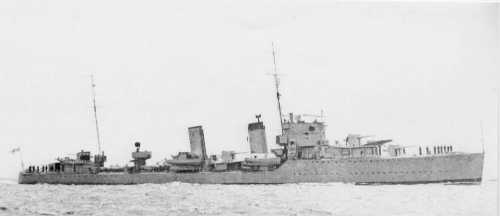
| Navy | The Royal Navy |
| Type | Destroyer |
| Class | A |
| Pennant | D 65 |
| Mod | Flotilla leader |
| Built by | Swan Hunter and Wigham Richardson Ltd. (Wallsend-on-Tyne, U.K.): Wallsend |
| Ordered | 29 May 1928 |
| Laid down | 20 Jun 1928 |
| Launched | 8 Aug 1929 |
| Commissioned | 4 Jun 1930 |
| Lost | 27 Jul 1940 |
| History | HMS Codrington proved to be a fast ship, reaching 37.7 knots on a displacement of 1.674 tons with 39.257shp during 6-hour full-power trials, but her gearing was noisy and had to be re-cut before final acceptance. Also Codrington had a large turing circle. HMS Codrington (Capt. George Frederick Stevens-Guille, OBE, DSO, RN) was sunk at Dover by German aircraft on 27 July 1940. |
Commands listed for HMS Codrington (D 65)
Please note that we're still working on this section
and that we only list Commanding Officers for the duration of the Second World War.
| Commander | From | To | |
| 1 | Capt. David James Robert Simson, RN | 24 Aug 1939 | 26 Nov 1939 |
| 2 | Cdr. Caspar Silas Balfour Swinley, RN | 26 Nov 1939 | 8 Feb 1940 |
| 3 | Capt. George Elvey Creasy, RN | 8 Feb 1940 | 16 May 1940 |
| 4 | Capt. George Frederick Stevens-Guille, DSO, OBE, RN | 16 May 1940 | 27 Jul 1940 |
You can help improve our commands section
Click here to Submit events/comments/updates for this vessel.
Please use this if you spot mistakes or want to improve this ships page.
Notable events involving Codrington include:
21 Sep 1939
HMS Cairo (Capt. H.P.K. Oram, RN), HMS Codrington (Capt. D.J.R. Simson, RN), HMS Blanche (Lt.Cdr. R.N. Aubrey, RN), HMS Beagle (Lt.Cdr. R.H. Wright, RN) and HMS Boadicea (Lt.Cdr. G.B. Kingdon, RN) departed Dover for a sweep towards the Dutch coast to intercept German shipping. (1)
22 Sep 1939
While returning from their fruitless sweep towards the Dutch coast, HMS Cairo (Capt. H.P.K. Oram, RN), HMS Codrington (Capt. D.J.R. Simson, RN), HMS Blanche (Lt.Cdr. R.N. Aubrey, RN), HMS Beagle (Lt.Cdr. R.H. Wright, RN) and HMS Boadicea (Lt.Cdr. G.B. Kingdon, RN) provided cover for convoy FN 9 which was a large convoy on passage from Southend to Methil.
They escorted the convoy until shortly before midnight when they turned south. (1)
7 Apr 1940
In the evening, ships from the Home Fleet; battleships HMS Rodney (Capt. F.H.G. Dalrymple-Hamilton, RN, flying the flag of Admiral J.M. Forbes, KCB, DSO, RN), HMS Valiant (Capt. H.B. Rawlings, OBE, RN), battlecruiser HMS Repulse (Capt. E.J. Spooner, DSO, RN), light cruisers HMS Penelope (Capt. G.D. Yates, RN), HMS Sheffield (Capt. C.A.A. Larcom, RN), Emile Bertin (Capt. R.M.J. Battet), with destroyers HMS Codrington (Capt. G.E. Creasy, MVO, RN), HMS Brazen (Lt.Cdr. M. Culme-Seymour, RN), HMS Electra (Lt.Cdr. S.A. Buss, MVO, RN), HMS Escapade (Cdr. H.R. Graham, RN), HMS Griffin (Lt.Cdr. J. Lee-Barber, RN), HMS Bedouin (Cdr. J.A. McCoy, RN), HMS Eskimo (Cdr. St.J.A. Micklethwait, DSO, RN), HMS Punjabi (Cdr. J.T. Lean, RN), HMS Jupiter (Cdr. D.B. Wyburd, RN) and HMS Kimberley (Lt.Cdr. R.G.K. Knowling, RN) departed from Scapa Flow to patrol in Norwegian waters near position 61°00'N, 01°00'E.
10 Apr 1940
Around 1530 hours the destroyers HMS Jupiter (Cdr. D.B. Wyburd, RN), HMS Afridi (Capt. P.L. Vian, RN), HMS Mashona (Cdr. W.H. Selby, RN), HMS Mohawk (Cdr. J.W.M. Eaton, RN), HMS Somali (Capt. R.S.G. Nicholson, DSO, DSC, RN), HMS Electra (Lt.Cdr. S.A. Buss, MVO, RN), HMS Escapade (Cdr. H.R. Graham, RN), HMS Brazen (Lt.Cdr. M. Culme-Seymour, RN) and HMS Codrington (Capt. G.E. Creasy, MVO, RN) arrived at Sullom Voe to fuel. (2)
11 Apr 1940
Convoy NP 1.
This troop convoy departed the Clyde on 11 April 1940 for Harstad, Norway. In the end the convoy was split up and one part arrived at Harstad on 15 April. The other part arrived off Namsos on 16 April.
It was made up of the troopships Empress of Australia (British, 21833 GRT, built 1914), Monarch of Bermuda (British, 22424 GRT, built 1931) and Reina del Pacifico (British, 17702 GRT, built 1931).
They were escorted by the destroyer HMS Amazon (Lt.Cdr. N.E.G. Roper, RN).
Early in the afternoon of 12 April the troopships Batory (Polish, 14387 GRT, built 1936) and Chrobry (Polish, 11442 GRT, built 1939) departed Scapa Flow to join convoy NP 1 at sea.
They were escorted by the destroyers HMS Highlander (Cdr. W.A. Dallmeyer, RN), HMS Vanoc (Lt.Cdr. J.G.W. Deneys, RN), HMS Volunteer (Lt.Cdr. N. Lanyon, RN), HMS Whirlwind (Lt.Cdr. J.M. Rodgers, RN) and HMS Witherington (Lt.Cdr. J.B. Palmer, RN). The netlayer HMS Protector (Capt. W.Y la L. Beverley, RN) also departed Scapa Flow with these ships.
Around 1600/12, the light cruisers HMS Manchester (Capt. H.A. Packer, RN, flying the flag of Vice Admiral G. Layton, CB, DSO, RN) and HMS Birmingham (Capt. A.C.G. Madden, RN) departed Scapa Flow to join the convoy at sea which they did around 1945/12.
Shortly afterwards the convoy was also joined by the AA cruiser HMS Cairo (Capt. P.V. McLaughlin, RN) and the destroyers HMS Brazen (Lt.Cdr. M. Culme-Seymour, RN), HMS Fearless (Cdr. K.L. Harkness, RN) and HMS Griffin (Lt.Cdr. J. Lee-Barber, RN) which had sailed from Sullom Voe around 1130/12.
Late in the evening of 12 April repair ship HMS Vindictive (Capt. A.R. Halfhide, RN) escorted by the destroyers HMS Codrington (Capt. G.E. Creasy, MVO, RN), HMS Acasta (Cdr. C.E. Glasfurd, RN) and HMS Ardent (Lt.Cdr. J.F. Barker, RN) departed Scapa Flow to join the convoy which they did late in the afternoon of the 13th.
Coming south from a patrol off the Vestfjord area were the battleship HMS Valiant (Capt. H.B. Rawlings, OBE, RN), battlecruiser HMS Repulse (Capt. E.J. Spooner, DSO, RN) and the destroyers HMS Janus (Cdr. J.A.W. Tothill, RN), HMS Javelin (Cdr. A.F. Pugsley, RN) and HMS Juno (Cdr. W.E. Wilson, RN). These ships made rendez-vous with the convoy in the afternoon of the 13th after which HMS Repulse with the three J-class destroyers continued on towards Scapa Flow while HMS Valiant joined the convoy.
On April 14th it was decided that some of the troops were to be sent to Namsos and the convoy split up;
Troopships Chrobry and Empress of Australia escorted by the light cruisers HMS Manchester and HMS Birmingham, AA cruiser HMS Cairo and the destroyers HMS Highlander, HMS Vanoc and HMS Whirlwind split off late in the afternoon. This convoy arrived off Namsos early in the morning of the 16th.
The remainder of the ships; troopships Batory, Monarch of Bermuda, Reina del Pacifico, repair ship HMS Vindictive and netlayer HMS Protector with their escort made up of the battleship HMS Valiant and the destroyers HMS Codrington, HMS Amazon, HMS Acasta, HMS Ardent, HMS Brazen, HMS Fearless, HMS Griffin, HMS Volunteer and HMS Witherington arrived at Vaagsfjord late in the morning of the 15th. They had been escorted in by the light cruisers HMS Southampton (Capt. F.W.H. Jeans, CVO, RN) and HMS Aurora (Capt. L.H.K. Hamilton, DSO, RN).
22 May 1940
Operation Lamp.
Cutting of underwater telephone line between Amsterdam and the U.K.
During 22 to 24 May 1940, the submarine HMS Salmon (Cdr. E.O. Bickford, DSO, RN), assisted the trawler Barbados in the attempted cutting of an underwater cable between the Netherlands and the U.K. The operation was covered by the British destroyers HMS Codrington (Capt. G.F. Stevens-Guille, DSO, OBE, RN) and HMS Jaguar (Lt.Cdr. J.F.W. Hine RN). The operation was not successful. (3)
28 May 1940
HMS Codrington (Capt. G.F. Stevens-Guille, DSO, OBE, RN), HMS Grenade (Cdr. R.C. Boyle, RN), HMS Jaguar (Lt.Cdr. J.F.W. Hine, RN) and HMS Javelin (Cdr. A.F. Pugsley, RN) departed Harwich for patrol. Later they were ordered to proceed to Dunkirk to pick up troops.
En-route HMS Codrington, HMS Jaguar and HMS Javelin picked up thirty-three survivors from the British merchant vessel Abukir which had been sunk with troops on board she had taken off at Ostend, Belgium.
Apparently these three destroyers then proceeded to Dunkirk.
27 Jul 1940
Sunk in secret losses due to marine hazards and during air-raids on harbours. Loss announced, in UK, 18 May 1945 (4)
Media links
|
|
Sources
- ADM 53/107790
- ADM 199/376
- ADM 199/373
- Personal communication
ADM numbers indicate documents at the British National Archives at Kew, London.
As an Amazon Associate uboat.net earns a commission from qualifying purchases.