
Allied Warships
HMS Hecla (i) (F 20)
Destroyer Depot Ship of the Hecla class
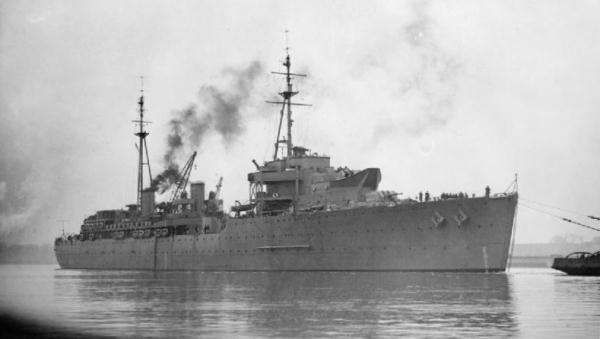
Photo from Imperial War Museum (IWM), FL-22892
| Navy | The Royal Navy |
| Type | Destroyer Depot Ship |
| Class | Hecla |
| Pennant | F 20 |
| Built by | John Brown Shipbuilding & Engineering Company Ltd. (Clydebank, Scotland) |
| Ordered | |
| Laid down | 23 Jan 1939 |
| Launched | 14 Mar 1940 |
| Commissioned | 6 Jan 1941 |
| Lost | 12 Nov 1942 |
| Loss position | 35° 43'N, 9° 54'W |
| History | In 1941 HMS Hecla was based at Hvalfjord, Iceland, she tended the captured German U-boat U-570 until the boat was towed to UK and renamed HMS Graph. On 16 April 1942 the German minelayer Doggerbank laid 80 EMC mines in 5 sections off Cape Agulhas. On May 15th whilst on passage eastward to join the Far Eastern Fleet she struck a mine in one of these sectors, Hecla was seriously damaged, but managed to reach Simonstown towed by the cruiser HMS Gambia, and the South African Naval Forces two minesweepers Southern Barrier and Terje who swept ahead of the escort. On immediate arrival she was placed in the Selborne dry dock. June was spent in the Selborne dry dock affecting repairs to the underwater damage. The explosion had occurred under her huge workshops and storerooms. Dozens of torpedoes and mines were scattered and destroyed, but fortunately none exploded. A total of 24 men lost their lives, and 112 were wounded. The dead were buried in False Bay Simonstown. July was spent conducting trials in False Bay. August - September, was again spent in the dry dock, later during September she was declared operational. On November 12th, during the Allied landings in North Africa, HMS Hecla (A/Capt. George Vivian Barnett Faulkner, RN) was torpedoed just after midnight by U-515 and sunk west of Gibraltar in position 35º43'N, 09º54'W. The escorting destroyer HMS Marne was also torpedoed whilst attempting to rescue the survivors, and the destroyer had to be towed to Gibraltar. The destroyer HMS Venomous succeeded in rescuing more survivors from Hecla and landed them at Casablanca. In all 279 off her crew went down with the ship and 568 men were rescued. Hit by U-boat |
| U-boat Attack | See our U-boat attack entry for the HMS Hecla (i) |
Commands listed for HMS Hecla (i) (F 20)
Please note that we're still working on this section
and that we only list Commanding Officers for the duration of the Second World War.
| Commander | From | To | |
| 1 | Commodore 2nd cl. Cyril George Bucknill Coltart, RN | 30 Sep 1940 | early 1942 |
| 2 | Cdr. Percy James Oliver, RN | early 1942 | 2 Apr 1942 |
| 3 | A/Cdr. John Rochfort D'Oyly, RN | 2 Apr 1942 | 6 Apr 1942 |
| 4 | Capt. Edward Francis Bold Law, RN | 6 Apr 1942 | 21 Aug 1942 |
| 5 | A/Cdr. John Rochfort D'Oyly, RN | 21 Aug 1942 | 2 Nov 1942 |
| 6 | A/Capt. George Vivian Barnett Faulkner, RN | 2 Nov 1942 | 12 Nov 1942 |
You can help improve our commands section
Click here to Submit events/comments/updates for this vessel.
Please use this if you spot mistakes or want to improve this ships page.
Notable events involving Hecla (i) include:
16 Apr 1942
Convoy WS 18.
This convoy was assembled off Oversay on 16 April 1942.
It was made up of the following (troop) transports; Aorangi (British, 17491 GRT, built 1924), Capetown Castle (British, 27000 GRT, built 1938), City of Capetown (British, 8046 GRT, built 1937), Clan Lamont (British, 7250 GRT, built 1939), Dempo (Dutch, 17024 GRT, built 1931, Duchess of Bedford (British, 20123 GRT, built 1928), Empress of Canada (British, 21517 GRT, built 1922), Empress of Japan (British, 26032 GRT, built 1930), Highland Chieftain (British, 14135 GRT, built 1929), Highland Princess (British, 14133 GRT, built 1930), Maloja (British, 20914 GRT, built 1923), Marnix van St. Aldegonde (Dutch, 19355 GRT, built 1930), Nieuw Zeeland (Dutch, 11069 GRT, built 1928), Orbita (British, 15495 GRT, built 1915), Orduna (British, 15507 GRT, built 1914), Phemius (British, 7406 GRT, built 1921), Rangitata (British, 16737 GRT, built 1929), Reina del Pacifico (British, 17702 GRT, built 1931), Soudan (British, 6677 GRT, built 1931) and Waipawa (British, 12436 GRT, built 1934).
The destroyer tender HMS Hecla (Capt. E.F.B. Law, RN) was also part of the convoy.
On assembly from Oversay the convoy was escorted by the light cruiser HMS Gambia (Capt. M.J. Mansergh, CBE, RN, Senior Officer), heavy cruiser HMS Frobisher (Capt. J.F.W. Mudford, RN), destroyers HMS Georgetown (Lt.Cdr. P.G. MacIver, RNR), HMS Lancaster (A/Cdr. N.H. Whatley, RN), HMS Salisbury (Lt.Cdr. M.H.R. Crichton, RN), HMS St. Marys (Lt.Cdr. K.H.J.L. Phibbs, RN), HMS Volunteer (Lt. A.S. Pomeroy, RN), HMS Boadicea (Lt.Cdr. F.C. Brodrick, RN), HrMs Van Galen (Lt.Cdr. F.T. Burghard, RNethN) and the destroyer escorts HMS Badsworth (Lt. G.T.S. Gray, DSC, RN), HMS Lauderdale (Lt. G.D. Pound, DSC, RN) and HMS Tetcott (Lt. R.H. Rycroft, RN).
Around 0700N/19, HMS Badsworth and HMS Lauderdale parted company to return to the U.K.
Around 1900N/19, HMS Lancaster, HMS St. Marys, HMS Boadicea and HMS Volunteer parted company to return to the U.K.
Around 2000N/19, HrMs Van Galen and HMS Tetcott parted company to refuel at Ponta Delgada, Azores and to rejoin the convoy on completion. The departed Ponta Delgada to rejoin the convoy on the 20th.
Around 0915N/21, HMS Georgetown and HMS Salisbury parted company to refuel at Ponta Delgada, Azores.
Around 1900N/22, HrMs Van Galen rejoined.
Around 1030N/23, HMS Tetcott rejoined. Both had been delayed in rejoining the convoy due to them having difficulty finding the convoy.
Around 0930N/26, the destroyers HMS Wild Swan (Lt.Cdr. C.E.L. Sclater, RN), HMS Boreas (Lt.Cdr. E.L. Jones, DSC, RN) and the corvette HMS Petunia (Lt.Cdr. J.M. Rayner, RD, RNR) joined.
The convoy arrived at Freetown on 29 April 1942.
-----------------------------------------------------------------------------------------------------------------
The convoy departed Freetown on 3 May 1942 in the same composition with the addition of the troop transport Rimutaka (British, 16576 GRT, built 1923), transport Agwileon (American, 6678 GRT, built 1907) and the seaplane carrier HMS Albatross (A/Capt. F.W.H. Clarke, RN).
Escort on departure from Freetown was provided by the light cruiser HMS Gambia, heavy cruiser HMS Frobisher, destroyers HMS Wivern (Cdr. M.D.C. Meyrick, RN), HMS Boreas, HrMs Van Galen and escort destroyer Tetcott.
Around 1245Z/4, the corvette HMS Hydrangea (A/Lt.Cdr. J.E. Woolfenden, RNR) joined. The corvette FFS Commandant Detroyant was also to have joined the convoy but failed to do so.
Around 1430Z/4, HMS Wivern and HMS Boreas were detached.
Around 1020Z/5, HMS Hydrangea parted company.
In the morning of 8 May 1942, HMS Frobisher fuelled HMS Tetcott and on completion of doing so parted company with the convoy around 1315Z/8 to escort the Agwileon to Walvis Bay. This ship was detached from the convoy as she was unable to keep up.
In the morning of 9 May 1942, HMS Gambia fuelled HrMs Van Galen however after only 57 tons of fuel had been transferred to hose parted due to the bad weather conditions. These two ships then parted company with the convoy to proceed to St. Helena, which was only 52 nautical miles away, where they were able to complete fuelling (another 155 tons was transferred) while at anchor. HMS Gambia rejoined the convoy around 1550A/10. HrMS Van Galen proceeded independently to Capetown arriving there on 22 May 1942.
Late in the morning of the 14th, HMS Gambia transferred 20 tons of fuel to HMS Tetcott which was running low.
Around 1300B/14, the A/S whalers HMS Southern Gem (T/Lt. D.C. Hayes, RNVR) and HMS Southern Pride (T/Lt. F.A. Darrah, RNVR) joined.
Around 0300B/15, the Capetown section parted company. It was made up of the Dempo, Empress of Canada, Marnix van St. Aldegonde, Nieuw Zeeland, Orbita, Orduna, Phemius, Reina del Pacifico, Rimutaka and Waipawa. HMS Albatross, HMS Tetcott, HMS Southern Gem and HMS Southern Pride went with them. The Capetown section arrived there later the same morning.
The remainder of the convoy continued on to Durban escorted by HMS Gambia.
At 1600B/15, HMS Hecla suffered a heavy explosion on the starboard side. Position was to the south of Cape Aghulas, in 36°06'S, 19°55'E. It was though that she had been torpedoed but this was soon changed to being mined. HMS Gambia stood by the stricken vessel. Later it was found out that also the transport Soudan had also been mined and had been sunk as a result of the damage sustained.
HMS Hecla and HMS Gambia arrived off Simonstown around 0800B/16. HMS Hecla was immediately docked in the Selborne dry dock.
The Durban section of convoy WS 18 was then joined around 1000B/16 by the AA cruiser HMS Carlisle (Capt. D.M.L. Neame, DSO, RN). This ship had been en-route from Durban to Simonstown and had now been ordered to escort the Durban section with HMS Gambia absent.
The Durban section arrived at Durban around noon on the 18th.
-----------------------------------------------------------------------------------------------------------------
On 19 May 1942, the Capetown section of the convoy departed from there. It was now made up of the Bulkoil (American (tanker), 8071 GRT, built 1942), Dempo, Empress of Canada, Marnix van St. Aldegonde, Nieuw Zeeland, Orbita, Orduna, Phemius, Reina del Pacifico and Waipawa. HMS Albatross was also with the convoy which was escorted by HMS Frobisher. The Phemus however had to return to Capetown later the same day.
On 23 May 1942, the Durban section of the convoy departed from there. It was made up of the Capetown Castle, City of Capetown, Clan Lamont (British, 7250 GRT, built 1935), Empire Woodlark (British, 7793 GRT, built 1913) and Llandaff Castle (British, 10799 GRT, built 1926). They were escorted by the battleship HMS Resolution (Capt. A.R. Halfhide, CBE, RN).
The two sections then merged, but the Reina del Pacifico was detached to proceed independently to Bombay arriving there on 2 June.
Around 0615C/27, the Phemus rejoined the convoy after having returned to Capetown on the 19th.
Around 2300C/27, the Llandaff Castle parted company with the convoy to proceed to Diego Suarez. HMS Frobisher went with her as escort. They arrived there around 2000C/29.
Around 1330C/30, the light cruisers HMS Emerald (Capt. F.C. Flynn, RN) and HMS Enterprise (Capt. J.C.A. Annesley, DSO, RN) joined. HMS Resolution, HMS Albatross and the Empire Woodlark then parted company to proceed to Kilindini where they arrived the following morning.
At 0745D/31, the armed merchant cruiser HMS Worcestershire (A/Capt.(Retd.) E.H. Hopkinson, RN) joined. HMS Emerald then parted company.
Around 1530D/2, HMS Worcestershire parted company taking the Bulkoil, Phemius and Waipawa with her to Aden where they arrived around 0900C/4.
The remainder of the convoy continued on towards Bombay escorted by HMS Enterprise. It arrived at Bombay around 1100FG/7. (1)
15 May 1942
HMS Hecla (Capt. E.F.B. Law, RN) was mined off Cape town, South Africa. She was towed to Simonstown for 18 weeks of repairs.
18 Aug 1942
HMS Hecla (Capt. E.F.B. Law, RN) is undocked at the Simonstown Dockyard. (2)
21 Sep 1942
HMS Hecla (A/Cdr. J.R. D'Oyly, RN) is docked at the Simonstown Dockyard. She was undocked again later the same day. (3)
20 Oct 1942
Around 1400C/20, the heavy cruiser HMS Shropshire (Capt. J.T. Borrett, OBE, RN), destroyers HMS Arrow (Cdr. A.M. McKillop, RN), HMS Active (Lt.Cdr. M.W. Tomkinson, RN) and destroyer depot ship HMS Hecla (A/Cdr. J.R. D'Oyly, RN) departed Simonstown to join convoy CF 7 which was to depart from Capetown.
[For more info on this convoy see the event ' Convoy CF 7 ' for 20 October 1942.] (4)
20 Oct 1942
Convoy CF 7.
This convoy departed Capetown on 20 October 1942.
It was made up of the troop transports; Antenor (British, 11174 GRT, built 1925), Highland Brigade (British, 14134 GRT, built 1929), Maloja (British, 20914 GRT, built 1923) and Samaria (British, 19597 GRT, built 1921).
Off Capetown the convoy was joined by the destroyer depot ship HMS Hecla (A/Cdr. J.R. D'Oyly, RN) which came from Simonstown.
HMS Hecla had been escorted by the heavy cruiser HMS Shropshire (Capt. J.T. Borrett, OBE, RN) and the destroyers HMS Arrow (Cdr. A.M. McKillop, RN) and HMS Active (Lt.Cdr. M.W. Tomkinson, RN) which were also the convoy escort.
Around 0905B/27, HMS Arrow parted company with the convoy to proceed to Pointe Noire to fuel.
Around 1000B/27, HMS Active parted company with the convoy to proceed to Pointe Noire to fuel.
Around 1050B/27, the corvette HMS Amaranthus (T/Lt. W.S. Thomson, RNR) joined the convoy.
Around 1800B/27, the corvette HMS Tamarisk (Lt. S. Ayles, RNR) joined the convoy.
Around 1800B/28, HMS Arrow and HMS Active rejoined the convoy from Pointe Noire.
Around 0730A/30, the auxiliary A/S whaler HMS Southern Pride (T/Lt. F.A. Darrah, RNVR) joined the convoy. HMS Tamarisk then parted company to proceed to Lagos.
The convoy arrived at Freetown on 2 November 1942.
4 Nov 1942
Convoy CF 7A.
This convoy departed Freetown on 4 November 1942.
It was made up of the troop transports; Antenor (British, 11174 GRT, built 1925), Highland Brigade (British, 14134 GRT, built 1929), Maloja (British, 20914 GRT, built 1923), Samaria (British, 19597 GRT, built 1921) and Volendam (British, 15434 GRT, built 1922).
The destroyer depot ship HMS Hecla (A/Cdr. J.R. D'Oyly, RN) and repair ship HMS Vindictive (Capt. H.G.D. Acland, DSO, RN) were also part of the convoy.
On departure from Freetown the convoy was escorted by the heavy cruiser HMS Shropshire (Capt. J.T. Borrett, OBE, RN), destroyers HMS Arrow (Cdr. A.M. McKillop, RN) and HMS Active (Lt.Cdr. M.W. Tomkinson, RN) and sloop HMS Bridgewater (Cdr.(Retd.) N.W.H. Weekes, OBE, RN).
Around 1110Z/9, the destroyer HMS Marne (Lt.Cdr. H.N.A. Richardson, DSO, DSC, RN) joined the convoy.
Around 1225Z/9, the destroyer HMS Venomous (Cdr. H.W. Falcon-Stewart, RN) joined the convoy.
Around 1235Z/9, HMS Hecla and HMS Vindictive parted company with the convoy to proceed to Gibraltar escorted by HMS Marne and HMS Venomous.
Around 0800N/11, the destroyers HMS Duncan (Capt. H.St.L. Nicolson, DSO, RN) and HMS Anthony (Lt.Cdr. J.M. Hodges, DSO, RN) joined the convoy. HMS Arrow and HMS Active then parted company to proceed to Ponta Delgada, Azores.
Around 0945N/12, HMS Arrow and HMS Active rejoined the convoy. HMS Bridgewater then parted company to proceed to Ponta Delgada, Azores to fuel and then return to Freetown.
The convoy arrived at Liverpool on 17 November 1942 escorted by HMS Arrow and HMS Active.
The Highland Brigade had been detached on the 16th to Belfast and HMS Shropshire, HMS Duncan and HMS Anthony had proceed to the Clyde also arriving on the 16th.
12 Nov 1942
At 00.15 hours on 12 November 1942 German U-boat U-515 fired a spread of four torpedoes at the British destroyer tender HMS Hecla which was misidentified as a Birmingham class light cruiser and hit her in the engine room. Two torpedoes were surface-runners and the last also malfunctioned and was a circle-runner. The U-boat then hit the ship with three coups de gr?ce at 01.28, 01.49 and 02.06 hours, sinking the vessel.
At 02.11 hours, U-515 fired two torpedoes and badly damaged the escorting HMS Marne (Lt.Cdr. H.N.A. Richardson, DSO, DSC, RN)
Sources
- ADM 199/1211
- ADM 53/115563
- ADM 53/115564
- ADM 53/116654 + ADM 187/21
ADM numbers indicate documents at the British National Archives at Kew, London.