
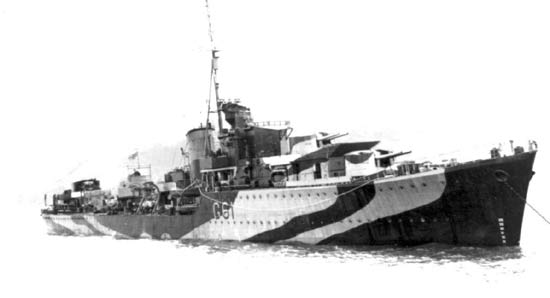
The destroyer HMS Javelin (F 61) of the Royal Navy.
Technical information
| Type | Destroyer |
| Displacement | 1690 (Jervis 1695) BRT |
| Length | 357 feet (oa) |
| Complement | 183 (Jervis 218) men |
| Armament | 6 4.7" guns (3x2) 4 2pdr AA (1x4) 8 .5" MG AA (2x4) 10 21" torpedo tubes (2x5) |
| Max speed | 36 knots |
| Engines | Geared turbines, 2 shafts |
| Power | 40000 HP |
| Notes on class | The J, K and N Class ships were developed as a result of the Admiralty under pressure to cut costs but requiring more new and powerful destroyers. The cost of further Tribal Class ships was attractive but could not be justified on cost grounds. The Staff requirement also required a return to a heavy torpedo outfit. While some see these ships as cut down versions of the Tribal Class they were the first to see the introduction on Longitudinal Frames and other weight saving methods of construction. Several ships owed this method of construction to their survival, HMS Javelin was mined and reduced to less than half her original length, but she was towed in and repaired. Many of the J and K Classes served and were lost in the Mediterranean they participated in many successful engagements, accounting for Italian cruisers, destroyers and many merchant ships. Pennant numbers changes from F .. to G .. in late 1940 (in or around December). |
All ships of the J class
| ||
 | HMS Jackal (F 22) | Lost on 12 May 1942 |
| | HMS Jaguar (F 34) | Lost on 26 Mar 1942 |
| | HMS Janus (F 53) | Lost on 23 Jan 1944 |
| | HMS Javelin (F 61) | |
| | HMS Jersey (F 72) | Lost on 2 May 1941 |
| HMS Juno (F 46) | Lost on 21 May 1941 | |
| | HMS Jupiter (F 85) | Lost on 27 Feb 1942 |
Flotilla leader | ||
| ||
| | HMS Jervis (F 00) | |
Full wartime service history on this vessel. | ||
 Royal Navy (more on
 See all Destroyer classes.
|
J class ships hit by U-boats (1) | |||
| 26 Mar 1942 | HMS Jaguar | Sunk | U-652 |
 The last stand of the tin can sailors Hornfischer, James D. |
Books dealing with this subject include:
|
