

| Navy | The Royal Navy |
| Type | Destroyer |
| Class | I |
| Pennant | D 02 |
| Mod | Flotilla leader |
| Built by | Cammell Laird Shipyard (Birkenhead, U.K.) |
| Ordered | 14 Nov 1935 |
| Laid down | 29 Apr 1936 |
| Launched | 15 Oct 1936 |
| Commissioned | 25 Jun 1937 |
| Lost | 25 Feb 1944 |
| Loss position | 41° 26'N, 12° 38'E |
| History | HMS Inglefield (A/Cdr. Charles Fraser Harrington Churchill, DSC, RN) was sunk by a German radio controlled glider bomb off Anzio, Italy in position 41º26'N, 12º38'E. |
Commands listed for HMS Inglefield (D 02)
Please note that we're still working on this section
and that we only list Commanding Officers for the duration of the Second World War.
| Commander | From | To | |
| 1 | Capt. Arthur George Talbot, RN | 7 May 1937 | 7 Nov 1939 |
| 2 | Capt. Percy Todd, RN | 7 Nov 1939 | 19 May 1942 |
| 3 | Cdr. Arthur George West, RN | 8 Jun 1942 | |
| 4 | Lt.Cdr. Richard Horncastle, RN | 3 Jun 1943 | |
| 5 | A/Cdr. Charles Fraser Harrington Churchill, RN | 3 Jun 1943 | 25 Feb 1944 |
You can help improve our commands section
Click here to Submit events/comments/updates for this vessel.
Please use this if you spot mistakes or want to improve this ships page.
Notable events involving Inglefield include:
16 Sep 1939
HMS Courageous (Capt. W.T. Makeig-Jones, RN) departed Plymouth for an anti-submarine patrol in the Western Approaches. She was escorted by the destroyers HMS Inglefield (Capt. A.G. Talbot, RN), HMS Ivanhoe (Cdr. B. Jones, RN), HMS Impulsive (Lt.Cdr. W.S. Thomas, RN) and HMS Intrepid (Cdr. J.W. Josselyn, RN) of which the last one listed joined later at sea as she was unable to depart Plymouth on time.
In the evening HMS Impulsive attacked a submarine contact and HMS Inglefield went to assist but the contact was classified as 'non-sub' and both destroyers then re-joined the screen.
17 Sep 1939
The sinking of HMS Courageous.
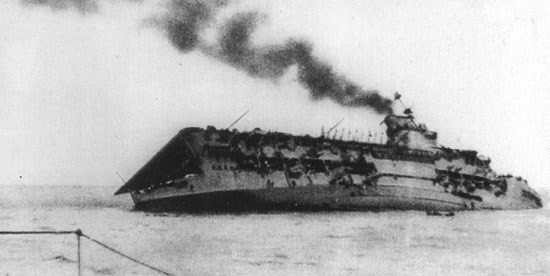 HMS Courageous sinking as seen from one of the escorting destroyers.
HMS Courageous (Capt. W.T. Makeig-Jones, RN) was on anti-submarine patrol about 350 nautical miles west of Lands End, still escorted by HMS Inglefield (Capt. A.G. Talbot, RN), HMS Ivanhoe (Cdr. B. Jones, RN), HMS Impulsive (Lt.Cdr. W.S. Thomas, RN) and HMS Intrepid (Cdr. J.W. Josselyn, RN).
At 1445 hours, the group picked up a distress call from the British merchant Kafiristan that was being attacked by the German submarine U-53 about 350 miles west of Cape Clear. The destroyers HMS Inglefield and HMS Intrepid were detached and the carrier launched four Swordfish aircraft, one of them forced the U-boat to dive without damaging it at 1700 hours.
At about 1800 hours, another U-boat, U-29, spotted the carrier group and began chasing it, but had no chance to get into a favorable attack position until the carrier turned into the wind to recover the four Swordfish returning from the search for U-53. She was now heading on a straight course at 18 knots towards the U-boat which attacked only five minutes after the last aircraft landed. At 1950 hours, U-29 fired a spread of three G7e torpedoes at HMS Courageous and hit her with two of them on the port side abaft the bridge. She almost immediately took a heavy list to port and sank after 17 minutes about 190 miles southwest of Dursey Head, Ireland.
The Commanding Officer, 17 other officers and 501 ratings were lost, including 36 RAF service crewmen. All Swordfish aircraft of 811 and 822 Sqdn FAA were lost with the ship.
While HMS Ivanhoe attacked U-29 with depth charges, HMS Impulsive began to rescue the survivors and was soon joined by the American merchant Collingsworth, the British merchant Dido and the Dutch passenger ship Veendam, which launched 14 lifeboats and also saved the ships log. The rescue work proved difficult due to the heavily oiled sea. Further help arrived when HMS Kempenfelt (Capt. C. Caslon, RN) and HMS Echo (Cdr. S.H.K. Spurgeon, RAN) joined HMS Ivanhoe in the submarine hunt together with the by now returned HMS Intrepid, but the U-boat escaped during the night. Also two light cruisers, HMS Caradoc (Capt. E.W.L. Longley-Cook, RN) and HMS Ceres (Capt. E.G. Abbott, AM, RN) arrived at the scene together with the destroyer HMS Kelly (Capt. L.F.A.V.N. Mountbatten, GCVO, RN), but the cruisers were soon ordered away.
The merchant Dido had picked up 23 officers and 195 ratings and was escorted to Liverpool by HMS Intrepid. The survivors rescued by the neutral merchants were transferred to HMS Inglefield and HMS Kelly and arrived at Devonport (Plymouth) on the afternoon of 19 September.
After this loss and the unsuccessful attack of U-39 on HMS Ark Royal (Capt. A.J. Power, RN) only three days earlier, carriers were withdrawn from such patrols as they were considered to be to valuable.
28 Sep 1939
Convoy Red 2.
This convoy departed Southampton on 29 September 1939.
It was made up of the liners (serving as troopships); Athlone Castle (British, 25564 GRT, built 1936), Empress of Australia (British, 21833 GRT, built 1914) and Franconia (British, 20175 GRT, built 1923).
The armed merchant cruiser (not outfitted yet) HMS Alcantara (Capt.(Retd.) J.G.P. Ingham, DSO, RN) was also part of the convoy.
The convoy was escorted by the destroyers HMS Inglefield (Capt. A.G. Talbot, RN) and HMS Ivanhoe (Cdr. B. Jones, RN) which joined in Spithead early on the 29th.
The convoy arrived at Gibraltar on 3 October 1939.
The convoy, less the Athlone Castle departed Gibraltar later the same day. The convoy was now escorted by the destroyers HMS Greyhound (Cdr. W.R. Marshall A'Deane, RN) and HMS Glowworm (Lt.Cdr. G.B. Roope, RN).
At 0815A/5, the destroyers HMS Decoy (Cdr. E.G. McGregor, RN) and HMS Delight (Cdr. M. Fogg-Elliott, RN), which came from Malta, took over from HMS Greyhound and HMS Gipsy which then parted company.
At 1746A/5, HMS Alcantara and the Franconia collided. Both ships were damaged.
The convoy arrived at Malta on 6 October 1939.
The convoy departed Malta on 7 October 1939 but was now only made up of the Empress of Australia. She was now escorted by the destroyers HMS Grenville (Capt. G.E. Creasy, MVO, RN) and HMS Gipsy (Lt.Cdr. N.J. Crossley, RN).
The convoy arrived at Alexandria on 9 October 1939.
7 Oct 1939
Around 1100A/7, the battleships HMS Resolution (Capt. C.H. Knox-Little, RN, flying the flag of Rear-Admiral L.E. Holland, CB, RN), HMS Revenge (Capt. E.R. Archer, RN) and the destroyers HMS Wolverine (Cdr. R.C. Gordon, RN), HMS Witherington (Lt.Cdr. G.C. Fryer, RN), HMS Volunteer (Lt.Cdr. H. Gartside-Tippinge, RN) and HMS Verity (Lt.Cdr. A.R.M. Black, RN) departed Portland for Halifax, Nova Scotia. Both battleships had silver on board for safe storage in Canada.
Around 1645A/7, the light cruisers HMS Emerald (Capt. A.W.S. Agar, VC, DSO, RN), HMS Enterprise (Capt. H.J. Egerton, RN), HMS Caradoc (Capt. E.W.L. Longley-Cook, RN) and the destroyers HMS Inglefield (Capt. A.G. Talbot, RN) and HMS Ivanhoe (Cdr. B. Jones, RN), departed Plymouth. Both E-class cruiser had gold bullion on board for safe storage in Canada.
Around 1900A/7 both forces made rendezvous.
The destroyers parted company around 1930A/8.
They arrived at Halifax on the 16th and were escorted into port by the destroyers HMCS Fraser (Cdr. W.B. Creery, RCN) and HMCS St. Laurent (Lt.Cdr. H.G. de Wolf, RCN) which had joined around 0630Q/16. (1)
14 Oct 1939
German U-boat U-45 was sunk south-west of Ireland, in position 50°58'N, 12°57'W, by depth charges from the British destroyers HMS Inglefield (Capt. A.G. Talbot, RN), HMS Ivanhoe (Cdr. B. Jones, RN), HMS Intrepid (Cdr. J.W. Josselyn, RN) and HMS Icarus (Lt.Cdr. C.D. Maud, RN).
20 Nov 1939
German U-boat U-18 attacks the Royal Navy destroyer HMS Inglefield (Capt. P. Todd, RN) off Rattray Head with a spread of torpedoes but they miss their intended target.
23 Nov 1939
Sinking of the armed merchant cruiser HMS Rawalpindi
Around midday on 21 November 1939 the German battlecruisers Scharnhorst and Gneisenau, escorted by the light cruisers Köln and Leipzig and the destroyers Z 11 / Bernd von Arnim, Z 12 / Erich Giese and Z 20 / Karl Galster, departed Wilhelmshaven for a raid into the North Atlantic, this was to relieve the pressure of the pocket battleship Admiral Graf Spee operating in the South Atlantic. Late on the 21st the escorts left the battlecruisers.
Just after 1500A/23 the British armed merchant cruiser HMS Rawalpindi (Capt.(Retd.) E.C. Kennedy, RN) sighted the Scharnhorst. Rawalpindi was part of the British Northern Patrol and was stationed south-east of Iceland in the Iceland-Faroe gap. Captain Kennedy at first tried to get away from the German ship and report to the Admiralty that he sighted the German pocket battleship Deutschland, still believed to be operating in the North Atlantic, and so as to buy time so that other ships of the Northern patrol could come to his assistance. Just after 1600 hours, Rawalpindi came within range of the Scharnhorst and was quickly reduced to a flaming wreck. During this engagement Scharnhorst was hit by a 6in shell from Rawalpindi causing only light damage. Scharnhorst and Gneisenau together picked up 27 survivors from the Rawalpindi which finally sank around 2000 hours.
The British light cruiser HMS Newcastle (Capt J. Figgins, RN), that was also part of the Northern Patrol, picked up Rawalpindi's signal and closed the scene. She sighted the Gneisenau but the Germans managed to escape in the fog.
The Admiralty also thought the ship sighted by Rawalpindi and Newcastle was the Deutschland that was trying to return to Germany. In response to the sighting and destruction of the Rawalpindi the Admiralty took immediate action; The battleships HMS Nelson (Capt. G.J.A. Miles, RN, flying the flag of Admiral J.M. Forbes, KCB, DSO, RN) HMS Rodney (Capt. F.H.G. Dalrymple-Hamilton, RN) and the heavy cruiser HMS Devonshire (Capt. J.M. Mansfield, DSC, RN, flying the flag of Vice-Admiral J.H.D. Cunningham, CB, MVO, RN) escorted by the destroyers HMS Faulknor (Capt. C.S. Daniel, RN), HMS Fame (Cdr. P.N. Walter, RN), HMS Firedrake (Lt.Cdr. S.H. Norris, RN), HMS Foresight (Lt.Cdr. G.T. Lambert, RN), HMS Forester (Lt.Cdr. E.B. Tancock, RN), HMS Fortune (Cdr. E.A. Gibbs, RN) and HMS Fury (Cdr. G.F. Burghard, RN) departed the Clyde around 1930A/23 to patrol of Norway to cut off the way to Germany for the Deutschland.
The light cruisers HMS Southampton (Capt. F.W.H. Jeans, CVO, RN, flying the flag of Vice-Admiral G.F.B. Edward-Collins, CB, KCVO, RN), HMS Edinburgh (Capt. F.C. Bradley, RN) and HMS Aurora (Capt. G.B. Middleton, RN) escorted by the destroyers HMS Afridi (Capt. G.H. Creswell, DSC, RN), HMS Gurkha (Cdr. F.R. Parham, RN), HMS Bedouin (Cdr. J.A. McCoy, RN), HMS Kingston (Lt.Cdr. P. Somerville, RN) and HMS Isis (Cdr. J.C. Clouston, RN) departed Rosyth to patrol between the Orkney and Shetland islands.
Light cruiser HMS Sheffield (Capt. E. de F. Renouf, CVO, RN) was sent from Loch Ewe to the last known position of the German ship(s).
On northern patrol, south of the Faroes were the light cruisers HMS Caledon (Capt. C.P. Clark, RN), HMS Cardiff (Capt. P.K. Enright, RN) and HMS Colombo (Commodore R.J.R. Scott, RN). These were joined by HMS Dunedin (Capt. C.E. Lambe, CVO, RN) and HMS Diomede (Commodore E.B.C. Dicken, OBE, DSC, RN).
Of the ships of the Denmark strait patrol, the heavy cruisers HMS Suffolk (Capt. J.W. Durnford, RN) and HMS Norfolk (Capt. A.G.B. Wilson, MVO, DSO, RN) were ordered to proceed to the Bill Bailey Bank (to the south-west of the Faroe Islands).
The light cruiser HMS Glasgow (Capt. F.H. Pegram, RN) escorted by the destroyers HMS Maori (Cdr. G.N. Brewer, RN) and HMS Zulu (Cdr. J.S. Crawford, RN) were already at sea patrolling north-east of the Shetlands were to be joined by the destroyers HMS Inglefield (Capt. P. Todd, RN), HMS Imperial (Lt.Cdr. C.A.de W. Kitcat, RN), HMS Impulsive (Lt.Cdr. W.S. Thomas, RN) and HMS Imogen (Cdr. E.B.K. Stevens, RN).
The light cruisers HMS Calypso (Capt. N.J.W. William-Powlett, DSC, RN) and HMS Ceres (Capt. E.G. Abbott, AM, RN) were stationed off Kelso Light to act as a night attack striking force. The destroyers HMS Somali (Capt. R.S.G. Nicholson, DSC, RN), HMS Ashanti (Cdr. W.G. Davis, RN), HMS Mashona (Cdr. P.V. McLaughlin, RN) and HMS Punjabi (Cdr. J.T. Lean, RN) had just departed Belfast on escort duties. They were ordered to join Admiral Forbes. The ships they were escorting were ordered to return to Belfast.
The destroyers HMS Tartar (Lt.Cdr. D.E. Holland-Martin, RN), HMS Kandahar (Cdr. W.G.A. Robson, RN) and HMS Kashmir (Cdr. H.A. King, RN) departed Scapa Flow with orders to locate and shadow the German ships. HMS Tartar however had to return to Scapa Flow the next day due to a damaged rudder. The other two destroyers were ordered to join HMS Aurora which was to form a strike group of destroyers.
Despite the British effort to intercept the German ships, both German battlecruisers returned to Wilhelmshaven on the 27th.
27 Nov 1939
At 0015A/27, in very heavy weather and rough seas, HMS Triad (Lt.Cdr. R.McC.P. Jonas, RN), while in position 58°45'N, 05°23'E (to the south of Stavanger), developed problems with her after hydroplanes. The result of these problems is that she was not under control. Repairs could not be made and after a few hours a signal was made to base requesting a tow and escort.
Around 1100A/27 three Hudson aircraft arrived on the scene and patrolled overhead.
Around 1500A/27 the destroyers HMS Inglefield (Capt. P. Todd, RN) and HMS Maori (Cdr. G.N. Brewer, RN) arrived on the scene.
Around 1615A/27 HMS Triad was taken in tow by HMS Inglefied, however around 1800A/27 the tow parted and efforts to resume towing failed. (2)
28 Nov 1939
Several attempts to connect a towline from HMS Inglefield (Capt. P. Todd, RN) to HMS Triad (Lt.Cdr. R.McC.P. Jonas, RN) were made but all failed due to the very heavy weather and rough seas.
Around 0900A/28, HMS Triad was ordered to proceed astern up wind. A speed of two knots could be maintained.
Around 0940A/28, Three Hudson aircraft arrived to provide air cover. (2)
29 Nov 1939
Around 0900A/29, HMS Triad (Lt.Cdr. R.McC.P. Jonas, RN) was taken in tow by HMS Inglefield (Capt. P. Todd, RN) at a speed of 4 knots.
At 1140A/29, the Admiralty ordered the ships to proceed into Norwegian waters. HMS Triad was to effect repairs in neutral waters. (2)
30 Nov 1939
Around 0545A/30, HMS Triad (Lt.Cdr. R.McC.P. Jonas, RN), towed by HMS Inglefield (Capt. P. Todd, RN) and escorted by HMS Maori (Cdr. G.N. Brewer, RN) arrived in Norwegian waters in Mastrafjord.
Around 0730A/30, all ships anchored in Mastra Fjord. After talks with Norwegian officials permission was granted that Triad could make repairs to her after hydroplanes.
At 1636A/30, HMS Triad was taken in tow by a tug to Stavanger where she arrived at 2011 hours. (2)
10 Dec 1939
Convoy TC 1.
This convoy of troopships departed Halifax around 0510Q/10, for the Clyde where it arrived on 17 December 1939.
The convoy was made up of the following troopships / liners; Aquitania (British, 44786 GRT, built 1914, carrying 2638 troops), Duchess of Bedford (British, 20123 GRT, built 1928, carrying 1312 troops), Empress of Australia (British, 21833 GRT, built 1914, carrying 1235 troops), Empress of Britain (British, 42348 GRT, built 1931, carrying 1303 troops) and Monarch of Bermuda (British, 22424 GRT, built 1931, carrying 961 troops),
Close escort was provided on leaving Halifax by the battleship HMS Resolution (Capt. O. Bevir, RN) and the Canadian destroyers HMCS Fraser (Cdr. W.N. Creery, RCN), HMCS Ottawa (Capt. G.C. Jones, RCN), HMCS Restigouche (Lt.Cdr. W.B.L. Holms, RCN) and HMCS St. Laurent (Lt.Cdr. H.G. de Wolf, RCN). These Canadian destroyers remained with the convoy until 12 December 1939 when they set course to return to Halifax.
Cover for the convoy was provided by the battlecruiser HMS Repulse (Capt. E.J. Spooner, DSO, RN), aircraft carrier HMS Furious (Capt. M.L. Clarke, DSC, RN), light cruiser HMS Emerald (Capt. A.W.S. Agar, VC, DSO, RN) and the destroyers HMS Hunter (Lt.Cdr. L. de Villiers, RN) and HMS Hyperion (Cdr. H.St.L. Nicholson, RN). At dusk on the 10th both destroyers were detached to join the local escort. They returned to Halifax with the Canadian destroyers.
Early on the 15th, HMS Emerald was detached, HMS Newcastle (Capt. J. Figgins, RN) had joined the cover force in the afternoon of the 14th to take her place.
When the convoy approached the British isles, the destroyers HMS Eskimo (Cdr. St.J.A. Micklethwait, RN), HMS Bedouin (Cdr. J.A. McCoy, RN), HMS Mashona (Cdr. P.V. McLaughlin, RN), HMS Somali (Capt. R.S.G. Nicholson, DSC, RN), HMS Kandahar (Cdr. W.G.A. Robson, RN), HMS Khartoum (Cdr. D.T. Dowler, RN), HMS Kingston (Lt.Cdr. P. Somerville, RN), HMS Kashmir (Cdr. H.A. King, RN), HMS Fearless (Cdr. K.L. Harkness, RN), HMS Ilex (Lt.Cdr. P.L. Saumarez, RN) and HMS Impulsive (Lt.Cdr. W.S. Thomas, RN) departed the Clyde on the 12th to sweep ahead of the convoy. HMS Imperial (Lt.Cdr. C.A.de W. Kitcat, RN) was also to have sailed but was unable to join. HMS Matabele (Cdr. G.K. Whitmy-Smith, RN) was sailed in her place and later joined the other destroyers at sea.
After German warships had been reported in the North Sea, and concerned for the safety of convoy TC.1, Admiral Forbes, departed the Clyde on the 13th to provide additional cover with the battleships HMS Warspite (Capt. V.A.C. Crutchley, VC, DSC, RN), HMS Barham (Capt. H.T.C. Walker, RN), battlecruiser HMS Hood (Capt. I.G. Glennie, RN, flying the flag of Rear-Admiral W.J. Whitworth, CB, DSO, RN) and the destroyers HMS Inglefield (Capt. P. Todd, RN), HMS Icarus (Lt.Cdr. C.D. Maud, RN), HMS Imogen (Cdr. E.B.K. Stevens, RN), HMS Imperial, HMS Isis (Cdr. J.C. Clouston, RN) and HMS Foxhound (Lt.Cdr. P.H. Hadow, RN). The destroyers HMS Forester (Lt.Cdr. E.B. Tancock, RN) and HMS Firedrake (Lt.Cdr. S.H. Norris, RN) sailed from Loch Ewe and later joined this force at sea. Three cruisers from the Northern Patrol were ordered to patrol in position 53°55’N, 25°00’W to provide cover for the convoy. These were the heavy cruisers HMS Berwick (Capt. I.M. Palmer, DSC, RN), HMS Devonshire (Capt. J.M. Mansfield, DSC, RN, flying the flag of Vice-Admiral J.H.D. Cunningham, CB, MVO, RN) and the light cruiser HMS Glasgow (Capt. F.H. Pegram, RN).
The light cruisers HMS Southampton (Capt. F.W.H. Jeans, CVO, RN), HMS Edinburgh (Cdr. C. Wauchope, RN, temporary in command) departed Rosyth to patrol between the Shetlands and the Faroes.
The destroyers HMS Afridi (Capt. G.H. Creswell, DSC, RN), HMS Maori (Cdr. G.N. Brewer, RN) and HMS Nubian (Cdr. R.W. Ravenhill, RN) departed Rosyth and proceeded north at high speed to try to cut of the enemy warhips if they were to enter the Atlantic.
The light cruisers HMS Cardiff (Capt. P.K. Enright, RN), HMS Ceres (Capt. E.G. Abbott, AM, RN), HMS Delhi (Capt L.H.K. Hamilton, DSO, RN), HMS Diomede (Commodore E.B.C. Dicken, OBE, DSC, RN) which were on the Northern Patrol were to concentrate near the Faroes where they were joined by HMS Colombo (Commodore R.J.R. Scott, RN) and HMS Dragon (Capt. R.G. Bowes-Lyon, MVO, RN) which were on passage to their patrol stations.
Around 0430Z/17, in foggy conditions, the outward bound liner Samaria (British, 19597 GRT, built 1921) collided with both HMS Furious and the Aquitania but no major damage was done to either one of the three ships.
The convoy arrived safely in the Clyde on 17 December 1939. (3)
13 Dec 1939
The battleships HMS Warspite (Capt. V.A.C. Crutchley, VC, DSC, RN, flying the flag of Admiral J.M. Forbes, KCB, DSO, RN), HMS Barham (Capt. H.T.C. Walker, RN), battlecruiser HMS Hood (Capt. I.G. Glennie, RN, flying the flag of Rear-Admiral W.J. Whitworth, CB, DSO, RN) and the destroyers HMS Inglefield (Capt. P. Todd, RN), HMS Icarus (Lt.Cdr. C.D. Maud, RN), HMS Imogen (Cdr. E.B.K. Stevens, RN), HMS Imperial, HMS Isis (Cdr. J.C. Clouston, RN) and HMS Foxhound (Lt.Cdr. P.H. Hadow, RN) sailed from the Clyde to provide cover for convoy TC 1. This convoy transported Canadian troops to the U.K. The destroyers HMS Forester (Lt.Cdr. E.B. Tancock, RN) and HMS Firedrake (Lt.Cdr. S.H. Norris, RN) sailed from Loch Ewe and later joined this force at sea.
[For more info on convoy TC 1 see the event 'Convoy TC 1' for 10 December 1939.]
17 Dec 1939
The battleships HMS Warspite (Capt. V.A.C. Crutchley, VC, DSC, RN, flying the flag of Admiral J.M. Forbes, KCB, DSO, RN), HMS Barham (Capt. H.T.C. Walker, RN), battlecruiser HMS Hood (Capt. I.G. Glennie, RN, flying the flag of Rear-Admiral W.J. Whitworth, CB, DSO, RN) and the destroyers HMS Somali (Capt. R.S.G. Nicholson, DSC, RN), HMS Inglefield (Capt. P. Todd, RN), HMS Icarus (Lt.Cdr. C.D. Maud, RN), HMS Imogen (Cdr. E.B.K. Stevens, RN), HMS Imperial (Lt.Cdr. C.A.de W. Kitcat, RN), HMS Isis (Cdr. J.C. Clouston, RN) and HMS Foxhound (Lt.Cdr. P.H. Hadow, RN) arrived at the Clyde.
19 Dec 1939
HMS Barham (Capt. H.T.C. Walker, RN), HMS Repulse (Capt. E.J. Spooner, DSO, RN) escorted by HMS Inglefield (Capt. P. Todd, RN), HMS Icarus (Lt.Cdr. C.D. Maud, RN), HMS Imogen (Cdr. E.B.K. Stevens, RN), HMS Isis (Cdr. J.C. Clouston, RN) and HMS Khartoum (Cdr. D.T. Dowler, RN) departed the Clyde. They were to provide cover for convoy HN 5 (from Norway to the U.K.) and afterwards for the ships of the Northern Patrol.
At 1700 hours this day, while in position 55°30'N, 05°02'W HMS Khartoum reported that a torpedo had been fired at her and she made three A/S attacks. Also HMS Isis attacked a submarine contact. No German submarine reported attacking a destroyer and being counter attacked so the A/S contacts must have been bogus. (4)
22 Dec 1939
It was time for the destroyers to start refueling so at 2000/22 HMS Imogen (Cdr. E.B.K. Stevens, RN) and HMS Khartoum (Cdr. D.T. Dowler, RN) parted company with HMS Barham (Capt. H.T.C. Walker, RN), HMS Repulse (Capt. E.J. Spooner, DSO, RN), HMS Inglefield (Capt. P. Todd, RN), HMS Icarus (Lt.Cdr. C.D. Maud, RN) and HMS Isis (Cdr. J.C. Clouston, RN). They then proceeded to Sullom Voe to fuel and returned at 1045/24.
At 2015/24, HMS Icarus and HMS Isis parted company to proceed to Sullom Voe to fuel. They returned at 1230/26.
At 2005/26, HMS Inglefield parted company to fuel at Sullom Voe. She rejoined the force at 0855/28. (5)
4 Jan 1940
Battleship HMS Rodney (Capt. F.H.G. Dalrymple-Hamilton, RN, flying the flag of Admiral J.M. Forbes, KCB, DSO, RN), battlecruiser HMS Repulse (Capt. E.J. Spooner, DSO, RN) and the destroyers HMS Inglefield (Capt. P. Todd, RN), HMS Icarus (Lt.Cdr. C.D. Maud, RN), HMS Imogen (Capt. E.B.K. Stevens, DSC, RN), HMS Firedrake (Lt.Cdr. S.H. Norris, DSC, RN), HMS Bedouin (Cdr. J.A. McCoy, RN), HMS Matabele (Cdr. G.K. Whitmy-Smith, RN), HMS Mohawk (Cdr. J.W.M. Eaton, RN) and HMS Kingston (Lt.Cdr. P. Somerville, DSO, RN) departed Greenock to patrol near the Shetland Islands to provide distant cover for the Northern Patrol and convoys to and from Norway.
10 Jan 1940
Battleship HMS Rodney (Capt. F.H.G. Dalrymple-Hamilton, RN, flying the flag of Admiral J.M. Forbes, KCB, DSO, RN), battlecruiser HMS Repulse (Capt. E.J. Spooner, DSO, RN) and the destroyers HMS Inglefield (Capt. P. Todd, RN), HMS Icarus (Lt.Cdr. C.D. Maud, RN), HMS Imogen (Capt. E.B.K. Stevens, DSC, RN), HMS Bedouin (Cdr. J.A. McCoy, RN), HMS Matabele (Cdr. G.K. Whitmy-Smith, RN), HMS Mohawk (Cdr. J.W.M. Eaton, RN) and HMS Kingston (Lt.Cdr. P. Somerville, DSO, RN) returned to Greenock from patrol.
14 Jan 1940
Operation to intercept the disabled German merchant vessel Trautenfels.
On 14 January the German merchant vessel Trautenfels (6418 GRT, built 1921) was reported to be off the coast of Norway with her rudder lost and unable to steer.
The light cruiser HMS Aurora (Capt. G.B. Middleton, RN) departed Scapa Flow almost immediately the same day to try to intercept this vessel.
On the 15th the light cruiser HMS Manchester (Capt. H.H. Bousfield, RN) was also sailed from Scapa Flow for this purpose.
Also on the 15th the destroyers HMS Maori (Cdr. G.N. Brewer, RN), HMS Tartar (Lt.Cdr. D.E. Holland-Martin, DSC, RN), HMS Kandahar (Cdr. W.G.A. Robson, RN) and HMS Kashmir (Cdr. H.A. King, RN) sailed from Rosyth and the destroyers HMS Inglefield (Capt. P. Todd, RN), HMS Icarus (Lt.Cdr. C.D. Maud, RN), HMS Kelvin (Lt.Cdr. J.L. Machin, RN), HMS Khartoum (Cdr. D.T. Dowler, RN) and HMS Kimberley (Lt.Cdr. R.G.K. Knowling, RN) departed the Clyde.
On the 16th (around 0915Z/16) yet another light cruiser was sailed from Scapa Flow, this was HMS Newcastle (Capt. J. Figgins, RN).
Shortly before 0200/16 the destroyers HMS Kelvin and HMS Kimberley collided with each other. Kimberely sustained no serious damage and proceeded to Scapa Flow. Kelvin was damaged and returned to the Clyde for repairs.
The operation was cancelled on the 17th when it was reported that the Trautenfels had arrived at Narvik being towed there by the German merchant vessel Rauenfels (8460 GRT, built 1928).
HMS Aurora and HMS Manchester then proceeded to patrol to the south-east of Iceland.
HMS Maori, HMS Tartar and HMS Inglefield were ordered on the 17th to patrol off the Norwegian coast to intercept German ore ships coming from the north.
HMS Newcastle returned to Scapa Flow around 2215Z/17.
19 Jan 1940
Convoy HN 8
This convoy was assembled in Norwegian waters near Bergen on 19 January 1940 and arrived at Methil on 22 January 1940.
The convoy was made up of the following merchant vessels; Almora (Norwegian, 2433 GRT, built 1905), Baltanglia (British, 1523 GRT, built 1921), Briarwood (British, 4019 GRT, built 1930), Brott (Norwegian, 1583 GRT, built 1937), Bruse (Norwegian, 2205 GRT, built 1933), Canopus (Finnish, 1592 GRT, built 1911), Castor (Finnish, 1225 GRT, built 1906), Cygnus (Norwegian, 1333 GRT, built 1921), Delfinus (Norwegian, 1293 GRT, built 1912), Erica (Norwegian, 1592 GRT, built 1919), Folda (British, 1165 GRT, built 1920), Galatea (Norwegian, GRT, 1151 built 1912), Granfoss (Norwegian, 1461 GRT, built 1913), Graziella (Norwegian, 2137 GRT, built 1917), Havborg (Norwegian, 1234 GRT, built 1924), Helfrid (Swedish, 719 GRT, built 1922), Komet (Norwegian, 1147 GRT, built 1912), Kongshaug (Norwegian, 1156 GRT, built 1898), Libra (Norwegian, 1536 GRT, built 1917), Nina (Norwegian, 1371 GRT, built 1917), Nydalen (Norwegian, 625 GRT, built 1920), Oinaas (Finnish, 1423 GRT, built 1910), Parma (Finnish, 2010 GRT, built 1898), Pluto (Norwegian, 1598 GRT, built 1918), Rosenborg (Finnish, 1512 GRT, built 1919), Rym (Norwegian, 1369 GRT, built 1919), Saxen (Swedish, 1135 GRT, built 1921), Sitona (Norwegian, 1143 GRT, built 1920), Skum (Norwegian, 1304 GRT, built 1916), Snyg (Norwegian, 1326 GRT, built 1918), Solhavn (Norwegian, 1630 GRT, built 1918), Spes (Norwegian, 1142 GRT, built 1918), Svanholm (British, 1321 GRT, built 1922), Sverre Nergaard (Swedish, 1030 GRT, built 1900), Thyra (Norwegian, 1655 GRT, built 1918), Torbrand (Norwegian, 308 GRT, built 1918), Veni (Norwegian, 2982 GRT, built 1901), Vespasian (Norwegian, 1570 GRT, built 1935), Vesta (Norwegian, 1310 GRT, built 1930) and Vestra (Norwegian, 1422 GRT, built 1904).
Escort was provided by the following destroyers; HMS Inglefield (Capt. P. Todd, RN), HMS Icarus (Lt.Cdr. C.D. Maud, RN), HMS Imogen (Cdr. C.L. Firth, MVO, RN), HMS Impulsive (Lt.Cdr. W.S. Thomas, RN), HMS Kashmir (Cdr. H.A. King, RN), HMS Icarus (Lt.Cdr. C.D. Maud, RN) and HMS Kimberley (Lt.Cdr. R.G.K. Knowling, RN) which all joined at sea.
Cover was provided by the light cruisers HMS Glasgow (Capt. F.H. Pegram, RN) and HMS Edinburgh (Capt. C.M. Blackman, DSO, RN, flying the flag of Vice-Admiral G.F.B. Edward-Collins, CB, KCVO, RN).
24 Jan 1940
Convoy ON 9.
This convoy was formed off Methill on 24 January 1940. It arrived in Norwegian waters near Bergen on 27 January 1940.
This convoy was made up of the following merchant vessels; Anna (Finnish, 1043 GRT, built 1897), Basel (Norwegian, 1110 GRT, built 1924), Bolette (Norwegian, 1167 GRT, built 1920), Fanefjeld (Norwegian, 1354 GRT, built 1920), Helder (Dutch, 3629 GRT, built 1920), Kalix (Swedish, 2801 GRT, built 1913), Kurikka (British, 3106 GRT, built 1918), Majorca (British, 1126 GRT, built 1921), Minorca (British, GRT, 1123 built 1921), Pollux (Finnish, 1284 GRT, built 1898), Sekstant (Norwegian, 1626 GRT, built 1919), Transport (Norwegian, 1998 GRT, built 1921) and Wanda (Finnish, 1902 GRT, built 1897).
Escort was provided by the destroyers HMS Inglefield (Capt. P. Todd, RN), HMS Isis (Cdr. J.C. Clouston, RN), HMS Tartar (Cdr. L.P. Skipwith, RN) and HMS Kashmir (Cdr. H.A. King, RN).
The submarine HMS Seal (Lt.Cdr. R.P. Lonsdale, RN) was also part of the escort.
HMS Tartar was relieved on the 25th by HMS Khartoum (Cdr. D.T. Dowler, RN) which in turn was relieved later that day by HMS Imogen (Cdr. C.L. Firth, MVO, RN).
Close cover for this convoy was provided by the light cruisers HMS Edinburgh (Capt. C.M. Blackman, DSO, RN, flying the flag of Vice-Admiral G.F.B. Edward-Collins, CB, KCVO, RN) and HMS Glasgow (Capt. F.H. Pegram, RN) which departed Scapa Flow on the 25th.
The convoy arrived safely off the Norwegian coast on the 27th.
27 Jan 1940
Convoy HN 9A.
This convoy was formed near Bergen, Norway on 27 January 1940. It arrived at Methill on 31 January 1940.
This convoy was made up of the following merchant vessels; Albert (Swedish, 1745 GRT, built 1922), Carbonia (Swedish, 1918 GRT, built 1916), Ceres (Finnish, 996 GRT, built 1889), Edna (Norwegian, 915 GRT, built 1905), Eikhaug (Norwegian, 1436 GRT, built 1903), Ergo (Finnish, 1928 GRT, built 1893), Favorit (Norwegian, 2826 GRT, built 1920), Haardrade (Norwegian, 750 GRT, built 1922), Helios (Estonian, 1309 GRT, built 1894), Inga (Finnish, 2410 GRT, built 1907), Ingaro (Swedish, 1999 GRT, built 1916), Inger (Norwegian, 1409 GRT, built 1930), Ingerfire (Norwegian, 3835 GRT, built 1905), Julia (Greek, 4352 GRT, built 1914), Juta (Estonian, 1559 GRT, built 1908), Kjell Billner (Norwegian, 1128 GRT, built 1907), Knoll (Norwegian, 1151 GRT, built 1916), Kul (Norwegian, 1310 GRT, built 1907), Lab (Norwegian, 1118 GRT, built 1912), Ledaal (Norwegian, 3076 GRT, built 1899), Leonardia (Swedish, 1583 GRT, built 1906), Louis de Geer (Swedish, 1847 GRT, built 1916), Makefjell (Norwegian, 1567 GRT, built 1932), Mammy (Norwegian, 1656 GRT, built 1911), Namdo (Swedish, 2738 GRT, built 1907), Nordia (Swedish, 1316 GRT, built 1921), Nurgis (Norwegian, 700 GRT, built 1919), Ramava (Latvian, 2141 GRT, built 1900), Rigel (Nowegian, 3828 GRT, built 1924), Skotfoss (Norwegian, 1465 GRT, built 1917), Tautra (Norwegian, 1749 GRT, built 1920), Torne (Swedish, 3792 GRT, built 1913), Torni (British, 2044 GRT, built 1918), Vaga (Norwegian, 1612 GRT, built 1924), Veni (Norwegian, 2982 GRT, built 1901), Vesla (Norwegian, 1107 GRT, built 1913) and Vestfoss (Norwegian, 1388 GRT, built 1909).
Escort was provided by the destroyers HMS Inglefield (Capt. P. Todd, RN), HMS Imogen (Cdr. C.L. Firth, MVO, RN), HMS Isis (Cdr. J.C. Clouston, RN), HMS Kashmir (Cdr. H.A. King, RN) amd the submarine HMS Seal (Lt.Cdr. R.P. Lonsdale, RN).
Close cover for this convoy was provided by the light cruisers HMS Edinburgh (Capt. C.M. Blackman, DSO, RN, flying the flag of Vice-Admiral G.F.B. Edward-Collins, CB, KCVO, RN) and HMS Glasgow (Capt. F.H. Pegram, RN).
The destroyer HMS Mohawk (Cdr. J.W.M. Eaton, RN) joined on 30 January and then split off from the convoy together with HMS Inglefield and twelve ships from the convoy to proceed to the west coast of the U.K.
The bulk of the convoy arrived safely at Methill on 31 January.
13 Feb 1940
Convoy ON 12.
This convoy was formed off Methil on 13 February 1940. It arrived in Norwegian waters near Bergen on 16 February 1940.
This convoy was made up of the following merchant vessels; Blythmoor (British, 6582 GRT, built 1922), Breda (Norwegian, 1260 GRT, built 1915), Carolus (Finnish, 2375 GRT, built 1919), Cathrine (Estonian, 1885 GRT, built 1904), Corvus (Norwegian, 1317 GRT, built 1921), Edna (Norwegian, 915 GRT, built 1905), Ericus (Finnish, 2114 GRT, built 1919), Finse (Norwegian, 1618 GRT, built 1916), Fulton (Norwegian, 1109 GRT, built 1905), Hammarland (Finnish, 3875 GRT, built 1911), Hardingham (British, 5415 GRT, built 1933), Havborg (Norwegian, 1234 GRT, built 1924), Karentoft (Danish, 2220 GRT, built 1920), Lysaker (Norwegian, 910 GRT, built 1919), Ophir (Norwegian, 1005 GRT, built 1906), Otterpool (British, 4876 GRT, built 1926), Romanby (British, 4887 GRT, built 1927), Salmonpool (British, 4803 GRT, built 1924), Senta (Swedish, 1497 GRT, built 1905), Signe (Finnish, 1540 GRT, built 1882), Skodsborg (Swedish, 1450 GRT, built 1919), Swainby (Norwegian, 4935 GRT, built 1917) and Trio (Swedish, 1482 GRT, built 1922).
Escort was provided by the destroyers HMS Inglefield (Capt. P. Todd, RN), HMS Ilex (Lt.Cdr. P.L. Saumarez, DSC, RN), HMS Imperial (Lt.Cdr. C.A.de W. Kitcat, RN) and HMS Delight (Cdr. M. Fogg-Elliott, RN). Also the submarine HMS Thistle (Cdr. R.W. Stirling-Hamilton, RN) was part of the escort.
On the 15th the anti-aircraft cruiser HMS Calcutta (Capt. H.A. Packer, RN) and the destroyer HMS Imogen (Cdr. C.L. Firth, MVO, RN) joined the escort. (6)
16 Feb 1940
Convoy HN 12
This convoy departed from Norway, near Bergen on 16 February 1940. The bulk of the convoy arrived at Methil on 19 February 1940.
The convoy was made up of the following merchant vessels; Activ (Norwegian , 507 GRT, built 1903), Amsterdam (Dutch, 7329 GRT, built 1922), Arnold Bratt (Swedish, 1430 GRT, built 1925), Bera (Swedish, 11286 GRT, built 1939), Columba (Norwegian, 1118 GRT, built 1929), Consul Bratt (Swedish, 1117 GRT, built 1913), Frode (Norwegian, 697 GRT, built 1917), Gottfrid (Finnish, 1592 GRT, built 1899), Hundvaag (Norwegian, 690 GRT, built 1908), Iberia (Swedish, 1399 GRT, built 1903), Kongshavn (Norwegian, 751 GRT, built 1906), Liv (Norwegian, 3068 GRT, built 1906), Maria Toft (Danish, 1911 GRT, built 1928), Meteor (Norwegian, 3717 GRT, built 1904), Mimer (Norwegian, 1143 GRT, built 1905), Rex (Swedish, 1013 GRT, built 1877), Rosten (Norwegian, 737 GRT, built 1920), Roy (Norwegian, 1768 GRT, built 1921), Sekstant (Norwegian, 1626 GRT, built 1919), Skarv (Norwegian, 852 GRT, built 1923), Stig Gorthon (Swedish, 2241 GRT, built 1924), Svanholm (British, 1321 GRT, built 1922), Vaga (Norwegian, 1612 GRT, built 1924), Viiu (Estonian, 1908 GRT, built 1917), Vim (Norwegian, 1114 GRT, built 1913) and Wipunen (Finnish, 4103 GRT, built 1913).
Escort was provided by the destroyers HMS Inglefield (Capt. P. Todd, RN), HMS Ilex (Lt.Cdr. P.L. Saumarez, DSC, RN), HMS Imogen (Cdr. C.L. Firth, MVO, RN) and HMS Delight (Cdr. M. Fogg-Elliott, RN). Anti-Aircraft protection was provided until the afternoon of the 17th by the anti-aircraft cruiser HMS Calcutta (Capt. H.A. Packer, RN) which then proceeded to Sullom Voe. The submarine HMS Thistle (Cdr. R.W. Stirling-Hamilton, RN) was also part of the convoy escort.
The destroyer HMS Daring (Cdr. S.A. Cooper, RN) joined the convoy at sea on the 16th having departed Rosyth on the 15th.
Cover for the convoy was provided from the afternoon of February 17th until early on the 18th by the light cruisers HMS Edinburgh (Capt. C.M. Blackman, DSO, RN, flying the flag of Vice-Admiral G.F.B. Edward-Collins, CB, KCVO, RN) and HMS Arethusa (Capt. Q.D. Graham, RN).
On the 18th the convoy was joined by three merchant ships from the Orkneys and by their escort, the destroyer HMS Imperial (Lt.Cdr. C.A.de W. Kitcat, RN).
Shortly before 0400 hours, on the 18th, HMS Daring was torpedoed and sunk by German U-boat U-23 about 40 nautical miles east of the Pentland Firth in position 58°40'N, 01°35'W. HMS Thistle sights the sinking destroyer and directs the other destroyers to the rescue. HMS Inglefield (appartenly returned) picked up one officer and three ratings from a Carley float and HMS Ilex another rating from wreckage, they are the only survivors. 156 of the crew are lost. HMS Ilex also hunted the U-boat without success.
Following the sinking of HMS Daring the destroyers HMS Gallant (Lt.Cdr. C.P.F. Brown, RN), HMS Nubian (Cdr. R.W. Ravenhill, RN), HMS Sikh (Cdr. J.A. Giffard, RN) and HMS Jaguar (Lt.Cdr. J.F.W. Hine, RN) were sent out from Rosyth to join the convoy and escort the merchant vessels to Methil so that the original destroyer escort could hunt the submarine. [It remains unclear to us though if HMS Jaguar actually joined the convoy as she also departed Methil as escort for an east coast convoy on the 18th.] (6)
18 Feb 1940
HMS Inglefield (Capt. P. Todd, RN) picks up four survivors from the British destroyer HMS Daring that was torpedoed and sunk by German U-boat U-23 about 40 nautical miles east of the Pentland Firth in position 58°40'N, 01°35'W.
20 Feb 1940
HMS Inglefield (Capt. P. Todd, RN) and HMS Delight (Cdr. M. Fogg-Elliott, RN) arrived at Scapa Flow from escort duties.
22 Feb 1940
Convoy HN 14.
This convoy departed from Norwegian waters near Bergen on 22 February 1940 and the bulk of the convoy arrived at Methil on 26 February 1940.
The convoy was made up of the following merchant vessels; Baron Blythswood (British, 3668 GRT, built 1929), Fanjefjeld (Norwegian, 1354 GRT, built 1920), Framnas (Swedish, 721 GRT, built 1931), Hilda (Finnish, 1144 GRT, built 1915), Hjalmar Wessel (Norwegian, 1742 GRT, built 1935), Inga (Danish, 1494 GRT, built 1921), Kalix (Swedish, 2801 GRT, built 1913), Mall (Estonian, 1863 GRT, built 1918), Narvik (Swedish, 4251 GRT, built 1914), Orion (Estonian, 770 GRT, built 1870), Peet (Estonian, 2111 GRT, built 1913), Sado (Norwegian, 925 GRT, built 1917), Skagen (Danish, 900 GRT, built 1914), Snyg (Norwegian, 1326 GRT, built 1918), Sten (Norwegian, 1464 GRT, built 1910), Tora Elise (Norwegian, 721 GRT, built 1919), Toran (Norwegian, 3318 GRT, built 1918) and Utklippan (Swedish, 1599 GRT, built 1883).
More merchant vessels were to have been part of the convoy but due to the late arrival of convoy ON 14 and the bad weather conditions these ships had returned to Bergen.
[The eventual composition of the convoy remains a bit unclear to us and further research will be needed.]
A close escort was provided for the convoy made up of the AA cruiser HMS Cairo (Capt. P.V. McLaughlin, RN) and the destroyers HMS Escapade (Cdr. H.R. Graham, RN), HMS Eclipse (Lt.Cdr. I.T. Clark, RN), HMS Electra (Lt.Cdr. S.A. Buss, MVO, RN), HMS Escort (Lt.Cdr. J. Bostock, RN) and the submarine HMS Narwhal (Lt.Cdr. E.R.J. Oddie, RN).
Cover for the convoy was provided by the light cruisers HMS Edinburgh (Capt. C.M. Blackman, DSO, RN, flying the flag of Vice-Admiral G.F.B. Edward-Collins, CB, KCVO, RN) and HMS Arethusa (Capt. Q.D. Graham, RN).
At 1300/24, HMS Cairo parted company with the convoy and proceeded to Sullom Voe.
Around 0400/25, HMS Eclipse and HMS Electra were detached taking the merchant ships for the west coast with them.
Around 0730/25, the destroyers HMS Inglefield (Capt. P. Todd, RN) and HMS Imogen (Cdr. C.L. Firth, MVO, RN) joined.
Shortly afterwards HMS Narwhal signalled to HMS Escapade that she sighted something. HMS Escapade immediately altered course to investigate and soon sighted a surfaced submarine. She did not open fire in the hope of getting closer. When the range was 5000 to 6000 yards the submarine submerged. HMS Escapade ran in for a further three minutes and then started the use her Asdic. She soon got a contact and started attacking with depth charges. She was joined by the other destroyers. The enemy submarine, which was the U-63, was eventually forced to the surface and her crew was being picked up by HMS Inglefield, HMS Imogen and HMS Escort.
The convoy arrived at Methil on 26 February 1940.
25 Feb 1940
German U-boat U-63 tried to attack convoy HN-14, in doing so she was sighted by the British submarine HMS Narwhal (Lt.Cdr. E.R.J. Oddie, RN). The escorting destroyers HMS Escort (Lt.Cdr. J. Bostock, RN), HMS Inglefield (Capt. P. Todd, RN) and HMS Imogen (Cdr. C.L. Firth, RN) were warned. They located, attacked and sank U-63 with depth charges south east of the Shetland Islands.
7 Mar 1940
In the late afternoon, the battleship HMS Rodney (Capt. F.H.G. Dalrymple-Hamilton, RN, flying the flag of Admiral J.M. Forbes, KCB, DSO, RN), battlecruisers HMS Renown (Capt. C.E.B. Simeon, RN) and HMS Repulse (Capt. E.J. Spooner, DSO, RN) and the destroyers HMS Hardy (Capt. B.A. Warburton-Lee, RN), HMS Hostile (Cdr. J.P. Wright, RN), HMS Fortune (Cdr. E.A. Gibbs, DSO, RN), HMS Foxhound (Lt.Cdr. G.H. Peters, RN), HMS Inglefield (Capt. P. Todd, RN), HMS Imogen (Cdr. C.L. Firth, MVO, RN), HMS Punjabi (Cdr. J.T. Lean, RN) and HMS Kimberley (Lt.Cdr. R.G.K. Knowling, RN) departed the Clyde for Scapa Flow.
They were joined shortly after noon on the 8th by the destroyers HMS Faulknor (Capt. A.F. de Salis, RN) and HMS Forester (Lt.Cdr. E.B. Tancock, RN).
At 1730/8, they arrived off the Hoxa entrance to Scapa Flow but was could not enter due to the possible threat from aerial laid magnetic mines. The force remained steaming up and down in the Pentland Firth whilst minesweepers started to clear the entrance.
The ships were only able to enter Scapa Flow around 1000/9.
19 Mar 1940
Ships from the Home Fleet departed Scapa Flow in the afternoon in two groups to cover (convoy) operations.
These groups were; Battleships HMS Rodney (Capt. F.H.G. Dalrymple-Hamilton, RN, flying the flag of Admiral J.M. Forbes, KCB, DSO, RN), HMS Valiant (Capt. H.B. Rawlings, OBE, RN) and HMS Warspite (Capt. V.A.C. Crutchley, VC, DSC, RN). These were escorted by the destroyers HMS Hardy (Capt. B.A. Warburton-Lee, RN), HMS Hero (Cdr. H.W. Biggs, RN), HMS Hostile (Cdr. J.P. Wright, RN), HMS Hotspur (Cdr. H.F.H. Layman, RN), HMS Hunter (Lt.Cdr. L. de Villiers, RN), HMS Hyperion (Cdr. H.St.L. Nicholson, RN), HMS Fearless (Cdr. K.L. Harkness, RN) and HMS Forester (Lt.Cdr. E.B. Tancock, RN).
Battlecruisers HMS Renown (Capt. C.E.B. Simeon, RN, flying the flag of Vice Admiral W.J. Whitworth, CB, DSO, RN) and HMS Repulse (Capt. E.J. Spooner, DSO, RN). These were escorted by the destroyers HMS Inglefield (Capt. P. Todd, RN), HMS Ilex (Lt.Cdr. P.L. Saumarez, DSC, RN), HMS Delight (Cdr. M. Fogg-Elliot, RN), HMS Diana (Lt.Cdr. E.G. Le Geyt, RN), HMS Fortune (Cdr. E.A. Gibbs, DSO, RN) and HMS Bedouin (Cdr. J.A. McCoy, RN).
23 Mar 1940
In the afternoon and evening the destroyers HMS Inglefield (Capt. P. Todd, RN) and HMS Fortune (Cdr. E.A. Gibbs, DSO, RN) were fuelled at sea by (7)
27 Mar 1940
The two groups of the Home Fleet that had been covering operations returned to Scapa Flow around 1100 hours. These were;
Battleships HMS Rodney (Capt. F.H.G. Dalrymple-Hamilton, RN, flying the flag of Admiral J.M. Forbes, KCB, DSO, RN), HMS Valiant (Capt. H.B. Rawlings, OBE, RN) and HMS Warspite (Capt. V.A.C. Crutchley, VC, DSC, RN). Escorted by the destroyers HMS Hardy (Capt. B.A. Warburton-Lee, RN), HMS Hasty (Lt.Cdr. L.R.K. Tyrwhitt, RN), HMS Hero (Cdr. H.W. Biggs, RN), HMS Hostile (Cdr. J.P. Wright, RN), HMS Hotspur (Cdr. H.F.H. Layman, RN), HMS Hunter (Lt.Cdr. L. de Villiers, RN), HMS Hyperion (Cdr. H.St.L. Nicholson, RN), HMS Fearless (Cdr. K.L. Harkness, RN) and HMS Forester (Lt.Cdr. E.B. Tancock, RN).
Battlecruisers HMS Renown (Capt. C.E.B. Simeon, RN, flying the flag of Vice Admiral W.J. Whitworth, CB, DSO, RN) and HMS Repulse (Capt. E.J. Spooner, DSO, RN). Escorted by the destroyers HMS Inglefield (Capt. P. Todd, RN), HMS Ilex (Lt.Cdr. P.L. Saumarez, DSC, RN), HMS Delight (Cdr. M. Fogg-Elliot, RN), HMS Diana (Lt.Cdr. E.G. Le Geyt, RN), HMS Fortune (Cdr. E.A. Gibbs, DSO, RN) and HMS Bedouin (Cdr. J.A. McCoy, RN).
29 Mar 1940
HMS Spearfish (Lt.Cdr. J.H. Forbes, RN) conducted A/S exercises at / off Scapa Flow with the destroyers HMS Inglefield (Capt. P. Todd, RN), HMS Ilex (Lt.Cdr. P.L. Saumarez, DSC, RN), HMS Imogen (Cdr. C.L. Firth, MVO, RN), HMS Isis (Cdr. J.C. Clouston, RN), HMS Encounter (Lt.Cdr. E.V.St J. Morgan, RN) and HMS Delight (Cdr. M. Fogg-Elliot, RN). (8)
2 Apr 1940
Around 0100 hours the destroyers HMS Inglefield (Capt. P. Todd, RN), HMS Imogen (Cdr. C.L. Firth, MVO, RN), HMS Isis (Cdr. J.C. Clouston, RN) and HMS Jupiter (Cdr. D.B. Wyburd, RN) departed Scapa Flow to search for a reported damaged enemy submarine in the Moray Firth. The A/S hunt was not succesful and the destroyers returned to Scapa Flow early in the evening.
5 Apr 1940
Operation Wilfed.
Minelaying in Norwegian territorial waters and subsequent movements leading up to the First Battle of Narvik.
Three British forces were to lay mines in Norwegian territorial waters, these were;
' Force WB ': destroyers HMS Hyperion (Cdr. H.St.L. Nicolson, RN) and HMS Hero (Cdr. H.W. Biggs, RN). They were to simulate a minelay of Bud. This force departed Scapa Flow with HMS Renown at 1830/5 (see below).
' Force WS ': Auxiliary minelayer HMS Teviotbank (Cdr.(Retd.) R.D. King-Harman, DSC and Bar, RN) and the destroyers HMS Inglefield (Capt. P. Todd, RN), HMS Ilex (Lt.Cdr. P.L. Saumarez, DSC, RN), HMS Imogen (Cdr. C.L. Firth, MVO, RN) and HMS Isis (Cdr. J.C. Clouston, RN). This force was to lay mines in the Stadlandet area between Aalesund and Bergen.
' Force WV ': Minelaying destroyers: HMS Esk (Lt.Cdr. R.J.H. Couch, RN, with Capt. J.G. Bickford, DSC, RN, Capt. D.10 onboard), HMS Icarus (Lt.Cdr. C.D. Maud, RN), HMS Impulsive (Lt.Cdr. W.S. Thomas, RN) and HMS Ivanhoe (Cdr. P.H. Hadow, RN) escorted by destroyers HMS Hardy (Capt. B.A. Warburton-Lee, RN), HMS Havock (Cdr. R.E. Courage, RN), HMS Hotspur (Cdr. H.F.H. Layman, RN) and HMS Hunter (Lt.Cdr. L. de Villiers, RN). This force was to lay mines in the entrance to the Vestfiord.
To cover ' Force WS ' it had been intended to sent out the battlecruiser HMS Renown (Capt. C.E.B. Simeon, RN) and the destroyers HMS Greyhound (Cdr. W.R. Marshall-A'Deane, RN), HMS Glowworm (Lt.Cdr. G.B. Roope, RN) and the destroyers from ' Force WB '. As the Admiralty received information that all four Norwegian coast defence ships were at Narvik this was changed at the last moment and the Renown force was then ordered to cover ' Force WV ' instead. Renown and her escorting destroyers departed Scapa Flow around 1830/5.
' Force WS ' departed Scapa Flow around 1930/5. During the night the destroyers in company with HMS Renown had lost contact with her in the heavy weather. By dawn they were regaining contact when HMS Glowworm reported a man overboard at 0620/6. She was given permission shortly afterwards to search for her missing crewmember and doubled back.
' Force WV ' departed Sullom Voe around 0515/6. They were to rendezvous at sea with HMS Renown, her escorting destroyers and ' Force WB '. Rendezvous was effected at 0735/6.
HMS Hyperion and HMS Hero, were detached to refuel at Lerwick prior to their simulated minelay off Bud. They arrived at Sullom Voe around 1545/6.
When the Admiralty found out on the 7th that only HMS Greyhound was with HMS Renown the light cruiser HMS Birmingham (Capt. A.C.G. Madden, RN) and the destroyers HMS Fearless (Cdr. K.L. Harkness, RN) and HMS Hostile (Cdr. J.P. Wright, RN) were ordered to make rendezvous with HMS Renown off the Vestfiord.
In the evening of the 7th, HMS Renown signalled her intention to be in position 67°15'N, 10°40'E at 0500/8 to HMS Birmingham and HMS Glowworm. Due to the bad weather conditions HMS Birmingham and her escort failed to make the rendezvous in time.
Between 0430 and 0530/8 the' Force WS ' laid their minefield in Vestfiord. HMS Hardy, HMS Havock, HMS Hotspur and HMS Hunter then proceeded to make rendezvous with HMS Renown while HMS Esk, HMS Icarus, HMS Impulsive and HMS Ivanhoe patrolled near the minefield.
At 0759/8 HMS Glowworm, who was then in position 65°04'N, 06°04'E, and steering towards the rendezvous with HMS Renown, sighted the German destroyers Z 11 / Bernd von Arnim and Z 18 / Hans Ludemann. Immediately HMS Glowworm sent an enemy report and at then engaged Z 18 / Hans Ludemann.
At 0855/8, HMS Glowworm reported an unknown ship bearing 0°, steering 180° in position 65°06'N, 06°20'E. The German destroyers had called for assistance and drew HMS Glowworm towards the heavy cruiser Admiral Hipper which then egaged the British destroyer. Mortally wounded by the enemy's gunfire, HMS Glowworm managed to ram the German cruiser, tearing away 130 feet of the cruiser's armour belt and wrenching the emey's starboard torpedo tubes from their mountings.
At 0904/8, HMS Glowworm sent her last signal before sinking in position 64°13'N, 06°28'E. After the war Lt.Cdr. Roope, Glowworm's Commanding Officer was posthumously awarded the Victoria Cross.
Immediately after the receipt of HMS Glowworm's enemy report, HMS Renown and HMS Greyhound, then in position 67°34'N, 10°00'E turned south steering for the reported position believing that the enemy force was heading for Vestfiord and expecting to meet them around 1330/8.
At 0915/8, the C-in-C Home Fleet, detached the battlecruiser HMS Repulse (Capt. E.J. Spooner, DSO, RN), light cruiser HMS Penelope (Capt. G.D. Yates, RN) and the destroyers HMS Bedouin (Cdr. J.A. McCoy, RN), HMS Eskimo (Cdr. St.J.A. Micklethwait, DSO, RN), HMS Punjabi (Cdr. J.T. Lean, RN) and HMS Kimberley (Lt.Cdr. R.G.K. Knowling, RN) from his force to go to the aid of HMS Glowworm.
At 1045/8 the Admiralty ordered all destroyers of ' Force WV ' including those patrolling the minefield to join HMS Renown and HMS Greyhound.
At 1330/8 HMS Renown and HMS Greyhound, not having encountered the enemy, reversed course and steered to the north-east to make rendezvous with the destroyers of ' Force WV '.
At 1715/8 near the Skomvaer Lighthouse, about seventy miles west of Bodø, HMS Renown and HMS Greyhound made rendezvous with HMS Hardy, HMS Havock, HMS Hotspur, HMS Hunter, HMS Esk, HMS Icarus, HMS Impusive and HMS Ivanhoe. They then again turned to the south but sailing with gale force winds from the north-west the ships had great difficulty to keep formation and stay in company.
At 2100/8 the ' Renown ' force reversed course on to 280° to prevent the enemy from entering Narvik. This was on ordered from the Admiralty. They now had to proceed into a full north-west gale.
At 0100/ 9, the ' Renown ' force changed course to 180°.
At 0337/9, when in position 67°22'N, 09°36'E, and now steering 130°, HMS Renown, still with the destroyers in company, sighted two unknown ships, bearing 070°, distance 10 miles. They were sighted despite a snow storm. The ships were thought to be a German battlecruiser and a heavy cruiser but were in fact the German battlecruisers Gneisenau and Scharnhorst.
At 0359/9, HMS Renown, having now positively identified the ships as German, turned on 305°, parallel to the German ships.
At 0405/9, HMS Renown fire with her main armament at a range a little over 18000 yards. Target was the Gneisenau. Renown's secondary armament, (4.5" DP) opened fire on the Scharnhorst. The destroyers also joined in with their 4.7" guns.
At 0416/8, HMS Renown received a 28cm shell hit on her foremast. Only HMS Hardy and HMS Hunter were able to keep up with HMS Renown in the gale conditions, but the other destroyers fell behind. Also at about this time HMS Renown sustained weather damage to her starboard anti torpedo bulge.
At 0417/8, HMS Renown hit Gneisenau's fire control system out of action so the German ship turned away on course 30°. The Scharnhorst then moven between her sister ship and HMS Renown to lay a smoke screen.
At 0419/9 HMS Renown scored a it on Gneisenau's 'A' turret. A further hit was also abtained. HMS Renown then shifted her main armament to the Scharnhorst but she was then hit herself in the stern. Damage was minor. The Germans then broke off the action and turned away to the north-east at best speed.
Renown tried to follew the German ships but could only do around 20 - 23 knots so as not to swamp 'A' turret in the bad weather. The German ships gradually managed to pull away.
At 0515/9, HMS Renown briefly reopened fire on the Scharnhorst as she came into range when the Germans also had to reduce speed temporarily.
At 0615/9, HMS Renown lost contact with the German ships. By now also no of her escorting destroyers was in touch with her. During the action 230 rounds of 15" and 1065 rounds of 4.5" had been fired.
At 0626/19, Vice-Admiral Whitworth ordered HMS Hardy to take all destroyers under her command and to patrol the entrance to Vestfiord.
At 0800/9, HMS Renown turned west. One hour later the Admiralty ordered HMS Renown and other units of the Home Fleet to concentrate off the Vestfiord.
Around 1400/9, HMS Renown made rendezvous with HMS Renown, HMS Penelope, HMS Bedouin, HMS Eskimo, HMS Punjabi, HMS Kimberley and HMS Hostile. HMS Penelope was then detached to patrol in the entrance to the Vestfiord while the remainder of the force moved to patrol 30 miles to the west of HMS Penelope. HMS Hostile however was apparently ordered to join the other 'H'-class destroyers under Capt. D 2 in HMS Hardy.
That leaves us with Forces ' WB ' and ' WS ', HMS Teviotbank with her destroyer escort of HMS Inglefield, HMS Ilex, HMS Imogen and HMS Isis was ordered, at 2251/7, to abort the minelay and proceed to Sullom Voe. The destroyers went ahead and arrived at 0830/9 followed by HMS Teviotbank at 1100/9. HMS Inglefield, HMS Ilex, HMS Imogen, HMS Isis, HMS Hyperion and HMS Hero departed Sullom Voe at 0300/10 to join Admiral Forbes force which they did around 1100/10.
11 Apr 1940
Around 1500A/11, in position 64°34'N, 07°31'E, the heavy cruisers HMS Devonshire (Capt. J.M. Mansfield, DSC, RN, flying the flag of Vice-Admiral J.H.D. Cunningham, CB, MVO, RN), HMS Berwick (Capt. I.M. Palmer, DSC, RN) and the destroyers HMS Inglefield (Capt. P. Todd, RN) and HMS Imogen (Cdr. C.L. Firth, MVO, RN) were detached from the Fleet to carry out a search for enemy shipping in Inner Lead between Trondheim and the Vestfjord.
Also assigned to Vice-Admiral Cunningham's Force were the destroyers HMS Ilex (Lt.Cdr. P.L. Saumarez, DSC, RN) and HMS Isis (Cdr. J.C. Clouston, RN). These destroyers at that time had been detached from the Fleet. They were then ordered, by W/T, to search Nansen Fjord, paying particular attention to Namsos and then to join Vice-Admiral Cunningham's Force in position 64°38'N, 10°10'E at 2100A/11. On doing so they reported that they had encountered no enemy shipping.
Meanwhile HMS Inglefield and HMS Imogen had been ordered to search as much of Indreleia to southward as possible before dark, entering and leaving at Buholmraasa. They were to rejoin the cruisers at the same rendezvous position as for HMS Ilex and HMS Isis. On rejoining they reported they had searched up to 64°00'N, but had encountered no enemy shipping.
The Force then proceeded to the north-west until 0100A/12 after which course was set to close the coast.
At 0500A/12, HMS Isis and HMS Imogen were detached off Kya Light in position 64°28'N, 10°13'E with orders to get pilots at Rørvik and then to examine the Indrelea as far as Åsvær Fjord (66°17'N, 12°18'E) after which they were to proceed out to sea.
Meanwhile, the cruisers and two remaining destroyers proceeded northwards.
Around 1530A/12, HMS Isis and HMS Imogen rejoined and she reported that the destroyers had been cheered by the Norwegian population and that they had encountered the Norwegian gunboat Nordkapp which reported that they had sunk the German tanker Kattegat (6031 GRT, built 1928) [she was later salvaged though].
The Force rejoined the Fleet around 0930A/13. The destroyers were soon afterwards ordered to proceed to Skjelfjord, Lofoten Islands to fuel. (9)
14 Apr 1940
Around 0700A/14, the heavy cruisers HMS Devonshire (Capt. J.M. Mansfield, DSC, RN, flying the flag of Vice-Admiral J.H.D. Cunningham, CB, MVO, RN), HMS Berwick (Capt. I.M. Palmer, DSC, RN), in position 69°30'N, 16°05'E, parted company with the fleet when the destroyers HMS Inglefield (Capt. P. Todd, RN), HMS Ilex (Lt.Cdr. P.L. Saumarez, DSC, RN), HMS Imogen (Cdr. C.L. Firth, MVO, RN) and HMS Isis (Cdr. J.C. Clouston, RN) returned from fuelling.
HMS Berwick with HMS Inglefield and HMS Imogen were then detached to investigate Andfjord, Vågsfjorden and adjacent inlets.
HMS Devonshire with HMS Ilex and HMS Isis meanwhile proceeded to examine Ringvassøy and Kvaløy Fjords where D/F bearings had showed the possible presence of an enemy vessel. At 0940A/14 the destroyers were sent into the fjords while HMS Devonshire remained at sea but she later went to Tromsø, arriving around 1500A/14. The destroyers were ordered to conduct A/S patrols in the north and south entrance to Tromsø.
The source of the D/F bearings proved to be a Norwegian seaplane. A delegation made up of the British Vice Consol, the Senior Norwegain Naval Officer, the Harbour Master and the Chief Operator of the Tromsø W/T station visited the Vice-Admiral to inform him of the local situation. Later the Vice-Admiral had a meeting with a Norwegian General.
At 2100A/14, HMS Devonshire, HMS Ilex and HMS Isis departed Tromsø for Kirkenes. HMS Berwick and her two destroyers were ordered to join them north of the North Cape around 0700A/15.
At 0100A/15, HMS Ilex and HMS Isis were detached in position 70°15'N, 20°28'E to join the aircraft carrier HMS Furious (Capt. T.H. Troubridge, RN). HMS Imogen had meanwhile been detached by HMS Berwick at 2320A/15 for the same purpose.
Around 0700A/15, HMS Devonshire was joined by HMS Berwick and HMS Inglefield. They arrived at Kirkenes around 1600A/15. The cruisers were ready to embark one battalion each of Norwegian troops but the Major in charge of the troops had been ordered to sent only battalion to Tromsø. This battalion was already embarked in the transport Dronning Maud (1505 GRT, built 1925) and their supplies and merchanical transport had already sailed in another transport escorted by an armed trawler. The British Force had sighted this ship while they were en-route to Kirkenes. A Liaison Officer from the Royal Norwegian Navy now boarded HMS Devonshire and joined the Vice-Admiral's staff. He had also with him a complete set of Norwegian charts of the area for which the Vice-Admiral had asked.
Around 1800A/15, a signal was received from the Kirkenes Coastal Wireless Station reporting the presence of two warships off Petsamo. HMS Inglefield was then sent out to investigate. The warships were found to be Russian and were guard ships of the Uragan / Shtorm class. When Inglefield started to shadow these ships she was taken under fire by Russian shore batteries.
Another transport, the Kong Haakon (874 GRT, built 1904) and the above mentioned Dronning Maud departed Kirkenes around 1800A/15. The Dronning Maud was to call at Vardø.
HMS Berwick and HMS Inglefield were ordered to provide cover for the Kong Haakon and the transport and trawler that had sailed earlier.
HMS Devonshire sailed at 2000A/15 to provide cover for the Dronning Maud for its onward voyage to Tromsø.
HMS Inglefield reported that while on her way to join HMS Berwick she had encountered a Russian submarine of the SHCH-class on the surface near Vardø. The submarine was flying her colours.
HMS Devonshire arrived at Tromsø around 1645A/16. There she found HMS Furious, which had arrived there around 0600A/16, and which had established a destroyer patrol in the northern and southern approaches to the anchorage.
The Norwegian transport arrived during the night of 16/17 April 1940.
HMS Inglefield arrived shortly after 0500A/17.
HMS Berwick arrived around 0730A/17.
At Tromsø, HMS Furious and the destroyers started fuelling from local resources but the refuelling rate was very slow. Non the less all destroyer were able to fuel to the maximum. HMS Furious was able to embark 700 tons bringing her bunkers back to 40%.
Around 0005A/18, HMS Imogen was sent to Kirkenes to escort transports with a second batallion from there to Tromsø. The convoy with HMS Imogen returned to Tromsø around 2130A/19.
Around 1200A/18, HMS Furious got underway for flying operations during which she was escorted by HMS Ilex and HMS Isis. Around 1500A/18, HMS Furious was attacked by German aircraft during which she was near missed several times and damage was sustained to her hull and turbine blades. HMS Furious and her escorts returned to the anchorage around 2115A/18.
HMS Inglefield which was on A/S patrol in the northern approaches to the achorage was ordered to proceed to pick up a wounded British aviator from HMS Furious.
Around 2200A/18, the RFA tanker War Pindari (5548 GRT, built 1920) arrived escorted by the destroyer HMS Fortune (Cdr. E.A. Gibbs, DSO, RN). HMS Berwick then embarked 400 tons of FFO. After the fuelling of HMS Berwick was completed, the oiler went alongside HMS Furious to complete her with fuel as she was to remain in the area.
Around 0800A/19, HMS Devonshire, HMS Berwick and HMS Inglefield then departed Tromsø for Scapa Flow where they arrived around 1000A/21. (9)
30 Apr 1940
HMS Manchester (Capt. H.A. Packer, RN, flying the flag of Vice Admiral G. Layton, CB, DSO, RN) and HMS Birmingham (Capt. A.C.G. Madden, RN) departed Scapa Flow together for Aandalsnes where they were to evacuate troops. They were escorted by the destroyers HMS Inglefield (Capt. P. Todd, RN), HMS Diana (Lt.Cdr. E.G. Le Geyt, RN) and HMS Delight (Cdr. M. Fogg-Elliott, RN). (10)
1 May 1940
In the evening, HMS Manchester (Capt. H.A. Packer, RN, flying the flag of Vice Admiral G. Layton, CB, DSO, RN), HMS Birmingham (Capt. A.C.G. Madden, RN), HMS Inglefield (Capt. P. Todd, RN), HMS Diana (Lt.Cdr. E.G. Le Geyt, RN) and HMS Delight (Cdr. M. Fogg-Elliott, RN) arrived off Aandalsnes to evacuate troops. At Aandalsnes they joined the AA cruiser HMS Calcutta (Capt. D.M. Lees, DSO, RN), destroyers HMS Somali (Capt. R.S.G. Nicholson, DSO, DSC, RN), HMS Mashona (Cdr. W.H. Selby, RN) and the sloop HMS Auckland (Cdr. J.G. Hewitt, RN). (11)
2 May 1940
After having taken on board troops, HMS Manchester (Capt. H.A. Packer, RN, flying the flag of Vice Admiral G. Layton, CB, DSO, RN), HMS Birmingham (Capt. A.C.G. Madden, RN), HMS Inglefield (Capt. P. Todd, RN) and HMS Delight (Cdr. M. Fogg-Elliott, RN) set course to return to Scapa Flow where they arrived around 0015/3. HMS Diana (Lt.Cdr. E.G. Le Geyt, RN) was detached to transport the Norwegian General Ruga and his staff to Tromsö, where she arrived at 1100/3. HMS Somali (Capt. R.S.G. Nicholson, DSO, DSC, RN) had gone ahead and arrived at Scapa Flow at 1630/2. HMS Calcutta (Capt. D.M. Lees, DSO, RN) and HMS Mashona (Cdr. W.H. Selby, RN) arrived at Scapa Flow at 0730/3 and finally HMS Auckland (Cdr. J.G. Hewitt, RN) arrived there at 1015/3. (11)
4 May 1940
Around 1600A/4, the aircraft carrier HMS Ark Royal (Capt. C.S. Holland, RN, flying the flag of Vice-Admiral L.V. Wells, CB, DSO, RN), AA cruiser, AA cruiser HMS Curlew (Capt. B.C.B. Brooke, RN) and the destroyers HMS Inglefield (Capt. P. Todd, RN), HMS Encounter (Lt.Cdr. E.V.St J. Morgan, RN), HMS Mashona (Cdr. W.H. Selby, RN), HMS Sikh (Cdr. J.A. Giffard, RN), HMS Tartar (Cdr. L.P. Skipwith, RN) and HMS Jaguar (Lt.Cdr. J.F.W. Hine, RN) departed Scapa Flow for operations off Norway.
On the 6th, HMS Ark Royal flew of a Walrus to Harstad with the Staff Officer Operations onboard. He was to confer with Admiral of the Fleet W.H.D. Boyle (Lord Cork), GCB, GCVO, RN, the Flag Officer, Northern Norway.
In the afternoon of the 6th, HMS Ark Royal flew off six Skua's for a fighter patrol over Tjelsundet, Bogen and Harstad. One aircraft reported having sighted a submarine near the Andenes Lighthouse. Therefore an A/S patrol of three Swordfish was flown off but these sighted nothing.
At 0640A/7, HMS Encounter and HMS Jaguar were detached to fuel at Harstad. They returned at 2000A/7 at which time HMS Sikh and HMS Tartar were detached to fuel at Harstad.
On the 7th, flight operations were carried out by HMS Ark Royal, these included fighter patrols in the Narvik / Harstad area. Also the Walrus aircraft with the Staff Officer Operations returned to HMS Ark Royal. Two Swordfish aircraft carried out a photographic reconnaissance of the area east of Bogen.
HMS Sikh and HMS Tartar rejoined at 1054/8. Later that day, at 1737A/8, HMS Inglefield and HMS Mashona were sent to Harstad to fuel.
On the 8th, flight operations were carried out by HMS Ark Royal, these included the usual fighter patrols in the Narvik / Harstad area. In the afternoon Skua's damaged two enemy bombers and forced a enemy flying boat down. One of the Skua's was lost in this last engagement. The crew was safe and later returned to HMS Ark Royal. Also one Swordfish carried out a photographic reconnaissance of the east east of Bogen and the Herjangsfjord. In the afternoon two more Swordfish conducted an A/S patrol around the carrier force.
At 0902A/9, HMS Inglefield and HMS Mashona rejoined. At 1315A/9, HMS Jaguar was detached to Harstad. At 2253A/9, HMS Encounter was detached to Harstad.
On the 9th, flight operations were carried out by HMS Ark Royal. The flying operations started around 0800A/9 with a strike force of 9 Swordfish aircraft which were to to carry out an attack on the railway line at Nordalsbroen, Hundalen and Sildvik. They were followed by three Skua's which were to give fighter protection for this Swordfish strike force. Two more Skua's were then flown off for a defensive patrol. Three of the Swordfish had to return to HMS Ark Royal and one had to ditch and the crew was picked up by a destroyer. The remaining Swordfish successfully attacked railway infrastructure. One of the Skua's of the fighter cover for the Swordfish had to crash land due to engine problems. It's crew survived and managed to escape capture by the Germans. No flying was prossible for the remainder of the day due to the weather conditions.
At 0225/10, HMS Jaguar rejoined followed by HMS Encounter at 1703A/10 at which time HMS Sikh and HMS Tartar were detached for Harstad.
On the 10th, no flying was possible until early afternoon when 2 flights of three Skua's each were flown off for fighter patrols in the Narvik, area. Fighted patrols were maintained throughout the remainder of the day.
At 1355A/11, HMS Sikh and HMS Tartar rejoined and HMS Mashona and HMS Jaguar were detached with orders to proceed to Scapa Flow.
On the 11th, flying commenced around 1000 hours when three Skua's were flown off to provide fighter cover for Allied convoys. This fighter cover was maintained throughout the day.
On the 12th, flying commenced around 0400 hours with Skua's been again flown off for convoy fighter cover. These fighter patrols were discontinued around noon. In late afternoon aircraft were flown off for operations and fighter patrols in the Narvik area.
At 1304A/13, HMS Curlew and HMS Inglefield were detached to fuel at Harstad.
On the 13th, flying already started at 0215 hours when two Skua's were flown off for fighter patrol over Herjangsfjord. Also a Swordfish was flown off for reconnaissance duty for the Army. Fighter patrols would be maintained over the Fleet and various areas throughout early in the morning. Also several strike forces were flown off to engage land targets. Flying was halted around 0800 hours due to the unsuitable weather conditions.
At 0830A/14, HMS Inglefield rejoined. At 1338A/14, the destroyers HMS Westcott (Lt.Cdr. W.F.R. Segrave, RN) and HMS Volunteer (Lt.Cdr. N. Lanyon, RN) joined. At the same time HMS Inglefield and HMS Sikh were detached with orders to proceed to Scapa Flow while HMS Encounter was detached to Harstad. At 1350A/14, HMS Curlew rejoined but she left again at 2057A/14.
On the 14th, flying commenced only at 1100 hours when three Skua's were flown off for a fighter patrol over Bjerkvik. Fighted patrols were maintained throughout the day in various areas.
At 0615A/15, HMS Encounter rejoined. HMS Tartar parted company on the 15th, also to fuel at Harstad (no time given).
On 15 May, flying commenced shortly after 0400 hours, when two Skua's were flown off for a fighter patrol over Hartvig. Fighter patrols were maintained over several area's throughout the day. Also several stike forces of Swordfish aircraft were flown off during the day.
At 0703A/16, HMS Westcott parted company to proceed to Harstad to effect repairs there as she was suffering from engine trouble and her Asdic was out of action. At 1044A/16, HMS Tartar rejoined. At 1800A/16, HMS Volunteer was detached to fuel at Harstad.
On 16 May, flying commenced around 0300 hours, when a strike force of 9 Swordfish was flown off to attack enemy troops and stores on the Hemnes Peninsula in the Ranfjorden. Three Skua's were also flown off to give them fighter protection. They also were to sink the damaged troopship Chrobry (Polish, 11442 GRT, built 1939). One bomb hit the ship and she finally sank. Earlier attempts had failed to sink the derelict wreck. Fighter patrols made up of Skua's were flown off throughout the day to patrol in various areas. Also late in the afternoon a Swordfish was flown off for a photographic reconnaissance.
At 2100A/17, HMS Volunteer rejoined from Harstad.
On the 17th, fighter protection was provided for HMS Effingham (Capt. J.M. Howson, RN), HMS Cairo (Capt. P.V. McLaughlin, RN), HMS Coventry (Capt. R.F.J. Onslow, DSC, RN), HMS Matabele (Cdr. G.K. Whitmy-Smith, RN) and HMS Echo (Cdr. S.H.K. Spurgeon, DSO, RAN) which where en-route from Harstard to Bodo carrying troops. These fighter patrols continued until 0630A/18.
At 0200A/18, the destroyer HMS Brazen (Lt.Cdr. Sir M. Culme-Seymour, RN) joined. At 1445A/18, the destroyer HMS Antelope (Lt.Cdr. R.T. White, RN) joined. At 1800A/18, HMS Encounter was detached to oil. HMS Tartar was also detached on this day (no time given).
Late the 18th, two groups of three Skua's were flown off by HMS Ark Royal for figher cover in the Narvik area.
At 1612A/19, HMS Encounter rejoined. At 1900A/19, HMS Volunteer parted company to oil at Harstad.
On the 19th, No flying took place as conditions inshore were unsuitable.
At 1830A/20, HMS Volunteer rejoined and HMS Brazen was detached to oil at Harstad.
On the 20th, around 0330 hours, HMS Ark Royal flew off a strike force of 9 Swordfish that was to attack Hundalen and Sildvik. Around the same time 3 Skua's were flown off for a fighter patrol in the Narvik area. More Skua fighters patrols for the Narvik area were flown off at 0400 and 0600 hours. When these aircraft all returned later in the morning, visibility had deteriorated and flying was halted for the remainder of the day.
At 1928A/21, HMS Brazen rejoined.
On 21 June HMS Ark Royal flew of 6 Skua's around 0300 hours for a fighter patrol near Bardufoss airfield to cover the landing of Gladiator fighters there that were flown off from HMS Furious. Later Skua's were flown off to conduct a fighter patrol off Bardufoss.
Around 2345A/22, HMS Volunteer and HMS Encounter lost touch in thick fog. They only rejoined at 1523/23, after the fog had cleared. HMS Ark Royal now ended her operations off Norway and course was set to return to Scapa Flow.
At 0455A/24, HMS Antelope was detached followed by HMS Brazen at 1518A/24. HMS Ark Royal, HMS Volunteer and HMS Encounter arrived at Scapa Flow around 1915A/24.
11 May 1940
Around 1300A/11, the heavy cruiser HMS Devonshire (Capt. J.M. Mansfield, DSC, RN, flying the flag of Vice-Admiral J.H.D. Cunningham, CB, MVO, RN) departed Tromso for Kirkenes.
She was escorted by the destroyer HMS Westcott (Lt.Cdr. W.F.R. Segrave, RN).
The destroyer HMS Volunteer (Lt.Cdr. N. Lanyon, RN) was unable to sail with them due to defects and was ordered to sail as soon as she was able to.
Later in the afternoon HMS Westcott reported a hole in her Asdic dome and that she was only able to use her Asdic at very slow speed.
HMS Devonshire arrived at Kirkenes around 1215A/12. HMS Westcott remained out in the Kors Fjord on A/S patrol.
Around 1630A/12, HMS Volunteer arrived and after disembarking a contingent of Royal Marines relieved HMS Westcott on patrol in the Kors Fjord.
Around 2030A/12, HMS Westcott sailed to take over the A/S patrol from HMS Volunteer which went alongside HMS Devonshire shortly after 2100A/11, to effect more repairs and also fuel from the cruiser.
Around 0300A/13, HMS Volunteer departed to take over the A/S patrol from HMS Westcott which then returned and oiled from HMS Devonshire and proceeded on patrol again around 0830A/13.
HMS Devonshire departed Kirkenes around 0900A/13 and was then joined by the destroyers in Kors Fjord.
Around 1300A/14, they made rendezvous, in position 70°53'N, 15°47'E, with the aircraft carrier HMS Ark Royal (Capt. C.S. Holland, RN, flying the flag of Vice-Admiral L.V. Wells, CB, DSO, RN) and her destroyer screen which at that time was made up of HMS Inglefield (Capt. P. Todd, RN), HMS Encounter (Lt.Cdr. E.V.St J. Morgan, RN), HMS Sikh (Cdr. J.A. Giffard, RN) and HMS Tartar (Cdr. L.P. Skipwith, RN). HMS Westcott and HMS Volunteer then joined the carrier.
HMS Devonshire had been ordered to proceed to Tromso where she arrived around 0150A/15. She then commenced fuelling. The following day she had completed up to 75%. (12)
9 Jun 1940
At 1245A/9, the battleship HMS Rodney (Capt. F.H.G. Dalrymple-Hamilton, RN, flying the flag of Admiral of the Fleet C.M. Forbes, KCB, DSO, RN), battlecruiser HMS Renown (Capt. C.E.B. Simeon, RN, flying the flag of Vice-Admiral W.J. Whitworth, CB, DSO, RN) escorted by the destroyers HMS Inglefield (Capt. P. Todd, RN), HMS Electra (Lt.Cdr. S.A. Buss, MVO, RN), HMS Escort (Lt.Cdr. J. Bostock, RN), HMS Zulu (Cdr. J.S. Crawford, RN) and HMS Kelvin (Lt.Cdr. J.L. Machin, RN) departed Scapa Flow to provide cover for convoys coming down from Norway and to search for the reported German capital ships. A sixth destroyer, HMS Amazon (Lt.Cdr. N.E.G. Roper, RN), which had been en-route from the Clyde to Scapa Flow, apparently joined at sea.
At 1345A/10, HMS Amazon was detached to fuel at Sullom Voe.
On June, 10th the aircraft carrier HMS Ark Royal (Capt. C.S. Holland, RN, flying the flag of Vice-Admiral L.V. Wells, CB, DSO, RN) was ordered to join this force which she did at 1525A/10. She had the destroyers HMS Ashanti (Cdr. W.G. Davis, RN), HMS Mashona (Cdr. W.H. Selby, RN) and HMS Highlander (Cdr. W.A. Dallmeyer, RN) with her. At 1140A/10, the destroyers HMS Diana (Lt.Cdr. E.G. Le Geyt, RN) and HMS Acheron (Lt.Cdr. R.W.F. Northcott, RN) had been exchanged for HMS Ashanti and HMS Mashona.
At 1925A/10, HMS Mashona was detached to join the destroyer HMS Campbell (Lt.Cdr. R.M. Aubrey, RN) and escort this destroyer, which had to proceed at the most economical speed due to fuel shortage, to Sullom Voe where they arrived at 0745A/12.
At 1020A/11, HMS Ashanti and HMS Highlander were detached to Scapa Flow. They were ordered to proceed through positions 64'N, 05'W and 61'N, 05'W.
The destroyers HMS Fearless (Cdr. K.L. Harkness, RN), HMS Escapade (Cdr. H.R. Graham, RN), HMS Antelope (Lt.Cdr. R.T. White, RN), and HMS Amazon departed Sullom Voe at 2230A/11th to join the Home Fleet at sea which they did at 0830A/12. [HMS Amazon did not join the Home Fleet so either she did not sail or returned.] At 2100A/12, the destroyer HMS Forester (Lt.Cdr. E.B. Tancock, RN) sailed from Scapa Flow to make rendez-vous with the Home Fleet in position 63'N, 04'W at 1300A/13. The destroyers HMS Mashona, HMS Campbell and HMS Veteran (Cdr. J.E. Broome, RN) departed Sullom Voe at 0400A/13 to do the same. They joined the Home Fleet at 1725A/14 with the exception of HMS Campbell which joined HMS Ark Royal's screen at 2230A/13.
Between 0007A/13and 0015A/13, HMS Ark Royal flew off fifteen Skuas to attack German warships at Trondheim. Seven of them returned around 0330A/13, eight had been lost.
Around 0430A13, HMS Electra collided with HMS Antelope in thick fog which the Fleet had just entered. HMS Inglefiel stood by HMS Antelope while HMS Zulu took HMS Electra in tow. All set course for Scapa Flow.
At 0600A/13, HMS Ark Royal was detached to proceed to Scapa Flow escorted by HMS Escort and HMS Kelvin. HMS Campbell joined them at 2230A/13. They arrived at Scapa Flow wit at 1545A/14.
At 1130A/13, the destroyers HMS Tartar (Capt. C. Caslon, RN), HMS Maori (Cdr. H.T. Armstrong, RN), HMS Bedouin (Cdr. J.A. McCoy, DSO, RN) and HMS Ashanti (Cdr. W.G. Davis, RN) departed Scapa Flow to make rendez-vous with the Home Fleet in position 65'N, 04'W. They joined at 0840A/14.
At 0950A/14, HMS Escapade was detached from the screen of the Home Fleet to join HMS Electra that was being towed by HMS Zulu..
At 0100A/15, HMS Forester and HMS Veteran were detatched from the Home Fleet to proceed to the Faroes for escort duty.
At 0330A/15, HMS Antelope, escorted by HMS Inglefield arrived at Scapa Flow.
At 1715A/15, HMS Rodney, HMS Renown, HMS Tartar, HMS Mashona, HMS Maori, HMS Bedouin, HMS Ashanti and HMS Fearless arrived at Scapa Flow.
At 1430A/16, HMS Electra, in tow of the tug HMS Brigand and escorted by HMS Zulu and HMS Escapade arrived at Scapa Flow. (8)
21 Jun 1940
Heavy cruiser HMS York (Capt. R.H. Portal, DSC, RN), light cruisers HMS Manchester (Capt. H.A. Packer, RN, flying the flag of Vice-Admiral G.F.B. Edward-Collins, CB, KCVO, RN), HMS Sheffield (Capt. C.A.A. Larcom, RN) and HMS Birmingham (Capt. A.C.G. Madden, RN) departed Rosyth escorted by the destroyer HMS Gallant (Lt.Cdr. C.P.F. Brown, RN) to rendez-vous with the heavy cruiser HMS Sussex (Capt. R.V. Symonds-Tayler, DSC, RN) and light cruiser HMS Newcastle (Capt. J. Figgins, RN) at sea (These two cruisers had departed Scapa Flow early in the morning) and then to join the battlecruisers HMS Renown (Capt. C.E.B. Simeon, RN, flying the flag of Vice-Admiral W.J. Whitworth, CB, DSO, RN), HMS Repulse (Capt. W.G. Tennant, CB, MVO, RN) and the destroyers HMS Inglefield (Capt. P. Todd, RN), HMS Zulu (Cdr. J.S. Crawford, RN), HMS Maori (Cdr. H.T. Armstrong, RN), HMS Mashona (Cdr. W.H. Selby, RN), HMS Forester (Lt.Cdr. E.B. Tancock, RN), HMS Escort (Lt.Cdr. J. Bostock, RN) and HMS Diana (Lt.Cdr. E.G. Le Geyt, RN) which had departed Scapa Flow at 1220/21.
The German battlecruiser Scharnhorst had been sighted leaving Trondheim southwards escorted by four destroyers and four torpedo-boats. The Germans however retreated inside the fjords and the British ships were recalled arriving back in port on 22 June. (13)
22 Jun 1940
HMS Renown (Capt. C.E.B. Simeon, RN, flying the flag of Vice-Admiral W.J. Whitworth, CB, DSO, RN), HMS Repulse (Capt. W.G. Tennant, CB, MVO, RN), HMS Inglefield (Capt. P. Todd, RN), HMS Zulu (Cdr. J.S. Crawford, RN), HMS Forester (Lt.Cdr. E.B. Tancock, RN), HMS Escort (Lt.Cdr. J. Bostock, RN) and HMS Diana (Lt.Cdr. E.G. Le Geyt, RN) returned to Scapa Flow.
28 Jun 1940
HMS Rodney (Capt. F.H.G. Dalrymple-Hamilton, RN, flying the flag of Admiral of Fleet J.M. Forbes, KCB, DSO, RN) conducted gunnery exercises off Scapa Flow during which she was (most likely) escorted by HMS Inglefield (Capt. P. Todd, DSO, RN), HMS Zulu (Cdr. J.S. Crawford, RN) and HMS Diana (Lt.Cdr. E.G. Le Geyt, RN). (14)
16 Jul 1940
Around 1030A/16, a British force made up of the heavy cruisers HMS Shropshire (Capt. J.H. Edelsten, RN), HMS Sussex (Capt. R.V. Symonds-Tayler, DSC, RN), light cruisers HMS Glasgow (Capt. H. Hickling, RN), HMS Southampton (Capt. B.C.B. Brooke, RN, flying the flag of Rear-Admiral M.L. Clarke, DSC, RN) and the destroyers HMS Cossack (Capt. E.L. Berthon, DSC and Bar, RN), HMS Maori (Cdr. H.T. Armstrong, RN), HMS Sikh (Cdr. J.A. Giffard, RN), HMS Zulu (Cdr. J.S. Crawford, RN), HMS Inglefield (Capt. P. Todd, DSO, RN), HMS Imogen (Cdr. C.L. Firth, MVO, RN), HMS Fortune (Cdr. E.A. Gibbs, DSO, RN) and HMS Fury (Lt.Cdr. T.C. Robinson, RN) departed Scapa Flow to conduct a raid against German shipping off the west coast of Denmark.
The force proceeded towards the Danish west coast until shortly before 1600A/16 but then reversed course due to negative air reconnaissance reports.
HMS Shorpshire was detached to the Clyde, where she was to undergo further repairs to her turbines, around 2315A/16. She arrived at Govan around 1200A/18 and was then taken in hand at the Fairfield shipyard.
Shortly before midnight, while in the Pentland Firth and in thick fog, HMS Glasgow collided with HMS Imogen. The destroyer had to be abandoned. Seventeen ratings were killed but HMS Glasgow was able to pick up the remaining crew of which eleven were wounded, one of which later died from his wounds. HMS Glasgow sustained damage to her bow. HMS Imogen was not seen to sink but she was lost out of sight in the heavy fog.
The damaged HMS Glasgow proceeded to Scapa Flow with HMS Southampton arriving around 0945A/17.
HMS Sussex arrived at Scapa Flow around 1100A/17.
The destroyers remained out during the day searching for the hulk of HMS Imogen but it was not sighted. They arrived at Scapa Flow around 1800A/17.
19 Jul 1940
The damaged cruiser HMS Glasgow (Capt. H. Hickling, RN) departed Scapa Flow for Liverpool at 1800A/19. She was escorted by the destroyers HMS Inglefield (Capt. P. Todd, DSO, RN), HMS Ashanti (Cdr. W.G. Davis, RN) and HMS Mashona (Cdr. W.H. Selby, RN). Near Cape Wrath the destroyer HMS Diana (Lt.Cdr. E.G. Le Geyt, RN), which had been patrolling in that area, joined around 2152A/19. Around 0045A/20, HMS Ashanti and HMS Mashona parted company and set course to return to Scapa Flow where they arrived at 0500A/20.
21 Jul 1940
HMS Glasgow (Capt. H. Hickling, RN), HMS Inglefield (Capt. P. Todd, DSO, RN) and HMS Diana (Lt.Cdr. E.G. Le Geyt, RN) arrived at Liverpool around 1200A/21.
The cruiser immediately entered the Canada graving dock and commenced de-ammunitioning on completion of which she was then taken in hand for repairs by the Harland & Wolff shipyard.
HMS Inglefield, HMS Diana and HMS Watchman (Lt.Cdr. E.C.L. Day, RN) departed Liverpool around 1400A/21 for escort duty.
22 Jul 1940
Around 1700 hours HMS Illustrious (Capt. D.W. Boyd, DSC, RN) and HMS Fiji (Capt. W.G. Benn, RN) met their destroyer screen that was to escort them for the final part of the voyage to the Clyde. This destroyer screen was made up of HMS Inglefield (Capt. P. Todd, RN), HMS Diana (Lt.Cdr. E.G. Le Geyt, RN) and HMS Watchman (Lt.Cdr. E.C.L. Day, RN).
Around 2100 hours that evening HMS Diana hit a whale and had her Asdic dome damaged and out of action. Also she was taking on water forward and had her speed reduced to 22 knots. (15)
23 Jul 1940
Shortly before 2000 hours HMS Illustrious (Capt. D.W. Boyd, DSC, RN) and HMS Fiji (Capt. W.G. Benn, RN) and their destroyer screen made up of HMS Inglefield (Capt. P. Todd, RN), HMS Diana (Lt.Cdr. E.G. Le Geyt, RN) and HMS Watchman (Lt.Cdr. E.C.L. Day, RN) arrived off Greenock. (15)
23 Jul 1940
Convoy TC 6.
This convoy of troopships departed Halifax on 23 July 1940 for the U.K.
The convoy was made up of the following troopships; Antonia (British, 13867 GRT, built 1921, carrying 881 troops), Batory (Polish, 14287 GRT, built 1936, carrying 1198 troops), Duchess of York (British, 20021 GRT, built 1929, carrying 982 troops), Monarch of Bermuda (British, 22424 GRT, built 1931, carrying 1328 troops), Samaria (British, 19597 GRT, built 1921, carrying 1016 troops) and Sobieski (Polish, 11030 GRT, built 1939, carrying 1061 troops).
The troopship Empress of Australia (British, 21833 GRT, built 1914, carrying 1611 troops) was also with the convoy on departure from Halifax. She was to proceed to Iceland and parted company with the convoy en-route.
On departure from Halifax the convoy was escorted the battleships HMS Revenge (Capt. E.R. Archer, RN), light cruiser HMS Emerald (Capt. F.C. Flynn, RN) and the destroyers HMCS Assiniboine (Capt. G.C. Jones, RCN) and HMCS Saguenay (Cdr. G.R. Miles, RCN).
Both Canadian destroyers returned to Halifax later on 23 July.
In the afternoon and early evening of July 30th, the destroyers HMS Inglefield (Capt. P. Todd, RN), HMS Sikh (Cdr. J.A. Giffard, RN), HMS Highlander (Cdr. W.A. Dallmeyer, RN), HMS Amazon (Lt.Cdr. N.E.G. Roper, RN), HMS Keppel (Lt.Cdr.(Emgy.) E.G. Heywood-Lonsdale, RN), HMS Wanderer (Cdr. J.H. Ruck-Keene, RN), HMS Viscount (Lt.Cdr. M.S. Townsend, OBE, DSC, RN) and HMS Vanquisher (Cdr. C.B. Alers-Hankey, RN) joined the convoy.
The convoy arrived in the Clyde on 1 August 1940.
6 Aug 1940
The aircraft carrier HMS Furious (Capt. T.H. Troubridge, RN) conducted flying exercises off Scapa Flow. She was, most likely, escorted by the destroyers HMS Punjabi (Cdr. J.T. Lean, DSO, RN), HMS Arrow (Cdr. H.W. Williams, RN) and HMS Anthony (Lt.Cdr. N.J.V. Thew, RN).
During the exercises HMS Anthony was detached together with the destroyer HMS Inglefield (Capt. P. Todd, DSO, RN), which was on passage from Port ZA (Loch Alsh) to Scapa Flow, to investigate two Dutch coasters which were passing through the Pentland Firth westwards. These two destroyer arrived at Scapa Flow shortly before midnight. (16)
8 Aug 1940
The aircraft carrier HMS Furious (Capt. T.H. Troubridge, RN) conducted flying exercises off Scapa Flow. She was, most likely, escorted by the destroyers HMS Inglefield (Capt. P. Todd, DSO, RN), HMS Maori (Cdr. H.T. Armstrong, RN) and HMS Duncan (Cdr. A.D.B. James, RN). (17)
17 Aug 1940
The auxiliary minelayers Menestheus (Capt. W.H.D. Friedberger, RN), Port Napier (Capt.(Retd.) J.N. Tait, CBE, DSC, RN), Port Quebec (Capt.(Retd.) E.C. Watson, RN), Southern Prince (A/Capt. E.M.C. Barraclough, RN) departed Port ZA (Loch Alsh) for minelaying mission SN 12.
They were escorted by the AA cruiser HMS Cairo (Capt. P.V. McLaughlin, RN) and the destroyers HMS Inglefield (Capt. P. Todd, DSO, RN), HMS Firedrake (Lt.Cdr. S.H. Norris, DSC, RN), HMS Javelin (Cdr. A.F. Pugsley, RN) and HMS Jaguar (Lt.Cdr. J.F.W. Hine, RN).
HMS Firedrake was relieved by HMS Echo (Cdr. S.H.K. Spurgeon, DSO, RAN) on the 18th (she had sailed from Scapa Flow at 1030/18) after which HMS Firedrake proceeded to Scapa Flow.
The auxiliary minelayers returned to Port ZA shortly before 0100/19 escorted by HMS Inglefield and HMS Echo. HMS Javelin and HMS Jaguar proceeded to Scapa Flow where they arrived at 0630/19. (18)
23 Aug 1940
HMS Rodney (Capt. F.H.G. Dalrymple-Hamilton, RN) proceeded from Scapa Flow to Rosyth where she is to refit. She was escorted by the destroyers HMS Inglefield (Capt. P. Todd, DSO, RN), HMS Echo (Cdr. S.H.K. Spurgeon, DSO, RAN), HMS Escapade (Cdr. H.R. Graham, DSO, RN) and HMS Javelin (Cdr. A.F. Pugsley, RN). (19)
24 Aug 1940
Having exchanged her 15" gun barrels, battlecruiser HMS Hood (Capt. I.G. Glennie, RN, flying the flag of Vice-Admiral W.J. Whitworth, CB, DSO, RN) departed the Rosyth Dockyard for Scapa Flow at 1900 hours. She was escorted by the destroyers HMS Inglefield (Capt. P. Todd, DSO, RN), HMS Echo (Cdr. S.H.K. Spurgeon, DSO, RAN), HMS Escapade (Cdr. H.R. Graham, DSO, RN) and HMS Javelin (Cdr. A.F. Pugsley, RN). (20)
25 Aug 1940
HMS Hood (Capt. I.G. Glennie, RN, flying the flag of Vice-Admiral W.J. Whitworth, CB, DSO, RN), HMS Inglefield (Capt. P. Todd, DSO, RN), HMS Echo (Cdr. S.H.K. Spurgeon, DSO, RAN), HMS Escapade (Cdr. H.R. Graham, DSO, RN) and HMS Javelin (Cdr. A.F. Pugsley, RN) arrived at Scapa Flow around 0715 hours. (20)
27 Aug 1940
HMS Barham (Capt G.C. Cooke, RN) departed Scapa Flow for Gibraltar. She was escorted by HMS Inglefield (Capt. P. Todd, DSO, RN), HMS Eclipse (Lt.Cdr. I.T. Clark, RN) and HMS Escapade (Cdr. H.R. Graham, DSO, RN). They were joined at sea by
HMS Echo (Cdr. S.H.K. Spurgeon, DSO, RAN) which sailed later and overtook the other ships. (21)
28 Aug 1940
Operation Menace, the attack on Dakar, 23-24 September 1940.
Part I, initial movements of the Allied naval forces
The actual attack on Dakar took place on 23 and 24 September 1940 but preparations off course started earlier.
28 August 1940.
The battleship HMS Barham (Capt G.C. Cooke, RN) departed Scapa Flow for Gibraltar. She was escorted by HMS Inglefield (Capt. P. Todd, DSO, RN), HMS Eclipse (Lt.Cdr. I.T. Clark, RN) and HMS Escapade (Cdr. H.R. Graham, DSO, RN). They were joined at sea by HMS Echo (Cdr. S.H.K. Spurgeon, DSO, RAN) which sailed later.
29 August 1940.
The transports Anadyr (British, 5321 GRT, built 1930), Casamance (French, 5817 GRT, built 1921), Fort Lamy (British, 5242 GRT, built 1919), Nevada (French, 5693 GRT, built 1918) and the tanker Ocean Coast (British, 1173 GRT, built 1935) split off in position 54’N, 18’W from convoy OB 204 (which had departed from the British east coast on 26/27 August) to proceed to Dakar. When they split off their escort towards Dakar were the Free French sloop Savorgnan de Brazza and the Free French A/S trawler President Houduce.
31 August 1940.
On this day three groups of ships departed from British ports.
From Scapa Flow the following ships sailed; troopships Ettrick (British, 11279 GRT, built 1938), Kenya (British, 9890 GRT, built 1938) and Sobieski (Polish, 11030 GRT, built 1939). These were escorted by the light cruiser HMS Fiji (Capt. W.G. Benn, RN) and the destroyers HMS Ambuscade (Lt.Cdr. R.A. Fell, RN), HMS Antelope (Lt.Cdr. R.T. White, DSO, RN), HMS Volunteer (Lt.Cdr. N. Lanyon, RN) and HMS Wanderer.
From Liverpool the following ships sailed; troopships Karanja (British, 9891 GRT, built 1931), Pennland (Dutch, 16082 GRT, built 1922) and Westernland (Dutch, 16313 GRT, built 1918) and the transport Belgravian (British, 3136 GRT, built 1937). These were escorted by the destroyers HMS Mackay (Cdr. G.H. Stokes, RN), HMS Vanoc (Lt.Cdr. J.G.W. Deneys, RN) and the corvette HMS Erica (Lt.Cdr. W.C. Riley, RNR).
From the Clyde the following warships sailed; HMS Devonshire (Capt. J.M. Mansfield, DSC, RN, flying the flag of Vice-Admiral J.H.D. Cunningham, CB, MVO, RN, the Commander of the upcoming operation), the destroyer HMS Harvester (Lt.Cdr. M. Thornton, RN) and the French sloops (minesweepers) Commandant Dominé and Commandant Duboc.
All these ships were expected to arrive at Freetown on 13 September where they would be joined by ships coming from Gibraltar and ships that were based at Freetown.
1 September 1940.
The outward passage was initially uneventful and Vice-Admiral Cunningham’s group joined up with the group that came from Liverpool at 0600/1 (zone -1). But that evening misfortune occurred when HMS Fiji was torpedoed by the German submarine U-32 when about 40 nautical miles north-northeast of Rockall in position 58°10’N, 12°55’W. She then returned to the Clyde. Her convoy then continued on escorted by the four destroyers until they met Vice-Admiral Cunningham’s force at 0900/2. The convoy was now known as ‘Convoy MP’. The place of HMS Fiji in the operation was subsequently taken over by the Australian heavy cruiser HMAS Australia (Capt. R.R. Stewart, RN).
2 September 1940.
HMS Barham (Capt G.C. Cooke, RN), HMS Inglefield (Capt. P. Todd, DSO, RN), HMS Echo (Cdr. S.H.K. Spurgeon, DSO, RAN), HMS Eclipse (Lt.Cdr. I.T. Clark, RN) and HMS Escapade (Cdr. H.R. Graham, DSO, RN) arrived at Gibraltar from Scapa Flow.
The destroyer escort for the MP convoy parted company at 1400/2 and was ordered to join HMS Revenge (Capt. E.R. Archer, RN) which was escorting Canadian troop convoy TC 7 to the Clyde.
Passage of the MP convoy southwards was relatively uneventful except for some submarine alarms and also some engine defects during which speed had to be reduced a bit.
6 September 1940.
HMS Barham (Capt G.C. Cooke, RN), HMS Inglefield (Capt. P. Todd, DSO, RN), HMS Echo (Cdr. S.H.K. Spurgeon, DSO, RAN), HMS Eclipse (Lt.Cdr. I.T. Clark, RN) and HMS Escapade (Cdr. H.R. Graham, DSO, RN) departed Gibraltar for Freetown in the evening but now accompanied by ships from Force H; the aircraft carrier HMS Ark Royal (Capt. C.S. Holland, RN), battleship HMS Resolution (Capt. O. Bevir, RN) and the destroyers HMS Faulknor (Capt. A.F. de Salis, RN), HMS Forester (Lt.Cdr. E.B. Tancock, RN), HMS Foresight (Lt.Cdr. G.T. Lambert, RN), HMS Fortune (Cdr. E.A. Gibbs, DSO, RN), HMS Fury (Lt.Cdr. T.C. Robinson, RN) and HMS Greyhound (Cdr. W.R. Marshall A'Deane, DSO, DSC, RN).
After passing between Madeira and the Canary Islands on the 8th this force, which constituted the major part of the warships involved in the upcoming operation, turned south at 0900/9. By 0800/11 the force was in position 20°18’N, 19°54’W about 1000 nautical miles south of Casablanca.
Vice-Admiral Cunningham in HMS Devonshire was then in position 16°50’N, 22°00’W, about 240 nautical miles to the south-west ward of the main force. He had just sighted the MS convoy (the five transports), escorted by Savorgnan de Brazza, some 300 nautical miles north-west of Dakar. Vice-Admiral Cunningham ordered the convoy Commodore to take the convoy into Freetown.
A signal was then received that Vichy-French warships had passed the Straits of Gibraltar and had turned south. Three light cruisers and three large destroyers were reported to have made up this force. It was not known where they were bound for but possibly Casablanca. Their appearance seriously affected the whole operation.
The Vichy-French cruiser force.
At 1850 hours on 9 September 1940, H.M. Consul General, Tangier, had informed Admiral Sir Dudley North, Flag Officer commanding North Atlantic, and repeated to the Foreign Office, that a French Squadron in the Mediterranean might try to pass through the Strait of Gibraltar within the next 72 hours. This report received confirmation the next day when the French Admiralty requested the British Naval Attaché, Madrid, to advise the Naval authorities at Gibraltar of the departure from Toulon on the 9th of three light cruisers of the Georges Leygues class and three large destroyers of the Fantasque class. They would pass through the Straits of Gibraltar on the morning of the 11th, no mention was made of their destination. This information reached the Admiralty at 2350/10 and Admiral North at 0008/11.
The Government policy with regards to Vichy warships at that time had been defined in a signal sent to all Commanders-in-Chief and Flag Officers commanding shortly after the attack on the battleship Richelieu at Dakar in July. This message, after stressing the importance of terminating the state of tension then existing between the French navy and ourselves, stated that His Majesty’s Government had decided to take no further action in regard to French ships in French colonial and North African ports, and went on to say ‘ We shall, of course, however, reserve the right to take action in regard to French warships proceeding to enemy controlled ports.’ Recent intelligence had indicated that it was highly improbable that any warships would make for the German occupied Biscay ports, and a Admiral North had not been informed of the Dakar project, he saw no reason to take any steps to interfere with the movements of the French warships.
Early on September 11th, the destroyers HMS Hotspur (Cdr. H.F.H. Layman, DSO, RN), HMS Griffin (Lt.Cdr. J. Lee-Barber, DSO, RN) and HMS Encounter (Lt.Cdr. E.V.St J. Morgan, RN), which were hunting a reported submarine to the eastward of the Strait of Gibraltar. At 0445 they sighted six French warships steaming fast to the westward and reported them. At 0617/11, Admiral North informed the Admiralty that the lights of six ships, probably warships, steering west at high speed, had been reported by HMS Hotspur at 0515 hours in position 36°03'N, 04°14'W (60 miles east of Gibraltar) and that he had ordered the destroyers to take no further action. At 0711 hours he added that he intended to keep in touch with this force by air and that he would report probable destination.
Meanwhile, Vice-Admiral Somerville, commanding Force H, on receiving the signal from HMS Hotspur had brought HMS Renown (Capt C.E.B. Simeon, RN) and the only destroyer available, HMS Vidette (Lt. E.N. Walmsley, RN), to one hour’s notice for full speed. He did not put to sea because he too, believed the Government’s policy was to avoid interference with French warships as stated in the signal of 12 July.
The French squadron passed Gibraltar to the westward shortly after 0830/11 having given it’s composition in reply to the demand as the light cruisers Georges Leygues, Gloire, Montcalm and the destroyers Le Malin, Le Fantasque and L’Audacieux. This information reached the Admiralty at 1043/11 in a signal sent by Admiral North at 0917/11.
No further action was taken during the forenoon and the situation at noon was that the French Squadron was in position 35°00'N, 06°40'W (about 75 nautical miles south-south-west of Gibraltar) steering 213° at 20 knots. They were being observed by reconnaissance aircraft from RAF 200 Sq. based at Gibraltar. The Admiralty and Air Ministery were being kept informed.
Here was a complication that might well effect the Dakar operation should Dakar be the destination of the French Squadron. It does not seem to have been viewed in this light at the Admiralty, until the 1st Sea Lord himself, who was attending a meeting in the Cabinet Offices that forenoon, telephoned orders for HMS Renown and all available destroyers to raise steam for full speed. A signal to this end was then sent to Admiral Somerville at 1239/11. This was over twelve hours after the original message from Madrid had reached the Admiralty.
Movements of Force H, 11 to 14 September 1940.
The noon position and their course indicated Casablanca as the most probable destination of the French Squadron and at 1347/11 the Admiralty ordered Admiral Somerville to sea to intercept them. Further instructions followed at 1429 hours. These was no objection with them going to Casablanca but they could not be allowed to proceed to Dakar. Shortly after 1600 hours aircraft reported that the French Squadron had entered Casablanca.
Admiral Somerville left Gibraltar at 1630 hours in the Renown escorted by the destroyers HMS Griffin, HMS Velox (Cdr.(Retd.) J.C. Colvill, RN) and HMS Vidette. At 2006 hours he was ordered by the Admiralty to establish a patrol to intercept the French Squadron if they sailed southwards from Casablanca. In the early morning hours of the 12th at 0235 hours, HMS Vidette, encountered a four-funneled French destroyer (this was Milan) in position 33°55'N, 08°31'W (west-north-west of Casablanca). She sighted a darkened ship some 6 miles on her port bow. She challenged but got no reply. A searchlight was turned on and revealed a four-funneled French destroyer. Vidette then fired two salvoes and the French destroyer, ignoring a signal to stop, then retired at high speed behind a smoke screen. Shortly afterwards Vidette was recalled from her patrol and ordered to rejoin Renown.
The French squadron was still at Casablanca at 0923/12 according to an aircraft report. At 0934 hours, Admiral Somerville turned north to meet three more destroyers coming from Gibraltar. These were; HMS Hotspur, HMS Encounter and HMS Wishart (Cdr. E.T. Cooper, RN). These were met at 1300 hours, in position 33°05'N, 09°40'W. They then turned to the south-west again. HMS Hotspur was stationed to patrol closer inshore.
At 0405/13, HMS Renown sighted three darkened ships in position 31°25'N, 11°30'W. These were thought to be the three Fantasque class destroyers. They were steaming north at 20 knots and were allowed to proceed. Admiral Somerville continued his patrol but fuel began to become an issue. The weather was to rough for the destroyers to fill up at sea and two of them will have to be detached that evening to refuel. This would much reduce the chance to intercept the French Squadron and Admiral Somerville informed the Admiralty of this. Adding tat he considered a patrol should be established off Dakar. His signal crossed one from the Admiralty stating that according to French sources the Squadron would remain only shortly at Casablanca before proceeding to Dakar.
This forecast proved correct. At 1530/13 aircraft reported that the light cruisers were no longer at Casablanca. Due to his fuel situation Admiral Somerville signalled that he would leave his patrol area for Gibraltar at 2000 hours that evening. But at 1916 hours the Admiralty ordered him to steer for Dakar at 18 knots. This was being done but Vidette and Velox were detached to Gibraltar to fuel.
At 2335/19 the Admiralty cancelled the order so at 0121/14, Renown and the four remaining destroyers set course to return to Gibraltar which they reached at 2000/14.
Patrol of Dakar by Vice-Admiral Cunningham’s forces.
To return to Vice-Admiral Cunningham. He knew that the French Squadron had left the Mediterranean at 1542/11 and that Vice-Admiral Somerville had been ordered to intercept them. Within a couple of hours he learnt that the French Squadron had entered Casablanca. The next forenoon (0947/12) he was informed that Vice-Admiral Somerville had been ordered to establish a patrol and to prevent them from proceeding to the south.
Vice-Admiral Cunningham’s forces were then approaching Freetown. At 1145/12, an aircraft from HMS Ark Royal approached HMS Devonshire to report that the Ark Royal would be in position 13°59'N, 20°08'W at 1300 hours and expected to arrive at Freetown with HMS Barham, HMS Resolution and ten destroyers at 0700/14. The next morning, 13 September, at 0820 hours an aircraft again closed HMS Devonshire. An order was then passed that four destroyers were to be detached to join HMS Devonshire and the convoy before dark. At 1008 hours HMS Devonshire left the convoy to close Ark Royal’s force, sighing it an hour later 20 nautical miles to the north-north-east. Devonshire remained in visual touch until 1700 hours when course was set to return to the convoy taking the destroyers HMS Faulknor, HMS Foresight, HMS Forester and HMS Fury with him.
Shortly after 1800/13, Vice-Admiral Cunningham was informed that the French cruisers had left Casablanca and that Vice-Admiral Somerville in the Renown had been ordered to proceed to the Dakar area.
Shortly after midnight 13th/14th, a signal came in from the Admiralty ordering Vice-Admiral Cunningham to establish a patrol immediately to prevent the French cruisers from reaching Dakar, employing every available ship. The same orders went to the Commander-in-Chief, South Atlantic. HMS Cumberland (Capt. G.H.E. Russell, RN), which had departed Freetown for the U.K. at 2000/13 was placed under Vice-Admiral Cunninham’s orders and HMS Cornwall (Capt. C.F. Hammill, RN), on her way from Simonstown to Freetown, was ordered to increase speed.
The original operation was now swallowed up in the task of intercepting the French ships. Time had become a factor of the utmost importance and without waiting for daylight, Vice-Admiral Cunningham and General Irwin, went over to see General de Gaulle on board the Westernland at 0120/14, who immediately roused Capitaine Thierry d’Argenlieu and armed him with a letter forbidding any French warship to proceed to Dakar. Within twenty minutes they were on their way back to the Dorsetshire with Capt. D’Argenlieu and the following measures were taken;
HMAS Australia which was coming from the Clyde to take the place of HMS Fiji was ordered to close HMS Devonshire, which would be steering for Dakar, then 400 nautical miles distant.
The Ark Royal was ordered to sent her six remaining destroyers; HMS Inglefield, HMS Greyhoud, HMS Fortune, HMS Echo, HMS Eclipse and HMS Escapade to Freetown to fuel and herself proceed with despatch to position 16’N, 17°40’W.
HMS Barham and HMS Resolution and the other four destroyers; HMS Faulknor, HMS Foresight, HMS Forester and HMS Fury, were to fuel at Freetown and leave for the Dakar area as soon as fuelling had been completed.
Convoy’s MP and MS were to proceed to Freetown with their French escorts.
HMS Devonshire meanwhile had altered course to the northward for Dakar at 0230/14, speed 18 knots. It was not possible to transfer General Irwin and his staff and the General thus found himself speeding northward with the orders for the landing while his troops went on to Freetown. HMAS Australia joined HMS Devonshire at 0300 hours and half an hour later the cruisers had worked up to 27 knots. HMS Cumberland and HMS Ark Royal were approaching from the south.
At 1000/14, HMS Devonshire and HMAS Australia were 200 nautical miles south of Dakar in position 11°23’N, 17°42’W, with HMS Cumberland and HMS Ark Royal respectively 45 and 100 miles astern of them. Aircraft from Ark Royal carried out reconnaissance ahead of Devonshire and Australia from this time onwards. Also flights over Dakar were carried out. That afternoon a large amount of shipping was reported in the harbour and also a submarine was sighted on the surface at 1533 in position 260°, Cape Manuel, 10 nautical miles, steering 260°. It could not be seen if the French cruisers had arrived at Dakar.
At 1900/14 the Devonshire and Australia, reduced to 17 knots on reaching the latitude of Dakar and then turned back to join Cumberland. She was met at 1940 hours and then the cruisers turned northward once more. They established a patrol line at 2320 hours, 4 miles apart, courses 270°-090°, between the meridians 17°30’W and 18°00W in latitude 16°00’N.
But they were too late. Just before midnight 14/15 September a message was received from the Admiralty that a Vichy report had announced that the cruisers had arrived safely at Dakar. The Vichy cruisers actually had arrived at Dakar at 1600/14.
Dawn air reconnaissance on the 15th failed to spot the cruisers at Dakar and by this time the three heavy cruisers were running low on fuel and at 1001 hours Vice-Admiral Cunningham sent a signal to the Admiralty to ask if he should withdraw to Freetown to refuel and prepare for operation ‘Menace’, leaving HMS Cumberland to patrol off Dakar, or to report the patrol about 0001/17 and accept indefinite delay of operation ‘Menace’. He recommended the first alternative.
At 1027 hours, however, the Ark Royal signalled that the cruisers had been located at Dakar. All ships then set course for Freetown to refuel except HMS Cumberland which was left to patrol off Dakar. The next day, the 16th, she met the Vichy French merchant vessel Poitiers (4185 GRT, built 1921) 100 miles south of Dakar and fired a salvo across her bows. Her crew then set her on fire and abandoned her. She was then sunk by gunfire from the cruiser.
Cancellation of Operation ‘Menace’.
By the evening of 15 September, Vice-Admiral Cunningham’s forces were all making once again for Freetown. A destroyer had been sent on ahead with the operation orders and two staff officers. The escape of the French cruisers, however, called for a drastic re-consideration of the original plan.
In London the War Cabinet met at 1000/16 to consider the new situation. The Prime Minister pointed out that in his view the operation had to be cancelled and at 1346/16, Vice-Admiral Cunningham received a signal that the landing of troops at Dakar in ‘Operation Menace’ was impracticable. It was proposed that General de Gaulle’s force should land at Duala with the object of consolidating his influence in the Cameroons, Equatorial Africa and the Chads. The British portion of the force was to remain at Freetown. Unless de Gaulle had any strong objection, this plan had to be put into operation forthwith.
Vice-Admiral Cunningham and General Irwin were reluctant to take this view. They replied at 1642 hours suggesting that if HMS Cornwall and HMS Cumberland would be added to their force they should be enough to deal with the French cruisers. The answer came at 2245 hours; they were left a liberty to consider the whole situation and discuss it with de Gaulle, whom they informed of the new proposal.
HMS Devonshire arrived at Freetown at 0630/17. The Vice-Admiral and the General proceeded to consult with General de Gaulle. The latter was much perturbed at the possible cancellation of the original plan and that very morning he sent a telegram to the Prime Minister desiring ‘to insist’ that the plan should be carried out and emphasising the vital importance to the Allies of gaining control of the basis in French Africa. He now urged on the Force Commanders that if the unopposed landing failed the Free French troops should attempt a landing at Rufisque. They decided to support this proposal and shortly after midnight they forwarded their recommendations to the Admiralty for consideration. The reply from H.M. Government came at 1159/18; ‘ We cannot judge relative advantages of alternative schemes from here. We give you full authority to go ahead and do what you think is best, in order to give effect to the original purpose of the expedition. Keep us informed.’
With a free hand such as is seldom enjoyed in these days of rapid communication by the leaders of an overseas expedition in unbroken touch with their Government, the Joint Commanders decided to proceed with ‘Menace’ on 22 September.
The French cruisers again, 19 to 26 September 1940.
The naval and military staffs were working hard at preparations for the landing when the next day, 19 September, French cruiser appeared again on the scene. HMAS Australia, which had left Freetown the day before to relieve HMS Cumberland on patrol, at 1019/19 in position 10°23’N, 16°54’W, north-west of Freetown, sighted the three La Galissonniere class cruisers 14 nautical miles off steering south-east. Once more the naval forces had to raise steam with all despatch. HMAS Australia and HMS Cumberland were already had on the trial. General de Gaulle again arranged for Captain Thierry d’Angenlieu to carry a message requisting the French cruisers to return to Casablanca.
General Irwin and his staff, with Admiral Cunningham’s Chief Staff Officer, Capt. P.N. Walter, were transferred to the troopship Karanja, and at 1400 hours HMS Devonshire left Freetown at 27 knots with the destroyers HMS Inglefield, HMS Greyhound and HMS Escapade. It was hoped to sight the French cruisers before dark. HMS Barham with HMS Fortune and HMS Fury made for a position to the south-east of the French. HMS Ark Royal, which had engine trouble to repair first, was to follow at 0500/20. A message came from the Admiralty that the French cruisers were not to return to Dakar.
The French cruisers turned back to the north-west and increased speed to 29 knots. Torrential rain was falling, hiding everything from view, but HMAS Australia and HMS Cumberland were able to keep in touch and at 1830/19 HMAS Australia managed to pass directions not to return to Dakar. She was then in position 09°02’N, 15°14’W, just keeping in touch while doing 31 knots. Then the French cruiser Gloire broke down and separated from the other two cruisers. The British then lost touch with these two cruisers. HMS Devonshire meanwhile was steaming to a position to cut off the way to Conakri in French Guinea. HMS Cumberland then regained touch with the two French cruisers (Georges Leygues (flag) and Montcalm) who were speeding north while HMAS Australia picked up the Gloire which was steering eastwards at reduced speed. Night had fallen when HMS Devonshire with HMS Inglefield still in company showed up. HMS Inglefield took Captain d’Argenlieu on board of the Gloire. The French captain refused to accede to his representations, but when Vice-Admiral Cunningham intervened he agreed to proceed to Casablanca. HMAS Australia escorted her until 21 September, leaving her then, on Admiralty instructions, to proceed unescorted.
HMS Cumberland meanwhile managed to keep in touch with the other two cruisers. Her attempts at parley failed, but the French signalled that ‘under no circumstances shall my cruisers pass under German control’. HMS Cumberland followed them all the way to Dakar but was unable to prevent them from entering, which they did at 0550/20.
Meanwhile, on 18 September, far away to the southward, a fourth French cruiser had been sighted escorting a naval tanker. This was the Primaguet escorting the Tarn. HMS Cornwall had departed Freetown on 16 September to meet HMS Delhi (Capt. A.S. Russell, RN) and HMS Dragon (Capt. R.J. Shaw, MBE, RN) off Cape Formosa (south Nigeria). They swept towards Fernando Po [now called Bioko] to intercept any French forces bound for the Cameroons with instructions to direct them back to Casablanca. On 17 September at 2000 hours information came that a French warship and an oiler had been in position 07°25’N, 14°40’W at 1500/15. The Cornwall proceeded to search and on the 18th her aircraft picked up the cruiser Primaguet and oiler Tarn 35 nautical miles ahead. The Commander-in-Chief, South Atlantic ordered her to be shadowed.
Her lights were sighted at 2142/18 but disappeared at 0425/19. When dawn broke the horizon was clear. She was picked up again at 1009/19. A boarding party from HMS Delhi went on board. The Captain, after making a formal protest, asked to be allowed to remain stopped until 1700/19 after which she proceeded, first westward, then northward, being shadowed by HMS Cornwall and HMS Delhi until 1830/21 when HMS Delhi had to proceed to Freetown to refuel. HMS Cornwall shadowed her alone untul the 23rd when she was rejoined by HMS Delhi. For two days they followed her close, still steaming north. On the 25th Primaguet fuelled from the Tarn. They were then off the Cape Verde Island. The next day the Admiralty approved the cruisers to return to Freetown. The Primaguet gave a promise that she would proceed to Casablanca with the Tarn where they indeed arrived in due course. The British cruisers then turned south. They had kept the Primaguet and Tarn in sight for five days. Thus two out of the four cruisers in the area had been diverted to Casablanca without the use of force. (22)
2 Sep 1940
HMS Barham (Capt G.C. Cooke, RN), HMS Inglefield (Capt. P. Todd, DSO, RN), HMS Echo (Cdr. S.H.K. Spurgeon, DSO, RAN), HMS Eclipse (Lt.Cdr. I.T. Clark, RN) and HMS Escapade (Cdr. H.R. Graham, DSO, RN) arrived at Gibraltar. (23)
6 Sep 1940
The battleships HMS Barham (Capt G.C. Cooke, RN), HMS Resolution (Capt. O. Bevir, RN), aircraft carrier HMS Ark Royal (Capt. C.S. Holland, RN) and the destroyers HMS Inglefield (Capt. P. Todd, DSO, RN), HMS Greyhound (Cdr. W.R. Marshall A'Deane, DSO, DSC, RN), HMS Faulknor (Capt. A.F. de Salis, RN), HMS Forester (Lt.Cdr. E.B. Tancock, RN), HMS Foresight (Lt.Cdr. G.T. Lambert, RN), HMS Fortune (Cdr. E.A. Gibbs, DSO, RN), HMS Fury (Lt.Cdr. T.C. Robinson, RN), HMS Eclipse (Lt.Cdr. I.T. Clark, RN) and HMS Escapade (Cdr. H.R. Graham, DSO, RN) departed Gibraltar for Freetown / Operation Menace. The destroyer HMS Echo (Cdr. S.H.K. Spurgeon, DSO, RAN) was unable to sail with them but sailed later so as to overtake the force and join them at sea.
[For more info see the event ' Operation Menace, the attack on Dakar, 23-24 September 1940, Part I, initial movements of the Allied naval forces ' for 28 August 1940.]
23 Sep 1940
Operations Menace, the attack on Dakar, 23-24 September 1940.
Part II, the actual attack.
General intentions.
By 20 September the attack force was assembled at Freetown. It was made up of the following warships; battleships HMS Barham (Capt G.C. Cooke, RN, flying the flag of Vice-Admiral J.H.D. Cunningham, CB, MVO, RN), HMS Resolution (Capt. O. Bevir, RN), aircraft carrier HMS Ark Royal (Capt. C.S. Holland, RN), heavy cruisers HMS Cumberland (Capt. G.H.E. Russell, RN), HMS Cornwall (Capt. C.F. Hammill, RN) (detached), HMAS Australia (Capt. R.R. Stewart, RN), HMS Devonshire (Capt. J.M. Mansfield, DSC, RN), light cruisers HMS Delhi (Capt. A.S. Russell, RN) (detached) and HMS Dragon (Capt. R.J. Shaw, MBE, RN), destroyers HMS Echo (Cdr. S.H.K. Spurgeon, DSO, RAN), HMS Eclipse (Lt.Cdr. I.T. Clark, RN) and HMS Escapade (Cdr. H.R. Graham, DSO, RN), HMS Faulknor (Capt. A.F. de Salis, RN), HMS Forester (Lt.Cdr. E.B. Tancock, RN), HMS Foresight (Lt.Cdr. G.T. Lambert, RN), HMS Fortune (Cdr. E.A. Gibbs, DSO, RN), HMS Fury (Lt.Cdr. T.C. Robinson, RN) and HMS Greyhound (Cdr. W.R. Marshall A'Deane, DSO, DSC, RN) and HMS Inglefield (Capt. P. Todd, DSO, RN), sloops HMS Bridgewater (A/Cdr.(Retd.) H.F.G. Leftwich, RN), HMS Milford, Savorgnan de Brazza (Free French, Lt.Cdr. A. Roux), Commandant Dominé (Free French, Lt. J.P.Y. de la Porte des Vaux) and Commandant Duboc (Free French, Lt.Cdr. M.A.F. Bourgine) , auxiliary patrol vessel Président Houduce (Free French, Lt. L. Deschatres) and the net tender HMS Quannet (T/Lt. C.E. Richardson, RNR).
Vice-Admiral Cunningham then transferred his flag from HMS Devonshire to HMS Barham accompanied by General Irwin and his staff. All was ready for the passage to Dakar but at General de Gaulle request the opening day was deferred to 23 September.
The task force would arrive off Dakar at dawn on 23 September. It would patrol in groups while French airmen would take off in aircraft from HMS Ark Royal and land at Ouakam airfield to endeavour to win over the French air force. British aircraft meanwhile would drop proclamations and announcements of the arrival of de Gaulle on the town of Dakar and the forts.
An hour later, Captain d’Argenlieu would land in a motor boat with a communication from General de Gaulle to the Governor requiring a reply within two hours. The Free French sloops carrying de Gaulle’s troops would approach and, if necessary, force the anti-submarine boom. Meanwhile Vice-Admiral Cunningham’s Force with fighter and anti-submarine patrols would lie off the harbour as follows.
Group A) The two French troopships, Pennland and Westernland, ten miles to the south of Cape Manuel.
Group B) HMS Barham, HMS Resolution and the cruisers, two miles to the seaward of group A.
Group C) The four British troopships, two miles to the seaward of Group B.
Group D) The other transports, six miles to the seaward of Group C.
Group E) HMS Ark Royal further to the seaward.
If there appeared to be a good chance of a favourable reception the Free French sloops would land their troops at one of the wharves while the French troopships made for the harbour.
It was hoped that the forts would be reluctant to fire on French ships and as soon as de Gaulle was firmly established the British Force would withdraw. If the forts offered serious resistance General de Gaulle would call on Vice-Admiral Cunningham to quell it with a minimum of force. If it was clear that an organised and continuous resistance would be offered and local authorities refused to parley, the Free French ships would withdraw out of range while the British force broke down resistance and landed troops to capture the town and its defences.
The possible contingencies would be referred to as situation ‘Happy’, ‘Sticky’ or ‘Nasty’ according to events. ‘Happy’ would mean a favourable reception and unopposed landing. ‘Sticky’ would mean resistance of a formal or sporadic nature. ‘Nasty’ would mean serious resistance. HM ships then would move in to engage the forts, and British troops would prepare to land.
Commencement of operations.
The forces left Freetown in three groups;
Group I consisted of the five transports escorted by HMS Bridgewater, HMS Quannet and President Houduce. It had already left Freetown on the 19th of September.
Group II consisted of the French troopships Pennland and Westernland, the food ship Belgravian and the three Free French sloops and also of the British troopships Ettrick, Karanja, Kenya and Sobieski escorted by HMS Devonshire, HMS Faulknor, HMS Forester, HMS Fury and HMS Milford (Capt.(Retd.) S.K. Smyth, RN). This group departed Freetown at 0600/21.
Group III consisted of HMS Barham, HMS Resolution, HMS Ark Royal, HMS Inglefield, HMS Greyhound, HMS Foresight, HMS Fortune, HMS Echo and HMS Escapade. This group departed Freetown at 0900/21. Early the next day this group was joined by HMS Cumberland, HMAS Australia and HMS Dragon.
The weather was fine and the sea was calm. Passage north to Dakar was uneventful. Aircraft from the Ark Royal conducted photographic reconnaissance on the 22nd.
At Dakar there were the following French warships; the uncompleted battleship Richelieu, the light cruisers Georges Leygues and Montcalm, the destroyers Le Fantasque, Le Malin, L’Audacieux and Le Hardi, three submarines Ajax, Perseé and Bévéziers (this last one was in dock) and some smaller vessels.
Zero hour for the commencement of the attack was set at 0550/23 and all ships managed to get into their assigned positions at that time. Visibility was however very poor due to mist, and was no more then 3 to 5 nautical miles. The fog was expected to clear during the day but in fact the opposite happened and visibility decreased steadily during the day. The shore was rarely sighted.
During the forenoon, the warships and transports patrolled up and down. Punctually at daybreak (0505 hours), HMS Ark Royal, then some 25 nautical miles from Dakar, flew off five aircraft most of which were manned by Free French flying officers. Two of these aircraft landed safely at Ouakam airfield at 0554 hours. Within 10 minutes a signal was displayed indicating ‘success’. This however proved to be premature. At 0608 hours a third aircraft landed on the airfield. Disembarked her three passengers and then took off without much interference. Two minutes later the ‘success’ signal was removed and a fourth aircraft broke off her attempt to land. Nothing more was heard from the Free French officers that had been landed. Two fighters were then seen to take off and they chased away the three remaining aircraft together with AA fire from the Richelieu and from the battery on Gorée Island. The attempt to win over the airfield had failed.
HMS Barham had sighted the Westernland at 0600 hours and Vice-Admiral Cunningham had sent a message of goodwill to General de Gaulle. The Free French sloop Savorgnan de Brazza was of the boom at 0555 hours and her two motor boats, with Captain d’Argenlieu and the Generals other emissaries were on their way to the boom gate at 0605 hours. The gate was open and at 0640 hours they were entering the harbour.
Visibility was poor, and the Savorgnan de Brazza took station of the boom to keep the boats in sight. The emissaries landed and encountered a hot reception. They were fired on and wounded in resisting an attempt to arrest them, but managed to re-embark and withdraw under fire. A blank round was fired at the Savorgnan de Brazza at 0745 hours followed by three salvoes, which fell astern. Just then the motor boats were sighted and at 0750 hours Captain d’Argenlieu sent a signal that he had met serious resistance. This reached Vice-Admiral Cunningham at 0807 hours. The other French sloops were to be at the boom at 0905 hours to pass it (or force it if needed) and land their troops. If the reception had been favourable the French troopships were then to enter the harbour to disembark the main body of troops. The Commandant Dominé and Commandant Duboc were actually at the boom at 0805 hours, one hour early. They encountered no opposition until they approached the mole. They were taken under fire with heavy machine guns and were ordered to stop. The Richelieu fired a blank round and then opened fire with small guns. Both sloops then turned for the gate under the cover of a smoke screen. Also the guns from the Gorée Island battery were joining in. At 0820 hours the Commandant Dominé and Commandant Duboc were sighted by the Savorgnan de Brazza which was intended to lead them in at 0905 hours. The sloops had not expected such a hostile reception and retired on the British Fleet which was sighted a 0900 hours.
Meanwhile HMS Barham at 0706 hours had turned north-north-west towards the land, and at 0740 hours Cape Manuel was in sight some 5 nautical miles away. At 0827 hours, with the land still just visible from HMS Barham Vice-Admiral Cunningham asked General de Gaulle whether he wished the British ships to close the shore and show themselves at the risk of being fired on. Five minutes later came the signal ‘proposals rejected’. At 0840 hours General de Gaulle signalled that the Richelieu and Gorée Island guns had been firing and that he had ordered his own ships to make a determined effort; if they failed he suggested that the Vice-Admiral should show himself of Dakar. Just then, one minute later, came the signal from the Savorgnan de Brazza confirming the emissary’s proposals had been rejected.
Situation deteriorates.
It was clear by this time an unfavourable situation was rapidly developing. General de Gaulle’s proposals to the Governor had been rejected and two of his emissaries had been seriously wounded, his sloops had been fired upon and the Vichy French ships in the harbour were raising steam. In spite of these manifest tokens of hostility the General apparently still hoped for a peaceful solution. At 0905 hours, however, Vice-Admiral Cunningham warned his force that the situation was developing towards ‘Sticky’.
Valuable and comprehensive reports were coming in from the British aircraft reconnoitring Dakar. Although these aircraft were fired on by all the French ships in the harbour and by machine guns on the jetty, Vice-Admiral Cunningham gave orders that a French flying boat over the fleet should not be attaked, for there still seemed to be hopeful signs that the French air force might join de Gaulle. At 0948 hours a signal arrived from HMS Ark Royal to say that one of the Gloire class cruisers had slipped. The Vice-Admiral at once instructed HMS Foresight, the northern destroyer of the anti-submarine screen, to order any French cruiser sighted to return to harbour. At 1005 hours, however, the shore batteries opened fire on HMS Foresight and the Vice-Admiral ordered her to withdraw following this with a signal to HMS Ark Royal to stand by with six aircraft to bomb Gorée Island. He also warned the French Admiral that if the fire were continued he would regretfully be compelled to return it. The French Admiral replied that if Vice-Admiral Cunningham did not wish him to fire he should remove himself more then 20 nautical miles from Dakar. Meanwhile the force had turned westwards at 1016 hours. Two minutes later Vice-Admiral Cunningham detached HMAS Australia to examine a ship reported to the north. At 1025 hours, HMAS Australia, identified two Le Fantasque class destroyers steering westwards and ordered them to return to harbour, backing up this order with a warning shot. They at once turned back and the Australia then resumed her place in line after having been fired upon by shore guns.
At 1030 hours, two La Galissonnière class cruisers were reported leaving Dakar and Vice-Admiral Cunningham at once informed the French that if their ships left the harbour he would use force to compel their return. Two French submarines were also reported to be underway and at 1050 hours Vice-Admiral Cunningham warned the French Admiral that if they left Dakar harbour he would attack them. One minute later a report came in that the submarines were passing the entrance and when a torpedo missed HMS Foresight Vice-Admiral Cunningham cancelled the order for HMS Ark Royal to bomb Gorée Island but to bomb the submarines instead. At the same time he detached HMS Inglefield and HMS Foresight to attack them and he also turned the remained of the force to close Gorée Island to support them. Almost immediately HMS Foresight came under fire and at 1051 hours she was hit forward by a shell. Thus the actual first hit was made by the French.
By 1100 hours the whole force was under fire from the guns at Cape Manuel. HMS Inglefield reported also being missed by a torpedo. Two minutes later HMS Inglefield and HMS Foresight were were engaging one of the submarines (the Perseé) on the surface to the north-westward. Events followed rapidly. HMS Inglefield was hit by a shore battery. By 1104 hours the submarine was sighted on the Barham’s port bow. She was engaged by the 6” guns from HMS Barham, HMS Resolution and HMS Dragon. She was badly hit and soon abandoned by her crew, finally sinking at 1137 hours in position 065°, Cape Manuel lighthouse, 2740 yards. Simultaneously HMS Barham fired five 15” gun salvoes at the Cape Manuel battery but accordingly to a subsequent French broadcast they caused heavy civilian casualties ashore.
When the force turned back to the south-westwards at 1107 hours, HMS Inglefield was again hit aft by a shore battery. With HMS Foresight she engaged the second submarine (the Ajax) which at once made for the harbour entrance, and Vice-Admiral Cunningham, still hoping for a peaceful solution, and in accordance with the agreement to use no more force then necessary to overcome sporadic resistance, ordered the force to cease fire.
At 1119 hours however, HMS Dragon, ordered to attack the second submarine, came under fire from the guns at Cape Manuel. The whole force at once turned west but though the land was barely visible through the mist, HMS Foresight and HMS Cumberland, which were close to HMS Barham were hit almost immediately by the shore guns. The damage to HMS Cumberland was serious. She was struck by what was thought to be an 11.2” shell (actually it was a 9.4” shell) just above the armour belt on the port side. The engine rooms became temporary untendable and she was forced to withdraw to Bathurst, taking no further part in the operation. Nothing further was to be gained by remaining close inshore and at 1135 hours the force turned to the southward.
At 1154 hours a signal from the High Commissioner, French West Africa was received stating ‘We confirm that we will oppose all landings, you have taken the initiative in causing French blood to flow’. The situation at noon was thus far from hopeful but it was decided a final attempt to land the Free French troops at Rufisque would be undertaken (operation ‘Charles’).
Situation ‘Sticky’.
Operation ‘Charles’ was to be a final attempt for a peaceful landing of the Free French troops at Rufisque Bay before beginning a systematic reduction of the Dakar defences as a preliminary to a British landing.
It was considered essential in this plan to maintain the French character of the landing as far as possible; the Free French transports were to be accompanied as far as possible by their own warships, and by two British destroyers only, HMS Inglefield and HMS Forester, which would lead them in and, if necessary, provide flanking fire.
At 1158 hours, Vice-Admiral Cunningham signalled to de Gaulle, ‘what about operation ‘Charles’ now ?’. The General replied at 1212 hours that he desired to to ahead with operation ‘Charles’ but that he required the latest reports. He was then given the latest aircraft reports, which showed no surface ships outside the boom. A zero hour for ‘Charles’ was then set at 1530 hours if the Generals ships could reach Rufisque Bay in time. A signal was sent to the entire force that the situation was now ‘Sticky’.
General de Gaulle then asked Vice-Admiral Cunningham what opposition might be expected from shore batteries and the Vice-Admiral replied that the bad visibility would help the forces taking part in ‘Operation Charles’. At 1335 hours HMS Barham proceeded westwards to endeavour to locate the General’s flagship the Westernland but she could not be found. HMS Barham then spent three hours searching for her in the mist.
A baffling phase of uncertainty followed. In the thick weather which precluded visual signalling between Barham and Westernland radio telephony and wireless communication between Vice-Admiral Cunningham and General de Gaulle, though at first satisfactory, deteriorated progressively during the afternoon. This was due to jamming of radio telephony by a heavy traffic of military signals between the Westernland herself and the Free French sloops. At the root of the trouble was the fact that General de Gaulle was in a separate ship. Everything possible had been done to improvise additional lines of communication, but these proved inadequate to meet the situation. For some three hours that afternoon all contact was lost with General de Gaulle and the French transports.
At 1358 hours Vice-Admiral Cunningham informed the Admiralty that de Gaulle was attempting a landing but at 1445 hours a signal was received from de Gaulle to say that he was awaiting instructions to which the Vice-Admiral replied at 1504 hours ‘carry out Charles, report zero hour’.
But to carry out ‘Charles’, however, HMS Inglefield and HMS Forester had to get in touch with the French transports, and despite repeated calls for their positions no one knew where they were.
An ultimatum was made ready to be sent to the authorities and people of Dakar informing them that failing to accept General de Gaulle proposals, the British fleet would open fire on the fortifications of Dakar. This was misunderstood by General de Gaulle and he thought that the ultimatum had already been delivered so he suspended ‘Operation Charles’. Troops would not be landed by the transports but only a smaller number would be landed by the French sloops. Vice-Admiral Cunningham was only informed about this after two hours.
Meanwhile further complications had arisen. Aircraft reported a French destroyer off Gorée Island (this was the L’Audacieux), threatening the approach to Rufisque Bay. HMAS Australia, HMS Fury and HMS Greyhound were detached at 1608 hours to ward her off. The French destroyer was engaged and set on fire after she had fired two torpedoes at HMAS Australia.
Around 1630 hours HMS Devonshire finally sighted the French transports some 20 nautical miles from Rufisque Bay. This meant that ‘Charles’ could not be completed before dark. These was at least one enemy submarine (possibly two) in the area. In these weather conditions it was not though possible to give sufficient protection to the transports in Rufisque Bay. On these grounds Vice-Admiral Cunningham cancelled ‘Operation Charles’ at 1642 hours.
Two minutes later an air report reached him reporting two La Galissonniere class cruisers three nautical miles north-north-east of Gorée Island which were steering towards Rufisque Bay at 17 knots. Vice-Admiral Cunningham at once turned the battleships towards Rufisque to cover the Westernland and Pennland in case they were still making for it. He held this course until 1710 hours and then altered to the southward to regain contact with the British transports. A signal timed 1635 hours from General de Gaulle that he expected to arrive at 1650 hours, which would be zero hour, reached Vice-Admiral Cunningham at 1720 hours. Actually at that moment the Free French sloops, having parted from the French transports at 1648 hours reached Rufisque Bay. It is not clear how they were missed by the Vichy cruisers, which and air report placed, together with a large destroyer, two nautical miles were of Rufisque at 1740 hours. This was the last air report, for at 1745 hours weather conditions obliged HMS Ark Royal to withdraw all reconnaissance aircraft. It did not reach Vice-Admiral Cunningham until 1835 hours.
Meanwhile at 1805 hours, General de Gaulle’s signal timed 1620 hours had at last arrived and the Vice-Admiral knew that the Free French sloops would probably be attempting a landing. He immediately sent off HMS Inglefield and HMS Forester, which found the Westernland in position 155°, Rufisque Bay, 10 nautical miles at 1835 hours.
Free French sloops at Rufisque, 23 September 1940.
As mentioned previously the Free French sloops parted company with the Westernland and Pennland at 1648 hours some 7.5 nautical miles from Rufisque to carry out ‘their mission’. There seemed to be considerable doubt as to what this mission was. It certainly was not ‘Operation Charles’ as had been intended. The landing party in each sloop consisted of about 60 ‘fusilier marines’, making it about 180 in total. They arrived off Rusfisque at 1720 hours. The Savornan de Brazza, whose draught was greater then the other two, anchored about 500 yards from the shore. The Commandant Dominé and Commandant Duboc pushed in right towards the jetty, and all three lowered their boats. Fire was almost immediately opened on the Commandant Duboc by a 4” gun in a blockhouse at Cap de Biches. She was hit and one officer was killed and three men seriously wounded. Fire was opened by the sloops and the battery was knocked out. The Commandant Duboc then retired behind a smoke screen. Two of the Savorgnan de Brazza’s motor boats towing whalers were making for the beach to the right of the jetty. When within 300 yards from the shore they met with heavy machine gun fire and stopped, while the Commandant Dominé, covering them, opened fire on the shore emplacements, but could not locate them in the failing light and mist. But then at 1758 hours a signal was received from the Westernland cancelling ‘Operation Charles’. The landing parties were then re-embarked and at 1838 hours the three Free French sloops left for their patrol line.
Situation ‘Nasty’.
The day was drawing to a close. All hopes of a friendly reception had been scattered. The ships were lying in a fog off a hostile coast with submarines in the vicinity. Vice-Admiral Cunningham and General Irwin considered landing British forces at Rufisque, but decided against it.
At 1910/23, while the Free French sloops were closing the Westernland and Pennland, Vice-Admiral Cunningham with the ‘battlefleet’; HMS Barham, HMS Resolution and HMS Devonshire, turned west to cover the transports (which were still to the southward) for the night.
Ten minutes before, at 1900 hours, the Vichy French Governor General, M. Pierre Boisson, had in a broadcast stated emphatically that Dakar would not submit. There could be no further hope of a peaceful settlement and at 2052 hours General de Gaulle was asked whether he agreed that the situation was now ‘Nasty’ and to the issue of the ultimatum. The Admiralty had been kept fully informed of the situation and at 2105 hours a personal message from the Prime Minister arrived ‘Having begun we must go on to the end, stop at nothing’.
General de Gaulle reply arrived at 22235 hours, he agreed that the situation was now ‘Nasty’ and that the ultimatum should go out. It was broadcast at 2345 hours in French and English to the Admiral, Governor General and people of Dakar. They had prevented General de Gaulle from landing. Dakar might be seized by the Germans / Italians and the Allies were bound to prevent this. Their forces were approaching. The conditions offered must be accepted by 0600/24 or the guns of the Allies would open fire.
The Governor General’s answer reached Vice-Admiral Cunningham at 0400/24. It was an unqualified refusal; ‘I shall defend Dakar to the end’. There was nothing more to be said. At dawn the battlefleet was approaching the coast to take up their bombardment stations.
The attack on Dakar, the attack opens, 24 September 1940.
HMS Ark Royal had orders to carry out a reconnaissance as early as possible backed up by bombing attacks on the Richelieu, Forts Manual and Gorée, and the two light cruisers lying off Dakar.
Visibility had greatly improved since the previous day and was six nautical miles at 0625 hours when the first striking force of six Skua’s of No. 800 Squadron, loaded with 500 lb. S.A.P. bombs, took off from HMS Ark Royal to attack the cruisers and other suitable targets.
At 0703 hours aircraft reported a destroyer damaged off Rufisque, two cruisers in the roads and three destroyers coming slowly out. It was seven minutes later when the Skuas carried out a high level bombing attack on the Richelieu and one of the destroyers. By this time the battlefleet was on its bombardment course and the Barham’s spotting aircraft was in the air. They were followed by six Swordfish of No. 820 Squadron loaded with G.P. bombs for an attack on the town of Dakar, which was to synchronise with the ships bombardment.
It had been calculated that at 0725 hours the battlefleet would be within 16000 yards of the forts and fire could be opened, but unfortunately when the moment arrived nothing could be seen of them in the prevailing mist. A long range bombardment was clearly impractical, and the fleet turned away temporarily in order to re-dispose the cruisers and destroyers for a short range attack. At the same time HMS Fortune was detached to obtain a shore fix, but she came under accurate fire from the forts and her fix proved unreliable.
The Ark Royal’s first Swordfish striking force was diverted to bomb Cape Manuel. At 0800 hours she despatched another striking force of six Swordfish of No. 810 Squadron loaded with S.A.P. bombs to attack the Richelieu. It was hoped that by the time it attacked the Richelieu the opening of the naval bombardment would provide a diversion, but this did not occur; one Swordfish was shot down and two others failed to return.
A diversion was also provided on the enemy’s side. At 0805 hours HMS Fortune, which had rejoined the battlefleet, reported a submarine contact inside the screen and dropped three depth charges. At 0831 hours the Vichy French submarine Ajax surfaced. She was unable to dive or move and surrendered. Her whole crew was rescued before she sank. The Fortune’s boarding party found six ‘tube ready’ light burning, and it was evidently only the destroyers depth charges that saved the fleet from attack.
The incident still further delayed the bombardment and it was not till 0920 hours, forty minutes after the first Swordfish striking force had attacked the Richelieu with S.A.P. bombs, that Gorée Island was sighted. At 0935 hours the shore batteries opened fire and one minute later the Barham and Resolution replied with their 15” guns, firing on the Richelieu at ranges of 13600 to 15000 yards respectively, while the cruisers HMAS Australia and HMS Devonshire engaged a destroyer of the Le Fantasque class.
The first bombardment.
As soon as the British ships opened fire a French destroyer of the Le Fantasque class steamed south laying a smoke screen to the eastward of the anchorage and Gorée Island. The French cruisers inside the boom to the northward, sheltering amongst the many merchant vessels, also made a smoke screen, which drifted slowly south and, combining with the mist and heavy smoke from the vicinity of the Richelieu, eventually obscured all targets.
Shooting became extreme difficult, for range taking was nearly impossible. There were other serious handicaps. HMS Barham, which was newly commissioned after repairs, had never carried out any bombardment practice. Neither battleship had done any concentration firing, and neither had its customary observer in the air.
After engaging the Richelieu for nine minutes the Resolution’s director training gear failed and she shifted fire to the Cape Manuel battery, on which she probably obtained a hit. The Barham’s aircraft reported several straddles across the Richelieu, which was thought to have been hit. The smoke-laying cruiser was still active, and at 0942 hours the Barham’s 6” guns engaged her without success.
Meanwhile the Devonshire and Australia had engaged and damaged a large destroyer of Rufisque which was subsequently engaged by the Inglefield, Foresight and Forester, and left burning.
The fire encountered by the fleet consisted of occasional one- and two-gun salvoes (yellow splash) from the Richelieu’s 15” guns, salvoes of 9.4” from Cape Manuel (white splash), Gorée Island, and an unseen battery, and a number of smaller rounds from the Richelieu and various shore batteries. The French fire was slow but accurate. By 1010 hours the targets were wholly obscured by smoke, and shortly afterward the fleet withdrew to the southward, leaving the Ark Royal to report the result of the bombardment.
As the fleet made to the south, Vichy Glenn-Martin bombers made high level attacks on it without success, though three bombs fell close to HMAS Australia.
At 1141 hours the Ark Royal reported the results of the bombardment; several near misses with bombs on the Richelieu; one near miss with a bomb on a destroyers; one 15” hit on the Cape Manual battery, which had ceased fire; one 15” hit and repeated straddles on the Richelieu; straddles across the cruisers in Hahn Bay, one of which was set on fire aft. No hits had been obtained on the Gorée Island battery.
The second bombardment.
At 1146 hours relief spotting aircraft for the battleships were ordered and targets for a further bombardment at 1315 hours were allocated as follows; the Barham on Richelieu; the Resolution on Goréé Island; the Devonshire on Cape Manuel; the Australia on the cruisers inside the boom. The spotting aircraft took off from HMS Ark Royal at 1220 hours and as a report reached her about this time that Vichy cruisers and destroyers were proceeding towards Rufisque, a torpedo striking force was got ready to attack them immediately after the second bombardment.
French aircraft were still busy. At 1217 hours a French bomber dropped six bombs close to HMS Barham. It was driven off by Skuas. Shortly afterwards a shadowing cruiser was sighted while the fleet was approaching Gorée Island. She was engaged from 14500 yards by the main armament from HMS Barham and HMS Resolution. She then turned away under a smoke screen. Fire was then checked. At 1248 hours, Vice-Admiral Cunningham ordered the Devonshire and Australia to engage her, but cancelled this order five minutes later when his destroyers, which were coming under an accurate fire from shore batteries, were told to take station on his disengaged side. By an unfortunate mischance the first order – to engage the cruiser – never reached the Devonshire and she interpreted Vice-Admiral Cunningham’s second signal ‘cruisers negative engage’, which referred only to the hostile cruiser, as an order to take no further part in the bombardment. Accordingly at 1300 hours she turned away to the east with HMAS Australia and neither ship took part in the subsequent bombardment.
The bombardment was reopened in the afternoon, at 1300 hours HMS Barham obtained a shore fix and turned north-west on her bombardment course. Five minutes later she engaged the Richelieu bearing 330°, range 17000 yards. HMS Resolution opened fire on Gorée Island from 16000 yards. The batteries at Cape Manuel, which had been reported hit, Gorée Island and Dakar Point at once replied. The Richelieu also opened fire with her 15” guns firing two gun salvoes with fair accuracy. She continued firing until her fire was blanked by the mole.
The French gunfire concentrated on the Barham and was heaviest between 1312 and 1320 hours. At 1315 hours an 9.4” projectile hit the Barham. At 1320 hours she was hit again and two minutes later she was hit twice.
The smoke screen tactics of the forenoon were repeated as soon as the British ships were sighted, and by 1311 hours the targets again became obscured. Although spotting aircraft reported that the Barham was straddling the Richelieu, the salvos appeared to be out for line, and apparently the Vichy French battleship was not being hit. The Resolution did not succeed in silencing the main Gorée Island battery and it is doubtful whether she was being spotted on the correct target. She was straddled by several salvoes of 5.4” and 6” shells from the shore batteries. At 1323 hours the Richelieu ceased fire. A minute later HMS Barham and HMS Resolution broke off the attack and at at 1326 hours the shore batteries also ceased firing.
The results of the bombardment were not encouraging. Despite the expenditure of nearly 400 rounds of 15” ammunition, none of the larger shore batteries had been silenced. The Richelieu was still in action, and the position of several 5.4” batteries, whose fire had proven effective against the destroyers, and would be still more so against the transports, had not even been located.
In spite of the poor visibility the fire of the shore batteries had been remarkably accurate and indicated that their fire was directed by listening devices rather then from forward observation posts, from which the battlefleet would generally had been out of sight. French air action had increased considerably since the previous day and the French will to resist appeared unimpaired. A report from HMS Ark Royal stated that the hostile attitude of the French fighters had made it hazardous for her aircraft to operate in the Dakar harbour area.
The question of a landing in force still remained. In these circumstances Vice-Admiral Cunningham decided to consult General de Gaulle and at 1400 hours the Barham withdrew to the southward to meet the Westernland before dark.
Swordfish aircraft attack the French cruisers.
Then minutes later, at 1410 hours, HMS Ark Royal’s striking force of nine Swordfish aircraft of No. 820 and 810 Squadrons took off while a fighter escort of three Skuas to attack the Vichy-French cruisers proceeding towards Rufisque. At 1440 hours the leader was forced down with engine trouble, his crew being picked up by the destroyer HMS Escapade. At 1500 hours the eight remaining Swordfish Swordfish attacked the two La Galissonnière class cruisers and a destroyer in the bay. In the prevailing haze the attack, which was made from an east-south-easterly direction, took the French by surprise. When the first sub-flight came down just outside the anti-submarine nets the three vessels were barely moving, but they immediately put their helms hard over and turned to port at full speed. The Swordfish claimed hits on one of the cruisers and the destroyer but this seemed to be doubtful. One Swordfish was forced down by AA fire on her way back to the Ark Royal. The crew was rescued by the destroyer HMS Echo.
Conference with General de Gaulle.
HMS Barham stopped at 1615 hours. General de Gaulle then came on board to confer with Vice-Admiral Cunningham and General Irwin. General de Gaulle, though deeply distressed and surprised about the nature of the defences, was still confident that the situation in French West Africa would improve as the power of his movement grew stronger. He explained that in view of the determined opposition encountered, and the probable destructive effects of the bombardment, it was imperative, from the point of view from the French opinion, that he should not be closely connected with the destruction and loss of French life, which had presumably taken place, lest his further utility to the common cause should be hopelessly compromised.
Though he would prefer not to use his troops he was prepared, if really needed, to support a British landing regardless of consequences. He considered, however, that a British landing was no longer feasible, and emphasised that a reverse would be a most serious check to the Allied cause.
He blamed himself for undue optimism in underestimating the possibility of a resolute defence, and suggested that the bombardment should be suspended at his direct request and Dakar so informed; that his forces should go to Bathurst for exercises, with a view of a possible advance upon Dakar over land; that British naval action should be taken to cover his passage and prevent the reinforcement and revictualling of Dakar.
General de Gaulle returned to the Westernland at 1800 hours. The situation was considered by Vice-Admiral Cunningham and General Irwin in the light of these proposals. A Swordfish, which had crashed near the Barham at 1830 hours, reported that one cruiser was beached and burning east of Rufisque, one buring in Gorée Bay, and two detroyers were beached in Hann Bay (this information was subsequently found to be incorrect). It was essential to immobilise the Vichy French cruisers and neutralise the main armament of the French forts before attempting a landing. It was decided that the attack on the defences must be renewed the next day if weather conditions were favourable. General de Gaulle and the Admiralty were informed accordingly and dispositions were made for a landing of British troops at Rufisque, to follow up any success obtained by the bombardment.
Final bombardment. HMS Resolution torpedoed.
The next day, 25 September 1940, broke fine and clear with extreme visibility. The Ark Royal at 1531/24 had proposed bombing Ouakam and Gorée at dawn and at 2348/24 was ordered to do so, but owning to wireless congestion, this was not received until 0200/25 when Captain Holland considered it too late. The targets allocated to the battleships and cruisers were the same as for the second bombardment; spotting aircraft, with fighter protection, were to be in position at 0900/25. At 0530 hours three reconnaissance aircraft took off from the Ark Royal, but by 0700 hours, two had been driven back by French fighter patrols. At 0754 hours, HMS Devonshire sighted a submarine submerging some eight nautical miles to the east of the battlefleet, which was then some 25 nautical miles to the south of Dakar. HMS Forester was at once detached to hunt it, leaving only two destroyers to screen the battlefleet.
At 0803 hours they were ordered to withdraw to the disengaged flank as soon as the shore batteries opened fire. The battleships were then steaming towards Gorée Island ready to open fire, with the cruisers three miles away to the east. HMS Resolution had orders to take independent avoiding action if necessary during the bombardment. At 0857 hours a circular buoy was sighted which HMS Barham fired on, suspecting it to be a sound locating device. One minute later the Richelieu opened fire on HMS Barham from a range of 23000 yards.
At 0901 hours the signal to turn to the bombarding course (050°) was hauled down in HMS Barham. It was not only the British which acted on this signal. Captain Lancelot of the Vichy submarine Bévézièrs was watching the approaching battleships though the periscope. Experience with the Royal Navy before the fall of France had taught him our manoeuvring signals. On seeing ‘Blue 7’ hoised, he waited for it to be hauled down; then fired his torpedoes at the turning point. Thus it came about that as the Resolution was turning, five torpedoes were seen approaching her port beam. Already committed to the turn she could only apply full helm in the hope of turning short and combing the tracks. In this she almost succeeded, for three torpedoes passed ahead and another narrowly missed her astern. The fifth, however, struck her on the port side amidships causing serious flooding, but fortunately no loss of life. HMS Barham avoided the three torpedoes that had missed the Resolution ahead and they passed astern, exploding harmlessly on the bottom.
HMS Resolution, which had developed a list of 12° to port, was still able to steam. At 0905 hours HMS Barham opened fire on the Richelieu from 21000 yards and also the cruisers engaged their targets, HMS Devonshire firing on Cape Manuel and HMAS Australia on the French cruisers inside the boom. Fire from the Richelieu and shore batteries was deliberate and accurate; it was concentrated on HMS Barham and frequently straddled her. The British cruisers were also under heavy fire. HMS Barham was hit once and HMAS Australia twice. HMS Resolution was badly damaged and it was necessary for her to withdraw and at 0912 hours HMS Barham turned to cover her. About this time HMS Foresight reported that she had sunk the French submarine with depth charges (but this was not the case). She and HMS Inglefield were then ordered to cover HMS Resolution with a smoke screen. The two cruisers were recalled. About 0918 hours Vichy French fighters shot down the Australia’s Walrus aircraft. HMS Forester was ordered to try to rescue the crew but she came under heavy fire from shore batteries and had to retire.
At 0921 hours, HMS Barham ceased fire and took station close astern of HMS Resolution with HMS Devonshire and HMAS Australia on each quarter. The Ark Royal was ordered to provide maximum fighter protection, and the battlefleet withdrew to the southward.
HMS Resolution was steaming at 10 knots and between 0940 and 0950 hours two high level bombing attacks were made on her, both of them were unsuccessful. The whole force now steered south-west at the best possible speed and by 1134 hours the flagship, HMS Barham had the whole force in sight.
The Vice-Admiral now had to decide whether to continue the attack on Dakar or to withdraw his force. The chance of capturing Dakar was clearly remote and in the end it was decided to discontinue the attack and to withdraw his force to Freetown without further delay. A signal to this effect was made at 1152 hours.
Withdrawal to Freetown.
Before a signal could be passed to the Admiralty a signal was received from the Prime Minister who was aware of the damage to HMS Resolution. Vice-Admiral Cunningham was ordered to abandon the enterprise against Dakar.
By 2000/25, HMS Barham was about 100 nautical miles south of Dakar steering south at 7 knots. The next day the sea was smooth as the weather was fine. HMS Resolution was taken in tow by HMS Barham. On the 27th the tow parted but was quickly secured again and the battleships were able to continue southwards at 6 knots.
HMS Cumberland rejoined the force having effected temporary repairs at Bathurst. HMS Cornwall and HMS Delhi had also joined after having chased the French cruiser Primaguet and the tanker Tarn.
At 0550/29, HMS Barham passed the boom at Freetown followed by the rest of the force. So ended a difficult operation. No British warship had been sunk but several had been damaged. HMS Cumberland was out of action for 13 days and HMS Fiji for six months. HMS Resolution was temporarily patched up at Freetown but was not fully operational. She returned to England six months later but was then sent on to the U.S.A. for full repairs. It was a full year later before she was again ready for active service. Five more ships HMS Barham, HMAS Australia, HMS Dragon, HMS Inglefield and HMS Foresight were also damaged but their fighting efficiency was not seriously impaired. (22)
28 Jan 1941
HMS Prince of Wales (Rear Admiral L.H.K. Hamilton, DSO and Bar, RN) departed Liverpool for Rosyth. She was escorted by the destroyers HMS Highlander (Cdr. S. Boucher, RN), HMS Hesperus (Cdr. D.G.F.W. MacIntyre, RN) and HMS Havelock (Cdr. E.H. Thomas, RN).
At 1825 hours the anti-aircraft cruiser HMS Curacoa (Capt. C.C. Hughes-Hallett, RN) also joined.
At 0850/29 the destroyer HMS Jackal (Cdr. C.L. Firth, MVO, RN) joined until 1253 hours when she departed the screen.
Shortly before 1600/29 light cruiser HMS Nigeria (Capt. J.G.L. Dundas, RN) and the destroyers HMS Inglefield (Capt. P. Todd, DSO, RN), HMS Maori (Cdr. H.T. Armstrong, DSC, RN) and HMAS Nizam (Lt.Cdr M.J. Clark, RAN) joined coming from Scapa Flow. HMS Hesperus and HMS Havelock were then detached. (24)
31 Jan 1941
HMS Nigeria (Capt. J.G.L. Dundas, RN) and the destroyers HMS Inglefield (Capt. P. Todd, DSO, RN), HMS Maori (Cdr. H.T. Armstrong, DSC, RN) and HMAS Nizam (Lt.Cdr M.J. Clark, RAN) returned to Scapa Flow from escort duty. (25)
4 Feb 1941
Minelaying operation SN 7.
At 1830Z/4, the auxiliary minelayers Southern Prince (A/Capt. E.M.C. Barraclough, RN, flying the flag of Rear-Admiral R.L. Burnett, OBE, RN), HMS Agamemnon (Capt. (Retd.) F. Ratsey, RN), HMS Menestheus (Capt. W.H.D. Friedberger, RN), HMS Port Quebec (Capt. (Retd.) E.C. Watson, RN) departed Port ZA (Loch Alsh) to lay Minefield SN 7. They were escorted by the destroyers HMS Brighton (Cdr. (Retd.) C.W.V.T.S. Lepper, RN), HMS Charlestown (Lt.Cdr. T. Johnston, RN), HMS Lancaster (A/Cdr. N.H. Whatley, RN) and HMS St. Albans (Lt.Cdr. (Emgy.) S.G.C. Rawson, RN).
Around 2100Z/4, the battleship HMS Rodney (Capt. F.H.G. Dalrymple-Hamilton, RN) departed Scapa Flow to provide distant cover for the operation. She was escorted by the destroyers HMS Inglefield (Capt. P. Todd, DSO, RN), HMS Echo (Cdr. S.H.K. Spurgeon, DSO, RAN), HMS Electra (Cdr. C.W. May, RN) and HMS Brilliant (Lt.Cdr. F.C. Brodrick, RN). On leaving Scapa Flow they were joined by the light cruiser HMS Nigeria (Capt. J.G.L. Dundas, RN) which was to provide close cover for the auxiliary minelayers. HMS Nigeria was already at sea as she had been participating in exercises earlier on the day.
At 0845Z/5, HMS Nigeria parted company with HMS Rodney and her escorting destroyers.
At 1353Z/5, HMS Menestheus exploded a drifting mine in her port paravane which resulted in engine damage. She was unable to proceed and was taken in tow by HMS Agamemnon to return to Port ZA escorted by HMS Charleston and HMS St. Albans. They arrived at Loch Alsh around 1115Z/7.
Mines were laid on the 6th. The intended minefield was now only partially laid.
HMS Rodney, HMS Nigeria, HMS Inglefield, HMS Echo, HMS Electra and HMS Brilliant returned to Scapa Flow around 1530Z/7.
HMS Southern Prince, HMS Port Quebec, HMS Brighton and HMS Lancaster returned to Port ZA around 1730Z/7.
The minefield was completed in a later minelaying operation (SN 7B). (26)
16 Feb 1941
HMS Repulse (Capt. W.G. Tennant, CB, MVO, RN) departed Scapa Flow for Rosyth around 2200 hours. She is escorted by HMS Inglefield (Capt. P. Todd, DSO, RN), HMS Maori (Cdr. H.T. Armstrong, DSC, RN) and HMS Zulu (Cdr. H.R. Graham, DSO, RN).
17 Feb 1941
HMS Repulse (Capt. W.G. Tennant, CB, MVO, RN) arrived at Rosyth where she was to refit and prepare for foreign service. Her escorting destroyers, HMS Inglefield (Capt. P. Todd, DSO, RN), HMS Maori (Cdr. H.T. Armstrong, DSC, RN) and HMS Zulu (Cdr. H.R. Graham, DSO, RN), then returned to Scapa Flow where they arrived late in the evening.
17 Feb 1941
Convoy TC 9.
This troop convoy departed Halifax on 17 February 1941 and arrived in the Clyde on 27 February 1941.
Is was made up of the troopships: Dempo (Dutch, 17024 GRT, built 1931), Duchess of York (British, 20021 GRT, built 1929), Johan van Oldenbarneveld (Dutch, 19429 GRT, built 1930), Orontes (British, 20097 GRT, built 1925) and Warwick Castle (British, British, 20107 GRT, built 1930).
On departure from Halifax it was escorted by the battleship HMS Royal Sovereign (Capt. H.B. Jacomb, RN) and the armed merchant cruiser HMS Wolfe (A/Capt.(Retd.) W.G.A. Shuttleworth, RN).
HMS Wolfe was detached on 18 February 1941.
On 20 February the light cruiser HMS Edinburgh (Capt. C.M. Blackman, DSO, RN, flying the flag of Vice-Admiral L.E. Holland, CB, RN) departed Scapa Flow to join the convoy, She relieved HMS Royal Sovereign on 23 February which then returned to Halifax arriving on 28 February. On 24 February the destroyers HMCS Assiniboine (A/Lt.Cdr. J.H. Stubbs, RCN), HMCS Ottawa (Cdr. E.R. Mainguy, RCN), HMCS Restigouche (Cdr. H.N. Lay, OBE, RN) and HMS Havelock (Cdr. E.H. Thomas, DSC, RN) joined the convoy. HMS Havelock was detached on 25 February. The three Canadian destroyers remained with the convoy until 26 February.
On the 25 February, light cruiser HMS Aurora (Capt. W.G. Agnew, RN) and the destroyers HMS Inglefield (Capt. P. Todd, DSO, RN), HMS Echo (Lt.Cdr. C.H.deB. Newby, RN), HMS Eclipse (Lt.Cdr. I.T. Clark, RN) and Léopard (Lt.Cdr. J. Evenou) joined the convoy; Léopard already being detached later on the 25th. Destroyer HMS Mistral (Cdr. C.H. Brooks, RAN) joined the convoy on the 26th. Destroyer HMS Churchill (Cdr.(Retd.) G.R. Cousins, RN) also escorted the convoy in the Western Approaches. The convoy reached the Minches in the evening of 26 February. Light cruiser HMS Edinburg with the destroyers HMS Inglefield, HMS Echo and HMS Eclipse then proceeded to Scapa Flow arriving at 0100/27.
Light cruiser HMS Aurora with the destroyers Mistral and HMS Churchill took the convoy into the Clyde and arrived at Greenock on the 27th.
2 Mar 1941
Around 1430A/2, the battleships HMS Nelson (Capt. G.J.A. Miles, RN, flying the flag of A/Adm. J.C. Tovey, KCB, DSO, RN), HMS King George V (Capt. W.R. Patterson, CVO, RN), light cruisers HMS Edinburgh (Capt. C.M. Blackman, DSO, RN, flying the flag of Vice-Admiral L.E. Holland, CB, RN), HMS Nigeria (Capt. J.G.L. Dundas, RN) and the destroyers HMS Inglefield (Capt. P. Todd, DSO, RN), HMS Maori (Cdr. H.T. Armstrong, DSC, RN), HMS Punjabi (Cdr. S.A. Buss, MVO, RN), HMS Echo (Lt.Cdr. C.H.deB. Newby, RN) and HMS Eclipse (Lt.Cdr. I.T. Clark, RN) departed Scapa Flow to provide cover for operation Claymore.
[For more info on this operation see the event ' Operation Claymore ' 4 March 1941.] (27)
4 Mar 1941
Operation Claymore.
Commando raid on the Lofoten Islands, Norway.
Around 2345A/28 the destroyers HMS Somali (Capt. C. Caslon, RN), HMS Bedouin (Cdr. J.A. McCoy, DSO, RN), HMS Eskimo (Lt.Cdr. E.G. Le Geyt, RN), HMS Tartar (Cdr. L.P. Skipwith, RN), HMS Legion (Cdr. R.F. Jessel, RN) and the landing ships HMS Princess Beatrix (A/Cdr. T.B. Brunton, RN) and HMS Queen Emma (Lt.Cdr. E.J.R. North, RNR) departed Scapa Flow for operation ' Claymore '. These ships fuelled at Skálafjørður, Faeroer Islands arriving there around 1900A/1. They departed about five hour later.
A cover force, made up the battleships HMS Nelson (Capt. G.J.A. Miles, RN, flying the flag of A/Adm. J.C. Tovey, KCB, DSO, RN), HMS King George V (Capt. W.R. Patterson, CVO, RN), light cruisers HMS Edinburgh (Capt. C.M. Blackman, DSO, RN, flying the flag of Vice-Admiral L.E. Holland, CB, RN), HMS Nigeria (Capt. J.G.L. Dundas, RN) and the destroyers HMS Inglefield (Capt. P. Todd, DSO, RN), HMS Maori (Cdr. H.T. Armstrong, DSC, RN), HMS Punjabi (Cdr. S.A. Buss, MVO, RN), HMS Echo (Lt.Cdr. C.H.deB. Newby, RN) and HMS Eclipse (Lt.Cdr. I.T. Clark, RN) departed Scapa Flow around 1430A/2.
At 1900A/3, HMS Edinburgh and HMS Nigeria were detached to provide close cover for the landing force. '
During the operation the submarine HMS Sunfish (Lt. G.R. Colvin, RN) acted as a beacon to guide the ships of the landing force in.
During the operation HMS Somali remained at sea in the Vestfiord. She managed to enter the German patrol vessel NN 04 / Krebs during which imported Enigma coding meterial was captured. Krebs was then sunk.
The landing ship HMS Queen Emma and the destroyers HMS Bedouin and HMS Tartar proceeded to Svolvaer.
The landing ship HMS Princess Beatrix and the destroyers HMS Eskimo and HMS Legion proceeded to Stamsund.
The commandoes were landed. At Stamsund they destroyed the Lofotens Cod Boiling Plant while two factories were destroyed at Henningsvær and thirteen at Svolvær. About 800000 gallons (3600 m3) of fish oil and paraffin were set on fire.
The commandoes captured 225 prisoners including Norwegian collaborators and also took 314 Norwegian volunteers with them which wanted to join the Norwegian armed forces.
Besides that the merchant vessels Bernard Schulte (1058 GRT, built 1923), Eilenau (1404 GRT, built 1910) and Felix Heumann (2468 GRT, built 1921) were sunk by demolition charges at Svolvær.
HMS Tartar sank the German merchant vessels Hamburg (fishmeal factory ship, 6136 GRT, built 1911) and Pasajes (1996 GRT, built 1923).
The German merchant vessel Gumbinnen (1381 GRT, built 1922) was sunk by with demolition charges by the Army landing party.
The Norwegian passenger/cargo vessel Mira (1152 GRT, built 1891) was sunk by HMS Bedouin.
The Norwegian fishing vessel (trawler) Myrland (321 GRT, built 1918) joined the British force and proceeded to the Faroes, arriving there on 7 March 1941.
HMS Edinburgh and HMS Nigeria arrived at Scapa flow around 1200A/6.
HMS Somali, HMS Bedouin, HMS Eskimo, HMS Tartar, HMS Legion, HMS Princess Beatrix and HMS Queen Emma arrived at Scapa Flow around 1300A/6.
HMS Nelson, HMS King George V, HMS Inglefield, HMS Maori, HMS Punjabi, HMS Echo and HMS Eclipse arrived at Scapa Flow around 1400A/6. (27)
19 Mar 1941
The battleship HMS Queen Elizabeth (Capt. C.B. Barry, DSO, RN) escorted by the destoyers HMS Inglefield (Capt. P. Todd, DSO, RN), HMS Arrow (Cdr. R.E. Hyde-Smith, RN), HMS Echo (Lt.Cdr. C.H.deB. Newby, RN), HMS Eclipse (Lt.Cdr. I.T. Clark, RN), HMS Electra (Cdr. C.W. May, RN) and HMS Eskimo (Lt.Cdr. E.G. Le Geyt, RN) departed Scapa Flow at 0515/19. At 0630 hours they were joined at sea by the battlecruiser HMS Hood (Capt. R. Kerr, CBE, RN, flying the flag of Vice-Admiral W.J. Whitworth, CB, DSO, RN) which had departed Rosyth the previous afternoon. The destroyer HMAS Nestor (Cdr. G.S. Stewart, RAN) and the escort destroyers HMS Eridge (Lt.Cdr. W.F.N. Gregory-Smith, RN) and HMS Whaddon (Lt.Cdr. P.G. Merriman, RN), which had been escorting HMS Hood then proceeded to Scapa Flow.
The ships then proceeded to the area to the south of Iceland where they were to join the battleship HMS Nelson and her escorting destroyers which is already patrolling there to intercept the German battlecruisers Scharnhorst and Gneisenau if they were trying to return to Germany.
23 Mar 1941
Battleship HMS Nelson (Capt. G.J.A. Miles, RN, flying the flag of A/Adm. J.C. Tovey, KCB, DSO, RN) and her escorting destroyers; HMS Active (Lt.Cdr. M.W. Tomkinson, RN), HMS Boadicea (A/Cdr. E.C.L. Turner, RN) and HMS Escapade (Lt.Cdr. E.N.V. Currey, DSC, RN) arrived at Scapa Flow around 0030A/23.
Battlecruiser HMS Hood (Capt. R. Kerr, CBE, RN, flying the flag of Vice-Admiral W.J. Whitworth, CB, DSO, RN), battleship HMS Queen Elizabeth (Capt. C.B. Barry, DSO, RN) and their escorting destoyers; HMS Inglefield (Capt. P. Todd, DSO, RN), HMS Echo (Lt.Cdr. C.H.deB. Newby, RN), HMS Electra (Cdr. C.W. May, RN) and HMS Eskimo (Lt.Cdr. E.G. Le Geyt, RN) arrived at Scapa Flow around 0700A/23.
Destroyers HMS Arrow (Cdr. R.E. Hyde-Smith, RN) and HMS Eclipse (Lt.Cdr. I.T. Clark, RN), which had been detached by the Hood force, first had to proceed to Lough Foyle to refuel, after which they departed that place for Scapa Flow arriving around 1145A/23 and 1900A/23, respectively.
29 Mar 1941
HMS Prince of Wales (Capt. J.C. Leach, MVO, RN) conducted compass trials off Scapa Flow. During these trials she was escorted by the destroyers HMS Inglefield (Capt. P. Todd, DSO, RN), HMS Active (Lt.Cdr. M.W. Tomkinson, RN) and HMS Whaddon (Lt.Cdr. P.G. Merriman, RN).
(28)
31 Mar 1941
HMS Prince of Wales (Capt. J.C. Leach, MVO, RN) conducted full power trials off Scapa Flow. During these trials she was escorted by the destroyers HMS Inglefield (Capt. P. Todd, DSO, RN), HMS Active (Lt.Cdr. M.W. Tomkinson, RN) and HMS Echo (Lt.Cdr. C.H.deB. Newby, RN).
Following these trials she was placed in full commission. (28)
2 Apr 1941
Around 1645A/2, the battleship HMS Queen Elizabeth (Capt. C.B. Barry, DSO, RN) departed Scapa Flow for Halifax, Nova Scotia. She is escorted by the destroyers HMS Inglefield (Capt. P. Todd, DSO, RN), HMS Eclipse (Lt.Cdr. I.T. Clark, RN) and HMS Eskimo (Lt.Cdr. E.G. Le Geyt, RN).
At 0400A/5, the destroyers parted company. HMS Inglefield and HMS Eclipse set course for Reykjavik, Iceland while HMS Eskimo set course to return to Scapa Flow.
At 2215A/5, HMS Queen Elizabeth altered course to the south-east having been ordered by the Admiralty to proceed to position 46°00'N, 21°30'W. The following day this position is adjusted to 46°00'N, 21°00'W where HMS Queen Elizabeth was to make rendezvous at 0800A/8 with the battlecruiser HMS Repulse (Capt. W.G. Tennant, CB, MVO, RN) and her escorting destroyers, HMS Highlander (Cdr. S. Boucher, RN), HMS Fortune (Lt.Cdr. E.N. Sinclair, RN) and HMS Fury (Lt.Cdr. T.C. Robinson, RN). (29)
16 Apr 1941
Convoy HX 121.
This convoy departed Halifax on 16 April 1941.
It was made up of the following merchant vessels; Antar (British, 5222 GRT, built 1941), Beechwood (British, 4987 GRT, built 1940), Belinda (Norwegian (tanker), 8325 GRT, built 1939), British Endurence (British (tanker), 8406 GRT, built 1936), Caledonia (British (tanker), 9892 GRT, built 1936), Capsa (British (tanker), 8229 GRT, built 1931), Capulet (British (tanker), 8190 GRT, built 1932), City of Barcelona (British, 5787 GRT, built 1930), Cornwall (British, 10605 GRT, built 1920), Danby (British, 4281 GRT, built 1937), Darina (British, 8113 GRT, built 1939), Denbydale (British, (Royal Fleet Auxiliary tanker), 8145 GRT, built 1941), Dordrecht (British, 4402 GRT, built 1928), El Ciervo (British (tanker), 5841 GRT, built 1923), Empire Puma (British, 7777 GRT, built 1920), Empire Snow (British, 6327 GRT, built 1941), Empire Wildebeeste (British, 5631 GRT, built 1918), Ensis (British (tanker), 6207 GRT, built 1937), Grena (British (tanker), 8117 GRT, built 1934), Hilda Knudsen (British (tanker), 9178 GRT, built 1928), Indochinois (British, 6966 GRT, built 1939), King Arthur (British, 5224 GRT, built 1928), Kolsnaren (Swedish, 2465 GRT, built 1923), La Pampa (British, 4149 GRT, built 1938), Langleebrook (British, 4246 GRT, built 1930), Langleetarn (British, 4908 GRT, built 1929), Lombardy (British, 3379 GRT, built 1921), Manchester Division (British, 6048 GRT, built 1918), Manchester Spinner (British, 4767 GRT, built 1918), Mary Kingsley (British, 5021 GRT, built 1930), Mirza (Dutch (tanker), 7991 GRT, built 1929), Moena (Dutch, 9286 GRT, built 1923), Oilfield (British (tanker), 8516 GRT, built 1938), Opalia (British (tanker), 6195 GRT, built 1938), Polartank (Norwegian (tanker), 6356 GRT, built 1930), Port Hardy (British, 8897 GRT, built 1923), Rembrandt (British, 5559 GRT, built 1941), Rookley (British, 4998 GRT, built 1940), Saint Bertrand (British, 5522 GRT, built 1929), San Emiliano (British (tanker), 8071 GRT, built 1939), San Felix (British (tanker), 13037 GRT, built 1921), Sourabaya (British (tanker), 10107 GRT, built 1915), Stanford (British, 5969 GRT, built 1941), Stanley (British, 6463 GRT, built 1919), Tahchee (British (tanker), 6508 GRT, built 1914), Trehata (British, 4817 GRT, built 1918), Tresillian (British, 4743 GRT, built 1925) and Tudor Prince (British, 1914 GRT, built 1940).
On departure from Halifax the convoy was escorted by the armed merchant cruiser HMS California (Capt. C.J. Pope, RAN) and the corvettes HMCS Chambly (T/A/Cdr. J.D. Prentice, RCN), HMCS Collingwood (T/Lt. W. Woods, RCNR) and HMCS Orillia (T/Lt.Cdr. W.E.S. Briggs, RCNR). The corvettes however soon returned to Halifax.
Around 1000PQ(+3.5)/19, the battleship HMS Revenge (Capt. E.R. Archer, RN) joined the convoy. She had departed Halifax on 17 April 1941.
HMS Revenge parted company with the convoy around 2245ON(+1.5)/23 to return to Halifax.
In the afternoon of 25 April the destroyers HMS Inglefield (Capt. P. Todd, DSO, RN), HMS Maori (Cdr. H.T. Armstrong, RN, HMS Malcolm (Cdr. C.D. Howard-Johnston, DSC, RN), HMS Watchman (Lt.Cdr. E.C.L. Day, RN) and corvette HMS Violet (Lt.Cdr. K.M. Nicholson, RNR) joined the convoy.
Around 0930Z/27, HMS California parted company with the convoy to proceed to Iceland escorted by HMS Malcolm.
In the morning of the 28th the corvettes, HMS Abelia (T/Lt. F. Ardern, RNR), HMS Gladiolus (Lt.Cdr. H.M.C. Sanders, DSC, RNR), HMS Veronica (Lt.Cdr.(Retd.) D.F. White, RNR), A/S trawlers HMS St. Elstan (T/Lt. G. Butcher, RNVR), HMS St. Kenan (T/Lt. R.R. Simpson, RNR), HMS St. Zeno (T/Lt. J.K. Craig, RNVR), HMS Vizalma (T/Lt. M.M. Firth, RNVR) and the rescue ship Zaafaran (British, 1559 GRT, built 1921) joined the convoy.
In the afternoon of the 28th the destroyers HMS Douglas (Cdr. W.E. Banks, DSC, RN), HMS Roxborough (Lt. V.A. Wight-Boycott, OBE, RN) and HMS Leamington (Lt.Cdr. H.G. Bowerman, RN) joined the convoy.
Also on 28 April 1941, German submarines attacked the convoy. The tanker Capulet was torpedoed and damaged by U-552. Later on the 28th, the tankers Caledonia, Oilfield and transport Port Hardy were torpedoed and sunk by U-96.
On 2 May 1941, the drifting wreck of the abandoned Capulet was finshed off by the German submarine U-201.
The convoy arrived in British waters on 3 May 1941.
19 Apr 1941
Intelligence reported the German battleship Bismarck proceeding to sea, British movements to intercept.
In the early morning hours of 19 April 1941 the Admiralty received reports that the German battleship Bismarck was reported to have passed the Skaw together with two cruisers and three destroyers.
The battlecruiser HMS Hood (Capt. R. Kerr, CBE, RN, flying the flag of Vice-Admiral W.J. Whitworth, CB, DSO, RN) with the light cruiser HMS Kenya (Capt. M.M. Denny, CB, RN) and the destroyers HMS Cossack (Capt. P.L. Vian, DSO and Bar, RN), HMS Maori (Cdr. H.T. Armstrong, RN) and HMS Zulu (Cdr. H.R. Graham, DSO, RN) were already at sea (departed Scapa Flow around 1700/18) proceeding southwards to relieve HMS King George V (Capt. W.R. Patterson, CVO, RN, flying the flag of A/Adm. J.C. Tovey, KCB, DSO, RN) and HMS Nigeria (Capt. J.G.L. Dundas, RN) on the Bay of Biscay patrol. They were now ordered to proceed northwards to provide cover for the cruiser patrol in the Island-Faroes passage. HMS King George V and HMS Nigeria initially turned north but soon returned to their patrol area off the Bay of Biscay. Their escorting destroyers, HMS Mashona (Cdr. W.H. Selby, RN), HMS Electra (Cdr. C.W. May, RN), HMS Escapade (Lt.Cdr. E.N.V. Currey, DSC, RN) had been detached to fuel at Londonderry on the morning of the 15th. They returned from fuelling on the morning of the 20th.
For these cruiser patrols the following ships were sailed. From Iceland (Hvalfjord); heavy cruiser HMS Norfolk (Capt. A.J.L. Phillips, RN, flying the flag of Rear-Admiral W.F. Wake-Walker CB, OBE, RN), light cruisers HMS Galatea (Capt. E.W.B. Sim, RN, flying the flag of Rear-Admiral A.T.B. Curteis, CB, RN) and HMS Arethusa (Capt. Q.D. Graham, RN). From Scapa Flow; heavy cruisers HMS Suffolk (Capt. R.M. Ellis, RN), HMS Exeter (Capt. O.L. Gordon, MVO, RN), light cruiser HMS Edinburgh (Capt. C.M. Blackman, DSO, RN, flying the flag of Vice Admiral L.E. Holland, CB, RN), destroyers HMS Inglefield (Capt. P. Todd, DSO, RN), HMS Tartar (Cdr. L.P. Skipwith, RN), HMS Echo (Lt.Cdr. C.H.deB. Newby, RN), HMS Achates (Lt.Cdr. Viscount Jocelyn, RN) and HMS Anthony (Lt.Cdr. J.M. Hodges, RN).
HMS Inglefield joined the force of HMS Hood around 1045/20.
Shortly before midnight the battleship HMS Rodney (Capt. F.H.G. Dalrymple-Hamilton, RN) sailed from the Clyde escorted by ORP Piorun (Cdr. E.J.S. Plawski), ORP Garland (Lt.Cdr. K.F. Namiesniowski) and HMS Saladin (Lt.Cdr. L.J. Dover, RN). In the early hours of the 20th HMS Rodney collided with the auxiliary A/S trawler HMS Topaze (Ch.Skr. G.R. Gale, RNR) which sank with its entire crew as a result.
The reported German movements turned out to be false and most of the British forces were back in port by the early morning of 23 April 1941 at latest.
HMS Hood and her four escorting destroyers had arrived at Hvalfiord, Iceland in the morning on 21 April. HMS Kenya had been ordered to join the Iceland - Faroer Islands patrol as was HMS Edinburgh. (30)
21 Apr 1941
HMS Hood (Capt. R. Kerr, CBE, RN, flying the flag of Vice-Admiral W.J. Whitworth, CB, DSO, RN), HMS Cossack (Capt. P.L. Vian, DSO and Bar, RN), HMS Maori (Cdr. H.T. Armstrong, RN), HMS Zulu (Cdr. H.R. Graham, DSO, RN) and HMS Inglefield (Capt. P. Todd, DSO, RN) arrived at Hvalfjord, Iceland where they were to remain for the time being at two hours notice for sea. (31)
6 May 1941
Convoy HX 125
This convoy departed Halifax on 6 May 1941 in two sections, convoy HX 125A and convoy HX 125B. They merged in the afternoon of May 16th.
Convoy HX 125A was made up of the following merchant vessels; Abraham Lincoln (Norwegian, 5784 GRT, built 1929), Armadale (British, 5066 GRT, built 1929), Athelknight (British (tanker), 8940 GRT, built 1930), Atlantic (British, 5414 GRT, built 1939), Baron Dunmore (British, 3938 GRT, built 1933), Bic Island (British, 4000 GRT, built 1917), British Cinfidence (British (tanker), 8494 GRT, built 1936), British Fortitude (British (tanker), 8482 GRT, built 1937), British Sincerity (British (tanker), 8538 GRT, built 1939), Clausina (British (tanker), 8083 GRT, built 1938), Dallington Court (British, 6889 GRT, built 1929), El Aleto (British (tanker), 7203 GRT, built 1927), Empire Confidence (British, 5023 GRT, built 1935), Eskbank (British, 5137 GRT, built 1937), Fjordheim (British, 4115 GRT, built 1930), Garonne (Norwegian (tanker), 7113 GRT, built 1921), Glenwood (British, 4897 GRT, built 1940), Harmala (British, 5730 GRT, built 1935), Harpagon (British, 5719 GRT, built 1935), Ingerfem (British, 3987 GRT, built 1912), King Neptune (British, 5224 GRT, built 1928), King William (British, 5274 GRT, built 1928), Lancastrian Prince (British, 1914 GRT, built 1940), Lucellum (British (tanker), 9425 GRT, built 1938), Luminetta (British (tanker), 6159 GRT, built 1927), Luxor (British (tanker), 6554 GRT, built 1930), O.A. Knudsen (Norwegian (tanker), 11007 GRT, built 1938), Port Nicholson (British, 8402 GRT, built 1919), Ramsay (British, 4855 GRT, built 1930), Robert F. Hand (British (tanker), 12197 GRT, built 1933), San Amado (British (tanker), 7316 GRT, built 1935), San Cipriano (British (tanker), 7966 GRT, built 1937), Silverelm (British, 4351 GRT, built 1924), Taron (British (tanker), 8054 GRT, built 1936), Temple Arch (British, 5138 GRT, built 1940), Temple Inn (British, 5218 GRT, built 1940), Topdalsfjord (Norwegian, 4271 GRT, built 1921), Trevilley (British, 5296 GRT, built 1940), Troubadour (Norwegian, 5808 GRT, built 1920) and Vancouver (British (tanker), 5729 GRT, built 1928).
On departure from Halifax convoy HX 125A was escorted by the armed merchant cruiser HMS Ascania (Capt.(Retd.) C.H. Ringrose-Wharton, RN) and the corvettes HMCS Cobalt (T/A/Lt.Cdr. R.B. Campbell, RCNR) and HMCS Wetaskiwin (Lt.Cdr. G.S. Windeyer, RCN). The corvettes however soon returned to Halifax.
------------------------------------------------------------------------------------------------------
Convoy HX 125B was made up of the following merchant vessels; Breedijk (Dutch, 6861 GRT, built 1922), Briarwood (British, 4019 GRT, built 1930), British Destiny (British (tanker), 8470 GRT, built 1937), British Governor (British (tanker), 6840 GRT, built 1926), British Prestige (British (tanker), 7106 GRT, built 1931), Christian Holm (British (tanker), 9119 GRT, built 1927), City of Adelaide (British, 6589 GRT, built 1920), Clearpool (British, 5404 GRT, built 1935), Cockaponset (British, 5995 GRT, built 1919), Corrales (British, 5363 GRT, built 1930), Diloma (British (tanker), 8146 GRT, built 1939), Egyptian Prince (British, 3490 GRT, built 1922), Empire Barracuda (British, 4972 GRT, built 1919), Empire Hail (British, 7005 GRT, built 1941), Evgenia Chandris (Greek, 5317 GRT, built 1920), Frontenac (Norwegian (tanker), 7350 GRT, built 1928), Gold Shell (British (tanker), 8208 GRT, built 1931), Hellen (Norwegian, 5289 GRT, built 1921), Ida Knudsen (Norwegian (tanker), 8913 GRT, built 1925), Invincible (British, 7592 GRT, built 1918), Kelso (British, 3956 GRT, built 1924), Kent (British, 8697 GRT, built 1918), Lodestone (British, 4877 GRT, built 1938), Manchester Exporter (British, 5277 GRT, built 1918), Masunda (British, 5250 GRT, built 1929), Modavia (British, 4858 GRT, built 1927), Norfolk (British, 10948 GRT, built 1918) and Nyanza (British, 4974 GRT, built 1928).
On departure from Halifax convoy HX 125B was escorted by the sloop HMS Aberdeen (Lt. S.G. Rivers-Smith, RN).
------------------------------------------------------------------------------------------------------
On 7 May 1941, the battleship HMS Revenge (Capt. E.R. Archer, RN) departed Halifax to provide cover for both sections of the convoy. She set course to return to Halifax around midnight during the night of 13/14 May 1941.
Four recently transferred US Coast Guard Cutters were also with the convoy, though these had not been rearmed and worked up. These were; HMS Banff (Lt.Cdr. P.S. Evans, RN), HMS Culver (Lt.Cdr. R.T. Gordon-Duff, RN), HMS Fishguard (Lt.Cdr. H.L. Pryse, RNR) and HMS Hartland ( A/Cdr. D.E.G. Wemyss, RN).
On the 16th the destroyers HMS Chelsea (Lt.Cdr. R.D.H.S. Pankhurst, RN), HMS Churchill (Cdr.(Retd.) G.R. Cousins, RN), HNoMS Mansfield (Cdr. F. Ulstrup, RNorN), HMS Verity (Cdr. R.H. Mills, RN), HMS Wolverine (Lt.Cdr. J.M. Rowland, RN) and the corvettes HMS Begonia (T/Lt. T.A.R. Muir, RNR), HMS Convolvulus (T/Lt. R.S. Connell, RNR) and HMS Larkspur (Lt. S.C.B. Hickman, RNR) joined the convoy coming from Iceland. They remained with the convoy until the 18th.
In the afternoon of the 16th, Convoys HX 125A and HX 125B merged into one big convoy.
Around 1330Z/18, HMS Ascania parted company with the convoy to proceed to Reykjavik.
On the 18th the destroyers HMS Ramsey (Lt.Cdr. R.B. Stannard, VC, RNR), HMS Ripley (Lt.Cdr. J.A. Agnew, RN), HMS Walker (Cdr. D.G.F.W. MacIntyre, DSO, RN), HMS Watchman (Lt.Cdr. E.C.L. Day, RN), sloop HMS Enchantress (Lt.Cdr. A.E.T. Christie, OBE, RN), corvettes HMS Bluebell (Lt.Cdr. R.E. Sherwood, RNR), HMS Candytuft (Lt.Cdr.(Retd.) F.B. Collinson, RD, RNR), HMS Honeysuckle (Lt.Cdr. G.W. Gregorie, RNR), HMS Hydrangea (Lt. J.E. Woolfenden, RNR), HMS Tulip (Lt.Cdr. A. Wilkinson, RNR) and HMS Wallflower (Lt.Cdr. I.J. Tyson, RN), and the minesweeper HMS Salamander (Lt.Cdr. W.A. Cooke, RN) joined the convoy.
On the 19th the destroyer HMS Caldwell (Lt.Cdr. E.M. Mackay, RNR) joined on the 19th as did the minesweepers HMS Bramble (Capt. M.H. Evelegh, RN), HMS Gossamer (Lt.Cdr. A.D.H. Jay, RN), HMS Seagull ( Cdr.(Retd.) R.H.V. Sivewright, RN) and HMS Sharpshooter (Lt.Cdr. D. Lampen, RN) but apparently only for a short while.
The destroyers HMS Inglefield (Capt. P. Todd, DSO, RN) and HMS Escapade (Lt.Cdr. E.N.V. Currey, DSC, RN) joined the convoy on the 20th.
also on the 20th the corvettes HMS Tulip and HMS Wallflower were detached.
The destroyers HMS Inglefield and HMS Escapade were destached on the 21st as was the corvette HMS Honeysuckle.
The convoy arrived in British waters on 22 May 1941.
7 May 1941
HrMs O 14 (Lt.Cdr. G. Quint, RNN(R)) conducted A/S exercises at / off Scapa Flow with HMS Inglefield (Capt. P. Todd, DSO, RN) and HMS Antelope (Lt.Cdr. R.B.N. Hicks, DSO, RN). (32)
9 May 1941
During the night of 9/10 May 1941, HMS Hood (Capt. R. Kerr, CBE, RN, flying the flag of Vice-Admiral W.J. Whitworth, CB, DSO, RN) and HMS Kenya (Capt. M.M. Denny, CB, RN) conducted gunnery exercises off Scapa Flow. It appears that the destroyers HMS Inglefield (Capt. P. Todd, DSO, RN), HMS Echo (Lt.Cdr. C.H.deB. Newby, RN) and HMS Antelope (Lt.Cdr. R.B.N. Hicks, DSO, RN) were also present for escort duty. (33)
18 May 1941
Chase and sinking of the German battleship Bismarck, 18 to 27 May 1941.
Part I.
Departure of the Bismarck from the Baltic.
At 2130B/18 the German battleship Bismarck and the German heavy cruiser Prinz Eugen departed Gotenhafen for an anti-shipping raid in the North Atlantic. The following morning they were joined off Cape Arkona by the German destroyers Z 16 / Friedrich Eckhold and Z 23. They then proceeded through the Great Belt. The four ships were joined by a third destroyer, Z 10 / Hans Lody shortly before midnight on 19 May.
First reports of Bismarck and British dispositions 20-21 May 1941.
On 20 May 1941 two large warships with a strong escort were seen at 1500 hours northward out of the Kattegat. This information originated from the Swedish cruiser Gotland which had passed the Germans off the Swedish coast in the morning. The Naval Attaché at Stockholm received the news at 2100/20 and forwarded it to the Admiralty. At 0900/21 the Bismarck and her consorts entered Kors Fjord, near Bergen, Norway and anchored in nearby fiords. A reconnaissance aircraft flying over Bergen at 1330/21 reported having seen two Hipper class heavy cruisers there. One of these ships was later identified on a photograph as being the Bismarck. This intelligence went out at once to the Home Fleet.
The ships of the Home Fleet were at this time widely dispersed on convoy duties, patrols, etc. Some of the units were ranging as far as Gibraltar and Freetown. The Commander-in-Chief, A/Admiral Sir John Tovey, was at Scapa Flow in his flagship, HMS King George V (Capt. W.R. Patterson, CVO, RN). With him were her newly commissioned sister ship HMS Prince of Wales (Capt. J.C. Leach, MVO, RN), the battlecruiser HMS Hood (Capt. R. Kerr, CBE, RN, with Vice-Admiral L.E. Holland, CB, RN, onboard), the aircraft carrier HMS Victorious (Capt. H.C. Bovell, RN), the light cruisers HMS Galatea (Capt. E.W.B. Sim, RN, flying the flag of Rear-Admiral K.T.B. Curteis, CB, RN), HMS Aurora (Capt. W.G. Agnew, RN), HMS Kenya (Capt. M.M. Denny, CB, RN), HMS Neptune (Capt. R.C. O'Conor, RN) and the destroyers HMS Achates (Lt.Cdr. Viscount Jocelyn, RN), HMS Active (Lt.Cdr. M.W. Tomkinson, RN), HMS Antelope (Lt.Cdr. R.B.N. Hicks, DSO, RN), HMS Anthony (Lt.Cdr. J.M. Hodges, RN), HMS Echo (Lt.Cdr. C.H.deB. Newby, RN), HMS Electra (Cdr. C.W. May, RN), HMS Icarus (Lt.Cdr. C.D. Maud, DSO, RN), HMS Punjabi (Cdr. S.A. Buss, MVO, RN) and HMAS Nestor (Cdr. A.S. Rosenthal, RAN). HMS Victorious was under orders to escort troop convoy WS 8B from the Clyde to the Middle East. HMS Neptune was working up for service with the Mediterranean Fleet and was to escort convoy WS 8X from the Clyde to the Middle East on completion. She did not sail to operate against the Bismarck having only just began her post-refit work-up programme.
Rear-Admiral W.F. Wake-Walker (commanding the first Cruiser Squadron), with the heavy cruisers HMS Norfolk (Capt. A.J.L. Phillips, RN) (flag) and HMS Suffolk (Capt. R.M. Ellis, RN) was on patrol in the Denmark Straight. The light cruisers HMS Manchester (Capt. H.A. Packer, RN) and HMS Birmingham (Capt. A.C.G. Madden, RN) were patrolling between Iceland and the Faeroes. The battlecruiser HMS Repulse (Capt. W.G. Tennant, CB, MVO, RN) was at the Clyde to escort troop convoy WS 8B.
Action taken by the Commander-in-Chief, Home Fleet
Admiral Tovey took the following action when he received the news the Bismarck had been spotted at Bergen. Vice-Admiral Holland with the Hood, Prince of Wales, Achates, Antelope, Anthony, Echo, Electra and Icarus was ordered to cover Rear Admiral Wake-Walker's cruisers in the Denmark Straight. His force departed Scapa Flow around 0100/22.
HMS Arethusa (Capt. A.C. Chapman, RN), which was taking the Vice-Admiral, Orkneys and Shetlands, to Reykjavik on a visit of inspection, was ordered to remain at Hvalfiord and placed at Rear-Admiral Wake-Walkers disposal. HMS Manchester and HMS Birmingham were ordered to top off with fuel at Skaalefiord and them to resume their patrol. The other ships that remained at Scapa Flow were brought to short notice for steam.
The Free French submarine FFS Minerve (Lt. P.M. Sonneville), which was on patrol off south-west Norway was ordered to proceed to position 61°53'N, 03°15'E and HMS P 31 (Lt. J.B.de B. Kershaw, RN) was ordered to proceed to position 62°08'N, 05°08'E which is to the west of Stadtlandet.
The sailing of HMS Repulse and HMS Victorious with troop convoy WS 8B was cancelled and the ships were placed at the disposal of Admiral Tovey.
A reconnaissance aircraft flying over Bergen reported that the German ships were gone. This information reached Admiral Tovey at 2000/22. HMS Suffolk which had been fuelling at Hvalfiord was ordered to rejoin HMS Norfolk in the Denmark Strait. HMS Arethusa was ordered to join HMS Manchester and HMS Birmingham to form a patrol line between Iceland and the Faeroes. Vice-Admiral Holland, on his way to Iceland was told to cover the patrols in Denmark Strait north of 62°N. Admiral Tovey would cover the patrols south of 62°N.
Commander-in-Chief leaves Scapa Flow on 22 May 1941
The King George V, with Admiral Tovey on board, departed Scapa Flow at 2245/22. With the King George V sailed, HMS Victorious, HMS Galatea, HMS Aurora, HMS Kenya, HMS Hermione (Capt. G.N. Oliver, RN), HMS Windsor (Lt.Cdr. J.M.G. Waldegrave, DSC, RN), HMS Active, HMS Inglefield (Capt. P. Todd, DSO, RN), HMS Intrepid (Cdr. R.C. Gordon, DSO, RN), HMS Punjabi, HMS Lance (Lt.Cdr. R.W.F. Northcott, RN) and HMAS Nestor. HMS Lance however had to return to Scapa Flow due to defects.
At A.M. 23 May they were joined off the Butt of Lewis by HMS Repulse escorted by HMS Legion (Cdr. R.F. Jessel, RN), HMCS Assiniboine (A/Lt.Cdr. J.H. Stubbs, RCN) and HMCS Saguenay (Lt. P.E. Haddon, RCN) coming from the Clyde area which they departed on 22 May.
The Commander-in-Chief was 230 miles north-west of the Butt of Lewis in approximate position 60°20'N, 12°30'W when at 2032/23 a signal came in from HMS Norfolk that she had sighted the Bismarck in the Denmark Strait.
HMS Suffolk and HMS Norfolk made contact with the Bismarck in the Denmark Strait on 23 May 1941.
At 1922/23 HMS Suffolk sighted the Bismarck and Prinz Eugen in position 67°06'N, 24°50'W. They were proceeding to the south-west skirting the edge of the ice in Denmark Strait. HMS Suffolk immediately sent out an enemy report and made for the mist to the south-east. HMS Norfolk then commenced closing and sighted the enemy at 2030 hours. They were only some six nautical miles off and the Bismarck opened fire. HMS Norfolk immediately turned away, was not hit and also sent out an enemy report.
Although HMS Suffolk had sighted the enemy first and also sent the first contact report this was not received by the Commander-in-Chief. The enemy was 600 miles away to the north-westward.
Vice-Admiral Holland had picked up the signal from the Suffolk. He was at that moment about 300 nautical miles away. Course was changed to intercept and speed was increased by his force to 27 knots.
Dispositions, 23 May 1941.
At the Admiralty, when the Norfolk's signal came in, one of the first considerations was to safeguard the convoys at sea. At this time there were eleven crossing the North-Atlantic, six homeward and five outward bound. The most important convoy was troop convoy WS 8B of five ships which had left the Clyde the previous day for the Middle East. She was at this moment escorted by the heavy cruiser HMS Exeter (Capt. O.L. Gordon, MVO, RN), light cruiser (AA cruiser) HMS Cairo (A/Capt. I.R.H. Black, RN) and the destroyers HMS Cossack (Capt. P.L. Vian, DSO, RN), HMS Maori (Cdr. G.H. Stokes, DSC, RN), HMS Zulu (Cdr. H.R. Graham, DSO, RN), ORP Piorun (Kmdr.por. (Cdr.) E.J.S. Plawski), HMCS Ottawa (Cdr. E.R. Mainguy, RCN), HMCS Restigouche (Cdr. H.N. Lay, RCN) and the escort destroyer HMS Eridge (Lt.Cdr. W.F.N. Gregory-Smith, RN). HMS Repulse was also intended to have sailed with this convoy but she had joined the Commander-in-Chief instead.
Force H was sailed around 0200/24 from Gibraltar to protect this important convoy on the passage southwards. Force H was made up of the battlecruiser HMS Renown (Capt Sir R.R. McGrigor, RN), aircraft carrier HMS Ark Royal (Capt. L.E.H. Maund, RN), light cruiser HMS Sheffield (Capt. C.A.A. Larcom, RN) and the destroyers HMS Faulknor (Capt. A.F. de Salis, RN), HMS Foresight (Cdr. J.S.C. Salter, RN), HMS Forester (Lt.Cdr. E.B. Tancock, RN), HMS Foxhound (Cdr. G.H. Peters, DSC, RN), HMS Fury (Lt.Cdr. T.C. Robinson, RN) and HMS Hesperus (Lt.Cdr. A.A. Tait, RN).
HMS Norfolk and HMS Suffolk shadowing Bismarck 23 / 24 May 1941.
During the night of 23 / 24 May 1941 HMS Norfolk and HMS Suffolk hung on to the enemy, The Norfolk on their port quarter, Suffolk on their starboard quarter. All through the night they sent signals with updates on the position, course and speed of the enemy. At 0516 hours HMS Norfolk sighted smoke on her port bow and soon HMS Hood and HMS Prince of Wales came in sight.
HMS Hood and HMS Prince of Wales 23 / 24 May 1941.
At 2054/23 the four remaining escorting destroyers were ordered to follow at best speed in the heavy seas if they were unable to keep up with the capital ships which were proceeding at 27 knots. Two destroyers, HMS Antelope and HMS Anthony had been ordered to proceed to Iceland to refuel at 1400/23. The destroyers all managed to keep up for now and at 2318 hours they were ordered to form a screen ahead of both capital ships. At 0008/24 speed was reduced to 25 knots and course was altered to due north at 0017 hours. It was expected that contact with the enemy would be made at any time after 0140/24. It was just now that the cruisers lost contact with the enemy in a snowstorm and for some time no reports were coming in. At 0031 hours the Vice-Admiral signalled to the Prince of Wales that if the enemy was not in sight by 0210 hours he would probably alter course to 180° until the cruisers regained touch. He also signalled that he intended to engage the Bismarck with both capital ships and leave the Prinz Eugen to Norfolk and Suffolk.
The Prince of Wales' Walrus aircraft was ready for catapulting and it was intended to fly it off, but visibility deteriorated and in the end it was defuelled and stowed away at 0140 hours. A signal was then passed to the destroyers that when the capital ships would turn to the south they were to continue northwards searching for the enemy. Course was altered to 200° at 0203/24. As there was now little chance of engaging the enemy before daylight the crews were allowed to rest.
At 0247/24 HMS Suffolk regained touch with the enemy and by 0300 hours reports were coming in again. At 0353 hours HMS Hood increased speed to 28 knots and at 0400/24 the enemy was estimated to be 20 nautical miles to the north-west. By 0430 hours visibility had increased to 12 nautical miles. At 0440 hours orders were given to refuel the Walrus of HMS Prince of Wales but due to delays due to water in the fuel it was not ready when the action began and it was damaged by splinters and eventuelly jettisoned into the sea.
At 0535/24 hours a vessel was seen looming on the horizon to the north-west, it was the Bismarck. She was some 17 nautical miles away bearing 330°. Prinz Eugen was ahead of her but this was not immediately realised and as the silhoutte of the German ships was almost similar the leading ship was most likely thought to be the Bismarck on board HMS Hood.
Battle of the Denmark Strait, action with the Bismarck and Prinz Eugen. Loss of HMS Hood.
At 0537/24 HMS Hood and HMS Prince of Wales were turned together 40° to starboard towards the enemy. At 0549 hours course was altered to 300° and the left hand ship was designated as the target. This was a mistake as this was the Prinz Eugen and not the Bismarck. This was changed to the Bismarck just before fire was opened at 0552 hours. At 0554 hours the Bismarck and Prinz Eugen also opened fire. In the meantime Prince of Wales had also opened fire at 0053 hours. Her first salvo was over. The sixth salvo was a straddle. The Norfolk and Suffolk were too far astern of the enemy to take part in the action.
At 0555 hours Hood and Prince of Wales turned two points to port. This opened up Prince of Wales' A arcs as her ninth salvo was fired.
Shortly before 0605 hours Hood signalled that another turn of two points to port had to be executed. Bismarck had just fired her fifth salvo when the Hood was rent in two by a huge explosion rising apparently between the after funnel and the mainmast. The fore part began to sink seperately, bows up, whilst the after part remained shrouded in a pall of smoke. Three or four minutes later, the Hood had vanished between the waves leaving a vast cloud of smoke drifting away to the leeward. She sank in position 63°20'N, 31°50'W (the wreck was found in 2001 in approximate position 63°22'N, 32°17'W, the exact position has not been released to the public.)
The Prince of Wales altered course to starboard to avoid the wreckage of the Hood. The Bismarck now shifted fire from her main and secondary armament to her. Range was now 18000 yards. Within a very short time she was hit by four 15" and three 6" shells. At 0602 hours a large projectile wrecked the bridge, killing or wounding most of the personnel and about the same time the ship was holed underwater aft. It was decided temporarily to discontinue the action and at 0613 hours HMS Prince of Wales turned away behind a smoke screen. The after turret continued to fire but it soon malfunctioned and was out of action until 0825 hours. When the Prince of Wales ceased firing the range was 14500 yards. She had fired 18 salvos from the main armament and five from the secondary. The Bismarck made no attempt to follow or continue the action. She had also not escaped unscatched and had sustained two severe hits.
Such was the end of the brief engagement. The loss by an unlucky hit of HMS Hood with Vice-Admiral Holland, Captain Kerr and almost her entire ships company was a grievous blow, but a great concentration of forces was gathering behind the Commander-in-Chief, and Admiral Somerville with Force H was speeding towards him from the south.
The chase
When the Hood blew up, HMS Norfolk was 15 nautical miles to the northward coming up at 28 knots. By 0630/24 she was approaching HMS Prince of Wales and Rear-Admiral Wake-Walker, signalling his intention to keep in touch, told her to follow at best speed. The destroyers that had been with HMS Hood and HMS Prince of Wales were still to the northward. They were ordered to search for survivors but only HMS Electra found three. The Prince of Wales reported that she could do 27 knots and she was told to open out to 10 nautical miles on a bearing of 110° so that HMS Norfolk could fall back on her if she was attacked. Far off the Prinz Eugen could be seen working out to starboard of the Bismarck while the chase continued to the southward.
At 0757 hours, HMS Suffolk reported that the Bismarck had reduced speed and that she appeared to be damaged. Shortly afterwards a Sunderland that had taken off from Iceland reported that the Bismarck was leaving behind a broad track of oil. The Commander-in-Chief with HMS King George V was still a long way off, about 360 nautical miles to the eastward, and Rear-Admiral Wake-Walker on the bridge of HMS Norfolk had to make an important decision, was he to renew the action with the help of the Prince of Wales or was he to make it his business to ensure that the enemy could be intercepted and brought to action by the Commander-in-Chief. A dominant consideration in the matter was the state of the Prince of Wales. Her bridge had been wrecked, she had 400 tons of water in her stern compartments and two of her guns were unserverable and she could go no more then 27 knots. She had only been commissioned recently and barely a week had passed since Captain Leach had reported her ready for service. Her turrets were of a new and an untried model, liable for 'teething' problems and evidently suffering from them, for at the end of the morning her salvoes were falling short and wide. It was doubted if she was a match for the Bismarck in her current state and it was on these grounds that Rear-Admiral Wake-Walker decided that he would confine himself to shadowing and that he would not attempt to force on an action. Soon after 1100/24 visibility decreased and the Bismarck was lost out of sight in mist and rain.
Measures taken by the Admiralty, 24 May 1941.
After the loss of HMS Hood the following measures were taken by the Admiralty. To watch for an attempt by the enemy to return to Germany, HMS Manchester, HMS Birmingham and HMS Arethusa had been ordered at 0120/24 to patrol off the north-east point of Iceland. They were told to proceed to this location with all despatch.
HMS Rodney (Capt. F.H.G. Dalrymple-Hamilton, RN), which with four destroyers was escorting the troopship Britannic (26943 GRT, built 1930) westward, was ordered at 1022/24 to steer west on a closing course and if the Britannic could not keep up she was to leave her with one of the destroyers. Rodney was about 550 nautical miles south-east of the Bismarck. At 1200/24 she left the Britannic in position 55°15'N, 22°25'W and left HMS Eskimo (Lt.Cdr. E.G. Le Geyt, RN) with her. HMS Rodney then proceeded with HMS Somali (Capt. C. Caslon, RN), HMS Tartar (Cdr. L.P. Skipwith, RN) and HMS Mashona (Cdr. W.H. Selby, RN) westwards on a closing course.
Two other capital ships were in the Atlantic; HMS Ramillies (Capt. A.D. Read, RN) and HMS Revenge (Capt. E.R. Archer, RN). The Ramillies was escorting convoy HX 127 from Halifax and was some 900 nautical miles south of the Bismarck. She was ordered at 1144/24 to place herself to the westward of the enemy and leaving her convoy at 1212/24 in position 46°25'N, 35°24'W, she set course to the north. HMS Revenge was ordered to leave Halifax and close the enemy.
Light cruiser HMS Edinburgh (Capt. C.M. Blackman, DSO, RN) was patrolling in the Atlantic between 44°N and 46°N for German merchant shipping and was ordered at 1250/24 to close the enemy and take on relief shadower. At 1430/24 she reported her position as 44°17'N, 23°56'W and she was proceeding on course 320° at 25 knots.
Rear-Admiral Wake-Walker was ordered to continue shadowing even if he ran short of fuel so to bring the Commander-in-Chief into action.
The Bismack turns due south at 1320 hours on 24 May 1941.
In the low state of visibility, HMS Norfolk and HMS Suffolk had to be constantly on the alert against the enemy falling back and attacking them. At 1320/24 the Bismarck and Prinz Eugen altered course to the south and reduced speed. HMS Norfolk sighted them through the rain at a range of only 8 nautical miles. Norfolk had to quickly turn away under the cover of a smoke screen.
It was at 1530/24 when HMS Norfolk received a signal made by the Commander-in-Chief at 0800/24 from which it was estimated that the Commander-in-Chief would be near the enemy at 0100/25. This was later changed to 0900/25.
At 1545/24, Rear-Admiral Wake-Walker was asked by the Admiralty to answer four questions; 1) State the remaining percentage of the Bismarck's fighting efficiency. 2) What amout of ammunition had the Bismarck expended. 3) What are the reasons for the frequent alterations of course by the Bismarck. 4) What are your intentions as regards to the Prince of Wales' re-engaging the Bismarck.
The answers by Rear-Admiral Wake-Walker were as follows. 1) Uncertain but high. 2) About 100 rounds. 3) Unaccountable except as an effort to shake off HMS Norfolk and HMS Suffolk. 4) Consider it wisely for HMS Prince of Wales to not re-engage the Bismarck until other capital ships are in contact, unless interception failed. Doubtful if she has the speed to force an action.
The afternoon drew on towards evening. Still the Bismarck and Prinz Eugen held on to the south while the Norfolk, Suffolk and Prince of Wales were still keeping her in sight.
At 1711/24 in order to delay the enemy if possible, by attacking him from astern, the Prince of Wales was stationed ahead of the Norfolk. The enemy was not in sight from the Norfolk at that time, but the Suffolk was still in contact.
At 1841/24 the Bismarck opened fire on the Suffolk. Her salvoes fell short, but one or two shorts came near enough to cause some minor damage to her hull plating aft. HMS Suffolk replied with nine broadsides before turning away behind a smoke screen.
On seeing the Suffolk being attacked, HMS Norfolk turned towards and she and HMS Prince of Wales opened fire, the latter firing 12 salvoes. By 1856 hours the action was over. Two of the guns on the Prince of Wales malfuntioned again. After the action the cruisers started to zig-zag due to fear for German submarines.
British dispositions at 1800 hours on 24 May 1941.
From the Admiralty at 2025/24, there went out a signal summarising the situation at 1800/24. The position, course and speed of the Bismarck was given as 59°10'N, 36°00'W, 180°, 24 knots with HMS Norfolk, HMS Suffolk and HMS Prince of Wales still in touch. The Commander-in-Chiefs estimated position at 1800/24 was 58°N, 30°W, with HMS King George V and HMS Repulse. HMS Victorious was with the 2nd Cruiser Squadron (HMS Galatea, HMS Aurora, HMS Kenya). They had parted company with the Commander-in-Chief at 1509/24. Heavy cruiser HMS London (Capt. R.M. Servaes, CBE, RN) was in position 42°45'N, 20°10'W and had been ordered to leave her convoy and close the enemy. HMS Ramillies was in estimated position 45°45'N, 35°40'W. She had been ordered to place herself to the west of the enemy. HMS Manchester, HMS Birmingham and HMS Arethusa were returning from their position off the north-east of Iceland to refuel. HMS Revenge had left Halifax and was closing convoy HX 128. HMS Edinburgh was in approximate position 45°15'N, 25°10'W. She had been ordered to close and take over stand by shadower.
Evening of 24 May 1941.
At 2031/24 HMS Norfolk received a signal sent by the Commander-in-Chief at 1455/24 stating that aircraft from HMS Victorious might make an attack at 2200/24 and Rear-Admiral Wake-Walker now waited for an air attack which he expected at 2300 hours. By that time Bismarck had been lost from sight but at 2330/24 HMS Norfolk briefly sighted her at a distance of 13 nautical miles. At 2343/24 aircraft from HMS Victorious were seen approaching. They circled round HMS Prince of Wales and HMS Norfolk and the latter was able to direct them to the enemy. At 0009/25 heavy anti-aircraft gunfire was seen and the Bismarck was just visible as the aircraft attacked.
HMS Victorious and the 2nd Cruiser Squadron detached by the Commander-in-Chief.
At 1440/24 the Commander-in-Chief ordered the 2nd Cruiser Squadron (HMS Galatea, HMS Aurora, HMS Kenya, HMS Hermione) and HMS Victorious to a position within 100 nautical miles from Bismarck and to launch a torpedo bombing attack and maintain contact as long as possible. The object of the torpedo bombing attack was to slow the enemy down. On board the Victorious were only 12 Swordfish torpedo bombers and 6 Fulmar fighters. Victorious was only recently commissioned and her crew was still rather green. She had on board a large consignment of crated Hurricane fighters for Malta which were to be delivered to Gibraltar.
At 2208/24 HMS Victorious commenced launching 9 Swordfish in position 58°58'N, 33°17'E. Two minutes later al were on their way to find the Bismarck. The Squadron was led by Lt.Cdr.(A) E. Esmonde, RN.
HMS Victorious aircraft attack the Bismarck.
When the Swordfish took off from HMS Victorious the Bismarck was estimated to be in position 57°09'N, 36°44'W and was steering 180°, speed 24 knots. At 2330/24 they sighted the Bismarck but contact was lost in the bad weater. Shortly afterwards the Swordfish sighted HMS Prince of Wales, HMS Norfolk and HMS Suffolk. HMS Norfolk guided them to the enemy which was 14 nautical miles on her starboard bow. At 2350 hours a vessel was detected ahead and the squadron broke cloud to deliver an attack. To their surprise they found themselves over a United States Coastguard cutter. The Bismarck was 6 nautical miles to the southward and on sighting the aircraft opened up a heavy barrage fire. Lt.Cdr. Esmonde pressed home his attack, 8 of the Swordfish were able to attack, the other had lost contact in the clouds.
The 8 planes attacked with 18" torpedoes, fitted with Duplex pistols set for 31 feet. At midnight three Swordfish attacked simultaneously on the port beam. Three others made a longer approach low down attacking on the port bow a minute later. One took a longer course, attacking on the port quarter. One went round and attacked on the starboard bow a couple of minutes after midnight. At least one hit was claimed on the starboard side abreast the bridge. The Germans however state that no hit was scored but that the violent maneuvering of the ship to avoid the attack, together with the heavy firing by the Bismarck caused the leak in no.2 boiler room to open up. No.2 boiler room was already partially flooded and now had to be abandoned.
All Swordfish from the striking had returned to HMS Victorious by 0201/25. Two Fulmars launched at 2300/24 for shadowing failed to find their ship in the darkness due to the failure of Victorious' homing beacon. Their crews were in the end picked up from the chilly water.
HMS Norfolk and HMS Suffolk loose contact at 0306/25.
While the aircraft from HMS Victorious were making their attack, HMS Norfolk sighted a ship to the south-west and gave the order to open fire. HMS Prince of Wales was able to identify it in time as an American coast guard cutter, but in the movements prepartory to opening fire HMS Norfolk lost touch with the enemy for a time and it was not until 0116/25 that she suddenly sighted the Bismarck only 8 nautical miles away. There followed a brief exchange of fire. HMS Norfolk and HMS Prince of Wales turned to port to bring their guns to bear and the latter was ordered to engage. It was then 0130/25. The Prince of Wales fired two salvoes at 20000 yards by radar. The Bismarck answered with two salvoes which fell a long way short. The light was failing and the enemy was again lost to sight. HMS Suffolk, which had to most reliable RDF set was told to act independently so as to keep in touch.
Around 0306/25 the Suffolk lost touch with the Bismarck. At 0552/25 Rear-Admiral Wake-Walker asked if HMS Victorious could launch aircraft for a search at dawn.
Search measures, 25 May 1941.
With the disappearance of the Bismarck at 0306/25 the first phase of the pursuit ended. The Commander-in-Chief, in HMS King George V with HMS Repulse in company was then about 115 nautical miles to the south-east. At 0616/25, Rear-Admiral Wake-Walker signalled that it was most probable that Bismarck and Prinz Eugen made a 90° turn to the west or turned back and 'cut away' to the eastward astern of the cruisers. Suffolk was already searching to the south-west and Norfolk was waiting for daylight to do the same. Prince of Wales was ordered to join the King George V and Repulse.
Force H was still on a course to intercept the Bismarck while steaming on at 24 knots. The Rear-Admiral commanding the 2nd Cruiser Squadron in HMS Galatea had altered course at 0558/25 to 180° for the position where the enemy was last seen and the Victorious was getting 8 aircraft ready to fly off at 0730/25 for a search to the eastward. This plan however was altered on orders being recieved from the Commander-in-Chief to take the cruisers and Victorious and carry out a search to the north-west of the Bismarck's last reported position. Five Fulmars had already been up during the night, two of them had not returned to the ship. The search therefore had to be undertaken by Swordfish, the only aircraft available. At 0810/25, seven Swordfish were flown off from position 56°18'N, 36°28'W to search between 280° and 040° up to 100 nautical miles. The search was supplemented by Victorious herself as well as the cruisers from the 2nd Cruiser Squadron (Galatea, Aurora, Kenya and Hermione) which were spread some miles apart.
DF position of the Bismarck of 0852/25.
HMS King George V was still proceeding to the south-west when at 1030/25 the Commander-in-Chief recieved a signal from the Admiralty that the Bismarck's position had been obtained by DF (direction finding) and that it indicated that the Bismarck was on a course for the North Sea by the Faeroes-Iceland passage. To counter this move by the enemy the Commander-in-Chief turned round at 1047/25 and made for the Faeroes-Iceland passage at 27 knots. HMS Repulse was no longer in company with HMS King George V, she had been detached at 0906/25 for Newfoundland to refuel. Suffolk also turned to the eastward to search, her search to the south-west had been fruitless. The search by HMS Victorious, her aircraft and the 2nd Cruiser Squadron to the north-west also had no result. Six Swordfish were landed on by 1107/25, one failed to return. HMS Galatea, HMS Aurora and HMS Kenya now turned towards the DF position of the Bismarck to search in that direction. HMS Hermione had to be detached to Hvalfiord, Iceland to refuel as she was by now down to 40%. The other cruisers slowed down to 20 knots to economise their remaining fuel supply wich was also getting low. At this moment HMS King George V had about 60% remaining.
Events during 25 May 1941.
At 1100/25, HMS King George V, HMS Suffolk and HMS Prince of Wales were proceeding to the north-east in the direction of the enemy's DF signal. HMS Rodney was in position 52°34'N, 29°23'W some 280 nautical miles to the south-eastward on the route towards the Bay of Biscay. On receiving the Commander-in-Chiefs signal of 1047/25 she too proceeded to the north-east.
Meanwhile to Admiralty had come to the conclusion that the Bismarck most likely was making for Brest, France. This was signalled to the Commander-in-Chief at 1023/25 to proceed together with Force H and the 1st Cruiser Squadron on that assumption.
In the absence however of definite reports it was difficult to be certain of the position of the enemy. The DF bearings in the morning had not been very definite. At 1100/25, HMS Renown (Force H), was in position 41°30'N, 17°10'W was ordered to act on the assumption the enemy was making for Brest, France. She shaped course accordingly and prepared a comprehensive sheme of air search. At 1108/25, HMS Rodney, was told to act on the assumption that the enemy was making for the Bay of Biscay. At 1244/25 the Flag Officer Submarines ordered six submarines to take up intercepting positions about 120 nautical miles west of Brest. The submarines involved were HMS Sealion (Cdr. B. Bryant, DSC, RN), HMS Seawolf (Lt. P.L. Field, RN), HMS Sturgeon (Lt.Cdr. D. St. Clair-Ford, RN) from the 5th Submarine Flottilla at Portsmouth, HMS Pandora (Lt.Cdr. J.W. Linton, DSC, RN), which was on passage to the U.K. from the Mediterranean to refit, HMS Tigris (Lt.Cdr. H.F. Bone, DSO, DSC, RN), from the 3rd Submarine Flottilla at Holy Loch and HMS H 44 (Lt. W.N.R. Knox, DSC, RN), a training boat from the 7th Submarine Flotilla at Rothesay which happened to be at Holyhead. Seawolf, Sturgeon and Tigris were already on patrol in the Bay of Biscay, Sealion departed Portsmouth on the 25th as did H 44 but she sailed from Holyhead. Pandora was on passage to the U.K. to refit and was diverted.
At 1320/25 a good DF fix located an enemy unit within a 50 mile radius from position 55°15'N, 32°00'W. This was sent by the Admiralty to the Commander-in-Chief at 1419/25 and it was received at 1530/25. It was only in the evening that it was finally clear to all involved that Bismarck was indeed making for a French port. Air searches had failed to find her during the day. (34)
18 May 1941
Chase and sinking of the German battleship Bismarck, 18 to 27 May 1941.
Part II.
26 May 1941.
By now the question of fuel was becoming acute. For four days ships had been steaming at high speeds and the Commander-in-Chief was faced with the reality of fuel limits. HMS Repulse had already left for Newfoundland, HMS Prince of Wales had by now been sent to Iceland to refuel. HMS Victorious and HMS Suffolk had been forced to reduce speed to economise their fuel.
Coastal Command started air searches along the route towards the Bay of Biscay by long range Catalina flying boats. Lack of fuel was effecting the destroyer screens of the capital ships. There was no screen available for HMS Victorious. The 4th Destroyer Flotilla, escorting troop convoy WS 8B, was ordered at 0159/26 to join the Commander-in-Chief in HMS King George V and HMS Rodney as was HMS Jupiter (Lt.Cdr. N.V.J.P. Thew, RN) which sailed from Londonderry. Leaving the convoy the 4th D.F. proceeded to the north-east. Force H in the meantime was also approaching the immediate area of operations. These forces were to play an important part in the final stages of the chase of the Bismarck.
Force H, 26 May 1941.
HMS Renown, HMS Ark Royal and HMS Sheffield were having a rough passage north in heavy seas, high wind, rain and mist. Their escorting destroyers had already turned back towards Gibraltar at 0900/25. At dawn on the 26th there was half a gale blowing from the north-west. At 0716/26 HMS Ark Royal launched a security patrol in position 48°26'N, 19°13'W to search to the north and to the west just in case the Scharnhorst and Gneisenau had departed Brest to come to the aid of the Bismarck. At 0835/26 there followed an A/S patrol of ten Swordfish. All planes had returned by 0930. None had seen anything.
Bismarck sighted at 1030/26.
It was at 1030/26 that one of the long range Catalina's of the Coastal Command sighted the Bismarck in position 49°30'N, 21°55'W. It was received in HMS King George V at 1043 hours and in HMS Renown in 1038 hours. It placed the enemy well to the westward of the Renown. It was confirmed within the hour when two Swordfish from the Ark Royal which reported the Bismarck in position 49°19'N, 20°52'W some 25 miles east of the position given by the Catalina. The Commander-in-Chief was at that moment about 130 miles to the north of the Bismarck but it was soon clear that the Bismarck had too great a lead to permit her being overtaken unless her speed could be reduced. Nor was the question one merely of distance and speed. The Bismarck was approaching a friendly coast and could run her fuel tanks nearly dry and was sure of air protection, while the British ships would have a long journey back to base in the face of air and submarine attack. HMS Renown was ahead of the Bismarck but it was important that she did not engage the Bismarck unless the latter was already heavily engaged by the better armoured HMS King George V and HMS Rodney.
When the Catalina found the Bismarck at 1030 hours, the 4th Destroyer Flotilla was steering east to join the Commander-in-Chief. They seem to have crossed astern of the enemy's track about 0800/26. The Catalina's report reached Capt. Vian in HMS Cossack at 1054/26 and 'knowing that the Commander-in-Chief would order him to intercept the enemy' Capt. Vian altered course to the south-east.
First attack by aircraft from the Ark Royal.
At 1315/26 HMS Sheffield was detached to the southward with orders to close and shadow the enemy, who was estimated to be 40 nautical miles south-west of the Renown. The visual signal ordering this movement was not repeated to HMS Ark Royal, an omission which had serious consequenses for the aircraft that were to take off did not know that HMS Sheffield had parted company.
At 1450/26 HMS Ark Royal launched a striking force of 14 Swordfish aircraft with the orders to proceed to the south and attack the Bismarck with torpedoes. Weather and cloud conditions were bad and a radar contact was obtained on a ship some 20 nautical miles from the estimated position of the enemy that had been given to the leader shortly before takeoff. At 1550 hours they broke through the clouds and fired 11 torpedoes. Unfortunately the supposed enemy was HMS Sheffield which managed to avoid all torpedoes. The Bismarck at that time was some 15 nautical miles to the southward. The striking force then returned an all aircraft had landed on by 1720/26.
At 1740/26, HMS Sheffield, sighted the Bismarck in position 48°30'N, 17°20'W and took station about 10 nautical miles astern and commenced shadowing the enemy.
Ark Royal's second attack, 2047/26.
The first striking force on its way back sighted the 4th Destroyer Flotilla 20 nautical miles west of Force H. As soon as the aircraft from the first strike had landed they were refuelled and rearmed as fast as possible. Take off started at 1910/26, a total of 15 Swordfish were launched. Reports coming in from HMS Sheffield placed the Bismarck at 167°, 38 nautical miles from the Ark Royal. The striking force was ordered to contact HMS Sheffield who was told to use DF to guide them in.
At 1955/26 HMS Sheffield was sighted but soon lost in the bad weather conditions. She was found again at 2035 hours, she guided the Swordfish in and directed them by visual signal on the enemy bearing 110°, 12 nautical miles. The force took departure for the target in subflights in line astern at 2040/26.
At 2047/26 no.1 subflight of three Swordfish dived through the clouds and sighted the Bismarck 4 nautical miles off to the south-east. One Swordfish of no.3 subflight was with them. Approaching again just inside the cloud they made their final dive at 2053/26 on the port beam under a very intense and accurate fire from the enemy. They dropped four torpedoes of which one was seen to hit. No.2 subflight, made up of two Swordfish, lost touch with no.1 subflight in the clouds, climed to 9000 feet, then dived on a bearing obtained by radar and then attacked from the starboard beam, again under heavy and intense fire. They dropped two torpedoes for one possible hit. The third plane of this subflight had lost touch with the other two and had returned to HMS Sheffield to obtained another range and bearing to the enemy. It then flew ahead of the enemy and carried out a determined attack from his port bow under heavy fire and obtained a torpedo hit on the port side amidships.
Subflight no.4 followed subflight no.3 into the clouds but got iced up at 6600 feet. It then dived through the clouds and was joined by no.2 aircraft from subflight no.3. The Bismarck was then sighted engaging subflight no.2 to starboard. The four aircraft then went into the clouds and cicled the German battleships stern and then dived out of the clouds again and attack simultaneously from the port side firing four torpedoes. All however missed the Bismarck. They came under a very heavy and fierce fire from the enemy and one of the aircraft was heavily damaged, the pilot and air gunner being wounded.
The two aircraft of subflight no.5 lost contact with the other subflights and then with each other in the cloud. They climbed to 7000 feet where ice began to form. When coming out of the cloud at 1000 feet aircraft 4K sighted the Bismarck down wind, she then went back into the cloud under fire from the enemy. She saw a torpedo hit on the enemy's starboard side, reached a position on the starboard bow, withdrew to 5 miles, then came in just above the sea and just outside 1000 yards fired a torpedo which did not hit. The second plane of this flight lost his leader diving through the cloud, found himself on the starboard quarter and after two attempts to attack under heavy fire was forced to jettison his torpedo.
Of the two Swordfish of subflight no.6 one attacked the Bismarck on the starboard beam and dropped his torpedo at 2000 yards without success. The second plane lost the enemy, returned to the Sheffield for a new range and bearing and after searching at sea level attacked on the starboard beam but was driven off by intense fire. The attack was over by 2125/26. Thirteen torpedoes had been fired and it was thought two hits and one probable hit had been obtained. Two torpedoes were jettisoned. The severe nature and full effect of the damage done was at first not fully realised. Actually the Bismarck had received a deadly blow. The last of the shadowing aircraft to return had seen her make two complete circles. One torpedo had struck her on the port side amidships doing little damage but th other torpedo that hit was on the starboard quarter damaging her propellors, wrecking her steering gear and jambing her rudders, it was this torpedo hit that sealed her fate.
HMS Sheffield was still shadowing astern when at 2140/26 the Bismarck turned to port and fired six accurate salvoes of 15". None actually hit Sheffield but a near miss killed three men and seriously injured two. HMS Sheffield turned away and while doing so she sighted HMS Cossack and the other destroyers from the 4th DF approaching from the westward. She then gave them the approximate position of the Bismarck. At 2155/26, HMS Sheffield lost touch with the Bismarck. The destroyers continued to shadow and eventually attack. Meanwhile HMS Renown and HMS Ark Royal shaped course for the southward to keep the road clear for the Commander-in-Chief in HMS King George V and for HMS Rodney. Also in the Ark Royal aircraft were being got ready for an attack on the Bismarck at dawn.
Bismarck, 26 May 1941.
The Bismarck could no longer steer after the torpedo hit aft. The steering motor room was flooded up to the main deck and the rudders were jambed. Divers went down to the steering room and managed to centre one rudder but the other remained immovable. She was by this time urgently in need of fuel. It was hoped by the Germans that while she was nearing the French coast strong forces of aircraft and submarines would come to her assistance.
At 2242/26, Bismarck sighted the British destroyers. A heavy fire was opened on them. Their appearence greatly complicated the situation. Before their arrival however, Admiral Lütjens seems to have made up his mind as one hour earlier he had signalled to Berlin 'ship out of control. We shall fight to the last shell. Long live the Führer.'
The fourth Destroyer Flotilla makes contact, 26 May 1941.
Just as the sun was setting, Captain Vian (D.4) in HMS Cossack with HMS Maori, HMS Sikh, HMS Zulu and the Polish destroyer ORP Piorun arrived on the scene.
Shortly after 1900/26 HMS Renown and HMS Ark Royal were sighted to the northward. Ark Royal was just about to fly off the second striking force. The destroyers continued on the the south-east. At 2152/26 HMS Sheffield was sighted and from her Captain Vian obtained the approximate position of the enemy.
The destroyers were spread 2.5 nautical miles apart on a line bearing 250° - 070° in the order from north-east to south-west, Piorun, Maori, Cossack, Sikh, Zulu. During the latter stages of the approach speed was reduced and the flotilla manoeuvred so as to avoid making a high speed end-on contact.
At 2238/26, ORP Piorun on the port wing reported the Bismarck 9 nautical miles distant, bearing 145° and steering to the south-eastward.
Destroyers shadowing, late on 26 May 1941.
At the time the Piorun reported being in contact with the Bismarck the destroyers were steering 120°. All were at once ordered to take up shadowing positions. Four minutes later the Bismarck opened a heavy fire with her main and secondary armaments on the Piorun and Maori. Two attempts were made by these ships to work round to the northward of the enemy but they were silhouetted against the north-western horizon making them easy to spot. The Bismarck's fire was unpleasantly accurate, through neither destroyer was actually hit. The Commanding Officer of the Maori then decided to work round to the southward and altered course accordingly.
The Piorun closed the range and herself opened fire from 13500 yards but after firing three salvoes, she was straddled by a salvo which fell about 20 yards from the ships side. She then ceased fire and turned away to port while making smoke. During this engagement she lost touch with the other destroyers and later also with the Bismarck. She remained under fire for about one hour but was not hit. She worked round to the north-east of the Bismarck but eventually lost touch with her prey at 2355/26.
The other destroyers, meanwhile, had been working round to the southward of the enemy to take up shadowing positions to the eastward of him. Soon after the initial contact it was evident the the Bismarck's speed had been so seriously reduced that interception by the battlefleet was certain, provided that contact could be held. In these circumstances Captain Vian defined his object at firstly, to deliver the enemy to the Commander-in-Chief at the time he desired, and secondly, to sink or immoblise her with torpedoes during the night but not with to great a risk for the destroyers. Accordingly at 2248/26 as signal was made to all ordering them to shadow and this operation was carried out through the night, though torpedo attacks were carried out later under the cover of darkness.
As darkness came on, the weather deteriorated and heavy rain squalls became frequent. Visibility varied between 2.5 nautical miles and half a mile but the Bismarck, presumably using radar, frequently opened up accurate fire outside these ranges.
About half an hour after sunset, the destroyers were ordered at 2324/26 to take up stations prepartory to carrying out a synchronised torpedo attack. This was subsequently cancelled on account of the adverse weather conditions and they were ordered to attack independently as opportunity offered. At about 2300 hours the Bismarck altered course to the north-westward.
At this time HMS Zulu was in touch with her and kept her under observation from the southward. At 2342 hours the Bismarck opened fire on HMS Cossack, then about 4 miles to the south-south-west and shot away her aerials. The Cossack turned away under the cover of smoke, shortly afterwards resuming her course to the eastward.
A few minutes later, at 2350 hours, HMS Zulu came under heavy fire from the Bismarck's 15" guns. The first three salvoes straddled wounding an officer and two ratings. Drastic avoiding action was taken as a result of which Zulu lost touch. HMS Sikh, however, who had lost sight of the enemy half an hour previously, had observed her firing at HMS Cossack and now succeeded in shadowing from astern until 0020/27 when the enemy made a large alteration to port and commenced firing at her. HMS Sikh altered course to port, intending to fire torpedoes, but the view of the Torpedo Control Officer was obscured by shell splashes and Sikh then withdrew to the southward.
Destroyer night torpedo attacks, 26/27 May 1941.
HMS Zulu, after her escape at 2345/26, had steered to the northward and at 0030/27 fell in with HMS Cossack. Shortly afterwards she sighted ORP Piorun. On receipt of a signal from Captain Vian, timed 0040/27, to take any opporunity to fire torpedoes, HMS Zulu altered course to the westward,and at 0100/27 sighted the Bismarck steering 340°.
Positions of the destroyers was now as follows; to the north-eastward of the enemy, HMS Cossack was working round to the north and west. HMS Maori, since losing touch, had been making to the westward. She was now to the south-west of the Bismarck. HMS Sikh was some distance to the southward, not having received any information regarding the position of the Bismarck since 0025/27. HMS Zulu was astern of the enemy and in contact. Range was only 5000 yards. Bismarck finally spotted Zulu and at once opened fire with her main and secondary armament and straddled Zulu. She fired four torpedoes at 0121/27 but no hits were observed and they are believed to have missed ahead. Zulu then ran out to the northward in order to be clear of the other destroyers. Shortly afterwards they widnessed a successful attack by HMS Maori.
HMS Maori had seen the Bismarck opening fire on the Zulu at 0107/27. Maori then closed to 4000 yards on Bismarck's port quarter apparently undetected. When abeam of the enemy, who then appeared to be altering course to starboard Maori fired a star shell to see what he was about. Two minutes later, at 0137/27, two torpedoes were fired and course was altered towards the Bismarck with the intention of attacking again from her starboard bow once the enemy had steadied on her new course. Whilst Maori was turning a torpedo hit was observed on the enemy. A bright glow illuminated the waterline of the enemy battleship from stem to stern. Shortly afterwards there appeared between the bridge and the stem a glare that might have been a second hit. The enemy immediately opened up a very heavy fire with both main and secondairy armaments and quick firing guns. As the Maori was being straddled, she turned away, and increased to full speed. Shots continued to fall on both sides of the ship until the range had been opened up to 10000 yards. Maori was not actually hit. Meanwhile HMS Cossack had been creeping up from the north-eastward and at 0140/27, only three minutes after Maori had fired two torpedoes, Cossack launched three torpedoes from 6000 yards. Bismarck stood out plainly, silhoutted by the broadsides she was firing at the Maori. One torpedo was seen to hit. Flames blazed on the forecastle of the Bismarck after this hit but they were quickly extinguished. Probably as a consequence of the torpedo hits the Bismarck stopped dead in the water, this was reported by HMS Zulu at 0148/27. After about one hour the Bismarck got underway again. On receipt of this report, HMS Sikh, who was closing the scene of the action from the southward, made an attack. Four torpedoes were fired at 0218/27 at the stopped battleship. It is believed that one hit was obtained. After this attack Sikh remained in radar contact with the enemy until 0359/27 when contact was lost.
Around 0240/27 the Bismarck was underway again, proceeding very slowly to the north-westward. At 0335/27, HMS Cossack made another attack firing her last remaining torpedo from a range of 4000 yards. It missed. HMS Cossack then came under a heavy fire. She withdrew to the northward under the cover of smoke, altering to a westerly course shortly afterwards.
At 0400/27 all destroyers had lost touch with the enemy. HMS Cossack was then to the north-west and HMS Sikh, HMS Zulu and HMS Maori were between the south-west and south-east of the Bismarck. All destroyers now endeavoured to regain contact.
Touch with the enemy was not regained until shortly before 0600 hours. By that time ORP Piorun, which was running short of fuel, had been ordered to proceed to Plymouth.
Destroyers shadowing, morning twilight, 27 May 1941, final attack.
Touch was regained by HMS Maori at 0550/27 when she sighted the Bismarck zigzagging slowly on a base course of 340° at about 7 knots. Maori commenced shadowing until daylight. At 0625 hours, HMS Sikh was also in contact when the Bismarck emerged from a rain squal 7000 yards on her starboard bow. By then it was nearly full daylight but to the surprise of the crew of the Sikh she got away with it without being fired at.
Shortly before sunrise a final torpedo attack was carried out by HMS Maori, which fired two torpedoes at 0656/27 from 9000 yards. Both missed. The Bismarck opened fire and straddled Maori which escaped at 28 knots.
At daylight the destroyers were stationed in four sectors from which they were able to keep the enemy under continuous observation until the arrival of the Battle Fleet at 0845 hours.
Force H, 26/27 May 1941.
While the destroyers were shadowing the Bismarck, the pursuing forces were drawing steadily closer. To the north was the Commander-in-Chief with the King George V and the Rodney with the Norfolk closing on them. In the south HMS Dorsetshire (Capt. B.C.S. Martin, RN) was coming up, while Force H was waiting for the dawn. When Captain Vian's destroyers got in touch at 2251/26 the Renown and Ark Royal were north-west of the enemy. It was not possible to attack with aircraft during the night but all preparations were made to attack at dawn with 12 Swordfish. Course was shaped to the northward and then to the west for a time and at 0115/27 Force H turned south. Shortly afterwards instructions were received from the Commander-in-Chief to keep not less then 20 miles to the southward of the Bismarck so as to leave a clear approach for the Battle Fleet. Force H accordingly continued to the southward during the night. Bursts of starshell and gunfire could be seen during the night while the destroyers attacked. At 0509/27 an aircraft was flown off from HMS Ark Royal to act as a spotter for HMS King George V but it failed to find the Bismarck in the bad weather. The striking of force of 12 Swordfish was ready but due to the bad weather to strike was cancelled.
At 0810/27, HMS Maori was sighted. She reported the Bismarck 11 miles to the north of her. The made the enemy 17 miles to the north of HMS Renown so course was shaped to the south-west. At 0915/27 heavy gunfire could be heard and the striking force was flown off. They found the Bismarck at 1016/27. By then the battle was almost over, her guns were silenced and she was on fire. They saw her sink. At 1115/27 they had all landed back on HMS Ark Royal. A German Heinkel aircraft dropped a couple of bombs near HMS Ark Royal when they were landing on.
HMS Norfolk, 26/27 May 1941.
When the Catalina report (1030/26) came in, HMS Norfolk altered course to the south-west and increased speed to 27 knots. At 2130/26 the Bismarck was still some 160 nautical miles to the southward and speed was increased to 30 knots. At 2228/26 the report on the torpedo hit by the aircraft from Ark Royal came in and the Norfolk turned to the southward, continuing to close the enemy. At 0753/27 Norfolk sighted the Bismarck. She did not open fire and was lost to sight after ten minutes. At 0821/27, HMS King George V, was sighted to the westward, 12 nautical miles away. The position of the enemy was passed to the Commander-in-Chief. The action opened at 0847/27 at which time HMS Norfolk was then some 10 nautical miles from the Commander-in-Chief and due north of the Bismarck. HMS Norfolk had seen the beginning and was now to see the end.
HMS Dorsetshire, 26/27 May 1941.
On 26 May 1941, HMS Dorsetshire, was with convoy SL 74 proceeding from Freetown to the U.K. When she received the sighting report from the Catalina at 1056/26 she was some 360 nautical miles to the south of the Bismarck. She then left the protection of the convoy to the Armed Merchant Cruiser HMS Bulolo (Capt.(Retd.) R.L. Hamer, RN) and set course for the northward to take up the possible task of shadowing. By 2343/26 it became clear from reports that the Bismarck was making no ground to the eastward and that at 0230/27 she appeared to be laying stopped. Due to the heavy seas HMS Dorsetshire was forced to reduce speed to 25 knots and later even to 20 knots. At 0833/27 a destroyer was sighted ahead at a range of 8 nautical miles, it was HMS Cossack which reported the enemy at a range of 6 nautical miles. At 0850/27 the flashes of the Bismarck's guns could be seen to the westward. HMS Dorsetshire arrived at the scene of the action in the nick of time.
HMS King George V and HMS Rodney, 26/27 May 1941.
During 26 May 1941 the Commander-in-Chief in HMS King George V had been making hard to the south-east at 25 knots. He had been joined by HMS Rodney at 1806/26. They were then some 90 nautical miles north of the Bismarck. Fuel was a matter of grave anxiety. At noon on the 26th, HMS King George V, had only 32% remaining and HMS Rodney reported that she had to return at 0800/27. Speed had to be reduced on this account to 22 knots at 1705/26. In these circumstances it was no longer possible to hope to intercept the enemy, and the Commander-in-Chief decided that unless the enemy's speed had been reduced by 2400/26, he must turn at that hour. The only hope lay in the Bismarck being slowed up by the Swordfish attacking from HMS Ark Royal. A report came in that the striking force had left. Then at 2132/26, HMS Sheffield, reported that the enemy was steering 340° followed by 000° four minutes later. These reports indicated that the Bismarck was not able to hold her course and that her steering gear must have been damaged. It might still be possible to intercept her.
The Commander-in-Chief turned to the south at once hoping to make contact from the eastward in the failing light. Due to the bad weather conditions and visibility the Commander-in-Chief decided to haul off the the eastward and northward and then work round to engage from the westward at dawn. He turned eastward at 2306/26. During the night reports from Captain Vian's destroyers came in confirming the northerly course of the Bismarck. At 0236/27 the Commander-in-Chief ordered Captain Vian that the destroyers were to fire star-shell every half hour, but frequent rain squalls prevented these from being seen and they tended to attrack the enemy's fire. The Bismarck was still a formidable opponent for at 0353/27 Captain Vian reported that during the last hour she had done 8 nautical miles and that she was still capable of heavy and accurate fire. The Commander-in-Chief decided not to make a dawn approach but to wait until daylight while approaching from the west taking advantage of wind, sea and light. At 0529/27 HMS Rodney reported sighting HMS Norfolk to the eastward by DF. It was light at 0600 hours. At 0820 hours HMS Norfolk was sighted on the port bow of HMS King George V. She signalled 'enemy 130°, 16 nautical miles'. At 0843/27 looming on the starboard bow there emerges out of a rain squall the dark grey blot of a large ship. 'Enemy in sight'.
Bismarck 26/27 May 1941.
The Bismarck after altering course to the north-west had been labouring along with a jambed rudder, steering an erratic course at 8 knots. During the night the attacking destroyers were met with heavy and accurate salvoes. Sixteen torpedoes were fired at her. Early in the morning a glare of star-shell burst over her, lighting her up. Three torpedoes followed from a destroyer on the port bow (HMS Maori) of which one hit on the port side amidships. Three minutes later three more came from the starboard side (these were fired by HMS Cossack) of which one hit on the starboard bow. The damage that was sustained from these torpedo hits is not known. The Bismarck lay stopped for over one hour. At 0140/27 a message was received that a large number of Junkers bombers were coming to her aid as were U-boats but the Bismarck was beyond their help besides that the aircraft did not find her. One U-boat (U-556, which was out of torpedoes) on its way back from the Atlantic joined her and was within sight during the night. Another (U-74) arrived at 0600/27 but had been damaged in a depth charge attack and could do nothing as well. In the Bismarck the crew was exhausted and men were falling asleep at their posts. It was under these conditions that at 0840/27 two British battleships were seen to approach from the westward.
Situation before the action, 27 May 1941.
A north-westerly gale was blowing when dawn broke with a good light and clear horizon to the north-eastward. Reports received during the night indicated that, despite reduced speed and damaged rudders, Bismarck's armament was functioning effectively. Given the weather conditions the Commander-in-Chief decided to approach on a west-north-westerly bearing and, if the enemy continued his northerly course, to deploy to the southward on opposite course at a range of about 15000 yards. Further action was to be dictated by events.
Between 0600 and 0700 hours a series of enemy reports from HMS Maori which was herself located by DF bearings. This enabled HMS King George V to plot her position relatively to the Bismarck which had apparently settled down on a course of 330° at 10 knots. At 0708/27, HMS Rodney, was ordered to keep station 010° from the flagship. HMS Norfolk came in sight to the eastward at 0820/27 and provided a visual link between the Commander-in-Chief and the enemy. After the line of approach had been adjusted by two alterations of course, the Bismarck was sighted at 0843/27 bearing 118°, range about 25000 yards. Both British battleships was then steering 110° almost directly towards the enemy in line abreast formation, 8 cables apart.
Commencement of action 0847/27.
HMS Rodney opened fire at 0847/27, her first salvo sending a column of water 150 feet into the air. HMS King George V opened fire one minute later. Bismarck opened fire at 0850 hours after turning to open up A arcs. The first German salvo was short. The third and fourth salvoes straddled and nearly hit, but the Rodney manoeuvered succesfully to avoid them and the nearest fell 20 yards short. At 0854/27, HMS Norfolk joined in, but the target was not clearly visible and she opened fire without obtaining a range.
Observers state that the German gunnery was accurate at first, but commenced to deteriorate after 8 to 10 salvoes. The first hit on the Bismarck was believed to be scored by the Rodney at 0854 hours with her third salvo. Both British battleships made small alterations of course away from the enemy shortly after opening fire, the King George V to increase her distance from the Rodney and the latter to open her A arcs. From then onwards they manoeuvered independently although HMS Rodney conformed to the Flagship's general movements. The Bismarck's secondary armament came into action during this phase. HMS Rodney opened fire with her secondary armament at 0858 hours.
Run to the southward.
HMS King George V deployed to the southward at 0859/27 when the Bismarck was 16000 yards distant. HMS Rodney, 2.5 nautical miles to the northward, followed suit a minute or two later. Cordite smoke was hanging badly with the following wind and spotting was most difficult. Considerable smoke interference was therefore experienced on the southerly course which was partly overcome by radar. The Bismarck had transferred her fire to the King George V shortly after the turn but except for an occasional splash the latter hardly knew that she was under fire. At 0902/27, HMS Rodney saw a 16” shell hit the Bismarck on the upper deck forward, apparently putting the forward turrets out of action. At 0904 hours, HMS Dorsetshire joined in the firing from the eastwards from a range of 20000 yards but observation of the target was difficult and she had to check fire from 0913 to 0920 hours. Between 0910 and 0915 hours the range in King George V was more or less steady at 12000 yards.
The fate of the Bismarck was decided during this phase of the action although she did not sink until later. Around 0912 hours, the Bismarck was hit on her forward control position. During the run to the south HMS Rodney fired six torpedoes from 11000 yards and HMS Norfolk four from 16000 yards. No hits were obtained. The King George V’s secondary battery came into action at 0905 hours but this increased the smoke interference and was accordingly ordered to cease fire after two or three minutes.
Run to the northward.
At 0916/27 the Bismarck’s bearing was drawing rapidly aft and HMS Rodney turned 16 points to close and head her off. The King George V followed a minute or so later and both ships re-opened fire at ranges from 8600 and 12000 yards respectively. The Bismarck shifted her target to the Rodney about this time. A near miss damaged the sluice of her starboard torpedo tube. Most of the enemy’s guns had however been silenced at this time. Only one turret from her main armament was firing at this time as was part of her secondary armament. A fire was blazing amidships and she had a heavy list to port. During the run to the north HMS Rodney obtained a very favourable position on the Bismarck’s bow from which she poured in a heavy fire from close range. She also fired two torpedoes from 7500 yards but no hits were obtained.
HMS King George V’s position, further to leeward, was less favourable. Her view was obscured by smoke and splashes surrounding the target and her radar had temporarily broken down. Mechanical failures in the 14” turrets constituted, however, a more serious handicap at this stage. ‘A’, ‘X’ and ‘Y’ turrets were out of action for 30, 7 and a unspecified short period, respectively. This resulted in reduction of firepower of 80% for 7 minutes and 40% for 23 minutes which might have had serious effects under less favourable conditions. There were also several defects of individual guns in addition to those effecting the turrets.
At 0925/27, HMS King George V, altered outwards to 150° and reduced speed to avoid getting too far ahead of the Bismarck. She closed in again at 1005 hours, fired several salvoes from a range of only 3000 yards and then resumed her northerly course. Meanwhile HMS Rodney was zigzagging across the Bismarck’s line of advance at a range of about 4000 yards firing her main and secondary armaments. She also fired four torpedoes, one of which is thought to have hit. By 1015 hours the Bismarck was no more than a wreck. All her guns were silenced, her mast had been blown away, she was a black ruin, pouring high into the air a great cloud of smoke and flame. Men were seen jumping overboard at this time and the Captain of the King George V later remarked had he known it he would have ceased fire.
End of the action.
The Commander-in-Chief was confident that the enemy could never get back to harbour, and as both battleships were running short of fuel and as further gunfire was unlikely to hasten the Bismarck’s end, the Commander-in-Chief signalled the King George V and Rodney to steer 027° at 1015/27 in order to break off the action and return to base. At 1036/27 the Commander-in-Chief ordered HMS Dorsetshire to use her torpedoes, if she had any, on the enemy. In the meantime HMS Norfolk had been closing the target but due to the movements of the King George V and Rodney, had not fired her torpedoes until 1010 hours when she fired four torpedoes from 4000 yards and two possible hits were reported. The Dorsetshire was then approaching a mile or so to the southward, and anticipating the Commander-in-Chief’s signal at 1025 hours fired two torpedoes from 3600 yards into the enemy’s starboard side. She then steamed round the Bismarck’s bow and at 1036 hours fired another torpedo but now into her port side from 2600 yards. This was the final blow, the Bismarck heeled over quickly to port and commenced to sink by the stern. The hull turned over keel up and disappeared beneath the waves at 1040/27.
The Dorsetshire then closed and signalled to one of HMS Ark Royal’s aircraft to carry out a close A/S patrol while she was to pick up survivors assisted by HMS Maori. After 110 men had been picked up by both ships from the water both ships got underway again as a submarine was suspected to be in the area.
Damage to the Bismarck.
Survivors have told the story of terrible damage inflicted on her. The fore turrets seem to have been knocked out at 0902 hours. The fore control position was knocked out around 0912 hours. The after control position followed about 0915 hours. The after turrets were at that moment still in action. Then the aftermost gun turret was disabled by a direct hit on the left gun which burst sending a flash right through the turret. ‘C’ turret was the last one in action.
One survivor stated that around 0930 hours a shell penetrated the turbine room and another one entered a boiler room. A hit in the after dressing station killed all the medical staff and wounded that were in there at that moment. The upper deck was crowded with killed and wounded men and the seas surging in washed them overboard. Conditions below were even more terrible. Hatches and doors were jammed by concussion and blocked with wreckage. The air was thick with smoke and even more smoke was coming in from great holes in the upper deck. By 1000 hours all heavy guns were out of action and 10 minutes later the all secondary guns were also silent.
Commander-in-Chief returns.
As HMS King George V and HMS Rodney turned northwards they were joined by HMS Cossack, HMS Sikh and HMS Zulu at by 1600/28 more detroyers had joined the screen (HMS Maori, HMS Jupiter, HMS Somali, HMS Eskimo, HMS Punjabi, HMAS Nestor, HMS Inglefield, HMS Lance, HMS Vanquisher (Cdr. N.V. Dickinson, DSC, RN), HMCS St. Clair (Lt.Cdr. D.C. Wallace, RCNR), HMCS Columbia (Lt.Cdr. (Retd.) S.W. Davis, RN) and HMS Ripley (Lt.Cdr. J.A. Agnew, RN). Heavy air attacks were expected that day, but only four enemy aircraft appeared, one of which bombed the screen while another one jettisoned her bombs on being attacked by a Blenheim fighter. The destroyers HMS Mashona and HMS Tartar, 100 nautical miles to the southward, were not so furtunate. They were attacked in position 52°58’N, 11°36’W at 0955/28 by German aircraft. HMS Mashona was hit and sank at noon with the loss of 1 officer and 45 men. The Commander-in-Chief reached Loch Ewe at 1230/29. Vice-Admiral Somerville with Force H was on his way back to Gibraltar. HMS Renown, HMS Ark Royal, HMS Sheffield made rendezvous at 0800/29 with the destroyers HMS Faulknor (Capt. A.F. de Salis, RN), HMS Forester (Lt.Cdr. E.B. Tancock, DSC and Bar, RN), HMS Fury (Lt.Cdr. T.C. Robinson, RN) and HMS Wishart (Cdr. E.T. Cooper, RN). At 1605/29, HMS Forester and HMS Fury were detached to hunt a submarine further to the west. Force H, minus the two destroyers that had been detached, arrived at Gibraltar around 2030/29.
End of ‘Operation Rheinübung’.
The Bismarck’s consort, heavy cruiser Prinz Eugen, was not heard off until 4 June 1941 when aircraft reported her having arrived at Brest. After leaving the Bismarck at 1914/24, the Prinz Eugen’s primary need was to replenish her fuel stock. She set course for a rendez-vous with two tankers, the Spichern (9323 GRT, built 1935, former Norwegian Krossfonn) and the Esso Hamburg (9849 GRT, built 1939) which were position to the north-west of the Azores. All next day the German cruiser made her way southwards, and at 0906/26 , some 600 nautical miles west-north-west of the Azores she sighted the Spichern and refuelled. Two reconnaissance ships had also been ordered into this area, the Gonzenheim and the Kota Pinang. On the 28th Prinz Eugen fuelled from the Esso Hamburg. She then proceeded southwards to carry out cruiser warfare against independently routed ships in the area to the north and west of the Cape Verde Islands but an inspection of her engines the next day showed that an extensive overhaul was needed. Her Commanding Officer then decided to break off the action and course was set for Brest, France where she arrived at 2030/1 June.
A German reconnaissance ship, a supply vessel and two tankers were intercepted by Royal Navy warships and sunk by their own crew or sunk with gunfire. Also two tankers were captured. These were in chronological order; tanker Belchen (6367 GRT, built 1932, former Norwegian Sysla) by gunfire from HMS Kenya and HMS Aurora on 3 June 1941 in the Greenland area in approximate position 59°00'N, 47°00'W. On 4 June the tanker Esso Hamburg by HMS London and HMS Brilliant (Lt.Cdr. F.C. Brodrick, RN) in position 07°35'N, 31°25'W, tanker Gedania (8966 GRT, built 1920) was captured in the North Atlantic in position 43°38'N, 28°15'W by naval auxiliary (Ocean Boarding Vessel) HMS Marsdale (Lt.Cdr. D.H.F. Armstrong, RNR), she was put into service with the MOWT as Empire Garden, reconnaissance vessel Gonzenheim (4000 GRT, built 1937, former Norwegian Kongsfjord) was scuttled by her own crew after being sighted by HMS Esperance Bay ((Capt.(ret) G.S. Holden, RN) and intercepted by HMS Nelson (Capt. G.J.A. Miles, RN) and finally ordered to be boarded by HMS Neptune in position 43°29'N, 24°04'W. The next day (5 June) supply vessel Egerland (10040 GRT, built 1940) was intercepted by HMS London and HMS Brilliant in approximate position 07°00'N, 31°00'W. On 12 June, HMS Sheffield, intercepted tanker Friedrich Breme (10397 GRT, built 1936) in position 49°48'N, 22°20'W and finally on 15 June, HMS Dunedin (Capt. R.S. Lovatt, RN), captured the tanker Lothringen (10746 GRT, built 1940, former Dutch Papendrecht) in position 19°49'N, 38°30'W which had first been sighted by an aircraft from HMS Eagle (Capt. E.G.N. Rushbrooke, DSC, RN). The Lothringen was sent to Bermuda and was put into service by the MOWT as Empire Salvage. (34)
22 May 1941
Around 2300B/22, the battleship HMS King George V (Capt. W.R. Patterson, CVO, RN, flying the flag of A/Adm. J.C. Tovey, KCB, DSO, RN), aircraft carrier HMS Victorious (Capt. H.C. Bovell, RN), light cruisers HMS Galatea (Capt. E.W.B. Sim, RN, flying the flag of Rear-Admiral K.T.B. Curteis, CB, RN), HMS Aurora (Capt. W.G. Agnew, RN), HMS Kenya (Capt. M.M. Denny, CB, RN), HMS Hermione (Capt. G.N. Oliver, RN) and the destroyers HMS Inglefield (Capt. P. Todd, DSO, RN), HMS Intrepid (Cdr. R.C. Gordon, DSO, RN), HMS Punjabi (Cdr. S.A. Buss, MVO, RN), HMS Lance (Lt.Cdr. R.W.F. Northcott, RN), HMAS Nestor (Cdr. A.S. Rosenthal, RAN), HMS Active (Lt.Cdr. M.W. Tomkinson, RN) and HMS Windsor (Lt.Cdr. J.M.G. Waldegrave, DSC, RN) departed Scapa Flow for operations in the North Atlantic.
HMS Lance however quickly returned to Scapa Flow with defects.
[for more information on these operations see the event ' Chase and sinking of the German battleship Bismarck, 18 to 27 May 1941, Parts I and II ' for 18 May 1941.] (35)
24 May 1941
P.M. on the 24th, the destroyers HMS Inglefield (Capt. P. Todd, DSO, RN), HMCS Assiniboine (A/Lt.Cdr. J.H. Stubbs, RCN) and HMAS Nestor (Cdr. A.S. Rosenthal, RAN) were ordered to proceed to Reykjavik (Hvalfjord) to fuel.
The arrived in the Hvalfjord A.M. on the 26th. (36)
26 May 1941
P.M. on 26 May 1941, the destroyers HMS Inglefield (Capt. P. Todd, DSO, RN), HMS Punjabi (Cdr. S.A. Buss, MVO, RN), HMS Lance (Lt.Cdr. R.W.F. Northcott, RN), HMS Legion (Cdr. R.F. Jessel, RN) and HMAS Nestor (Cdr. A.S. Rosenthal, RAN) departed Hvalfjord for Londonderry where they arrived P.M. on the 27th. (36)
28 May 1941
After having fuelled the destroyers HMS Inglefield (Capt. P. Todd, DSO, RN), HMS Somali (Capt. C. Caslon, RN), HMS Eskimo (Lt.Cdr. E.G. Le Geyt, RN), HMS Punjabi (Cdr. S.A. Buss, MVO, RN), HMS Lance (Lt.Cdr. R.W.F. Northcott, RN), HMS Legion (Cdr. R.F. Jessel, RN) and HMAS Nestor (Cdr. A.S. Rosenthal, RAN) all departed Londonderry to join Home Fleet units at sea to escort them back to the U.K. (37)
30 May 1941
HMS King George V (Capt. W.R. Patterson, CVO, RN, flying the flag of A/Adm. J.C. Tovey, KCB, DSO, RN), HMS Inglefield (Capt. P. Todd, DSO, RN), HMS Cossack (Capt. P.L. Vian, DSO, RN), HMS Jupiter (Lt.Cdr. N.V.J.P. Thew, RN), HMAS Nestor (Cdr. A.S. Rosenthal, RAN) and HMS Lance (Lt.Cdr. R.W.F. Northcott, RN) departed Loch Ewe for Scapa Flow around 0600 hours. They arrived at Scapa Flow around 1300 hours.
The destroyers HMS Somali (Capt. C. Caslon, RN), HMS Eskimo (Lt.Cdr. E.G. Le Geyt, RN), HMS Punjabi (Cdr. S.A. Buss, MVO, RN) and HMS Zulu (Cdr. H.R. Graham, DSO, RN) had sailed with them but parted company soon after departure to proceed to Scapa Flow ahead of the other ships. (37)
6 Jun 1941
Around 0900B/6, HMS Inglefield (Capt. P. Todd, DSO, RN), HMS Jupiter (Lt.Cdr. N.V.J.P. Thew, RN) and HMAS Nestor (Cdr. A.S. Rosenthal, RAN) departed Scapa Flow, presumably for exercises. They returned later the same day. (38)
9 Jun 1941
HMS Manchester (Capt. H. Drew, DSC, RN) departed Scapa Flow for Hvalfjord, Iceland together with the destroyers with HMS Inglefield (Capt. P. Todd, DSO, RN) and HMS Icarus (Lt.Cdr. C.D. Maud, DSC and Bar, RN). (39)
11 Jun 1941
HMS Manchester (Capt. H. Drew, DSC, RN) arrived at Hvalfjord, Iceland and after fueling went out on patrol together with HMS Inglefield (Capt. P. Todd, DSO, RN), HMS Icarus (Lt.Cdr. C.D. Maud, DSC and Bar, RN) and HMS Achates (Lt.Cdr. the Viscount Jocelyn, RN). HMS Inglefield and HMS Icarus soon parted company to join HMS Edinburgh (Capt. H.W. Faulkner, RN). HMS Achates was relieved by HMS Active (Lt.Cdr. M.W. Tomkinson, RN) at 0200/14. HMS Achestes then went to Hvalfjord to refuel and later took over from HMS Active again. (39)
16 Jun 1941
HMS Edinburgh (Capt. H.W. Faulkner, RN, flying the flag of Commodore C.M. Blackman, DSO, RN) and HMS Inglefield (Capt. P. Todd, DSO, RN) departed Hvalfiord, Iceland to patrol in the Denmark Strait.
The next day they arrived in their patrol area but the Admiralty had decided to half the ships on the Denmark patrol so at 2200Z/17, HMS Edinburgh and HMS Inglefield parted company with HMS Edinburgh setting course to proceed to Scapa Flow. (40)
21 Jun 1941
Convoy TC 11.
This troop convoy departed Halifax on 21 June 1941.
Is was made up of the troopships Andes (British, 25689 GRT, built 1930), Britannic (British, 26943 GRT, built 1930), Indrapoera (Dutch, 10825 GRT, built 1925), Pasteur (British, 29253 GRT, built 1938), Stirling Castle (British, 25550 GRT, built 1936) and Windsor Castle (British, 19141 GRT, built 1922).
On departure from Halifax the convoy was escorted by the battleship HMS Ramillies (Capt. A.D. Read, RN), battlecruiser HMS Repulse (Capt. W.G. Tennant, CB, MVO, RN) and the destroyers HMS Havelock (Cdr. E.H. Thomas, DSC, RN), HMS Harvester (Lt.Cdr. M. Thornton, DSC, RN), HMCS Assiniboine (A/Lt.Cdr. J.H. Stubbs, RCN), HMCS St. Laurent (Lt.Cdr. H.S. Rayner, RCN), HMCS Skeena (Lt.Cdr. J.C. Hibbard, RCN).
Around 1245Z/21, HMCS St. Laurent and HMCS Skeena parted company with the convoy and proceeded to St. John's.
Shortly after 1900B/26, the destroyers HMS Cossack (Capt. E.L. Berthon, DSC and Bar, RN), HMS Sikh (Cdr. G.H. Stokes, RN), HMS Inglefield (Capt. P. Todd, DSO, RN), HMS Icarus (Lt.Cdr. C.D. Maud, DSO, RN), HMS Achates (Lt.Cdr. Viscount Jocelyn, RN), HMS Active (Lt.Cdr. M.W. Tomkinson, RN), HMS Antelope (Lt.Cdr. R.B.N. Hicks, DSO, RN) and HMS Sherwood (Lt.Cdr. S.W.F. Bennetts, RN) joined the convoy coming from Hvalfjord, Iceland.
Around 1200B/27, HMS Ramillies, HMS Harvester, HMS Havelock and HMCS Assiniboine parted company with the convoy and proceeded to Reykjavik, Iceland.
Around 0345B/28, HMS Sherwood was detached to return to Hvalfjord due to defects.
Around 0900B/28, the AA cruiser HrMs Jacob van Heemskerck (Cdr. E.J. van Holthe, RNN) joined the convoy.
The convoy arrived in the Clyde in the morning of June, 30th. (41)
3 Jul 1941
HMS Repulse (Capt. W.G. Tennant, CB, MVO, RN) departed Greenock for Scapa Flow. She was escorted by the destroyers HMS Inglefield (Capt. P. Todd, DSO, RN) and HMS Achates (Lt.Cdr. Viscount Jocelyn, RN). (42)
4 Jul 1941
HMS Repulse (Capt. W.G. Tennant, CB, MVO, RN), HMS Inglefield (Capt. P. Todd, DSO, RN) and HMS Achates (Lt.Cdr. Viscount Jocelyn, RN) arrived at Scapa Flow. (42)
23 Jul 1941
Operation EF.
Air attacks by the F.A.A. on Kirkenes and Petsamo.
Timespan: 22 July 1941 to 7 August 1941.
Around 0300B/22, ' Force Q ', the refuelling force, made up of the RFA tanker Black Ranger (3417 GRT, built 1941) and the destroyers HMS Eclipse (Lt.Cdr. I.T. Clark, RN) and HMS Echo (Lt.Cdr. C.H.deB. Newby, RN) departed Scapa Flow for Seidisfjord. On arrival at Seidisfjord the destroyers fuelled from the RFA tanker War Sudra (5599 GRT, built 1920). ' Force Q ' then departed for the rendezvous position in 70°28'N, 08°00'E.
Around 0100B/23, the minelayer HMS Adventure (Capt. N.V. Grace, RN) departed Scapa Flow for Seidisfjord where she arrived around 1800B/24.
Around 2345B/23, ' Force P ' made up of the aircraft carriers HMS Victorious (Capt. H.C. Bovell, RN), HMS Furious (Capt. A.G. Talbot, DSO, RN), heavy cruisers HMS Devonshire (Capt. R.D. Oliver, DSC, RN, flying the flag of Rear-Admiral W.F. Wake-Walker CB, OBE, RN), HMS Suffolk (Capt. R.M. Ellis, RN) and the destroyers HMS Intrepid (Cdr. R.C. Gordon, DSO, RN), HMS Escapade (Lt.Cdr. E.N.V. Currey, DSC, RN), HMS Achates (Lt.Cdr. the Viscount Jocelyn, RN), HMS Active (Lt.Cdr. M.W. Tomkinson, RN), HMS Antelope (Lt.Cdr. R.B.N. Hicks, DSO, RN) and HMS Anthony (Lt.Cdr. J.M. Hodges, RN) departed Scapa Flow for Seidisfjord, Iceland where they arrived around 1530Z/25 (minus HMS Achates and HMS Anthony, see below).
At 0258Z/25, HMS Achates hit a mine in position 64°11'N, 13°00'W and was badly damaged forward. She had 65 casualties. She was towed to Seidisfjord by HMS Anthony. They arrived at Seidisfjord around midnight. When Achates hit a mine from the British Field SN 69, it became apparent that ' Force P ' was out of position. ' Force P ' therefore went to the south to get clear and later turned to the west to make landfall to get thier bearings before proceeding to Seidisfjord where they arrived much later then had been intended. The operation was therefore postponed 24 hours so as to keep to the orininally intended times during the upcoming operation. All ships were therefore able to complete with fuel.
At 1230B/25, the destroyers HMS Inglefield (Capt. P. Todd, DSO, RN) and HMS Icarus (Lt.Cdr. C.D. Maud, DSO, RN) departed Scapa Flow for Operation EF as substitutions for HMS Achates and HMS Anthony.
Around 2330B/26, HMS Victorious, HMS Furious, HMS Devonshire, HMS Suffolk, Intrepid, Escapade, Active and Antelope departed Seidisfjord for the operation.
Around 0915B/28, HMS Adventure joined coming from Iceland. She had departed Seidisfjord around 1730B/26 for Archangelsk. The destroyer HMS Anthony sailed with her and remained with her until 1630B/27 when she parted company to return to Seidisfjord. It had originally been intended to sent Adventure out unescorted but as a German submarine was reported to have been in the area the destroyer had been ordered to accompany her for 24 hours.
Around 1515B/28, ' Force Q ' was sighted 20 miles ahead and course was set to make rendezvous. With ' Force Q ' were also the destroyers HMS Inglefield and HMS Icarus which had come directly from Scapa Flow (see above).
Oiling started around 1820B/28. HMS Eclipse and HMS Echo, which had recently oiled from the Black Ranger were topped of by HMS Devonshire with 60 tons each.
HMS Suffolk oiled HMS Intrepid and HMS Escapade with 150 tons each.
The Black Ranger oiled HMS Adventure.
At 0058B/29, thick for was encountered and oiling had to cease at once. HMS Adventure being still 130 tons short. Visibility remained bad and the force got scattered for some time and the whole force was only in company again late on the 29th. HMS Active and HMS Antelope had remained behind with the Black Ranger.
At 0300B/30, HMS Adventure parted company to proceed to Archangelsk where she arrived around 0845C/1.
Around 1400B/30, HMS Victorious and HMS Furious flew off aircraft to attack Kirkeness (HMS Victorious), Petsamo (HMS Furious) and figter cover for ' Force P '. Launching position was in approximately 70°40'N, 33°00'E. HMS Victorious launched 20 Albacores and 12 Fulmars while HMS Furious launched 18 Albacores, 6 Fulmars and 4 Hurricanes. The four Hurricanes from HMS Furious and three Fulmars from HMS Victorious were kept as Combat Air Patrol over ' Force P '.
The attack was considered a failure as the ships attacked at Kirkeness sustained only minor damage. At Petsamo there had been no enemy shipping at all and the aircraft attacked land targets and wooded quays instead. Own losses were heavy and a total of 11 Albarores and 2 Fulmars were lost and 8 Albacores were damaged. Around the time the aircraft had been flown off ' Force P ' was detected by the enemy and the aircraft received a warm reception as a result.
At 1900B/30, ' Force P ' retired to the northward. A fuel shortage had now arisen in HMS Furious and as a result she had to be detached to Seidisfjord where she arrived on the 3rd. HMS Suffolk, HMS Intrepid, HMS Echo and HMS Eclipse were sent with her to escort her.
On parting company with HMS Furious and her escorts, the remaining ships remained north-north-east of Bear Island and HMS Devonshire refuelled HMS Icarus between 0915B/1 and 1234B/1 (208 tons being supplied), HMS Inglefield between 1405B/1 and 1720B/1 (182 tons being supplied) and finally HMS Escapade between 1812B/1 and 2100B/1 (210 tons being supplied).
It had meanwhile been decided that an attack on Tromso was to be mounted by three Fulmar aircraft from HMS Victorious. They were flown off at 0106B/4 and they attacked two armed trawlers off Tromso. One of the Fulmars was shot down. The other two returned at 0303B/4 and 0325B/4. HMS Victorious, HMS Devonshire, HMS Inglefield, HMS Icarus and HMS Escapade then set course to return to Seidisfjord arriving around 1830B/5. (43)
5 Aug 1941
Around 1830B/5, HMS Victorious (Capt. H.C. Bovell, RN), HMS Devonshire (Capt. R.D. Oliver, DSC, RN, flying the flag of Rear-Admiral W.F. Wake-Walker CB, OBE, RN), HMS Inglefield (Capt. P. Todd, DSO, RN), HMS Icarus (Lt.Cdr. C.D. Maud, DSO, RN) and HMS Escapade (Lt.Cdr. E.N.V. Currey, DSC, RN) arrived at Seidisfjord from operation EF.
They departed Seidísfjord around 1500B/6 for Scapa Flow where they arrived around 2300B/7. (44)
8 Aug 1941
The battlecruiser HMS Renown (Rear-Admiral R.R. McGrigor, RN) and the troopship Pasteur (30447 GRT, built 1939) departed Gibraltar around 0130/8 for Rosyth and the Clyde respectively. They are escorted by the destroyers HMS Cossack (Capt. E.L. Berthon, DSC and Bar, RN), HMS Maori (Cdr. R.E. Courage, DSO, DSC and Bar, RN), HMS Sikh (Cdr. G.H. Stokes, RN) and HMS Lightning (Cdr. R.G. Stewart, RN).
At 2000/11, the destroyers HMS Inglefield (Capt. P. Todd, DSO, RN), HMS Impulsive (Lt.Cdr. W.S. Thomas, DSC, RN) and HMS Eclipse (Lt.Cdr. I.T. Clark, RN) departed Scapa Flow at 2000/11 to meet HMS Renown at 1700/12 in 55°45'N, 13°00'W and escort her to Rosyth.
Rendezvous was effected at 2115/17 and HMS Renown with these destroyers then parted company with the Pasteur which proceeded to the Clyde with HMS Cossack, HMS Maori, HMS Sikh and HMS Lightning.
HMS Renown, HMS Inglefield, HMS Impulsive and HMS Eclipse arrived at Rosyth at 1100/14.
20 Aug 1941
The battleship HMS King George V (Capt. W.R. Patterson, CVO, RN, flying the flag of A/Adm. J.C. Tovey, KCB, DSO, RN) conducted gunnery exercises at Scapa Flow on completion of which she departed Scapa Flow around 2100A/20 for Rosyth escorted by the destroyers HMS Inglefield (Capt. P. Todd, DSO, RN), HMS Punjabi (Cdr. S.A. Buss, MVO, RN) and HMS Lightning (Cdr. R.G. Stewart, RN).
HMS Inglefield and HMS Lightning were detached around 0700A/21 to return to Scapa Flow.
HMS King George V and HMS Punjabi continued on to the Rosyth Dockyard.
On arrival at Rosyth HMS King George V was immediately docked in No.1 Dock. (45)
21 Aug 1941
Operation (Convoy) Dervish
Departed Hvalfjord for Northern Russia on 21 August 1941. It had been intended to proceed to Murmansk but due to German air attacks on this city the convoy was diverted to Archangelsk where it arrived on 31 August 1941.
On departure from Hvalfjord the convoy was made up of the following merchant vessels; Alchiba (Dutch, 4427 GRT, built 1920), Esneh (British, 1931 GRT, built 1919), Lancastrian Prince (British, 1914 GRT, built 1940), Llanstephan Castle (British, 11348 GRT, built 1914), New Westminster City (British, 4747 GRT, built 1929) and Trehata (British, 4817 GRT, built 1928).
The Royal Fleet Auxiliary tanker Aldersdale (8402 GRT, built 1937) was also part of the convoy.
On departure from Hvalfjord the convoy was escorted by the destroyers HMS Electra (Cdr. C.W. May, RN), HMS Impulsive (Lt.Cdr. W.S. Thomas, DSC, RN), HMS Active (Lt.Cdr. M.W. Tomkinson, RN), minesweepers HMS Harrier (Cdr. E.P. Hinton, MVO, DSO, RN), HMS Halcyon (T/A/Lt.Cdr. H. Harding, RNR), HMS Salamander (Lt.Cdr. W.A. Cooke, RN) and the M/S trawlers HMS Hamlet (T/Lt. H.H. Bolton, RNVR), HMS Macbeth (T/Lt. R.M. Thorne, RNR) and HMS Ophelia (T/Lt. S. Bennett, RNVR).
On 29 August the three destroyers and the RFA tanker were detached from the convoy to proceed to Spitsbergen.
The convoy arrived safely at Archangelsk on 31 August 1941 not having been detected by the Germans.
Distant cover for this convoy was provided by ' Force M '. This force departed Scapa Flow around 1530A/23 and was made up of the aircraft carrier HMS Victorious (Capt. H.C. Bovell, CBE, RN), heavy cruisers HMS Devonshire (Capt. R.D. Oliver, DSC, RN, flying the flag of Rear-Admiral W.F. Wake-Walker CB, OBE, RN), HMS Suffolk (Capt. R.M. Ellis, RN) and the destroyers HMS Inglefield (Capt. P. Todd, DSO, RN), HMS Escapade (Lt.Cdr. E.N.V. Currey, DSC, RN) and HMS Eclipse (Lt.Cdr. I.T. Clark, RN).
Between 1230A/26 and 1430A/26, HMS Inglefield fuelled from HMS Suffolk. Between 1500A/26 and 1605A/26, HMS Escapade fuelled from HMS Devonshire.
' Force M ' arrived at Spitsbergen to refuel from the Aldersdale around 0045A/1. ' Force M ' departed again 0200A/2 to provide cover for other operations.
23 Aug 1941
Around 1530A/23, ' Force M ', made up the aircraft carrier HMS Victorious (Capt. H.C. Bovell, CBE, RN), heavy cruisers HMS Devonshire (Capt. R.D. Oliver, DSC, RN, flying the flag of Rear-Admiral W.F. Wake-Walker CB, OBE, RN), HMS Suffolk (Capt. R.M. Ellis, RN) and the destroyers HMS Inglefield (Capt. P. Todd, DSO, RN), HMS Escapade (Lt.Cdr. E.N.V. Currey, DSC, RN) and HMS Eclipse (Lt.Cdr. I.T. Clark, RN) departed Scapa Flow to provide distant cover for the Dervish convoy to Northern Russia.
[For more info on this convoy see the event ' Operation (Convoy) Dervish ' for 21 August 1941.] (46)
30 Aug 1941
Operation Strength.
Hurricane fighters flown off to Murmansk.
Around 0800A/30, ' Force L ', made up of the aircraft carrier HMS Argus (Capt. T.O. Bulteel, RN), heavy cruiser HMS Shropshire (Capt. J.T. Borrett, OBE, RN) and the destroyers HMS Somali (Capt. D.K. Bain, RN), HMS Matabele (Cdr. A.C. Stanford, DSC, RN) and HMS Punjabi (Cdr. S.A. Buss, MVO, RN) departed Scapa Flow for Seidisfjord, Iceland. However on arrival in the area around 0500A/1 they found heavy fog and it was not possible to enter the fjord and fuel. HMS Punjabi meanwhile had lost touch. She managed to enter Seidisfjord around 1045A/1 and after fuelling departed around 1300A/1 to overtake ' Force L ' which had meanwhile proceeded to a rendezvous position with the cover force ' Force M ' (see below) in position 74°00'N, 08°00'E.
Around 0200A/2, ' Force M ', which was made up of the aircraft carrier HMS Victorious (Capt. H.C. Bovell, CBE, RN), heavy cruisers HMS Devonshire (Capt. R.D. Oliver, DSC, RN, flying the flag of Rear-Admiral W.F. Wake-Walker CB, OBE, RN), HMS Suffolk (Capt. R.M. Ellis, RN) and the destroyers HMS Inglefield (Capt. P. Todd, DSO, RN), HMS Impulsive (Lt.Cdr. W.S. Thomas, DSC, RN) and HMS Eclipse (Lt.Cdr. I.T. Clark, RN) departed Bardam Bay (Van Keulenfjord), Spitsbergen to provice cover for ' Force L '. ' Force M ' had been refuelling at Spitsbergen having arrived there around 0045A/1 from earlier operations. ' Force M ' was also to have carried out operation ' E.G.V. One ' in which German coastal traffic was to have been attacked by aircraft from HMS Victorious but the weather conditions were found unsuitable and the operation was cancelled.
Between 0920A/2 and 1230A/2, HMS Somali fuelled from HMS Shropshire followed by HMS Matabele between 1350A/2 and 1550A/2.
Around 2000A/3, HMS Punjabi rejoined.
Around 0530A/4, ' Force M ' was sighted, and at 0710A/4, HMS Punjabi, proceeded ahead with a message for the Rear-Admiral commanding the First Cruiser Squadron, temporary in HMS Victorious, leading ' Force M '. The two forces more or less proceeded in company from now on.
Between 1521A/5 and 1730A/5, HMS Punjabi fuelled from HMS Shropshire.
Between 0445A/7 and 0757A/7 four flights of Hurricanes were flown off from HMS Argus following which both forces proceeded westwards.
' Force L ' parted company with ' Force M ' around 1000A/9. ' Force L ' proceeded to Seidisfjord with the destroyers HMS Inglefield, HMS Impulsive and HMS Eclipse. HMS Suffolk temporary joined ' Force L '. In the meantime ' Force L ' had made rendezvous with the RFA tanker Oligargh (6897 GRT, built 1918) which was en-route from Spitsbergen to Iceland. Between 0340A/10 and 0445A/10, HMS Impulsive fuelled from the Oligargh followed by HMS Eclipse between 0542A/10 and 0745A/10. Next up was HMS Suffolk which started fuelling at 0900A/10. At 121A/10 the hose and towing wire parted. At 1705A/10 a new connection was established and fuel was transferred until 1828A/10 when the hose had apparently sprung leak. A new hose was connected and pumping again started at 2038A/10 and ceased at 2232A/10. HMS Suffolk parted company with ' Force L ' at 2340A/10 when she set course to rejoin ' Force M '.
' Force M ' proceeded to Low Sound, Spitsbergen to fuel from the RFA tanker Aldersdale (8402 GRT, built 1937), which was there protected by the destroyer HMS Escapade (Lt.Cdr. E.N.V. Currey, DSC, RN). HMS Somali, HMS Matabele and HMS Punjabi were now with ' Force M '.
' Force M ', made up of HMS Victorious, HMS Devonshire, HMS Somali, HMS Matabele and HMS Punjabi arrived in Low Sound, Spitsbergen around 2100A/9. They departed again around 1040A/10 for Operation ' E.G.V. Two '. HMS Suffolk rejoined them around 0800A/11.
' Force L ', made up of HMS Argus, HMS Shropshire, HMS Inglefield, HMS Impulsive and HMS Eclipse arrived at Seidisfjord around 0800A/12. (47)
12 Sep 1941
Around 2030A/12, the aircraft carrier HMS Argus (Capt. T.O. Bulteel, RN), heavy cruiser HMS Shropshire (Capt. J.T. Borrett, OBE, RN) and the destroyers HMS Inglefield (Capt. P. Todd, DSO, RN), HMS Impulsive (Lt.Cdr. W.S. Thomas, DSC, RN) and HMS Eclipse (Lt.Cdr. I.T. Clark, RN) departed Seidisfjord for Scapa Flow. (48)
14 Sep 1941
Around 0730A/14, HMS Argus (Capt. T.O. Bulteel, RN), HMS Shropshire (Capt. J.T. Borrett, OBE, RN), HMS Inglefield (Capt. P. Todd, DSO, RN), HMS Impulsive (Lt.Cdr. W.S. Thomas, DSC, RN) and HMS Eclipse (Lt.Cdr. I.T. Clark, RN) arrived at Scapa Flow from Seidisfjord. (48)
3 Jan 1942
HrMs O 14 (Lt.Cdr. G. Quint, RNN(R)) departed Scapa Flow for her 4th war patrol. She was to proceed to a position of Hovden, Norway where she was to act as a beacon for the British destroyers HMS Inglefield (Capt. P. Todd, DSO, RN) and HMS Intrepid (Lt.Cdr. J.H. Lewes, DSC, RN), that were to conduct a raid on German shipping in that area [Operation Kitbag].
O 14 was escorted to the North-West of the Shetlands by the British ASW trawler HMS Stella Pegasi (T/Lt. F.S. Howell, RNR). (49)
6 Jan 1942
Operation Repeat Kitbag.
The object of this operation was an anti-shipping sweep in the Helle Fjord area.
The destroyers HMS Inglefield (Capt. P. Todd, DSO, RN) and HMS Intrepid (Lt.Cdr. J.H. Lewes, DSC, RN) departed Scapa Flow around 0300A/6. In the afternoon, after having completed exercises off Scapa Flow, the light cruiser HMS Sheffield (Capt. A.W. Clarke, RN) proceeded to a position so as to provide cover for the destroyers.
The Dutch submarine HrMs O 14 (Lt.Cdr. G. Quint, RNN(R)) was deployed as a navigational beacon to guide the destroyers in.
The destroyers first proceeded to the anchorage near Botnane but found it empty. They then proceeded to bombard the anchorage quays at Floro. A merchant vessel of about 2000 tons was claimed to have been sunk and damage was done to two trawlers, a cold storage plant and a canning factory. The destroyers retired from the area around midnight.
HMS Sheffield returned to Scapa Flow early in the afternoon of the 7th.
The destroyers returned to Scapa Flow around 1530A/7.
In fact the German transport Hedwigshütte (2240 GRT, built 1923) had been damaged while the patrol vessel V 5104 / Orkan had been grounded. (50)
9 Jan 1942
The battleship HMS Rodney (Capt. J.W. Rivett-Carnac, DSC, RN) conducted exercises off Scapa Flow. She was escorted by the destroyers HMS Inglefield (Capt. P. Todd, DSO, RN), HMS Intrepid (Lt.Cdr. J.H. Lewes, DSC, RN) and HMS Worcester (Lt.Cdr. E.C. Coats, RN).
Also participating in the exercises were the light cruisers HMS Nigeria (Capt. J.G.L. Dundas, CBE, RN, flying the flag of Rear-Admiral H.M. Burrough, CB, RN) and HMS Kenya (Capt. M.M. Denny, CB, RN). (51)
13 Jan 1942
HrMs O 14 (Lt.Cdr. G. Quint, RNN(R)) conducted A/S exercises at / off Scapa Flow with HMS Inglefield (Capt. P. Todd, DSO, RN), HMS Intrepid (Lt.Cdr. J.H. Lewes, DSC, RN) and HMS Faulknor (Capt. A.F. de Salis, DSO, RN). (52)
17 Jan 1942
Around 1630A/17, the battleships HMS King George V (Capt. W.R. Patterson, CB, CVO, RN, flying the flag of A/Admiral J.C. Tovey, KCB, KBE, DSO, RN, C-in-C Home Fleet), HMS Rodney (Capt. J.W. Rivett-Carnac, DSC, RN), aircraft carrier HMS Victorious (Capt. H.C. Bovell, CBE, RN), heavy cruiser HMS Suffolk (Capt. R.M. Ellis, DSO, RN), light cruisers HMS Sheffield (Capt. A.W. Clarke, RN, flying the flag of Rear-Admiral S.S. Bonham-Carter CB, CVO, DSO, RN), HMS Kenya (Capt. M.M. Denny, RN), HMS Nigeria (Capt. J.G.L. Dundas, CBE, RN, flying the flag of Rear-Admiral H.M. Burrough, CB, RN) and the destroyers HMS Inglefield (Capt. P. Todd, DSO, RN), HMS Faulknor (Capt. A.F. de Salis, DSO, RN), HMS Panther (Lt.Cdr. R.W. Jocelyn, RN), HMS Marne (Lt.Cdr. H.N.A. Richardson, DSC, RN), HMS Ashanti (Cdr. R.G. Onslow, RN), HMS Bedouin (Cdr. B.G. Scurfield, OBE, RN), HMS Eskimo (Cdr. E.G. Le Geyt, RN), HMS Intrepid (Lt.Cdr. J.H. Lewes, DSC, RN), HMS Echo (Lt.Cdr. C.H.deB. Newby, RN) and HMS Escapade (Lt.Cdr. E.N.V. Currey, DSC, RN) departed Scapa Flow for Hvalfiord. The German battleship Tirpitz was reported to be at sea. (53)
19 Jan 1942
Around 1230N/19, the battleships HMS King George V (Capt. W.R. Patterson, CB, CVO, RN, flying the flag of A/Admiral J.C. Tovey, KCB, KBE, DSO, RN, C-in-C Home Fleet), HMS Rodney (Capt. J.W. Rivett-Carnac, DSC, RN), aircraft carrier HMS Victorious (Capt. H.C. Bovell, CBE, RN), heavy cruiser HMS Suffolk (Capt. R.M. Ellis, DSO, RN), light cruisers HMS Sheffield (Capt. A.W. Clarke, RN, flying the flag of Rear-Admiral S.S. Bonham-Carter CB, CVO, DSO, RN), HMS Kenya (Capt. M.M. Denny, RN), HMS Nigeria (Capt. J.G.L. Dundas, CBE, RN, flying the flag of Rear-Admiral H.M. Burrough, CB, RN) and the destroyers HMS Inglefield (Capt. P. Todd, DSO, RN), HMS Faulknor (Capt. A.F. de Salis, DSO, RN), HMS Panther (Lt.Cdr. R.W. Jocelyn, RN), HMS Marne (Lt.Cdr. H.N.A. Richardson, DSC, RN), HMS Ashanti (Cdr. R.G. Onslow, RN), HMS Bedouin (Cdr. B.G. Scurfield, OBE, RN), HMS Eskimo (Cdr. E.G. Le Geyt, RN), HMS Intrepid (Lt.Cdr. J.H. Lewes, DSC, RN), HMS Echo (Lt.Cdr. C.H.deB. Newby, RN) and HMS Escapade (Lt.Cdr. E.N.V. Currey, DSC, RN) arrived at Hvalfiord. (53)
3 Feb 1942
The battleship HMS Rodney (Capt. J.W. Rivett-Carnac, DSC, RN), battlecruiser HMS Renown (Capt. C.S. Daniel, CBE, DSO, RN, flying the flag of Vice-Admiral A.T.B. Curteis, CB, RN, second in command Home Fleet) and the aircraft carrier HMS Victorious (Capt. H.C. Bovell, CBE, RN) conducted exercises off Hvalfjord. They were escorted by the destroyers HMS Inglefield (Capt. P. Todd, DSO, RN), HMS Icarus (Lt.Cdr. C.D. Maud, DSC and Bar, RN), HMS Somali (Capt. D.K. Bain, RN), HMS Eskimo (Cdr. E.G. Le Geyt, RN), HMS Bedouin (Cdr. B.G. Scurfield, OBE, RN), HMS Ashanti (Cdr. R.G. Onslow, RN), HMS Onslow (Capt. H.T. Armstrong, DSC and Bar, RN), HMS Offa (Lt.Cdr. R.A. Ewing, RN) and HMS Oribi (Cdr. J.E.H. McBeath, DSO, DSC, RN). (54)
4 Feb 1942
On 4/5 February 1942, the battleships HMS King George V (Capt. W.R. Patterson, CB, CVO, RN, flying the flag of A/Admiral J.C. Tovey, KCB, KBE, DSO, RN, C-in-C Home Fleet), heavy cruiser HMS Suffolk (Capt. R.M. Ellis, DSO, RN) and the destroyers HMS Inglefield (Capt. P. Todd, DSO, RN), HMS Icarus (Lt.Cdr. C.D. Maud, DSC and Bar, RN) conducted exercises off Hvalfjord. These included night exercises. (55)
12 Feb 1942
HMS Renown (Capt. C.S. Daniel, CBE, DSO, RN, flying the flag of Vice-Admiral A.T.B. Curteis, CB, RN, second in command Home Fleet) conducted full power trials and exercises off Hvalfjord, Iceland. She is escorted by the destroyers HMS Inglefield (Capt. P. Todd, DSO, RN), HMS Icarus (Lt.Cdr. C.D. Maud, DSC and Bar, RN) and HMS Marne (Lt.Cdr. H.N.A. Richardson, DSC, RN). (56)
19 Feb 1942
Operation EO.
Object: destruction of enemy shipping off Tromso, Norway.
Around 0600N/19, the battleship HMS King George V (Capt. W.R. Patterson, CB, CVO, RN, flying the flag of A/Admiral J.C. Tovey, KCB, KBE, DSO, RN, C-in-C Home Fleet), HMS Victorious (Capt. H.C. Bovell, CBE, RN), heavy cruiser HMS Berwick (Capt. G.H. Faulkner, DSC, RN) and the destroyers HMS Inglefield (Capt. P. Todd, DSO, RN), HMS Ashanti (Cdr. R.G. Onslow, RN), HMS Bedouin (Cdr. B.G. Scurfield, OBE, RN), HMS Eskimo (Cdr. E.G. Le Geyt, RN), HMS Icarus (Lt.Cdr. C.D. Maud, DSC and Bar, RN), HMS Fury (Lt.Cdr. C.H. Campbell, DSC and Bar, RN) and HMS Echo (Lt.Cdr. N. Lanyon, RN) departed Hvalfjord.
Around 0845Z/20, they were joined by the destroyers HMS Onslow (Capt. H.T. Armstong, DSC and Bar, RN), HMS Punjabi (Lt.Cdr. J.M.G. Waldegrave, DSC, RN) and HMS Tartar (Cdr. R.T. White, DSO, RN) which came from Seidisfjord.
The destroyers HMS Ashanti, HMS Bedouin, HMS Eskimo and HMS Icarus were then detached to Seidisfjord to fuel. They returned around 1630Z/20.
HMS Inglefield, HMS Fury and HMS Echo were then detached to Seidisfjord while the other ships proceeded on the operation.
At noon on 21 February a reconnaissance aircraft reported an enemy force of two battleships and three cruisers (this were actually the heavy cruisers Prinz Eugen, Admiral Scheer and the destroyers Z 4 / Richard Beitzen, Z 5 / Paul Jacobi, Z 7 / Hermann Schoemann, Z 14 / Friedrich Ihn, Z 25) off the south coast of Norway steering north. The Force assigned to operation EO then immediately changed course to the southward in the hope of reaching a position from which HMS Victorious could launch a night torpedo bomber attack. Operation EO was thus abandoned. Coastal and Bomber command aircraft set out to attack and submarines patrolling of the Norwegian coast (HMS Trident, HMS Tuna, HMS P 37 and FFS Minerve) concentrated in the southern approaches to Trondheim.
No further enemy reports were received, but the Fleet continued on a southerly course so that aircraft from HMS Victorious could be launched around 0300 hours on 22 February and sweep down the coast in the vicinity of Stadtlandet in the hope of sighting the enemy force.
Later that day an aircraft report was received showing that the enemy had retired and the operation was therefore postponed. The battlefleet then retired to the north-westward.
On 22 February a further report of the enemy proceeding northwards was received. The battlefleet then steamed south again and after dark closed the Norwegian coast. At 1800A/22, HMS Victorious, HMS Berwick, HMS Bedouin, HMS Eskimo, HMS Punjabi and HMS Icarus were detached to proceed ahead.
The escort destroyers HMS Chiddingfold (Lt.Cdr. L.W.L. Argles, RN) and HMS Grove (Lt.Cdr. J.W. Rylands, RN) departed Scapa Flow around 1900A/22 for air sea rescue duties for RAF aircraft operating against the German force.
At 0100A/23, ten torpedo aircraft were flown off from HMS Victorious followed by seven more around 0145A/23. All aircraft swept down the Norwegian coast in weather which was rapidly deteriorating. The enemy was not sighted, mainly to due to the very bad visibility. Following the sortie fourteen aircraft landed safely at Sumburgh, Shetland Islands. Three aircraft were lost.
Around 0600A/23, the enemy was spotted again when the submarine HMS Trident attacked them and heavily damaged the Prinz Eugen.
HMS Victorious, HMS Berwick and their four escorting destroyers rejoined HMS King George V and her three escorting destroyers around 0900A/23. Course was then set to Scapa Flow where they arrived around 1630A/23. (57)
20 Mar 1942
Convoys PQ 13 and QP 9.
Convoy PQ 13 from Iceland to Northern Russia and Convoy QP 9 from Northern Russia to Iceland.
On 20 March 1942 convoy PQ 13 departed Reykjavik for Murmansk.
The convoy was made up of the following merchant vessels; Ballot (Panamanian, 6131 GRT, built 1922), Bateau (Panamanian, 4687 GRT, built 1926), Dunboyne (American, 3513 GRT, built 1920), Effingham (American, 6421 GRT, built 1919), El Estero (Panamanian, 4219 GRT, built 1920), Eldena (American, 6900 GRT, built 1919), Empire Cowper (British, 7164 GRT, built 1941), Empire Ranger (British, 7008 GRT, built 1942), Empire Starlight (British, 6850 GRT, built 1941), Gallant Fox (Panamanian, 5473 GRT, built 1918), Harpalion (British, 5486 GRT, built 1932), Induna (British, 5086 GRT, built 1925), Mana (Honduras, 3283 GRT, built 1920), Mormacmar (American, 5453 GRT, built 1920), New Westminster City (British, 4747 GRT, built 1929), Raceland (Panamanian, 4923 GRT, built 1910), River Afton (British, 5479 GRT, built 1935), Scottish American (British (tanker), 6999 GRT, built 1920) and Tobruk (Polish, 7048 GRT, built 1942).
The RFA oiler Oligarch (6897 GRT, built 1918) was also part of the convoy.
Close escort on departure from Reykjavik was provided by the escort destroyer HMS Lamerton (Lt.Cdr. C.R. Purse, DSC, RN) and the A/S trawlers HMS Blackfly (T/Lt. A.P. Hughes, RNR) and HMS Paynter (Lt. R.H. Nossiter, RANVR). Three M/S whalers were also with the convoy, these were: Silja (Skr. W. Rigby, RNR), Sulla (T/Skr. T. Meadows, RNR) and Sumba (T/Lt. W.E. Peters, RNR).
In the afternoon of 23 March convoy PQ 13 was joined by the destroyers HMS Eclipse (Lt.Cdr. E. Mack, DSC, RN) and HMS Fury (Lt.Cdr. C.H. Campbell, DSC and Bar, RN, SO close escort) which came from Seidisfjord.
At 2030/23, the light cruiser HMS Trinidad (Capt. L.S. Saunders, RN) made contact with the convoy to provide close cover. A strong south-westerly wind had accelerated the passage and the convoy was some 40 miles ahead of its sheduled position when it was sighted by HMS Trinidad. On reaching the miridian 5°W course was altered to the eastward in compliance with Admiralty instructions amending the route, on order to avoid a U-boat area.
At 0200/24, HMS Lamerton and the RFA oiler Oligargh parted company with the convoy. They wre to make rendezvous with destroyers that were with the Home Fleet which were to fuel from the tanker.
By noon on the 24th the convoy was in position 69°20'N, 00°20'E, making good almost 9 knots. So far so good.
That night, however, a gale sprang up from the north-east and by the forenoon of the 25th it was blowing force 8, with visibility varying up to 2 miles. For the next 36 hours the gale continued unabated. By dawn on the 27th the convoy was widely scattered, and not a single merchant ship was in sight from HMS Trinidad or either of the escorting destroyers.
Throughout the 27th short visibility and heavy weather made it difficult to find the scattered units of PQ 13. HMS Trinidad was searching the area about 100 miles south-west of Bear Island, where she was joined by HMS Nigeria (Capt. J.G.L. Dundas, CBE, RN, flying the flag of the Rear-Admiral H.M. Burrough, CB, DSO, RN), sighted none for them till the evening, when two ships were located. HMS Eclipse some 180 miles to the south-westward had one ship in company. HMS Fury spent most of the afternoon finding and fueling the whaler Sumba in sesponse to a urgent appeal received from the Sumba at 1127/27. This she completed at 2041/2, and then steered to rejoin the convoy, falling in with the merchant vessel Harpalion at 0710/28, with whom she remained in company.
By this time the weather was moderating and the situation was approximately as follows. The convoy was strung out over 150 miles. Furthest east was the merchant vessel Empire Ranger by herself, some 80 miles due north of North Cape at 0800/28. About 40 miles astern of her was a group of six merchant vessels and the armed whaler HMS Silja. 35 miles astern of this group was the Harpalion with HMS Fury. A further 65 miles to the west were six merchant vessels with HMS Eclipse, HMS Paynter and HMS Sumba in company. Four merchant vessels and an armed whaler were straggling (most likely HMS Sulla had already gone down by this time though).
HMS Trinidad had spent the night sweeping to the eastward along the convoy route, sighted the Empire Ranger at 0830/28. She then turned and swept back along the convoy's track, with the intention of concentrating with HMS Fury and HMS Eclipse, in view of the possibility of surface attack of which warning had been received from the Admiralty. The Harpalion and HMS Fury were sighted at 1125/28 and 20 minutes later, with HMS Fury in company course was again altered to the eastward. Meanwhile the convoy had been located by the enemy air reconnaissance.
The forenoon of the 28th March was clear and sunny, with occasional snow patches. At 1007/28, HMS Trinidad sighted a shadowing aircraft. which she engaged ineffectively at long range. The enemy wasted no time, within about an hour their bombers arrived on the scene. In the afternoon the German destroyers Z 24, Z 25 and Z 26 sailed from Kirkenes in search of the convoy.
Throughout the remainder of the day, air attacks were carried out at intervals. The eastern group of six merchant vessels with HMS Silja was dive bombed twice, the Panamanian merchant vessel Ballot being so shaken by near-misss that she dopped astern and started to abandon ship, though she subsquently reached port under her own steam.
At 1127/28, HMS Paynter was attacked.
At 1318/28, HMS Trinidad was narrowly missed by three bombs from an aircraft which dided out of a cloud. Between 1418 and 1430/28, HMS Trinidad was persistently dived bombed by Ju-88's but she sustained only some minor damage from near misses.
During the afternoon the merchant Raceland was sunk by aircraft and at about 1930/28 the Empire Ranger reported that she was sinking and abandoning ship in position 72°13'N, 32°10'E. The trawler Blackfly was sent to this position but she did not sighted any survivors.
During the hours of darkness during the night of 28/29 March, HMS Trinidad and HMS Fury cruised to the southward if 72°25'N, 30°00'E in order to cut off the enemy destroyers, should they attack either main group of the convoy. Course was altered to the east-north-east at 0200/29, in order to close the leading group of merchant ships and to locate the destroyers Sokrushitelny, Gremyashchiy and HMS Oribi (Cdr. J.E.H. McBeath, DSO, DSC, RN) which had sailed from the Kola Inlet to make rendezvous which was effected at 0422/29. Around the same time, HMS Trinidad, opened fire on a U-boat which then dived to safety. This was U-378. Course was then shaped to the westward to close the group of merchant vessels that were with HMS Eclipse. Shortly afterwards they passed wreckage from the merchant vessel Empire Ranger. Four lifeboats, well stocked with ample supplies, were examined by HMS Oribi. The absence of survivors indicated that some ship must have rescued them.
The convoy group that was with HMS Eclipse now numbered eight merchant vessels. HMS Paynter and HMS Sumba were also with this group when they were found at 0630/29 in position 72°29'N, 31°48'E. The two Russian destroyers and HMS Oribi were ordered to remain with this group.
HMS Trinidad and HMS Fury altered course at 0700/29 to 105° and proceeded at 20 knots to seek the eastern group, which by now had been reduced to four ships. One ship, as already mentioned, had straggled the day before as a result of air attacks while another, the Induna, with HMS Silja in tow as the whaler had run short of fuel, got caught in heavy ice during the night and did not get clear till the following afternoon.
Meanwhile the German destroyers Z 24, Z 25 and Z 26 (S.O.) had left Kirkeness at 1330/28 and shaped course to the northward. At 2145/28, being then in approximately 72°20'N, 32°50'E course was altered to the westward to sweep along the estimated route of the convoy, at 15 knots. The destroyers were spread three miles apart. An hour later they came across the Empire Ranger's boats and picked up her survivors.
Continuing to the westward, they sighted a straggler, the Bateau at 0035/29 in position 72°20'N, 30°40'E. Z 26 promptly sank her by torpedo and gunfire. The Germans remained in the vicinity for an hour, and then, apparently thinking they were too far to the north-west, at 0140/29 set course 140°, and swept to the south-eastwar at 25 knots till 0530/29, when the turned due north up the meridian 33°55'E.
At 0820/29, they were once more on the estimated convoy route in approximately 72°22'N, 34°00'E. They altered course to 270° at 17 knots, to sweep to the westwards. This course took them directly towards HMS Trinidad and HMS Fury. The weather, which had earlier been fine, with the sky almost free from cloud and the visibility extreme, was then deteriorating and the visibility rapidly shortening.
The visibility had falled to two miles when at 0843/29, Trinidad's radar picked up an echo bearing 079°, 6.5 miles. Two minutes later the bearing changed to 092°, 4.5 miles - apparently three ships -. Captain Saunders though that they might be ships of the convoy but that he was surprised that three wounld be in this position. At 0849/29 shapes were sighted in the mist, which were identified as three foreign destroyers on approximate course 330°. As this could not be the Russian destroyers as these were further to the west fire was opened at the leading destroyer at 0851/29.
The Germans replied at almost the same moment. By 0852/29 the leading destroyer, Z 26 had been frequently hit and was blazing amidships. Fire was then shifted by HMS Trinidad to the second enemy destroyer in line. Half a minute later the wheel was put hard to starboard as it seemed likely that torpedoes had been fired and indeed two were seen later passing up the port side while the ship was still turning. The action now ceased for the time being.
Z 26, severely damaged, made to the north-westward. The other two German destroyers, who had not sighted the enemy through the mist, turned to the north-eastward to avoid torpedoes (none had been fired by the British), thus becoming separated from their leader whom they failed to rejoin for an hour.
Meanwhile, HMS Trinidad with HMS Fury astern had steadied on course 360°. At the same time radar contact was regained with Z 26 bearing 358°, 7200 yards so speed was increased and course altered to port so as to close. At 0917/29, the outline of the destroyer ws sighted fine on the port bow. HMS Trinidad, opened fire from 2900 yards. The enemy endeavoured to avoid the salvoes which were falling all round her by a continuous and violent zigzag. She did not return the fire and was apparently unable to fire her torpedoes due to damage but she was able to steam.
At 0922/29, HMS Trinidad fired a torpedo at Z 26. Two others fired shortly afterwards failed to leave the tubes due to icing. Meanwhile Z 26 was suppering a beating until at 0923/29 a torpedo was seen breaking surface 200 yards on the Trinidad's port bow. The wheel was put hard to port but it was too late and the torpedo hit HMS Trinidad between 71 and 79 stations on the port side. The ship almost immediately liste 17° to port, speed dropped to 8 knots, all communication from the compass platform failed and steering had to be shifted to the after-steering position.
Z 26 made off to the south-westward and was soon lost to view, pursued by HMS Fury, which from her station astern of HMS Trinidad had hitherto not sighted the enemy. This course took thhem close north of the approaching convoy. Visibility was then about 6 cables. The destroyers of the escort were zigzagging furiously around in order to maintain a decent speed when HMS Eclipse sighted a warship (Z 26) bearing 20° just visible in the mist. One of the Russian destroyers opened fire, but the Eclipse, mistaking her for HMS Trinidad, refrained from doing so. At this moment, 0930/29, HMS Fury appeared out of the snow ahead at high speed and for some minutes chaos reigned in the destroyer screen. HMS Fury actually fired two salvoes at HMS Eclipse before recognition. HMS Fury then turned back to rejoin HMS Trinidad, and the Eclipse, hauled round to the westward at 15 knots to follow the ship which had passed the convoy a few minutes before. HMS Eclipse had not gone far when her radar picked up an echo distant two miles, which she closed keeping the bearing about 20° on the port bow. Slowly the range decreased. At 0950/29 a ship was dimly sighted through the snow half a mile off. She was again taken for HMS Trinidad, but when the range was down to 800 yards she was recognised as a German destroyer and promptly engaged. The luckless Z 26 quickly increased speed to get away.
There followed a running fight in a snowstorm, the German ship making smoke and altering away whenever HMS Eclipse worked up on his quarter and opened A-arcs. The damage previously inflicted by HMS Trinidad prevented the German ship from replying to the British fire except with occasional shots which did no harm. Conditions were very severe. Spray, which swept over guns and bridge, immediately froze on anything it touched. Gundecks were icy and gun wells full of water and ice. Use of binoulares by bridge and director personnel was almost impossible.
This went on for half an hour, till at 1020/29, having by then been hit six times by 4.7" guns shells the Z 26 came to a stop, her stern almost awash and listing to port. HMS Eclipse was just about to fire her remaining torpedo into the German destroyer, when suddenly Z 24 and Z 25 hove into sight about two miles on her disengaged beam. At the same time the snow stopped and visibility increased rapidly. The two German destroyers immediately opened fire so HMS Eclipse made off at high speed to the north-westward, eventually reaching cover in a snow squall at 1035/29, but not before she had been hit aft by two shells at 1028/29 and holed above the waterline forward by two others which burst close alongside. Her main aerials were also shot away. The Germans made no attempt to follow, but stood by the sinking Z 26, which capsized at 1057/29. After rescuing survivors, Z 24 and Z 25 set course to retire at high speed to Kirkeness, where they arrived in the evening of the same day.
HMS Eclipse meanwhile find herself in an unseaworthy condition, short of fuel, and with nine wounded in urgent need of attention. She accordingly shaped course independently for Murmansk where she arrived the next day with only 40 tons of fuel remaining.
HMS Trinidad, meanwhile, after the explosion of the torpedo (It was later found out to have been her own) had turned to the south-eastward and was steering 130° at 6 knots, when HMS Fury rejoined her. Speed was slowly increased as much as due regard for the strain on her bulkheads permitted. At about 1100/29 the group of merchant ships screened by the Russian destroyers was overhauled and HMS Oribi was ordered to join HMS Fury as A/S screen. Early in the afternoon the minesweeper HMS Harrier (Cdr. E.P. Hinton, MVO, DSO, RN) also joined the screen. (The minesweepers HMS Harrier, HMS Gossamer (Lt.Cdr. T.C. Crease, RN), HMS Hussar (Lt. R.C. Biggs, DSC, RN) and HMS Speedwell (Lt.Cdr. J.J. Youngs, OBE, RNR) had departed the Kola Inlet on 28 March to patrol along the last part of the convoy route.) During the forenoon the list of HMS Trinidad had been gradually reduced and by this time she was on an even keel and making good between 12 to 14 knots. Late that night, however, priming with salt water in the feed water compelled a reduction of speed to only 2 to 4 knots, and threathened to stop her altogether. At 2315/29, HMS Trinidad was in position 70°18'N, 34°55'E, some 70 miles from the entrance to the Kola Inlet. By 0200/30, speed could be increased to 7 knots.
By the early moring the wind, which had been freshening all night, was blowing hard from the northward, with a considerable sea. On the whole HMS Trinidad weathered it well, and she reached to Kola Inlet at 0930/30. Three hours later HMS Trindidad and HMS Fury anchored at Rosta.
During 29 March 1942 the various groups and stragglers pursued their way to the east unmolested, turning to the southward on reaching the 37th meridian. Short visibility and low cloud gave protection from air attack and they were not yet in the area chosen by the enemy for submarine attack.
The western group of eight ships was escorted by the two Russian destroyers and HMS Oribi, ater their fleeting glimpse of Z 26, passed clear to the southwar of the other two German destroyers while they were searching for their leader. The four ships of the eastern group by the time surface actions were over were about to alter course to the south.
The Induna and HMS Silja did not get clear of the ice untill 1500/29. They estimated they were in approximately 72°00'N, 38°00'E and shaped course direct for Murmansk. Five hours later the tow parted and HMS Silja disappeared in a squall. Efforts to find her proved unvailing and the Induna continued her voyage alone. At 0707/30 (0807/30, German time), she was torpedoed by U-376 and sank around 0840/30 after having been hit be a coupe de grâce shortly before.
The Effingham was torpedoed by the German submarine U-456. She did not sink and a coupe de grâce missed. U-456 then lost sight of the damaged merhant vessel but she was found shortly afterwards by U-435 and she was then hit and sunk by the third torpedo fired from this submarine.
By the night of 30 March all the surviving 14 ships had arrived in the Kola Inlet except one which arrived early on 1 April. Nineteen ships had left Reykjavik on 20 March, five had been lost on passage.
-----------------------------------------------------------------------------------------------------
On 21 March 1942 convoy QP 9 departed Murmansk for Reykjavik.
The convoy was made up of the following merchant vessels; Ashkhabad (Russian, 5284 GRT, built 1917), Barrwhin (British, 4998 GRT, built 1929), City of Flint (American, 4963 GRT, built 1920), Daldorch (British, 5571 GRT, built 1930), Earlston (British, 7195 GRT, built 1941), Empire Baffin (British, 6978 GRT, built 1941), Empire Byron (British, 6645 GRT, built 1942), Empire Magpie (British, 6517 GRT, built 1919), Hartlebury (British, 5082 GRT, built 1934), Kingswood (British, 5080 GRT, built 1929), Llandaff (British, 4825 GRT, built 1937), Lowther Castle (British, 5171 GRT, built 1937), Makawao (Hunduran, 3545 GRT, built 1921), Marylyn (British, 4555 GRT, built 1930), North King (Panamanian, 4608 GRT, built 1903), Pravda (Russian, 2513 GRT, built 1928), Shelon (Russian, 2310 GRT, built 1918), Stepan Khalturin (Russian, 2513 GRT, built 1921) and Trevorian (British, 4599 GRT, built 1920).
On departured from the Kola Inlet the convoy was escorted by the destroyers HMS Offa (Lt.Cdr. R.A. Ewing, RN), Gremyashchiy and the minesweepers HMS Britomart (Lt.Cdr. S.S. Stammwitz, RN), HMS Gossamer, HMS Harrier, HMS Hussar, HMS Niger (Cdr.(ret.) A.J. Cubison, DSC and Bar, RN), HMS Sharpshooter (Lt.Cdr. D. Lampen, RN) and HMS Speedwell.
The light cruiser HMS Kenya (Capt. M.M. Denny, RN) departed the Kola Inlet on 22 March to overtake the convoy which she joined later on the same day. She remained with the convoy until it reached 01°00'E and then she parted company to proceed to Scapa Flow arriving there at 1030/29.
On 23 March most of the convoy escorts parted company to return to the Kola Inlet. The convoy continued on escorted by HMS Offa, HMS Britomart and HMS Sharpshoorter (S.O.).
The convoy had an uneventful passage except for that HMS Sharpshooter rammed and sank the U-boat U-655 on 24 March.
The convoy arrived at Reykjavik on 3 April 1942.
-----------------------------------------------------------------------------------------------------
Cover for these convoys was provided by ships from the Home Fleet.
At 1000/22, the battleships HMS King George V (Capt. W.R. Patterson, CB, CVO, RN, flying the flag of Vice-Admiral A.T.B. Curteis, CB, RN, second in command Home Fleet), HMS Duke of York (Capt. C.H.J. Harcourt, CBE, RN), battlecruiser HMS Renown (Capt. C.S. Daniel, CBE, DSO, RN), aircraft carrier HMS Victorious (Capt. H.C. Bovell, CBE, RN) and the destroyers HMS Faulknor (Capt. A.K. Scott-Moncrieff, RN), HMS Ashanti (Cdr. R.G. Onslow, RN), HMS Eskimo (Cdr. E.G. Le Geyt, RN), HMS Punjabi (Lt.Cdr. J.M.G. Waldegrave, DSC, RN), HMS Onslow (Capt. H.T. Armstrong, DSC and Bar, RN) and the escort destoyers HMS Ledbury (Lt.Cdr. R.P. Hill, RN), HMS Middleton (Lt.Cdr. D.C. Kinloch, RN) and HMS Wheatland (Lt. R.deL. Brooke, RN) departed Scapa Flow to proceed to the east of Iceland before proceeding to a position from where to provide distant cover for the convoys. HMS Ashanti (Cdr. R.G. Onslow, RN) parted company at 1230/22 to return to Scapa Flow due to defects.
Around 2245/22, the heavy cruiser HMS Kent (Capt. A.E.M.B. Cunninghame-Graham, RN) and light cruiser HMS Edinburgh (Capt. H.W. Faulkner, RN, flying the flag of Rear-Admiral S.S. Bonham-Carter, CB, CVO, DSO, RN) departed Scapa Flow to overtake the ships that had sailed earlier.
At 1600/23, the destroyers HMS Inglefield (Capt. P. Todd, DSO, RN), HMS Icarus (Lt.Cdr. C.D. Maud, DSC and Bar, RN), HMS Echo (Lt.Cdr. N. Lanyon, RN), HMS Bedouin (Cdr. B.G. Scurfield, OBE, RN) and HMS Tartar (Cdr. R.T. White, DSO, RN) sailed from Seidisfiord, Iceland to relief the fleet destroyers that had sailed with the Home Fleet from Scapa Flow. The destroyers were exchanged at 2100/23. HMS Faulknor, HMS Eskimo, HMS Punjabi and HMS Onslow arrived at Seidisfiord to fuel at 2230/23.
At 0400/24, HMS Faulknor, HMS Onslow, HMS Eskimo and HMS Punjabi departed from Seidisfiord to rejoined the fleet. A fifth destroyer was now with them, this was HMS Marne (Lt.Cdr. H.N.A. Richardson, DSC, RN). They rejoined at 0800/24 after which the three escort were detached to Seidisfiord.
At 0530/25, HMS Tartar, when in position 66°14'N, 02°34'W was detached to return to Scapa Flow having sustained damage in the severe weather conditions. She arrived at Scapa Flow at 2000/26.
At 1400/27, the destroyers HMS Escapade (Lt.Cdr. E.N.V. Currey, DSC, RN) and HMS Foresight (Cdr. J.S.C. Salter, OBE, RN) sailed from Skaalefiord, Iceland to join the Home Fleet at 1800/27 in position 63°05'N, 04°20'W to augment the destroyer screen on the Home Fleet's return passage to Scapa Flow which, given the fact that no German heavy units were at sea, was now in the proces of being undertaken.
HMS King George V, HMS Duke of York, HMS Renown, HMS Victorious, HMS Kent, HMS Edinburgh, HMS Inglefield, HMS Faulknor, HMS Onslow, HMS Echo, HMS Escapade, HMS Foresight, HMS Icarus, HMS Bedouin, HMS Eskimo, HMS Punjabi and HMS Marne returned to Scapa Flow at 0800/28. (58)
28 Mar 1942
Around 0800A/28, HMS King George V (Capt. W.R. Patterson, CB, CVO, RN), HMS Duke of York (Capt. C.H.J. Harcourt, CBE, RN), HMS Renown (Capt. C.S. Daniel, CBE, DSO, RN), HMS Victorious (Capt. H.C. Bovell, CBE, RN), HMS Kent (Capt. A.E.M.B. Cunninghame-Graham, RN), HMS Edinburgh (Capt. H.W. Faulkner, RN, flying the flag of Rear-Admiral S.S. Bonham-Carter, CB, CVO, DSO, RN, HMS Inglefield (Capt. P. Todd, DSO, RN), HMS Faulknor (Capt. A.K. Scott-Moncrieff, RN), HMS Onslow (Capt. H.T. Armstrong, DSC and Bar, RN), HMS Echo (Lt.Cdr. N. Lanyon, RN), HMS Escapade (Lt.Cdr. E.N.V. Currey, DSC, RN), HMS Foresight (Cdr. J.S.C. Salter, OBE, RN), HMS Icarus (Lt.Cdr. C.D. Maud, DSC and Bar, RN), HMS Bedouin (Cdr. B.G. Scurfield, OBE, RN), HMS Eskimo (Cdr. E.G. Le Geyt, RN), HMS Punjabi (Lt.Cdr. J.M.G. Waldegrave, DSC, RN) and HMS Marne (Lt.Cdr. H.N.A. Richardson, DSC, RN) returned to Scapa Flow from operations.
The Second in Command Home Fleet, Vice-Admiral A.T.B. Curteis, CB, RN, then struck his flag in HMS King George V and hoisted it in HMS Duke of York.
HMS King George V and HMS Victorious (Capt. H.C. Bovell, CBE, RN) departed Scapa Flow for Rosyth around 2100A/28. They were escorted by the destroyers HMS Faulknor, HMS Echo (Lt.Cdr. N. Lanyon, RN), HMS Escapade (Lt.Cdr. E.N.V. Currey, DSC, RN), HMS Icarus (Lt.Cdr. C.D. Maud, DSC and Bar, RN) and HMS Eskimo (Cdr. E.G. Le Geyt, RN).
They arrived at Rosyth around noon on the 29th. (59)
30 Mar 1942
HMS P 511 (Lt. M.F.R. Ainslie, DSC, RN) conducted A/S exercises at Scapa Flow with HMS Liverpool (Capt. W.R. Slayter, DSC, RN, flying the flag of Vice-Admiral J.C. Tovey, KCB, KBE, DSO, RN), HMS Inglefield (Capt. P. Todd, DSO, RN) and HMS Tetcott (Lt. R.H. Rycroft, RN). (60)
7 Apr 1942
The battleships HMS Duke of York (Capt. C.H.J. Harcourt, CBE, RN, flying the flag of Vice-Admiral A.T.B. Curteis, CB, RN, second in command Home Fleet) and USS Washington (Capt. H.H.J. Benson, USN) conducted exercises off Scapa Flow. They were escorted by the destroyers HMS Faulknor (Capt. A.K. Scott-Moncrieff, RN), HMS Inglefield (Capt. P. Todd, DSO, RN), HMS Icarus (Lt.Cdr. C.D. Maud, DSC and Bar, RN), USS Wilson (Lt.Cdr. R.G. Sturges, USN), USS Sterett (T/Cdr. J.G. Coward, USN) and USS Madison (T/Cdr. W.B. Ammon, USN). (61)
12 Apr 1942
Around 0830/12, HMS Renown (Commodore C.S. Daniel, CBE, DSO, RN), HMS Charybdis (Capt. L.D. Mackintosh, DSC, RN), HMS Inglefield (Capt. P. Todd, DSO, RN) and HMS Echo (Lt.Cdr. N. Lanyon, RN) departed Scapa Flow for the Clyde where they arrived around 0730/13.
Capt. Daniel temporary served in the rank of Commodore for the upcoming operation. (62)
14 Apr 1942
Operation Calender.
Spitfire fighters to be flown off to Malta.
Around 0700A/14, ' Force W ' made up of the battlecruiser HMS Renown (Commodore C.S. Daniel, CBE, DSO, RN), aircraft carrier USS Wasp (Capt. J.W. Reeves, Jr., USN) and the destroyers HMS Inglefield (Capt. P. Todd, DSO, RN), HMS Echo (Lt.Cdr. N. Lanyon, RN), HMS Ithuriel (Lt.Cdr. D.H. Maitland-Makgill-Crichton, DSC, RN), HMS Partridge (Lt.Cdr. W.A.F. Hawkins, DSC, OBE, RN), USS Lang (Lt.Cdr. E.A. Seay, USN) and USS Madison (Lt.Cdr. W.B. Ammon, USN) departed the Clyde for a mission to fly off Spitfire fighters to Malta.
At 2020A/15, ' Force W ' made a 90° emergency turn to port as HMS Partidge had obtained an A/S contact and attacked it with depth charges. The original course was resumed a little over 20 minutes later. At 2045A/15, HMS Partridge dropped more depth charges. ' Force W ' then commenced zig-zagging. HMS Partridge rejoined the screen at 2305A/15.
Around 1915A/17 all destroyers were detached to refuel at Gibraltar after they had been relieved, temporary, by the destroyers HMS Antelope (Lt.Cdr. E.N. Sinclair, RN), HMS Vidette (Lt.Cdr. E.N. Walmsley, RN), HMS Westcott (Cdr. I.H. Bockett-Pugh, DSO, RN), HMS Wishart (Cdr. H.G. Scott, RN) and HMS Wrestler (Lt. R.W.B. Lacon, DSC, RN). These destroyers had departed Gibraltar around 0001A/16.
HMS Inglefield, HMS Echo, HMS Ithuriel, HMS Partridge, USS Lang and USS Madison arrived at Gibraltar around 1500A/18. After fuelling they departed to conduct an A/S patrol to the east of Gibraltar and then rejoin ' Force W '.
Around 0700/19 the original screen rejoined from Gibraltar as did the cruisers HMS Cairo (A/Capt. C.C. Hardy, DSO, RN) and HMS Charybdis (Capt. L.D. Mackintosh, DSC, RN) also coming from Gibraltar. The cruisers had departed from Gibraltar at 0145A/19 and joined with the destroyers that were on A/S patrol at 0230A/19. HMS Antelope, HMS Westcott, HMS Wishart and HMS Wrestler were detached around 0630A/19 to return to Gibraltar where they arrived at 1100A/19. HMS Vidette for now remained with ' Force W '. She left the formation at 1900A/19 and proceeded to Gibraltar independently.
After fuelling HMS Antelope and HMS Westcott departed Gibraltar to rejoin ' Force W ' at 1415A/19 as did HMS Wishart and HMS Wrestler at 1545A/19. They rejoined ' Force W ' around 0900A/20.
At 0500A/20, in position 37°30'N, 03°20'E, USS Wasp commenced flying off 11 F4F Wildcat fighters to provide a combat air patrol whilst the Spitfires were launched. At 0545A/20 the flying off of 47 Spitfires commenced. All were successfully launched and the combat air patrol landed on around 0715A/20 when ' Force W ' reversed course and steered for Gibraltar.
At 1620A/20, HMS Vidette arrived at Gibraltar to fuel. She sailed again to rejoin ' Force W ' at 0130A/21.
At 0250A/21, HMS Cairo, HMS Inglefield, HMS Echo, USS Lang and USS Madison arrived at Gibraltar. After fuelling they departed again at 0625A/21 to rejoin the USS Wasp at sea.
At 1630A/21, HMS Renown, HMS Charybdis, HMS Antelope, HMS Vidette, HMS Westcott, HMS Wishart, HMS Wrestler, HMS Ithuriel and HMS Partridge arrived at Gibraltar after playing their part in Operation Calender.
USS Wasp now escorted by HMS Cairo, HMS Inglefield, HMS Echo, USS Lang and USS Madison set course for Scapa Flow.
Around 1645A/25, the destroyers USS Plunkett (Lt.Cdr. W.H. Standley, Jr., USN) and USS Wainwright (Lt.Cdr. R.H. Gibbs, USN) joined. Shortly afterwards HMS Cairo parted company and proceeded to Bangor Bay near Belfast, Northern Ireland arriving there around 0800A/26.
USS Wasp, HMS Inglefield, HMS Echo, USS Lang, USS Madison, USS Plunkett and USS Wainwright arrived at Scapa Flow around 1200A/26. (63)
26 Apr 1942
Convoys PQ 15 and QP 11 and the sinking of HMS Edinburgh and HMS Punjabi.
Convoy PQ 15 from Iceland to Northern Russia and Convoy QP 11 from Northern Russia to Iceland. Also includes an account on the sinking of HMS Edinburgh and HMS Punjabi.
On 26 April 1942 convoy PQ 15 departed Reykjavik for Murmansk where it arrived on 5 May 1942.
The convoy was made up of the following merchant vessels; Alcoa Cadet (American, 4823 GRT, built 1919), Alcoa Rambler (American, 5500 GRT, built 1919), Bayou Chico (American, 5401 GRT, built 1920), Botavon (British, 5858 GRT, built 1912), Cape Corso (British, 3807 GRT, built 1929), Cape Race (British, 3807 GRT, built 1930), Capira (Panamanian, 5625 GRT, built 1920), Deer Lodge (American, 6187 GRT, built 1919), Empire Bard (British, 3114 GRT, built 1942), Empire Morn (British, CAM ship, 7092 GRT, built 1941), Expositor (American, 4959 GRT, built 1919), Francis Scott Key (American, 7191 GRT, built 1941), Hegira (American, 7588 GRT, built 1919), Jutland (British, 6153 GRT, built 1928), Lancaster (American, 7516 GRT, built 1918), Mormacrey (American, 5946 GRT, built 1919), Mormacrio (American, 5940 GRT, built 1919), Paul Luckenbach (American, 6606 GRT, built 1913), Seattle Spirit (American, 5627 GRT, built 1919), Southgate (British, 4862 GRT, built 1926), Texas (American, 5638 GRT, built 1919) and Zebulon B. Vance (American, 7177 GRT, built 1942).
Two icebrakers were also part of the convoy, these were the Krassin (Russian, 4902 GRT, built 1917) and Montcalm (Canadian, 1432 GRT, built 1904, to be transferred to the Russians)
The RFA (Royal Fleet Auxiliary) tanker Grey Ranger (3313 GRT, built 1941) was also with the convoy.
On departure from Reykjavik the convoy was escorted by the minesweepers HMS Bramble (Capt. J.H.F. Crombie, RN), HMS Leda (Cdr. A.D.H. Jay, DSC, RN), HMS Seagull (Lt.Cdr. C.H. Pollock, RN) and the A/S trawlers HMS Cape Palliser (Lt. B.T. Wortley, RNR), HMS Northern Pride (T/Lt. A.R. Cornish, RNR), HMS Vizalma (T/Lt. J.R. Anglebeck, RNVR) and the A/P trawler Chiltern (Ch.Skr.(ret) P. Bevans, RNR).
Around 0300Z/28, ' Force Q ' a refuelling force for the convoy escorts, made up of the RFA (Royal Fleet Auxiliary) tanker Grey Ranger (3313 GRT, built 1941) departed Seidisfiord with her escort, the escort destroyer HMS Ledbury (Lt.Cdr. R.P. Hill, RN). With them were the AA ship HMS Ulster Queen (Capt.(Retd.) D.S. McGrath, RN) and the submarine HMS Sturgeon (Lt.Cdr. M.R.G. Wingfield, RN). They joined the convoy during the night of 28/29 April.
Around 0500Z/29, A close cover force made up of the light cruiser HMS Nigeria (Capt. J.G.L. Dundas, CBE, RN, flying the flag of Rear-Admiral H.M. Burrough, CB, RN), the destroyers HMS Somali (Capt. J.W.M. Eaton, DSO, DSC, RN), HMS Matchless (Lt.Cdr. J. Mowlam, RN), HMS Boadicea (Lt.Cdr. F.C. Brodrick, RN), HMS Venomous (Cdr. H.W. Falcon-Steward, RN), HNoMS St. Albans (Lt.Cdr. S.V. Storheill, RNorN) and the escort destroyer HMS Badsworth (Lt. G.T.S. Gray, DSC, RN) departed Seidisfiord to join the convoy which they did early on 30 April.
The heavy cruiser HMS London (Capt. R.M. Servaes, CBE, RN) also joined the convoy (close cover force), she had departed Scapa Flow around 1645B/28.
around 0635B/1, the submarine HMS Sturgeon parted company with the convoy to take up a patrol position in the Artic Sea. ' Force Q ', the refuelling force made up of the tanker Grey Ranger and escort destroyer HMS Ledbury also parted company with the convoy on 1 May.
Around 2220B/1, Six German Ju.88 torpedo bombers attacked the convoy but no hits were obtained. One of the attackers was shot down by AA fire.
During the night of 1/2 May, HMS London was detached to provide close cover for convoy QP 11.'
At 1000B/2, HMS Nigeria also parted company with the convoy to join convoy QP 11. The Admiralty had decided that there was no need for the cruisers to proceed further to the east as the enemy destroyers operating in Northern Norway had been sunk or damaged in action with the cover force of convoy QP 11 (see below).
At 2009B/2, HNoMS St. Albans and HMS Seagull attacked an A/S contact with depth charges in position 73°01'N, 17°32'E. The submarine was forced to the surface but turned out to be the Polish submarine ORP Jastrzab (Kpt.mar. (Lt.Cdr.) B. Romanowski). She was way out of position and in waters where German submarines were expected to be operating. No blame could possibly be taacked to HNoMS St. Albans and HMS Seagull. Five of the crew of the Polish submarine died while the others were picked up.
At 0120B/3, the convoy was again attacked by enemy torpedo bombers. Visibility was bad and the enemy planes were not sighted until it was too late. Also radar had not picked them up. The succeeded in sinking two merchant vessels, the Botavon (the ship of the Convoy Commodore) and the Cape Corso. A third merchant vessel, the Jutland was damaged and was abandoned by her crew. The drifting ship was shortly afterwards torpedoed and sunk by the German submarine U-251.
At 2230C/3, a final German air attack took place while the convoy was in position 73°00'N, 31°15'E. A bomb near missed the A/S trawler HMS Cape Palliser which sustained some slight damage. One German Ju.88 aircraft was shot down. Visibility deteriorated in the evening of the 4th and a south-easterly gale sprang up bringing heavy snow. This provided the convoy with excellent cover for the remainder of the passage. The convoy arrived in the Kola Inlet around 2100C/5.
-----------------------------------------------------------------------------------------------------
On 28 April 1942 convoy QP 11 departed Murmansk for Reykjavik where it arrived on 7 May 1942.
The convoy was made up of the following merchant vessels; Atheltemplar (British (tanker), 8992 GRT, built 1930), Ballot (Panamanian, 6131 GRT, built 1922), Briarwood (British, 4019 GRT, built 1930), Dan-Y-Bryn (British, 5117 GRT, built 1940), Dunboyne (American, 3515 GRT, built 1919), El Estero (Panamanian, 4219 GRT, built 1920), Eldena (American, 6900 GRT, built 1919), Gallant Fox (Panamanian, 5473 GRT, built 1918), Mormacmar (American, 5453 GRT, built 1920), Stone Street (Panamanian, 6131 GRT, built 1922), Trehata (British, 4817 GRT, built 1928), Tsiolkovsky (Russian, 2847 GRT, built 1935) and West Cheswald (American, 5711 GRT, built 1919).
On departure from Murmansk the convoy was escorted by the destroyers HMS Bulldog (Cdr. M. Richmond, OBE, DSO, RN), HMS Beagle (Cdr. R.C. Medley, RN), HMS Amazon (Lt.Cdr. N.E.G. Roper, RN), HMS Foresight (Cdr. J.S.C. Salter, OBE, RN), HMS Forester (Lt.Cdr. G.P. Huddart, RN), HMS Beverley (Lt.Cdr. J. Grant, RN), corvettes HMS Campanula (Lt.Cdr. W. Hine, RNR), HMS Oxlip (Lt.Cdr.(Retd.) F.B. Collinson, RD, RNR), HMS Saxifage (T/A/Lt.Cdr. R.P. Chapman, RNR), HMS Snowflake (Lt. H.G. Chesterman, RNR) and the A/S trawlers HMS Lord Middleton (T/Lt. R.H. Jameson, RNR) and HMS Northern Wave (T/Lt. W.G. Pardoe-Matthews, RNR). Cover was provided by the light cruiser HMS Edinburgh (Capt. H.W. Faulkner, RN, flying the flag of Rear-Admiral S.S. Bonham-Carter, CB, CVO, DSO, RN).
Besides these ships there was a local escort by the Russian destroyers Sokrushitelny and Gremyashchiy until at least 30°E and by the minesweepers HMS Gossamer (Lt.Cdr. T.C. Crease, RN), HMS Harrier (Cdr. E.P. Hinton, DSO, RN), HMS Hussar (Lt. R.C. Biggs, DSC, RN) and HMS Niger (Cdr.(ret.) A.J. Cubison, DSC and Bar, RN) until the evening of the 29th.
The convoy was sighted and reported by enemy aircraft and submarines on the 29th, but no attacks took place that day. The following afternoon (30 September), however, HMS Edinburgh, then zigzagging at high speed some 15 nautical miles ahead of the convoy, in approximate position 73°09'N, 32°45'E, was struck by two torpedoes from the German submarine U-456. Her stern was blown off and her steering gear was wrecked. She was able to steam at slow speed on two shafts. The explosion was seen from the convoy and the destroyers HMS Foresight and HMS Forester were detached to her assistance, followed shortly afterwards by the two Russian destroyers. Escorted by these destroyers HMS Edinburgh started in the 250 nautical mile return passage to Murmansk.
The presence of the destroyers prevented U-456 from finishing the cruiser off. She continued to shadown and report the Edinburgh's movements. These reported tempted the German Flag Officer, Northern Waters to sent three destroyers from Kirkenes to attack convoy QP 11 with its depleted escort and the destroyers Z 7 / Hermann Schoemann, Z 24 and Z 25 put to sea and steered to the north.
Convoy QP 11, meanwhile, continued its passage. At 0540/1, being then about 150 miles to the east-south-east of Bear Island it was unsuccesfully attacked by four torpedo aircraft. At the same time an enemy submarine was sighted and forced to dive by HMS Amazon. Frequent HF/DF bearings indicated that four enemy submarines were keeping pace with the convoy on different bearings, and at 0820/1, course was altered 40° to starboard (to 320°) in an endeavour to shake them off. Then ice was sighted in large quantities ahead. This was found to extend some 20 miles to the southward of the route, and course was again altered to the westward.
The forenoon passed without incident. The weather was moderate, wind north-north-east, force 3. Frequent snow squalls caused the visibility to vary between ten and two miles.
At 1345/1, the convoy was in course 275°, skirting heavy drift ice to starboard, when HMS Snowflake reported three radar contacts bearing 185°. At the some moment, HMS Beverley, screening on the port bow, reported enemy in sight, bearing 210°. The enemy proved to be three large destroyers. In the course of the next four hours they made five separate attempts to reach the convoy, each of which wass foiled by the aggressive tactics of the escorting destroyers desipite their great inferiority in gun power to the Germans.
On receipt of the Beverley's sighting report, Commander Richmond who was on the starboard bow of the convoy, moved across to the threatened flank and ordered the destroyers to concentrate on him. The convoy (with the corvettes and trawlers) at once carried out an emergency turn of 40° to starboard, the destroyers making smoke to cover it.
At 1400/1, HMS Bulldog turned towards the enemy on a south-westerly course, with the destroyers in line ahead in the order HMS Beagle, HMS Amazon and HMS Beverley. The Germans were at this time in line of bearing formation, about 10000 yards distant, heading towards the convoy. At 1407/1, both sides opened fire, the Germans turning together to starboard to open 'A' arcs, and the British destroyers to port to a similar course. Both sides fired torpedoes but none of them found its mark, but a track was seen to pass close astern of HMS Bulldog. After three minutes (1410/1), the Germans turned away asnd the British destroyers returned towards the convoy, making smoke. In this brief engagement HMS Amazon was hit. Her steering gear, telegraphs and one gun being put out of action, but she managed to keep control and was stationed at the rear of the line.
A quarter of an hour after this action ceased, the convoy suffered its only loss, when the Russian merchant vessel Tsiolkovsky, which was staggling from the convoy, was hit by torpedo and sink rapidly. The survivors were rescued by the Lord Middleton.
Commander Richmond, meanwhile, was keeping his destroyers between the convoy and the estimate position of the enemy. At 1433/1 they were again sighted, bearing 160° about 15000 yards off, and the second attack developed. The British destroyers again steered for them and at 1440/1 fire was opened at 12000 yards range. No hits were obtained by either side, but after five minutes the enemy turned away and the British once more retired on the convoy. By this time the convoy was well within the ice and ' in order to maintain touch the destroyers were led through lanes of open water as opportunity offered, bearing in mind that sufficient sea room to manoeuvre in action must be maintained. The presented a nice problem.'
About an hour elapsed before the enemy's next attempt. Then at 1558/1, he was sighted six miles away coming in from the eastward, bearing 115°. Commander Richmond repeated his tactics, and both sides opened fire at 1600/1. HMS Bulldog was straddled several times and slightly damaged, but after ten minutes the enemy turned away under smoke to the southward and the British again closed the convoy, by then spread out over a distance of some seven miles, as it picked its way through the heavy drift ice in single line formation.
Shortly before 1700/1 the Germans were again sighted, following a radar report from HMS Snowflake, this time bearing 146°, 20000 yards. HMS Bulldog led round towards them, fire was opened at 1658/1 and after seven minutes the enemy made smoke and turned away.
Half an hour later the Germans made their fifth and last attempt to break through. Fire was exchanged between 1736/1 and 1742/1, when they once more turned away. The British held on towards them for a few minutes till the rear destroyer disappeared into the smoke to the south-east. This was the last seen of them, shortly afterwards they were ordered to attack the damaged Edinburgh some 200 nautical miles to the eastward, and altered course accordingly. Commander Richmond of course could not know this, and for the next three hours he kept his force cruising between the supposed direction of the enemy and the convoy, while the latter was breaking its way through the ice. By 2155/1, the convoy was in open water and the destroyer resumed their screening stations.
The remainder of the passage was uneventful. Convoy PQ 15 was sighted proceeding to the eastward at 1000/2. QP 11 arrived at Reykjavik at 0700/7.
In the meantime, while convoy QP 11 was being subjected to the attacks by the German destroyers, the damaged HMS Edinburgh had been making the best of her way towards Murmansk. The first torpedo had hit the starboard side forward, causing considarable flooding. The second torpedo hit right aft and virtually blew her stern off. She had lost her rudder and the two inner shafts, but could steam at about 8 knots with the outer propellers.
HMS Foresight, HMS Forester, Sokrushitelny and Gremyashchiy arrived about an hour after she had been hit. An attempt by HMS Forester to take her in tow failed, with no stern and seven feet down by the bow, she came rapidly into the wind as soon as she gathered headway, and parted the tow. Further attempts to aid her were then delayed while the destroyers hunted a German submarine that was sighted on the surface four miles away.
During the night of 30 April / 1 May some progress at about three knots was made by the Edinburgh taking HMS Foresight in tow and using her to control the steering. At 0600/1, however, the Russian destroyers reported that they had to return to harbour for fuel and parted company. German submarines were known to be about and in these circumstances Rear-Admiral Bonham-Carter deemed it essential that both the remaining destroyers should be used for screeing. So HMS Foresight was cast off and HMS Edinburgh struggled on, steering as best she could with her engines. Left to her own devices, a persitent swing to port could only be countered by gathering sternway every few minutes and the speed of advance fell to two knots. Thus she proceeded for about 23 hours. That no enemy submarine succeeded in attacking during this anxious period is the measure of alterness of HMS Forester and HMS Foresight.
That afternoon the Bulldog's report of the German destroyer attacks came in. The probability of their shifting their attentions to HMS Edinburgh was at once realised and Rear-Admiral Bonham-Carter and he gave the following instructions; ' In event of attack by German destroyers, HMS Forester and HMS Foresight are to act independently, taking every opportunity to defeat the enemy without taking undue risks to themselves in defending HMS Edinburgh. HMS Edinburgh is to proceed wherever the wind permits, probably straight into the wind. If minesweepers are present they will also be told to act independently retiring under smoke screen as necessary. HMS Edinburgh had no RDF or Director working.'
At 1800/1, the Russian escort vessel Rubin joined and six hours later the minesweepers Gossamer, Harrier, Hussar and Niger arrived with a Russian tug. Disappointingly, the tug was not powerful enough to tow. Eventually at 0530/2, HMS Edinburgh was again making three knots under her own power and holding a fairly steady course of 150°. She was steered by the tug fine on the starboard bow and HMS Gossamer acting as a drogue on the port quarter. HMS Niger had been detached during the night to make rendezvous with the Russian destroyers which would return after fuelling. However they did sail long after they were expected to do so and HMS Niger rejoined at 1020/2. HMS Harrier, HMS Hussar, Rubin, HMS Foresight and HMS Forester patrolled around the damaged cruiser in a circle.
The wind was north-north-east, force three. As usual there were frequent snow squalls and the visibility varied from ten to two miles. Despite the fact that enemy submarines were known to be taking up positions to intercept, and the probability of destroyer attack there seemed to be a chance of making port. But it was not to be.
At 0627/3 gunfire from HMS Hussar, then on the starboard quarter, heralded the approach of the enemy, which proved to be the three destroyers. HMS Hussar was almost immediately straddled, and fell back on HMS Edinburgh.
There ensued a series of individual actions, ships engaging whenever visibility permitted. The Germans kept about seven miles to the north-north-east of HMS Edinburgh making full use of snow squalls and smoke to get within torpedo range, and it was seldom that more than one of them was in sight at the same time.
At the first alarm HMS Edinburgh cast off the tows and went on to her maximum speed - about eight knots. Unable to steer, she circled round to port, sometimes rapidly, sometimes on a wider curve, firing with 'B' turret whenever it could be directed from the bridge on to a fleeting target. The minesweepers remained near her, engaging the enemy with their one gun salvoes whenever they appeared and looking out for enemy submarines. HMS Foresight at once steered for the gunflashes at 24 knots while HMS Forester, which was two or three miles to the westward, went on to 30 knots and steered to join her.
First blood on either side was drawn by HMS Edinburgh, which opened fire on the Z 7 / Hermann Schoemann at 0636/2. Her first salvo fell within 100 yards. The German destroyer increased speed to 31 knots, made smike and turned away, but the second salvo scored a hit, which put both engines out of action and destroyed all control instruments. This fortunate hit had a marked effect on the events of the day. She came to a stop and remained virtually out of action, while from then onwards the efforts of her consorts were largely directed towards succouring and screening her.
Meanwhile HMS Foresight had sighted an enemy destroyer, Z 24, 10000 yards off, steering straight towards her, just as HMS Edinburgh opened fire at 0836/2. At 0640/2 the range was down to 8000 yards and Commander Salter opened fire on Z 24, altering course to the eastwards to open 'A' arcs. For the next eight minutes all three enemy destroyers were playing hide and seek in the snow and their own smoke screens. Targets were engaged as and when they came into vision, ranges varying between 6000 and 8000 yards.
HMS Forester was also fighting under much the same conditions, but shestood on to the northward when HMS Foresight turned to open her 'A' arcs. At 0650/1 she fired torpedoes. almost at the same moment she received three hits. One in No.1 boiler room brought her to a standstill. One put 'B' gun out of action and killed the Commanding Officer and one on 'X' gun shattered its breech mechanism. At 0653/2, torpedoes were seen passing underneath the ship in the direction of HMS Edinburgh which was then about five miles north-west of HMS Foresight which had just, at 0648/2, altered away from the enemy to the westward, in order to close HMS Edinburgh. Seeing HMS Forester stopped and on fire, Commander Salter steered to her assistance. HMS Forester with her sole remaining gun and her 1st Lieutenant now in Command, was engaging the stationary Z 7 / Hermann Schoemann some three miles to the northward, and shifted to the other destroyers whenever they appeared from the snow. HMS Foresight had closed to within half a mile by 0700/2, and then turned to an easterly course, so as not to foul the Forester's range, and engaged on of the destroyers which had been firing on her.
Just at this time, 0702/2, HMS Edinburgh was torpedoed. The torpedoes were seen breaking surface as they approached. These was nothing she could do to avoid them but it looked as if her eccentric gyrations would take her clear. However her 'luck' was out. One torpedo, which was running deep, struck her port side amidships at a point practically opposite one of the former hits. She immediately listed to port and gradually came to a standstill. The ship was 'open from side to side'. It was clear that she might break in two and sink at any moment, and Rear-Admiral Bonham-Carter ordered HMS Gossamer alongside to take off the wounded and passanger. HMS Edinburgh nevertheless continued to engage the enemy whenever they appeared. Her shooting was described by the Z 24 as 'extra-ordinarily good' and twice deterred her from going to the assistance of the Z 7 / Hermann Schoemann. However the list was increasing and when it reached 17° her guns would no longer bear. The Rear-Admiral then directed Captain Faulkner to abandon ship.
Meanwhile HMS Foresight after engaging her opponent for five minutes again turned to the westward and seeing HMS Forester being heavily straddled, passed between her and the enemy, drawing their fire. At 0714/2, Commander Salter, altered course to close the range, and a few minutes later fired a salvo of torpedoes (which missed) at the Z 7 / Herman Schoemann. Just afterwards he came under a heavy concentration of fire from Z 24 and Z 25 at 4000 yards range. He increased to full speed and tried to get away under smoke, but received four hits, one of them in No.3 boiler, which brought the ship to a standstill at 0724/2 in welter of steam and smoke with only one gun still in action.
The Edinburgh, Foresight and Forester were thus all stopped with their gun power much reduced. There seemed nothing to prevent the two comparatively undamaged German destroyers from sinking each of them separately and afterwards dealing with the slow, lightly armed minesweepers at their leisure. But though they made repeated attacks on the destroyers with heavy but fortunate inaccurate fire, they did not press home their advantage. Their main concern was with the Hermann Schoemann. Already thee attempts by the Z 24 to go alongside and take off her ship's company had been foiled by British gunfire, and they let the opportunity pass.
Ten minutes after HMS Foresight stopped, HMS Forester managed to get underway (0735/2). At the same time Z 24 and Z 25 again opened fire on her but they soon disappeared into smoke, emerging a few minutes later to concentrate on HMS Foresight. This gave HMS Forester an opportunity to repay the debt she owned for the respite HMS Foresight had afforded her earlier in the day, and, zigzagging between her and the enemy, she covered her with a heavy efficient smoke screen. This was the close of the action. Shortly afterwards Z 24 finally managed to get alongside Z 7 / Hermann Schoemann and took off about 200 survivors. The latter - already in a sinking condition - was then scuttled, and the Z 24 and Z 25 (which had received a hit in her wireless room) withdrew at high speed to the north-west and were lost to view by the British around 0820/2.
Meanwhile HMS Foresight had effected temporary repairs and by 0815/2 was proceeding slowly on the port engine. HMS Edinburgh had been abandoned by 0800/15, HMS Gossamer taking about 440 men and HMS Harrier, in which Rear-Admiral Bonham-Carter hoisted his flag, about 350. Meanwhile HMS Hussar was screening them and laying a smoke screen. Attempts by HMS Harrier to sink the cruiser by gunfire and depth charges failed so HMS Foresight was ordered to finish her off with her last remaining torpedo. This she did and all ships then shaped course for the Kola Inlet where they arrived without further incident the next day.
-----------------------------------------------------------------------------------------------------
To provide distant cover for these convoys a heavy cover force was deployed which departed Scapa Flow around 2200/28 and was made up of the battleships HMS King George V (Capt. W.R. Patterson, CB, CVO, RN, flying the flag of A/Admiral J.C. Tovey, KCB, KBE, DSO, RN, C-in-C Home Fleet), USS Washington (Capt. H.H.J. Benson, USN, flying the flag of Rear-Admiral R.C. Griffen, USN), aircraft carrier HMS Victorious (Capt. H.C. Bovell, CBE, RN), heavy cruisers USS Wichita (Capt. H.W. Hill, USN), USS Tuscaloosa (Capt. L.P. Johnson, USN), light cruiser HMS Kenya (Capt. A.S. Russell, RN), destroyers HMS Inglefield (Capt. P. Todd, DSO, RN), USS Wilson (Lt.Cdr. R.G. Sturges, USN), USS Wainwright (Lt.Cdr. R.H. Gibbs, USN), USS Madison (T/Cdr. W.B. Ammon, USN), USS Plunkett (Lt.Cdr. W.H. Standley, Jr., USN) and the escort destroyers HMS Belvoir (Lt. J.F.D. Bush, DSC and Bar, RN), HMS Hursley (Lt. W.J.P. Church, DSC, RN), HMS Lamerton (Lt.Cdr. C.R. Purse, DSC, RN) and HMS Middleton (Lt.Cdr. D.C. Kinloch, RN).
At 0600/30, they were joined by the destroyers HMS Martin (Cdr. C.R.P. Thomson, RN), HMS Marne (Lt.Cdr. H.N.A. Richardson, DSC, RN), HMS Oribi (Cdr. J.E.H. McBeath, DSO, DSC, RN) and HMS Punjabi (Lt.Cdr. J.M.G. Waldegrave, DSC, RN) which came from Seidisfiord. HMS Inglefield, USS Wilson, USS Wainwright, USS Madison and USS Plunkett then proceeded to Seidisfiord to refuel.
They rejoined the fleet in the afternoon. Another destroyer, HMS Eskimo (Cdr. E.G. Le Geyt, RN), had come with them. The four escort destroyers were then detached to return to Scapa Flow.
At 1550/1, in very bad visibility, HMS Punjabi ended up in front of HMS King George V which could not avoid a collision and cut HMS Punjabi in half. The aft part sank immediately and there was no time to set the ready depth charges to safe which as a result exploded also causing damage to HMS King George V. The front part of HMS Punjabi took 40 minutes to sink during which time HMS Martin and HMS Marne managed to take off 5 officers and 201 ratings.
As a result of the damage to HMS King George V, the battleship HMS Duke of York (Capt. C.H.J. Harcourt, CBE, RN, flying the flag of Vice-Admiral A.T.B. Curteis, CB, RN, second in command Home Fleet) departed from Hvalfiord, around 2045/1, to take her place in the cover force. HMS Duke of York was escorted by the destroyers HMS Faulknor (Capt. A.K. Scott-Moncrieff, RN) and HMS Escapade (Lt.Cdr. E.N.V. Currey, DSC, RN). They made rendezvous with the cover force around 2330/2 after which HMS King George V parted company at 0006/3 and proceeded to Seidisfiord escorted by HMS Martin, HMS Marne and HMS Oribi. They arrived at Seidisfjord around 1100/3. HMS Martin, HMS Marne and HMS Oribi then rejoined the fleet, having also fuelled at Seidisfiord, around 0610/4.
At 1800/4, USS Washington, HMS Wichita, USS Tuscaloosa, USS Wilson, USS Wainwright, USS Madison and USS Plunkett were detached to Hvalfiord where they arrived around 0815/6.
Around 2100/5, HMS Duke of York, HMS Victorious, HMS Kenya, HMS Inglefield, HMS Faulknor, HMS Escapade, HMS Eskimo, HMS Martin, HMS Marne and HMS Oribi arrived at Scapa Flow. (64)
5 May 1942
Around 2115B/5, HMS Duke of York (Capt. C.H.J. Harcourt, CBE, RN, flying the flag of Vice-Admiral A.T.B. Curteis, CB, RN, second in command Home Fleet), HMS Victorious (Capt. H.C. Bovell, CBE, RN), HMS Kenya (Capt. A.S. Russell, RN), HMS Inglefield (Capt. P. Todd, DSO, RN), HMS Faulknor (Capt. A.K. Scott-Moncrieff, RN), HMS Escapade (Lt.Cdr. E.N.V. Currey, DSC, RN), HMS Eskimo (Cdr. E.G. Le Geyt, RN), HMS Martin (Cdr. C.R.P. Thomson, RN), HMS Marne (Lt.Cdr. H.N.A. Richardson, DSC, RN) and HMS Oribi (Cdr. J.E.H. McBeath, DSO, DSC, RN) arrived at Scapa Flow from operations. (65)
12 May 1942
Attempted passage of the damaged light cruiser HMS Trinidad from northern Russia to Iceland.
Timespan: 12 May to 17 May 1942.
12 May 1942.
Shortly before midnight on this day a cruiser cover force departed Seidisfiord to provide cover during the passage of the damaged light cruiser HMS Trinidad (Capt. L.S. Saunders, RN, flying the flag of Rear-Admiral S.S. Bonham-Carter, CVO, DSO, RN) from northern Russia to Iceland. After the passage to Iceland it had been intended to send Trinidad to the Philadelphia Navy Yard in the U.S.A. for full repairs. This cruiser cover force was made up of the heavy cruiser HMS Kent (Capt. A.E.M.B. Cunninghame-Graham, RN), light cruisers HMS Liverpool (Capt. W.R. Slayter, DSC, RN), HMS Nigeria (Capt. J.G.L. Dundas, CBE, RN, flying the flag of Rear-Admiral H.M. Burrough, CB, RN) and the destroyers HMS Onslow (Capt. H.T. Armstrong, DSC and Bar, RN) HMS Inglefield (Capt. P. Todd, DSO, RN), HMS Icarus (Lt.Cdr. C.D. Maud, DSC and Bar, RN) and HMS Escapade (Lt.Cdr. E.N.V. Currey, DSC, RN).
Earlier this day, in the early morning, HMS Norfolk (Capt. E.G.H. Bellars, RN) had departed Hvalfiord, Iceland to join the other cruisers at sea which she did shortly after midnight the following morning.
13 May 1942.
In the evening the damaged HMS Trinidad departed Murmansk for the U.S.A. via Hvalfiord, Iceland. She had a close escort made up of the destroyers HMS Somali (Capt. J.W.M. Eaton, DSO, DSC, RN), HMS Matchless (Lt.Cdr. J. Mowlam, RN), HMS Foresight (Cdr. J.S.C. Salter, OBE, RN) and HMS Forester (Lt.Cdr. G.P. Huddart, RN).
14 May 1942.
Around 0730 hours, HMS Trinidad, was spotted by enemy aircraft. She was shadowed from then on and Soviet air support, that had been promised failed to show up. At 2200 hours she was attacked by JU 88's dive bombers. After about 25 attacks the force did not sustain serious damage although many ships had been near-missed. About ten torpedo aircraft then attacked at 2237 hours. Then at 2245 hours a lone Ju 88 attacked from the clouds and released a bomb from the height of 400 feet which hit HMS Trinidad right in the area where her previous damage had been starting a serious fire. She was able to avoid the torpedoes that had been fired at her by the torpedo bombers. Trinidad soon took on a 14 degree list to starboard but was still able to make 20 knots.
Shortly before midnight HMS Inglefield and HMS Escapade were detached by the cruiser cover force and set course to proceed to the Kola Inlet to reinforce the escort of the upcoming convoy QP 12.
15 May 1942. In the early morning however the fire in HMS Trinidad got out of control. In the end the ship had to be abandoned and was scuttled at 0120 hours by three torpedoes from HMS Matchless in position 73°35'N, 22°53'E.
Also in the early morning hours ships from the Home Fleet departed Scapa Flow to provide distant cover for HMS Trinidad during the later part of her passage. These ships were; battleship HMS Duke of York (Capt. C.H.J. Harcourt, CBE, RN, flying the flag of flying the flag of A/Admiral J.C. Tovey, KCB, KBE, DSO, RN, C-in-C Home Fleet), aircraft carrier HMS Victorious (Capt. H.C. Bovell, CBE, RN), heavy cruiser HMS London (Capt. R.M. Servaes, CBE, RN), destroyers HMS Faulknor (Capt. A.K. Scott-Moncrieff, RN), HMS Fury (Lt.Cdr. C.H. Campbell, DSC and Bar, RN), HMS Marne (Lt.Cdr. H.N.A. Richardson, DSC, RN), HMS Eclipse (Lt.Cdr. E. Mack, DSC, RN), HMS Oribi (Lt.Cdr. J.E.H. McBeath, DSO, DSC, RN) and the escort destroyers HMS Blankney (Lt.Cdr. P.F. Powlett, DSO, DSC, RN), HMS Middleton (Lt.Cdr. D.C. Kinloch, RN) and HMS Lamerton (Lt.Cdr. C.R. Purse, DSC, RN) and HMS Wheatland (Lt. R.deL. Brooke, RN).
The US battleship USS Washington (Capt. H.H.J. Benson, USN, with Rear-Admiral R.C. Griffen, USN on board), heavy cruiser USS Tuscaloosa (Capt. L.P. Johnson, USN) and the destroyers USS Mayrant (Cdr. C.C. Hartman, USN), USS Rhind (Lt.Cdr. H.T. Read, USN), and USS Rowan (Lt.Cdr. B.R. Harrison, Jr., USN) departed Hvalfiord, Iceland to make rendez-vous at sea with the ships from the Home Fleet.
The cruiser cover force was attacked by German aircraft (about 25 Ju 88's) for over an hour in the early evening. Many near misses were obtained but none of the ships was hit. By this time the cruiser force had been joined by HMS Somali, HMS Matchless, HMS Foresight and HMS Forester.
16 May 1942.
HMS Inglefield and HMS Escapade arrived at the Kola Inlet.
Both the cruiser cover force as the battlefleet were sighted and reported by enemy aircraft on this day but no attacks followed.
HMS Somali, HMS Matchless, HMS Foresight and HMS Forester, which all had survivors from Trinidad on board, were detached by the cruiser cover force with orders to proceed to Seidisfiord, Iceland to fuel and then to proceed to the Clyde.
17 May 1942.
HMS Somali, HMS Matchless, HMS Foresight and HMS Forester all arrived at Seidisfiord to fuel. After doing so they departed for the Clyde A.M. HMS Forester which had some wounded survivors from Trinidad on board that required immediate surgery was later diverted to Scapa Flow where she arrived on the 18th. The other three destroyers arrived at the Clyde on the 19th.
The cruiser cover force; HMS Nigeria (flag), HMS Liverpool, HMS Kent, HMS Norfolk, HMS Onslow and HMS Icarus arrived at Hvalfiord early in the afternoon.
The battlefleet; HMS Duke of York (flag), USS Washington, HMS Victorious, HMS London, USS Tuscaloosa, Faulknor, HMS Fury, HMS Eclipse, HMS Marne, HMS Oribi, USS Mayrant, USS Rhind, USS Rowan, HMS Wheatland, HMS Blankney, HMS Middleton and HMS Lamerton also arrived at Hvalfiord around the same time. (66)
21 May 1942
Convoy operation to and from northern Russia, convoy's PQ 16 and QP 12.
Convoy PQ 16 from Reykjavik to the Kola Inlet and convoy QP 12 from the Kola Inlet to Reykjavik.
Timespan: 21 May 1942 to 1 June 1942.
21 May 1942.
On this day convoy PQ 16 of 35 merchant vessels departed Reykjavik for northern Russia. The convoy was made up of the following merchant vessels. Alamar (American, 5689 GRT, built 1916), Alcoa Banner (American, 5035 GRT, built 1919), American Press (American, 5131 GRT, built 1920), American Robin (American, 5172 GRT, built 1919), Arcos (Russian, 2343 GRT, built 1918), Atlantic (British, 5414 GRT, built 1939), Carlton (American, 5127 GRT, built 1920), Chernyshevski (Russian, 3588 GRT, built 1919), City of Joliet (American, 6167 GRT, built 1920), City of Omaha (American, 6124 GRT, built 1920), Empire Baffin (British, 6978 GRT, built 1941), Empire Elgar (British, 2847 GRT, built 1942), Empire Lawrence (British, 7457 GRT, built 1941), Empire Purcell (British, 7049 GRT, built 1942), Empire Selwyn (British, 7167 GRT, built 1941), Exterminator (Panamanian, 6115 GRT, built 1924), Heffron (American, 7611 GRT, built 1919), Hybert (American, 6120 GRT, built 1920), John Randolph (American, 7191 GRT, built 1941), Lowther Castle (British, 5171 GRT, built 1937), Massmar (American, 5828 GRT, built 1920), Mauna Kea (American, 6064 GRT, built 1920), Michigan (Panamanian, 6419 GRT, built 1920), Minotaur (American, 4554 GRT, built 1918), Mormacsul (American, 5481 GRT, built 1920), Nemaha (American, 6501 GRT, built 1920), Ocean Voice (British, 7174 GRT, built 1941), Pieter de Hoogh (Dutch, 7168 GRT, built 1941), Revolutsioner (Russian, 2900 GRT, built 1936), Richard Henry Lee (American, 7191 GRT, built 1941), Shchors (Russian, 3770 GRT, built 1921), Stary Bolshevik (Russian, 3974 GRT, built 1933), Steel Worker (American, 5685 GRT, built 1920), Syros (American, 6191 GRT, built 1920) and West Nilus (American, 5495 GRT, built 1920).
Close escort was initially provided by the western escort which was made up of the British minesweeper HMS Hazard (Lt.Cdr. J.R.A. Seymour, RN) and the A/S trawlers St. Elstan (Lt. R.M. Roberts, RNR), Lady Madeleine (T/Lt. W.G.Ogden, RNVR), HMS Northern Spray (T/Lt. G.T. Gilbert, RNVR) and (until 23 May) Retriever (Free French).
------------------------------------------------------------------------------------------------------
Also on this day convoy QP 12 of 15 merchant vessels departed northern Russia for Reykjavik. The convoy was made up of the following merchant vessels. Alcoa Rambler (American, 5500 GRT, built 1919), Bayou Chico (American, 5401 GRT, built 1920), Cape Race (British, 3807 GRT, built 1930), Empire Morn (British, 7092 GRT, built 1941), Expositor (American, 4959 GRT, built 1919), Francis Scott Key (American, 7191 GRT, built 1941), Hegira (American, 7588 GRT, built 1919), Ilmen (Russian, 2369 GRT, built 1923), Kuzbass (Russian, 3109 GRT, built 1914), Paul Luckenbach (American, 6606 GRT, built 1913), Scotish American (British, 6999 GRT, built 1920), Seattle Spirit (American, 5627 GRT, built 1919), Southgate (British, 4862 GRT, built 1926), Texas (American, 5638 GRT, built 1919) and Topa Topa (American, 5356 GRT, built 1920).
Close escort was provided by the destroyers HMS Inglefield (Capt. P. Todd, DSO, RN), HMS Escapade (Lt.Cdr. E.N.V. Currey, DSC, RN), HMS Boadicea (Lt.Cdr. F.C. Brodrick, RN), HMS Venomous (Cdr. H.W. Falcon-Steward, RN), HNoMS St. Albans (Lt.Cdr. S.V. Storheill, RNorN), escort destroyer HMS Badsworth (Lt. G.T.S. Gray, DSC, RN), AA-ship HMS Ulster Queen (Capt.(Retd.) D.S. McGrath, RN), minesweeper HMS Harrier (Cdr. E.P. Hinton, DSO, RN) and the A/S trawlers HMS Cape Palliser (Lt. B.T. Wortley, RNR), HMS Northern Pride (T/Lt. A.R. Cornish, RNR), HMS Northern Wave (T/Lt. W.G. Pardoe-Matthews, RNR) and HMS Vizalma (T/Lt. J.R. Anglebeck, RNVR).
Furthermore a eastern local escort escorted the convoy as far as 30°E. This was made up of the Russian destroyers Grozniy, Sokrushitelny and the British minesweepers HMS Bramble (Capt. J.H.F. Crombie, RN), HMS Leda (Cdr. A.D.H. Jay, DSC, RN), HMS Seagull (Lt.Cdr. C.H. Pollock, RN), and HMS Gossamer (Lt.Cdr. T.C. Crease, RN).
22 May 1942.
The British heavy cruisers HMS Norfolk (Capt. E.G.H. Bellars, RN), HMS Kent (Capt. A.E.M.B. Cunninghame-Graham, RN) and light cruiser HMS Liverpool (Capt. W.R. Slayter, DSC, RN) left Hvalfiord to make rendez-vous with Rear Admiral Commanding, Tenth Cruiser Squadron in position 66°00'N, 13°00'E the next day and then form the cruiser covering force for convoy's PQ 16 and QP 12.
The US destroyers USS Wainwright (Lt.Cdr. R.H. Gibbs, USN), USS Mayrant (Cdr. C.C. Hartman, USN), USS Rhind (Lt.Cdr. H.T. Read, USN), and USS Rowan (Lt.Cdr. B.R. Harrison, Jr., USN) left Hvalfiord for Seidisfiord to fuel before joining the battlefleet at sea.
Force Q; RFA tanker Black Ranger (3417 GRT, built 1941) and her escort, the escort destroyer HMS Ledbury (Lt.Cdr. R.P. Hill, RN) as well as the close escort for convoy PQ 16 the AA ship HMS Alynbank (A/Capt.(rtd.) H.F. Nash, RN), corvettes HMS Honeysuckle (Lt. H.H.D. MacKillican, DSC, RNR), FFS Roselys, HMS Starwort (Lt.Cdr. N.W. Duck, RD, RNR), HMS Hyderabad (Lt. S.C.B. Hickman, RN)and the submarines HMS Seawolf (Lt. R.P. Raikes, RN) and HMS Trident (Lt. A.R. Hezlet, DSC, RN) left Seidisfiord around 1515B/22 to join convoy PQ 16 at sea.
23 May 1942.
The battlefleet, made up of the battleships HMS Duke of York (Capt. C.H.J. Harcourt, CBE, RN, flying the flag of A/Admiral J.C. Tovey, KCB, KBE, DSO, RN, C-in-C Home Fleet), USS Washington (Capt. H.H.J. Benson, USN, with Rear-Admiral R.C. Griffen, USN on board), aircraft carrier HMS Victorious (Capt. H.C. Bovell, CBE, RN), heavy cruiers USS Wichita (Capt. H.W. Hill, USN), HMS London (Capt. R.M. Servaes, CBE, RN), destroyers HMS Faulknor (Capt. A.K. Scott-Moncrieff, RN), HMS Intrepid (Cdr. C.A. de W. Kitcat, RN), HMS Icarus (Lt.Cdr. C.D. Maud, DSC and Bar, RN), HMS Eclipse (Lt.Cdr. E. Mack, DSC, RN), HMS Fury (Lt.Cdr. C.H. Campbell, DSC and Bar, RN) and the escort destroyers HMS Blankney (Lt.Cdr. P.F. Powlett, RN), HMS Lamerton (Lt.Cdr. C.R. Purse, DSC, RN), HMS Middleton (Lt.Cdr. D.C. Kinloch, RN), and HMS Wheatland (Lt.Cdr. R.de.L Brooke, RN) left Hvalfiord around midnight during the night of 22/23 May 1942, to provide distant cover for convoy's PQ 16 and QP 12.
Light cruiser HMS Nigeria (Capt. J.G.L. Dundas, CBE, RN, flying the flag of Rear-Admiral H.M. Burrough, CB, RN) and the destroyers HMS Onslow (Capt. H.T. Armstong, DSC and Bar, RN), HMS Oribi (Lt.Cdr. J.E.H. McBeath, DSO, DSC, RN), HMS Ashanti (Cdr. R.G. Onslow, RN), HMS Achates (Lt.Cdr. A.A. Tait, DSO, RN), HMS Martin (Cdr. C.R.P. Thomson, RN), HMS Marne (Lt.Cdr. H.N.A. Richardson, DSC, RN), HMS Volunteer (Lt. A.S. Pomeroy, RN), and ORP Garland (Kmdr.por. (Cdr.) H. Eibel, ORP) left Seidisfiord and joined the escort of PQ 16 P.M. heaving made rendez-vous with HMS Norfolk, HMS Kent and HMS Liverpool before joining the convoy.
Force Q (RFA Black Ranger and HMS Ledbury and the close escort HMS Alynbank, HMS Honeysuckle, FFS Roselys, HMS Starwort, HMS Hyderabad, HMS Seawolf and HMS Trident also joined convoy PQ 16 P.M.
The US destroyers USS Wainwright, USS Mayrant, USS Rhind and USS Rowan arrived at Seidisfiord to fuel before joining the battlefleet at sea sailing P.M.
24 May 1942.
The US destroyers USS Wainwright, USS Mayrant, USS Rhind and USS Rowan joined the battlefleet in position 65°50'N, 13°01'E.
British destroyers HMS Faulknor, HMS Fury, HMS Eclipse, HMS Intrepid and HMS Icarus were detached from the battlefleet to fuel at Seidisfiord, arriving A.M. and rejoining the battlefleet at sea P.M. HMS Middleton, HMS Lamerton, HMS Wheatland and HMS Blankney were then detached from the Battlefleet to fuel at Seidisfiord, arriving P.M.
------------------------------------------------------------------------------------------------------
One merchant vessel of convoy QP 12 had to return with engine defects, this was the American Hegira.
25 May 1942.
Both convoy's were reported by enemy aircraft this day.
Also several German U-boats from the 'Greif-wolfpack' were able to make contact with convoy PQ 16 during the day.
First one was U-209 at 0620 hours (All times of the U-boats are Berlin time). She was however driven off with gunfire from HMS Martin a little over an hour later. She again made contact briefly around 1750 hours.
Then at 0645 hours, U-436 also made contact. She however lost contact around 0800 hours.
At 0655 hours, U-703 briefly made contact but was driven off.
At 0751 hours U-591 briefly made contact.
At 1200 hours U-703 again made contact but lost contact soon afterwards.
At 1500 hours U-591 was detected and engaged with gunfire by HMS Martin. She dived and was then depth charged but sustained no damage.
U-436 again made contact at 1522 hours but lost contact again soon afterwards.
At 1615 hours, U-586 made contact also to loose contact soon afterwards.
At 2005 hours U-591 briefly made contact with the convoy but lost it soon afterwards.
PQ 16 was also attacked by torpedo and dive bombers, many near misses were obtained, The American merchant ship Carlton had a fractured a steam pipe and proceeded to Seidisfiord in tow of the A/S trawler HMS Northern Spray.
26 May 1942.
Shortly before 0300 hours U-703 attacked convoy PQ 16 and managed to torpedo and sink the American merchant Syros in position 72°35'N, 05°30'E.
During the remainder of day enemy aircraft were in contact and were homing in U-boats.
At 0400 hours (All U-boat times are Berlin time) U-209 briefly made contact.
At the same time U-436 was also in contact and fired one torpedo which missed.
At 0427 hours U-436 fired two torpedoes at the A/S trawler HMS Lady Madeleine. Both missed and Lady Madeleine then counter attacked with depth charges causing damage to the German submarine forcing her to break off her patrol.
At 0846 hours U-591 attacked HMS Achates with three torpedoes which missed. Achates then counter attacked but the depth charges fell way off.
At 0930 hours U-586 was driven off with gunfire by HMS Martin.
At 1400 hours U-703 briefly made contact.
At 2212 hours U-703 was detected by HMS Martin and engaged with gunfire. On diving she was depth charged but sustained no damage.
27 May 1942.
During the day convoy PQ 16 was attacked many times by enemy aircraft. Three of the merchant vessels were sunk by bombs; Empire Lawrence, Empire Purcell and Mormacsul. The Alamar was heavily damaged by bombs and was scuttled by HMS Trident. Also the merchant vessel Lowther Castle was sunk by enemy torpedo aircraft.
The merchant vessels Stary Bolshevik, Ocean Voice (with the Convoi-Commodore Capt. Gale on board), Empire Baffin and City of Joliet were damaged during the air attacks.
The destroyer ORP Garland was also damaged and detached to Murmansk. It is possible the destroyer was damaged by her own depth charges while attacking U-703 shortly before noon.
The already damaged merchant vessel Carlton, in tow of HMS Northern Spray towards Seidisfiord is also attacked by enemy aircraft but no hits were obtained on her.
Also on this day Russian destroyers from the eastern local escort sailed from Murmansk to join convoy PQ 16. It was made up Grozniy, Sokrushitelny, Valerian Kyubishev. Also four British minesweepers sailed to join the escort as well, these were HMS Bramble, HMS Leda, HMS Seagull and HMS Gossamer. They all joined the convoy escort the next day.
Force Q (RFA tanker Black Ranger escorted by HMS Ledbury is detached to Scapa Flow.
HMS Middleton, HMS Lamerton, HMS Wheatland and HMS Blankney departed Seidisfiord to make rendez-vous with the battlefleet in position 66°50'N, 11°25'W.
------------------------------------------------------------------------------------------------------
The merchant vessels Cape Race, Empire Morn and Southgate split off from convoy QP 12 and set course for the Clyde escorted by HMS Ulster Queen, HMS Venomous and HMS Badsworth.
28 May 1942.
HMS Victorious was detached from the battlefleet to Hvalfiord escorted by HMS Faulknor, HMS Fury and HMS Eclipse.
HMS Middleton, HMS Lamerton, HMS Wheatland and HMS Blankney joined the battlefleet at sea.
HMS Kent detached from the cruiser cover force and set course for Hvalfiord.
The damaged American merchant vessel City of Joliet had to be abandoned and was scuttled.
29 May 1942.
HMS Intrepid and HMS Icarus left the battlefleet for Skaalefiord to fuel, arriving A.M. and after fuelling sailed independently for Scapa Flow.
HMS Victorious end her escort HMS Faulknor, HMS Fury and HMS Eclipse arrived at Hvalfiord.
Force Q (RFA Black Ranger and HMS Ledbury) was ordered to proceed to Sullom Voe instead of Scapa Flow.
The cruiser cover force HMS Nigeria, HMS Liverpool, HMS Norfolk, HMS Onslow, HMS Oribi and HMS Marne arrived at Scapa Flow.
The battlefleet, which at that time was made up of the battleships HMS Duke of York, USS Washington, heavy cruisers HMS London, USS Wichita, destroyers USS Wainwright, USS Mayrant, USS Rhind and USS Rowan and the escort destroyers HMS Middleton, HMS Lamerton, HMS Wheatland and HMS Blankney also arrived at Scapa Flow.
HMS Kent arrived at Hvalfiord.
------------------------------------------------------------------------------------------------------
Convoy QP 12 (minus the three merchants and their escort that had been detached on the 27th) arrived at Reykjavik, Iceland.
30 May 1942.
The merchant vessels Cape Race, Empire Morn and Southgate (Ex QP 12) escorted by HMS Venomous and HMS Badsworth arrived at the Clyde. Ulster Queen had been ordered to proceed to Belfast where she arrived also on this day.
Convoy PQ 16 arrived at Murmansk. Six merchant ships continued on to Archangel where they arrived on 1 June. (66)
27 Jun 1942
Convoy operations PQ 17 / QP 13
Convoys to and from Northern Russia
On 27 June 1942 Convoy PQ 17 departed Reykjavik Iceland bound for northern Russia. This convoy was made up of the following merchant ships;
American Alcoa Ranger (5116 GRT, built 1919), Bellingham (5345 GRT, built 1920), Benjamin Harrison (7191 GRT, built 1942), Carlton (5127 GRT, built 1920), Christopher Newport (7191 GRT, built 1942), Daniel Morgan (7177 GRT, built 1942), Exford (4969 GRT, built 1919), Fairfield City (5686 GRT, built 1920), Honomu (6977 GRT, built 1919), Hoosier (5060 GRT, built 1920), Ironclad (5685 GRT, built 1919), John Witherspoon (7191 GRT, built 1942), Olopana (6069 GRT, built 1920), Pan Atlantic (5411 GRT, built 1919), Pan Kraft (5644 GRT, built 1919), Peter Kerr (6476 GRT, built 1920), Richard Bland (7191 GRT, built 1942), Washington (5564 GRT, built 1919), West Gotomska (5728 GRT, built 1919), William Hooper (7177 GRT, built 1942), Winston-Salem (6223 GRT, built 1920),
British Bolton Castle (5203 GRT, built 1939), Earlston (7195 GRT, built 1941), Empire Byron (6645 GRT, built 1941), Empire Tide (6978 GRT, built 1941), Hartlebury (5082 GRT, built 1934), Navarino (4841 GRT, built 1937), Ocean Freedom (7173 GRT, built 1942), River Afton (5479 GRT, built 1935), Samuel Chase (7191 GRT, built 1942), Silver Sword (4937 GRT, built 1920),
Dutch Paulus Potter (7168 GRT, built 1942),
Panamanian El Capitan (5255 GRT, built 1917), Troubadour (6428 GRT, built 1920),
The Russian tankers Azerbaidjan (6114 GRT, built 1932), Donbass (7925 GRT, built 1935),
The British (Royal Fleet Auxiliary) tanker Grey Ranger (3313 GRT, built 1941).
Also with the convoy was a British rescue ship Zaafaran (1559 GRT, built 1921).
The US merchants Exford and West Gotomska had to return both arrived back damaged at Reykjavik on 30 June. The first one due to ice damage and the second one due to damaged engines.
Escort was provided by the minesweepers HMS Britomart (Lt.Cdr. S.S. Stammwitz, RN), HMS Halcyon (Lt.Cdr. C.H. Corbet-Singleton, DSC, RN), HMS Salamander (Lt. W.R. Muttram, RN), A/S trawlers HMS Ayrshire (T/Lt. L.J.A. Gradwell, RNVR), HMS Lord Austin (T/Lt. O.B. Egjar, RNR), HMS Lord Middleton (T/Lt. R.H. Jameson, RNR) and HMS Northern Gem (Skr.Lt. W.J.V. Mullender, DSC, RD, RNR) and the submarine HMS P 615 (Lt. P.E. Newstead, RN).
The convoy was joined at sea by a close escort force made up of the following warships; destroyers HMS Keppel (Cdr. J.E. Broome, RN / in command of the close escort of the convoy) , HMS Offa (Lt.Cdr. R.A. Ewing, RN), HMS Fury (Lt.Cdr. C.H. Campbell, DSC and Bar, RN), HMS Leamington (Lt. B.M.D. L’Anson, RN), escort destroyers HMS Ledbury (Lt.Cdr. R.P. Hill, RN), HMS Wilton (Lt. A.P. Northey, DSC, RN), corvettes HMS Lotus (Lt. H.J. Hall, RNR), HMS Poppy (Lt. N.K. Boyd, RNR), HMS Dianella (T/Lt. J.G. Rankin, RNR), HMS La Malouine (T/Lt. V.D.H. Bidwell, RNR), Auxiliary AA ships HMS Palomares (A/Capt.(rtd.) J.H. Jauncey, RN) and HMS Pozarica (A/Capt.(rtd.) E.D.W. Lawford, RN) and submarine HMS P 614 (Lt. D.J. Beckley, RN). Also two more British rescue ships sailed with this force to join the convoy at sea; Rathlin (1600 GRT, built 1936) and Zamalek (1567 GRT, built 1921).
The RFA tanker Grey Ranger, which was to fuel the escorts, was now sailing independent from the convoy, she was escorted by the destroyer HMS Douglas (Lt.Cdr. R.B.S. Tennant, RN). Another RFA tanker, the Aldersdale, had now joined the convoy. It had originally been intended that the Aldersdale would take the role the Grey Ranger was now performing but Grey Ranger had been damaged by ice to the north of Iceland so both tankers swapped roles.
Meanwhile on June 26th the Archangel section of the return convoy QP 13 had departed that port. This section was made up of 22 merchant ships;
American American Press (5131 GRT, built 1920), American Robin (5172 GRT, built 1919), Hegira (7588 GRT, built 1919), Lancaster (7516 GRT, built 1918), Massmar (5828 GRT, built 1920), Mormacrey (5946 GRT, built 1919), Yaka (5432 GRT, built 1920),
British Chulmleigh (5445 GRT, built 1938), Empire Mavis (5704 GRT, built 1919), Empire Meteor (7457 GRT, built 1940), Empire Stevenson (6209 GRT, built 1941), St. Clears (4312 GRT, built 1936),
Dutch Pieter de Hoogh (7168 GRT, built 1941),
Panamanian Capira (5625 GRT, built 1920), Mount Evans (5598 GRT, built 1919),
Russian Alma Ata (3611 GRT, built 1920), Archangel (2480 GRT, built 1929), Budenni (2482 GRT, built 1923), Komiles (3962 GRT, built 1932), Kuzbass (3109 GRT, built 1914), Petrovski (3771 GRT, built 1921), Rodina (4441 GRT, built 1922), Stary Bolshevik (3794 GRT, built 1933)
They were escorted by the destroyers HMS Intrepid (Cdr. C.A. de W. Kitcat, RN), ORP Garland (Kmdr.por. (Cdr.) H. Eibel), the corvettes HMS Starwort (Lt.Cdr. N.W. Duck, RD, RNR), HMS Honeysuckle (Lt. H.H.D. MacKillican, DSC, RNR), the auxiliary AA ship HMS Alynbank (A/Capt.(rtd.) H.F. Nash, RN) and a local escort of four minesweepers; HMS Bramble (Capt. J.H.F. Crombie, DSO, RN), HMS Seagull (Lt.Cdr. C.H. Pollock, RN), HMS Leda (A/Cdr.(rtd.) A.H. Wynne-Edwards, RN) and HMS Hazard (Lt.Cdr. J.R.A. Seymour, RN).
the next day (27th) the Murmask section of convoy QP 13 also went to sea. This was made up of 12 merchant ships;
American City of Omaha (6124 GRT, built 1920), Heffron (7611 GRT, built 1919), Hybert (6120 GRT, built 1920), John Randolph (7191 GRT, built 1941), Mauna Kea (6064 GRT, built 1919), Nemaha (6501 GRT, built 1920), Richard Henry Lee (7191 GRT, built 1941),
British Atlantic (5414 GRT, built 1939), Empire Baffin (6978 GRT, built 1941), Empire Selwyn (7167 GRT, built 1941),
Panamanian Exterminator (6115 GRT, built 1924), Michigan (6419 GRT, built 1920),
They were escorted by the destroyers HMS Inglefield (Cdr. A.G. West, RN), HMS Achates (Lt.Cdr. A.A. Tait, DSO, RN), HMS Volunteer (Lt. A.S. Pomeroy, RN), the minesweepers HMS Niger (Cdr.ret.) A.J. Cubison, DSC and Bar, RN), HMS Hussar (Lt. R.C. Biggs, DSC, RN), the corvettes HMS Hyderabad (Lt. S.C.B. Hickman, RN), FFS Roselys and the A/S trawlers Lady Madeleine (T/Lt. W.G.Ogden, RNVR) and St. Elstan (Lt. R.M. Roberts, RNR). Also three Russian destroyers (Grozniy, Gremyashchiy and Valerian Kyubishev) joined the escort of convoy QP 13 as far as 30 degrees East.
To cover these convoy operations a close cover force departed Seidisfjord, Iceland around midnight during the night of 30 June / 1 July to take up a position to the north of convoy PQ 17. This force was made up of the British heavy cruisers HMS London (Capt. R.M. Servaes, CBE, RN, flying the flag of Rear-Admiral L.H.K. Hamilton, DSO and Bar, RN), HMS Norfolk (Capt. E.G.H. Bellars, RN), as well as the American heavy cruisers USS Tuscaloosa (Capt. L.P. Johnson, USN) and USS Wichita (Capt. H.W. Hill, USN). They were escorted by the British destroyer HMS Somali (Capt. J.W.M. Eaton, DSO, DSC, RN) and the American destroyers USS Rowan (Lt.Cdr. B.R. Harrison, Jr., USN) and USS Wainwright (Lt.Cdr. R.H. Gibbs, USN).
A distant cover force had meanwhile sailed from Scapa Flow late on the 29th to take up a cover position north-east of Jan Mayen Island. This force was made up of battleships HMS Duke of York (Capt. C.H.J. Harcourt, CBE, RN, with the Commander-in-Chief Home Fleet, Admiral Sir J. Tovey, KCB, KBE, DSO, RN on board), USS Washington (Capt. H.H.J. Benson, USN, with Rear-Admiral R.C. Griffen, USN on board), aircraft carrier HMS Victorious (Capt. H.C. Bovell, CBE, RN, with Vice-Admiral Sir B. Fraser, CB, KBE, RN, second in command Home Fleet on board), heavy cruiser HMS Cumberland (Capt. A.H. Maxwell-Hyslop, AM, RN), light cruiser HMS Nigeria (Capt. S.H. Paton, RN, flying the flag of Rear-Admiral H.M. Burrough, CB, RN). They were escorted by the destroyers HMS Faulknor (Capt. A.K. Scott-Moncrieff, RN, Capt. 8th Destroyer Flotilla), HMS Escapade (Lt.Cdr. E.N.V. Currey, DSC, RN), HMS Martin (Cdr. C.R.P. Thomson, RN), HMS Marne (Lt.Cdr. H.N.A. Richardson, DSC, RN), HMS Onslaught (Cdr. W.H. Selby, RN), HMS Middleton (Lt.Cdr. D.C. Kinloch, RN), HMS Blankney (Lt.Cdr. P.F. Powlett, RN) and HMS Wheatland (Lt.Cdr. R.de.L Brooke, RN). The destroyers HMS Onslow (Capt. H.T. Armstong, DSC and Bar, RN, Capt. 17th Destroyer Flotilla), HMS Ashanti (Cdr. R.G. Onslow, RN), USS Mayrant (Cdr. C.C. Hartman, USN) and USS Rhind (Lt.Cdr. H.T. Read, USN) meanwhile arrived at Seidisfiord, Iceland from Scapa Flow to fuel before joining the Battlefleet at sea later.
Earlier on the 29th Force X, which was to act as a decoy convoy to fool the Germans (Operation ES), had departed Scapa Flow. This force was made up of; the auxiliary minelayers HMS Southern Prince (A/Capt. J. Cresswell, RN), HMS Agamemnon (Capt.(rtd.) F. Ratsey, RN) , HMS Port Quebec (A/Capt.(rtd.) V. Hammersley-Heenan, RN) , HMS Menestheus (Capt.(rtd.) R.H.F. de Salis, DSC and Bar, OBE, RN) and four merchant vessels (colliers ?). They were escorted by the light cruisers HMS Sirius (Capt. P.W.B. Brooking, RN), HMS Curacoa (Capt. J.W. Boutwood, RN), minelayer HMS Adventure (Capt. N.V. Grace, RN), destroyers HMS Brighton (Cdr.(rtd). C.W.V.T.S. Lepper, RN), HMS St. Marys (Lt.Cdr. K.H.J.L. Phibbs, RN), HMAS Nepal (Cdr. F.B. Morris, RAN), HrMs Tjerk Hiddes (Lt.Cdr. W.J. Kruys. RNethN), the escort destroyers Oakley (Lt.Cdr. T.A. Pack-Beresford, RN), Catterick (Lt. A. Tyson, RN), and 4 A/S trawlers.
On 1 July 'Force X' was divided into two parts. One part was made up of the four auxiliary minelayers, HMS Sirius, HMS Adventure, HMS Brighton, HMS St. Marys, HMAS Nepal and HrMs Tjerk Hiddes. The other part was made up of the remaining ships of 'Force X'.
'Force X' sailed eastward twice, on 30 June and 2 July, to about position 61°30’N, 01°30’E but was not spotted by the Germans. On 2 July 1942, HMAS Nepal and HrMs Tjerk Hiddes were detached from 'Force X' to proceed to Portsmouth and Liverpool respectively. There they were to undergo post work up repairs before they would join the Eastern Fleet.
First contact with the enemy occurred on 1 July 1942 when escorts from convoy PQ 17 twice attacked German submarines that were spotted on the surface several miles from the convoy. These were U-456 that was depth charged by HMS Ledbury and sustained light damage and U-657 that was depth charged by HMS Ledbury and HMS Leamington, she sustained no damage. That evening convoy PQ 17 also suffered its first attack from the air. Nine torpedo aircraft approached the convoy at about 1800 hours in position 73°30’N, 04°00’E. Some dropped torpedoes but they exploded wide of the convoy. One aircraft was shot down, most likely by the destroyer USS Rowan which was en-route from the cruiser force to the convoy to fuel from the Aldersdale.
The next night the convoy ran into for which persisted until the forenoon of the 3rd. In the afternoon of 2 July, U-255 made a torpedo attack on one of the escorts, HMS Fury, two torpedoes were fire but both missed. Fury then counter attacked with depth charges but U-255 sustained no damage. At more or less the same time U-376 was also depth charged by two or three escorts, she was not damaged. Shortly afterwards U-334 was also depth charged but she also escaped without damage.
On the 3rd several U-Boats were in contact for short periods but three were driven off by the escorts in the afternoon. When the mist cleared shadowing aircraft soon regained contact on the convoy.
By the early morning of the 4th convoy PQ 17 was about 60 nautical miles north of Bear Island where it sustained its first loss. Just before 0500 hours the new American merchant vessel Christopher Newport was torpedoed by a single aircraft. Damage was serious and the ship was finished off by the British submarine HMS P 614 which was part of the convoys escort while the rescue ship Zamalek took off the crew. The ship however remained afloat and was finally finished off by U-457.
In the evening of the 4th German aircraft made a successful attack on the convoy hitting the British merchant vessel Navarino, the American merchant William Hooper and the Russian tanker Azerbaidjan. The Azerbaidjan was able to proceed at 9 knots and in the end reached port. The other two ships had to be sunk, most of their crews were picked up by the rescue vessels. William Hooper in fact remained afloat and was finally finished off by U-334.
The situation was now as follows. Convoy PQ 17 was now about 130 nautical miles north-east of Bear Island and had just come through the heavy air attack remarkably well. The convoy discipline and shooting had been admirable and a substantial toll had been taken on the enemy. Rear-Admiral Hamilton was still covering the convoy with his cruiser force some ten miles to the north-eastward, with orders by the Admiralty to do so until ordered otherwise. Some 350 miles to the westward the main cover force was cruising in the area south-west of Spitzbergen.
Now turning to the Germans. The approval of the Führer to sail the heavy ships to attack the convoy had still not been obtained. The Tirpitz and Admiral Hipper meanwhile had joined the Admiral Scheer at the Alternfjord but noting further could be done without the Führer’s approval.
Meanwhile at the Admiralty it was known that German heavy surface units had gone to sea from Trondheim (battleships Tirpitz and heavy cruiser Admiral Hipper) and Narvik (pocket battleships Lützow and Admiral Scheer) but they had not been detected at sea. Fearing an attack on the convoy by these ships was imminent the convoy was ordered to scatter at 2123/4. Shortly before that the close cover force had been ordered to withdraw to the west as it was obviously no match for the German heavy ships.
The Admiralty decision was conveyed to Rear-Admiral Hamilton in the following three signals; Most immediate. Cruiser force withdraw to the west at high speed. (2111B/4) Most immediate. Owning to threat of surface ships, convoy is to disperse and to proceed to Russian ports. (2123B/4) Most immediate. My 2323B/4. Convoy is to scatter. (2136B/4) To Rear-Admiral Hamilton these signals could only mean that further information the admiralty had been hoping for had indeed come in and was of such a nature as to render imperative the drastic measures now ordered. Actually the reason for use of high speed by the cruisers was due to the massing of enemy submarines between 11°E and 20°E and the order to scatter was intended merely as a technical amendment of the term disperse that was used in the previous signal. This could not be known by the recipients, and the cumulative effect of these three signals – especially as the last one had a more important marking as the middle one – was to imply that pressing danger was actually upon them. As Commander Broome put it he expected to see the cruisers open fire and the enemy’s mast appear on the horizon at any moment. In this belief he decided to take the destroyers of his escort group to reinforce the cruiser force, and ordered the two submarines to stay near the convoy when it scattered and to try to attack the enemy, while the rest of the escorting ships were to proceed independently to Archangel.
At 2215/4 Commander Broome passed the signal to scatter to Commodore Dowding. The convoy was then in position 75°55’N, 27°52’E. Commander Broome then departed with the destroyers of the close screen to join the cruiser force of Rear-Admiral Hamilton.
Rear-Admiral Hamilton received the Admiralty orders at 2200/4. HMS Norfolk had just flown off her aircraft on an ice patrol. He therefore stood to the eastward for half an hour while attemps were made to recall it but these were without success and at 2230 hours the force turned to a westerly course at 25 knots steering to pass to the southward of the convoy so as to be between it and the probable direction of the enemy. An hour later they passed the merchant vessels which were now on widely divergent courses.
Rear-Admiral Hamilton was much concerned at the effect of the apparent desertion of the merchant ships had on morale. Had he been aware that the Admiralty had no further information of the enemy heavy units then he himself possessed he would have remained in a covering position until the convoy was widely dispersed.
As time went on without further developments Rear-Admiral Hamilton became more and more puzzled as to what have led to the sudden scattering of the convoy. But whatever the reason, the orders for his own force were clear, so he remained his westerly course at 25 knots. Thick fog was encountered soon after midnight, which persisted with brief intervals till 0630/5. Commander Broome, equally mystified by the course of events, soon began to feel that his place was with the merchant ships but he thought Rear-Admiral Hamilton was acting on fuller information then himself. As soon as the fog lifted sufficiently for visual signalling he informed the Rear-Admiral of his last hurried instructions to PQ 17 and requested that they should be amplified or amended as nessesary.
Actually Rear-Admiral Hamilton, who was still under the impression that enemy surface forces were in close proximity, argued that once the convoy had been scattered the enemy would leave it to their air forces and submarines to deal with it (and this was exactly what the Germans did). He feared the enemy surface forces would be ordered to deal with his force and reinforced by Commander Broome’s destroyers he felt that he could fight a delaying action, and had a good chance of leading the enemy within reach of the aircraft of HMS Victorious and possibly the heavy ships of the force of the Commander-in-Chief.
At 0700/5, while in position 75°40’N, 16°00’E, Rear-Admiral Hamilton reduced to 20 knots and at 0930 hours set course for Jan Mayen Island. It was not until that forenoon that the situation as regards the enemy heavy ships was made clear to him. Meanwhile he had to decide what to do with Commander Broome’s destroyers. Accordingly he ordered them to fuel from HMS London and HMS Norfolk. By 1630 hours the fueling of HMS Ledbury, HMS Wilton, USS Rowan and HMS Keppel had been completed. At 1740 hours a German Focke Wulf aircraft made contact and correctly reported the force in position 74°30’N, 07°40’E. Having been located, Rear-Admiral Hamilton broke wireless silence and at 1830/5 informed the Commander-in-Chief of his position, course, speed and the composition of his force. This was the first time the Commander-in-Chief was informed of the fact the Commander Broome’s destroyers with with the force of Rear-Admiral Hamilton, a fact which he regretted.
The Commander-in-Chief, having spent 4 July cruising about 150 nautical miles north-west of Bear Island, had turned to the south-westward in the early morning of the 5th, and was then on his way back to Scapa Flow some 120 nautical miles south-west of the force of Rear-Admiral Hamilton. Shortly afterwards there came news at last of the German heavy ships. The Russian submarine K-21 reported at 1700/5 the Tirpitz, Admiral Scheer and eight destroyers in position 71°25’N, 23°40’E, steering course 045°. She claimed to have hit the Tirpitz with two torpedoes. An hour or so later, at 1816 hours, a reconnoitring aircraft reported eleven strange ships in position 71°31’N, 27°10’E steering 065°, speed 10 knots. And finally HMS P 54 (Lt. C.E. Oxborrow, DSC, RN), at 2029/5 reported the Tirpitz and Admiral Hipper escorted by at least six destroyers and eight aircraft in position 71°30’N, 28°40’E steering a course of 060° at a speed of 22 knots.
Actually the cruise of the German ships was of short duration. Hitler’s permission to lauch the operation had only been obtained in the forenoon of the 5th and the executive order was given at 1137 hours. Rear-Admiral Hamilton’s cruisers were then known to be moving to the westward and Admiral Tovey’s covering force was some 450 miles away from the convoy. It seemed there would be no immediate danger for the German heavy ships provided they could approach the merchant ships unseen and engage them for a time as short as possible. But the Allied sighting reports were intercepted and the Naval Staff calculated that Admiral Tovey would be able to close sufficiently to launch an air attack before they would be able to return to port I they continued operations against the merchant ships after 0100/6. Air and U-boat attacks were meanwhile taking a heavy toll on the convoy and it did not seem that it was worth the risk. At 2132/5 orders were given to abandon the operation. At 2152 hours, while in position 71°38’N, 31°05’E the German ships reversed course and returned to Altafjord.
During the night of 5/6 July the Admiralty made three signals to the Commander-in-Chief, Home Fleet suggesting that the Tirpitz might be ‘reluctant to go as far as the convoy’ if the battlefleet was sighted steering to the eastward, and that aircraft from HMS Victorious might be able to attack her if she had ben damaged by the Russian submarines. The latter appeared to Admiral Tovey unlikely, for as it seemed certain that the Tirpitz, especially if damaged, would not be sailed down the Norwegian coast until adequate fighter cover and seaward reconnaissance were available. However, arrangements were made for the fleet to reverse its course if the approach of enemy aircraft was detected and at 0645/6 course was altered back to the north-eastward. An hour later an enemy aircraft passed over the fleet above the clouds but endeavours to attract its attention by gunfire and fighters were unsuccessful. That forenoon Rear-Admiral Hamilton’s force joined the fleet at 1040/6. Weather was unsuitable for air reconnaissance and Admiral Tovey felt that nothing was to be gained by continuing to the north-eastward. Rear-Admiral Hamilton’s cruisers and eight destroyers were detached to Seidisfjord at 1230 hours and the battlefleet turned to the southward again shortly afterwards. All ships reached harbour on the 8th.
The last news of the enemy ships came on 7 July, when a British aircraft working from Vaenga, near Murmansk, reported the Tirpitz, Admiral Scheer and Admiral Hipper and some destroyers followed by an oiler from a neighbouring fjord turning out of Lang Fjord in Arnoy (70°N, 20°30’E). By this time the Allied ships were well on their way home but an attempt to attack the enemy was once again made by submarines. Anticipating their return to Narvik, HMS Sturgeon (Lt. M.R.G. Wingfield, RN) and FFS Minerve (Lt. P.M. Sonneville) had been ordered on 6 July to leave the main patrol line and to patrol to the mouth of the Vest Fjord on the 7th and the 8th, one at a time, in case the Tirpitz should pass on the outside of the Lofoten Islands, owning to her heavy draught due to possible damage. Nothing came of this, however, nor of a further patrol carried out by HMS Sturgeon on the night of 9/10 July close inshore some 70 nautical miles north of Trondheim in case of any German ships going to that port.
Now back to the ships of convoy PQ 17. The sudden order to scatter came to Commodore Dowding as an unpleasant surprise. Like Rear-Admiral Hamilton and Commander Broome he did not doubt that it heralded the immediate appearance of enemy heavy ships, and as the escorting destroyers parted company to join the cruisers, he signalled to HMS Keppel ‘Many thanks, goodbye and good hunting’ to which Commander Broome replied ‘It’s a grim business leaving you here’. It was indeed a grim business and the gravity of the situation was clear to all. Weather attack by surface craft developed in a few minutes or by aircraft and submarines during the next few days, the plight of the individual merchant ships – deprived of mutual support of their escort - was parlous in the extreme.
The convoy scattered as laid down in the instructions, in perfect order, though it must have been apparent to the ships that had to turn to the south-west that they were heading towards where the most trouble might be expected. The merchant ships proceeded mostly alone, or in groups of two or three. The anti-aircraft ships HMS Palomares and HMS Pozarica each took charge of a group, each collecting also two or three minesweepers or corvettes to act as a screen. They joined company the next day and proceeded towards Novaya Zemlya. HMS Salamander accompanied two merchantmen and a rescue ship. HMS Daniella was escorting the submarines, HMS P 614 and HMS P 615. She stood them clear of the convoy, when they separated to patrol in its wake, while the corvette went on by itself. At first the different groups spread on courses ranging from north to east, a few steering afterwards for Archangel, most seeking shelter in Novaya Zemlya. But less than half the merchant ships reached even ‘horrid Zembla’s frozen realms’, for 17 in addition to the oiler Aldersdale and the rescue ship Zaafaran were sunk during the next three days by bombing aircraft and U-boats. The bulk of the losses took place on the 5th while the ships were still far to the north, six being sunk by bombs and six were torpedoed by submarines. One ship was bombed on the 6th. Four were torpedoed by U-boats off the south-west coast of Novaya Zemlya between the evening of the 6th and the early morning of the 8th.
By the 7th of July, most of the escort, the rescue ship Zamalek and five merchant ships, the Ocean Freedom, Hoosier, Benjamin Harrison, El Capitan and Samual Chase, had reached Matochkin Strait. Commodore Dowding, whose ship the River Afton had been sunk by a U-boat on the 5th, arrived in HMS Lotus, which had rescued him and 36 survivors, including the Master after 3.5 hours on rafts and floats. After a conference on board HMS Palomares, these merchantmen were formed into a convoy into a convoy and sailed that evening, escorted by the two AA ships, HMS Halcyon, HMS Salamander, HMS Britomart, HMS Poppy, HMS Lotus and HMS La Malouine and three A/S trawlers. The Benjamin Harrison soon got separated in fog and returned to the Matochkin Strait but the remainder were still in company when the fog temporarily cleared during the forenoon of the 8th, and course was shaped to pass east and south of Kolguyev Island. It was an anxious passage, much fog and ice was encountered and U-boats were known to be about. From time to time boatloads of survivors from other ships already sunk were encountered and picked up. A remainder of the fate that might be in store for any of them. During the night of 9-10 July some 40 bombers carried out high level attacks on this small convoy. The attacks lasted for four hours, the Hoosier and El Capitan were sunk by near misses some 60 nautical miles north of Cape Kanin. Four aircraft are believed to have been shot down. The attacks ended at 0230/10 and half an hour later two Russian flying boats appeared. The surviving ships arrived at Archangel the next day, 11 July. Three ships out of thirty-seven were now in port, not a very successful convoy so far. Things were however not that bad as Commodore Dowding thought at that moment. The rescue ship Rathlin with two merchant ships, the Donbass and the Bellingham had arrived on the 9th, having shot down an aircraft the day before, and before long the news of other ships sheltering in Novaya Zemlya came in.
At his special request, Commodore Dowding, despite all he had been through, left Archangel in HMS Poppy on 16 July, in company with HMS Lotus and HMS La Malouine, to form these merchant ships into a convoy and bring them to Archangel. After a stormy passage they arrived at Byelushya Bay on the 19th. There 12 survivors from the merchant Olopana were found. During the day the coast was searched and in the evening the Winston Salem was found agound and later the Empire Tide was found at anchor. The next morning Motochkin Strait was entered and five merchant ships were found at anchor, the Benjamin Harrison, Silver Sword, Troubadour, Ironclad and the Azerbaidjan. A Russian icebreaker (the Murman) was also there as was a Russian trawler (the Kerov). Also, one of the escorts of convoy PQ 17 was found there, the British A/S trawler Ayrshire.
Commodore Dowding wasted no time. A conference was held that forenoon and in the evening all ships sailed, the Commodore leading in the Russian icebreaker Murman. The Empire Tide, which had a lot of survivors from sunken ships aboard joined the convoy early the next day. The Winston Salem was however still aground with two Russian tugs standing by. Much fog was encountered during the passage which was uneventful except for two U-boat alarms. The escort was reinforced by HMS Pozarica, HMS Bramble, HMS Hazard, HMS Leda, HMS Dianella and two Russian destroyers on the 22th. The convoy arrived safe at Archangel on the 24th.
Four days later (on the 28th) the Winston Salem was finally refloated. She managed reached harbour as the last ship of the ill-fated PQ 17 convoy making a total of 11 survivors out of a total of 35 ships. It was realised afterwards by the Admiralty that the decision to scatter the convoy had been premature.
The disastrous passage of convoy PQ 17 tended to throw into the background the fortunes of the westbound convoy, QP 13. This convoy of 35 ships sailed in two parts from Archangel and Murmansk and joined at sea on 28 June under Commodore N.H. Gale. Thick weather prevailed during most of the passage, but the convoy was reported by enemy aircraft on 30 June while still east of Bear Island and again on 2 July. No attacks developed, the enemy focus was on the eastbound convoy. That afternoon the ill-fated convoy PQ 17 was passed.
After an uneventful passage, convoy QP 13 divided off the north-east coast of Iceland on 4 July. Commodore Gale with 16 merchant ships turned south for Loch Ewe while the remaining 9 merchant ships continued round the north coast of Iceland for Reykjavik. At 1900/5 these ships formed into a five column convoy. They were escorted by HMS Niger (SO), HMS Hussar, FFL Roselys, HMS Lady Madeleine and HMS St. Elstan. They were now approaching the north-west corner of Iceland. The weather was overcast, visibility about one mile, wind north-east, force 8, sea rough. No sights had been obtained since 1800/2 and the convoys position was considerably in doubt. At 1910/5 Commander Cubison (C.O. HMS Niger) suggested that the front of the convoy should be reduced to two columns in order to pass between Straumnes and the minefield off the north-west coast of Iceland. This was the first the convoy Commodore had heard of the existence of this minefield. Soon afterwards, Commander Cubison gave his estimated position at 2000/5 as 66°45’N, 22°22’W and suggested altering course 222° for Straumnes Point at that time. This was done. About two hours later, at 2200 hours, HMS Niger which had gone ahead to try to make landfall leaving HMS Hussar as a visual link with the convoy, sighted what she took to be North Cape bearing 150° at a range of one mile and ordered the course of the convoy to be altered to 270°. Actually what HMS Niger sighted was a large iceberg but this was not realised for some time. At 2240/5 HMS Niger blew up and sank with heavy loss of life, including Commander Cubison. Five minutes later a last signal from her, explaining her mistaken landfall and recommending a return to course 222° was handed to the convoy Commodore. But it was too late, already explosions were occurring amongst the merchant ships. The westerly course had led the convoy straight into the minefield. Considerable confusion prevailed, some thinking that a U-boat attack was in progress, other imagining a surface raider. Four ships were sunk, the Heffron, Hybert, Massmar and the Rodina and two were seriously damaged, the John Randolph and the Exterminator. Good rescue work was carried out by the escorts, especially the FFL Roselys which picked up 179 survivors from various ships. Meanwhile HMS Hussar had obtained a shore fix, led out the remaining merchant ships, which reformed on a southerly course for Reykjavik where they arrived without further misadventure.
8 Jul 1942
HMS Duke of York (Capt. C.H.J. Harcourt, CBE, RN, flying the flag of A/Admiral J. Tovey, KCB, KBE, DSO, RN, C-in-C Home Fleet), HMS Victorious (Capt. H.C. Bovell, CBE, RN, flying the flag of Vice-Admiral Sir B. Fraser, CB, KBE, RN, second in command Home Fleet), HMS Cumberland (Capt. A.H. Maxwell-Hyslop, AM, RN), HMS Nigeria (Capt. S.H. Paton, RN, flying the flag of Rear-Admiral H.M. Burrough, CB, RN),
HMS Inglefield (Cdr. A.G. West, RN), HMS Icarus (Lt.Cdr. C.D. Maud, DSC and Bar, RN), HMS Intrepid (Cdr. C.A. de W. Kitcat, RN), HMS Foresight (Lt.Cdr. R.A. Fell, RN), HMS Fury (Lt.Cdr. C.H. Campbell, DSC and Bar, RN), HMS Offa (Lt.Cdr. R.A. Ewing, RN), HMS Blankney (Lt.Cdr. P.F. Powlett, RN), HMS Ledbury (Lt.Cdr. R.P. Hill, RN), HMS Middleton (Lt.Cdr. D.C. Kinloch, RN), HMS Wheatland (Lt.Cdr. R.de.L Brooke, RN) and HMS Wilton (Lt. A.P. Northey, DSC, RN) arrived at Scapa Flow from convoy escort / cover operations. (67)
21 Jul 1942
Around 0915Z/21, HMS Kenya (Capt. A.S. Russell, RN) departed Hvalfiord, followed about one hour later by HMS London (Capt. R.M. Servaes, CBE, RN, flying the flag of Rear-Admiral L.H.K. Hamilton, DSO and Bar, RN) and HMS Norfolk (Capt. E.G.H. Bellars, RN).
Around noon they were joined at sea by HMS Cumberland (Capt. A.H. Maxwell-Hyslop, AM, RN) which came from Scapa Flow.
Also participating in these exercises were the destroyers HMS Inglefield (Cdr. A.G. West, RN), HMS Intrepid (Cdr. C.A.de W. Kitcat, RN) and HMS Offa (Lt.Cdr. R.A. Ewing, RN).
Exercises were then carried out during the afternoon. Upon completion of the exercises HMS London, HMS Cumberland and the destroyers proceeded to Hvalfiord while HMS Norfolk and HMS Kenya set course for Scapa Flow. (68)
25 Jul 1942
Around 1030/25, HMS Renown (Capt. C.S. Daniel, CBE, DSO, RN), departed Hvalfiord for Scapa Flow. She is escorted by the destroyers HMS Inglefield (Cdr. A.G. West, RN), HMS Intrepid (Cdr. C.A.de W. Kitcat, RN) and HMS Offa (Lt.Cdr. R.A. Ewing, RN). On departure some gunnery exercises were carried out by, at least, HMS Renown.
They arrived at Scapa Flow around 0700/27. (69)
5 Aug 1942
HMS Upright (Lt.Cdr. A.F. Collett, DSC, RN) carried out exercises off Scapa Flow with HMS Anson (Capt. H.R.G. Kinahan, CBE, RN, flying the flag of Vice-Admiral Sir B. Fraser, CB, KBE, RN) and her destroyer screen made up of the destroyers HMS Inglefield (Cdr. A.G. West, RN), HMS Windsor (Lt.Cdr. D.H.F. Hetherington, DSC, RN) and HMS Walpole (Lt. A.S. Pomeroy, RN) which were out exercising. The battleship and her destroyers remained out exercising during the night. (70)
6 Aug 1942
HMS Upright (Lt.Cdr. A.F. Collett, DSC, RN) carried out exercises off Scapa Flow with HMS Anson (Capt. H.R.G. Kinahan, CBE, RN, flying the flag of Vice-Admiral Sir B. Fraser, CB, KBE, RN) and her destroyer screen which was made up of HMS Inglefield (Cdr. A.G. West, RN), HMS Windsor (Lt.Cdr. D.H.F. Hetherington, DSC, RN), HMS Walpole (Lt. A.S. Pomeroy, RN) and HMS Panther (Lt.Cdr. R.W. Jocelyn, RN). This last destroyer had joined HMS Anson and the other three destroyers in the afternoon. (71)
16 Aug 1942
Around 0230B/16, the battleship HMS Rodney (Capt. J.W. Rivett-Carnac, DSC, RN), aircraft carrier HMS Victorious (Capt. H.C. Bovell, CBE, RN, flying the flag of Rear Admiral A.L.St.G. Lyster, CB, CVO, DSO, RN) departed Gibraltar for the UK. They were escorted by the destroyers HMS Ashanti (Cdr. R.G. Onslow, DSO, RN), HMS Matchless (Lt.Cdr. J. Mowlam, RN), HMS Intrepid (Cdr. C.A.deW. Kitcat, RN), HMS Icarus (Lt.Cdr. C.D. Maud, DSC and Bar, RN), HMS Amazon (Lt.Cdr.(Emgy) Lord Teynham, RN and the escort destroyer HMS Zetland (Lt. J.V. Wilkinson, RN). HMS Rodney was again suffering from problems with her steering mechanism and now also had problems with her boilers.
Early in the afternoon of the 16th, HMS Rodney topped off HMS Zetland with fuel.
In the evening of the 17th, HMS Rodney topped off HMS Zetland and HMS Amazon with fuel.
At 2315A/19 [as per log of HMS Rodney, the log of HMS Victorious gives 0100A/20], HMS Zetland was detached to go to the aid of the damaged armed merchant cruiser HMS Cheshire (A/Capt. H.G. Hopper, RN).
At 2000A/20, HMS Inglefield (Cdr. A.G. West, RN), HMS Eclipse (Lt.Cdr. E. Mack, DSO, DSC, RN), HMS Windsor (Lt.Cdr. D.H.F. Hetherington, DSC, RN) and HMS Worcester (Lt.Cdr. W.A. Juniper, RN) joined coming from Scapa Flow.
At 0200A/21, HMS Matchless, HMS Icarus, HMS Intrepid and HMS Amazon were detached to Londonderry.
At 0915A/21, HMS Victorious, HMS Inglefield and HMS Windsor parted company so that HMS Victorious could fly off her aircraft before proceeding to Scapa Flow where they arrived around 1800A/21.
HMS Rodney made a short stop at Scapa Flow to land passengers before continuing on to Rosyth escorted by HMS Inglefield, HMS Eclipse and HMS Worcester. They arrived at Rosyth around 1130A/22. (72)
18 Aug 1942
HMS Upright (Lt.Cdr. A.F. Collett, DSC, RN) carried out A/S exercises with HMS Inglefield (Cdr. A.G. West, RN) and HNoMS Eskdale (Lt.Cdr. S. Storheill).
(71)
25 Aug 1942
Around 2015A/25, the light cruiser HMS Jamaica (Capt. J.L. Storey, RN) and the destroyers HMS Inglefield (Cdr. A.G. West, RN) and HMS Eclipse (Lt.Cdr. E. Mack, DSO, DSC, RN) and HMS Offa (Lt.Cdr. R.A. Ewing, RN) departed Scapa Flow to proceed to the Firth of Forth where they were to make rendezvous with the new battleship HMS Howe (Capt. C.H.L. Woodhouse, CB, RN) and then escort her to Scapa Flow. (73)
26 Aug 1942
The new battleship HMS Howe (Capt. C.H.L. Woodhouse, CB, RN) departed the Firth of Forth for Scapa Flow. She is escorted by the light cruiser HMS Jamaica (Capt. J.L. Storey, RN) and the destroyers HMS Inglefield (Cdr. A.G. West, RN) and HMS Eclipse (Lt.Cdr. E. Mack, DSO, DSC, RN) and HMS Offa (Lt.Cdr. R.A. Ewing, RN).
Aroumd 0615B/27, HMS Jamaica parted company. She then entered Scapa Flow around 0700B/27.
HMS Howe remained out for trials escorted by the three destroyers. They entered Scapa Flow late in the afternoon of the 27th. (74)
28 Aug 1942
The battleship HMS Anson (Capt. H.R.G. Kinahan, CBE, RN, flying the flag of Vice-Admiral Sir B. Fraser, CB, KBE, RN) and the light cruiser HMS Jamaica (Capt. J.L. Storey, RN) conducted exercises off Scapa Flow. During the exercises HMS Anson was escorted by the destroyers HMS Onslow (Capt H.T. Armstrong, DSC, RN), HMS Inglefield (Cdr. A.G. West, RN) and HMS Eclipse (Lt.Cdr. E. Mack, DSO, DSC, RN). (75)
26 Nov 1942
The battleship HMS Anson (Capt. H.R.G. Kinahan, CBE, RN, flying the flag of Vice-Admiral Sir B. Fraser, CB, KBE, RN) proceeded from Scapa Flow to Rosyth to give leave to her crew. She is escorted by the destroyers HMS Inglefield (Cdr. A.G. West, RN), HMS Fury (Lt.Cdr. C.H. Campbell, DSC and Bar, RN) and the escort destroyer HMS Blankney (Lt.Cdr. P.F. Powlett DSO and Bar, DSC, RN). (76)
10 Dec 1942
HMS P 49 (Lt. J.P. Fyfe, RN) conducted attack exercises off Scapa Flow during which HMS Anson ((Capt. H.R.G. Kinahan, CBE, RN, flying the flag of Vice-Admiral Sir B. Fraser, CB, KBE, RN) served as target. The battleship was escorted by HMS Inglefield (Cdr. A.G. West, RN), HMS Icarus (Lt.Cdr. E.N. Walmsley, DSC, RN) and HMS Eclipse (Lt.Cdr. E. Mack, DSO, DSC, RN). (77)
10 Dec 1942
During 10/11 December 1942, the battleships HMS King George V (Capt. P.J. Mack, DSO and Bar, RN, flying the flag of Admiral J.C. Tovey, KCB, KBE, DSO, RN, C-in-C Home Fleet), HMS Anson ((Capt. H.R.G. Kinahan, CBE, RN, flying the flag of Vice-Admiral Sir B. Fraser, CB, KBE, RN), light cruiser HMS Sheffield (Capt. A.W. Clarke, RN) and the destroyers HMS Onslow (Capt. R.St.V. Sherbrooke, DSO, RN), HMS Obedient (Lt.Cdr. D.C. Kinloch, RN), HMS Opportune (Cdr. J. Lee-Barber, DSO and Bar, RN), HMS Inglefield (Cdr. A.G. West, RN) and HMS Eclipse (Lt.Cdr. E. Mack, DSO, DSC, RN) conducted exercises off Scapa Flow. These included night exercises.
The following morning they were joined for a few hours by the light cruiser HMS Penelope (Capt. G.D. Belben, DSC, AM, RN). (78)
15 Dec 1942
Convoy JW 51A.
This convoy departed Loch Ewe on 15 December 1942.
The convoy was made up of the following merchant vessels; Beauregard (American, 5976 GRT, built 1920), Briarwood (British, 4019 GRT, built 1930), Dynastic (American, 5773 GRT, built 1919), El Almirante (Panamanian, 5248 GRT, built 1917), El Oceano (Panamanian, 6767 GRT, built 1925), Empire Meteor (British, 7457 GRT, built 1940), Gateway City (American, 5432 GRT, built 1920), Greylock (American, 7460 GRT, built 1921), J.L.M Curry (American, 7176 GRT, built 1942), Oremar (American, 6854 GRT, built 1919), Richard Bassett (American, 7191 GRT, built 1942), Richard Bland (American, 7191 GRT, built 1942), San Cipriano (British (tanker), 7966 GRT, built 1937), West Gotomska (American, 5728 GRT, built 1918) and Wind Rush (American, 5586 GRT, built 1918).
The RFA (Royal Fleet Auxiliary) tanker Oligarch (6894, built 1918) was also part of the convoy.
On departure from Loch Ewe the convoy was escorted by the escort destroyers HMS Blankney (Lt.Cdr. P.F. Powlett DSO and Bar, DSC, RN), HMS Chiddingfold (Lt.Cdr. L.W.L. Argles, RN), HMS Ledbury (Lt. D.R.N. Murdoch, RN), minesweeper HMS Seagull (Lt.Cdr. C.H. Pollock, RN), corvettes HMS Honeysuckle (Lt. H.H.D. MacKillican, DSC and Bar, RNR), HMS Oxlip (Lt. C.W. Leadbetter, RNR) and the A/S trawlers Lady Madeleine (T/Lt. W.G.Ogden, DSC, RNVR) and HMS Northern Wave (T/Lt. W.G. Pardoe-Matthews, RNR).
On the 17th the destroyers HMS Faulknor (Capt. A.K. Scott-Moncrieff, RN), HMS Inglefield (Cdr. A.G. West, RN), HMS Fury (Lt.Cdr. C.H. Campbell, DSC and Bar, RN), HMS Echo (Lt.Cdr. N. Lanyon, RN), HMS Eclipse (Lt.Cdr. E. Mack, DSO, DSC, RN), HMS Beagle (Cdr. R.C. Medley, DSO, RN) and HMS Boadicea (Lt.Cdr. F.C. Brodrick, RN) departed Seidisfjord to join the convoy which they did on the 18th. After the destroyers had joined the convoy the three escort destroyer parted company with the convoy.
On the 24th five of the merchant ships were detached to proceed to Molotovsk. They were escorted by the Russian destroyers Razyarenniy and Valerian Kyubishev.
The Murmansk section of the convoy arrived in the Kola Inlet on the 25th.
The Molotovsk section of the convoy arrived there on the 27th.
------------------------------------------------------------------------------------------------------
To provide distant cover for the convoy a ' battlefleet ' was deployed which was made up of the battleship HMS King George V (Capt. P.J. Mack, DSO and Bar, RN, flying the flag of Admiral J.C. Tovey, KCB, KBE, DSO, RN, C-in-C Home Fleet), heavy cruiser HMS Berwick (Capt. G.H. Faulkner, DSC, RN) and the destroyers HMS Musketeer (Cdr. E.N.V. Currey, DSC, RN), HMS Quadrant (Lt.Cdr. W.H. Farrington, RN) and HMS Raider (Lt.Cdr. K.W. Michell, RN). They departed Scapa Flow on 19 December 1942.
On 21 December they reached their covering position and cruiser to the southward of the convoy's route.
They arrived back at Scapa Flow on 25 December 1942.
------------------------------------------------------------------------------------------------------
To provide close cover for the convoy ' Force R ' a cruiser cover force was deployed. It was made up of the light cruisers HMS Sheffield (Capt. A.W. Clarke, RN, flying the flag of Rear-Admiral R.L. Burnett, CB, DSO, OBE, RN), HMS Jamaica (Capt. J.L. Storey, RN) and the destroyers HMS Matchless (Lt.Cdr. J. Mowlam, DSO, RN) and HMS Opportune (Cdr. J. Lee-Barber, DSO and Bar, RN). They had departed Scapa Flow on the 16th except for HMS Sheffield which joined them at sea later on the 16th coming from Loch Ewe.
On the 18th, both destroyers entered Seidisfjord to fuel. The cruisers did not do so due to thick fog and proceeded to cover the convoy without the destroyers.
On the 20th, the destroyers finally departed Seidisfjord to join the cruisers. They had been delayed due to defects in HMS Matchless.
On 23 December 1942 the destroyers joined the cruisers.
' Force R ' arrived in the Kola Inlet on 24 December 1942. (79)
30 Dec 1942
Convoy RA 51.
This convoy departed the Kola Inlet on 30 December 1942.
It was made up of the following merchant vessels; Belorussia (Russian, 2900 GRT, built 1936), Campfire (American, 5671 GRT, built 1919), Empire Galliard (British, 7170 GRT, built 1942), Empire Scott (British, 6150 GRT, built 1941), Hopemount (British, 7434 GRT, built 1929), Hugh Williamson (American, 7177 GRT, built 1942), John Walker (American, 7191 GRT, built 1942), Kotlin (Russian, 2545 GRT, built 1921), Meanticut (American, 6061 GRT, built 1921), Okhta (Russian, 1357 GRT, built 1918), Revolutsioner (Russian, 2900 GRT, built 1936), Richard Halvey (American, 7191 GRT, built 1942) and Volga (Russian, 2847 GRT, built 1935).
The RFA (Royal Fleet Auxiliary) tanker Oligarch (6894 GRT, built 1918) was also part of the convoy.
On departure from the Kola Inlet the convoy was escorted by the destroyers HMS Faulknor (Capt. A.K. Scott-Moncrieff, RN), HMS Inglefield (Cdr. A.G. West, RN), HMS Fury (Lt.Cdr. C.H. Campbell, DSC and Bar, RN), HMS Echo (Lt.Cdr. N. Lanyon, RN), HMS Eclipse (Lt.Cdr. E. Mack, DSO, DSC, RN), HMS Beagle (Cdr. R.C. Medley, DSO, RN), minesweeper HMS Gleaner (Lt.Cdr. F.J.G. Hewitt, DSC, RN) and the A/S trawlers HMS Cape Argona (T/A/Lt.Cdr. E.R. Pate, RNR), HMS Cape Mariato (T/Lt. H.T.S. Clouston, RNVR), HMS Daneman (T/Lt. G.O.T.D. Henderson, RNVR), HMS St. Kenan (Lt. J. Mackay, RNR).
On 31 December 1942, the convoy was spotted by German air reconnaissance.
The destroyer HMS Montrose (A/Cdr. W.J. Phipps, OBE, RN) and the escort destroyers HMS Blankney (Lt.Cdr. P.F. Powlett DSO and Bar, DSC, RN) and HMS Ledbury (Lt. D.R.N. Murdoch, RN) departed Seidisfjord to join the convoy which they did the following day.
HMS Faulknor, HMS Inglefield, HMS Fury, HMS Echo, HMS Eclipse and HMS Beagle were then detached to proceed to Seidisfjord.
Also the RFA tanker Oligarch was detached to Hvalfjord escorted by HMS Cape Mariato and HMS St. Kenan. They arrived at Hvalfjord on the 8th.
On the 7th, HMS Daneman had to be detached to Seidisfjord due to engine trouble.
The destroyer HMS Worcester (Lt.Cdr. W.A. Juniper, RN) left Seidisfjord and joined the convoy.
On the 9th, HMS Blankney was detached from the convoy to proceed to Scapa Flow arriving later the same day.
On the 10th, HMS Worcester was detached from the convoy to Stornoway due to condenser trouble.
HMS Montrose, HMS Ledbury and HMS Gleaner were detached from the convoy to Scapa Flow where they arrived on the 11th.
On the 11th, the convoy arrived at Loch Ewe escorted by HMS Cape Argona.
------------------------------------------------------------------------------------------------------
A close cover force ' Force R ' was deployed. It was made up of the light cruisers HMS Sheffield (Capt. A.W. Clarke, RN, flying the flag of Rear-Admiral R.L. Burnett, CB, DSO, OBE, RN) and HMS Jamaica (Capt. J.L. Storey, RN) which had departed the Kola Inlet on 27 December to provide cover, first for eastbound convoy JW 51B and then for westbound convoy RA 50.
They had engaged enemy surface forces on 31 December 1942 during the defence of convoy JW 51B and then had turned west to provide cover for convoy RA 51.
On 2 January 1943 they set course to proceed to Seidisfjord where they arrived on 4 January.
------------------------------------------------------------------------------------------------------
A battleforce, made up of the battleships HMS King George V (Capt. P.J. Mack, DSO and Bar, RN, flying the flag of Admiral J.C. Tovey, KCB, KBE, DSO, RN, C-in-C Home Fleet) and HMS Howe (Capt. C.H.L. Woodhouse, CB, RN), heavy cruisers HMS Kent (Capt. A.E.M.B. Cunninghame-Graham, RN, flying the flag of Rear Admiral L.H.K. Hamilton, DSO and Bar, RN) and HMS Berwick (Capt. G.H. Faulkner, DSC, RN), light cruiser HMS Bermuda (Capt. T.H. Back, RN) and the destroyers HMS Raider (Lt.Cdr. K.W. Michell, RN), HMS Queenborough (Cdr. E.P. Hinton, DSO and Bar, MVO, RN), HMS Musketeer (Cdr. E.N.V. Currey, DSC, RN), ORP Piorun (Cdr. T. Gorazdowski), HMS Montrose and HMS Worcester departed Scapa Flow on 31 December 1942 and steered north to cover the passage of convoy RA 51 between latitudes 70°00'N and 71°30'N and longitude 01°00'E to 05°00'E.
As the battlefleet proceeded to the north they ran into heavy weather on 1 Janauary 1943 and they had to slow down to enable the destroyers to keep up without sustaining weather damage. HMS Kent and HMS Berwick were then detached to proceed ahead to reach the covering position at the intended time.
On the 2nd, HMS Montrose was detached to Seidisfjord where she arrived on the 3rd.
On the 3rd the battlefleet, minus HMS Kent and HMS Berwick turned back towards Scapa Flow. HMS Worcester was detached to Seidisfjord where she arrived on the 4th.
HMS King George V, HMS Howe, HMS Bermuda, HMS Raider, HMS Queenborough, HMS Musketeer and ORP Piorun returned to Scapa Flow on the 5th.
HMS Kent and HMS Berwick returned to Scapa Flow on the 6th. (80)
11 Jan 1943
Operation FC.
Attempted interception of German warships of the Norwegian coast.
Around 0600A/11, the destroyers HMS Faulknor (Capt. A.K. Scott-Moncrieff, RN), HMS Queenborough (Cdr. E.P. Hinton, DSO and Bar, MVO, RN), HMS Onslaught (Cdr. W.H. Selby, RN), ORP Piorun (Kmdr.ppor. (Cdr.) T. Gorazdowski), HMS Inglefield (Cdr. A.G. West, RN), HMS Echo (Lt.Cdr. N. Lanyon, RN) and HMS Vivacious (Lt.Cdr. R. Alexander, RN) departed Scapa Flow for this operation. The German battlecruiser Scharnhorst, heeavy cruiser Prinz Eugen and a destroyer had been sighted by the British air reconnaissance, forewarned through ULTRA intercepts, near the Skaw. Actually three German destroyers were present; Z 5 / Paul Jacobi, Z 14 / Friedrich Ihn and Z 24. On being reported by the aircraft the German ships returned to the Baltic.
Around 2245A/11, when in approximate position 61°05'N, 01°44'E, unaware that the Germans had turned back, Capt. Scott-Moncrieff (Capt. 8th Destroyer Flotilla), abandoned the operation due to the bad weather conditions (gale) and set course to return to Scapa Flow. HMS Vivacious had developed steering trouble and had been detached earlier.
Around 2000A/11, the light cruisers HMS Bermuda (Capt. T.H. Back, RN) and HMS Glasgow (Capt. E.M. Evans-Lombe, RN) departed Scapa Flow to provide cover for operation FC. They turned back around 0230A/12 after the operation had been abandoned.
At 0859A/12, HMS Vivacious reported that she was stopped about 30 miles east of Lerwick in position 60°15'N, 00°10'W, due to to engine lubrication failure. From the returning destroyers HMS Inglefield and HMS Echo were detached to go to her assistance. Also the rescue tug HMS Buccaneer left Scapa Flow to go to her assistance.
Around 1135A/12, HMS Bermuda and HMS Glasgow returned to Scapa Flow.
At 1144A/12, HMS Vivacious reported that she was underway proceeding to Lerwick at 3 knots. HMS Inglefield and HMS Echo were then ordered to proceed to Scapa Flow. HMS Buccaneer was also recalled.
HMS Faulknor, HMS Queenborough, HMS Onslaught and ORP Piorun arrived at Scapa Flow late in the afternoon of the 12th.
HMS Inglefield and HMS Echo returned to Scapa Flow around 0900A/13. (81)
17 Jan 1943
Convoy JW 52.
This convoy departed Loch Ewe on 17 January 1943.
It was made up of the following merchant vessels; Atlantic (British, 5414 GRT, built 1939), Cornelius Barnett (American, 7177 GRT, built 1942), Dan-Y-Bryn (British, 5117 GRT, built 1940), Delsud (American, 4982 GRT, built 1919), El Oriente (Panamanian, 6012 GRT, built 1910), Empire Baffin (British, 6978 GRT, built 1941), Empire Clarion (British, 7031 GRT, built 1942), Empire Portia (British, 7058 GRT, built 1942), Empire Snow (British, 6327 GRT, built 1941), Empire Tristram (British, 7167 GRT, built 1942), Gulfwing (American (tanker), 10217 GRT, built 1928), Nicholas Gilman (British, 7176 GRT, built 1942), Ocean Faith (British, 7174 GRT, built 1942) and Temple Arch (British, 5138 GRT, built 1940).
The RFA tanker Oligarch (6894 GRT, built 1918) was also with the convoy.
On departure from Loch Ewe, around 1500A/17, the convoy was escorted by the escort destroyers HMS Blankney (Cdr. P.F. Powlett, DSO and Bar, DSC, RN), HMS Ledbury (Lt. D.R.N. Murdoch, RN), HMS Middleton (Lt. C.S. Battersby, RN), minesweeper HMS Britomart (Lt.Cdr. S.S. Stammwitz, RN), corvettes HMS Lotus (Lt. H.J. Hall, DSC, RNR), HMS Starwort (Lt. A.H. Kent, RNR) and the A/S trawlers HMS Northern Pride (T/Lt. A.L.F. Bell, RNR) and HMS St. Elstan (Lt. R.M. Roberts, RNR).
Around 1215A/21, the destroyers HMS Onslaught (Cdr. W.H. Selby, RN), HMS Offa (Cdr. R.A. Ewing, DSC, RN), HMS Matchless (Lt.Cdr. J. Mowlam, DSO, RN), HMS Musketeer (Cdr. E.N.V. Currey, DSC, RN), ORP Piorun (Cdr. T. Gorazdowski), HMS Beagle (Cdr. R.C. Medley, DSO, RN) and HMS Bulldog (Lt.Cdr. E.J. Lee, RN) joined the convoy in position 69°14'N, 03°24'W coming from Seidisfjord which the had around 0700A/21. HMS Blankney, HMS Ledbury and HMS Middleton were detached to Seidisfjord at 1220A/21 where they arrived on 22 January.
Also on 21 January the Empire Baffin was detached from the convoy to proceed to Akureyri where she arrived on 23 January. She was unable to keep up with the convoy.
On 23 January 1943, HMS Bulldog was fuelled by the Oligarch taking 74 tons.
Around 1215A/23, the convoy was sighted by a German reconnaissance aircraft.
Around 1225A/24, in position 73°18'N, 27°40'E, the convoy was attacked by four German HE 115 torpedo bombers. No damage was sustained though HMS Bulldog had to evade and two of the attackers were shot down by AA fire, one by HMS Bulldog and the other by combined fire from HMS Matchless and ships of the convoy.
U-boats were also in contact with the convoy. U 302 was driven off before she could attack around 0434B/24. At 2008B/24, U 622 fired four torpedoes at the convoy but no hits were obtained.
Arounf 0820B/25, U 622 was driven off by air cover. Around 1130A/25, a shadowing aircraft that had just been relieved dropped a bomb before returning home but no damage was inflicted as the bomb fell wide. It was ORP Piorun that was being attacked.
The convoy arrived in the Kola Inlet in the afternoon of the 27th January 1943.
HMS Britomart had towed in by HMS Lotus due to condenser trouble. They were screened by HMS St. Elstan.
-----------------------------------------------------------------------------------------------------------------------------------------
To provide close cover for the convoy ' Force R ' was deployed.
' Force R ', made up of the heavy cruiser HMS Kent (Capt. A.E.M.B. Cunninghame-Graham, RN, flying the flag of Rear Admiral L.H.K. Hamilton, CB, DSO and Bar, RN) and the light cruisers HMS Glasgow (Capt. E.M. Evans-Lombe, RN) and HMS Bermuda (Capt. T.H. Back, RN) departed Seidisfjord on 21 January.
At 0832B/24, the German submarine U 625 fired four torpedoes at HMS Kent and HMS Bermuda. No hits were obtained. The attack appeared to be unobserved.
' Force R ' arrived in the Kola Inlet around 0300A/26.
-----------------------------------------------------------------------------------------------------------------------------------------
To provide distant cover for the convoy a ' Battleforce ' was deployed.
The ' Battleforce ', which departed Scapa Flow on 21 January, was made up of the battleship HMS Anson (Capt. H.R.G. Kinahan, CBE, RN, flying the flag of Vice-Admiral Sir B. Fraser, CB, KBE, RN), light cruiser HMS Sheffield (Capt. A.W. Clarke, RN) and the destroyers HMS Faulknor (Capt. A.K. Scott-Moncrieff, RN), HMS Inglefield (Cdr. A.G. West, RN), HMS Eclipse (Lt.Cdr. E. Mack, DSO, DSC, RN) and HMS Montrose (A/Cdr. W.J. Phipps, OBE, RN).
On 22 January the destroyers HMS Queenborough (Cdr. E.P. Hinton, DSO and Bar, MVO, RN), HMS Raider (Lt.Cdr. K.W. Michell, RN), ORP Orkan (Cdr. S. Hryniewiecki) and HMS Echo (Lt.Cdr. N. Lanyon, RN) arrived at Seidisfjord to fuel. They departed later the same day to join the Battleforce which they did around 0700A/17 in approximate position 66°12'N, 11°50'W. The original destroyer screen was then detached. HMS Inglefield and HMS Montrose to Akureyri and HMS Faulknor and HMS Eclipse were to return to Scapa Flow.
Around 1250A/23, the ' Battleforce ' was sighed by a German reconnaissance aircraft.
During the morning of the 24th, HMS Anson fuelled HMS Echo. An attempt by HMS Sheffield to fuel ORP Orkan failed.
Around 0330A/27, the ' Battleforce ' arrived at Akureyri. (82)
21 Jan 1943
The battleship HMS Anson (Capt. H.R.G. Kinahan, CBE, RN, flying the flag of Vice-Admiral Sir B. Fraser, CB, KBE, RN), light cruiser HMS Sheffield (Capt. A.W. Clarke, RN) and the destroyers HMS Faulknor (Capt. A.K. Scott-Moncrieff, RN), HMS Inglefield (Cdr. A.G. West, RN), HMS Eclipse (Lt.Cdr. E. Mack, DSO, DSC, RN) and HMS Montrose (A/Cdr. W.J. Phipps, OBE, RN) departed Scapa Flow to provide cover for Convoy JW 52.
[For more info on this convoy see the event ' Convoy JW 52 ' for 17 January 1943.] (83)
29 Jan 1943
Convoy RA 52.
This convoy departed the Kola Inlet on 29 January 1943.
On departure it was made up of the following merchant vessels; Beauregard (American, 5976 GRT, built 1920), Briarwood (British, 4019 GRT, built 1930), Daldorch (British, 5571 GRT, built 1930), Dynastic (British, 5773 GRT, built 1919), El Almirante (Panamanian, 5248 GRT, built 1917), El Oceano (Panamanian, 6767 GRT, built 1925), Empire Meteor (British, 7457 GRT, built 1940), Gateway City (American, 5432 GRT, built 1920), Greylock (American, 7460 GRT, built 1921) and Wind Rush (American, 5586 GRT, built 1918).
The damaged destroyer HMS Onslow (Lt.Cdr. T.J.G. Marchant, RN) was also part of the convoy. She was not a part of the escort.
On departure from the Kola Inlet, around 1330C/29, the convoy was escorted by the destroyers HMS Onslaught (Cdr. W.H. Selby, RN), HMS Offa (Cdr. R.A. Ewing, DSC, RN), HMS Matchless (Lt.Cdr. J. Mowlam, DSO, RN), HMS Musketeer (Cdr. E.N.V. Currey, DSC, RN), ORP Piorun (Cdr. T. Gorazdowski), HMS Icarus (Lt.Cdr. E.N. Walmsley, DSC, RN), HMS Forester (Lt.Cdr. J.A. Burnett, DSC, RN), HMS Beagle (Cdr. R.C. Medley, DSO, RN) and HMS Bulldog (Lt.Cdr. E.J. Lee, RN), minesweepers HMS Harrier (Cdr. A.D.H. Jay, DSO, DSC, RN), HMS Seagull (Lt.Cdr. C.H. Pollock, RN), corvettes HMS Honeysuckle (Lt. H.H.D. MacKillican, DSC and Bar, RNR), HMS Hyderabad (Lt. S.C.B. Hickman, DSC, RNR), HMS Oxlip (Lt. C.W. Leadbetter, RNR), HMS Rhododendron (Lt. L.A. Sayers, RNR) and the A/S trawlers Lady Madeleine (T/Lt. W.G.Ogden, DSC, RNVR), HMS Northern Gem (Skr. H.C. Aisthorpe, RNR), HMS Northern Wave (T/Lt. W.G. Pardoe-Matthews, RNR) and HMS Vizalma (T/Lt. J.R. Anglebeck, RNVR).
From 1 February onwards the convoy was shadowed by enemy U-boats.
At 0900A/2, HMS Onslow was detached to proceed independently to Scapa Flow where she arrived on 4 February.
At 1417A/3, the merchant vessel Greylock was torpedoed and sunk by the German submarine U 255.
A midnight during the night of 3/4 February, HMS Forester was detached to report the convoy's position and then proceed to Seidisfjord to fuel. Also on this day the destroyer HMS Vivacious (Lt.Cdr. R. Alexander, RN) and escort destroyers HMS Blankney (Cdr. P.F. Powlett, DSO and Bar, DSC, RN) and HMS Middleton (Lt. C.S. Battersby, RN) departed Seidisfjord to join the convoy which they did around 1115A/5 in position 66°31'N, 15°18'W.
After the relief escorts had joined on the 5th, HMS Onslaught, HMS Offa, HMS Matchless, HMS Musketeer, ORP Piorun, HMS Icarus, HMS Beagle and HMS Bulldog were then detached from convoy to Seidisfiord to fuel, arriving there around 1700A/5.
At 1120A/5, HMS Seagull and HMS Honeysuckle were also detached to Seidisfjord for some repairs and fuel. They too arrived at Seidisfjord later on the 5th.
On 6 February, HMS Seagull and HMS Honeysuckle departed Seidisfjord to rejoin the convoy which they did around 1500A/8.
At 0200A/7, HMS Vivacious was detached from the convoy to join the ' Battleforce '.
On 8 February, HMS Middleton was detached from the convoy to proceed to the Clyde. HMS Blankney, HMS Harrier and HMS Seagull were detached from the convoy to proceed to Scapa Flow.
Later on 8 February, HMS Honeysuckle, HMS Hyderabad, HMS Oxlip and HMS Rhododendron were detached from the convoy to proceed to the Clyde while HMS Lady Madeleine, HMS Northern Gem, HMS Northern Wave and HMS Vizalma were detached to proceed to Belfast.
The convoy arrived at Loch Ewe on the 9th as did all the escorts at their respective destinations.
------------------------------------------------------------------------------------------------------------------------------------------
To provide close cover for the convoy ' Force R ' was deployed.
' Force R ', made up of the heavy cruiser HMS Kent (Capt. A.E.M.B. Cunninghame-Graham, RN, flying the flag of Rear Admiral L.H.K. Hamilton, CB, DSO and Bar, RN) and the light cruisers HMS Glasgow (Capt. E.M. Evans-Lombe, RN) and HMS Bermuda (Capt. T.H. Back, RN) departed the Kola Inlet around 1500C/30.
' Force R ' arrived at Scapa Flow around 1700A/4.
------------------------------------------------------------------------------------------------------------------------------------------
To provide distant cover for the convoy a ' Battleforce ' was deployed.
The ' Battleforce ', which departed Akureyri around 0630A/29, was made up of the battleship HMS Anson (Capt. H.R.G. Kinahan, CBE, RN, flying the flag of Vice-Admiral Sir B. Fraser, CB, KBE, RN), light cruiser HMS Sheffield (Capt. A.W. Clarke, RN) and the destroyers HMS Inglefield (Cdr. A.G. West, RN), HMS Oribi (Cdr. J.E.H. McBeath, DSO, DSC, RN), HMS Obedient (Cdr. D.C. Kinloch, RN) and ORP Orkan (Cdr. S. Hryniewiecki).
Around 1030A/1, they arrived in the covering position near 73°45'N, 12°40'E. They left this position for Hvalfjord on 2 February.
Around 1500A/3, HMS Obedient was detached to fuel at Seidisfjord.
Around 1730A/4, HMS Anson, HMS Sheffield, HMS Inglefield, HMS Oribi and ORP Orkan arrived at Hvalfjord. (80)
30 Jan 1943
Around 0630A/30, A ' Battleforce ', which was made up of the battleship HMS Anson (Capt. H.R.G. Kinahan, CBE, RN, flying the flag of Vice-Admiral Sir B. Fraser, CB, KBE, RN), light cruiser HMS Sheffield (Capt. A.W. Clarke, RN) and the destroyers HMS Inglefield (Cdr. A.G. West, RN), HMS Oribi (Cdr. J.E.H. McBeath, DSO, DSC, RN), HMS Obedient (Cdr. D.C. Kinloch, RN) and ORP Orkan (Cdr. S. Hryniewiecki) departed Akureyri to provide distant cover for convoy RA 52.
[For more info on this convoy see the event ' Convoy RA 52 ' for 29 January 1943.] (84)
4 Feb 1943
HMS Anson (Capt. H.R.G. Kinahan, CBE, RN, flying the flag of Vice-Admiral Sir B. Fraser, CB, KBE, RN), HMS Sheffield (Capt. A.W. Clarke, RN), HMS Inglefield (Cdr. A.G. West, RN), HMS Oribi (Cdr. J.E.H. McBeath, DSO, DSC, RN) and ORP Orkan (Cdr. S. Hryniewiecki) arrived at Hvalfjord from operations. (85)
8 Feb 1943
the battleship HMS Anson (Capt. H.R.G. Kinahan, CBE, RN, flying the flag of Vice-Admiral Sir B. Fraser, CB, KBE, RN), light cruiser HMS Sheffield (Capt. A.W. Clarke, RN) and the destroyers HMS Inglefield (Cdr. A.G. West, RN), HMS Oribi (Cdr. J.E.H. McBeath, DSO, DSC, RN) and HMS Vivacious (Lt.Cdr. R. Alexander, RN) departed Hvalfjord for Scapa Flow.
During the night of 9/10 February 1943, they conducted exercises with the battleship HMS Howe (Capt. C.H.L. Woodhouse, CB, RN), heavy cruisers HMS Kent (Capt. A.E.M.B. Cunninghame-Graham, RN, flying the flag of Rear Admiral L.H.K. Hamilton, CB, DSO and Bar, RN), HMS Berwick (Capt. G.H. Faulkner, DSC, RN) and the destroyers HMS Intrepid (Cdr. C.A.de W. Kitcat, RN), HMS Fury (Lt.Cdr. C.H. Campbell, DSC and Bar, RN) and HMS Eclipse (Lt.Cdr. E. Mack, DSO, DSC, RN) which had departed Scapa Flow for Hvalfjord on 7 February. (86)
11 Feb 1943
HMS Anson (Capt. H.R.G. Kinahan, CBE, RN, flying the flag of Vice-Admiral Sir B. Fraser, CB, KBE, RN), HMS Sheffield (Capt. A.W. Clarke, RN), HMS Inglefield (Cdr. A.G. West, RN), HMS Oribi (Cdr. J.E.H. McBeath, DSO, DSC, RN) and HMS Vivacious (Lt.Cdr. R. Alexander, RN) arrived at Scapa Flow from Hvalfjord. (83)
15 Feb 1943
Convoy JW 53.
This convoy departed Loch Ewe for Northern Russia on 15 February 1943.
On departure from Loch Ewe the convoy was made up of the following merchant vessels; Artigas (Panamanian, 5613 GRT, built 1920), Atlantic (British, 5414 GRT, built 1939), Beaconhill (American, 6941 GRT, built 1919), Bering (American, 7631 GRT, built 1920), British Governor (British (tanker), 6840 GRT, built 1926), City of Omaha (British, 6124 GRT, built 1920), Dover Hill (British, 5815 GRT, built 1918), Empire Baffin (British, 6978 GRT, built 1941), Empire Fortune (British, 6140 GRT, built 1943), Empire Galliard (British, 7170 GRT, built 1942), Empire Kinsman (British, 6744 GRT, built 1942), Empire Portia (British, 7058 GRT, built 1942), Empire Scott (British, 6150 GRT, built 1941), Explorer (British, 6235 GRT, built 1935), Francis Scott Key (American, 7191 GRT, built 1941), Israel Putnam (American, 7176 GRT, built 1942), James Bowie (American, 7176 GRT, built 1942), John Laurance (American, 7176 GRT, built 1942), Joseph E. Johnston (American, 7196 GRT, built 1942), Komiles (Russian, 3962 GRT, built 1932), Llandaff (British, 4825 GRT, built 1937), Marathon (Norwegian, 7208 GRT, built 1930), Mobile City (American, 6157 GRT, built 1920), Ocean Freedom (British, 7173 GRT, built 1942), Petrovski (Russian, 3771 GRT, built 1921), Pieter de Hoogh (British, 7168 GRT, built 1941), Tblisi (Russian, 7169 GRT, built 1912), Thomas Hartley (American, 7176 GRT, built 1942) and Tobruk (British, 7048 GRT, built 1942).
Three of the above listed ships sailed only on the 16th as convoy JW 53B and were to overtake and join the main convoy [see below].
On departure from Loch Ewe the convoy was escorted by the minesweeper HMS Jason (Cdr. H.G.A. Lewis, RN), corvettes HMS Bergamot (Lt. R.T. Horan, RNR), HMS Dianella (T/Lt. J.F. Tognola, RNR), HMS Poppy (Lt. N.K. Boyd, RNR) and the A/S trawlers HMS Lord Austin (T/Lt. E.L. Wathen, RNR) and HMS Lord Middleton (T/Lt. T.D. Bennett, RNR).
The escort destroyers escort destroyers HMS Meynell (Lt. B.M.D. I'Anson, RN), HMS Middleton (Lt. C.S. Battersby, RN), HMS Pytchley (Lt.Cdr. H. Unwin, DSC and Bar, RN) and minesweeper HMS Hazard (Lt.Cdr. L.C. Smith, RN) departed Scapa Flow on the same day and joined the convoy escort at sea. HMS Hazard however returned to Scapa Flow later the same day with weather damage and presumably never actually joined the convoy. She was replaced by HMS Halcyon (T/A/Lt.Cdr. H.L.D. Hoare, RNR) which departed Scapa Flow early on the 16th joining the convoy escort p.m. that day.
Also on the 16th convoy JW 53B, made up of three merchant ships of the above list, and escorted by the corvette HMS Bryony (T/Lt. T. Hand, RNR) departed Loch Ewe to overtake and join the convoy. The destroyers HMS Matchless (Lt.Cdr. J. Mowlam, DSO, RN) and HMS Musketeer (Cdr. E.N.V. Currey, DSC, RN) departed Scapa Flow to join convoy JW 53B which they did the following day after which HMS Bryony was detached to Liverpool as she had sustained weather damage. She arrived at Liverpool on the 18th.
On the 17th, the A/S trawler HMS Lord Middleton was detached with weather damage to Scapa Flow escorted by the corvette HMS Dianella. They arrived at Scapa Flow on the 18th.
On the 18th, one of the ships from convoy JW 53B was detached to Scapa Flow with weather damage. She was escorted by HMS Matchless. The merchant vessel eventually went back to Loch Ewe arriving there on the 22nd. HMS Matchless then went to Scapa Flow arriving there also on the 22nd.
On the 19th, the two remaining ships of convoy JW 53B also turned back, due to the weather conditions they were unable to overtake the main convoy. Three ships from the main convoy also turned back to Loch Ewe with weather damage. These five merchant vessels arrived back at Loch Ewe on 22 February. The destroyer HMS Musketeer proceeded to Akureyri, Iceland arriving there on the 20th.
On the 20th the destroyers HMS Milne (Capt. I.M.R. Campbell, RN), HMS Faulknor (Capt. A.K. Scott-Moncrieff, RN), HMS Boadicea (Lt.Cdr. F.C. Brodrick, RN), HMS Inglefield (Cdr. A.G. West, RN), HMS Obdurate (Lt.Cdr. C.E.L. Sclater, DSO, RN), HMS Obedient (Cdr. D.C. Kinloch, RN), HMS Opportune (Cdr. J. Lee-Barber, DSO and Bar, RN) and HMS Orwell (Lt.Cdr. J.M. Hodges, DSO, RN) departed Seidisfjord to join the escort of convoy JW 53 as did the corvettes HMS Bluebell (Lt. G.H. Walker, RNVR) and HMS Camellia (T/Lt. R.F.J. Maberley, RNVR). All these escorts joined the convoy p.m. 20th.
Also on the 20th the AA cruiser HMS Scylla (Capt. I.A.P. Macintyre, CBE, DSO, RN) and the destroyers HMS Fury (Lt.Cdr. C.H. Campbell, DSC and Bar, RN), HMS Eclipse (Lt.Cdr. E. Mack, DSO, DSC, RN), HMS Impulsive (Lt.Cdr. E.G. Roper, DSC, RN), HMS Intrepid (Cdr. C.A.de W. Kitcat, RN) and ORP Orkan (Kmdr.por. (Cdr.) S. Hryniewiecki) departed Akureyri also to join the escort of convoy JW 53 which they did on 21 February.
On the 21st, HMS Middleton and HMS Pytchley were detached from the escort of convoy JW 53 to proceed to Seidisfjord where the arrived p.m. the same day. HMS Middleton was unable to anchor at Seidisfjord and the proceeded to Scapa Flow instead where she arrived on 23 February.
On the 22nd, HMS Meynell and HMS Halcyon parted company with convoy JW 53. HMS Meynell arrived at Seidisfjord p.m. on the 22nd, HMS Halcyon arrived the next day.
On 23 February the convoy was sighted and reported by German air reconnaissance and of the next day the convoy was being shadowed by aircraft and U-boats.
At 2142A/24, the German submarine U-622 attacked a destroyer with torpedoes. She missed but was later depth charged by the destroyer HMS Orwell which most likely had also been the target of her attack. The submarine escaped without damage though.
On 25 February the convoy was attacked around noon by 14 Ju.88's in position 73°41'N, 29°42'E. No damage was done to any ship in the convoy.
Around noon the 26th the convoy was attacked again from the air, in position 71°16'N, 36°54'E and again no damage was done.
Also on the 26th a Russian escort made up of the destroyers Gromkiy, Grozniy, Valerian Kyubishev and Uritsky joined as did the British minesweeper HMS Britomart (Lt.Cdr. S.S. Stammwitz, RN).
Later on the 26th, seven of the merchant vessels were detached to Archangelsk with the Russian escorts as well as the minesweeper HMS Britomart.
The bulk of the convoy arrived in the Kola Inlet on 27 February. The Archangelsk section arrived there the following day.
------------------------------------------------------------------------------------------------------
A battle force (distant cover force) for this convoy was also deployed. It departed Akureyri, Iceland on 22 February 1943 and was made up of the battleships HMS King George V (Capt. T.E. Halsey, DSO, RN, flying the flag of Admiral J.C. Tovey, KCB, KBE, DSO, RN, C-in-C Home Fleet), HMS Howe (Capt. C.H.L. Woodhouse, CB, RN), heavy cruiser HMS Berwick (Capt. G.H. Faulkner, DSC, RN) and the destroyers HMS Onslaught (Cdr. W.H. Selby, RN), HMS Offa (Cdr. R.A. Ewing, DSC, RN), HMS Musketeer, HMS Meteor (Lt.Cdr. D.J.B. Jewitt, RN), ORP Piorun (Kmdr.ppor. (Cdr.) T. Gorazdowski) and HMS Icarus (Lt.Cdr. E.N. Walmsley, DSC, RN).
They arrived in their covering position, 150 miles south-west of Bear Island on 24 February.
On the 26th the distant cover force returned to Akureyri except for HMS Berwick which was detached to Hvalfjord where she arrived on the 27th.
------------------------------------------------------------------------------------------------------
Besides the distant cover force there was also a cruiser / close cover force ' Force R '.
It was made up of the light cruiser HMS Belfast (Capt. F.R. Parham, RN, flying the flag of Rear-Admiral R.L. Burnett, CB, OBE, RN) and the heavy cruisers HMS Cumberland (Capt. A.H. Maxwell-Hyslop, AM, RN) and HMS Norfolk (Capt. E.G.H. Bellars, RN) departed Seidisfjord on 21 February.
' Force R ' arrived in the Kola Inlet on 26 February 1943.
------------------------------------------------------------------------------------------------------
A ' carrier ' force made up of the escort carrier HMS Dasher (Cdr. C.N. Lentaigne, DSO, RN) and the destroyer HMS Impulsive and the escort destroyers HMS Blankney (Cdr. P.F. Powlett, DSO and Bar, DSC, RN) and HMS Ledbury (Lt. D.R.N. Murdoch, RN) was also to be deployed from Seidisfjord but as HMS Dasher and HMS Blankney suffered weather damage in the built up stage of the convoy operation so the deployment of the ' carrier ' force was cancelled. HMS Impulsive then went to Akureyri to join the ' battle ' force instead. (87)
1 Mar 1943
Convoy RA 53.
This convoy departed the Kola Inlet on 1 March 1943.
It was made up of the following merchant vessels; Calobre (Panamanian, 6891 GRT, built 1919), Chester Valley (American, 5078 GRT, built 1919), Cornelius Harnett (American, 7177 GRT, built 1942), Dan-Y-Bryn (British, 5117 GRT, built 1940), Delsud (American, 4982 GRT, built 1919), El Oriente (Panamanian, 6012 GRT, built 1910), Empire Archer (British, 7031 GRT, built 1941), Empire Clarion (British, 7031 GRT, built 1942), Empire Emerald (British, 8032 GRT, built 1941), Empire Snow (British, 6327 GRT, built 1941), Empire Tristram (British, 7167 GRT, built 1942), Executive (American, 4978 GRT, built 1920), Gulfwing (American (tanker), 10217 GRT, built 1928), J.L.M. Curry (American, 7176 GRT, built 1942), Jefferson Myers (American, 7582 GRT, built 1920), John H.B. Latrobe (American, 7191 GRT, built 1942), Mossovet (Russian, 2981 GRT, built 1935), Nicholas Gilman (American, 7176 GRT, built 1942), Ocean Faith (British, 7174 GRT, built 1942), Oremar (American, 6854 GRT, built 1919), Puerto Rican (American, 6076 GRT, built 1919), Ralph Waldo Emerson (American, 7176 GRT, built 1942), Richard Basset (American, 7191 GRT, built 1942), Richard Bland (American, 7191 GRT, built 1942), San Cipriano (British (tanker), 7966 GRT, built 1937), Temple Arch (British, 5138 GRT, built 1940), Vermont (American, 5670 GRT, built 1919), West Gotomska (American, 5728 GRT, built 1918) and Yorkmar (British, 5612 GRT, built 1919).
The RFA (Royal Fleet Auxiliary) tanker Oligarch (6894 GRT, built 1918) was also part of the convoy.
On departure the close escort was made up of the AA cruiser HMS Scylla (Capt. I.A.P. Macintyre, CBE, DSO, RN), destroyers HMS Milne (Capt. I.M.R. Campbell, RN), ORP Orkan (Kmdr.por. (Cdr.) S. Hryniewiecki), HMS Opportune (Cdr. J. Lee-Barber, DSO and Bar, RN), HMS Obdurate (Lt.Cdr. C.E.L. Sclater, DSO, RN), HMS Obedient (Cdr. D.C. Kinloch, RN), HMS Orwell (Lt.Cdr. J.M. Hodges, DSO, RN), HMS Faulknor (Capt. A.K. Scott-Moncrieff, RN), HMS Fury (Lt.Cdr. C.H. Campbell, DSC and Bar, RN), HMS Eclipse (Lt.Cdr. E. Mack, DSO, DSC, RN), HMS Inglefield (Cdr. A.G. West, RN), HMS Impulsive (Lt.Cdr. E.G. Roper, DSC, RN), HMS Intrepid (Cdr. C.A.de W. Kitcat, RN), HMS Boadicea (Lt.Cdr. F.C. Brodrick, RN), corvettes HMS Bergamot (Lt. R.T. Horan, RNR), HMS Lotus (Lt.Cdr. H.J. Hall, DSC, RNR), HMS Poppy (Lt. N.K. Boyd, RNR), Starwort and the A/S trawlers HMS Northern Pride (T/Lt. A.L.F. Bell, RNR) and HMS St. Elstan (Lt. R.M. Roberts, RNR).
On the 2nd the convoy was reported by the German submarine U 255 on 2 February 1943 which then commenced shadowing the convoy. Later in the day U 622 and U 629 also made contact with the convoy but were driven off. In the afternoon U 657 also made contact but soon lost it. In the evening the German submarine U 622 was depth charged by some ships of the convoy escort.
Early in the afternoon U 657 was driven off and depth charged but she escaped without damage.
In the late afternoon of 3 March the German submarine U 355 made a torpedo attack on the convoy but no hits were obtained. Following this attack the German submarine was depth charged by HMS Bergamot but she managed to escape without damage.
On 4 March U 255 was twice driven off before she could attack. Early in the day U 622 was detected and depth charged by the escort but she managed to escape without damage. The shortly before noon U 657 and shortly after noon U 355 both had the same experience.
Early on the 5th the convoy was also reported by German air reconnaissance.
In the morning of the 5th the German submarine U 255 made a torpedo attack. The British merchant Executive was sunk and the American merchant Richard Brand was hit and damaged. The torpedo did not explode but went right through the ship making a hole on both sides. The damaged ship was able to remain with the convoy for the moment though.
Around 1400A/5, the convoy was attacked by German Ju.88 aircraft but no damage was done.
On the 6th the destroyer HMS Vivacious (Lt.Cdr. R. Alexander, RN) and escort destroyers HMS Ledbury (Lt. D.R.N. Murdoch, RN), HMS Meynell (Lt. B.M.D. I'Anson, RN) and HMS Pytchley (Lt.Cdr. H. Unwin, DSC and Bar, RN) departed Akureyri to join the convoy which they did only on the 9th having been delayed by ice and bad weather. HMS Vivacious had also smashed her Asdic dome while en-route.
Around 1900A/6, the destroyers HMS Faulknor, HMS Eclipse, HMS Impulsive and HMS Opportune parted company with the convoy to proceed to Seidisfjord to fuel. They arrived at Seidisfjord around 2015A/8.
On the 7th, the destroyers HMS Intrepid, HMS Boadicea, HMS Obdurate and HMS Obedient parted company with the convoy to proceed to Seidisfjord to fuel.
Around 0740A/9, HMS Scylla was detached to Akureyri where she arrived around 1140A/10.
In the morning of the 9th, HMS Vivacious, HMS Ledbury, HMS Meynell and HMS Pytchley joined the convoy while HMS Intrepid, HMS Boadicea, HMS Obdurate and HMS Obedient arrived at Seidisfjord to fuel. HMS Ledbury joined a straggler, the Cornelius Harnett to escort her to Seidisfjord where they arrived around 0900A/10.
Also on the 9th the American merchant vessel J.L.M. Curry broke up in heavy weather and sank. Apparently her hull had developed cracks earlier. Her crew was picked up by HMS St. Elstan.
HMS Faulknor, HMS Eclipse, HMS Impulsive and HMS Opportune departed Seidisfjord around 1430A/9 to rejoin the convoy which they did around 1930A/9 in position 66°38'N, 11°24'W.
Around 2220A/9, HMS Eclipse and HMS Impulsive were detached to go to the assistance of the Puerto Rican, a straggler, which had been torpedoed by U 586. They searched the area for the ship but it had sunk in about 15 minutes and no survivors were found. eventually on 12 March one survivor, wearing a survival suit, was picked up from a raft by HMS St. Elstan.
On these destroyers joining, HMS Milne, ORP Orkan, HMS Orwell and HMS Inglefield detached from the convoy to proceed to Akureyri to fuel. They arrived around 1445A/10. Except for HMS Inglefield which turned back and rejoined the convoy around 0248A/10.
Around 0835A/10, HMS Vivacious was detached to Seidisfjord due to fuel shortage.
Around 0940A/10, HMS Meynell and HMS Pytchley were detached to Seidisfjord to fuel.
Besides that, on the 10th, the merchant vessel Richard Bland, which had been damaged earlier, (see above), was again sighted by U 255 after having straggled from the convoy. The submarine now managed to sink her. HMS Eclipse and HMS Impulsive which were about to rejoin the convoy after their fruitless search for survivors of the Puerto Rican were ordered to search for survivors.
Around 2130A/10, HMS Milne and ORP Orkan departed Akureyri to search for stragglers from the convoy. HMS Orwell departed later but was ordered to rejoin the convoy.
The merchant vessel John H.B. Latrobe was towed to Seidisfjord as she had defective steering by the destroyer HMS Oppurtune which had been detached from the convoy around 2050A/10. They were escorted by HMS St. Elstan. They arrived at Seidisfjord around 2100A/11.
HMS Vivacious and HMS Pytchley also departed Seidisfjord and rejoined the convoy around 0600A/11.
Around 1035A/11, HMS Fury was detached to Seidisfjord to fuel. She was ordered to take the Oligarch with her.
Around the same time HMS Bergamot, HMS Lotus and HMS Starwort left the convoy to fuel at Seidisfjord. After doing so they left Seidisfjord later on the 11th to rejoin the convoy.
HMS Poppy also parted company with the convoy, but later then the other corvettes. She too went to Seidisfjord but did not rejoin the convoy afterwards as she was held back, together with the two A/S trawlers to escort the Oligarch.
HMS Boadicea escorting the Cornelius Harnett departed Seidisfjord on the 11th to rejoin the convoy.
Around 1600A/11, HMS Eclipse rejoined the convoy.
Around 2200A/11, HMS Fury rejoined the convoy.
Around 0200A/12, HMS Orwell joined. She had encountered another straggler, the Oremar, en-route.
Around 0400A/12, HMS Meynell joined.
Around 1315A/12, HMS Inglefield, HMS Ledbury, HMS Bergamot, HMS Lotus and HMS Starwort rejoined the convoy. HMS Inglefield however remained briefly with the convoy as she was detached to Scapa Flow almost immediately.
Around 2000A/12, HMS Faulknor, HMS Fury, HMS Eclipse and HMS Orwell were detached to Scapa Flow where they arrived around 1330A/13.
On the 13th, HMS Impulsive arrived at Seidisfjord with survivors and HMS Milne also arrived there having searched for stragglers. ORP Orkan which had also been searching for stragglers proceeded direct to Scapa Flow arriving there on the 15th.
Also on the 13th, HMS Vivacious, HMS Ledbury, HMS Meynell and HMS Pytchley detached from the convoy and proceeded to Scapa Flow where they arrived on the 14th.
Two of the merchant vessels arrived at Loch Ewe on the 13th apparently having proceeded ahead of the convoy.
On the 14th, HMS Boadicea detached from the convoy to proceed to the Clyde where she arrived on the 15th.
HMS Bergamot detached with the Clyde section of the convoy (5 ships). After having delivered them off the Clyde on the 15th, HMS Bergamot continued on to Liverpool where she arrived later on the 15th.
The Loch Ewe section of the convoy (16 ships) arrived there on the 15th.
------------------------------------------------------------------------------------------------------
To provide distant cover for this convoy the ' battlefleet ' departed Akureyri around 0600N/2. The ' battlefleet ' was made up of the battleships HMS King George V (Capt. T.E. Halsey, DSO, RN, flying the flag of Admiral J.C. Tovey, KCB, KBE, DSO, RN, C-in-C Home Fleet), HMS Howe (Capt. C.H.L. Woodhouse, CB, RN), light cruiser HMS Glasgow (Capt. E.M. Evans-Lombe, RN) and the destroyers HMS Onslaught (Cdr. W.H. Selby, RN), HMS Offa (Cdr. R.A. Ewing, DSC, RN), HMS Musketeer (Cdr. E.N.V. Currey, DSC, RN), ORP Piorun (Kmdr.ppor. (Cdr.) T. Gorazdowski), HMS Icarus (Lt.Cdr. E.N. Walmsley, DSC, RN) and HMS Forester (Lt.Cdr. J.A. Burnett, DSC, RN).
They arrived in their covering position to the north of the convoy route on the 4th.
On the 5th they left the covering position for Scapa Flow where they arrived on the 6th minus HMS Glasgow and HMS Forester which had been detached to Skaalefjord, Faeroer Islands on the 5th. These two ships arrived there on the 6th. HMS Forester then fuelled from HMS Glasgow and they departed for Scapa Flow later the same day.
HMS Glasgow and HMS Forester arrived at Scapa Flow on the 7th.
------------------------------------------------------------------------------------------------------
A cruiser, close cover, Force was also deployed. It was known as ' Force R ' and was made up of the light cruiser HMS Belfast (Capt. F.R. Parham, RN, flying the flag of Rear-Admiral R.L. Burnett, CB, OBE, RN) and the heavy cruisers HMS Cumberland (Capt. A.H. Maxwell-Hyslop, AM, RN) and HMS Norfolk (Capt. E.G.H. Bellars, RN).
They had departed the Kola Inlet around 1100C/2 and arrived at Seidisfjord around 0700A/7.
After fuelling they departed again around 1615A/8 to continue to provide cover for the convoy.
On the 9th they set course to proceed to Scapa Flow where they arrived around 0500A/11. (87) 20 Mar 1943 She then left Rosyth for Scapa Flow around 1700A/20 escorted by the destroyers HMS Inglefield (Cdr. A.G. West, RN) and HMS Orwell (Lt.Cdr. J.M. Hodges, DSO, RN). (88) 21 Mar 1943 29 Mar 1943 19 May 1943 20 May 1943 25 May 1943 30 May 1943 Vice-Admiral A.U. Willis, CB, DSO, RN, then left HMS Nelson. [His flag was struck only on 5 June according to the log of HMS Nelson.] The battleship was docked in No.10 graving dock at the Devonport Dockyard later the same day for a short refit. (93) 1 Jun 1943 17 Jun 1943 They were joined on the 18th by the destroyer HMS Penn (Lt.Cdr. J.H. Swain, DSO, RN) which came from Londonderry where she had been boiler cleaning.
Around 1330B/21, they were joined by the aircraft carrier HMS Formidable (Capt. A.G. Talbot, DSO, RN, flying the flag of Rear-Admiral A.W.LaT. Bisset, RN) and her escort made up of the destroyers HMS Troubridge (Capt. C.L. Firth, MVO, RN), HMS Tumult (Lt.Cdr. N. Lanyon, RN), HMS Tyrian (Cdr. C.W. Greening, RN) and HMS Ilex (Lt.Cdr. V.A. Wight-Boycott, OBE, RN). These ships had departed Gibraltar around 2015B/19. [Actually the destroyers departed two hours previously, presumably to conduct an A/S sweep before the carrier left the harbour.]
They arrived at Gibraltar in the afternoon / evening of 23 June 1943, minus HMS Tumult and HMS Tyrian which had been detached. These destroyers only arrived on June 26th. (95) 28 Jun 1943 30 Jun 1943 They departed for Alexandria around 1600B/30.
Around noon on 1 July 1943, HMS Offa and ORP Piorun parted company to proceed to Mers-el-Kebir. This was after the destroyers HMS Raider (Lt.Cdr. K.W. Michell, RN) and RHS Vasilissa Olga (Lt.Cdr. G. Blessas) have joined coming from Bizerte. 5 Jul 1943 7 Jul 1943 9 Jul 1943 The ' 1st Division ', was at that time made up of the battleships HMS Nelson (Capt. G.H.E. Russell, RN, flying the flag of Vice-Admiral A.U. Willis, KCB, DSO, RN), HMS Rodney (Rear-Admiral. J.W. Rivett-Carnac, DSC, RN), aircraft carrier HMS Indomitable (Capt. G. Grantham, CB, DSO, RN, flying the flag of Rear-Admiral C. Moody, RN) and the destroyers HMS Troubridge (Capt. C.L. Firth, MVO, RN), HMS Tumult (Lt.Cdr. N. Lanyon, RN), HMS Tyrian (Cdr. C.W. Greening, RN), HMS Quilliam (Capt. S.H. Carlill, DSO, RN), HMS Quail (Lt.Cdr. R.F. Jenks, RN), HMS Queenborough (Cdr. E.P. Hinton, DSO and Bar, MVO, RN), HMS Petard (Lt.Cdr. R.C. Egan, RN), HMS Offa (Lt.Cdr. R.F. Leonard, RN) and ORP Piorun (Kmdr.por. (Cdr.) S.T. Dzienisiewicz).
The ' 2nd Division ' was at that time made up of the battleships HMS Warspite (Capt. H.A. Packer, RN, flying the flag of Rear-Admiral A.W.LaT. Bisset, RN), HMS Valiant (Capt. L.H. Ashmore, RN), aircraft carrier HMS Formidable (Rear-Admiral A.G. Talbot, DSO, RN) and the destroyers HMS Faulknor (Capt. A.K. Scott-Moncrieff, DSO, RN), HMS Fury (Cdr. C.H. Campbell, DSC and Bar, RN), HMS Echo (Lt. R.H.C. Wyld, RN), HMS Eclipse (Lt.Cdr. E. Mack, DSO, DSC, RN), HMS Inglefield (Cdr. C.F.H. Churchill, RN), HMS Ilex (Lt.Cdr. V.A. Wight-Boycott, OBE, RN), HMS Intrepid (Cdr. C.A.de W. Kitcat, RN), HMS Raider (Lt.Cdr. K.W. Michell, RN) and RHS Vasilissa Olga (Lt.Cdr. G. Blessas).
Also operating in the area was ' Force R ', the battlefleet oiling force, it was made up of the RFA tankers Pearleaf (5911 GRT, built 1917) [this tanker was apparently not present at the moment] and Cedardale (8132 GRT, built 1939). These tankers were escorted by the corvettes HMS Delphinium (Cdr. V.F. Smith, DSO, RD, RNR), the A/S trawler HMS Wolborough (T/Lt. H.S. May, RNR), A/S whalers HMSAS Protea (Lt. G. Burn-Wood, SANF), HMSAS Southern Isles (Lt. M.R.T. Terry-Lloyd, SANF), HMSAS Southern Sea (Lt. W.L. Graham, SANF) and the M/S trawler HMS Romeo (T/S.Lt. G. Clixby, RNVR). During the day twelve destroyers were fuelled by this force which then proceeded to Benghazi.
The light cruisers HMS Aurora (Commodore W.G. Agnew, CB, RN), HMS Penelope (Capt. G.D. Belben, DSC, AM, RN) rejoined the ' 1st Division ' around 0900B/9 having been detached around 1100B/8 to refuel at Malta.
The light cruisers HMS Cleopatra (Capt. J.F. Stevens, RN), HMS Euryalus (Capt. E.W. Bush, DSO and Bar, DSC, RN) rejoined the ' 1st Division ' around 1140B/9 having been detached around 1450B/8 to refuel at Tripoli.
At 1255B/9, ' Force Q ', made up of HMS Aurora, HMS Penelope, HMS Inglefield and HMS Offa parted company to patrol to the east of the south-east tip of Sicily and for bombardment duties. (97) 10 Jul 1943 Between 0220 and 0230/10, they bombarded Taormina which was further to the North. The railway station was the main target.
At 0630/10, they rejoined ' Force H ' which by now had come up from just north of the Gulf of Sirte to a position to the east of the south-east tip of Sicily.
At 1937/10, HMS Aurora and HMS Penelope were detached again to act independently from the main force. Now the destroyers HMS Ilex (Lt.Cdr. V.A. Wight-Boycott, OBE, RN) and HMS Raider (Lt.Cdr. K.W. Michell, RN) were with them. They were to patrol further north, to the south of the Straits of Messina.
Shortly after 2300/10, they were attacked by enemy aircraft but no damage was sustained. Enemy aircraft continued to be around during the night. (98) 10 Jul 1943 The ' 1st Division ', was made up of the battleships HMS Nelson (Capt. G.H.E. Russell, RN, flying the flag of Vice-Admiral A.U. Willis, KCB, DSO, RN), HMS Rodney (Rear-Admiral. J.W. Rivett-Carnac, DSC, RN), aircraft carrier HMS Indomitable (Capt. G. Grantham, CB, DSO, RN, flying the flag of Rear-Admiral C. Moody, RN), light cruisers HMS Cleopatra (Capt. J.F. Stevens, RN), HMS Euryalus (Capt. E.W. Bush, DSO and Bar, DSC, RN) and the destroyers HMS Troubridge (Capt. C.L. Firth, MVO, RN), HMS Tumult (Lt.Cdr. N. Lanyon, RN), HMS Tyrian (Cdr. C.W. Greening, RN), HMS Quilliam (Capt. S.H. Carlill, DSO, RN), HMS Quail (Lt.Cdr. R.F. Jenks, RN), HMS Queenborough (Cdr. E.P. Hinton, DSO and Bar, MVO, RN), HMS Petard (Lt.Cdr. R.C. Egan, RN) and ORP Piorun (Kmdr.por. (Cdr.) S.T. Dzienisiewicz).
The ' 2nd Division ' was made up of the battleships HMS Warspite (Capt. H.A. Packer, RN, flying the flag of Rear-Admiral A.W.LaT. Bisset, RN), HMS Valiant (Capt. L.H. Ashmore, RN), aircraft carrier HMS Formidable (Rear-Admiral A.G. Talbot, DSO, RN) and the destroyers HMS Faulknor (Capt. A.K. Scott-Moncrieff, DSO, RN), HMS Fury (Cdr. C.H. Campbell, DSC and Bar, RN), HMS Echo (Lt. R.H.C. Wyld, RN), HMS Eclipse (Lt.Cdr. E. Mack, DSO, DSC, RN), HMS Ilex (Lt.Cdr. V.A. Wight-Boycott, OBE, RN), HMS Intrepid (Cdr. C.A.de W. Kitcat, RN), HMS Raider (Lt.Cdr. K.W. Michell, RN) and RHS Vasilissa Olga (Lt.Cdr. G. Blessas).
Around 0630B/10, ' Force Q ', made up of the light cruisers HMS Aurora (Commodore W.G. Agnew, CB, RN), HMS Penelope (Capt. G.D. Belben, DSC, AM, RN) and the destroyers HMS Inglefield (Cdr. C.F.H. Churchill, RN) and HMS Offa (Lt.Cdr. R.F. Leonard, RN) rejoined after patrol and bombardment duties during the night.
Around 1930B/10, ' Force Q ', now made up of the same light cruiser but now with the destroyers HMS Ilex and HMS Raider parted company to patrol the northern flank of the assault area. (97) 11 Jul 1943 The ' 1st Division ', was made up of the battleships HMS Nelson (Capt. G.H.E. Russell, RN, flying the flag of Vice-Admiral A.U. Willis, KCB, DSO, RN), HMS Rodney (Rear-Admiral. J.W. Rivett-Carnac, DSC, RN), aircraft carrier HMS Indomitable (Capt. G. Grantham, CB, DSO, RN, flying the flag of Rear-Admiral C. Moody, RN), light cruisers HMS Cleopatra (Capt. J.F. Stevens, RN), HMS Euryalus (Capt. E.W. Bush, DSO and Bar, DSC, RN) and the destroyers HMS Troubridge (Capt. C.L. Firth, MVO, RN), HMS Tumult (Lt.Cdr. N. Lanyon, RN), HMS Tyrian (Cdr. C.W. Greening, RN), HMS Quilliam (Capt. S.H. Carlill, DSO, RN), HMS Quail (Lt.Cdr. R.F. Jenks, RN), HMS Queenborough (Cdr. E.P. Hinton, DSO and Bar, MVO, RN), HMS Petard (Lt.Cdr. R.C. Egan, RN), HMS Offa (Lt.Cdr. R.F. Leonard, RN) and ORP Piorun (Kmdr.por. (Cdr.) S.T. Dzienisiewicz).
The ' 2nd Division ' was made up of the battleships HMS Warspite (Capt. H.A. Packer, RN, flying the flag of Rear-Admiral A.W.LaT. Bisset, RN), HMS Valiant (Capt. L.H. Ashmore, RN), aircraft carrier HMS Formidable (Rear-Admiral A.G. Talbot, DSO, RN) and the destroyers HMS Faulknor (Capt. A.K. Scott-Moncrieff, DSO, RN), HMS Fury (Cdr. C.H. Campbell, DSC and Bar, RN), HMS Echo (Lt. R.H.C. Wyld, RN), HMS Eclipse (Lt.Cdr. E. Mack, DSO, DSC, RN), HMS Inglefield (Cdr. C.F.H. Churchill, RN), HMS Intrepid (Cdr. C.A.de W. Kitcat, RN) and RHS Vasilissa Olga (Lt.Cdr. G. Blessas).
' Force R ', the battlefleet oiling force, departed Benghazi to rendezvous with ' Force H '. ' Force R ' was made up of the RFA tankers Pearleaf (5911 GRT, built 1917) and Cedardale (8132 GRT, built 1939). These tankers were escorted by the corvettes HMS Delphinium (Cdr. V.F. Smith, DSO, RD, RNR), the A/S trawler HMS Wolborough (T/Lt. H.S. May, RNR), A/S whalers HMSAS Protea (Lt. G. Burn-Wood, SANF), HMSAS Southern Isles (Lt. M.R.T. Terry-Lloyd, SANF) and HMSAS Southern Sea (Lt. W.L. Graham, SANF).
Around 0700B/10, ' Force Q ', made up of the light cruisers HMS Aurora (Commodore W.G. Agnew, CB, RN), HMS Penelope (Capt. G.D. Belben, DSC, AM, RN) and the destroyers HMS Ilex (Lt.Cdr. V.A. Wight-Boycott, OBE, RN) and HMS Raider (Lt.Cdr. K.W. Michell, RN) rejoined after a patrol to the east of Sicily.
At 0900B/11, HMS Aurora and HMS Penelope parted company to proceed to Malta to refuel. They rejoined around 2000B/11.
Around 1530B/11, HMS Petard which was required for other duties was relieved by the escort destroyer HMS Brecon (Lt.Cdr. T.D. Herrick, DSC and Bar, RN).
Around 1700B/11, ' Force Q ', now made up of the light cruisers HMS Cleopatra, HMS Euryalus and the destroyers HMS Ilex and HMS Echo parted company to patrol to the east of Sicily during the night. They were to proceed to Malta to refuel upon completion of their patrol.
' Force R ' departed Benghazi on this day to rejoin. (97) 12 Jul 1943 When they departed from Malta ' Force H, 2nd division was approaching to do the same as the 1st division. The second division at that time made up of the battleships HMS Warspite (Capt. H.A. Packer, RN, flying the flag of Rear-Admiral A.W.LaT. Bisset, RN), HMS Valiant (Capt. L.H. Ashmore, RN), aircraft carrier HMS Formidable (Rear-Admiral A.G. Talbot, DSO, RN) and the destroyers HMS Faulknor (Capt. A.K. Scott-Moncrieff, DSO, RN), HMS Fury (Cdr. C.H. Campbell, DSC and Bar, RN), HMS Eclipse (Lt.Cdr. E. Mack, DSO, DSC, RN), HMS Inglefield (Cdr. C.F.H. Churchill, RN), HMS Intrepid (Cdr. C.A.de W. Kitcat, RN), HMS Raider (Lt.Cdr. K.W. Michell, RN) and RHS Vasilissa Olga (Lt.Cdr. G. Blessas). The ' 2nd Division 'departed Malta again around 1930B/12.
In the meantime the light cruisers HMS Aurora (Commodore W.G. Agnew, CB, RN), HMS Penelope (Capt. G.D. Belben, DSC, AM, RN), which had fuelled the previous day, remained underway near Malta.
Around 1715B/12, ' Force Q ', still made up of light cruisers HMS Cleopatra (Capt. J.F. Stevens, RN), HMS Euryalus (Capt. E.W. Bush, DSO and Bar, DSC, RN) and the destroyers HMS Ilex (Lt.Cdr. V.A. Wight-Boycott, OBE, RN) and HMS Echo (Lt. R.H.C. Wyld, RN), departed Malta to operate off the east coast of Sicily during the night. (97) 13 Jul 1943 The ' 1st Division ', was made up of the battleships HMS Nelson (Capt. G.H.E. Russell, RN, flying the flag of Vice-Admiral A.U. Willis, KCB, DSO, RN), HMS Rodney (Rear-Admiral. J.W. Rivett-Carnac, DSC, RN), aircraft carrier HMS Indomitable (Capt. G. Grantham, CB, DSO, RN, flying the flag of Rear-Admiral C. Moody, RN), light cruisers HMS Aurora (Commodore W.G. Agnew, CB, RN), HMS Penelope (Capt. G.D. Belben, DSC, AM, RN) and the destroyers HMS Troubridge (Capt. C.L. Firth, MVO, RN), HMS Tumult (Lt.Cdr. N. Lanyon, RN), HMS Tyrian (Cdr. C.W. Greening, RN), HMS Quilliam (Capt. S.H. Carlill, DSO, RN), HMS Quail (Lt.Cdr. R.F. Jenks, RN), HMS Queenborough (Cdr. E.P. Hinton, DSO and Bar, MVO, RN), HMS Offa (Lt.Cdr. R.F. Leonard, RN), ORP Piorun (Kmdr.por. (Cdr.) S.T. Dzienisiewicz) and the escort destroyer HMS Brecon (Lt.Cdr. T.D. Herrick, DSC and Bar, RN). At dawn HMS Petard (Lt.Cdr. R.C. Egan, RN) relieved HMS Brecon which was then detached to Malta.
The ' 2nd Division ' was made up of the battleships HMS Warspite (Capt. H.A. Packer, RN, flying the flag of Rear-Admiral A.W.LaT. Bisset, RN), HMS Valiant (Capt. L.H. Ashmore, RN), aircraft carrier HMS Formidable (Rear-Admiral A.G. Talbot, DSO, RN) and the destroyers HMS Faulknor (Capt. A.K. Scott-Moncrieff, DSO, RN), HMS Fury (Cdr. C.H. Campbell, DSC and Bar, RN), HMS Eclipse (Lt.Cdr. E. Mack, DSO, DSC, RN), HMS Inglefield (Cdr. C.F.H. Churchill, RN), HMS Intrepid (Cdr. C.A.de W. Kitcat, RN), HMS Raider (Lt.Cdr. K.W. Michell, RN) and RHS Vasilissa Olga (Lt.Cdr. G. Blessas).
' Force Q ', still made up of light cruisers HMS Cleopatra (Capt. J.F. Stevens, RN), HMS Euryalus (Capt. E.W. Bush, DSO and Bar, DSC, RN) and the destroyers HMS Ilex (Lt.Cdr. V.A. Wight-Boycott, OBE, RN) and HMS Echo (Lt. R.H.C. Wyld, RN) was operating to the east of Sicily. At 0420B/13, when HMS Euryalus detected a surface contact at a range of 10200 yards. The squadron then proceeded as to get into a favourable position relative to the moon. The radar reports, continuing, at 0432B/13, HMS Euryalus fired starshell at the target, which was now at a range of 5800 yards, which in the starshell's illumintation was seen to be a submarine on the surface. The squadron was immediately turned 90° to starboard and HMS Ilex and HMS Echo were detached to hunt the enemy. They had orders to rejoin an hour later if not in contact. At 0535B/13, when in position 37°25'N, 16°07'E, HMS Ilex obtained a firm contact about 700 yards away on her starboard bow. HMS Ilex made six depth charge attacks while HMS Echo made three attacks. After HMS Echo's last attack the Italian submarine Nereide surfaced at 0655B/13. Both destroyers immediately opened fire. HMS Echo scored a hit on the hull below the subvmarines conning tower and while passing ahead of the enemy she dropped four depth charges set to 50 feet. The Italian crew began to jump overboard and the Italian submarine sank within a minute or so after surfacing. HMS Echo picked up five officers and fifteen men, including the Commanding Officer. HMS Ilex picked up seven men. The destroyers then left the area at high speed and at 0812B/13 they rejoined HMS Cleopatra and HMS Euryalus. ' Force Q ' then joined ' Force H '.
At 1715B/13, ' Force Q ' parted company for another patrol during the night. ' Force Q ' was now made up of HMS Cleopatra, HMS Euryalus, HMS Quilliam and HMS Quail.
At 1820B/13, the ' 1st Division' and ' 2nd Division ' parted company. At 1925B/13, a requist came in for a battleship bombardment of Catania airport. The ' 2nd Division ' was closest to Catania and proceeded at 20 knots to comply. Course was reversed however when the bombardment was later cancelled. (97) 14 Jul 1943 At 0715B/14, ' Force Q ' joined ' Force H, 2nd Division ' which was made up of the battleships HMS Warspite (Capt. H.A. Packer, RN, flying the flag of Rear-Admiral A.W.LaT. Bisset, RN), HMS Valiant (Capt. L.H. Ashmore, RN), aircraft carrier HMS Formidable (Rear-Admiral A.G. Talbot, DSO, RN), destroyers HMS Faulknor (Capt. A.K. Scott-Moncrieff, DSO, RN), HMS Fury (Cdr. C.H. Campbell, DSC and Bar, RN), HMS Eclipse (Lt.Cdr. E. Mack, DSO, DSC, RN), HMS Inglefield (Cdr. C.F.H. Churchill, RN), HMS Intrepid (Cdr. C.A.de W. Kitcat, RN), HMS Raider (Lt.Cdr. K.W. Michell, RN) and RHS Vasilissa Olga (Lt.Cdr. G. Blessas).
Around 1215B/14, ' Force Q ' was ordered to refuel at Malta and was detached from ' Force H, 2nd Division. They were however recalled at 1750B/14 and rejoined after dark.
In the aftenoon, ' Force H, 1st Division ', arrived at Malta to fuel. These were the battleships HMS Nelson (Capt. G.H.E. Russell, RN, flying the flag of Vice-Admiral A.U. Willis, KCB, DSO, RN), HMS Rodney (Rear-Admiral. J.W. Rivett-Carnac, DSC, RN), aircraft carrier HMS Indomitable (Capt. G. Grantham, CB, DSO, RN, flying the flag of Rear-Admiral C. Moody, RN), light cruisers HMS Aurora (Commodore W.G. Agnew, CB, RN), HMS Penelope (Capt. G.D. Belben, DSC, AM, RN), and the destroyers HMS Troubridge (Capt. C.L. Firth, MVO, RN), HMS Tumult (Lt.Cdr. N. Lanyon, RN), HMS Tyrian (Cdr. C.W. Greening, RN), HMS Queenborough (Cdr. E.P. Hinton, DSO and Bar, MVO, RN), HMS Offa (Lt.Cdr. R.F. Leonard, RN), HMS Petard (Lt.Cdr. R.C. Egan, RN), ORP Piorun (Kmdr.por. (Cdr.) S.T. Dzienisiewicz), HMS Ilex (Lt.Cdr. V.A. Wight-Boycott, OBE, RN) and HMS Echo (Lt. R.H.C. Wyld, RN). (99) 15 Jul 1943 Early in the evening, ' Force H, 1st Division ', made up of the battleships HMS Nelson (Capt. G.H.E. Russell, RN, flying the flag of Vice-Admiral A.U. Willis, KCB, DSO, RN), HMS Rodney (Rear-Admiral. J.W. Rivett-Carnac, DSC, RN), aircraft carrier HMS Indomitable (Capt. G. Grantham, CB, DSO, RN, flying the flag of Rear-Admiral C. Moody, RN), light cruisers HMS Aurora (Commodore W.G. Agnew, CB, RN), HMS Penelope (Capt. G.D. Belben, DSC, AM, RN), and the destroyers HMS Troubridge (Capt. C.L. Firth, MVO, RN), HMS Tumult (Lt.Cdr. N. Lanyon, RN), HMS Tyrian (Cdr. C.W. Greening, RN), HMS Queenborough (Cdr. E.P. Hinton, DSO and Bar, MVO, RN), HMS Petard (Lt.Cdr. R.C. Egan, RN), HMS Offa (Lt.Cdr. R.F. Leonard, RN), ORP Piorun (Kmdr.por. (Cdr.) S.T. Dzienisiewicz), HMS Ilex (Lt.Cdr. V.A. Wight-Boycott, OBE, RN) and HMS Echo (Lt. R.H.C. Wyld, RN) departed Malta to resume their patrol off Sicily to provide cover for the ships participating in the landings. (99) 16 Jul 1943 Following the attack, HMS Indomitable, listed 12° to port. She lost speed and subsequently dropped out of line which at that point had been HMS Aurora, HMS Nelson, HMS Rodney, HMS Indomitable and HMS Penelope. On seeing her dropping astern Vice-Admiral Willis ordered ORP Piorun and HMS Echo to join her, later HMS Ilex was also ordered to stay with the carrier. Eventually HMS Indomatable rejoined the Division.
At 0730B/16, rendezvous was effected with ' Force H, 2nd division ' which was made up of the battleships HMS Warspite (Capt. H.A. Packer, RN, flying the flag of Rear-Admiral A.W.LaT. Bisset, RN), HMS Valiant (Capt. L.H. Ashmore, RN), aircraft carrier HMS Formidable (Rear-Admiral A.G. Talbot, DSO, RN) and the destroyers HMS Faulknor (Capt. A.K. Scott-Moncrieff, DSO, RN), HMS Fury (Cdr. C.H. Campbell, DSC and Bar, RN), HMS Eclipse (Lt.Cdr. E. Mack, DSO, DSC, RN), HMS Inglefield (Cdr. C.F.H. Churchill, RN), HMS Intrepid (Cdr. C.A.de W. Kitcat, RN), HMS Petard (Lt.Cdr. R.C. Egan, RN), HMS Raider (Lt.Cdr. K.W. Michell, RN) and RHS Vasilissa Olga (Lt.Cdr. G. Blessas).
HMS Formidable then joined the 1st Division while the damaged HMS Indomitable joined the 2nd Division which then proceeded to Malta to refuel arriving there in the morning.
At 1530B/16, HMS Formidable was detached to proceed to Malta escorted by the destroyer HMS Tartar (Cdr. St.J.R.J. Tyrwhitt, DSC, RN) and escort destroyers HMS Lauderdale (Lt. G.D. Pound, DSC, RN) and HMS Oakley (Lt.Cdr. T.A. Pack-Beresford, RN). These three ships had joined the force shortly before HMS Formidable was detached. They apparently did not enter Malta but just escorted the carrier there. (100) 17 Jul 1943 The force returned to Malta around 0700B/18. (101) 23 Jul 1943 At 1341B/23 (1338B/23 according to German sources), while in position 37°03'N, 15°24'E, HMS Newfoundland was hit in the stern by a torpedo from the German submarine U-407. Her rudder was blown off but she was able to continue at 22 knots steering by her propellers.
HMS Laforey was detached to hunt the submarine where the remainder of the ships continued their passage to Malta where they arrived around 1730B/23.
HMS Laforey meanwhile searched for the attacker. She attacked a contact at 1428B/23 but this was thought to be non-sub.
At 1440B/23, she joined the 8th Destroyer Flottila which was patrolling in the area and they commenced a box search. Six destroyers were now present, these were HMS Laforey, HMS Raider (Lt.Cdr. K.W. Michell, RN), HMS Inglefield (Cdr. C.F.H. Churchill, DSC, RN), HMS Ilex (Lt.Cdr. V.A. Wight-Boycott, OBE, RN), HMS Faulknor (Capt. A.K. Scott-Moncrieff, DSO, RN) and HMS Eclipse (Lt.Cdr. E. Mack, DSO, DSC, RN).
At 1541B/23, while sweeping northwards HMS Laforey and HMS Eclipse sighted two torpedo tracks coming their way. They combed the tracks and commenced an attack. At 1550 hours HMS Laforey dropped a pattern of eight depth charges for no result. Shortly afterwards HMS Eclipse dropped a pattern of five depth charges.
HMS Laforey made a second attack at 1557B/23 and HMS Eclipse also made a second attack at 1608B/23.
At 1615B/23 HMS Laforey made her third attack in which, once again, eight depth charges were dropped. Shortly afterwards the Italian submarine Ascianghi surfaced in her wake. The other destroyers closed in and opened fire with all guns. The submarine sank stern first at 1623B/23. A total of twenty-seven survivors were picked up by HMS Laforey and HMS Eclipse.
It was long thought that it had been Ascianghi which had torpedoed and damaged HMS Newfoundland as the Italians had claimed to have attacked a cruiser but their torpedoes were in fact the ones sighted by HMS Laforey and HMS Eclipse at 1451B/23. The German submarine had managed to slip away undetected. (102) 28 Jul 1943 The force arrived at Augusta around 1000/29. (103) 31 Jul 1943 They made rendezvous around 1950/31 with the destroyers HMS Faulknor (Capt. A.K. Scott-Moncrieff, DSO, RN), HMS Inglefield (Cdr. C.F.H. Churchill, DSC, RN), HMS Loyal (Lt.Cdr. H.E.F. Tweedie, DSC, RN) and HMS Raider (Lt.Cdr. K.W. Michell, RN).
Course was then set towards Crotone.
At 0207/1, the bombardment commenced. After about 15 to 20 minutes fire was ceased. During the bombardment two small craft that were patrolling off the coast were sunk.
HMS Aurora, HMS Penelope, HMS Laforey and HMS Lookout returned to Augusta around 1200/1. One hour before HMS Faulknor, HMS Inglefield, HMS Loyal and HMS Raidar were detached to Malta where they arrived later the same day. (104) 5 Aug 1943 9 Aug 1943 28 Aug 1943 30 Aug 1943 After having fuelled, HMS Capetown departed Malta for Alexandria later the same day. (108) 1 Sep 1943 The destroyers HMS Loyal (Lt.Cdr. H.E.F. Tweedie, DSC, RN), HMS Offa (Lt.Cdr. R.F. Leonard, RN) and ORP Piorun (Cdr. S.T. Dzienisiewicz) had been patrolling in the area during the night of 1/2 September joined them for a while before proceeding to Augusta later on 2 September 1943.
HMS Warspite, HMS Valiant, HMS Faulknor, HMS Fury, HMS Eclipse, HMS Inglefield, HMS Intrepid and HMS Raider also proceeded to Augusta on 3 September but they departed again later the same day and proceeded to Malta. (109) 5 Sep 1943 They were most likely escorted by the destroyers HMS Troubridge (Capt. C.L. Firth, MVO, RN), HMS Tumult (Lt.Cdr. N. Lanyon, RN), HMS Tyrian (Cdr. C.W. Greening, RN), HMS Raider (Lt.Cdr. K.W. Michell, RN), HMS Inglefield (A/Cdr. C.F.H. Churchill, RN), HMS Fury (Cdr. C.H. Campbell, DSC and Bar, RN) and HMS Eclipse (Lt.Cdr. E. Mack, DSO, DSC, RN) (110) 7 Sep 1943 The ' 1st Division ' was made up of the battleships HMS Nelson (Capt. G.H.E. Russell, RN, flying the flag of Vice-Admiral A.U. Willis, KCB, DSO, RN), HMS Rodney (Rear-Admiral. J.W. Rivett-Carnac, DSC, RN) the aircraft carrier HMS Illustrious (Capt. R.L.B. Cunliffe, RN, flying the flag of Rear-Admiral C. Moody, RN). They were escorted by the destroyers HMS Quilliam (Capt. S.H. Carlill, DSO, RN), HMS Quail (Lt.Cdr. R.F. Jenks, RN), HMS Queenborough (Cdr. E.P. Hinton, DSO and Bar, MVO, RN), HMS Petard (Lt.Cdr. R.C. Egan, RN), HMS Troubridge (Capt. C.L. Firth, MVO, RN), HMS Tumult (Lt.Cdr. N. Lanyon, RN), HMS Tyrian (Cdr. C.W. Greening, RN), HMS Offa (Lt.Cdr. R.F. Leonard, RN) and ORP Piorun (Kmdr.por. (Cdr.) S.T. Dzienisiewicz).
The ' 2nd Division ' was made up of the battleships HMS Warspite (Capt. H.A. Packer, RN, flying the flag of Rear-Admiral A.W.LaT. Bisset, RN), HMS Valiant (Capt. L.H. Ashmore, RN), aircraft carrier HMS Formidable (Rear-Admiral A.G. Talbot, DSO, RN) and the destroyers HMS Faulknor (Capt. A.K. Scott-Moncrieff, DSO, RN), HMS Fury (Cdr. C.H. Campbell, DSC and Bar, RN), HMS Echo (Lt. R.H.C. Wyld, RN), HMS Eclipse (Lt.Cdr. E. Mack, DSO, DSC, RN), HMS Inglefield (Cdr. C.F.H. Churchill, RN), HMS Ilex (Lt.Cdr. V.A. Wight-Boycott, OBE, RN), HMS Intrepid (Cdr. C.A.de W. Kitcat, RN), HMS Raider (Lt.Cdr. K.W. Michell, RN) and RHS Vasilissa Olga (Lt.Cdr. G. Blessas).
Around 0800B/8, the ' 1st Division ' was joined at sea by the French destroyers Le Fantasque (Capt. C.Y.F.M. Perzo) and Le Terrible (Cdr. P.J.G.M. Lancelot) which came from Bizerta.
At 1630B/8, HMS Eclipse was detached to act as beacon for troop-carrying aircraft. She rejoined at 0630/9.
Around 2100B/8, both divisions were attacked by enemy torpedo bombers when about 60 nautical miles south-west of Capri. Several ships sighted torpedo tracks and both HMS Warspite and HMS Formidable reported being narrowly missed. The attacks continued until 0025B/9.
At 1330B/9, the ' 2nd Division ' less HMS Formidable, HMS Eclipse and HMS Ilex but with Le Terrible was detached to meet the Italian battlefleet that was coming from La Spezia to surrender in accordance with the terms of the armistice. The ' 2nd Division ' then escorted the Italian fleet to Malta where they arrived in the morning of the 11th.
At 1530B/9, HMS Eclipse was once more detached for beacon duties.'
During the day both carriers had provided eight fighters for a continuous CAP patrol during daylight.
As of 0550B/10, the CAP patrol was started up again by the carriers and was kept up throughout the day. Nothing of interest happened on this day.
At 1800B/10, Le Terrible was detached to fuel at Palermo and then rejoin the fleet.
At 0600B/11, the CAP patrol was started up yet again.
At 1900B/11, ' Force H, 1st Division ' withdrew from the area in which several German submarines were now known to be operating.
Around 1800B/12, ' Force H, 1st Division ' returned to Malta. Both French ships had proceeded to Algiers where they also arrived on the 12th. (111) 15 Sep 1943 26 Sep 1943 30 Sep 1943 30 Sep 1943 HMS Pathfinder parted company on 1 October and returned to Malta arriving on 2 October.
HMS Valiant, HMS Troubridge, HMS Ilex and HMS Inglefield arrived at Algiers on 2 October and departed again for Gibraltar later the same day.
They arrived at Gibraltar on 3 October. (114) 5 Oct 1943 At 1948A/6, HMS Illustrious and HMS Formidable parted company to return to Gibraltar after they had been ordered to do so. They took HMS Venus, HNoMS Stord, HMS Obedient and HMS Inglefield with them. They arrived at Gibraltar around 1445A/7.
At 1745A/7, HMS Matchless broke down. HMS Mahratta was ordered to stand by her while the other ships continued. They rejoined around 1800A/8.
At 0810A/9, HMS Valiant, HMS Mahratta and HMS Matchless parted company and set course for Plymouth where they arrived around 1600A/10.
HMS Unicorn, HMS Onslow and HMS Hardy proceeded to Greenock arriving there around 1130A/10. (115) 13 Oct 1943 In the afternoon of the 14th, HMS Inglefield was fuelled by HMS King George V while HMS Obedient fuelled from HMS Howe.
Around 2200A/17, HMS Illustrious, HMS Formidable, HMS Inglefield, HMS Obedient, HMS Venus and USS Hobson parted company for the Clyde. At 0210A/18, USS Hobson parted company to proceed to Londonderry where she arrived around 0820A/18. Around the same time HMS Obedient also parted company to proceed to Scapa Flow where she arrived on the 18th. HMS Illustrious, HMS Formidable, HMS Inglefield, HMS Venus arrived in the Clyde around 1030A/18.
HMS King George V, HMS Howe, HMS Savage, HNoMS Stord, USS Forrest and USS Capps continued on towards Scapa Flow.
Around 1345A/18, HMS Howe, HMS Savage and HNoMS Stord were detached to Scapa Flow where they arrived around 1445A/18.
HMS King George V, HMS Forrest and USS Capps then continued on to Rosyth where they arrived around 0800A/19.
(116) 29 Oct 1943 This convoy departed Alexandria on 29 October 1943.
On departure from Alexandria the convoy was made up of the following ships;
Billy Mitchell (American, 7176 GRT, built 1943),
Binger Hermann (American, 7176 GRT, built 1943),
Cape Howe (British, 6999 GRT, built 1943),
Charles A. Warfield (American, 7176 GRT, built 1943),
City of Delhi (British, 7443 GRT, built 1925),
City of Keelung (British, 5186 GRT, built 1919),
Clan Murdoch (British, 5950 GRT, built 1919),
Edward Canby (American, 7176 GRT, built 1943),
Edward L. Grant (American, 7176 GRT, built 1943),
Empire Adur (British, 1479 GRT, built 1920),
Empire Stour (British, 4678 GRT, built 1930),
Ephraim W. Baughman (American, 7176 GRT, built 1943),
Fort Carillon (British, 7129 GRT, built 1943),
Fort Dease Lake (British, 7126 GRT, built 1943),
Fort Erie (British, 7128 GRT, built 1943),
Fort Fidler (British, 7127 GRT, built 1943),
Fort Frederick (British, 7135 GRT, built 1942),
Frontenac (British, 7148 GRT, built 1943),
Hutchinson I Cone (American, 7176 GRT, built 1943),
James Shields (American, 7176 GRT, built 1943),
John Hart (American, 7176 GRT, built 1942),
Kaimata (British, 5269 GRT, built 1931),
Oliver Wolcott (American, 7181 GRT, built 1942),
Peebles (British, 4982 GRT, built 1936),
President de Vogue (Norwegian (tanker), 9320 GRT, built 1935),
Roger Sherman (American, 7181 GRT, built 1942),
Samuel Seabury (American, 7176 GRT, built 1942),
Shirrabank (British, 7274 GRT, built 1940),
Stephen T. Mather (American, 7176 GRT, built 1943),
Tatra (Norwegian, 4766 GRT, built 1937),
Thomas J. Jarvis (American, 7176 GRT, built 1943),
Trevelyan (British, 7292 GRT, built 1943),
Turkistan (British, 6935 GRT, built 1939),
Washington Irving (American, 7176 GRT, built 1942),
William Grayson (American, 7191 GRT, built 1942) and
William Tilghman (American, 7191 GRT, built 1942).
On departure from Alexandria the convoy was escorted by the corvettes HMS Delphinium (Cdr. V.F. Smith, DSO, RD, RNR), RHS Apostolis, RHS Sakhtouris, auxiliary A/S trawler HMS Wolborough (T/Lt. G.A. Hartnell, RNR) and the auxiliary A/S whaler HMS Klo (?).
On 2 November 1943, the following ships arrived at Augusta after having been detached from the convoy;
Cape Howe,
City of Delhi,
Clan Murdoch,
Fort Carillon,
Fort Dease Lake,
Fort Erie,
Fort Fidler,
Fort Frederick,
Frontenac,
President de Vogue and
Trevelyan while the following ships joined the convoy coming from Augusta;
Ambrose E. Burnside (American, 7181 GRT, built 1942),
Antonia (Dutch (tanker), 3357 GRT, built 1938),
Audun (Norwegian, 1304 GRT, built 1925),
Danio (Norwegian, 3496 GRT, built 1924),
Derwenthall (British, 4934 GRT, built 1940),
Empire Rival (British, 7045 GRT, built 1943),
Empire Usk (British, 3229 GRT, built 1918),
Esso Charleston (American (tanker), 7949 GRT, built 1938),
Fernmoor (),
Fort Albany (British, 7131 GRT, built 1943),
Fort Charnisay (British, 7133 GRT, built 1943),
Fort Maurepas (British, 7133 GRT, built 1942),
Fort McPherson (British, 7132 GRT, built 1943),
Gleniffer (British, 9559 GRT, built 1919),
Henry Barnard (American, 7176 GRT, built 1942),
Howard A. Kelly (American, 7191 GRT, built 1943),
Jacob H. Gallinger (American, 7176 GRT, built 1943),
James M. Wayne (American, 7176 GRT, built 1943),
James W. Fannin (American, 7244 GRT, built 1943),
John Clarke (American, 7176 GRT, built 1943),
Josiah Bartlett (American, 7176 GRT, built 1942),
Lou Gehrig (American, 7176 GRT, built 1943),
Petter (Norwegian (tanker), 9109 GRT, built 1935),
Rallus (British, 1871 GRT, built 1922),
Richard Bassett (American, 7191 GRT, built 1942),
Solomon Juneau (American, 7176 GRT, built 1943),
Stephen A. Douglas (American, 7219 GRT, built 1942),
Suncrest (British, 5117 GRT, built 1940),
Thomas Hart Benton (American, 7187 GRT, built 1943) and
William Few (American, 7191 GRT, built 1942).
On 3 November 1943, the following ships arrived at Malta after having been detached from the convoy;
Empire Stour and
Petter while the Empire Snipe (British, 2497 GRT, built 1919) joined the convoy coming from Malta.
On 4 November 1943, the following ships arrived at Malta after having been detached from the convoy;
Antonia,
Audun,
Fort McPherson and
Rallus while following ships joined the convoy coming from Bizerta;
Clark Mills (American, 7176 GRT, built 1942),
Eli Whitney (American, 7181 GRT, built 1942),
Elihu Yale (American, 7176 GRT, built 1942),
George Handley (American, 7176 GRT, built 1943),
Grenville M. Dodge (American, 7194 GRT, built 1942),
Henry Ward Beecher (American, 7176 GRT, built 1942),
J.E.B. Stuart (American, 7196 GRT, built 1942),
John Sullivan (American, 7176 GRT, built 1943),
Jonathan Grout (American, 7176 GRT, built 1942),
Joseph T. Robinson (American, 7196 GRT, built 1942),
Lesto (British, 1893 GRT, 1918),
Louisa M. Alcott (American, 7176 GRT, built 1943),
Macuba (Dutch (tanker), 8249 GRT, built 1931),
Montebello (Italian, 570 GRT, built 1918),
Moses Austin (American, 7244 GRT, built 1943),
Oliver Hazard Perry (American, 7176 GRT, built 1942),
Paine Wingate (American, 7176 GRT, built 1942),
Robert H. Harrison (American, 7181 GRT, built 1942),
Smith Thompson (American, 7176 GRT, built 1942),
Thomas R. Mashall (American, 7200 GRT, built 1943),
Torborg (Norwegian (tanker), 6042 GRT, built 1921) and
West Durfee (American, 5522 GRT, built 1918). Also joining the convoy was the HMS LST 11 (T/A/Lt.Cdr. G.H. Hummel, RNR).
On 4 November 1943, the following ships arrived at Bone after having been detached from the convoy;
Danio and
Empire Rival while following ships joined the convoy coming from Bone;
Empire Guinevere (British, 7072 GRT, built 1942),
John Carver (American, 7176 GRT, 1942) and
Thelma (Norwegian (tanker), 8297 GRT, built 1937).
On 4 November 1943, the Empire Guinevere arrived at Augusta after having been detached from the convoy.
On 5 November 1943, the following ships arrived at Bougie after having been detached from the convoy;
Derwenthall,
Fort Charnisay and
Gleniffer.
On 5 November 1943, the following ships arrived at Algiers after having been detached from the convoy;
Empire Snipe,
Fernmoor,
Lesto,
Montebello and
Thelma while the following ships joined the convoy coming from Algiers;
Baron Ruthven (British, 3178 GRT, built 1925),
Bralanta (Norwegian (tanker), 9608 GRT, built 1936),
Empire Cormotant (British, 5760 GRT, built 1942),
Gulfhawk (American (tanker), 10217 GRT, built 1928),
Marsa (British, 4405 GRT, built 1928),
Memphis City (American, 5686 GRT, built 1921) and
Pan Aruba (Norwegian, 9231 GRT, built 1931).
On 6 November 1943, the following ships arrived at Oran after having been detached from the convoy;
Henry Barnard,
James M. Wayne,
James W. Fannin,
Marsa and
Thomas Hart Benton as well as
HMS LST 11 while the following ships joined the convoy coming from Oran;
Albert C. Ritchie (American, 7176 GRT, built 1943),
Baron Napier (British, 3559 GRT, built 1930),
Cleveland Abbe (American, 7176 GRT, built 1942),
Gideon Welles (American, 7176 GRT, built 1942),
James McCosh (American, 7176 GRT, built 1943),
James W. Nesmith (American, 7176 GRT, built 1942),
Joseph H. Nicholson (American, 7176 GRT, built 1943),
Lambert Cadwallader (),
Leiv Eiriksson (Norwegian (tanker), 9952 GRT, built 1936),
Mount Baker (American, 6022 GRT, built 1940),
Richard Jordan Gatling (American, 7181 GRT, built 1942),
Thomas B. Robertson (American, 7176 GRT, built 1942),
Tide Water (American (tanker), 8886 GRT, built 1930) and
Tristram Dalton (American, 7191 GRT, built 1942). Also the stores ship USS Merak (Lt.Cdr. J.W. Cawthon, USN) joined the convoy.
On 6 November 1943, the destroyer HMS Anthony (Lt.Cdr. J.H. Wallace, DSC, RN) departed Gibraltar to join the convoy while it was still in the Mediterranean.
On 7 November 1943, the Empire Cormorant arrived at Oran after after having straggled from the convoy.
On 7 November 1943, the following ships arrived at Gibraltar after having been detached from the convoy;
Baron Ruthven,
City of Keelung,
Empire Usk,
Fort Albany,
Fort Maurepas,
Kaimata,
Peebles and
Turkistan while the following ships joined the convoy coming from Gibraltar;
Helen Hunt Jackson (American, 7176 GRT, built 1942),
Matt W. Ransom (American, 7176 GRT, built 1943),
Scottish Monarch (British, 7004 GRT, built 1943) and
Wolverine (American, 4990 GRT, built 1919). Also joining from Gibraltar were the damaged light cruisers HMS Cleopatra (Cdr. M.J. Ross, DSC, RN) and HMS Uganda (Capt. W.G. Andrewes, RN) which were to take passage to the USA to undergo full repairs there.
Also the current escort; HMS Anthony, HMS Delphinium, RHS Apostolis, RHS Sakhtouris, HMS Wolborough and HMS Klo arrived at Gibraltar after having been relieved by the destroyers HMS Antelope (Cdr. J.G. Gould, RN), HMS Inglefield (Cdr. C.F.H. Churchill, DSC, RN), HMS Witherington (Lt.Cdr. R.B.S. Tennant, RN) and the armed yacht HMS Thalassa (T/A/Lt.Cdr. S.G. Barnes, RNR).
On 7 November 1943, the destroyers USS Baldwin (T/Cdr. G. Knuepfer, USN, with COMTASKFOR 66 / COMDESDIV 36, T/Capt. W.J. Marshall, USN, on board), USS Harding (T/Cdr. G.G. Palmer, USN), USS Satterlee (T/Lt.Cdr. J.F. Witherow, Jr., USN), USS Thompson (T/Cdr. L.A. Ellis, USN) and minesweepers USS Tide (Lt.Cdr. A. Robinson, USNR) and USS Threat (Lt.Cdr. H.E. Ferrill, USNR) departed Casablanca to make rendezvous with the convoy which was made on the 8th when they relieved the British escort which then parted company and proceeded to Gibraltar.
Later on 8 November 1944, the following ships joined the convoy coming from Casablanca which they had departed earlier in the day;
Fort la Maune (British, 7130 GRT, built 1942),
George W. Woodward (American, 7176 GRT, built 1943),
James Gunn (American, 7191 GRT, built 1943),
John M. Morehead (American, 7176 GRT, built 1943),
Peter J. McGuire (American, 7181 GRT, built 1942). With them was also the naval tanker USS Chepachet (Cdr. H.R. Adams, USNR). They were escorted by the destroyers USS McCormick (T/Lt.Cdr. F.A. Brock, USN, USS Broome (T/Lt. C.S. Arthur, Jr., USN) and the patrol vessel USS PC-481 (Lt. N.W Roeder, USNR). The destroyers then joined the convoy while the patrol vessel set course to return to Casablanca taking the Baron Napier with her.
On 11 November 1943, USS Chepachet fuelled all six destroyers of the escort.
On 13 November 1943, two ships joined coming from the Azores, these were the following;
Cape Clear (British, 5085 GRT, built 1939) and
Empire Outpost (British, 6978 GRT, built 1943). Their trawler escort did not join the convoy.
On 17 November 1943, USS Chepachet fuelled all six destroyers of the escort.
On 21 November 1943, USS Chepachet was detached to the Azores. To escort her there the destroyer escorts USS Ricketts (Lt.Cdr. G.L. Rollins, USCG) and USS Harveson (Lt.Cdr. P.L. Stinson, USCG) had arrived on the scene.
On 22 November 1943, the convoy split up into the ' Hapton Roads, Baltimore and Philadelphia Section ' escorted by USS Harding, USS Satterlee, USS Tide and USS Threat and the ' New York Section ' with the remainder of the escorts.
The sections arrived at their destinations on 24 November 1943. 12 Nov 1943 On departure from Plymouth HMS Renown was escorted by the heavy cruiser HMS London (Capt. R.V. Symonds-Tayler, DSC, RN) and the destroyers HMS Rocket (Lt.Cdr. H.B. Acworth, OBE, RN), HMS Teazer (Lt.Cdr. A.A.F. Talbot, DSO and Bar, RN) and HMS Ulster (Lt.Cdr. W.S. Donald, DSC, RN).
They arrived in Gibraltar Bay around 1900/15 where HMS Renown picked up some passengers. HMS Renown and HMS London departed Gibraltar Bay again around 1930/15 with their destroyer escort. Around 2130/15 the destroyers HMS Douglas (Lt.Cdr. K.H.J.L. Phibbs, RN), HMS Antelope (Cdr. J.G. Gould, RN), HMS Anthony (Lt.Cdr. J.H. Wallace, DSC, RN) and HMS Grenville (Lt.Cdr. R.P. Hill, DSO, RN) took over the escort.
Around 1230/16, HMS Renown, HMS London, HMS Douglas, HMS Antelope, HMS Anthony and HMS Grenville arrived at Algiers. While at Algiers most of Mr. Churchills entourage left HMS Renown and embarked on HMS London.
Around 1930/16, HMS Renown, HMS London, HMS Grenville departed Algiers for Malta. They were joined (later) at sea by the destroyers HMS Inglefield (Cdr. C.F.H. Churchill, DSC, RN) and Rocket which came from Gibraltar.
Around 1730/17, HMS Renown, HMS London, HMS Grenville, HMS Rocket and HMS Inglefield arrived at Malta.
As Mr. Churchill was sick, HMS Renown remained at Malta for the moment but HMS London left for Alexandria at 2200/17 escorted by HMS Rocket and HMS Ulster.
At 1830/18, HMS Rocket parted company to return to Malta where she arrived at 1115/19.
At 0615/19, HMS Fury (Lt.Cdr. T.F. Taylor, RN) joined.
At 1300/19, HMS London, HMS Ulster and HMS Fury arrived at Alexandria.
At 2345/19, HMS Renown slipped her buoy at Malta to proceed to Alexandria. She was escorted by HMS Grenville, HMS Rocket and HMS Inglefield. They arrived at Alexandria at 1200/21. The Prime Minister and a small staff disembarked at 1315/21. (117) 9 Dec 1943 Around 0915/10, the were joined by the escort destroyers HMS Croome (Lt. H.D.M. Slater, RN) and HMS Tetcott (Lt. A.F. Harkness, DSC, OBE, RNR). These ships parted company around 1545/10.
Around 0400/11, HMS Fury (Lt.Cdr. T.F. Taylor, RN) and HMS Inglefield (Cdr. C.F.H. Churchill, DSC, RN) joined.
Around 0415/11, HMS Penelope, HMS Jervis, HMS Pathfinder and HMS Penn parted company to proceed to Malta where they arrived around 0700/11.
HMS London, HMS Fury and HMS Inglefield then continued on to Gibraltar where they arrived around 0430/13. (118) 4 Jan 1944 This left the frigates HMS Berry (T/A/Lt.Cdr. C.S. Pirie, RNVR), HMS Blackwood (Lt.Cdr. L.T. Sly, RD, RNR), HMS Cooke (Lt.Cdr. L.C. Hill, OBE, RD, RNR), HMS Domett (T/A/Lt.Cdr. S. Gordon, RNVR) and HMS Parrett (Lt.Cdr.(Retd.) T. Hood, RNR) to escort the carriers HMS Illustrious (Capt. R.L.B. Cunliffe, RN, flying the flag of Rear-Admiral C. Moody, CB, RN) and HMS Unicorn (Capt. H.L.St.J. Fancourt, DSO, RN).
Also on this day the destroyers HMS Active (Lt.Cdr. P.G. Merriman, DSC, RN), HMS Anthony (Lt.Cdr. J.H. Wallace, DSC, RN), HMS Brilliant (Lt.Cdr. J. Smallwood, RN), HMS Inglefield (Cdr. C.F.H. Churchill, DSC, RN), HMS Isis (Cdr. B. Jones, DSO, DSC, RN) and HMS Urchin (Lt.Cdr. J.T.B. Birch, DSO, DSC, RN) departed Gibraltar to make rendezvous with the carriers and take over the escort from the frigates so that there too could proceed to Gibraltar to fuel. (119) 5 Jan 1944 The battleship group, made up of HMS Queen Elizabeth (Capt. H.G. Norman, CBE, RN), HMS Valiant (Capt. G.E.M. O’Donnell, DSO, RN), HMS Renown (Capt. B.C.B. Brooke, RN, flying the flag of Vice Admiral A.J. Power, KCB, CVO, RN, second in command of the Eastern Fleet) and escorted by the destoyers HMS Termagant (Lt.Cdr. J.P. Scatchard, DSC, RN), HMS Tenacious (Lt.Cdr. D.F. Townsend, RN), HMS Kempenfelt (Lt.Cdr. J.B. Marjoribanks, RN) and the frigates HMS Duckworth (Cdr. R.G. Mills, DSO, DSC and Bar, RN) and HMS Essington (A/Lt.Cdr. W. Lambert, RNVR) arrived at Gibraltar around 2130A/5 and all ships commenced fuelling. (120) 6 Jan 1944 Around 0800A/6, they joined HMS Illustrious (Capt. R.L.B. Cunliffe, RN, flying the flag of Rear-Admiral C. Moody, CB, RN) and HMS Unicorn (Capt. H.L.St.J. Fancourt, DSO, RN), HMS Active (Lt.Cdr. P.G. Merriman, DSC, RN), HMS Anthony (Lt.Cdr. J.H. Wallace, DSC, RN), HMS Brilliant (Lt.Cdr. J. Smallwood, RN), HMS Inglefield (Cdr. C.F.H. Churchill, DSC, RN), HMS Isis (Cdr. B. Jones, DSO, DSC, RN) and HMS Urchin (Lt.Cdr. J.T.B. Birch, DSO, DSC, RN) which had just passed the Straits of Gibraltar eastbound.
After fuelling the frigates HMS Berry (T/A/Lt.Cdr. C.S. Pirie, RNVR), HMS Blackwood (Lt.Cdr. L.T. Sly, RD, RNR), HMS Cooke (Lt.Cdr. L.C. Hill, OBE, RD, RNR), HMS Domett (T/A/Lt.Cdr. S. Gordon, RNVR) departed Gibraltar later in the day to overtake the force. (120) 7 Jan 1944 HMS Active, HMS Anthony, HMS Brilliant and HMS Isis were then detached. Shortly after doing so they were detached to hunt an enemy submarine [this was U-343].
Late in the evening HMS Termagant, HMS Tenacious and HMS Kempenfelt were detached to fuel at Bizerta. (121) 8 Jan 1944 Shortly after these three destroyers had rejoined the force, HMS Inglefield was detached to Bizerta.
Late on the day the destroyer HMS Urchin was detached to Malta. (120) 24 Jan 1944 At 1730A/24, fire was opened on a coastal road near Terracina. Fire was ceased at 1742A/24.
At 2108A/24, fire was again opened on a coastal road near Terracina. Fire was ceased at 2130A/24.
At 2300A/24, fire was again opened on a coastal road near Terracina. Fire was ceased at 2320A/24.
At 0347A/25, fire was again opened on a coastal road near Terracina. Fire was ceased at 0408A/25.
At 0615A/25, HMS Mauritius was joined by HMS Inglefield (A/Cdr. C.F.H. Churchill, DSC, RN) which had also been operating and bombarding in the area having also arrived on the 24th from Naples.
At 0908A/25, fire was again opened on a coastal road near Terracina. Intermittent bombardment was carried out on this target throughout the entire forenoon. Fire was ceased at 1204A/25 and HMS Mauritius proceeded to seaward to return to Naples.
Around 1625A/25, HMS Mauritius anchored in Naples Bay. HMS Inglefield also returned to Naples in the afternoon of the 25th. (122) 27 Jan 1944 Around 0700A/27, she was joined by HMS Kempenfelt (Lt.Cdr. J.B. Marjoribanks, RN).
Around 0810A/27, HMS Kempenfelt was ordered to act independently.
At 1040A/27, fire was opened on a crossroads east of Formia. Fire was ceased at 1115A/27. Direct hits had been reported by the forward conroller.
At 1150A/27, fire was opened on enemy mechanised infantery on a road near Formia. Fire was ceased after 12 minutes.
At 1335A/27, fire was opened on Formia. Fire on this target was checked at 1340A/27 when fire was shifted to a coastal battery near Gaeta. Fire was checked on 1500A/27.
At 1520A/27, fire was opened on enemy motor transport. Fire was checked 40 minutes later.
At 1645A/27, fire was opened on enemy gun positions near Formia. Fire was ceased at 1656A/27 after which HMS Mauritius retired to seaward.
At 0135A/28, HMS Mauritius returned to the vicinity of Formia.
At 0310A/28, fire was opened on a crossroad near Formia. Fire was ceased after 15 minutes.
At 0425A/28, fire was opened on a village. Fire was checked at 0453A/28.
At 0445A/28, fire was re-opened on the crossroad near Formia which had already been bombarded earlier that morning. Fire was checked aftr four minutes.
At 0500A/28, fire was opened on Formia. Fire was ceased at 0505A/28.
At 0510A/28, HMS Mauritius withdrew to seaward.
Around 0715A/28, HMS Mauritius was joined by HMS Inglefield (A/Cdr. C.F.H. Churchill, DSC, RN).
At 0825A/28, HMS Mauritius arrived back off Formia.
At 0950A/28, fire was opened on enemy gun positions near Gaeta. Such targets were now carried out intermittently during thee forenoon. Fire was ceased at 1225A/28.
At 1335A/28, fire was opened on enemy motor transport on the Formia - Gaeta road. Fire was checked at 1358A/28.
At 1407A/28, Fire was opened on enemy gun positions near Formia. At 1418A/28, an enemy shell landed close to HMS Mauritius. Fire was ceased at 1438A/28.
At 1559A/28, Fire was opened on Castellonorato. Fire was ceased after 31 minutes.
At 1720A/28, HMS Mauritius withdrew to seaward.
At 0250A/29, arrived back off the coast near Castellonorato. Fire was opened on this place at 0312A/29 but fire was checked after 3 minutes.
At 0317A/29, fire was opened on a crossroads. Fire was ceased after 5 minutes.
At 0330A/29, HMS Mauritius withdrew to seaward to return to Naples.
Around 1245A/29, HMS Mauritius anchored in Naples Bay. (122) 12 Feb 1944 HMS Poebe returned to Naples (Gulf of Pozzuoli) around 1915A/12. (123) 13 Feb 1944 HMS Poebe returned to Naples around 1900A/13. (123) 18 Feb 1944 At 0758A/18, she arrived in the operations area.
At 0950A/18, she opened fire on enemy gun positions near Formia.
At 1015A/18, HMS Mauritius (Capt. W.W. Davis, RN) came under fairly accurate enemy fire from a shore battery and she withdrew to seaward.
At 1105A/18, the bombardment was resumed for 10 minutes. On completion of this bombardment course was set for Anzio.
At 1128A/18, an enemy battery opened fire but it failed to find the range.
At 1615A/18, HMS Mauritius opened fire on a building in Anzio suspected of being a German headquarters. Fire was ceased after 20 minutes. The forward observer had reported direct hits on the target.
At 1640A/18, HMS Mauritius withdrew from the Anzio area.
At 1800A/18, HMS Grenville (Capt. H.P. Henderson, RN) and HMS Inglefield (A/Cdr. C.F.H. Churchill, DSC, RN) joined company for an anti-shipping sweep to the northward of 41°30'N but they sighted nothing.
At 0815A/19, the destroyers parted company with the cruiser.
HMS Mauritius dropped anchor in Naples Bay at 0915A/19. (124) 25 Feb 1944 Sources ADM numbers indicate documents at the British National Archives at Kew, London.
The escort carrier HMS Dasher (Capt. L.A.K. Boswell, DSO, RN) is undocked at the Rosyth Dockyard.
Around 0745A/21, the escort carrier HMS Dasher (Capt. L.A.K. Boswell, DSO, RN), HMS Inglefield (Cdr. A.G. West, RN) and HMS Orwell (Lt.Cdr. J.M. Hodges, DSO, RN) arrived at Scapa Flow from Rosyth. (89)
HMS H 34 (Lt. J.P. Angell, RN) conducted A/S exercises off Lough Foyle with HMS Inglefield (Cdr. A.G. West, RN), HMS Fury (Lt.Cdr. C.H. Campbell, DSC and Bar, RN), HMS Eclipse (Lt.Cdr. Edward Mack, DSO, DSC, RN) and HMS Icarus (Lt.Cdr. E.N. Walmsley, DSC, RN). (90)
The battleship HMS Howe (Capt. C.H.L. Woodhouse, CB, RN) departed Rosyth for Scapa Flow where she arrived the following morning. She was escorted by the destroyers HMS Musketeer (Cdr. E.N.V. Currey, DSC, RN), HMS Inglefield (Lt.Cdr. R. Horncastle, RN) and the escort destroyer HMS Brissenden (Lt. D.C. Beatty, RN). (91)
The battleship HMS Howe (Capt. C.H.L. Woodhouse, CB, RN) departed Scapa Flow for Gibraltar. She was escorted by the destroyers HMS Onslow (Lt.Cdr. R.F. Leonard, RN), HMS Orwell (Lt.Cdr. J.M. Hodges, DSO, RN) and HMS Inglefield (Lt.Cdr. R. Horncastle, RN). (92)
HMS Howe (Capt. C.H.L. Woodhouse, CB, RN), HMS Onslow (Lt.Cdr. R.F. Leonard, RN), HMS Orwell (Lt.Cdr. J.M. Hodges, DSO, RN) and HMS Inglefield (Lt.Cdr. R. Horncastle, RN) arrived at Gibraltar from Scapa Flow. (91)
Around 0830B/26, HMS Nelson (Capt. G.H.E. Russell, RN, flying the flag of Vice-Admiral A.U. Willis, CB, DSO, RN), HMS Onslow (Lt.Cdr. R.F. Leonard, RN), HMS Orwell (Lt.Cdr. J.M. Hodges, DSO, RN) and HMS Inglefield (Lt.Cdr. R. Horncastle, RN) arrived at Plymouth from Gibraltar.
Around 0715B/1, the battleship HMS Rodney (Capt. J.W. Rivett-Carnac, DSC, RN) departed Plymouth for Scapa Flow. She was escorted by the destroyers HMS Inglefield (Lt.Cdr. R. Horncastle, RN), HMS Onslow (Lt.Cdr. R.F. Leonard, RN) and ORP Piorun (Cdr. S.T. Dzienisiewicz). They arrived at Scapa Flow around 0700B/3. (94)
Around 1400B/17, the battleships the battleships HMS Nelson (Capt. G.H.E. Russell, RN, flying the flag of Vice-Admiral A.U. Willis, KCB, DSO, RN), HMS Rodney (Capt. J.W. Rivett-Carnac, DSC, RN), HMS Valiant (Capt. L.H. Ashmore, RN), HMS Warspite (Capt. H.A. Packer, RN), aircraft carrier HMS Indomitable (Capt. G. Grantham, CB, DSO, RN, flying the flag of Rear-Admiral C. Moody, RN) departed Scapa Flow for Gibraltar. They were escorted by the destroyers HMS Faulknor (Capt. A.K. Scott-Moncrieff, DSO, RN), HMS Fury (Cdr. C.H. Campbell, DSC and Bar, RN), HMS Echo (Lt. R.H.C. Wyld, RN), HMS Inglefield (Cdr. C.F.H. Churchill, RN), HMS Intrepid (Cdr. C.A.de W. Kitcat, RN), HMS Quilliam (Capt. S.H. Carlill, DSO, RN), HMS Quail (Lt.Cdr. R.F. Jenks, RN), HMS Queenborough (Cdr. E.P. Hinton, DSO and Bar, MVO, RN), HMS Panther (Lt.Cdr. R.W. Jocelyn, RN), HMS Pathfinder (Cdr. E.A. Gibbs, DSO and 2 Bars, RN), HMS Offa (Lt.Cdr. R.F. Leonard, RN) and ORP Piorun (Kmdr.por. (Cdr.) S.T. Dzienisiewicz).
Around 1800B/28, the battleships HMS Warspite (Capt. H.A. Packer, RN, flying the flag of Rear-Admiral A.W.LaT. Bisset, RN), HMS Valiant (Capt. L.H. Ashmore, RN), aircraft carrier HMS Formidable (Capt. A.G. Talbot, DSO, RN) and the destroyers HMS Faulknor (Capt. A.K. Scott-Moncrieff, DSO, RN), HMS Fury (Cdr. C.H. Campbell, DSC and Bar, RN), HMS Echo (Lt. R.H.C. Wyld, RN), HMS Eclipse (Lt.Cdr. E. Mack, DSO, DSC, RN), HMS Inglefield (Cdr. C.F.H. Churchill, RN), HMS Ilex (Lt.Cdr. V.A. Wight-Boycott, OBE, RN), HMS Intrepid (Cdr. C.A.de W. Kitcat, RN), HMS Offa (Lt.Cdr. R.F. Leonard, RN) and ORP Piorun (Kmdr.por. (Cdr.) S.T. Dzienisiewicz) departed Gibraltar for Algiers. (96)
Around 0815B/30, the battleships HMS Warspite (Capt. H.A. Packer, RN, flying the flag of Rear-Admiral A.W.LaT. Bisset, RN), HMS Valiant (Capt. L.H. Ashmore, RN), aircraft carrier HMS Formidable (Capt. A.G. Talbot, DSO, RN) and the destroyers HMS Faulknor (Capt. A.K. Scott-Moncrieff, DSO, RN), HMS Fury (Cdr. C.H. Campbell, DSC and Bar, RN), HMS Echo (Lt. R.H.C. Wyld, RN), HMS Eclipse (Lt.Cdr. E. Mack, DSO, DSC, RN), HMS Inglefield (Cdr. C.F.H. Churchill, RN), HMS Ilex (Lt.Cdr. V.A. Wight-Boycott, OBE, RN), HMS Intrepid (Cdr. C.A.de W. Kitcat, RN), HMS Offa (Lt.Cdr. R.F. Leonard, RN) and ORP Piorun (Kmdr.por. (Cdr.) S.T. Dzienisiewicz) arrived at Algiers.
Around 0700C/5, the battleships HMS Warspite (Capt. H.A. Packer, RN, flying the flag of Rear-Admiral A.W.LaT. Bisset, RN), HMS Valiant (Capt. L.H. Ashmore, RN), aircraft carrier HMS Formidable (Capt. A.G. Talbot, DSO, RN) and the destroyers HMS Faulknor (Capt. A.K. Scott-Moncrieff, DSO, RN), HMS Fury (Cdr. C.H. Campbell, DSC and Bar, RN), HMS Echo (Lt. R.H.C. Wyld, RN), HMS Eclipse (Lt.Cdr. E. Mack, DSO, DSC, RN), HMS Inglefield (Cdr. C.F.H. Churchill, RN), HMS Ilex (Lt.Cdr. V.A. Wight-Boycott, OBE, RN), HMS Intrepid (Cdr. C.A.de W. Kitcat, RN), HMS Raider (Lt.Cdr. K.W. Michell, RN) and RHS Vasilissa Olga (Lt.Cdr. G. Blessas) arrived at Alexandria.
Around 1145C/7, the ' 2nd Division ' of ' Force H ' , made up of the battleships HMS Warspite (Capt. H.A. Packer, RN, flying the flag of Rear-Admiral A.W.LaT. Bisset, RN), HMS Valiant (Capt. L.H. Ashmore, RN), aircraft carrier HMS Formidable (Capt. A.G. Talbot, DSO, RN) and the destroyers HMS Faulknor (Capt. A.K. Scott-Moncrieff, DSO, RN), HMS Fury (Cdr. C.H. Campbell, DSC and Bar, RN), HMS Echo (Lt. R.H.C. Wyld, RN), HMS Eclipse (Lt.Cdr. E. Mack, DSO, DSC, RN), HMS Inglefield (Cdr. C.F.H. Churchill, RN), HMS Ilex (Lt.Cdr. V.A. Wight-Boycott, OBE, RN), HMS Intrepid (Cdr. C.A.de W. Kitcat, RN), HMS Raider (Lt.Cdr. K.W. Michell, RN) and RHS Vasilissa Olga (Lt.Cdr. G. Blessas) departed Alexandria for Operation Husky.
The 1st and 2nd divisions of ' Force H ', the main cover force for Operation Husky, were operating in the area the south of Malta. They had met around dawn.
Between 0115 and 0130/10, HMS Aurora (Commodore W.G. Agnew, CB, RN), HMS Penelope (Capt. G.D. Belben, DSC, AM, RN), HMS Offa (Lt.Cdr. R.F. Leonard, RN) and HMS Inglefield (Cdr. C.F.H. Churchill, DSC, RN) bombarded Catania, on the east coast of Sicily. Targets were allocated as follows; HMS Aurora the central railway station, HMS Penelope the power station and the destroyers the 'Bacino di Ponente' (this was probably a water basin).
The 1st and 2nd divisions of ' Force H ', the main cover force for Operation Husky, were still operating in the area the south of Malta.
The 1st and 2nd divisions of ' Force H ', the main cover force for Operation Husky, continue to operate in the Ionian Sea near Malta.
Between about 0900B/12 and 1315B/12, the capital ships of ' Force H, 1st Division ', which made up of the battleships HMS Nelson (Capt. G.H.E. Russell, RN, flying the flag of Vice-Admiral A.U. Willis, KCB, DSO, RN), HMS Rodney (Rear-Admiral. J.W. Rivett-Carnac, DSC, RN), aircraft carrier HMS Indomitable (Capt. G. Grantham, CB, DSO, RN, flying the flag of Rear-Admiral C. Moody, RN), destroyers HMS Troubridge (Capt. C.L. Firth, MVO, RN), HMS Tumult (Lt.Cdr. N. Lanyon, RN), HMS Tyrian (Cdr. C.W. Greening, RN), HMS Quilliam (Capt. S.H. Carlill, DSO, RN), HMS Quail (Lt.Cdr. R.F. Jenks, RN), HMS Queenborough (Cdr. E.P. Hinton, DSO and Bar, MVO, RN) and ORP Piorun (Kmdr.por. (Cdr.) S.T. Dzienisiewicz) and the escort destoyer HMS Brecon (Lt.Cdr. T.D. Herrick, DSC and Bar, RN), anchored off Valetta, Malta while their escorting destroyers went into the harbour to fuel.
The 1st and 2nd divisions of ' Force H ', the main cover force for Operation Husky, were still operating in the Ionian Sea near Malta.
At 0206B/14, ' Force Q ', made up of the light cruisers HMS Cleopatra (Capt. J.F. Stevens, RN), HMS Euryalus (Capt. E.W. Bush, DSO and Bar, DSC, RN) and the destroyers HMS Quilliam (Capt. S.H. Carlill, DSO, RN), HMS Quail (Lt.Cdr. R.F. Jenks, RN), was attacked by six enemy torpedo bombers. HMS Euryalus reported sighting two torpedoes and HMS Quail reported being missed by one by 100 yards.
' Force H, 2nd Division ' which was made up of the battleships HMS Warspite (Capt. H.A. Packer, RN, flying the flag of Rear-Admiral A.W.LaT. Bisset, RN), HMS Valiant (Capt. L.H. Ashmore, RN), aircraft carrier HMS Formidable (Rear-Admiral A.G. Talbot, DSO, RN), destroyers HMS Faulknor (Capt. A.K. Scott-Moncrieff, DSO, RN), HMS Fury (Cdr. C.H. Campbell, DSC and Bar, RN), HMS Eclipse (Lt.Cdr. E. Mack, DSO, DSC, RN), HMS Inglefield (Cdr. C.F.H. Churchill, RN), HMS Intrepid (Cdr. C.A.de W. Kitcat, RN), HMS Raider (Lt.Cdr. K.W. Michell, RN) and RHS Vasilissa Olga (Lt.Cdr. G. Blessas) kept patrolling the area during the day. ' Force Q ', made up of the light cruisers HMS Cleopatra (Capt. J.F. Stevens, RN), HMS Euryalus (Capt. E.W. Bush, DSO and Bar, DSC, RN) and the destroyers HMS Quilliam (Capt. S.H. Carlill, DSO, RN), HMS Quail (Lt.Cdr. R.F. Jenks, RN) was with ' Force H, 2nd Division ' during the day. ' Force Q ' was detached at 1700B/15 for yet another patrol to the east of Sicily.
Around 0020B/16 ' Force H, 1st Division ' which was made up of the battleships HMS Nelson (Capt. G.H.E. Russell, RN, flying the flag of Vice-Admiral A.U. Willis, KCB, DSO, RN), HMS Rodney (Rear-Admiral. J.W. Rivett-Carnac, DSC, RN), aircraft carrier HMS Indomitable (Capt. G. Grantham, CB, DSO, RN, flying the flag of Rear-Admiral C. Moody, RN), light cruisers HMS Aurora (Commodore W.G. Agnew, CB, RN), HMS Penelope (Capt. G.D. Belben, DSC, AM, RN), and the destroyers HMS Troubridge (Capt. C.L. Firth, MVO, RN), HMS Tumult (Lt.Cdr. N. Lanyon, RN), HMS Tyrian (Cdr. C.W. Greening, RN), HMS Queenborough (Cdr. E.P. Hinton, DSO and Bar, MVO, RN), HMS Offa (Lt.Cdr. R.F. Leonard, RN), ORP Piorun (Kmdr.por. (Cdr.) S.T. Dzienisiewicz), HMS Ilex (Lt.Cdr. V.A. Wight-Boycott, OBE, RN) and HMS Echo (Lt.Cdr. R.H.C. Wyld, RN) was attacked by an Italian aircraft. The aircraft was difficult to identify and was first thought to be friendly but at 0028B/16 HMS Indomitale was hit by a torpedo abreast the boiler room on her port side. Position of the attack was 36°22'N, 16°08'E.
Around 1245B/17, the battleship HMS Warspite (Capt. H.A. Packer, RN, flying the flag of Rear-Admiral A.W.LaT. Bisset, RN), light cruiser HMS Euryalus (Capt. E.W. Bush, DSO and Bar, DSC, RN) and the destroyers HMS Faulknor (Capt. A.K. Scott-Moncrieff, DSO, RN), HMS Fury (Cdr. C.H. Campbell, DSC and Bar, RN), HMS Eclipse (Lt.Cdr. E. Mack, DSO, DSC, RN), HMS Inglefield (Cdr. C.F.H. Churchill, RN), HMS Intrepid (Cdr. C.A.de W. Kitcat, RN), HMS Petard (Lt.Cdr. R.C. Egan, RN), HMS Raider (Lt.Cdr. K.W. Michell, RN) and RHS Vasilissa Olga (Lt.Cdr. G. Blessas) departed Malta. HMS Warspite was to conduct a bombardment of Catania which she did between 1842B/17 and 1902B/17.
Around 1250B/23, the light cruisers HMS Newfoundland (Capt. W.R. Slayter, DSC, RN, flying the flag of Rear-Admiral C.H.J. Harcourt, CBE, RN), HMS Mauritius (Capt. W.W. Davis, RN) and the destroyers HMS Laforey (Capt. R.M.J. Hutton, DSO, RN), HMS Lookout (Lt.Cdr. A.G. Forman, DSC, RN) and HMS Loyal (Lt.Cdr. H.E.F. Tweedie, DSC, RN) departed Augusta for Malta.
Around 1500/28, light cruisers HMS Aurora (Commodore W.G. Agnew, CB, RN), HMS Penelope (Capt. G.D. Belben, DSC, AM, RN) and the destroyers HMS Laforey (Capt. R.M.J. Hutton, DSO, RN), HMS Lookout (Lt.Cdr. A.G. Forman, DSC, RN), HMS Faulknor (Capt. A.K. Scott-Moncrieff, DSO, RN), HMS Ilex (Lt.Cdr. V.A. Wight-Boycott, OBE, RN), HMS Inglefield (Cdr. C.F.H. Churchill, DSC, RN) and HMS Intrepid (Cdr. C.A.de W. Kitcat, RN) departed Malta for a patrol to the south of the Straits of Messina after which they were to proceed to Augusta.
Around 1715/31, the light cruisers HMS Aurora (Commodore W.G. Agnew, CB, RN), HMS Penelope (Capt. G.D. Belben, DSC, AM, RN) and the destroyers HMS Laforey (Capt. R.M.J. Hutton, DSO, RN), HMS Lookout (Lt.Cdr. A.G. Forman, DSC, RN) departed Augusta.
During 5/6 August 1943, the battleships HMS Nelson (Capt. G.H.E. Russell, RN, flying the flag of Vice-Admiral A.U. Willis, KCB, DSO, RN), HMS Rodney (Rear-Admiral. J.W. Rivett-Carnac, DSC, RN), aircraft carrier HMS Formidable (Rear-Admiral A.G. Talbot, DSO, RN) and the destroyers HMS Faulknor (Capt. A.K. Scott-Moncrieff, DSO, RN), HMS Echo (Lt.Cdr. R.H.C. Wyld, RN), HMS Inglefield (A/Cdr. C.F.H. Churchill, DSC, RN), HMS Ilex (Lt.Cdr. V.A. Wight-Boycott, OBE, RN), HMS Intrepid (Cdr. C.A.de W. Kitcat, RN), HMS Lookout (Lt.Cdr. A.G. Forman, DSC, RN), HMS Offa (Lt.Cdr. R.F. Leonard, RN), HMS Raider (Lt.Cdr. K.W. Michell, RN) and HMS Tyrian (Cdr. C.W. Greening, RN) conducted exercises off Malta. These included night exercises. (105)
Around 0800B/9, HMS Uganda (Capt. W.G. Andrewes, RN) and HMS Inglefield (Cdr. C.F.H. Churchill, RN) departed Malta for Augusta where they arrived around 1445B/9. (106)
Around 1300C/28, the aircraft carrier HMS Formidable (Rear-Admiral A.G. Talbot, DSO, RN) and the light cruiser HMS Capetown (A/Cdr. C.J. Grenfell, RN) departed Alexandria for Malta. They were escorted by the destroyers HMS Pathfinder (Cdr. E.A. Gibbs, DSO and 3 Bars, RN), HMS Inglefield (A/Cdr. C.F.H. Churchill, RN), HMS Echo (Lt. R.H.C. Wyld, RN) and RHS Vasilissa Olga (Lt.Cdr. G. Blessas). (107)
Around 1115B/30, HMS Formidable (Rear-Admiral A.G. Talbot, DSO, RN), HMS Capetown (A/Cdr. C.J. Grenfell, RN), HMS Pathfinder (Cdr. E.A. Gibbs, DSO and 3 Bars, RN), HMS Inglefield (A/Cdr. C.F.H. Churchill, RN), HMS Echo (Lt. R.H.C. Wyld, RN) and RHS Vasilissa Olga (Lt.Cdr. G. Blessas) arrived at Malta from Alexandria.
The battleships HMS Warspite (Capt. H.A. Packer, RN, flying the flag of Rear-Admiral A.W.LaT. Bisset, RN) and HMS Valiant (Capt. L.H. Ashmore, RN) departed Malta for exercises. On completion of the exercises they proceeded to bombard the Italian coast near Capo dell'Armi, Calabria. They were escorted by the destroyers HMS Faulknor (Capt. A.K. Scott-Moncrieff, DSO, RN), HMS Fury (Lt.Cdr. T.F. Taylor, RN), HMS Eclipse (Lt.Cdr. E. Mack, DSO, DSC, RN), HMS Inglefield (Cdr. C.F.H. Churchill, RN), HMS Intrepid (Cdr. C.A.de W. Kitcat, RN) and HMS Raider (Lt.Cdr. K.W. Michell, RN).
HMS Illustrious (Capt. R.L.B. Cunliffe, RN, flying the flag of Rear-Admiral C. Moody, RN) and HMS Formidable (Rear-Admiral A.G. Talbot, DSO, RN) conducted flying exercises off Malta.
Around 1600B/7, ' Force H ', both the ' 1st Division ' and the ' 2nd Division ' departed Malta for the Tyrrhenian Sea. They were to provide cover for the landings at Salerno during ' Operation Avalanche '.
The battleships HMS Nelson (Capt. G.H.E. Russell, RN, flying the flag of Vice-Admiral A.U. Willis, KCB, DSO, RN), HMS Rodney (Rear-Admiral. J.W. Rivett-Carnac, DSC, RN) and the destroyers HMS Quilliam (Capt. S.H. Carlill, DSO, RN), HMS Quail (Lt.Cdr. R.F. Jenks, RN), HMS Queenborough (Cdr. E.P. Hinton, DSO and Bar, MVO, RN), HMS Inglefield (Cdr. C.F.H. Churchill, RN), HMS Ilex (Lt.Cdr. V.A. Wight-Boycott, OBE, RN) and HMS Raider (Lt.Cdr. K.W. Michell, RN) proceeded from Malta to Augusta. (112)
The battleship HMS Rodney (Capt. R.O. Fitzroy, RN) proceeded from Malta to Augusta. She was escorted by the destroyers HMS Inglefield (Cdr. C.F.H. Churchill, RN), HMS Ilex (Lt.Cdr. V.A. Wight-Boycott, OBE, RN) and HMS Raider (Lt.Cdr. K.W. Michell, RN). (113)
The battleship HMS Rodney (Capt. R.O. Fitzroy, RN) proceeded from Augusta to Malta. She was escorted by the destroyers HMS Inglefield (Cdr. C.F.H. Churchill, RN), HMS Ilex (Lt.Cdr. V.A. Wight-Boycott, OBE, RN) and HMS Raider (Lt.Cdr. K.W. Michell, RN). (113)
The battleship HMS Valiant (Capt. L.H. Ashmore, RN) departed Gibraltar for Algiers. She is escorted by the destroyers HMS Troubridge (Capt. C.L. Firth, MVO, RN), HMS Pathfinder (Cdr. E.A. Gibbs, DSO and 3 Bars, RN), HMS Ilex (Lt.Cdr. V.A. Wight-Boycott, OBE, RN) and HMS Inglefield (Cdr. C.F.H. Churchill, RN).
Around 2100A/5, the battleship HMS Valiant (Capt. L.H. Ashmore, RN) and the aircraft carriers HMS Illustrious (Capt. R.L.B. Cunliffe, RN, flying the flag of Rear-Admiral C. Moody, RN), HMS Formidable (Capt. P. Ruck-Keene, CBE, RN) and HMS Unicorn (Capt. Q.D. Graham, CBE, DSO, RN) departed Gibraltar for the U.K. They were escorted by the destroyers HMS Onslow (Capt. J.A. McCoy, DSO, RN), HMS Obedient (Lt.Cdr. H. Unwin, DSC and Bar, RN), HMS Hardy (Lt.Cdr. R. Horncastle, RN), HMS Venus (Cdr. J.S.M. Richardson DSO, RN), HNoMS Stord (Lt.Cdr. S.V. Storheill), HMS Mahratta (Lt.Cdr. E.A.F. Drought, DSC, RN), HMS Matchless (Lt.Cdr. J. Mowlam, DSO, RN) and HMS Inglefield (A/Cdr. C.F.H. Churchill, DSC, RN).
Around 1030A/13, the battleships HMS King George V (Capt. T.E. Halsey, DSO, RN), HMS Howe (Capt. C.H.L. Woodhouse, CB, RN), aircraft carrier HMS Illustrious (Capt. R.L.B. Cunliffe, RN, flying the flag of Rear-Admiral C. Moody, RN), HMS Formidable (Capt. P. Ruck-Keene, CBE, RN) and the destroyers HMS Inglefield (A/Cdr. C.F.H. Churchill, DSC, RN), HMS Obedient (Lt.Cdr. H. Unwin, DSC and Bar, RN), HMS Savage (Cdr. R.C. Gordon, DSO, RN), HNoMS Stord (Lt.Cdr. S.V. Storheill), HMS Venus (Cdr. J.S.M. Richardson DSO, RN), USS Forrest (T/Cdr. K.P. Letts, USN, with COMDESDIV 20, T/Capt. C.M. Jensen, USN on board), USS Hobson (T/Lt.Cdr. K. Loveland, USN) and USS Capps (T/Cdr. B.E.S. Trippensee, USN) departed Gibraltar for the U.K.
Convoy GUS 20.
HMS Renown (Capt. W.E. Parry, CB, RN) departed Plymouth for Gibraltar. On board were the Prime Minister and his entourage. Mr. Churchill was to proceed to Cairo for the Sextant conference with President Roosevelt from the USA and Generalissimo Chiang Kai-shek from China.
Around 1600/9, the heavy cruiser HMS London (Capt. R.V. Symonds-Tayler, DSC, RN), light cruiser HMS Penelope (Capt. G.D. Belben, DSC, AM, RN) and the destroyers HMS Jervis ( Capt. H.P. Henderson, RN), HMS Pathfinder (Lt.Cdr. F.W. Hawkins, RN) and HMS Penn (Lt.Cdr. J.H. Swain, DSO, RN) departed Alexandria for Gibraltar or Malta.
Around 1630Z/4, HMS Queen Elizabeth (Capt. H.G. Norman, CBE, RN), HMS Valiant (Capt. G.E.M. O’Donnell, DSO, RN), HMS Renown (Capt. B.C.B. Brooke, RN, flying the flag of Vice Admiral A.J. Power, KCB, CVO, RN, second in command of the Eastern Fleet) parted company with the carriers to proceed ahead of them to Gibraltar to fuel. They took the destroyers HMS Termagant (Lt.Cdr. J.P. Scatchard, DSC, RN), HMS Tenacious (Lt.Cdr. D.F. Townsend, RN), HMS Kempenfelt (Lt.Cdr. J.B. Marjoribanks, RN) and the frigates HMS Duckworth (Cdr. R.G. Mills, DSO, DSC and Bar, RN) and HMS Essington (A/Lt.Cdr. W. Lambert, RNVR) with them as escorts.
Around 0900Z/5, the destroyers HMS Active (Lt.Cdr. P.G. Merriman, DSC, RN), HMS Anthony (Lt.Cdr. J.H. Wallace, DSC, RN), HMS Brilliant (Lt.Cdr. J. Smallwood, RN), HMS Inglefield (Cdr. C.F.H. Churchill, DSC, RN), HMS Isis (Cdr. B. Jones, DSO, DSC, RN) and HMS Urchin (Lt.Cdr. J.T.B. Birch, DSO, DSC, RN), joined HMS Illustrious (Capt. R.L.B. Cunliffe, RN, flying the flag of Rear-Admiral C. Moody, CB, RN) and HMS Unicorn (Capt. H.L.St.J. Fancourt, DSO, RN). The carriers escort made up of the frigates HMS Berry (T/A/Lt.Cdr. C.S. Pirie, RNVR), HMS Blackwood (Lt.Cdr. L.T. Sly, RD, RNR), HMS Cooke (Lt.Cdr. L.C. Hill, OBE, RD, RNR), HMS Domett (T/A/Lt.Cdr. S. Gordon, RNVR) and HMS Parrett (Lt.Cdr.(Retd.) T. Hood, RNR) then parted company to proceed ahead of the carriers to fuel at Gibraltar.
Around 0430A/6, HMS Queen Elizabeth (Capt. H.G. Norman, CBE, RN), HMS Valiant (Capt. G.E.M. O’Donnell, DSO, RN), HMS Renown (Capt. B.C.B. Brooke, RN, flying the flag of Vice Admiral A.J. Power, KCB, CVO, RN, second in command of the Eastern Fleet), HMS Termagant (Lt.Cdr. J.P. Scatchard, DSC, RN), HMS Tenacious (Lt.Cdr. D.F. Townsend, RN), HMS Kempenfelt (Lt.Cdr. J.B. Marjoribanks, RN), HMS Duckworth (Cdr. R.G. Mills, DSO, DSC and Bar, RN) and HMS Essington (A/Lt.Cdr. W. Lambert, RNVR), departed Gibraltar.
Around 0900A/7, the frigates HMS Berry (T/A/Lt.Cdr. C.S. Pirie, RNVR), HMS Blackwood (Lt.Cdr. L.T. Sly, RD, RNR), HMS Cooke (Lt.Cdr. L.C. Hill, OBE, RD, RNR), HMS Domett (T/A/Lt.Cdr. S. Gordon, RNVR) joined the force made up of HMS Queen Elizabeth (Capt. H.G. Norman, CBE, RN), HMS Valiant (Capt. G.E.M. O’Donnell, DSO, RN), HMS Renown (Capt. B.C.B. Brooke, RN, flying the flag of Vice Admiral A.J. Power, KCB, CVO, RN, second in command of the Eastern Fleet), HMS Illustrious (Capt. R.L.B. Cunliffe, RN, flying the flag of Rear-Admiral C. Moody, CB, RN) and HMS Unicorn (Capt. H.L.St.J. Fancourt, DSO, RN), HMS Active (Lt.Cdr. P.G. Merriman, DSC, RN), HMS Anthony (Lt.Cdr. J.H. Wallace, DSC, RN), HMS Brilliant (Lt.Cdr. J. Smallwood, RN), HMS Inglefield (Cdr. C.F.H. Churchill, DSC, RN), HMS Isis (Cdr. B. Jones, DSO, DSC, RN), HMS Termagant (Lt.Cdr. J.P. Scatchard, DSC, RN), HMS Tenacious (Lt.Cdr. D.F. Townsend, RN), HMS Kempenfelt (Lt.Cdr. J.B. Marjoribanks, RN), HMS Urchin (Lt.Cdr. J.T.B. Birch, DSO, DSC, RN), HMS Duckworth (Cdr. R.G. Mills, DSO, DSC and Bar, RN) and HMS Essington (A/Lt.Cdr. W. Lambert, RNVR).
Around 1500A/8, HMS Termagant (Lt.Cdr. J.P. Scatchard, DSC, RN), HMS Tenacious (Lt.Cdr. D.F. Townsend, RN), HMS Kempenfelt (Lt.Cdr. J.B. Marjoribanks, RN), rejoined HMS Queen Elizabeth (Capt. H.G. Norman, CBE, RN), HMS Valiant (Capt. G.E.M. O’Donnell, DSO, RN), HMS Renown (Capt. B.C.B. Brooke, RN, flying the flag of Vice Admiral A.J. Power, KCB, CVO, RN, second in command of the Eastern Fleet), HMS Illustrious (Capt. R.L.B. Cunliffe, RN, flying the flag of Rear-Admiral C. Moody, CB, RN) and HMS Unicorn (Capt. H.L.St.J. Fancourt, DSO, RN), HMS Inglefield (Cdr. C.F.H. Churchill, DSC, RN), HMS Urchin (Lt.Cdr. J.T.B. Birch, DSO, DSC, RN), HMS Berry (T/A/Lt.Cdr. C.S. Pirie, RNVR), HMS Blackwood (Lt.Cdr. L.T. Sly, RD, RNR), HMS Cooke (Lt.Cdr. L.C. Hill, OBE, RD, RNR), HMS Domett (T/A/Lt.Cdr. S. Gordon, RNVR), HMS Duckworth (Cdr. R.G. Mills, DSO, DSC and Bar, RN) and HMS Essington (A/Lt.Cdr. W. Lambert, RNVR).
Around 1440A/24, HMS Mauritius (Capt. W.W. Davis, RN) departed Naples for the operation zone to the south of Anzio.
Around 0400A/27, HMS Mauritius (Capt. W.W. Davis, RN) departed Naples for the operation zone off Formia.
Around 0400A/12, the light cruiser HMS Phoebe (Capt. C.P. Frend, RN) departed Naples for fire support duty in the Anzio area. During fire support duties she was escorted / assisted by the destroyers HMS Inglefield (A/Cdr. C.F.H. Churchill, DSC, RN), HMS Urchin (Lt.Cdr. J.T.B. Birch, DSO, DSC, RN) and the escort destroyer HMS Wolsey (Lt. F.W. Hayden, RN).
Around 0450A/13, the light cruiser HMS Phoebe (Capt. C.P. Frend, RN) departed the Gulf of Pozzuoli for fire support duty in the Anzio area. During fire support duties she was again escorted / assisted by the destroyers HMS Inglefield (A/Cdr. C.F.H. Churchill, DSC, RN), HMS Urchin (Lt.Cdr. J.T.B. Birch, DSO, DSC, RN) and the escort destroyer HMS Wolsey (Lt. F.W. Hayden, RN).
Around 0555A/18, HMS Mauritius (Capt. W.W. Davis, RN) departed Naples for the operation zone off Formia.
Casualties: 35 dead, 157 survivors. (125)Media links
British destroyers & frigates
Norman Friedman
Destroyers of World War Two
Whitley, M. J.
As an Amazon Associate uboat.net earns a commission from qualifying purchases.